 8af800a122
Graphiti's OpenAIClient routes "simpler" extraction prompts to ModelSize.small, falling back to a hard-coded `gpt-4.1-nano` when no small_model is configured. Against Qwen/Dashscope (and other OpenAI-SDK endpoints that don't host that model) this surfaces as a 404 mid-graph build, even when LLM_MODEL_NAME points at a working model. Add LLM_SMALL_MODEL_NAME (defaults to LLM_MODEL_NAME) and pass it through the Graphiti LLMConfig so the small slot is always populated with a model the configured endpoint actually serves. Closes #37 |
||
|---|---|---|
| .claude | ||
| .github/workflows | ||
| .kiro | ||
| .ticket | ||
| backend | ||
| frontend | ||
| locales | ||
| scripts | ||
| static/image | ||
| .dockerignore | ||
| .env.example | ||
| .gitignore | ||
| CLAUDE.md | ||
| Dockerfile | ||
| LICENSE | ||
| README-EN.md | ||
| README-ZH.md | ||
| README.md | ||
| docker-compose.yml | ||
| package-lock.json | ||
| package.json | ||
README.md









⚡ Overview
MiroFish is a next-generation AI prediction engine powered by multi-agent technology. By extracting seed information from the real world (such as breaking news, policy drafts, or financial signals), it automatically constructs a high-fidelity parallel digital world. Within this space, thousands of intelligent agents with independent personalities, long-term memory, and behavioral logic freely interact and undergo social evolution. You can inject variables dynamically from a "God's-eye view" to precisely deduce future trajectories — rehearse the future in a digital sandbox, and win decisions after countless simulations.
You only need to: Upload seed materials (data analysis reports or interesting novel stories) and describe your prediction requirements in natural language
MiroFish will return: A detailed prediction report and a deeply interactive high-fidelity digital world
Our Vision
MiroFish is dedicated to creating a swarm intelligence mirror that maps reality. By capturing the collective emergence triggered by individual interactions, we break through the limitations of traditional prediction:
- At the Macro Level: We are a rehearsal laboratory for decision-makers, allowing policies and public relations to be tested at zero risk
- At the Micro Level: We are a creative sandbox for individual users — whether deducing novel endings or exploring imaginative scenarios, everything can be fun, playful, and accessible
From serious predictions to playful simulations, we let every "what if" see its outcome, making it possible to predict anything.
🌐 Live Demo
Welcome to visit our online demo environment and experience a prediction simulation on trending public opinion events we've prepared for you: mirofish-live-demo
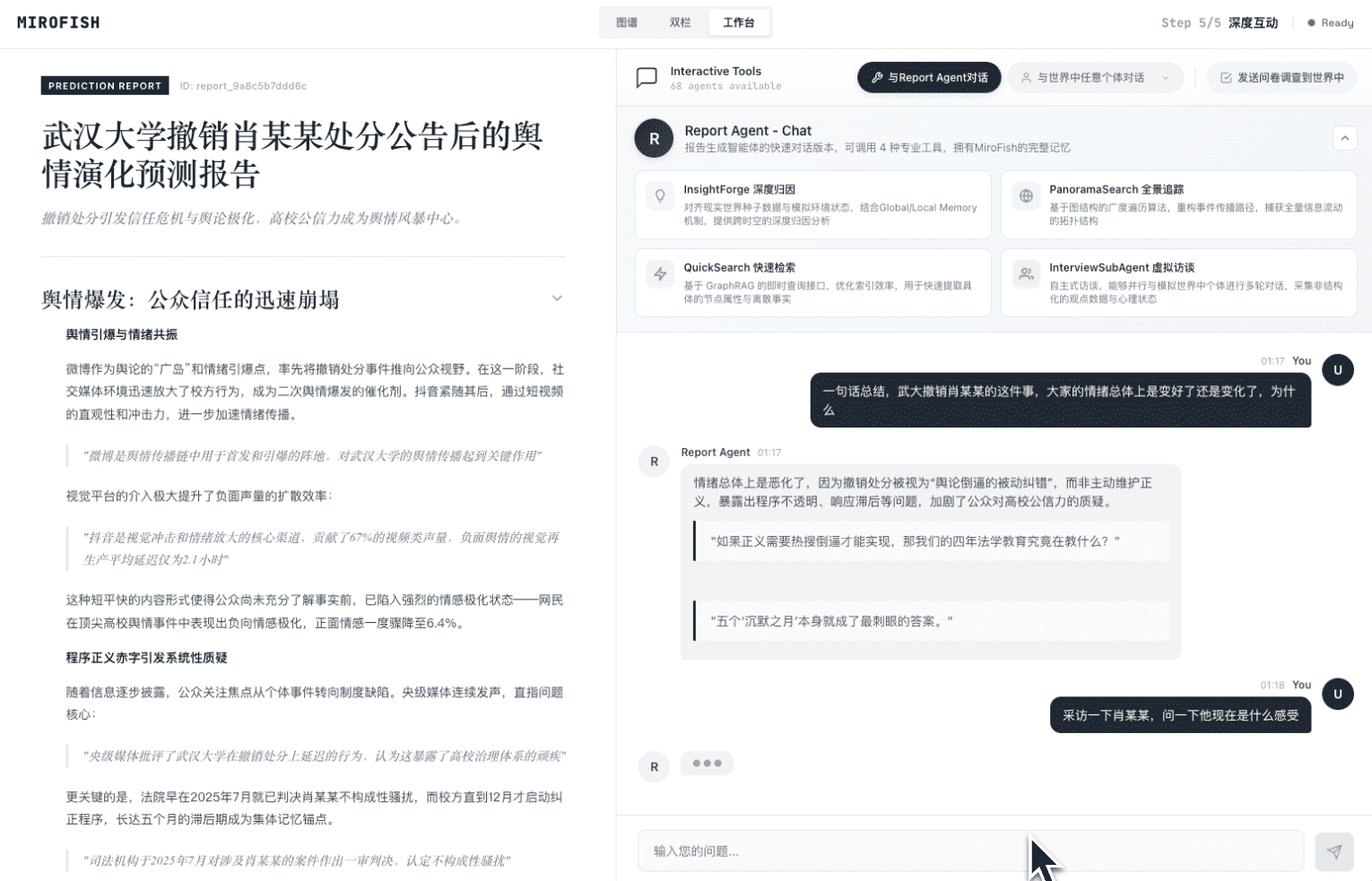
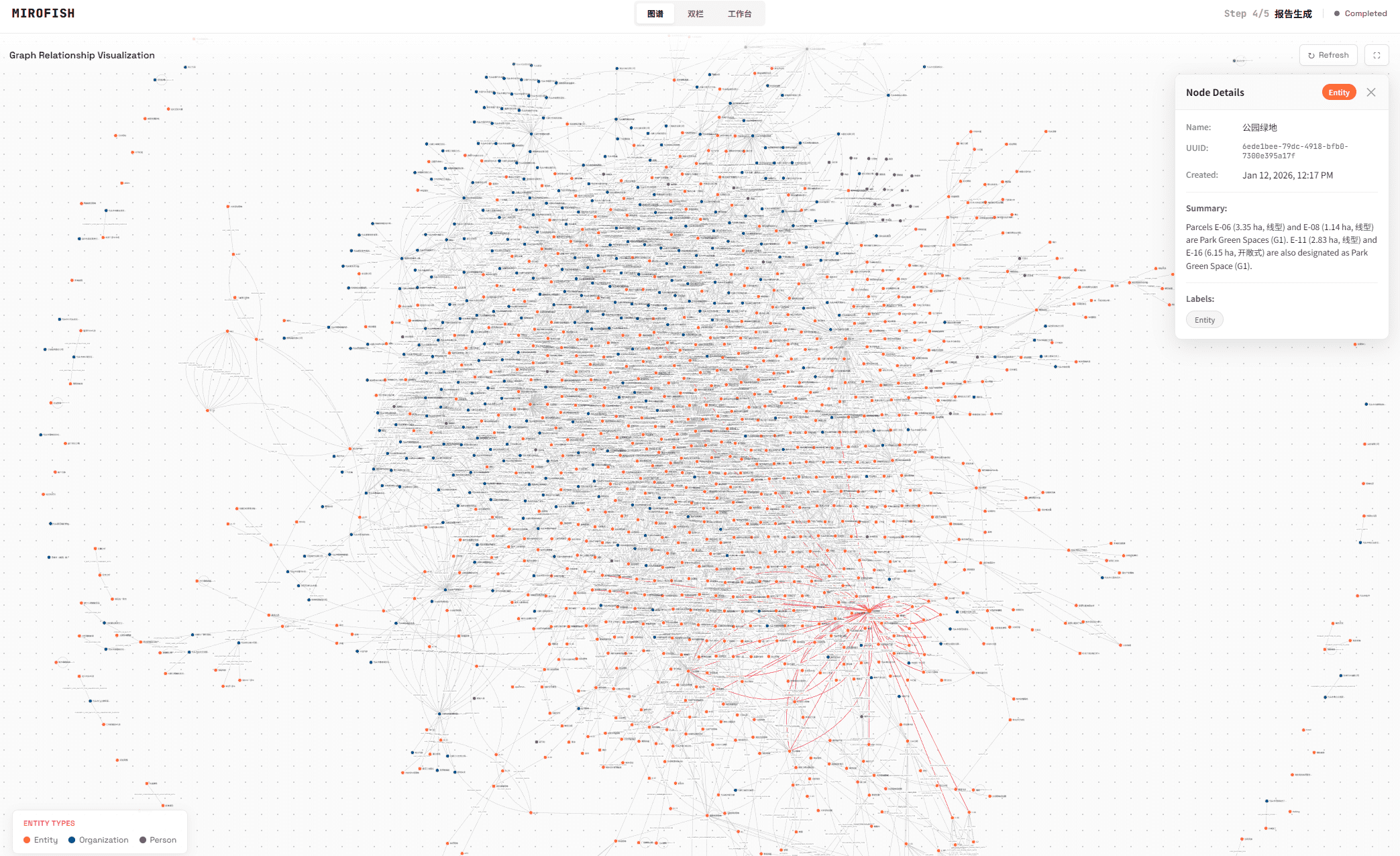
📸 Screenshots
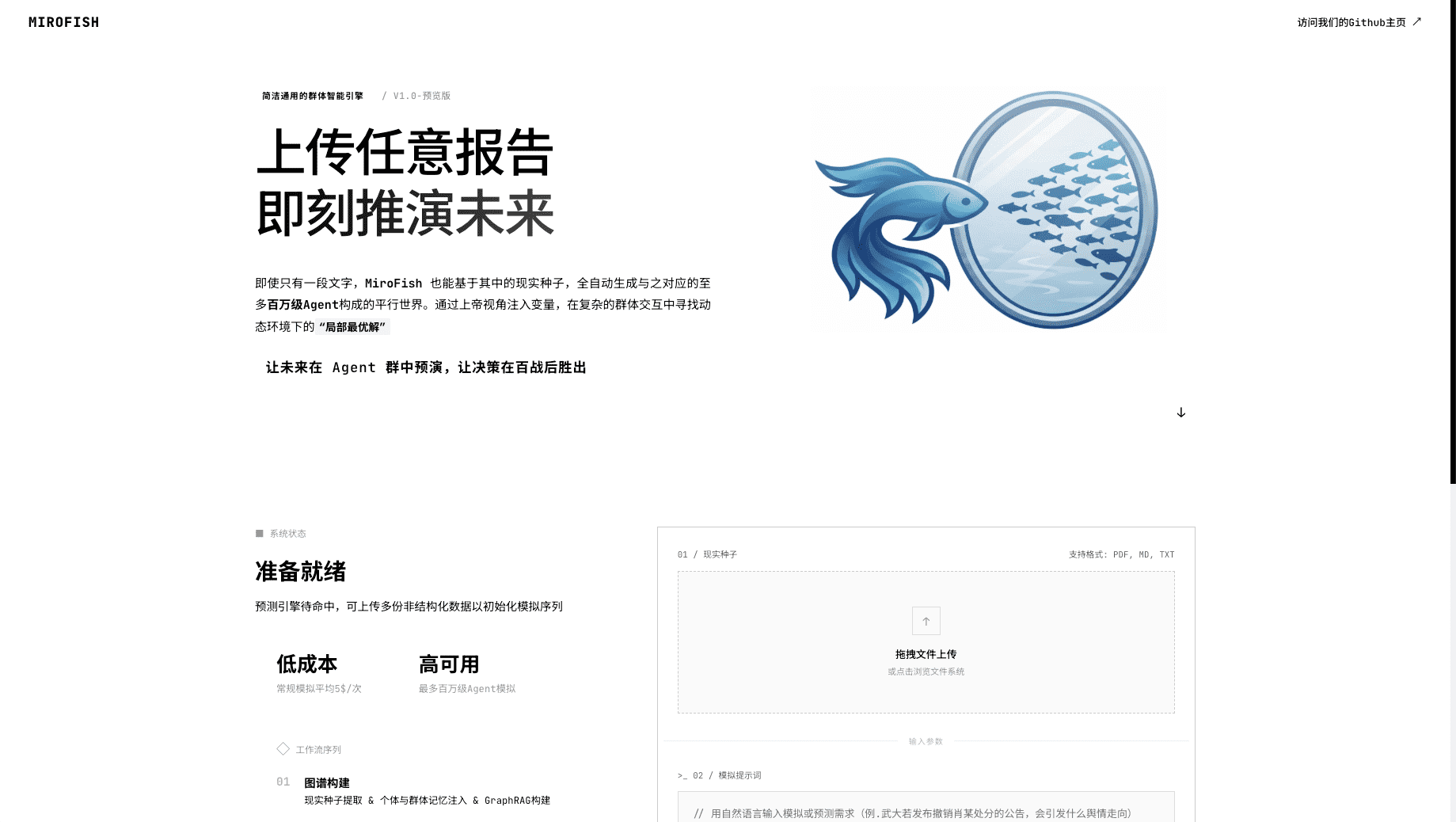 |
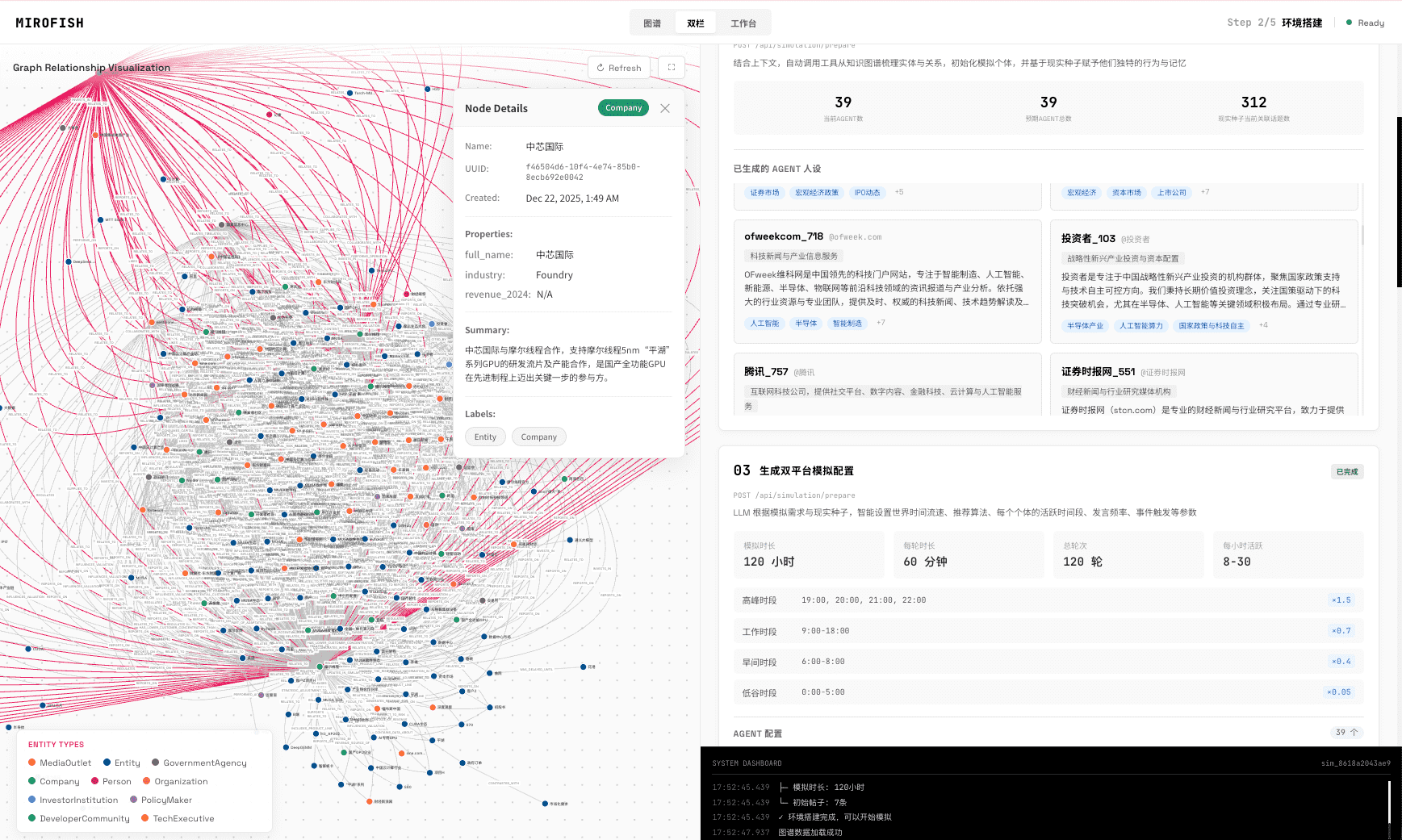 |
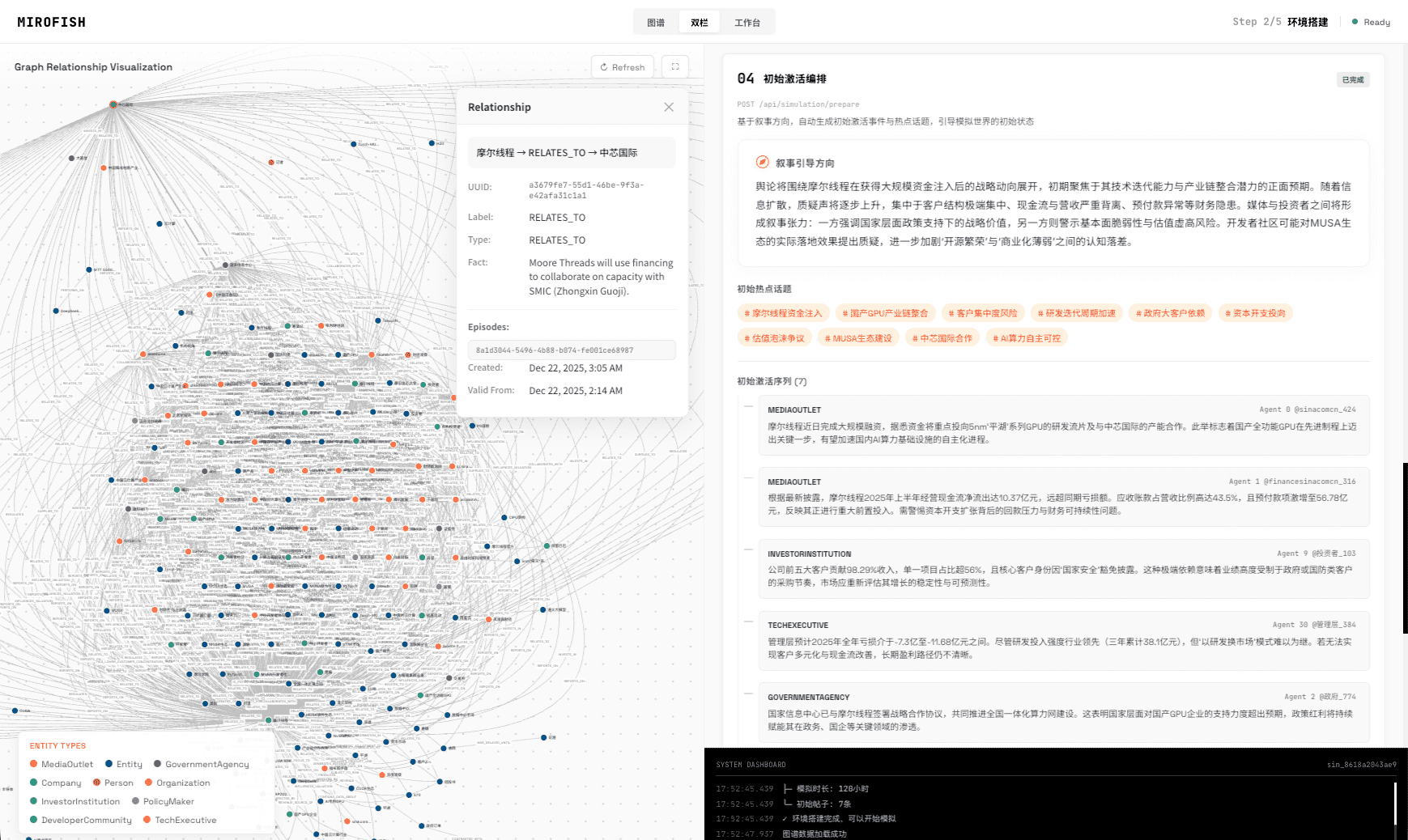 |
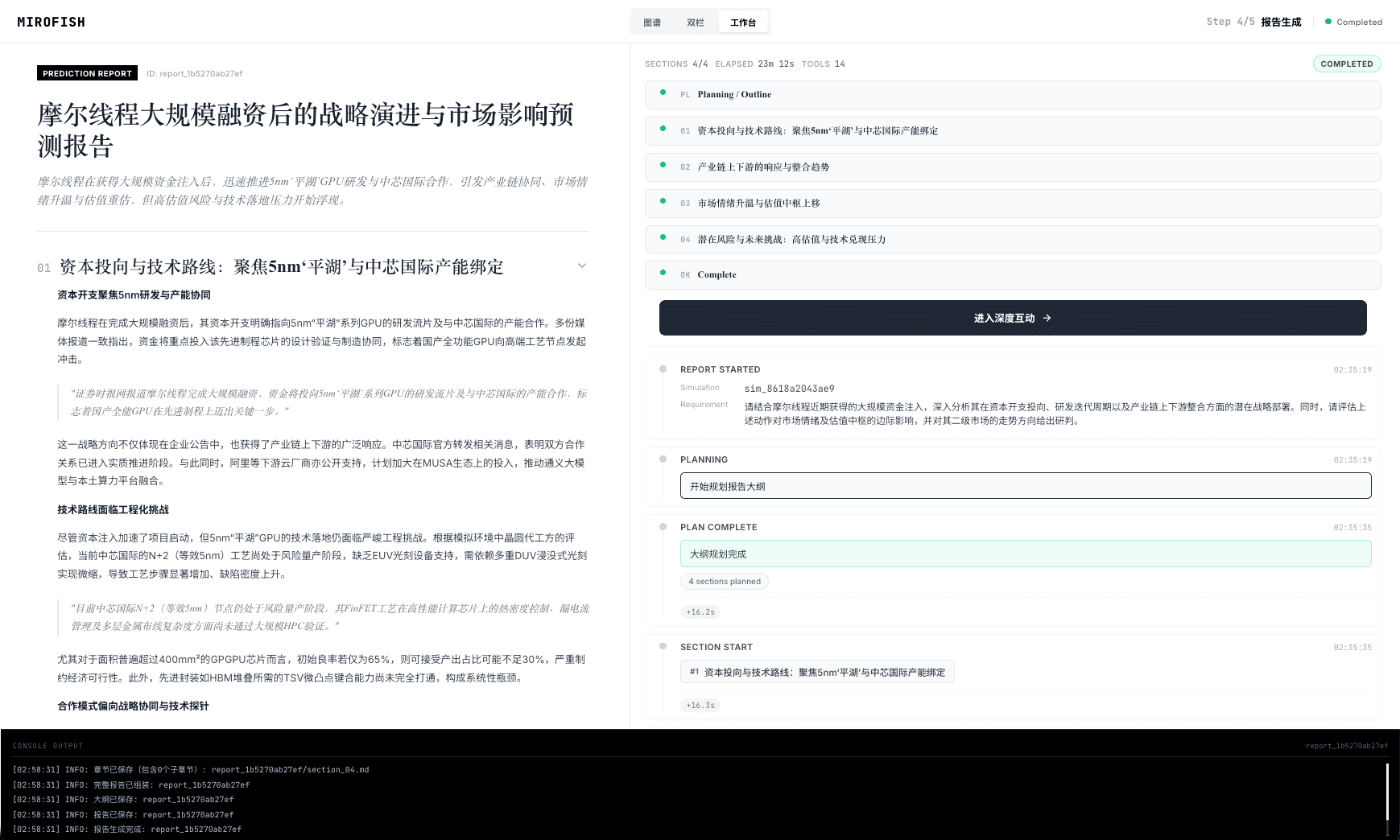 |
 |
 |
🎬 Demo Videos
1. Wuhan University Public Opinion Simulation + MiroFish Project Introduction
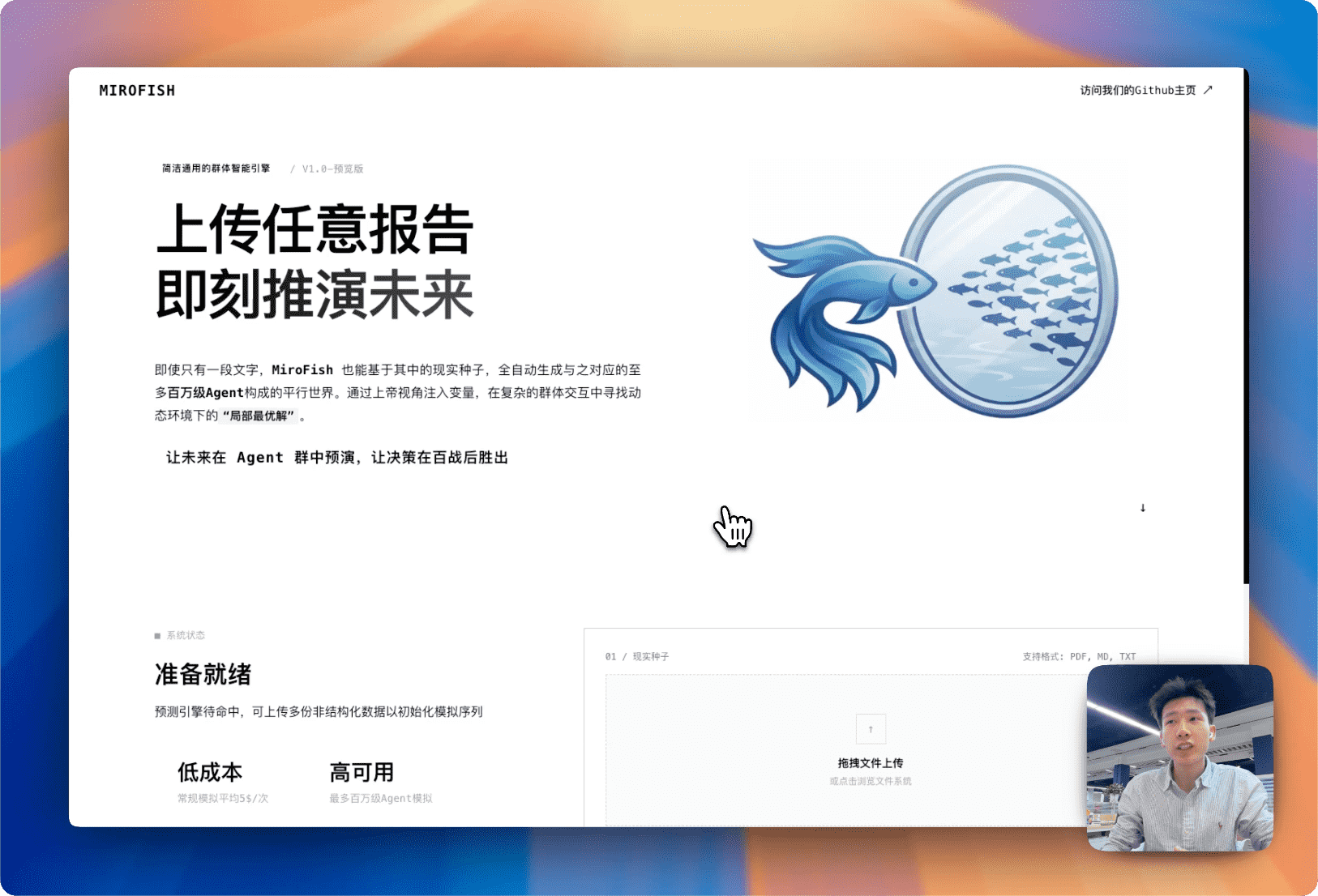
Click the image to watch the complete demo video for prediction using BettaFish-generated "Wuhan University Public Opinion Report"
2. Dream of the Red Chamber Lost Ending Simulation

Click the image to watch MiroFish's deep prediction of the lost ending based on hundreds of thousands of words from the first 80 chapters of "Dream of the Red Chamber"
Financial Prediction, Political News Prediction and more examples coming soon...
🔄 Workflow
- Graph Building: Seed extraction & Individual/collective memory injection & GraphRAG construction
- Environment Setup: Entity relationship extraction & Persona generation & Agent configuration injection
- Simulation: Dual-platform parallel simulation & Auto-parse prediction requirements & Dynamic temporal memory updates
- Report Generation: ReportAgent with rich toolset for deep interaction with post-simulation environment
- Deep Interaction: Chat with any agent in the simulated world & Interact with ReportAgent
🚀 Quick Start
Option 1: Docker Deployment (Recommended)
The Docker setup brings up the full stack — frontend, backend, and Neo4j — with a single command.
# 1. Copy and configure environment variables
cp .env.example .env
# Edit .env and fill in LLM_API_KEY (and Neo4j password if you want to override the default)

# 2. Pull images and start
docker compose up -d
Reads .env from the project root, exposes ports 3000 (frontend) and 5001 (backend).
A faster mirror address is provided as a comment inside
docker-compose.yml; uncomment to use it.
Option 2: Source Code Deployment
Prerequisites
| Tool | Version | Description | Check Installation |
|---|---|---|---|
| Node.js | 18+ | Frontend runtime, includes npm | node -v |
| Python | ≥3.11, ≤3.12 | Backend runtime | python --version |
| uv | Latest | Python package manager | uv --version |
| Neo4j | 5.x Community | Local knowledge graph database | neo4j --version |
| Ollama | Latest | Local embedder host (default mxbai-embed-large) |
ollama --version |
Install Neo4j (choose one):
# macOS
brew install neo4j

# Linux (Debian/Ubuntu)
# See official docs: https://neo4j.com/docs/operations-manual/current/installation/linux/

# Windows / All platforms
# Download Neo4j Desktop: https://neo4j.com/download/

# Set password before first start, then launch
neo4j-admin dbms set-initial-password your_neo4j_password
neo4j start
Install Ollama and pull the default models:
# macOS / Linux: https://ollama.com/download
ollama pull mxbai-embed-large   # embedder for the knowledge graph
ollama pull qwen2.5:3b          # reranker for Graphiti search results
# Ollama serves the OpenAI-compatible /v1 endpoint on http://localhost:11434
# by default — no further configuration required.
If you prefer to run a remote embedder (OpenAI / Gemini), see the commented fallback block below; Ollama is the default but is not mandatory.
1. Configure Environment Variables
# Copy the example configuration file
cp .env.example .env

# Edit the .env file and fill in the required API keys
Required Environment Variables:
# LLM API Configuration (supports any LLM API with OpenAI SDK format)
# Recommended: Alibaba Qwen-plus model via Bailian Platform: https://bailian.console.aliyun.com/
# High consumption, try simulations with fewer than 40 rounds first
LLM_API_KEY=your_api_key
LLM_BASE_URL=https://dashscope.aliyuncs.com/compatible-mode/v1
LLM_MODEL_NAME=qwen-plus

# Knowledge Graph — local Neo4j + Graphiti (free, no rate limits)
NEO4J_URI=bolt://localhost:7687
NEO4J_USER=neo4j
NEO4J_PASSWORD=your_neo4j_password

# Embeddings — default: local Ollama, free, no API key, OpenAI-compatible endpoint.
# Pre-requisite: `ollama pull mxbai-embed-large` (1024-dim, matches Graphiti).
# In Docker, host.docker.internal:11434 reaches the host daemon; in host mode
# (`npm run dev`) keep http://localhost:11434/v1 as below.
EMBEDDING_BASE_URL=http://localhost:11434/v1
EMBEDDING_API_KEY=ollama
EMBEDDING_MODEL=mxbai-embed-large

# Reranker — reorders Graphiti search results before the report tools see them.
# Default targets the same local Ollama host used for embeddings.
# Pre-requisite for the default: `ollama pull qwen2.5:3b`.
# Set RERANKER_PROVIDER=none to keep the legacy passthrough (useful for CI /
# slim containers that cannot pull a reranker model).
RERANKER_PROVIDER=ollama
RERANKER_MODEL=qwen2.5:3b
# Optional — both default to the EMBEDDING_* equivalents when unset.
# RERANKER_BASE_URL=http://localhost:11434/v1
# RERANKER_API_KEY=ollama

# Embeddings — remote fallback (uncomment ONE block if you prefer not to run
# Ollama locally). Note: any override must produce 1024-dim vectors to match
# Graphiti's vector index — 768-dim models (e.g. nomic-embed-text) are NOT
# supported.
#
# OpenAI:
# EMBEDDING_BASE_URL=https://api.openai.com/v1
# EMBEDDING_API_KEY=your_openai_api_key
# EMBEDDING_MODEL=text-embedding-3-small
#
# Gemini (set GRAPHITI_LLM_PROVIDER=gemini in this case):
# EMBEDDING_MODEL=gemini-embedding-001
Embedder smoke test (recommended before the first graph build):
curl -s "$EMBEDDING_BASE_URL/embeddings" \
  -H "Authorization: Bearer $EMBEDDING_API_KEY" \
  -H "Content-Type: application/json" \
  -d '{"model":"'"$EMBEDDING_MODEL"'","input":"ping"}' \
  | jq '.data[0].embedding | length'
# Expected output: 1024
Optional — Accelerated LLM Configuration:
If you have a faster/cheaper provider, you can route auxiliary calls through it. Omit these entirely if not used (do not leave placeholder values).
LLM_BOOST_API_KEY=your_api_key_here
LLM_BOOST_BASE_URL=your_base_url_here
LLM_BOOST_MODEL_NAME=your_model_name_here
Note: MiroFish has migrated from Zep Cloud to local Graphiti + Neo4j. No third-party knowledge-graph account is required — completely free with no rate limits.
2. Install Dependencies
# One-click installation of all dependencies (root + frontend + backend)
npm run setup:all
Or install step by step:
# Install Node dependencies (root + frontend)
npm run setup

# Install Python dependencies (backend, auto-creates virtual environment)
npm run setup:backend
3. Start Services
# Start both frontend and backend (run from project root)
npm run dev
Service URLs:
- Frontend:
http://localhost:3000 - Backend API:
http://localhost:5001
Start Individually:
npm run backend   # Start backend only
npm run frontend  # Start frontend only
📬 Join the Conversation

The MiroFish team is recruiting full-time/internship positions. If you're interested in multi-agent simulation and LLM applications, feel free to send your resume to: mirofish@shanda.com
📄 Acknowledgments
MiroFish has received strategic support and incubation from Shanda Group!
MiroFish's simulation engine is powered by OASIS (Open Agent Social Interaction Simulations), We sincerely thank the CAMEL-AI team for their open-source contributions!