 169caec941
The RE pass against lghub_agent.arm64 plus the G522 live probe resolved
the V2 wire format. Key corrections to the previous implementation:

  1. 5-byte stride is [filter_type, freq_hi, freq_lo, gain_hi, gain_lo].
     The initial RE interpretation of [freq_hi, freq_lo, gain, q_hi, q_lo]
     was wrong — the 0x78 byte is a filter-type sentinel (peaking), not
     the high byte of a frequency.
  2. No header before the bands. G522's default "header" was actually
     band 0: a high-pass filter at 20 Hz (filter_type=0x00, freq=0x0014).
     Total is 10 bands (1 HP + 9 peaking at ISO octaves), not 9.
  3. Frequency is raw Hz as BE u16 — no log/ERB/bin transform. 0x4E20
     is exactly 20000 Hz.
  4. Gain is signed BE int16 (not int8), scaled by step_db from
     getEQInfos. ±120 maps to ±6 dB at 0.05 dB/LSB on the G522.
  5. No Q on the wire — firmware-fixed per filter type.

get_advanced_eq_info is unchanged (13-byte V2 decode was already right).
Parser tuple shape is now (filter_type_byte, freq_hz, gain_db) across
both V0/V1 and V2 paths; V0/V1 synthesises filter_type=peaking so the
shape is uniform. Band labels display real Hz — "HP 20Hz", "50Hz",
"125Hz", ..., "20000Hz" on G522.

Stays read-only. Will enable write once we round-trip-test with known
raw bytes.
|
||
|---|---|---|
| .github | ||
| bin | ||
| docs | ||
| lib | ||
| po | ||
| rules.d | ||
| rules.d-uinput | ||
| share | ||
| tests | ||
| tools | ||
| .coveragerc | ||
| .git-blame-ignore-revs | ||
| .gitignore | ||
| .pre-commit-config.yaml | ||
| .python-version | ||
| CHANGELOG.md | ||
| COPYRIGHT | ||
| LICENSE.txt | ||
| MANIFEST.in | ||
| Makefile | ||
| README.md | ||
| RELEASE.md | ||
| RHEL.md | ||
| Release_Notes.md | ||
| mkdocs.yml | ||
| pyproject.toml | ||
| release.sh | ||
| setup.py | ||
README.md
 Solaar
Solaar is a Linux manager for many Logitech keyboards, mice, and other devices that connect wirelessly to a Unifying, Bolt, Lightspeed or Nano receiver as well as many Logitech devices that connect via a USB cable or Bluetooth. Solaar is not a device driver and responds only to special messages from devices that are otherwise ignored by the Linux input system.
More Information - Usage - Capabilities - Rules - Manual Installation - Known Issues


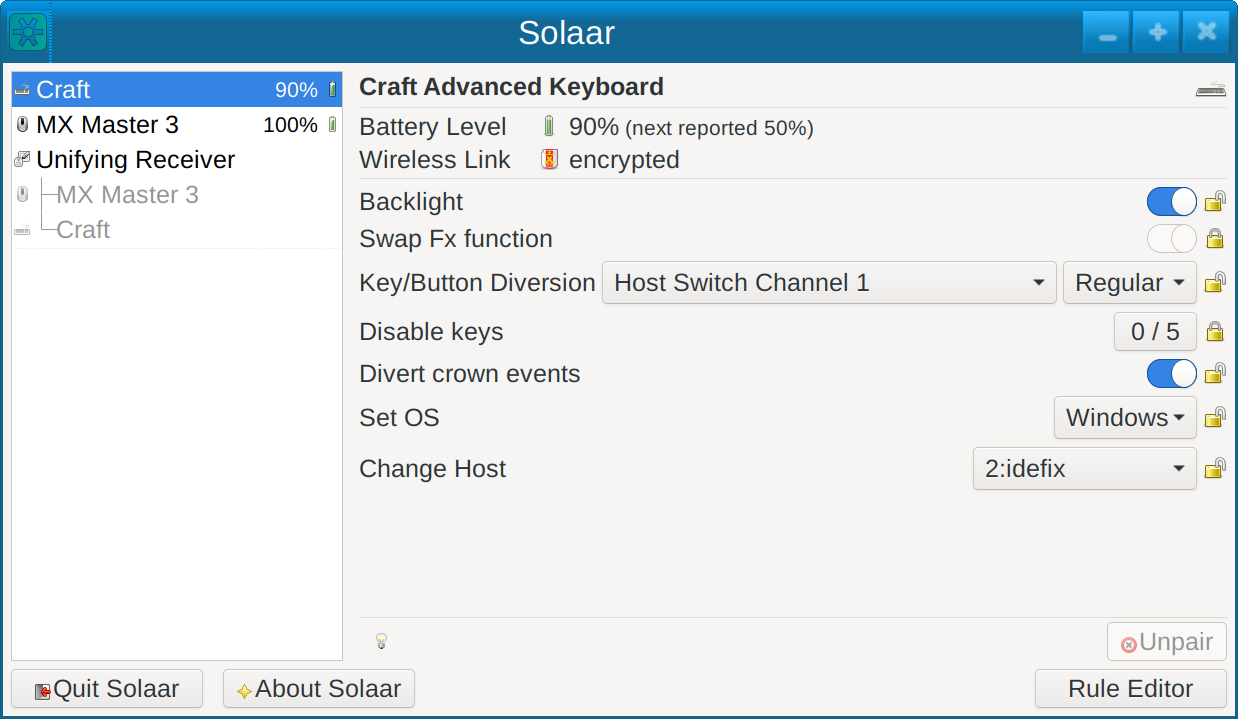
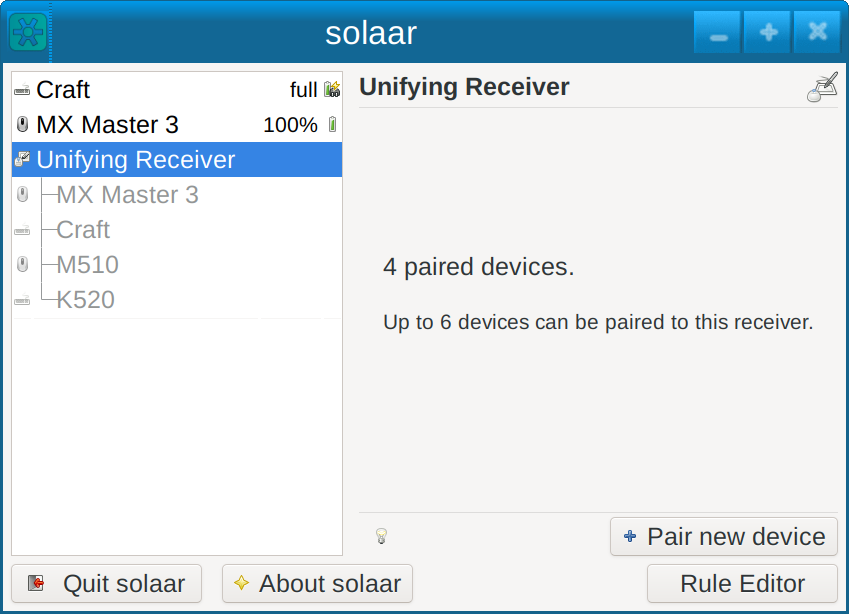
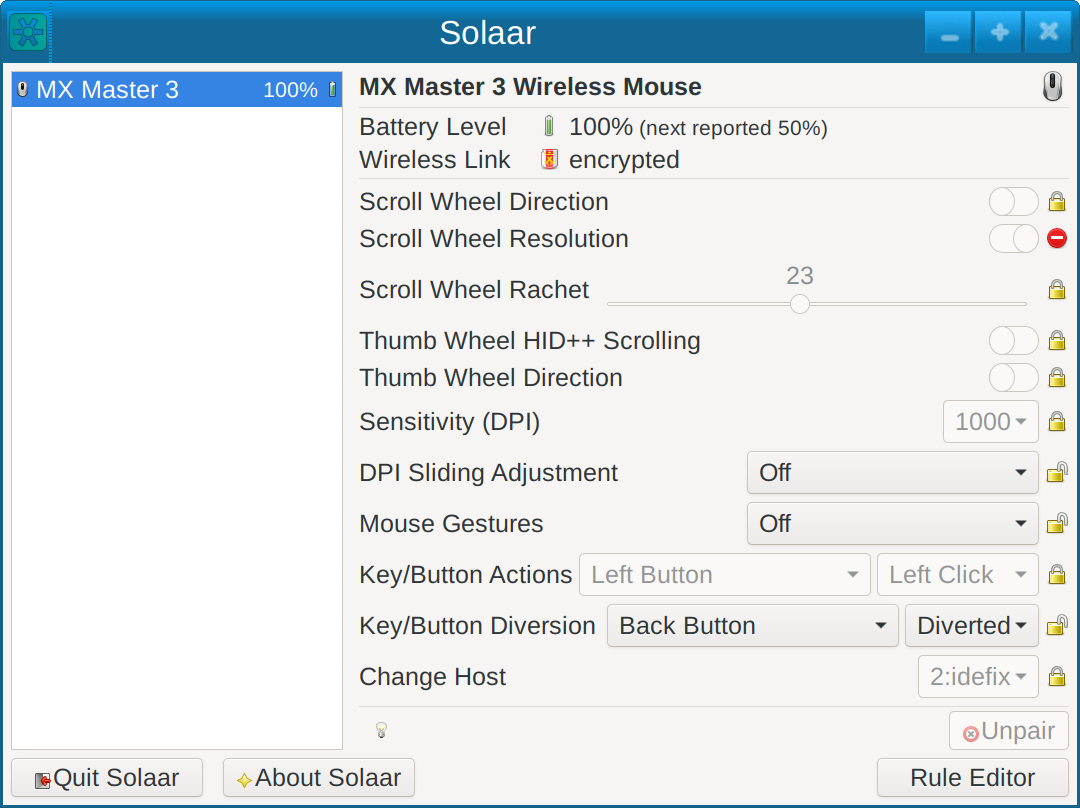
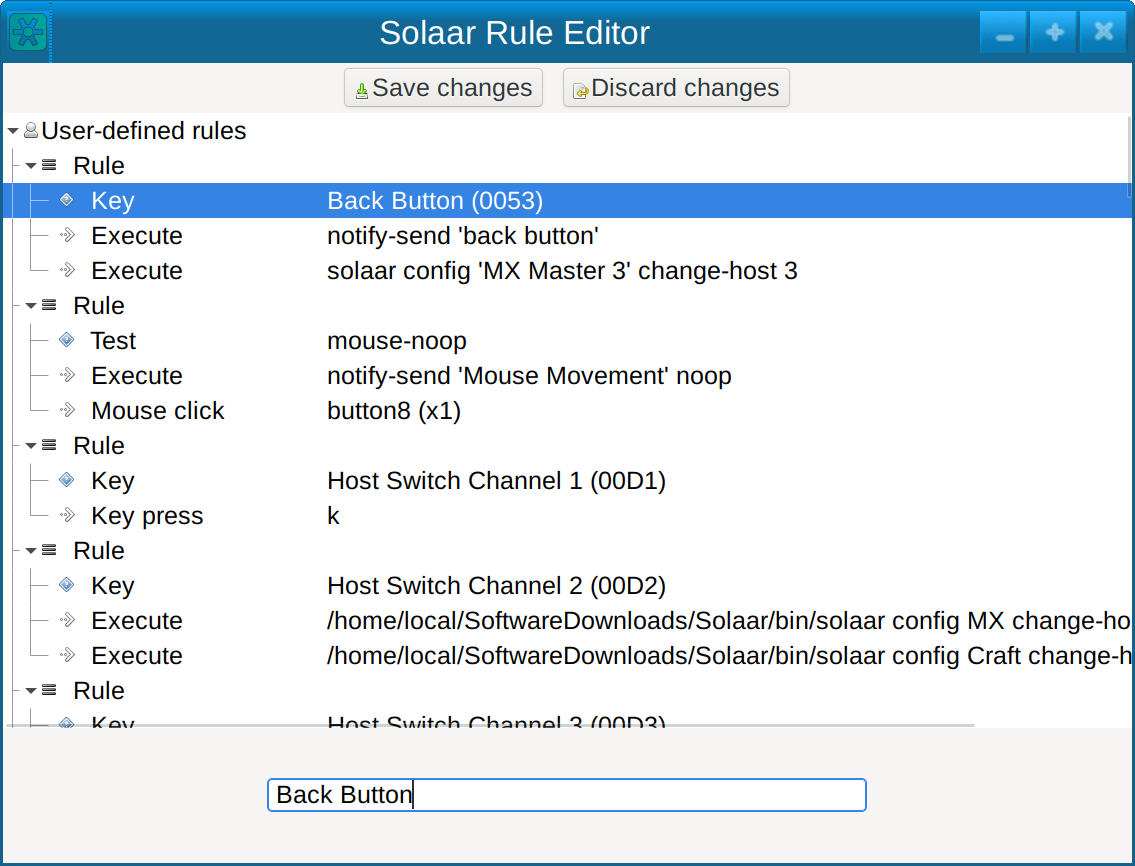
Solaar supports:
- pairing/unpairing of devices with receivers
- configuring device settings
- custom button configuration
- running rules in response to special messages from devices
For more information see the main Solaar documentation page. -
Installation Packages
Up-to-date prebuilt packages are available for some Linux distros (e.g., Fedora) in their standard repositories. If a recent version of Solaar is not available from the standard repositories for your distribution, you can try one of these packages:
- Arch solaar package in the extra repository
- Ubuntu/Kubuntu package in Solaar stable ppa
- NixOS Flake package in Svenum/Solaar-Flake
Solaar is available from some other repositories but may be several versions behind the current version:
- a Debian package, courtesy of Stephen Kitt
- a Ubuntu package is available from universe repository
- a Gentoo package, courtesy of Carlos Silva and Tim Harder
- a Mageia package, courtesy of David Geiger