 61d19cf56a
The 0x8081 PerKeyLighting v2 protocol has no GetIndividualRgbZones
function — there's no way to ask the device what colors are currently
on the per-key buffer over HID++. PerKeyLighting.read() papered over
this gap by fabricating an all-"No change" sentinel map whenever the
caller asked for a live (uncached) read, which produced misleading
solaar show output like:

    Per-key Lighting (saved): {1:0xc01c28, 2:0xc52d26, ...}
    Per-key Lighting        : {1:No change, 2:No change, ...}

— even with the keyboard clearly running the saved colors.

Two-part fix:

1. PerKeyLighting.read() now returns self._value if populated (from
   prior write or persister) regardless of `cached`. Only fabricates
   the all-"No change" map when there's truly no state — fresh device,
   no prior write, nothing persisted. This is the right starting state
   in that case because per-key writes are additive over a buffer of
   unknown content.

   Other callers benefit too: solaar config calls read(cached=False) on
   per-key settings to display current values, and prior to this
   change it would get fabricated sentinels back instead of the
   in-memory map.

2. Add a `live_readable = True` class attribute to Setting (default
   preserves existing behavior). Override to False on PerKeyLighting.
   solaar show gates its live-read print on this flag, so non-readable
   settings show only the (saved) line — which is the authoritative
   record of what was last written to a setting whose live state can't
   be read back.

After both fixes solaar show prints just:

    Per-key Lighting (saved): {1:0xc01c28, 2:0xc52d26, ...}

— honest about what we know.

690 tests pass; pre-commit clean.
|
||
|---|---|---|
| .github | ||
| bin | ||
| docs | ||
| lib | ||
| po | ||
| rules.d | ||
| rules.d-uinput | ||
| share | ||
| tests | ||
| tools | ||
| .coveragerc | ||
| .git-blame-ignore-revs | ||
| .gitignore | ||
| .pre-commit-config.yaml | ||
| .python-version | ||
| CHANGELOG.md | ||
| COPYRIGHT | ||
| LICENSE.txt | ||
| MANIFEST.in | ||
| Makefile | ||
| README.md | ||
| RELEASE.md | ||
| RHEL.md | ||
| Release_Notes.md | ||
| mkdocs.yml | ||
| pyproject.toml | ||
| release.sh | ||
| setup.py | ||
README.md
 Solaar
Solaar is a Linux manager for many Logitech keyboards, mice, and other devices that connect wirelessly to a Unifying, Bolt, Lightspeed or Nano receiver as well as many Logitech devices that connect via a USB cable or Bluetooth. Solaar is not a device driver and responds only to special messages from devices that are otherwise ignored by the Linux input system.
More Information - Usage - Capabilities - Rules - Manual Installation - Known Issues


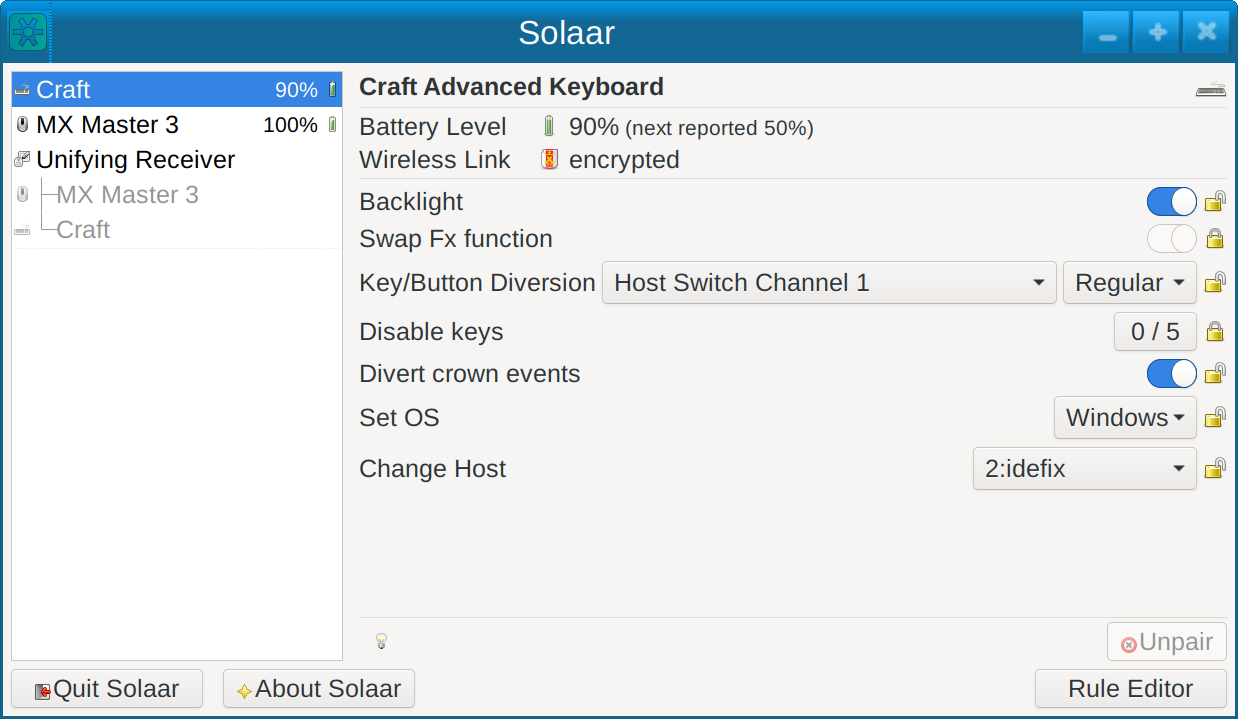
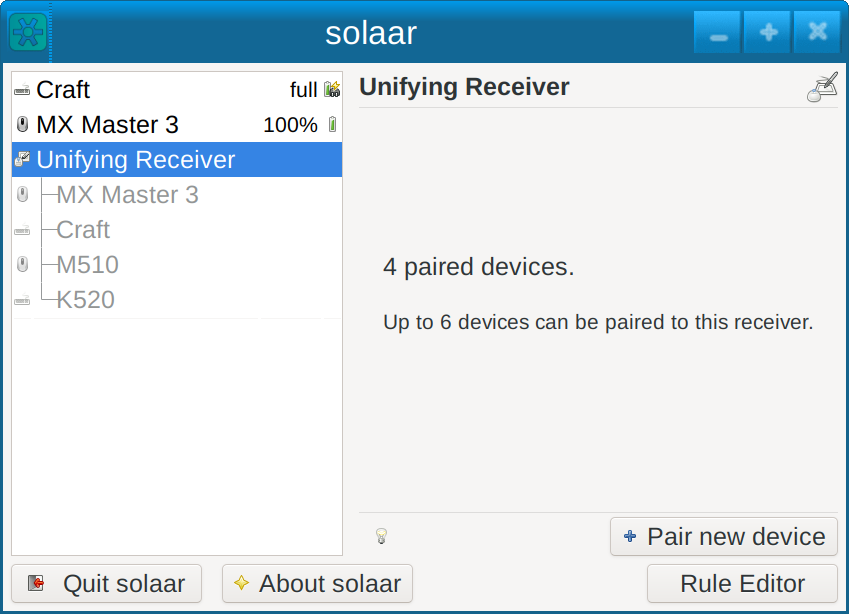
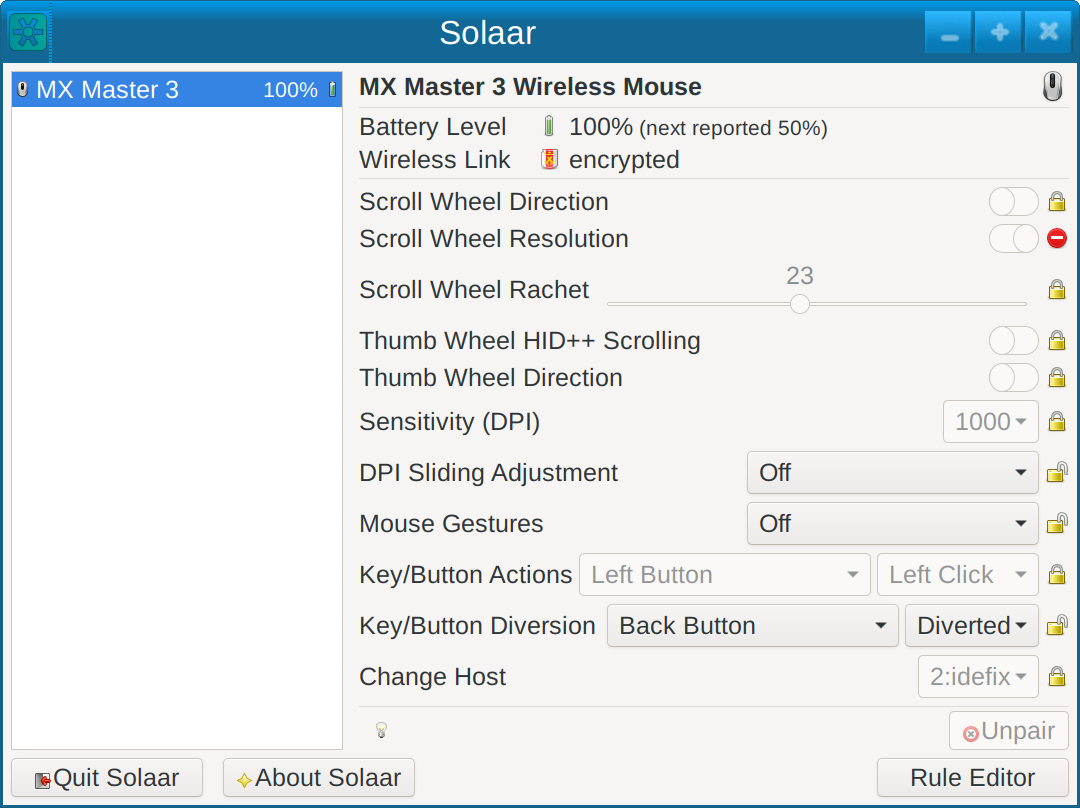
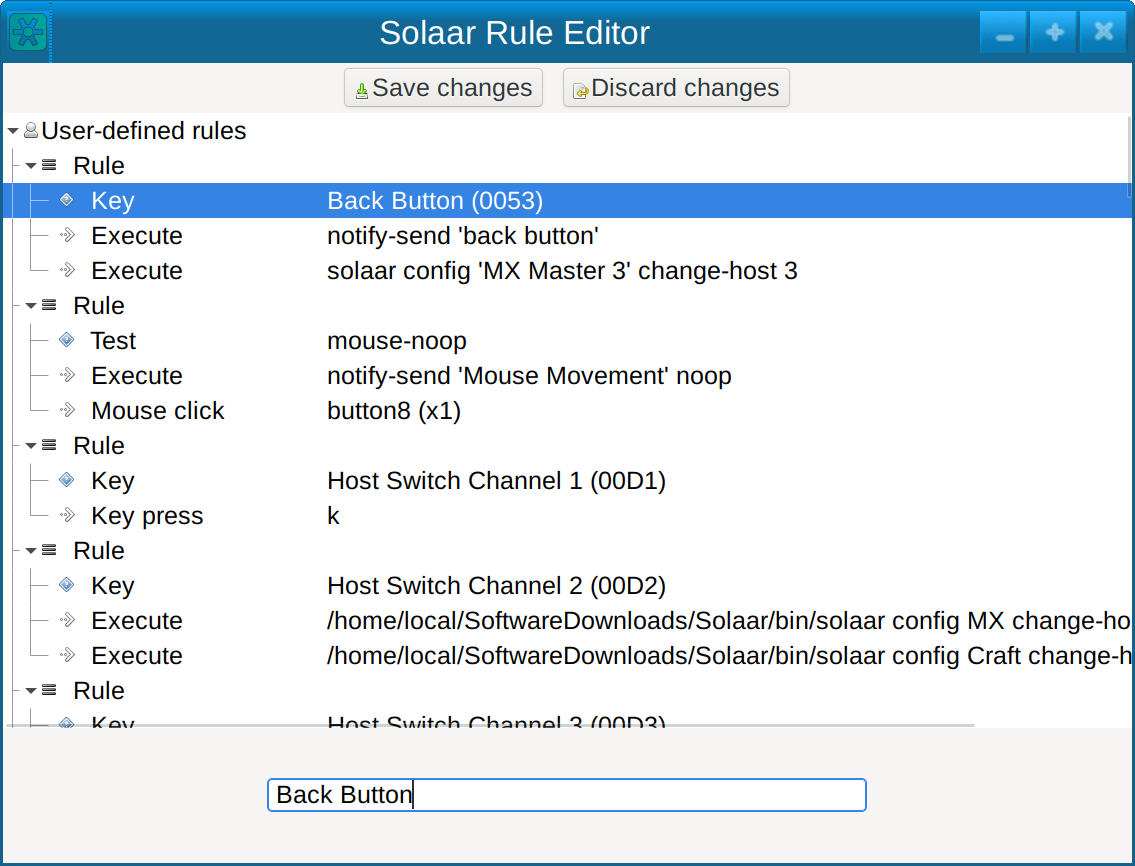
Solaar supports:
- pairing/unpairing of devices with receivers
- configuring device settings
- custom button configuration
- running rules in response to special messages from devices
For more information see the main Solaar documentation page. -
Installation Packages
Up-to-date prebuilt packages are available for some Linux distros (e.g., Fedora) in their standard repositories. If a recent version of Solaar is not available from the standard repositories for your distribution, you can try one of these packages:
- Arch solaar package in the extra repository
- Ubuntu/Kubuntu package in Solaar stable ppa
- NixOS Flake package in Svenum/Solaar-Flake
Solaar is available from some other repositories but may be several versions behind the current version:
- a Debian package, courtesy of Stephen Kitt
- a Ubuntu package is available from universe repository
- a Gentoo package, courtesy of Carlos Silva and Tim Harder
- a Mageia package, courtesy of David Geiger