 73adad2a52
A usbmon capture of G HUB's bring-up (receiver passed to a Win11 VM) showed the root cause of the dead F-row/media keys AND the F4 blackout: the RGB SW-control claim switched the keyboard to host mode (ONBOARD_PROFILES 0x10 0x02). On the G915 TKL host mode disables the F-row/media keys (#1100), and the host-mode transition made the firmware re-assert the M/MR indicator (overlaid on F1-F4 on this keyless model) over the per-key colours. G HUB drives the LEDs from onboard mode via the RGB SetSWControl claim alone, never switching. Gated by modelId in device_quirks.py so no other device changes: - rgb_claim_keeps_onboard_mode(): _claim_sw_control skips the onboard-> host switch for listed models -> F-keys/media keys work and the power-on F4 blackout is gone, with no timer and no G-key divert. - rgb_repaint_on_profile_change(): re-assert + repaint on a reported profile change so an accidental switch doesn't strand the scheme. Documented residual (cannot be fixed without breaking the keys): F1-F4 are the M1/M2/M3/MR indicator zones on the TKL. The firmware re-asserts the active-profile indicator on them on profile switch and after idle, so those keys can show the indicator instead of the user colour. Claiming that subsystem (G-key divert) would stop it but disables the F-row/media keys, so onboard mode + working keys is the chosen trade-off. Co-Authored-By: Claude Fable 5 <noreply@anthropic.com> |
||
|---|---|---|
| .github | ||
| bin | ||
| docs | ||
| lib | ||
| po | ||
| rules.d | ||
| rules.d-uinput | ||
| share | ||
| tests | ||
| tools | ||
| .coveragerc | ||
| .git-blame-ignore-revs | ||
| .gitignore | ||
| .pre-commit-config.yaml | ||
| .python-version | ||
| CHANGELOG.md | ||
| COPYRIGHT | ||
| LICENSE.txt | ||
| MANIFEST.in | ||
| Makefile | ||
| README.md | ||
| RELEASE.md | ||
| RHEL.md | ||
| Release_Notes.md | ||
| mkdocs.yml | ||
| pyproject.toml | ||
| release.sh | ||
| setup.py | ||
README.md
 Solaar
Solaar is a Linux manager for many Logitech keyboards, mice, and other devices that connect wirelessly to a Unifying, Bolt, Lightspeed or Nano receiver as well as many Logitech devices that connect via a USB cable or Bluetooth. Solaar is not a device driver and responds only to special messages from devices that are otherwise ignored by the Linux input system.
More Information - Usage - Capabilities - Rules - Manual Installation - Known Issues


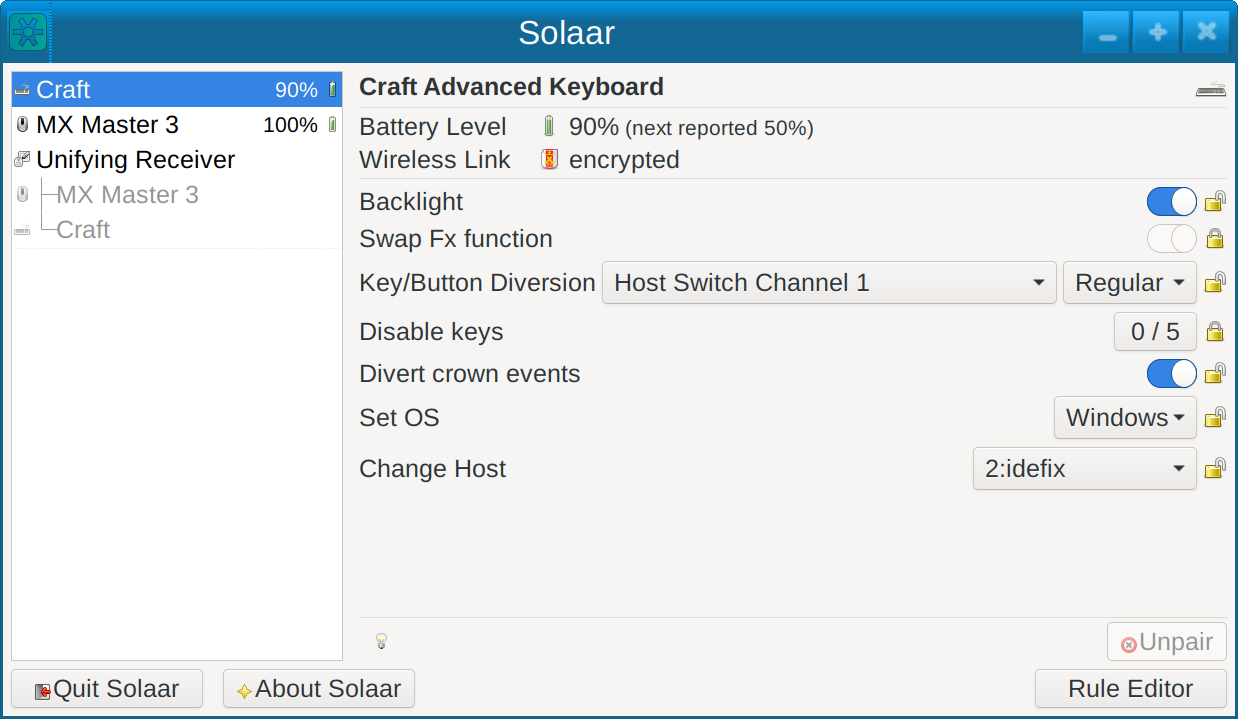
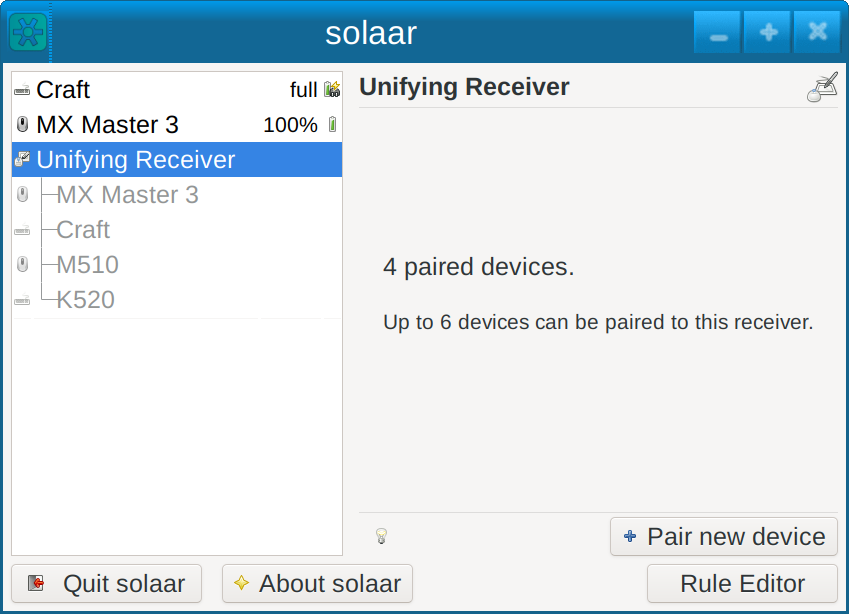
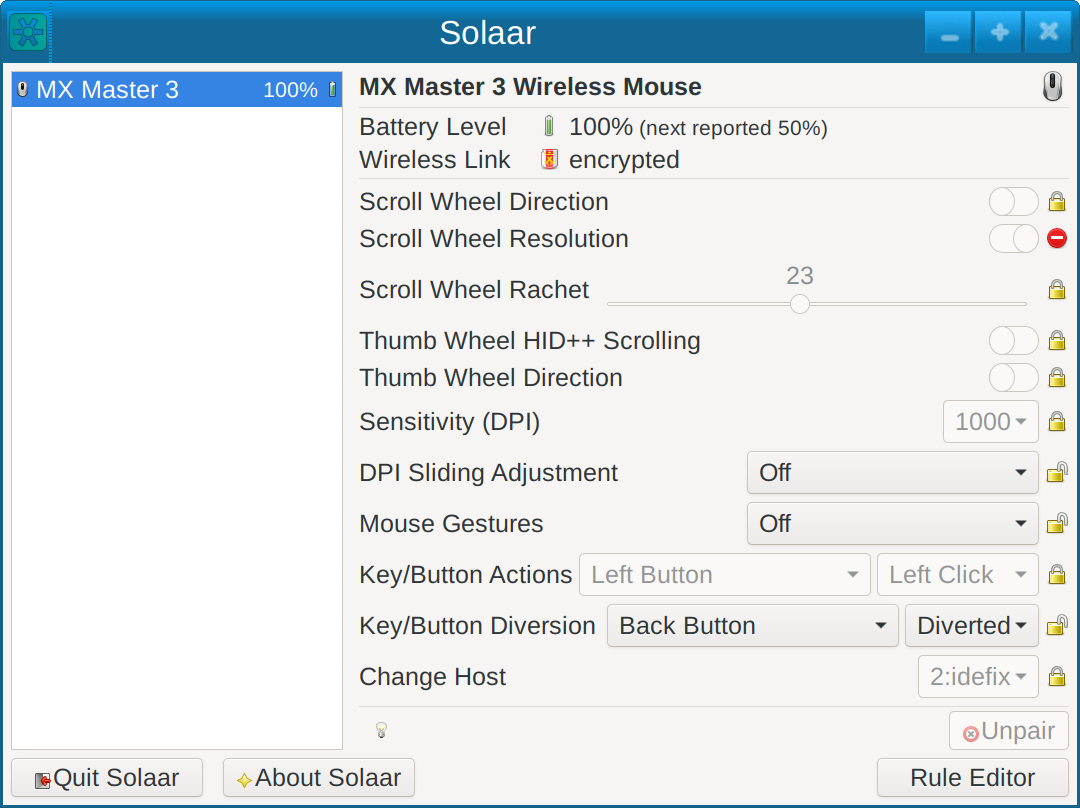
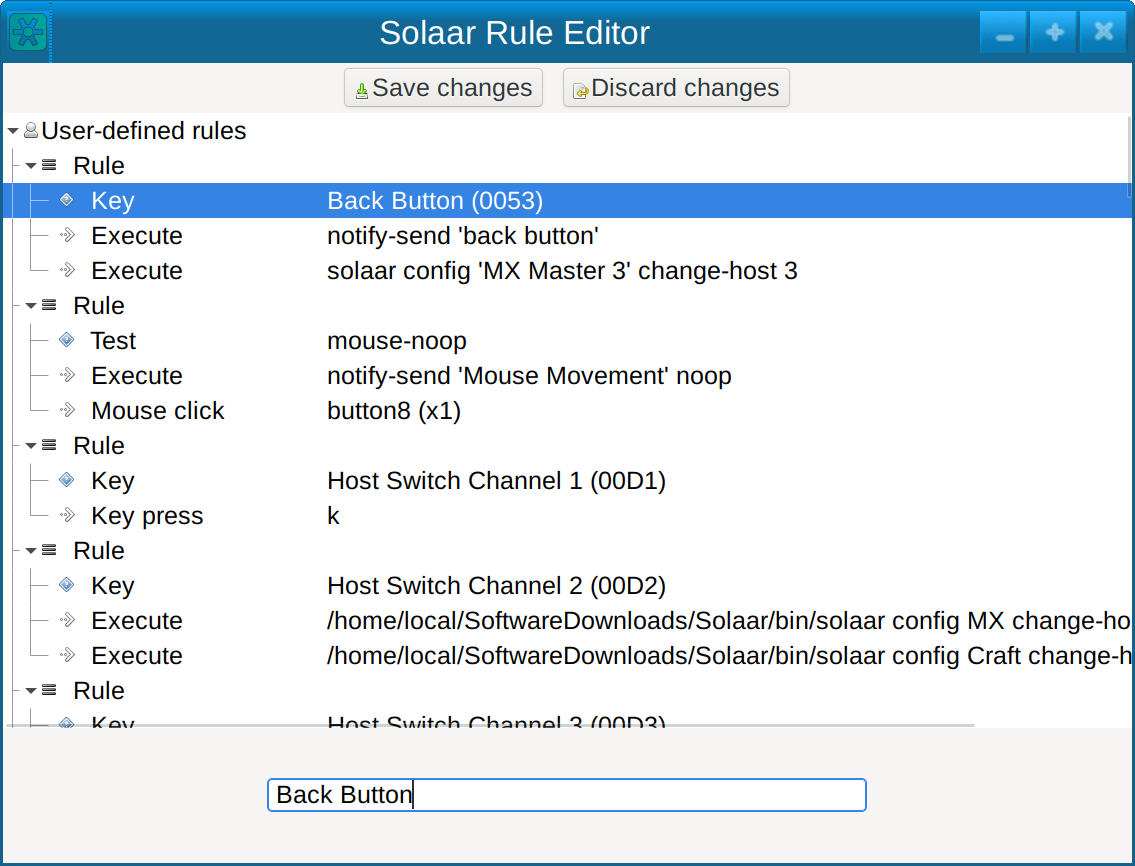
Solaar supports:
- pairing/unpairing of devices with receivers
- configuring device settings
- custom button configuration
- running rules in response to special messages from devices
For more information see the main Solaar documentation page. -
Installation Packages
Up-to-date prebuilt packages are available for some Linux distros (e.g., Fedora) in their standard repositories. If a recent version of Solaar is not available from the standard repositories for your distribution, you can try one of these packages:
- Arch solaar package in the extra repository
- Ubuntu/Kubuntu package in Solaar stable ppa
- NixOS Flake package in Svenum/Solaar-Flake
Solaar is available from some other repositories but may be several versions behind the current version:
- a Debian package, courtesy of Stephen Kitt
- a Ubuntu package is available from universe repository
- a Gentoo package, courtesy of Carlos Silva and Tim Harder
- a Mageia package, courtesy of David Geiger