 badce9bb07
* device: seed Centurion device kind=headset at construction Centurion-transport devices have no static descriptor and are not receiver-paired, so their kind was only resolved by an online feature scan. A headset powered off when Solaar started showed no kind, hence no headphone icon in the tray/window — unlike receiver-paired mice and keyboards, whose kind comes from the receiver's persistent pairing registers. Every Centurion-transport device seen so far is a headset, and the centurion flag is known at construction time. Seed _kind=headset there so the icon is correct offline and on first run. Drop the now-dead online _infer_kind_centurion() feature scan and its Centurion branch in the kind property. * centurion: seed child headset kind via pairing_info The construction-time kind=headset seeding only covered the direct create_device path. G522-style devices reach a CenturionReceiver, whose notify_devices() builds the headset as a child Device with device_info=None and sets dev.centurion=True only after __init__ — so the __init__ guard never fired and the child kept kind=None. Set kind=headset in the pairing_info dict the receiver already passes into Device.__init__, which covers the bridge path. Both paths now seed the kind offline. |
||
|---|---|---|
| .github | ||
| bin | ||
| docs | ||
| lib | ||
| po | ||
| rules.d | ||
| rules.d-uinput | ||
| share | ||
| tests | ||
| tools | ||
| .coveragerc | ||
| .git-blame-ignore-revs | ||
| .gitignore | ||
| .pre-commit-config.yaml | ||
| .python-version | ||
| CHANGELOG.md | ||
| COPYRIGHT | ||
| LICENSE.txt | ||
| MANIFEST.in | ||
| Makefile | ||
| README.md | ||
| RELEASE.md | ||
| RHEL.md | ||
| Release_Notes.md | ||
| mkdocs.yml | ||
| pyproject.toml | ||
| release.sh | ||
| setup.py | ||
README.md
 Solaar
Solaar is a Linux manager for many Logitech keyboards, mice, and other devices that connect wirelessly to a Unifying, Bolt, Lightspeed or Nano receiver as well as many Logitech devices that connect via a USB cable or Bluetooth. Solaar is not a device driver and responds only to special messages from devices that are otherwise ignored by the Linux input system.
More Information - Usage - Capabilities - Rules - Manual Installation - Known Issues


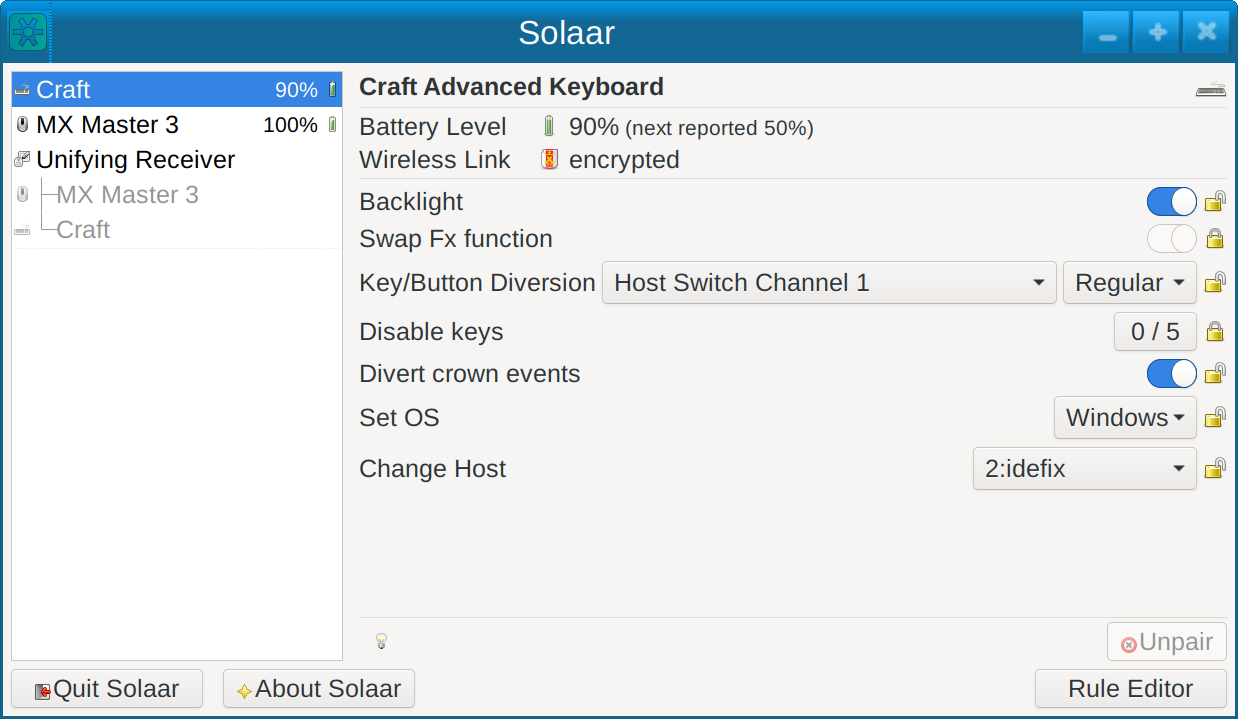
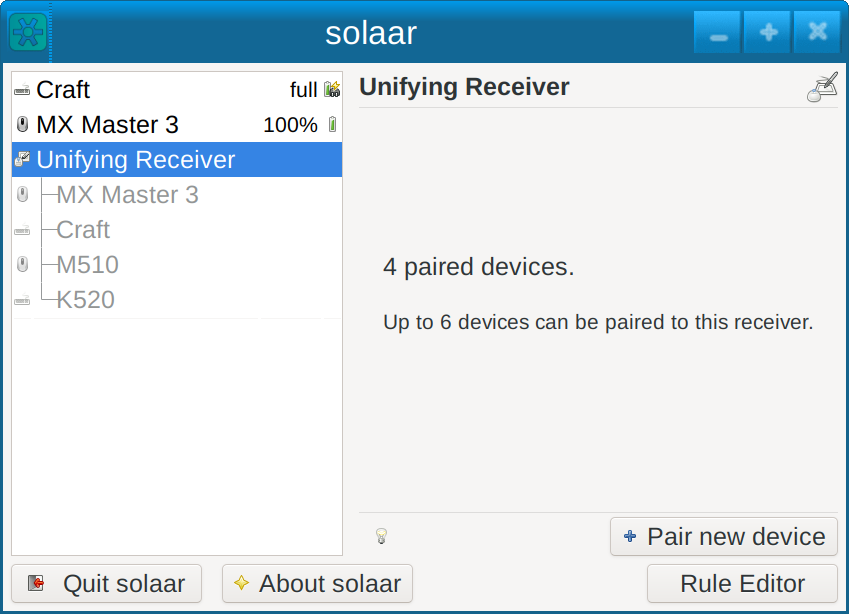
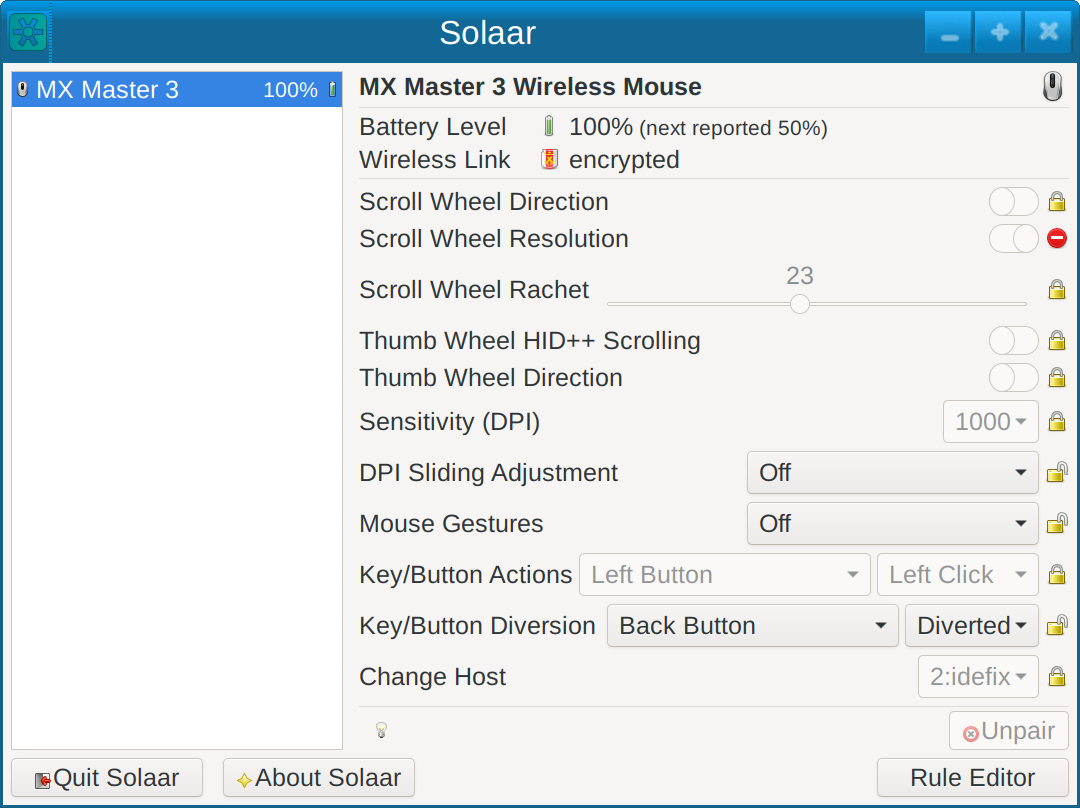
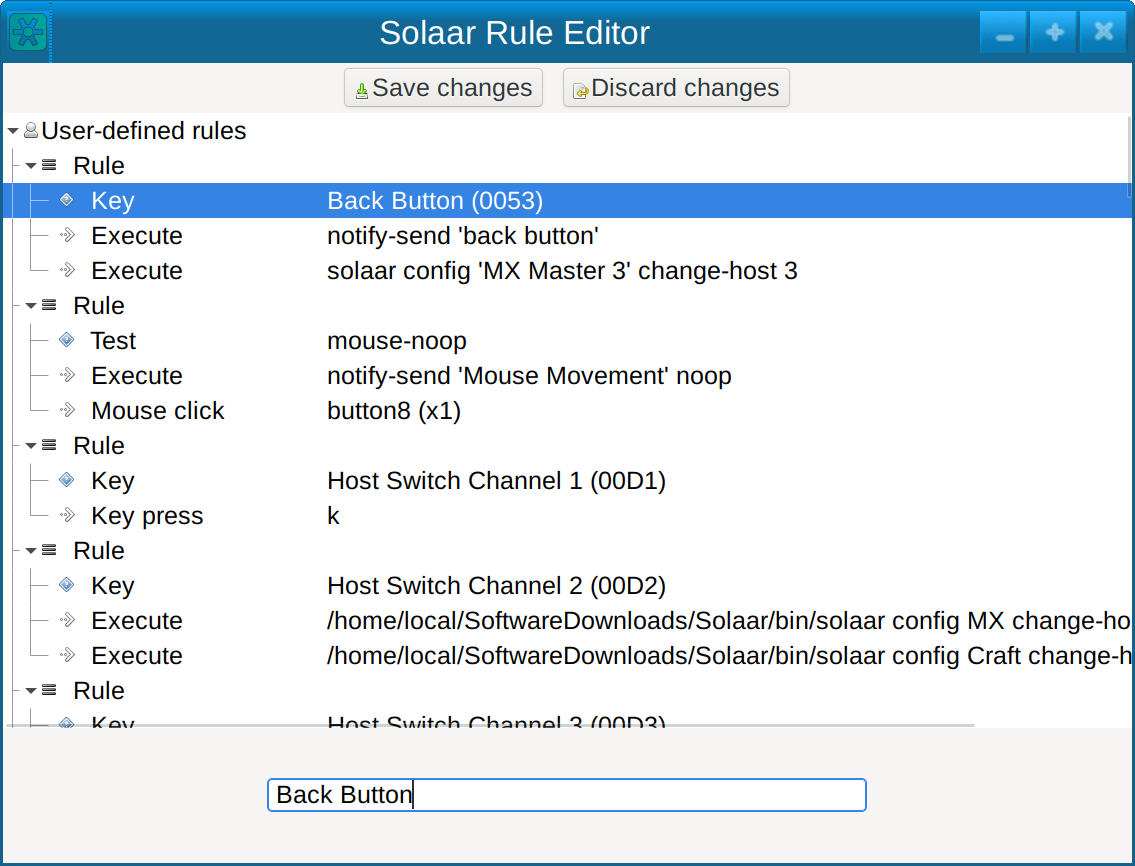
Solaar supports:
- pairing/unpairing of devices with receivers
- configuring device settings
- custom button configuration
- running rules in response to special messages from devices
For more information see the main Solaar documentation page. -
Installation Packages
Up-to-date prebuilt packages are available for some Linux distros (e.g., Fedora) in their standard repositories. If a recent version of Solaar is not available from the standard repositories for your distribution, you can try one of these packages:
- Arch solaar package in the extra repository
- Ubuntu/Kubuntu package in Solaar stable ppa
- NixOS Flake package in Svenum/Solaar-Flake
Solaar is available from some other repositories but may be several versions behind the current version:
- a Debian package, courtesy of Stephen Kitt
- a Ubuntu package is available from universe repository
- a Gentoo package, courtesy of Carlos Silva and Tim Harder
- a Mageia package, courtesy of David Geiger