 c7820c2fca
Rewrite PARAMETERS_FIELDS with the actual field layout for each module.
The previous table treated byte 0 as a "state" byte across the board
and shifted every other field by one position; the offset-0 byte is
just the first real field of each struct (NR sensitivity, NG/Comp/
DeEss/DePop threshold, Limiter boost, HPF frequency). Verified field-
by-field against the captured G522 bring-up samples — every parsed
default now matches the device-reported factory value:

  NR  : sensitivity=40 release=50ms bias=0 attenuation=-6dB
  NG  : threshold=-45dB attenuation=-15dB attack=1ms hold=150ms
        release=250ms
  Comp: threshold=-18dB attack=50ms release=400ms post_gain=3dB
        pre_gain=0dB ratio=2
  DeEss: threshold=-27dB frequency=8000Hz width_q=32 attack=1ms
        release=250ms attenuation=-12dB
  DePop: threshold=-12dB frequency=100Hz width_q=16 attack=1ms
        release=250ms attenuation=-12dB
  HPF : frequency=120Hz

Compressor `byte7_packed` was wrong — pre_gain and ratio occupy
distinct bytes (5 / 6 / 7) rather than being bit-packed into byte 7.
HPF frequency moved from offset 1 to offset 0 (we'd been reading
0x7800 = 30720 Hz instead of 0x0078 = 120 Hz).

Add parse_info() to decode GetInfo (fn 0x40) into per-field
{min, max} dicts. Layout is per-field [min, max] back-to-back using
each field's wire encoding. probe_module logs the bounds at INFO so
the corpus shows device-reported ranges alongside the parsed values.

Most fields drop their `(raw)` placeholder labels for proper unit
labels (dB, ms, Hz). De-esser/De-popper width_q stays opaque because
the device-loaded scale constant isn't pinned down.
|
||
|---|---|---|
| .github | ||
| bin | ||
| docs | ||
| lib | ||
| po | ||
| rules.d | ||
| rules.d-uinput | ||
| share | ||
| tests | ||
| tools | ||
| .coveragerc | ||
| .git-blame-ignore-revs | ||
| .gitignore | ||
| .pre-commit-config.yaml | ||
| .python-version | ||
| CHANGELOG.md | ||
| COPYRIGHT | ||
| LICENSE.txt | ||
| MANIFEST.in | ||
| Makefile | ||
| README.md | ||
| RELEASE.md | ||
| RHEL.md | ||
| Release_Notes.md | ||
| mkdocs.yml | ||
| pyproject.toml | ||
| release.sh | ||
| setup.py | ||
README.md
 Solaar
Solaar is a Linux manager for many Logitech keyboards, mice, and other devices that connect wirelessly to a Unifying, Bolt, Lightspeed or Nano receiver as well as many Logitech devices that connect via a USB cable or Bluetooth. Solaar is not a device driver and responds only to special messages from devices that are otherwise ignored by the Linux input system.
More Information - Usage - Capabilities - Rules - Manual Installation - Known Issues


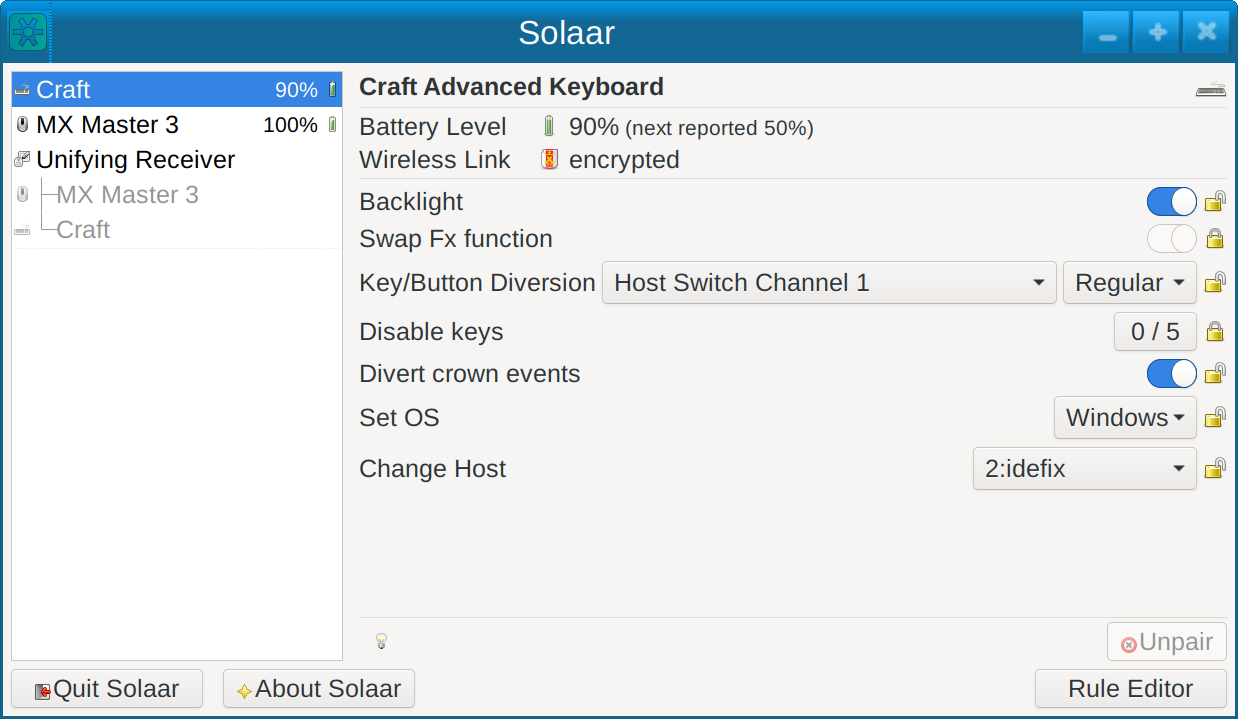
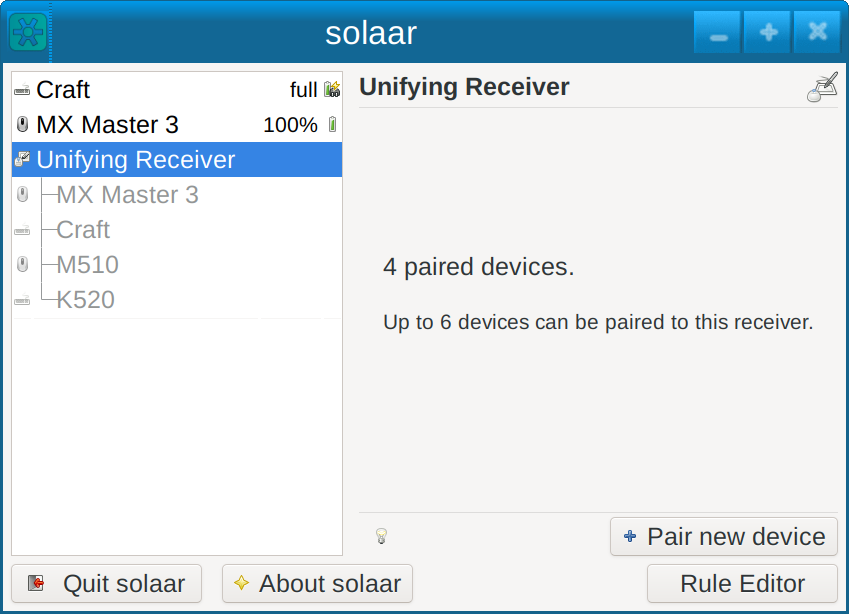
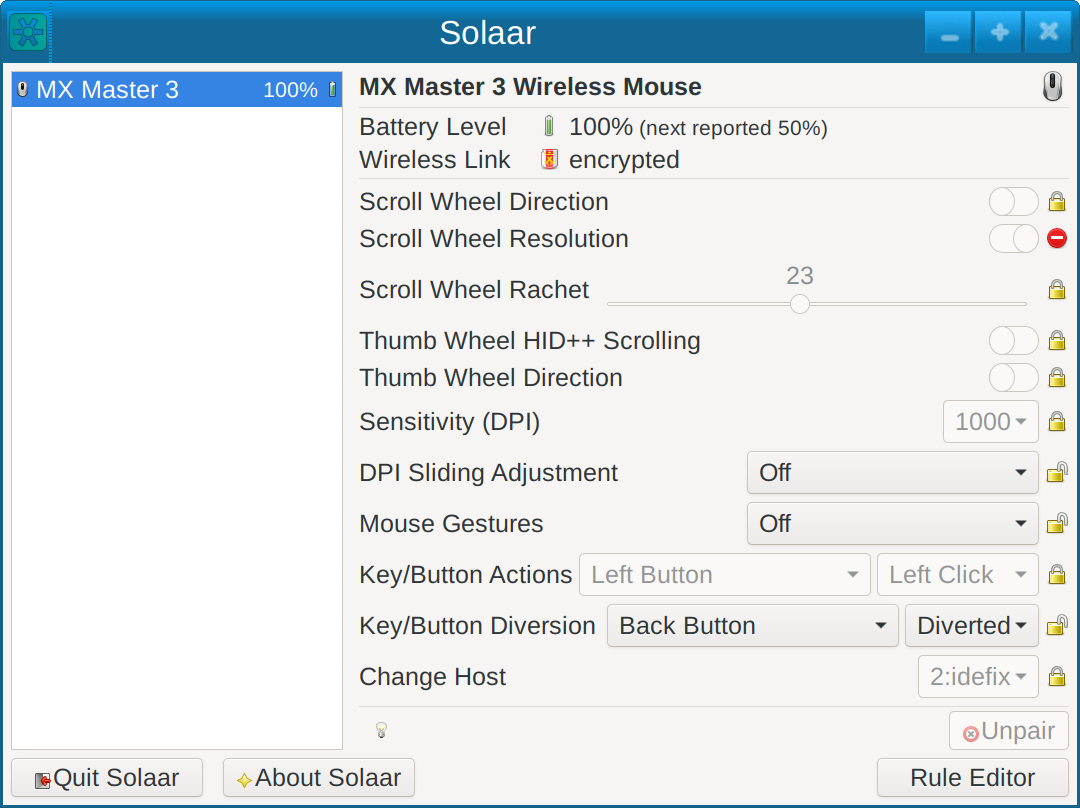
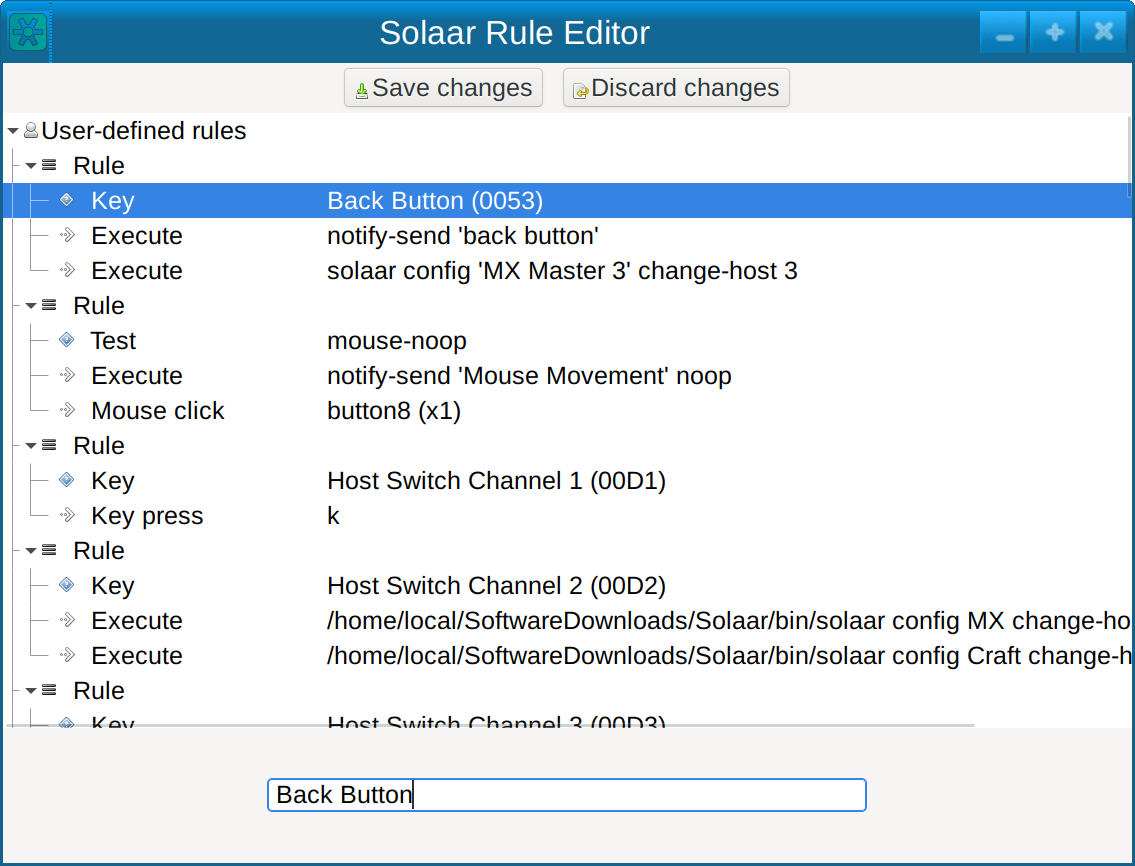
Solaar supports:
- pairing/unpairing of devices with receivers
- configuring device settings
- custom button configuration
- running rules in response to special messages from devices
For more information see the main Solaar documentation page. -
Installation Packages
Up-to-date prebuilt packages are available for some Linux distros (e.g., Fedora) in their standard repositories. If a recent version of Solaar is not available from the standard repositories for your distribution, you can try one of these packages:
- Arch solaar package in the extra repository
- Ubuntu/Kubuntu package in Solaar stable ppa
- NixOS Flake package in Svenum/Solaar-Flake
Solaar is available from some other repositories but may be several versions behind the current version:
- a Debian package, courtesy of Stephen Kitt
- a Ubuntu package is available from universe repository
- a Gentoo package, courtesy of Carlos Silva and Tim Harder
- a Mageia package, courtesy of David Geiger