## Thinking Path

> - Paperclip is the open source app people use to manage AI agents for
work.
> - Several people can send instructions to the same agent and task.
> - A fixed GitHub token in the provider process can keep the first
person's access after another person's message is accepted.
> - Task ownership cannot select credentials for each accepted
instruction or preserve the identity of an operation already in
progress.
> - This pull request records ordered execution identity contexts and
resolves credentials when managed Git, gh, or GitHub tools start.
> - The benefit is automatic personal GitHub access for shared agents,
with durable continuation rules and no teammate credential fallback.

## Linked Issues or Issue Description

**Subsystem affected**

Cross-cutting: orchestration, connection grants, database, runtime
adapters, native runners, and run details.

**Problem or motivation**

A shared agent must use the person whose instructions it has accepted. A
queued message must retain its author. A retry or approval without new
instructions must retain the originating identity. GitHub must remain
optional for ordinary work.

**Proposed solution**

Persist execution identity separately from task ownership. Give new
processes a run-scoped broker capability and token-free managed
launchers. Capture identity at operation start. Keep an explicit
dedicated-agent grant as an override. Show redacted diagnostics in run
details.

**Alternatives considered**

Per-task ownership, fixed provider tokens, and mutable repository author
configuration do not handle accepted steering or concurrent operations.
A manual account-selection action would add unnecessary setup to each
turn.

**Roadmap alignment**

This completes the existing Multiple Human Users, MCP Tool Gateway &
Apps, Secrets Manager, and Self-healing Runs capabilities. The
implementation follows the maintainer-approved plan.

Related work: Refs #12843, Refs #12907. Existing proposals #4618 and
#8945 cover per-agent or per-worktree author configuration. This change
instead follows the accepted human instruction across runtime types.
Refs #11831 for governed personal connection delegation; this change
preserves connection audience checks and does not use standing
delegation as a personal credential fallback.

## What Changed

- Add durable, ordered identity contexts and active run references.
Preserve message authors through consolidation, steering, retries,
delegation, approvals, routines, and restart.
- Add an authenticated operation-time GitHub credential broker and
local/remote managed git and gh launchers. Keep personal tokens out of
the long-lived provider process.
- Resolve GitHub gateway and server-side Git operations through the same
responsible-person or dedicated-grant selection rules.
- Make absent and unavailable GitHub credentials non-blocking at generic
startup. Clear host and prior-person credentials. Keep anonymous Git
access where supported.
- Add run-detail identity history and the dedicated-account warning.
Keep task ownership and queue-versus-steer decisions unchanged.
- Preserve personal OAuth declarations through connection edits. Retain
exact selected grants in the gateway.
- Fix continuation races found during real acceptance: verify a warm
owner before credential rotation, and wait for bounded durable runner
suspension before the next run starts.
- Make migrations replay-safe. Retain identity through agent/run
deletion, remove it with its company, and clean terminal launcher
directories before releasing execution environments. Document
coordinated release and rollback.

## Verification

- Full workspace typecheck, build, and token gates passed. The complete
local suite passed in its normal test groups: 17,120 passing tests,
including all 143 serialized server suites. After integrating the newly
merged runner API work, full local typecheck and build passed again,
along with 890 focused integration tests. All 31 checks on the
integrated revision passed, including build, browser E2E, release
registry, canary dry run, typecheck, security and all test suites.
Greptile is 5/5 with all review threads resolved.
- Current focused checks passed: 142 native executor tests, 67 runtime
lifecycle tests, 9 durable identity tests, 75 credential/routine tests,
19 low-trust/resumption tests, and the executable migration replay test.
- Authenticated browser acceptance with two Paperclip users and two
GitHub accounts on one shared native agent passed. Real commits and
pushes followed A → B accepted steering → queued A continuation in the
same saved conversation. GitHub commit author and committer identities
matched all three operations. Both runs succeeded and task ownership
stayed unchanged.
- Real GitHub MCP calls switched from A to B after accepted steering. A
delegated subtask retained its originating identity across a server
restart.
- Disabling B's GitHub connection left ordinary work successful. Managed
gh was unauthenticated and the provider had no inherited GH_TOKEN or
GITHUB_TOKEN.
- The browser displayed run-detail diagnostics and the exact
dedicated-account warning. A final controller-restart check followed by
another-person continuation retained the conversation, selected the
correct GitHub login and Git author, and removed each terminal launcher
directory.
- Company-lifetime migration and all five previously failing CI suites
passed locally (167 tests). Same-token gateway A → B → A and six
broker/launcher boundary tests passed.
- Remote callback, launcher, sandbox, and runtime contract tests passed.
Both native and legacy Codex completed actual Daytona executions on the
integrated revision ([campaign
results](https://github.com/paperclipai/paperclip/actions/runs/34155056509)).
The remote package-manager shim staging regression also passed locally.

## Risks

- Deploy the migrations, server broker, launchers, and runner artifacts
together. Existing processes finish with their original contract. New
managed processes need the broker endpoint for GitHub operations.
- Finish or stop new managed executions before rolling application code
back. Keep the additive schema and identity history during rollback.
- Scripts that require a persistent raw GH_TOKEN must use managed git,
gh, or GitHub gateway tools. Run capabilities authorize code executing
within that run to acquire its current identity; this is not
hostile-code isolation within one execution principal. Managed commands
prevent automatic credential carryover; arbitrary code deliberately
copying a credential is outside that boundary.
- Uncertain steering acknowledgement deliberately holds new credential
acquisition until reconciliation. Already-started operations retain
their captured identity.
- GitHub private access and provider outages can still fail the specific
operation that needs them. Dedicated grant failure does not fall back to
personal access.

## Model Used

OpenAI GPT-6 through Codex assisted implementation, review, shell
execution, and browser acceptance. The exact model variant and
context-window size are not exposed in this session. Tool use included
TypeScript and Rust tests, database integration tests, GitHub CLI, and
authenticated browser control.

## Checklist

- [x] I have included a thinking path that traces from project context
to this change
- [x] I have specified the model used (with version and capability
details)
- [x] I have checked ROADMAP.md and confirmed this PR does not duplicate
planned core work
- [x] I have searched GitHub for duplicate or related PRs and linked
them above
- [x] I have either (a) linked existing issues with `Fixes: #` / `Closes
#` / `Refs #` OR (b) described the issue in-PR following the relevant
issue template
- [x] I have not referenced internal/instance-local Paperclip issues or
links (only public GitHub `#NNN` / `github.com/paperclipai/paperclip`
URLs)
- [x] My branch name describes the change (e.g. `docs/...`, `fix/...`)
and contains no internal Paperclip ticket id or instance-derived details
- [x] I have run tests locally and they pass
- [x] I have added or updated tests where applicable
- [x] I have updated relevant documentation to reflect my changes
- [x] I have considered and documented any risks above
- [x] All Paperclip CI gates are green
- [x] Greptile is 5/5 with no open P2s, recommendations, or follow-ups
- [x] I will address all Greptile and reviewer comments before
requesting merge

---------

Co-authored-by: Paperclip <noreply@paperclip.ing>
## Thinking Path
> - Paperclip orchestrates AI-agent companies and needs secrets handling
to work across local development, hosted operators, and governed agent
execution.
> - The affected subsystem is the company-scoped secrets control plane:
database schema, server services/routes, CLI workflows, and the Secrets
settings UI.
> - The gap was that secrets were local-only and operators could not
manage provider vaults or import existing remote references without
exposing plaintext.
> - This branch adds provider vault configuration plus an AWS Secrets
Manager remote-import path while preserving company boundaries, binding
context, and audit trails.
> - I kept the PR to a single branch PR, removed unrelated
lockfile/package drift, rebased the full branch onto the current
`public-gh/master`, and addressed fresh Greptile findings.
> - The benefit is a reviewable implementation of provider-backed
secrets with focused tests covering provider selection, import
conflicts, deleted secret reuse, rotation guards, and AWS signing
behavior.
## What Changed
- Added provider vault support for company secrets, including provider
config storage, default vault handling, health checks, binding usage,
access events, and remote import preview/commit.
- Added an AWS Secrets Manager provider using SigV4 request signing,
bounded request timeouts, namespace guardrails, cached runtime
credential resolution, and external-reference linking without plaintext
reads.
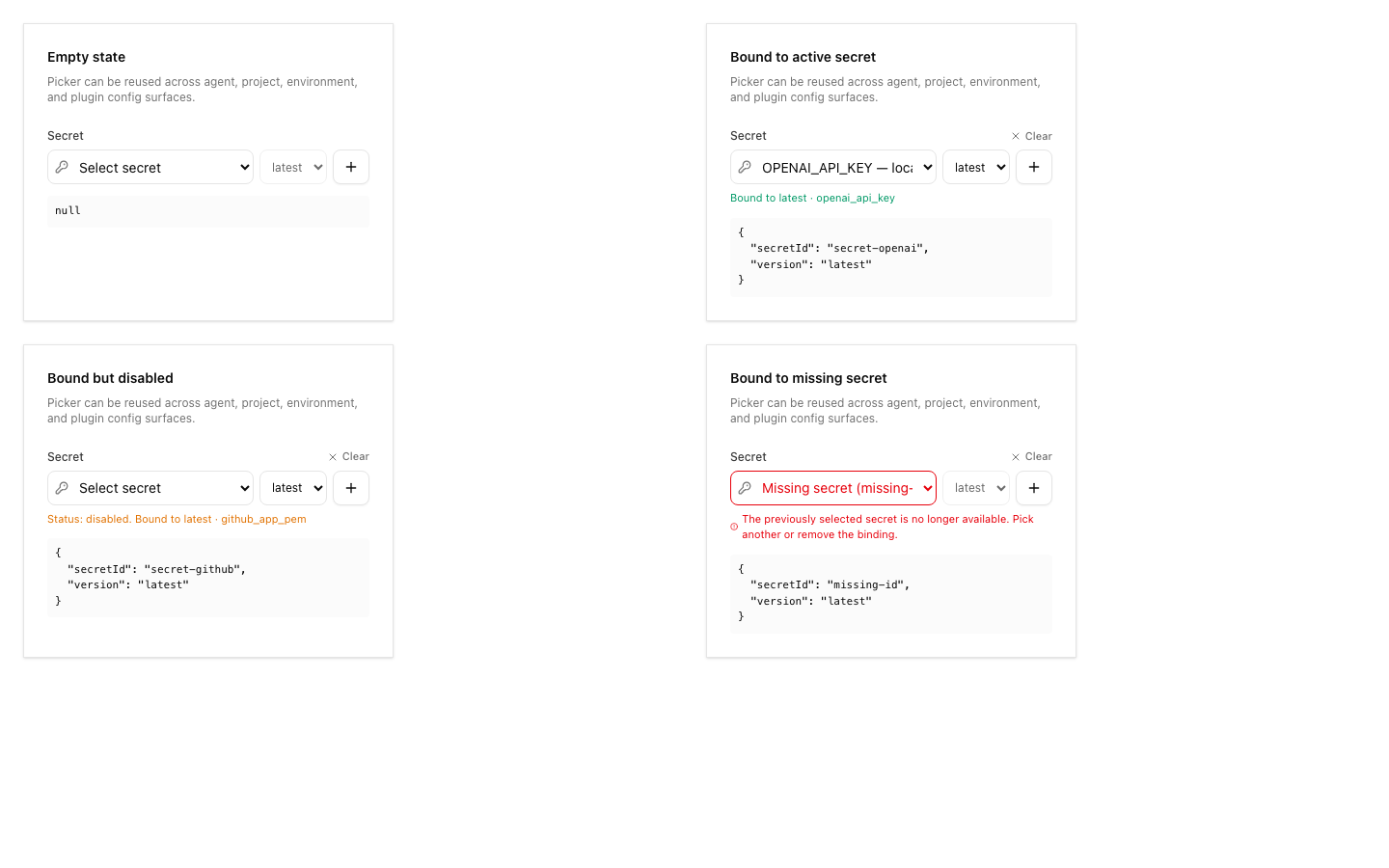
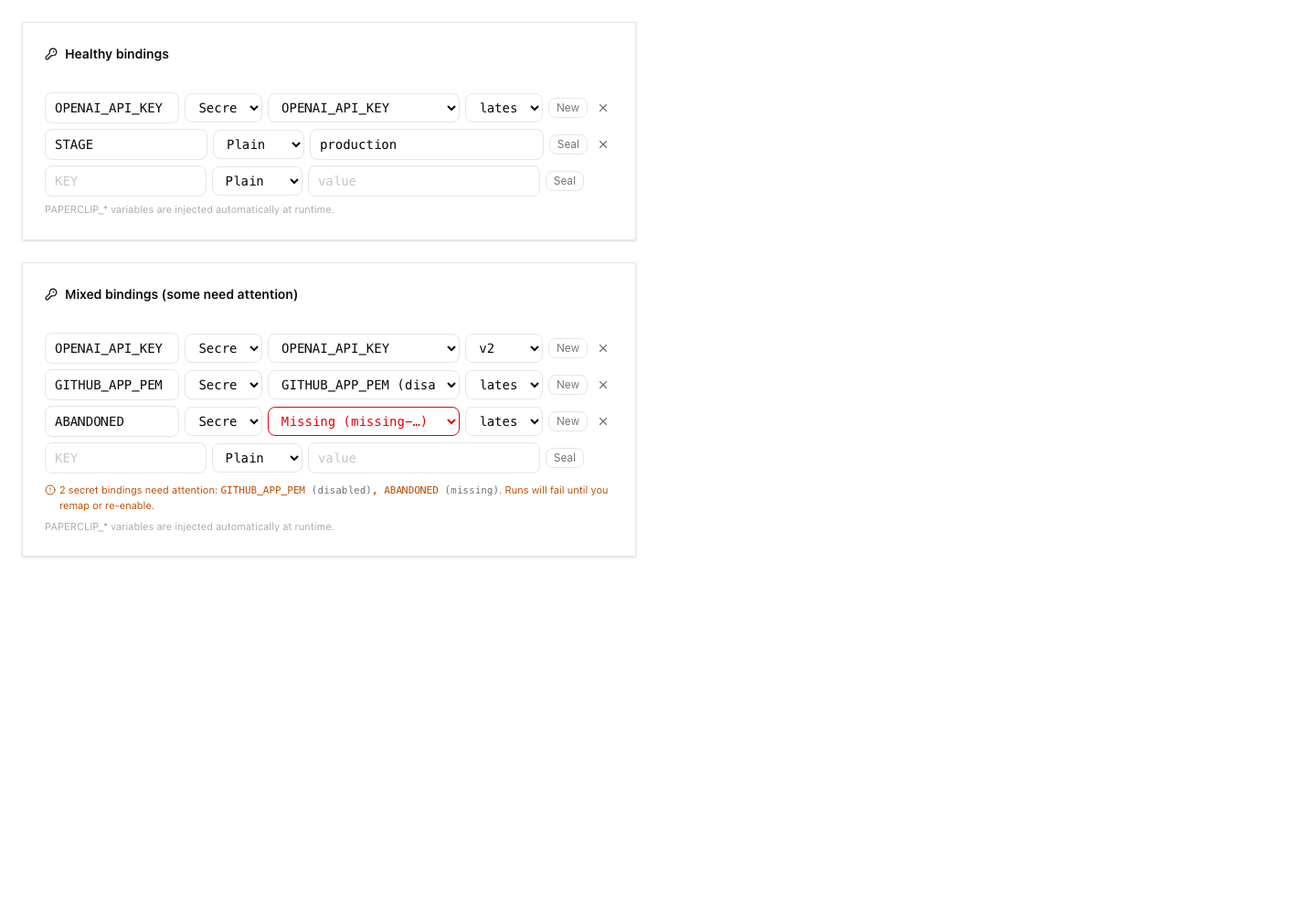
- Added Secrets UI surfaces for vault management and remote import, plus
CLI/API documentation for setup and operations.
- Stabilized routine webhook secret binding paths and SSH
environment-driver fixture bindings discovered during verification.
- Addressed Greptile and CI findings: no lockfile/package drift,
monotonic migration metadata, disabled-vault default races, soft-deleted
secret hiding/recreate behavior, remove behavior with disabled vaults,
soft-deleted external-reference re-import, non-active rotation guards,
managed-secret soft deletion through PATCH, and per-call AWS SDK
credential client churn.
- Rebased this branch onto `public-gh/master` at `0e1a5828` and
force-pushed with lease to keep this as the single PR for the branch.
## Verification
- `git fetch public-gh master`
- `git rebase public-gh/master`
- `git diff --name-only public-gh/master...HEAD | grep
'^pnpm-lock\.yaml$' || true` confirmed `pnpm-lock.yaml` is not in the PR
diff.
- Confirmed migration ordering: master ends at `0081_optimal_dormammu`;
this PR adds `0082_dry_vision` and
`0083_company_secret_provider_configs`.
- Inspected migrations for repeat safety: new tables/indexes use `IF NOT
EXISTS`; foreign keys are guarded by `DO $$ ... IF NOT EXISTS`; column
additions use `ADD COLUMN IF NOT EXISTS`.
- `pnpm -r typecheck` passed before the Greptile follow-up commits.
- `pnpm test:run` ran the full stable Vitest path before the Greptile
follow-up commits; it completed with 3 timing-related failures under
parallel load: `codex-local-execute.test.ts`,
`cursor-local-execute.test.ts`, and `environment-service.test.ts`.
- `pnpm --filter @paperclipai/server exec vitest run
src/__tests__/codex-local-execute.test.ts
src/__tests__/cursor-local-execute.test.ts
src/__tests__/environment-service.test.ts` passed on targeted rerun
(`24/24`).
- `pnpm build` passed before the Greptile follow-up commits. Vite
reported existing chunk-size/dynamic-import warnings.
- After Greptile follow-up commits: `pnpm --filter @paperclipai/server
exec vitest run src/__tests__/secrets-service.test.ts` passed (`26/26`).
- After Greptile follow-up commits: `pnpm --filter @paperclipai/server
exec vitest run src/__tests__/aws-secrets-manager-provider.test.ts
src/__tests__/secrets-service.test.ts` passed (`39/39`).
- After Greptile follow-up commits: `pnpm --filter @paperclipai/server
typecheck` passed.
- Captured Storybook screenshots from `ui/storybook-static` for visual
review.
- Latest PR checks on `5ca3a5cf`: `policy`, serialized server suites
1/4-4/4, `Canary Dry Run`, `e2e`, `security/snyk`, and `Greptile Review`
pass; aggregate `verify` is still registering the completed child
checks.
- Greptile review loop continued through the latest requested pass; all
Greptile review threads are resolved and the latest `Greptile Review`
check on `5ca3a5cf` passed with 0 comments added.
## Screenshots
Before: the provider-vault and remote-import surfaces did not exist on
`master`; these are after-state screenshots from the Storybook fixtures.

## Risks
- Migration risk: this adds new secret provider tables and extends
existing secret rows. The migrations were checked for monotonic ordering
and idempotent guards, but reviewers should still inspect upgrade
behavior carefully.
- Provider risk: AWS support uses direct SigV4 requests. Automated tests
cover signing, request timeouts, vault-config selection, namespace
guardrails, pending-version archival, sanitized provider errors, and
service-level cleanup paths. A real-vault AWS smoke test remains
deployment validation for an operator with AWS credentials rather than
an unverified merge blocker in this local branch.
- UI risk: the Secrets page and import dialog are large new surfaces;
screenshots are included above for reviewer inspection.
- Verification risk: the full local stable test command hit
parallel-load timing failures, although the exact failed files passed
when rerun directly.
- Operational risk: remote import intentionally avoids plaintext reads;
operators must understand that imported external references resolve at
runtime and may fail if AWS permissions change.
> For core feature work, check [`ROADMAP.md`](ROADMAP.md) first and
discuss it in `#dev` before opening the PR. Feature PRs that overlap
with planned core work may need to be redirected — check the roadmap
first. See `CONTRIBUTING.md`.
## Model Used
- OpenAI Codex, GPT-5 coding agent with local shell/tool use in the
Paperclip worktree. Exact context-window size was not exposed by the
runtime.
## Checklist
- [x] I have included a thinking path that traces from project context
to this change
- [x] I have specified the model used (with version and capability
details)
- [x] I have checked ROADMAP.md and confirmed this PR does not duplicate
planned core work
- [ ] I have run tests locally and they pass
- [x] I have added or updated tests where applicable
- [x] If this change affects the UI, I have included before/after
screenshots
- [x] I have updated relevant documentation to reflect my changes
- [x] I have considered and documented any risks above
- [x] I will address all Greptile and reviewer comments before
requesting merge
---------
Co-authored-by: Paperclip <noreply@paperclip.ing>
Co-authored-by: Claude Sonnet 4.6 <noreply@anthropic.com>
## Thinking Path

> - Paperclip orchestrates AI agents for zero-human companies
> - Adapters spawn CLIs against local, SSH, and sandbox targets,
threading a runtime env through `runAdapterExecutionTargetProcess` and
the SSH/sandbox runners
> - Host identity vars (HOME, TMPDIR, XDG_*, NVM_DIR, PATH) routinely
leak into the env we send to remote targets — sometimes via test probes,
sometimes via runtime config — and break sandboxed/SSH'd CLIs whose own
profiles set those values correctly
> - The sanitization logic existed but lived alongside other helpers in
`server-utils.ts` and was applied piecemeal at adapter callsites, so it
was easy to bypass
> - This pull request lifts the sanitization into a standalone
`remote-execution-env.ts`, applies it at the SSH and sandbox runtime
boundary so every remote spawn goes through it, and removes the
duplicated callsite-level filtering
> - The benefit is identity-bound host env stops leaking across
SSH/sandbox transports regardless of which adapter calls in

## What Changed

- `packages/adapter-utils/src/remote-execution-env.ts`: new module —
single source of truth for which env keys are identity-bound and how to
strip them when the value matches the host's value
- `packages/adapter-utils/src/server-utils.ts`: remove the inline
sanitization (now in `remote-execution-env.ts`)
- `packages/adapter-utils/src/execution-target.ts`: apply sanitization
at the sandbox runtime boundary
- `packages/adapter-utils/src/ssh.ts`: apply sanitization at the SSH
spawn boundary
- `packages/adapters/opencode-local/src/server/test.ts`: drop
now-redundant callsite filtering
- `packages/adapters/pi-local/src/server/test.ts`: drop now-redundant
callsite filtering
- New tests `execution-target.test.ts` and
`execution-target-sandbox.test.ts` cover the sanitizer flow at both
transports, including positive cases (host-shaped path stripped) and
explicit-override preservation

## Verification

- `pnpm vitest run --no-coverage --project @paperclipai/adapter-utils
--project @paperclipai/adapter-opencode-local --project
@paperclipai/adapter-pi-local`
- `pnpm typecheck` clean

## Risks

Low–medium. The sanitization is now applied at one layer (boundary)
instead of N (callsites), so behavior is more consistent. Any adapter
that previously relied on a leaked host var landing on the remote shell
would now see it stripped — but those reliances were what this change
exists to fix.

## Model Used

Claude Opus 4.7 (1M context)

## Checklist

- [x] I have included a thinking path that traces from project context
to this change
- [x] I have specified the model used (with version and capability
details)
- [x] I have checked ROADMAP.md and confirmed this PR does not duplicate
planned core work
- [x] I have run tests locally and they pass
- [x] I have added or updated tests where applicable — new tests at both
transports
- [x] If this change affects the UI, I have included before/after
screenshots — N/A (no UI)
- [x] I have updated relevant documentation to reflect my changes
- [x] I have considered and documented any risks above
- [x] I will address all Greptile and reviewer comments before
requesting merge
## Thinking Path

> - Paperclip orchestrates AI agents for zero-human companies, running
adapter
> commands like `claude`, `codex`, `pi` either locally or on remote
runtimes
>   (SSH hosts, sandboxes, etc.)
> - On a fresh remote runtime — particularly an ephemeral sandbox — the
> adapter's CLI may not be installed yet. Today operators handle this
via
> external configuration (e.g. a project-level `provisionCommand` shell
> script) that has to know about every adapter the operator might want
to use
> - This means every adapter has its own well-known npm package, but
operators
>   end up writing duplicate provision shell scripts that paste together
> `npm install -g @anthropic-ai/claude-code`, `npm install -g
@openai/codex`,
>   etc. — knowledge the adapter itself already has
> - This PR moves that knowledge into the adapter modules: each adapter
declares
> how its runtime command should be detected and (if applicable)
installed
> via `getRuntimeCommandSpec(config)`. The execution path runs the
adapter's
> own install command on remote sandbox targets before launching, so a
fresh
> sandbox bootstraps itself instead of requiring a hand-written
provision script
> - The benefit is fewer footguns for operators provisioning remote
runtimes,
>   and a clean place for new adapters to plug in their install recipe

## What Changed

- New types in `packages/adapter-utils/src/types.ts`:
    - `AdapterRuntimeCommandSpec` describing `command`, optional
      `detectCommand`, and optional `installCommand`
    - Optional `getRuntimeCommandSpec(config)` on `ServerAdapterModule`
- Optional `runtimeCommandSpec` on `AdapterExecutionContext` so adapters
      receive the resolved spec at execute time
- New helper `ensureAdapterExecutionTargetRuntimeCommandInstalled(...)`
in
`packages/adapter-utils/src/execution-target.ts` that runs the install
command
on remote targets when `transport === "sandbox"`. SSH and local targets
are
  no-ops. Throws on timeout or non-zero exit so failures surface early.
- Each of `claude-local`, `codex-local`, `cursor-local`, `gemini-local`,
  `opencode-local`, `pi-local`'s `execute.ts` now reads
`ctx.runtimeCommandSpec?.installCommand` and calls the helper before
launching
  the adapter command.
- `server/src/adapters/registry.ts` declares `getRuntimeCommandSpec` for
each
  adapter:
- claude/codex/gemini/opencode/pi-local: `npm install -g <package>`
recipe via
a shared `buildNpmRuntimeCommandSpec` helper, with a defensive guard
that
only auto-installs when the configured `command` matches the well-known
      fallback (custom binaries are left alone).
- cursor-local: declares `command` only; no auto-install (no public npm
      package), preserving the existing manual setup.
- `server/src/services/heartbeat.ts` resolves the spec via
`adapter.getRuntimeCommandSpec?.(runtimeConfig)` and passes it through
to
  `AdapterExecutionContext`.
- Tests added in `execution-target.test.ts` (~75 lines), e2b
`plugin.test.ts` (~32 lines), and `environment-run-orchestrator.test.ts`
  (~76 lines).

## Verification

- `pnpm --filter @paperclipai/adapter-utils test`
- `pnpm --filter @paperclipai/server test --
environment-run-orchestrator`
- `pnpm --filter @paperclipai/sandbox-providers-e2b test`
- Manual QA: run an adapter (claude/codex/etc.) against a fresh
sandbox-backed
environment that does NOT have the adapter CLI pre-installed. Confirm
the
install runs once at the start of the agent run and the adapter then
launches
successfully. Re-run on the same sandbox; confirm the install command is
  idempotent and the second run starts faster.
- Confirm SSH and local execution paths are unaffected (gated by
  `transport === "sandbox"`).

## Risks

- Behavioural shift on sandbox runs: a new install step now runs at the
start
  of every sandbox agent run for adapters with `installCommand` set. The
install commands are idempotent (`if ! command -v X >/dev/null 2>&1;
then
npm install -g <pkg>; fi`), so this is fast on warm sandboxes. On a cold
  sandbox, the first run takes longer.
- Operators who used the legacy project-level `provisionCommand` to
install
adapter CLIs can drop that part of their script; the adapter handles it
now.
  Existing scripts continue to work — installs are idempotent.
- The cursor-local adapter has no auto-install (no public npm package).
  Behaviour for cursor-local on sandboxes is unchanged.
- New optional surface on `ServerAdapterModule`. Plugins that don't
implement
  `getRuntimeCommandSpec` retain previous behaviour (no auto-install).

## Model Used

- OpenAI GPT-5.4 (reasoning effort: high) via Codex CLI
- Provider: OpenAI
- Used to author the code changes in this PR

## Checklist

- [x] I have included a thinking path that traces from project context
to this change
- [x] I have specified the model used (with version and capability
details)
- [x] I have checked ROADMAP.md and confirmed this PR does not duplicate
planned core work
- [x] I have run tests locally and they pass
- [x] I have added or updated tests where applicable
- [ ] If this change affects the UI, I have included before/after
screenshots — N/A
- [ ] I have updated relevant documentation to reflect my changes — N/A
- [x] I have considered and documented any risks above
- [x] I will address all Greptile and reviewer comments before
requesting merge
## Thinking Path

> - Paperclip orchestrates AI agents for zero-human companies
> - Agents run inside environments (local, SSH, E2B sandbox)
> - Operators need to configure and manage these environments
> - But environment settings were buried inside the general company
settings page, making them hard to find
> - Additionally, when testing an agent from the configuration form, the
test always ran locally regardless of which environment was selected
> - This PR moves environments into a dedicated top-level company
settings section and wires the "Test Environment" button to run inside
the selected environment
> - The benefit is operators can find and manage environments more
easily, and the test button now validates the actual environment the
agent will use

## What Changed

- Added a dedicated `CompanyEnvironments` settings page with its own
route and sidebar entry
- Updated `CompanySettingsSidebar` and `CompanySettingsNav` to include
the new environments section
- Modified the agent test route (`POST /agents/:id/test`) to accept an
optional `environmentId` parameter
- Updated all adapter `test.ts` handlers to resolve and use the
specified execution target environment
- Added `resolveTestExecutionTarget` to `execution-target.ts` for remote
environment test resolution with cwd fallback
- Moved the "Test Environment" button and its feedback display into the
`NewAgent` page footer for better UX flow

## Verification

- `pnpm test` — all existing and new tests pass
- `pnpm typecheck` — clean
- Manual: navigate to Company Settings, confirm "Environments" appears
as a top-level section
- Manual: configure an agent with a non-local environment, click "Test
Environment", confirm the test runs inside that environment

## Risks

- Low risk. UI-only routing change for the settings page. The
test-in-environment change adds an optional parameter with a local
fallback, so existing behavior is preserved when no environment is
specified.

## Model Used

Codex GPT 5.4 high via Paperclip.

## Checklist

- [x] I have included a thinking path that traces from project context
to this change
- [x] I have specified the model used (with version and capability
details)
- [x] I have checked ROADMAP.md and confirmed this PR does not duplicate
planned core work
- [x] I have run tests locally and they pass
- [x] I have added or updated tests where applicable
- [x] If this change affects the UI, I have included before/after
screenshots
- [x] I have updated relevant documentation to reflect my changes
- [x] I have considered and documented any risks above
- [x] I will address all Greptile and reviewer comments before
requesting merge
## Thinking Path

> - Paperclip orchestrates AI agents for zero-human companies
> - The environments subsystem already models execution environments,
but before this branch there was no end-to-end SSH-backed runtime path
for agents to actually run work against a remote box
> - That meant agents could be configured around environment concepts
without a reliable way to execute adapter sessions remotely, sync
workspace state, and preserve run context across supported adapters
> - We also need environment selection to participate in normal
Paperclip control-plane behavior: agent defaults, project/issue
selection, route validation, and environment probing
> - Because this capability is still experimental, the UI surface should
be easy to hide and easy to remove later without undoing the underlying
implementation
> - This pull request adds SSH environment execution support across the
runtime, adapters, routes, schema, and tests, then puts the visible
environment-management UI behind an experimental flag
> - The benefit is that we can validate real SSH-backed agent execution
now while keeping the user-facing controls safely gated until the
feature is ready to come out of experimentation

## What Changed

- Added SSH-backed execution target support in the shared adapter
runtime, including remote workspace preparation, skill/runtime asset
sync, remote session handling, and workspace restore behavior after
runs.
- Added SSH execution coverage for supported local adapters, plus remote
execution tests across Claude, Codex, Cursor, Gemini, OpenCode, and Pi.
- Added environment selection and environment-management backend support
needed for SSH execution, including route/service work, validation,
probing, and agent default environment persistence.
- Added CLI support for SSH environment lab verification and updated
related docs/tests.
- Added the `enableEnvironments` experimental flag and gated the
environment UI behind it on company settings, agent configuration, and
project configuration surfaces.

## Verification

- `pnpm exec vitest run
packages/adapters/claude-local/src/server/execute.remote.test.ts
packages/adapters/cursor-local/src/server/execute.remote.test.ts
packages/adapters/gemini-local/src/server/execute.remote.test.ts
packages/adapters/opencode-local/src/server/execute.remote.test.ts
packages/adapters/pi-local/src/server/execute.remote.test.ts`
- `pnpm exec vitest run server/src/__tests__/environment-routes.test.ts`
- `pnpm exec vitest run
server/src/__tests__/instance-settings-routes.test.ts`
- `pnpm exec vitest run ui/src/lib/new-agent-hire-payload.test.ts
ui/src/lib/new-agent-runtime-config.test.ts`
- `pnpm -r typecheck`
- `pnpm build`
- Manual verification on a branch-local dev server:
  - enabled the experimental flag
  - created an SSH environment
  - created a Linux Claude agent using that environment
- confirmed a run executed on the Linux box and synced workspace changes
back

## Risks

- Medium: this touches runtime execution flow across multiple adapters,
so regressions would likely show up in remote session setup, workspace
sync, or environment selection precedence.
- The UI flag reduces exposure, but the underlying runtime and route
changes are still substantial and rely on migration correctness.
- The change set is broad across adapters, control-plane services,
migrations, and UI gating, so review should pay close attention to
environment-selection precedence and remote workspace lifecycle
behavior.

## Model Used

- OpenAI Codex via Paperclip's local Codex adapter, GPT-5-class coding
model with tool use and code execution in the local repo workspace. The
local adapter does not surface a more specific public model version
string in this branch workflow.

## Checklist

- [x] I have included a thinking path that traces from project context
to this change
- [x] I have specified the model used (with version and capability
details)
- [x] I have checked ROADMAP.md and confirmed this PR does not duplicate
planned core work
- [x] I have run tests locally and they pass
- [x] I have added or updated tests where applicable
- [ ] If this change affects the UI, I have included before/after
screenshots
- [x] I have updated relevant documentation to reflect my changes
- [x] I have considered and documented any risks above
- [x] I will address all Greptile and reviewer comments before
requesting merge
 Dotta
Dotta
 Devin Foley


