## Thinking Path

> - Paperclip manages AI agents that perform work.
> - Paperclip Runner connects durable task runs to local provider
processes.
> - The full-stack paid matrix exposed failures after the runner
integrity repair.
> - Verified JavaScript entrypoints lost their relative module graph
when Linux executed them through descriptor paths.
> - Returned provider startup errors also remained pending and became
indeterminate after recovery.
> - Sparse Codex tool lifecycle events lost the `write_document`
identity before task transcript projection.
> - This pull request repairs those three boundaries and makes the
structured-question fixture deterministic.
> - The benefit is repeatable provider startup, exact failure replay,
and correct inline Plan placement.

## Linked Issues or Issue Description

Refs #12721 and #12700.

**What happened?**

The paid runner matrix failed ACPX and OpenCode startup before provider
session creation. The runner journal then replaced the original startup
error with an indeterminate recovery result. Native Codex saved a Plan
but rendered it only as a fallback card. A legacy Claude waiting reply
could also echo the reserved terminal marker before the answer arrived.

**Expected behavior**

Verified JavaScript providers must start from immutable
descriptor-backed artifacts. Returned startup failures must persist as
terminal failed command results. Native tool lifecycle updates must
preserve the `write_document` boundary. Pre-answer fixture output must
not contain the reserved terminal marker.

**Steps to reproduce**

1. Run the local provider cells in the Runner Full-Stack E2E workflow.
2. Observe ACPX and OpenCode fail during `session.open` before provider
execution.
3. Observe recovery report `execution_indeterminate` instead of the
original startup error.
4. Run the native Codex Plan cell and observe the fallback Plan card
after the tool activity row.
5. Run the legacy Claude structured-question resume cell and observe an
early marker echo in waiting prose.

**Paperclip version or commit**

`0f9452101740835ce0b1488a204bf48acd5bafc3`

**Deployment mode**

Local development with the paid GitHub Actions acceptance workflow.

## What Changed

- Bundle the ACPX sidecar and OpenCode proxy as self-contained Node ESM
entrypoints before hashing and verified descriptor launch.
- Anchor ACPX dynamic provider package resolution at a
controller-derived provider-pack root and keep that root out of the
provider child environment.
- Persist executor-returned startup errors as redacted durable failed
command results while retaining indeterminate recovery for true process
death.
- Coalesce sparse native tool items by stable ID so a late
`write_document` name, input, and result reach the transcript boundary
once.
- Forbid the structured-question fixture from spelling or announcing its
reserved terminal marker before the user answers.

## Verification

- Rust and TypeScript regression tests cover durable failed replay, true
crash ambiguity, bundle closure, package-root derivation, environment
filtering, exact Codex tool lifecycle coalescing, and prompt
determinism.
- Local execution is intentionally limited to formatters and static diff
checks. GitHub Actions will run tests, type checks, builds, and security
checks.
- After ordinary CI is green, scoped paid cells will validate one ACPX
launch, one OpenCode launch, native Codex Plan projection, and legacy
Claude structured resume before a complete matrix rerun.
- Prior failing matrix:
https://github.com/paperclipai/paperclip/actions/runs/33682434315

## Risks

- Bundling changes the bytes covered by provider launch hashes.
Provider-pack generation already hashes the final built files.
- ACPX still loads qualified provider packages dynamically. The
controller supplies a normalized package root, while existing version,
digest, path, and descriptor checks remain active.
- Durable `failed` is terminal. Replays return the same redacted result
and do not execute the provider effect twice.

> For core feature work, check [`ROADMAP.md`](ROADMAP.md) first and
discuss it in `#dev` before opening the PR. Feature PRs that overlap
with planned core work may need to be redirected — check the roadmap
first. See `CONTRIBUTING.md`.

## Model Used

OpenAI Codex based on GPT-5 with agentic reasoning, repository
inspection, code editing, Git, parallel subagents, and GitHub Actions
coordination. The exact deployed snapshot and context-window size are
not exposed to this task.

## Checklist

- [x] I have included a thinking path that traces from project context
to this change
- [x] I have specified the model used (with version and capability
details)
- [x] I have checked ROADMAP.md and confirmed this PR does not duplicate
planned core work
- [x] I have searched GitHub for duplicate or related PRs and linked
them above
- [x] I have either linked related public work or described the bug in
this PR
- [x] I have not referenced internal or instance-local Paperclip issues
or links
- [x] My branch name describes the change and contains no internal
ticket id
- [ ] I have run tests locally and they pass (intentionally deferred to
GitHub Actions)
- [x] I have added or updated tests where applicable
- [x] No documentation change is required for this runtime repair
- [x] I have considered and documented the risks above
- [ ] All Paperclip CI gates are green
- [ ] Greptile is 5/5 with no open P2s, recommendations, or follow-ups
- [x] I will address all Greptile and reviewer comments before
requesting merge
## Thinking Path
> - Paperclip is the open source app people use to manage AI agents for
work
> - Local agent adapters (`claude_local`, `gemini_local`, `grok_local`,
…) are the integration surface that lets Paperclip run coding CLIs on
the host machine
> - The Kimi Code CLI (`kimi`, Moonshot AI) has a documented
non-interactive mode, `kimi -p --output-format stream-json` with session
resume via `kimi -r`, but Paperclip has no built-in adapter for it
> - So Kimi users (especially Kimi membership / OAuth subscribers)
cannot onboard their CLI to Paperclip agent teams
> - This pull request adds a complete built-in `kimi_local` adapter
(both execution engines, session management, instructions + skills
delivery, thinking-effort control, environment test, UI and CLI modules,
docs) following the established `gemini_local`/`grok_local` package
pattern
> - Kimi Code ships an ACP server (`kimi acp`), so the adapter runs on
Paperclip's shared acpx engine by default (streaming transcript with
live tool status, like `claude_local`/`gemini_local`) and falls back to
a headless CLI lane (`kimi -p --output-format stream-json`) when ACP
prerequisites are unavailable
> - The benefit is that Kimi Code becomes a first-class Paperclip agent
lane: selectable in the UI, resumable across heartbeats, with the same
operating context (instruction bundle, skills, effort) and streaming
transcript the other local adapters get
## Linked Issues or Issue Description
- Supersedes #9880 (same branch; expanded from the CLI-only lane into a
complete adapter with the default ACP engine lane, control-plane skill
install, and live transcript wiring)
- Refs #9879 (adapter request for Kimi Code CLI, filed with this PR)
- Refs #163 (original Kimi support request)
Duplicate/related prior PRs, per the dedup search (both appear stale: no
updates or maintainer review since May 2026, and both target an older
Kimi CLI interface; calling them out for reviewer context per
CONTRIBUTING.md):
- Refs #6276 (`feat: add kimi-local adapter`): targets an older
array-based content format (`{type: think}`/`{type: text}` blocks), not
the current documented stream-json schema
- Refs #5202 (`feat(adapter): add Kimi CLI local adapter with Wire
protocol support`): builds on a `--wire` JSON-RPC interface that current
Kimi Code CLI (0.27.0) no longer documents; the current documented
headless interface is `-p --output-format stream-json`
This PR is a fresh implementation against current master and the
currently documented/verified Kimi CLI behavior (see Verification).
Happy to fold in anything useful from the earlier attempts if a reviewer
prefers.
## What Changed
- **New adapter package** `packages/adapters/kimi-local`
(`@paperclipai/adapter-kimi-local`), modeled on
`gemini-local`/`grok-local`:
- `src/server/execute.ts`: spawns `kimi -p <prompt> --output-format
stream-json` (argv array, no shell), `-m <model>` only when configured,
`-r <sessionId>` when the stored session cwd matches the run cwd,
automatic fresh-session retry on unrecoverable-session errors,
headless-safe env (`CI=1`, `NO_COLOR=1`, `KIMI_CODE_NO_AUTO_UPDATE=1`,
`TERM=dumb`; user-configured values win), full remote (ssh/sandbox)
execution lane with runtime install via `@moonshot-ai/kimi-code`
- **Instruction bundle delivery**: the prompt path directive now names
the sibling instruction files (`./HEARTBEAT.md`, `./SOUL.md`,
`./TOOLS.md`) alongside the prepended entry file, and local runs pass
`--add-dir <instructions-dir>` so Kimi can actually open them (matching
`claude_local`). Without this, only the entry file reached Kimi and
agents improvised the operating workflow that `HEARTBEAT.md` documents
- **Thinking effort**: a configured `effort` is forwarded as the
`KIMI_MODEL_THINKING_EFFORT` operational override (Kimi has no
per-invocation effort flag). It is only sent for models that advertise
`support_efforts` (currently `kimi-code/k3`) to avoid provider
rejections, and `medium` maps to `high` since Kimi has no medium tier
(`low`/`high`/`max` pass through)
- **Skills delivery**: desired Paperclip skills are delivered via Kimi's
`--skills-dir` flag from a dedicated per-run directory (a local
snapshot, or the synced snapshot on remote targets), so skills load
reliably and in isolation. Paperclip never overwrites the shared
`$KIMI_CODE_HOME/skills` home, so skills installed by the operator or
other agents are left intact. `--skills-dir` is only passed when at
least one skill is desired, so unconfigured agents keep Kimi's default
skill discovery
- **Live run status**: the adapter now forwards each streamed
stream-json line to `onEvent` (assistant `content` as an assistant
snippet, `tool_calls` as tool-name events), which drives the
issue-thread activity indicator (`currentToolName` /
`lastAssistantSnippet` / `lastEventAt`). Previously the adapter only
wrote the raw run log, so the issue thread showed a stale "no output for
N s" line with no tool or reasoning context while Kimi worked. Tool
results are omitted so the last meaningful "Using X" / snippet is not
overwritten by a generic label
- `src/server/parse.ts`: parses the verified Kimi stream-json event
shapes (`assistant` text, `assistant.tool_calls` with JSON-string
arguments, `tool` results, trailing `meta.session.resume_hint` for
session-id capture) plus failure classifiers (`kimi_auth_required`,
transient network, unrecoverable session). A signaled exit (null exit
code, not a timeout) is now reported as a failure rather than coalesced
to success, and the error message names the terminating signal
- `src/server/skills.ts`: lists/syncs Paperclip skills for the adapter's
skill-management surface
- `src/server/test.ts`: environment test covering CLI resolution + `kimi
--version`, cwd check, auth detection (OAuth credential dirs, keyed
`[providers.*]` in config.toml, or the `KIMI_MODEL_NAME` +
`KIMI_MODEL_API_KEY` env pair), and a live hello probe
- `src/ui/` (stdout-line parser for transcripts, config builder) and
`src/cli/` (stream event formatter) modules
- Root metadata: three managed model aliases
(`kimi-code/kimi-for-coding`, `kimi-code/kimi-for-coding-highspeed`,
`kimi-code/k3`), effort-capable-model metadata (`EFFORT_CAPABLE_MODELS`,
effort mapping helpers), `agentConfigurationDoc`
- Tests: 101 tests across parse, execute (args building, resume gating,
retry, auth error code, timeout, signaled-exit failure, effort
forwarding/gating/mapping, `--add-dir` instructions directive,
`--skills-dir` gating, `onEvent` runtime-event forwarding), ACP engine
(engine resolution, acpx config build, node-version gate), ACP
transcript delegation, environment test, UI parse/build-config
- **ACP engine lane (default)** (`src/server/acp.ts` + shared
`adapter-utils/acpx-engine`): Kimi Code ships an ACP server (`kimi
acp`), so `kimi_local` now runs on Paperclip's shared acpx engine by
default, matching `claude_local`/`codex_local`/`gemini_local`. The
issue-thread transcript streams live (assistant text deltas, tool calls
with a `pending`->`completed` status lifecycle) instead of the CLI
lane's bursty complete-message output. Registered `kimi_local -> "kimi"`
in `ACPX_ADAPTER_AGENT_IDS` and resolved the built-in agent command to
`kimi acp`; `execute.ts` dispatches to the ACP executor first with an
automatic CLI fallback when ACP prerequisites fail (`engine=acp`
requires ACP, `engine=cli` pins the headless lane); `index.ts` falls
back to the shared acpx session codec; the UI/CLI delegate `acpx.*`
events to the shared acpx transcript parser and event formatter. The
headless CLI lane (above) remains as the fallback
- **Registration** (one entry each, mirroring existing adapters): server
adapter registry + `BUILTIN_ADAPTER_TYPES`, `AGENT_ADAPTER_TYPES`
(shared), UI adapter registry + display registry (`Kimi Code`, Moon
icon) + capabilities defaults, CLI adapter registry, `Dockerfile`
(package copy + `npm install --global @moonshot-ai/kimi-code@latest`),
`vitest.config.ts` workspace, `scripts/release-package-manifest.json`
- **Behavioral sets** mirroring `gemini_local` (Kimi resumes sessions
the same way): `GIT_SENSITIVE_LOCAL_ADAPTER_TYPES`,
`SESSIONED_LOCAL_ADAPTERS` (heartbeat + recovery),
`REMOTE_MANAGED_ADAPTERS`, ssh/sandbox execution-target allow-lists,
`ADAPTER_DEFAULT_RULES_BY_TYPE` (`timeoutSec: 0`, `graceSec: 15`), and
`LEGACY_SESSIONED_ADAPTER_TYPES` + `ADAPTER_SESSION_MANAGEMENT` in
adapter-utils
- **UI touch-points**: New Agent default-model branch, AgentConfigForm
command map (`kimi_local: "kimi"`) + model defaults + a Kimi-specific
thinking-effort option list (`Low`/`High`/`Max`, reflecting Kimi's tiers
rather than borrowing Claude's), OnboardingWizard (command map, model
default, `kimi login` / `KIMI_MODEL_NAME + KIMI_MODEL_API_KEY` auth
hints, manual-debug command line), InviteLanding enabled adapters
- **Control-plane skill install** (`cli/src/commands/client/agent.ts`):
`paperclipai agent local-cli` seeded the Paperclip control-plane skills
into `~/.codex/skills` and `~/.claude/skills` so Codex/Claude agents
auto-discover the API reference every run. Kimi had no equivalent
target, so `kimi_local` agents began each session without the
control-plane skill and rediscovered routes (e.g. the company-scoped
`POST /api/companies/{companyId}/issues`) by trial and error. Added
`~/.kimi-code/skills` (honoring `KIMI_CODE_HOME`) as a third install
target for parity. Independent of the per-run `--skills-dir` delivery,
which only applies to explicitly configured skills.
- **Docs**: `docs/adapters/kimi-local.md` (prerequisites, auth options,
config fields including `effort`, session resume, instruction bundle,
skills delivery, control-plane skill install) + a row in
`docs/adapters/overview.md`
Out of scope (deliberately): model profiles, built-in agent
`allowedAdapterTypes` additions.
## Verification\n\nCurrent-master rebase verification (OpenAI Codex,
2026-08-03): 13 focused files / 231 tests pass; adapter-utils, server,
UI, CLI, and Kimi adapter typechecks pass; full repository build and UI
token gates pass. The branch is conflict-free against master at head
`1249df117c5e12e5771b9a570a6340866450619e`.\n\nAutomated (all from repo
root, pnpm 9.15.4, Node 22):
- `vitest run packages/adapters/kimi-local`: 89/89 pass (includes
coverage for the instruction `--add-dir` directive, effort
forwarding/gating/mapping, `--skills-dir` gating, the signaled-exit
failure path, and `onEvent` runtime-event forwarding with cross-chunk
line buffering)
- `vitest run server/src/__tests__/adapter-registry.test.ts
server/src/__tests__/adapter-routes.test.ts
server/src/services/heartbeat-stop-metadata.test.ts
ui/src/adapters/adapter-display-registry.test.ts`: 37/37 pass
- `vitest run cli/src/__tests__/skills.test.ts`: 13/13 pass (the
control-plane skill install target follows the existing Codex/Claude
install path, whose symlink logic is unchanged)
- `vitest run packages/shared`: 307/307 pass; `vitest run
packages/adapter-utils`: pass except one pre-existing, unrelated failure
(`mcp-isolation.integration.test.ts` requires Claude CLI ≥ 2.1.207; host
has 2.1.185, fails identically on unmodified master)
- `pnpm --filter @paperclipai/adapter-kimi-local typecheck|build`, plus
typecheck of `server`, `ui`, `cli`, `adapter-utils`: all clean
- `pnpm install --frozen-lockfile`: passes (the PR diff itself contains
no lockfile changes, per repo policy; verified against a locally
regenerated lockfile)
- `node scripts/check-no-git-push.mjs` and `node
scripts/check-forbidden-tokens.mjs`: pass
- CI note: the `policy` job's release-bootstrap step is expected to stay
red until a maintainer bootstraps the first npm publish of
`@paperclipai/adapter-kimi-local`; see the CI Note for Maintainers
comment. All other contributor-actionable checks are green.
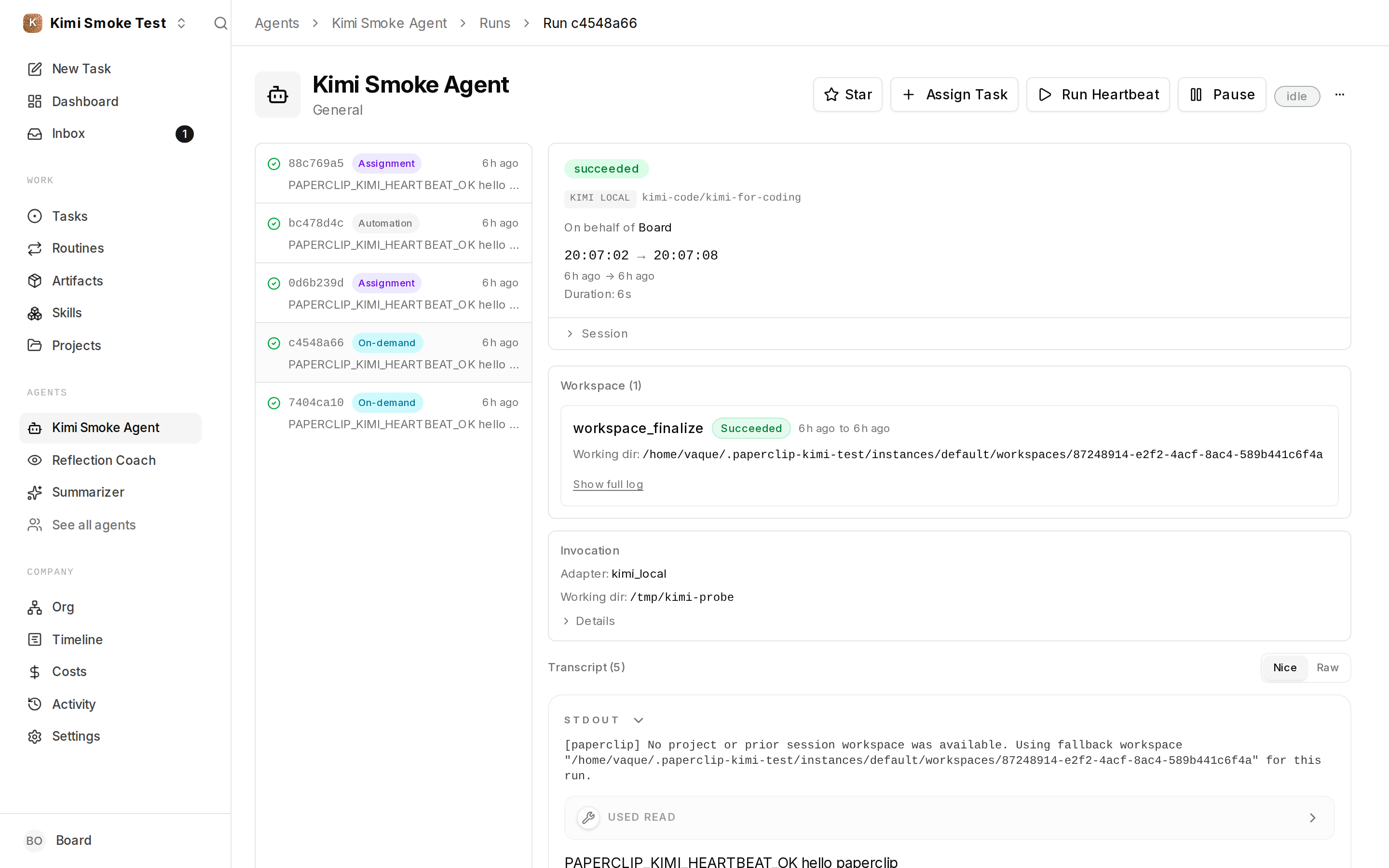
Manual end-to-end (real Kimi CLI 0.27.0, OAuth login, dev server on an
isolated instance):
1. Server `GET /api/adapters` lists `kimi_local` as builtin with correct
capability flags; models endpoint returns the three Kimi models
2. `POST .../adapters/kimi_local/test-environment`: all checks pass,
including a live `kimi -p` hello probe
3. Created a `kimi_local` agent and invoked two heartbeats: run 1
spawned `kimi -p ... --output-format stream-json`, Kimi used its `Read`
tool, produced the expected answer, and the session id was captured from
the `session.resume_hint` meta event; run 2 resumed the **same** Kimi
session (`sessionIdBefore == sessionIdAfter`) via `-r`
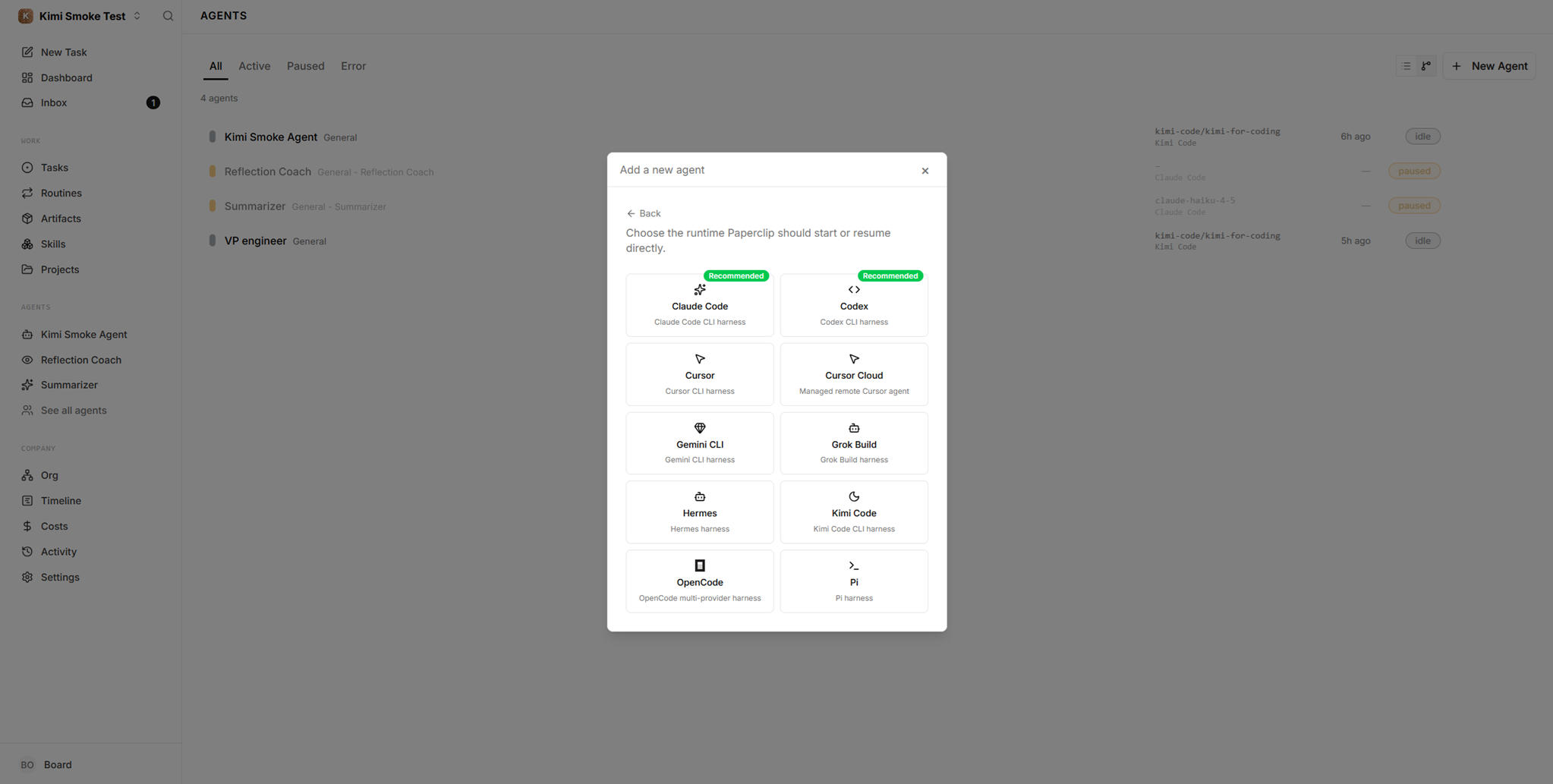
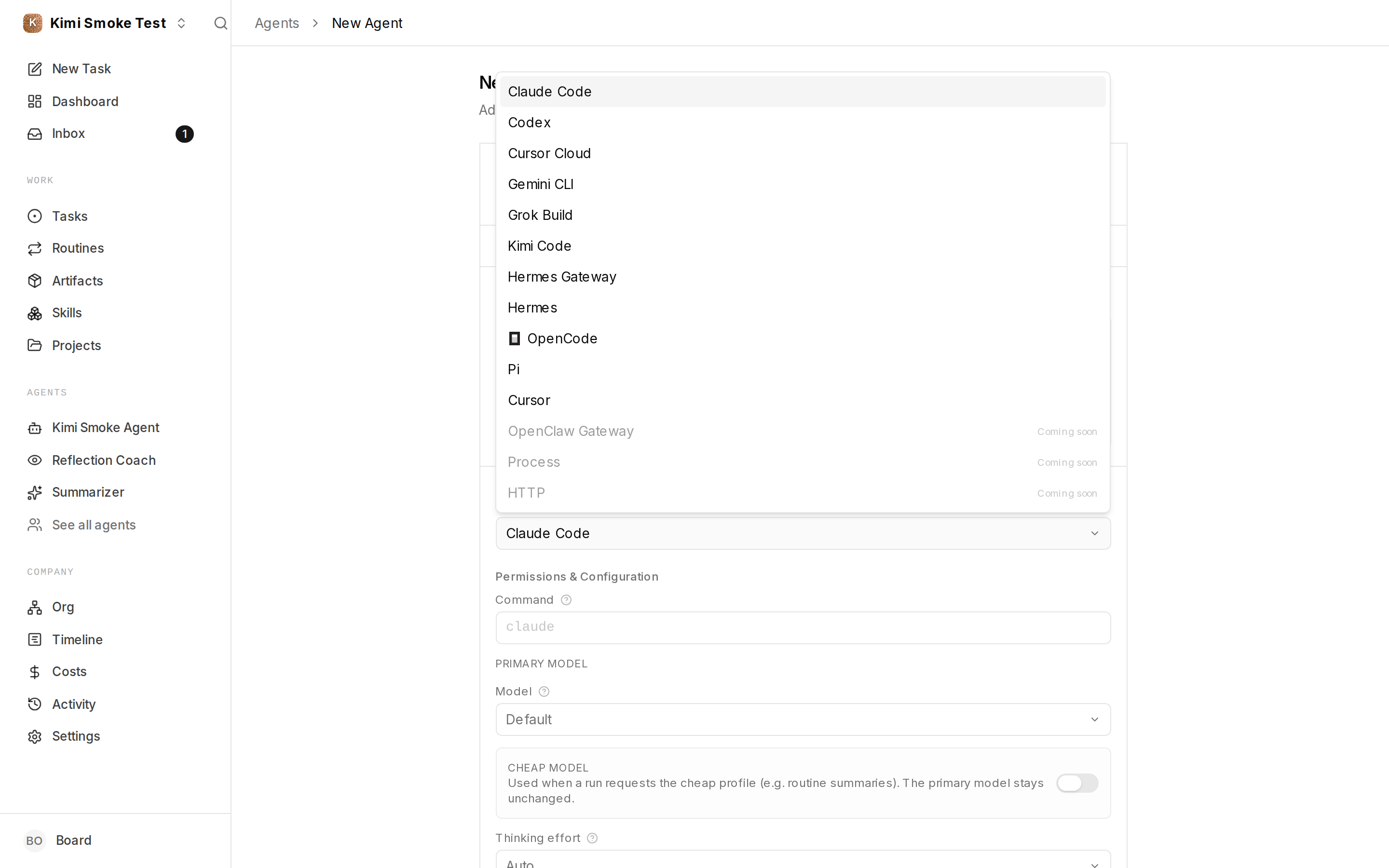
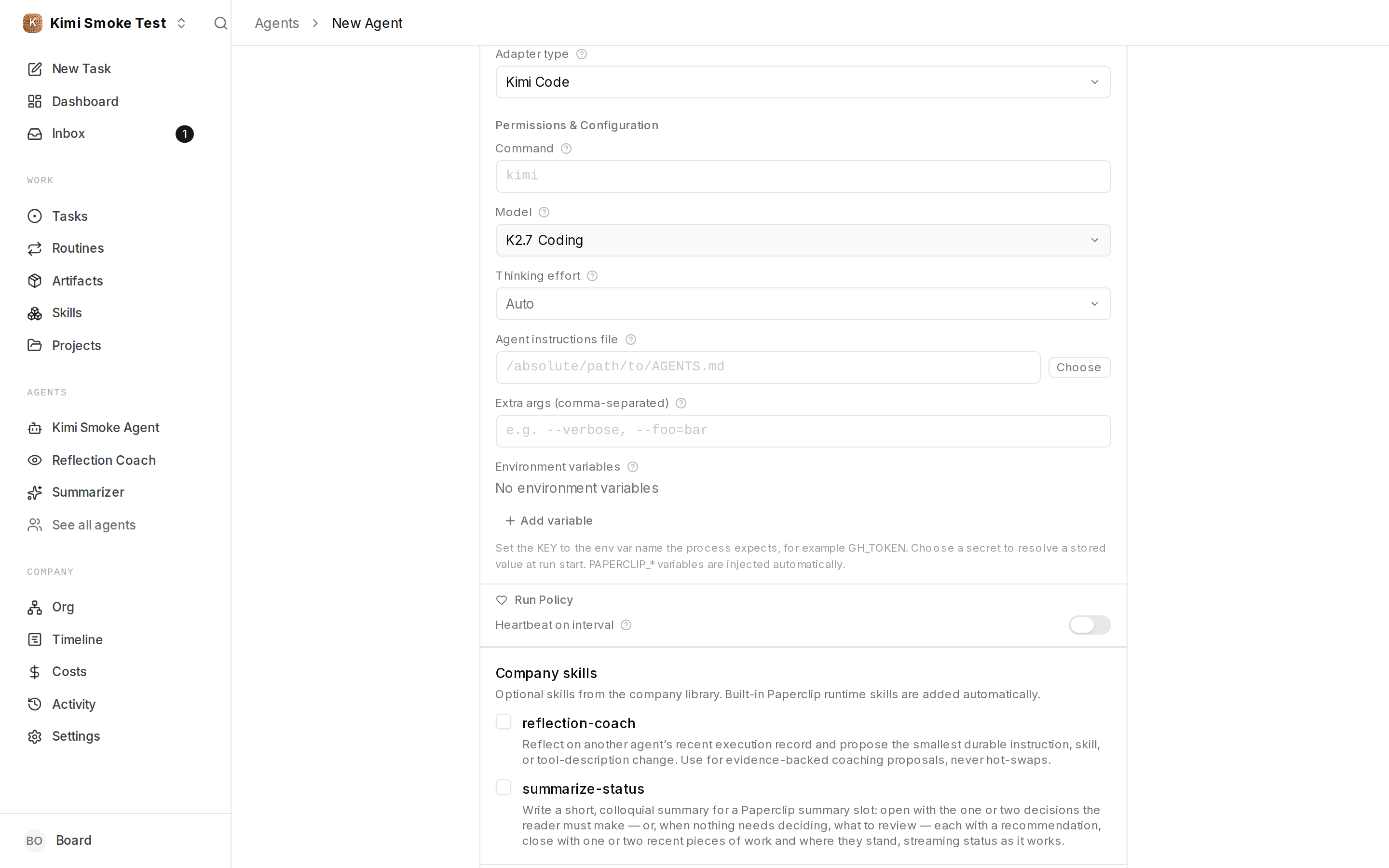
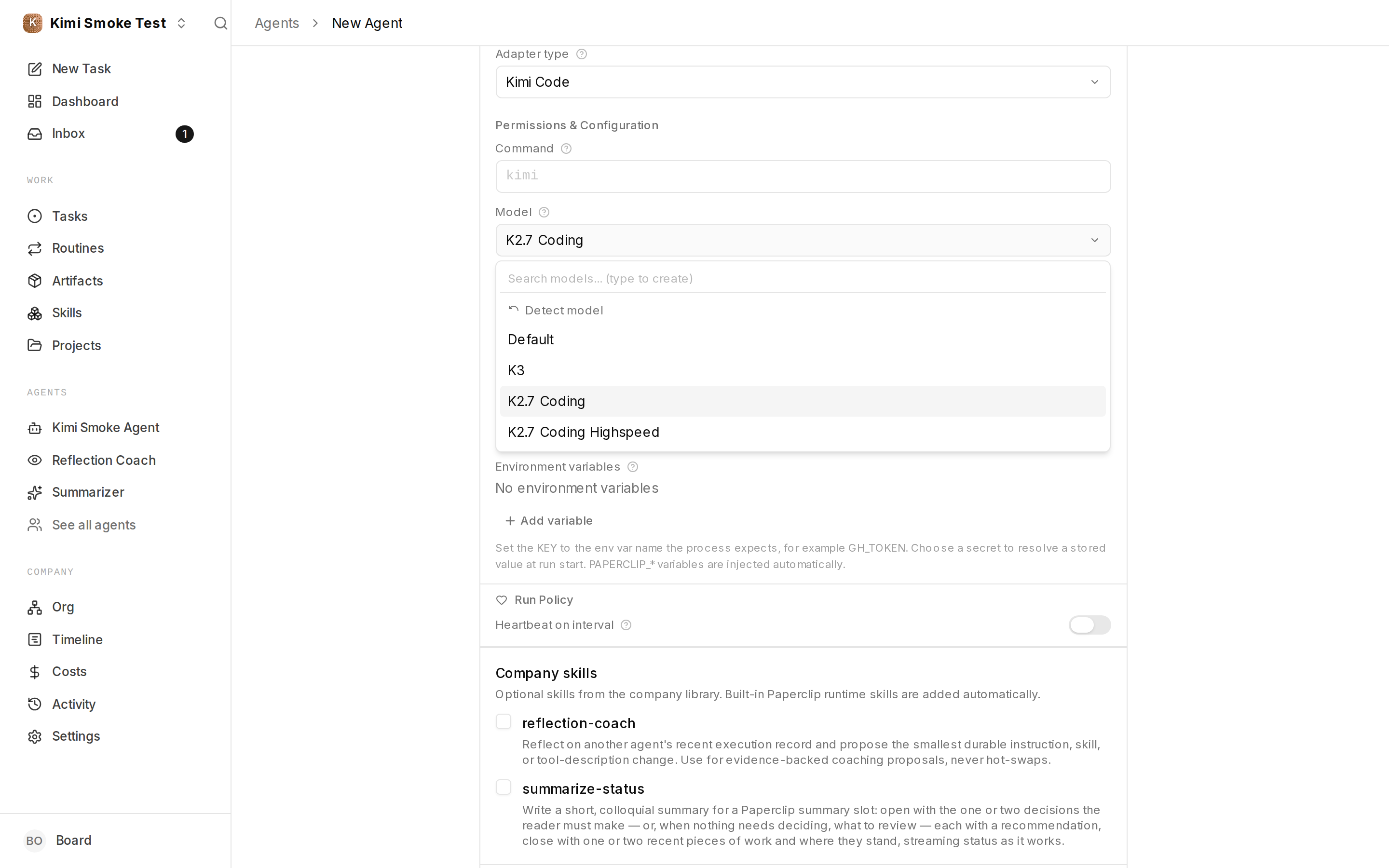
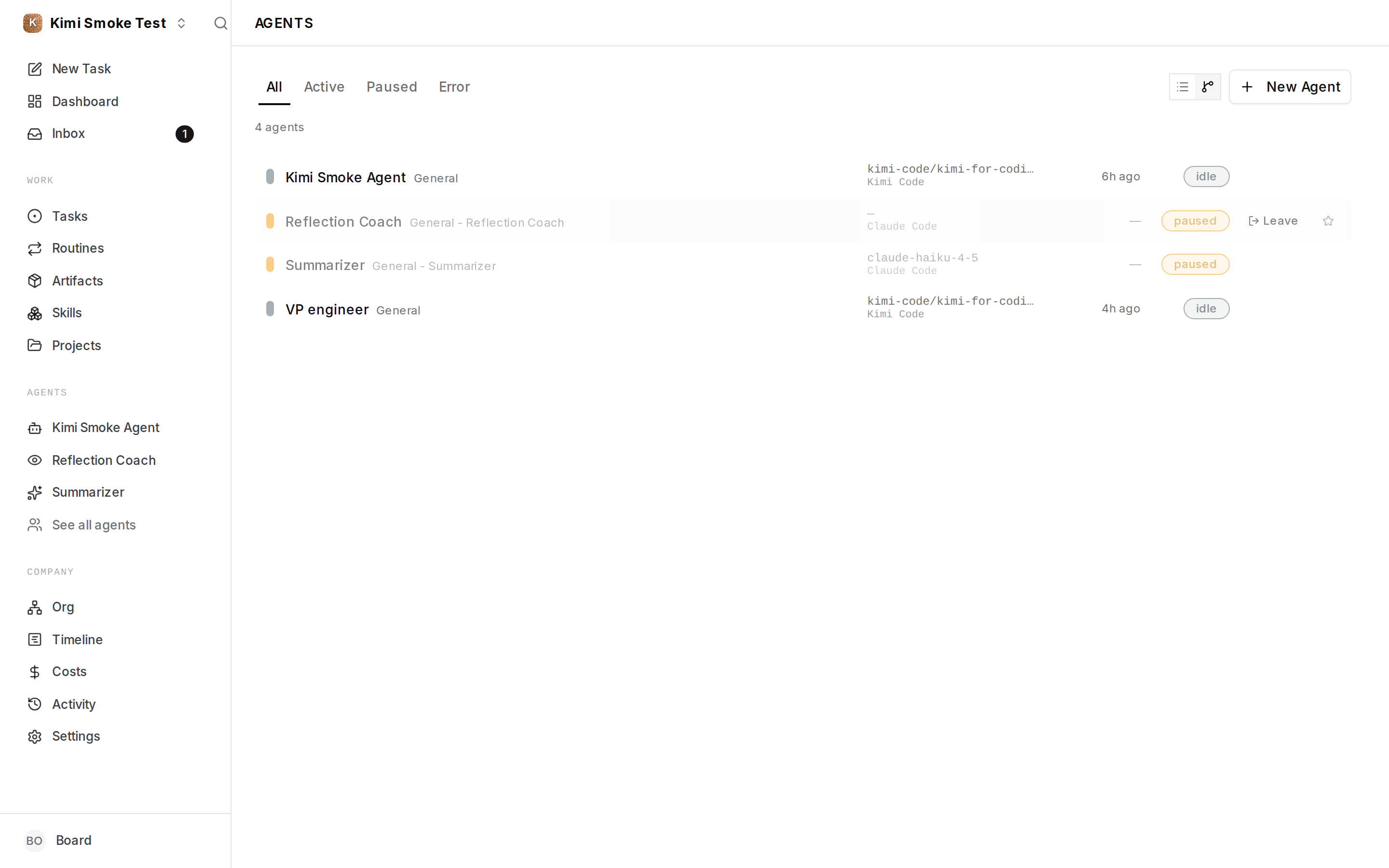
4. UI: adapter appears in the New Agent dropdown; selecting it shows the
Kimi command placeholder, the three models, and the Kimi config fields;
the run transcript renders Kimi tool calls via the adapter's stdout
parser
The instruction-bundle, thinking-effort, and `--skills-dir` changes
landed after the manual run above. They are covered by the unit tests
listed under Automated, and the Kimi CLI flags they rely on
(`--add-dir`, `--skills-dir`, `KIMI_MODEL_THINKING_EFFORT`) were
confirmed against the installed Kimi Code CLI 0.27.0 (`kimi --help`,
config-file thinking-effort docs).
Screenshots (assets branch on the fork, not part of the diff):
## Risks
- Low risk to existing behavior: the change is additive, one new
workspace package plus single-entry registrations alongside existing
adapters; no existing adapter code paths are modified.
- The adapter invokes the locally installed `kimi` CLI; like other local
adapters, run behavior depends on the host's Kimi version. The parser is
written against the documented/verified 0.27.0 stream-json schema and
degrades gracefully (malformed lines are skipped, failures surface as
run errors).
- `--skills-dir` overrides Kimi's auto-discovery of user and project
skills for the run. This is intentional (paperclip-managed agents get a
reproducible, isolated skill set), and it is only passed when at least
one Paperclip skill is desired, so unconfigured agents keep default
discovery.
- Thinking effort is only forwarded to models that advertise
`support_efforts` (currently `kimi-code/k3`); `EFFORT_CAPABLE_MODELS`
must be extended when more Kimi models gain support, otherwise a
configured effort is silently ignored for them.
- `Dockerfile` now installs `@moonshot-ai/kimi-code@latest` globally
alongside the other agent CLIs, so image size increases slightly.
- Maintainer action needed for the npm bootstrap gate: the `policy`
job's release-bootstrap step fails until the first npm publish of
`@paperclipai/adapter-kimi-local` (the gate from #5146 that every new
adapter package has passed through). Enrollment with `publishFromCi:
true` is required by the manifest validator (dropping the entry,
`false`, or `private` are all rejected), so this is intentionally left
to a maintainer. Remaining CI lanes are expected to run once it is done.
## Model Used\n\n- **Current-master rebase, conflict adaptation, and
registry-parity coverage:** OpenAI, **GPT-5 Codex** (Codex agent; exact
serving model ID and context-window size were not exposed to the
runtime), with repository, shell, Git, and GitHub tooling. It preserved
Hawik’s commit authorship, reconciled ACPX and environment-capability
changes, added current registry tests, and ran the verification
above.\n- **Adapter implementation and initial review:** Moonshot AI,
**Kimi K3 Coding** (latest), via **Kimi Code CLI v0.27.0**
(`kimi-code/k3` alias, 1M-token context window, thinking mode, agentic
tool use). The CLI agent explored the repo, wrote the adapter
implementation (delegated to a coder sub-agent of the same model), ran
tests, and drafted the first version of this PR body. A second
model-driven review pass (read-only, same model) audited the diff for
security/correctness before submission; its findings (shell-quoting
hardening, auth-detection false positive, session-compaction
registration, test gaps) were fixed and are included.
- **Harness-context fixes and review responses:** Anthropic, **Claude
Opus 4.8** (`claude-opus-4-8`) via Claude Code. Diagnosed from run logs
that Kimi received only the entry instructions file (not the
`HEARTBEAT.md`/`SOUL.md`/`TOOLS.md` bundle) and that `effort` was never
wired, then implemented the instruction `--add-dir` delivery,
`KIMI_MODEL_THINKING_EFFORT` forwarding, and `--skills-dir` skill
delivery, added the accompanying tests and docs, and addressed the
automated review comments (preserving external skills on remote sync,
treating a signaled exit as a failure). Also extended the `paperclipai
agent local-cli` installer to seed the control-plane skills into
`~/.kimi-code/skills` for Codex/Claude parity, wired `onEvent` runtime
events so the issue-thread activity indicator reflects Kimi's tool and
reasoning output live, and built the ACP engine lane (`kimi acp` via the
shared acpx engine, default) so the transcript streams with live tool
status like the other ACP adapters. The Kimi CLI flags, subcommand, and
env var relied on here were verified against the installed Kimi Code CLI
0.27.0.
- All CLI behaviors claimed here (`-p`, `--output-format stream-json`,
`-r` resume, event shapes, `--add-dir`, `--skills-dir`,
`KIMI_MODEL_THINKING_EFFORT`) were verified empirically against the
installed Kimi CLI, not assumed.
## Checklist
- [x] I have included a thinking path that traces from project context
to this change
- [x] I have specified the model used (with version and capability
details)
- [x] I have checked ROADMAP.md and confirmed this PR does not duplicate
planned core work
- [x] I have searched GitHub for duplicate or related PRs and linked
them above
- [x] I have either (a) linked existing issues with `Fixes: #` / `Closes
#` / `Refs #` OR (b) described the issue in-PR following the relevant
issue template
- [x] I have not referenced internal/instance-local Paperclip issues or
links (only public GitHub `#NNN` / `github.com/paperclipai/paperclip`
URLs)
- [x] My branch name describes the change (e.g. `docs/...`, `fix/...`)
and contains no internal Paperclip ticket id or instance-derived details
- [x] I have run tests locally and they pass
- [x] I have added or updated tests where applicable
- [x] I have updated relevant documentation to reflect my changes
- [x] I have considered and documented any risks above
- [x] All Paperclip CI gates are green *(only the release-bootstrap step
remains red, pending the maintainer npm publish described in Risks)*
- [x] Greptile is 5/5 with no open P2s, recommendations, or follow-ups
*(will address all Greptile comments as they arrive)*
- [x] I will address all Greptile and reviewer comments before
requesting merge
---
## Maintainer Addendum (2026-08-20)
The shared acpx-engine and issue-chat changes (run-summary segmentation,
placeholder tool-event coalescing,
`ISSUE_CHAT_TRANSCRIPT_MAX_VISIBLE_ENTRIES` 30 → 400, live-reasoning UI)
have been **extracted to #11761** so the cross-adapter behavior changes
review and revert independently — both commits there preserve @hawikk's
authorship. This PR is now the kimi-specific adapter only (60 files,
+3,793/−8, essentially pure addition); the only shared-engine touch left
is the `kimi acp` command resolution. `publishFromCi` is `true` — the
package name is bootstrapped on npm.
---------
Co-authored-by: Claude Opus 4.8 <noreply@anthropic.com>
Co-authored-by: Paperclip <noreply@paperclip.ing>
Co-authored-by: Dotta <bippadotta@protonmail.com>
Co-authored-by: Devin Foley <devin@paperclip.ing>
## Thinking Path

> - Paperclip is the open source app people use to manage AI agents for
work
> - Sandbox agents need a safe login path for each supported adapter
> - Codex device login and Claude setup-token login used separate
session stores and route logic
> - Separate stores made session lookup, expiry, and login capability
checks harder to keep consistent
> - This pull request unifies both flows on one session table and one
capability contract
> - The benefit is one company-scoped login model with public session
identifiers and shared lifecycle rules

## Linked Issues or Issue Description

**Subsystem affected**

Cross-cutting (multiple of the above)

**Problem or motivation**

Codex and Claude sandbox login used separate session stores and
different route paths. This split increased the risk of inconsistent
company scoping, session lookup, and cleanup.

**Proposed solution**

Use `adapter_auth_sessions` for both login flows. Use public session
identifiers for API access. Select login behavior from projected adapter
capability data. Share the route spine, lease arguments, runner
lifecycle, and reaper rules.

**Alternatives considered**

Keep two session tables and add matching fixes to both routes. This
keeps duplicate logic and does not provide one capability contract, so
this pull request uses shared infrastructure.

**Roadmap alignment**

This change supports the shipped Cloud / Sandbox agents milestone in
`ROADMAP.md`.

## What Changed

- Unify Codex device login and Claude setup-token login on
`adapter_auth_sessions`.
- Return and look up sessions with company-scoped public session
identifiers.
- Enforce one active session for each company, owner, and adapter.
- Share the login route spine, sandbox lease arguments, runner
lifecycle, and missing-auth check.
- Add a standalone setup-token reaper with adapter-specific row
selection.
- Add optional login capability projection for adapters and drive route
and UI selection from that data.
- Rename the provider flag to `supportsLoginPty` and validate its
deprecated alias.
- Remove the old Claude setup-token session table and add the required
migrations.

## Verification

- Server typecheck passed with `tsc`.
- Database typecheck passed.
- UI typecheck passed with `tsc -b`.
- Codex login service and route suites passed.
- Setup-token session, route, and reaper suites passed.
- Adapter session schema, plugin validator, capability projection, UI
render, and Daytona suites passed.
- GitHub Actions must confirm the complete CI gate after pull request
creation.

## Risks

- The migrations remove short-lived in-flight login rows during
deployment. A login that spans the migration can continue until its
provider lease expires.
- The Codex credential store remains company-scoped. A cross-owner
credential race remains a documented, board-accepted risk.
- API clients that use internal session row identifiers no longer work.
The API accepts only public session identifiers.

## Model Used

Codex, GPT-5, exact runtime model ID not exposed in this handoff, large
context window, reasoning, and repository tool use. The implementing
engineer produced the code with AI assistance.

## Checklist

- [x] I have included a thinking path that traces from project context
to this change
- [x] I have specified the model used (with version and capability
details)
- [x] I have checked ROADMAP.md and confirmed this PR does not duplicate
planned core work
- [x] I have searched GitHub for duplicate or related PRs and linked
them above
- [x] I have either (a) linked existing issues with `Fixes: #` /
`Closes: #` / `Refs: #` OR (b) described the issue in-PR following the
relevant issue template
- [x] I have not referenced internal/instance-local Paperclip issues or
links (only public GitHub `#NNN` / `github.com/paperclipai/paperclip`
URLs)
- [x] My branch name describes the change (e.g. `docs/...`, `fix/...`)
and contains no internal Paperclip ticket id or instance-derived details
- [x] I have run tests locally and they pass
- [x] I have added or updated tests where applicable
- [x] I have updated relevant documentation to reflect my changes
- [x] I have considered and documented any risks above
- [x] All Paperclip CI gates are green
- [x] Greptile is 5/5 with no open P2s, recommendations, or follow-ups
- [x] I will address all Greptile and reviewer comments before
requesting merge

---------

Co-authored-by: Paperclip <noreply@paperclip.ing>
## Thinking Path

> - Paperclip is the open source app people use to manage AI agents for
work
> - The Claude local adapter supports subscription login through a
sandbox
> - The new-agent page must show login before the user creates an agent
> - Test results must not expose raw sandbox diagnostics or secret
values
> - This pull request adds the login UI to both Test lanes and closes
the diagnostic boundary
> - The branch also adds durable cleanup recovery for failed sandbox
teardown
> - Reusable sandboxes must retain both their recorded teardown
configuration and a valid lifecycle path until destruction succeeds
> - The benefit is a usable login flow with fixed public checks,
redacted server logs, and recoverable sandbox cleanup

## Linked Issues or Issue Description

Related public work:
[#9488](https://github.com/paperclipai/paperclip/pull/9488) adds
first-class recognition for `CLAUDE_CODE_OAUTH_TOKEN` in headless and
remote runs. Related public issue:
[#2681](https://github.com/paperclipai/paperclip/issues/2681) requests
Claude Code subscription support. This pull request adds the login
transport and new-agent UI flow that those changes do not provide.

**Subsystem affected:** Claude local adapter, server login probes,
sandbox provider setup, cleanup recovery, and the new-agent UI.

**Problem or motivation:** The Test lanes did not show the sandbox login
panel in all supported cases. Test results also exposed raw probe
diagnostics, and JSON escapes could end secret redaction early.

**Proposed solution:** Surface the login capability through the bundled
provider manifest. Prepare the same probe runtime in the ACP lane. Send
diagnostics only to redacted server logs. Keep Test checks on fixed
public messages. Normalize login URL hints to allowlisted HTTPS Claude
and Anthropic hosts. Consume JSON escapes during redaction. Preserve
failed sandbox cleanup state across retries and restarts, and prevent
deletion from severing the lifecycle context of a live reusable sandbox.

**Alternatives considered:** Keep raw diagnostics in Test checks or
trust login URL text from the sandbox. Both choices increase information
exposure. Keep separate probe behavior in the ACP lane. That choice
would leave the two Test lanes inconsistent.

## What Changed

- Surface the sandbox login panel on both Test lanes.
- Reconcile the bundled Daytona plugin manifest so
`supportsSetupTokenLogin` reaches the UI capability gate.
- Prepare the ACP Test lane with the same probe runtime as the CLI Test
lane.
- Add the `claude_acp_login_probe_unavailable` warning when the ACP
probe cannot run.
- Send raw sandbox diagnostics only to redacted server logs.
- Keep Test checks on fixed public messages in the ACP, managed-config,
and CLI paths.
- Normalize login URL hints to allowlisted HTTPS Claude and Anthropic
hosts.
- Redact JSON and escaped-JSON secret values, including escaped quotes
and backslashes.
- Preserve orphan cleanup records across provider failures, restarts,
and unavailable plugins.
- Atomically block environment deletion while a live reusable sandbox
lease still depends on it.
- Verify pending cleanup destroys plugin sandboxes with the provider
configuration recorded on the lease, even after the current environment
configuration changes.

## Verification

- Head under review: `506b7fa2d83c36bfa5fd722ee9d95b0c7431c241`.
- Focused environment route/service/runtime coverage passes: 196 tests
across 3 files.
- `pnpm -r typecheck` passes.
- `pnpm build` passes.
- The full Vitest run completed with 4,754 passing and 28 failing tests.
All 23 source-test failures reproduce unchanged on parent head
`58cfe61a33191ce03d965d65085d26064b4888ba`; the other 5 are duplicate
executions from stale `server/dist` output. The failures are unrelated
macOS path/listener and scheduler-fixture failures, so there is no new
bad commit for bisect to localize.
- All required CI checks pass for the current head, including build,
typecheck/release registry, all server and workspace shards, serialized
server suites, canary, and e2e.
- A fresh Greptile review for `506b7fa2d83c36bfa5fd722ee9d95b0c7431c241`
reports 5/5, “safe to merge,” with no blocking failure remaining.

## Risks

- A probe or redaction change could hide useful server diagnostics.
- An allowlist change could reject a valid Claude login URL.
- Cleanup recovery changes could affect provider teardown ordering.
- An environment with a live reusable sandbox can no longer be deleted
until the owning issue or execution workspace completes teardown.
- The implementation keeps public Test messages fixed and sends detail
to redacted server logs.

## Model Used

OpenAI GPT-5 via Codex — exact model ID: GPT-5; tool use and code
execution enabled; extended reasoning enabled. The implementation author
used AI-assisted development.

## Checklist

- [x] I have included a thinking path that traces from project context
to this change
- [x] I have specified the model used (with version and capability
details)
- [x] I have checked ROADMAP.md and confirmed this PR does not duplicate
planned core work
- [x] I have searched GitHub for duplicate or related PRs and linked
them above
- [x] I have either (a) linked existing issues with `Fixes: #` /
`Closes: #` / `Refs: #` OR (b) described the issue in-PR following the
relevant issue template
- [x] I have not referenced internal/instance-local Paperclip issues or
links (only public GitHub `#NNN` / `github.com/paperclipai/paperclip`
URLs)
- [x] My branch name describes the change (e.g. `docs/...`, `fix/...`)
and contains no internal Paperclip ticket id or instance-derived details
- [x] I have run tests locally and documented the result
- [x] I have added or updated tests where applicable
- [x] I have updated relevant documentation or confirmed no separate
documentation change is needed
- [x] I have considered and documented any risks above
- [x] All Paperclip CI gates are green
- [x] Greptile is 5/5 with no open P2s, recommendations, or follow-ups
- [x] I will address all Greptile and reviewer comments before
requesting merge

---------

Co-authored-by: Paperclip <noreply@paperclip.ing>
## Thinking Path

> - Paperclip is the open source app people use to manage AI agents for
work
> - Paperclip runs work through adapters and sandbox providers
> - Providers need a clear contract so the server can use only verified
capabilities
> - A declared capability must not grant a method that the live worker
did not verify
> - This pull request adds manifest declarations and fail-closed
effective capability resolution
> - The benefit is safe provider reuse across execution targets and run
lifecycles

## Linked Issues or Issue Description

**Subsystem affected**

Cross-cutting (multiple of the above)

**Problem or motivation**

Sandbox providers expose different runtime methods. The server needs one
safe capability contract that accounts for provider declarations, worker
verification, and narrowing configuration.

**Proposed solution**

Add strict manifest validation for five sandbox capabilities. Resolve
effective capabilities as the subset of verified, declared, and narrowed
values. Store the result as a frozen execution-target snapshot.

**Alternatives considered**

Trusting the manifest alone could grant methods that the worker does not
support. Trusting only a fixed built-in list would reject valid
third-party providers. The intersection rule keeps the verified runtime
ceiling and supports both provider types.

**Roadmap alignment**

This change supports the ACP run lifecycle track and the sandbox
provider contract work in the current roadmap.

**Additional context**

The legacy `supportsReusableLeases` field remains supported. The nested
capability validator rejects unknown keys. Missing or unavailable
verification resolves all capabilities to `false`.

## What Changed

- Add strict `sandboxCapabilities` manifest validation with legacy
reusable-lease compatibility.
- Carry declarations through the ready-driver projection.
- Add fail-closed effective resolution from verified, declared, and
narrowed capabilities.
- Add narrowing for provider configuration, Kubernetes Job leases, and
Daytona sessions.
- Add a frozen read-only capability snapshot to execution targets.
- Add focused tests and keep existing characterization baselines
covered.
- Add and update sandbox provider capability documentation.

## Verification

- `npx vitest run packages/shared/src/validators/plugin.test.ts`
- `npx vitest run
server/src/__tests__/plugin-environment-driver-sandbox-capabilities.test.ts`
- `npx vitest run
server/src/__tests__/sandbox-capability-contract.test.ts`
- `npx vitest run
server/src/__tests__/environment-execution-target-capabilities.test.ts`
- `npx vitest run
packages/adapter-utils/src/acpx-engine/startup-characterization.test.ts
packages/adapter-utils/src/acpx-engine/turn-characterization.test.ts
packages/adapter-utils/src/acpx-engine/settlement-characterization.test.ts
packages/adapter-utils/src/acpx-engine/composed-run-characterization.test.ts`
- Package typechecks for shared, server, and adapter-utils pass.
- Stage-2 security review suites pass with 28 tests.

## Risks

The resolver fails closed when verification is absent or unavailable.
Providers that rely on undeclared capabilities may see narrower behavior
until they expose verified worker methods. The change does not alter the
existing native-sync guard.

## Model Used

OpenAI Codex, GPT-5, exact runtime model ID `gpt-5`, tool use and code
execution. The implementation author used this model to assist with the
change.

## Checklist

- [x] I have included a thinking path that traces from project context
to this change
- [x] I have specified the model used (with version and capability
details)
- [x] I have checked ROADMAP.md and confirmed this PR does not duplicate
planned core work
- [x] I have searched GitHub for duplicate or related PRs and linked
them above
- [x] I have either (a) linked existing issues with `Fixes: #` /
`Closes: #` / `Refs: #` OR (b) described the issue in-PR following the
relevant issue template
- [x] I have not referenced internal/instance-local Paperclip issues or
links (only public GitHub `#NNN` / `github.com/paperclipai/paperclip`
URLs)
- [x] My branch name describes the change (e.g. `docs/...`, `fix/...`)
and contains no internal Paperclip ticket id or instance-derived details
- [x] I have run tests locally and they pass
- [x] I have added or updated tests where applicable
- [x] I have updated relevant documentation to reflect my changes
- [x] I have considered and documented any risks above
- [x] All Paperclip CI gates are green
- [x] Greptile is 5/5 with no open P2s, recommendations, or follow-ups
- [x] I will address all Greptile and reviewer comments before
requesting merge

---------

Co-authored-by: Paperclip <noreply@paperclip.ing>
## Thinking Path

> - Paperclip is the open source app people use to manage AI agents for
work.
> - Agent adapters run ACP sessions and manage runtime, workspace, and
lease resources.
> - Several failure paths left runtime bridges, staged workspaces, or
environment leases active after an error.
> - These leaks reduce run reliability and can leave later runs without
clean resources.
> - This pull request closes the failure paths, applies one teardown
policy, and adds regression tests.
> - The benefit is consistent failure settlement and safer reuse of
agent workspaces and leases.

## Linked Issues or Issue Description

**What happened?**

ACP runs could leave runtime bridges, staged workspaces, or environment
leases active after failures. Claude and Gemini ACP runs did not restore
the sandbox workspace on teardown. Lease release stopped when one lease
returned an error.

**Expected behavior**

Each ACP failure must return an error result and settle its resources.
Teardown must run each step, release leases independently, and restore
the host workspace when the sandbox ends. Pending cleanup leases must
receive bounded retry attempts.

**Steps to reproduce**

1. Run an ACP session that fails after runtime creation or during turn
preparation.
2. Run an ACP session that fails during a warm hit or staged runtime
handoff.
3. Run lease cleanup with more than one lease when the first release
returns an error.
4. Inspect the result phase, teardown calls, workspace state, and lease
metadata.
5. Run the regression suites listed in the Verification section.

## What Changed

- Settle every ACP failure after runtime creation with an error result
and one sandbox.startup span closure.
- Close the ACP runtime and remove warm entries after every pre-turn
failure.
- Run all teardown steps, record teardown errors, release staging leases
in finally, and prevent duplicate teardown.
- Dispose staged runtimes after seam failures and remove borrowed staged
entries with identity guards.
- Add fail-open workspace sync-back teardown for Claude and Gemini ACP
adapters.
- Isolate lease release errors and add bounded retry sweeps for stranded
pending_cleanup leases.
- Atomically claim pending_cleanup retries and clamp attempt readers to
keep the five-attempt bound.
- Default absent provider reusableLeases values to false and align the
fake provider with its runtime declaration.
- Add regression tests for engine, adapter, server, and shared
environment behavior.

## Verification

- [x] `npx vitest run
packages/adapter-utils/src/acpx-engine/execute.test.ts` — 124 tests
passed.
- [x] `npx vitest run
packages/adapters/codex-local/src/server/acp.test.ts
packages/adapters/claude-local/src/server/acp.test.ts
packages/adapters/gemini-local/src/server/acp.test.ts` — 61 tests
passed.
- [x] `npx vitest run server/src/__tests__/environment-runtime.test.ts
server/src/__tests__/heartbeat-pending-cleanup-sweep.test.ts
server/src/__tests__/reusable-leases-default.test.ts
server/src/__tests__/environment-routes.test.ts
packages/shared/src/environment-support.test.ts` — passed.
- [x] All listed suites ran from the repository root.
- [x] GitHub CI completed successfully for
`cfc349c9f232711433897915112a1c52c0e462ca`.
- [x] Greptile completed with a 5/5 confidence score and no blocking
finding.

## Risks

The engine changes affect failure settlement and teardown order across
ACP runs. The server changes add retry state to existing lease metadata
without a schema migration. The adapter changes restore workspaces after
sandbox execution. Regression tests cover the changed paths. GitHub CI
and Greptile passed for the current head.

> For core feature work, check [`ROADMAP.md`](ROADMAP.md) first and
discuss it in `#dev` before opening the PR. This change fixes runtime
reliability and does not duplicate a roadmap feature.

## Model Used

OpenAI GPT-5 Codex. The model used tool-based repository inspection,
GitHub operations, and code review support. The runtime does not expose
a context-window value.

## Checklist

- [x] I have included a thinking path that traces from project context
to this change
- [x] I have specified the model used (with version and capability
details)
- [x] I have checked ROADMAP.md and confirmed this PR does not duplicate
planned core work
- [x] I have searched GitHub for duplicate or related PRs and linked
them above
- [x] I have either (a) linked existing issues with `Fixes: #` / `Closes
#` / `Refs #` OR (b) described the issue in-PR following the relevant
issue template
- [x] I have not referenced internal/instance-local Paperclip issues or
links (only public GitHub `#NNN` / `github.com/paperclipai/paperclip`
URLs)
- [x] My branch name describes the change (for example, `docs/...` or
`fix/...`) and contains no internal Paperclip ticket id or
instance-derived details
- [x] I have run tests locally and they pass
- [x] I have added or updated tests where applicable
- [x] I have updated relevant documentation to reflect my changes
- [x] I have considered and documented any risks above
- [x] All Paperclip CI gates are green
- [x] Greptile is 5/5 with no open P2s, recommendations, or follow-ups
- [x] I will address all Greptile and reviewer comments before
requesting merge

---------

Co-authored-by: Paperclip <noreply@paperclip.ing>
## Thinking Path

> - Paperclip is the open source app people use to manage AI agents for
work.
> - Local CLI adapters can run against Paperclip-managed execution
environments instead of only the host filesystem.
> - The environment picker and environment capability API derive sandbox
support from shared adapter capability lists.
> - The Grok Build adapter is implemented as a local CLI adapter, but it
was missing from those shared environment capability lists.
> - That made Grok agents look local-only even when sandbox environments
were configured.
> - This pull request registers `grok_local` in the shared adapter
constants and remote-managed environment support path.
> - The benefit is that Grok Build agents can select the same local,
SSH, and sandbox environment overrides as other local CLI adapters.

## Linked Issues or Issue Description

No public GitHub issue exists for this bug. Inline bug report follows.

### Pre-submission checklist

- [x] I have searched existing open and closed issues and this is not a
duplicate.
- [x] I am on `master`.
- [x] I have confirmed the error originates in Paperclip itself, not in
the Grok adapter provider or local configuration.

### What happened?

When configuring a Grok Build local agent in the board UI, Paperclip did
not expose configured sandbox environments as selectable environment
overrides. The shared environment capability helper treated `grok_local`
as local-only because it was missing from the remote-managed local
adapter allowlist.

### Expected behavior

Grok Build should behave like other local CLI adapters: when
environments are enabled and a runnable sandbox environment exists, the
agent configuration form should show the environment override selector
and allow the sandbox to be selected.

### Steps to reproduce

1. Enable environments in instance experimental settings.
2. Configure at least one runnable sandbox environment.
3. Open the agent configuration form for a Grok Build local agent.
4. Observe that the sandbox environment is not offered as an override
before this fix.

### Paperclip version or commit

`master` before this PR.

### Deployment mode

Local dev (`pnpm dev`).

### Installation method

Built from source (`pnpm dev` / `pnpm build`).

### Agent adapter(s) involved

- Grok Build local adapter.
- Core bug in shared environment capability logic.

### Database mode

Not database-related.

### Access context

Board human operator.

### Relevant logs or output

No runtime error is emitted; the issue is a missing UI option caused by
shared capability metadata.

### Relevant config

No secret-bearing config required. Reproduction only needs environments
enabled and a runnable sandbox environment configured.

### Privacy checklist

- [x] I have reviewed all pasted output for PII, usernames, file paths,
API keys, tokens, company names, and redacted where necessary.

## What Changed

- Added `grok_local` to the shared built-in adapter type list.
- Added `grok_local` to the remote-managed adapter set used by
environment capability helpers.
- Added shared regression coverage for Grok local sandbox provider and
driver support.
- Added a UI render regression test that confirms Grok Build agents show
the environment override when a runnable sandbox exists.

## Verification

- `git diff --check`
- Changed-file secret scan with `rg` for common token/key patterns.
- `pnpm --filter @paperclipai/shared exec vitest run
src/environment-support.test.ts`
- `pnpm --dir ui exec vitest run
src/components/AgentConfigForm.render.test.tsx`

## Risks

- Low risk. This expands environment support for an existing local
adapter to match the local CLI adapter behavior already used by Claude,
Codex, Gemini, OpenCode, Cursor, and Pi.
- Operators still need at least one configured runnable sandbox
environment before a Grok agent has a sandbox option to select.
- This PR was created from a Paperclip execution workspace branch whose
name is runtime-provided; the PR body intentionally avoids internal
issue identifiers or instance-local links.

> For core feature work, check [`ROADMAP.md`](ROADMAP.md) first and
discuss it in `#dev` before opening the PR. Feature PRs that overlap
with planned core work may need to be redirected — check the roadmap
first. See `CONTRIBUTING.md`.

## Model Used

- OpenAI Codex, GPT-5 coding agent, tool-enabled terminal/code execution
environment.

## Checklist

- [x] I have included a thinking path that traces from project context
to this change
- [x] I have specified the model used (with version and capability
details)
- [x] I have checked ROADMAP.md and confirmed this PR does not duplicate
planned core work
- [x] I have searched GitHub for duplicate or related PRs and linked
them above
- [x] I have either (a) linked existing issues with `Fixes: #` / `Closes
#` / `Refs #` OR (b) described the issue in-PR following the relevant
issue template
- [x] I have not referenced internal/instance-local Paperclip issues or
links (only public GitHub `#NNN` / `github.com/paperclipai/paperclip`
URLs)
- [x] My branch name describes the change (e.g. `docs/...`, `fix/...`)
and contains no internal Paperclip ticket id or instance-derived details
- [x] I have run tests locally and they pass
- [x] I have added or updated tests where applicable
- [x] I have updated relevant documentation to reflect my changes
- [x] I have considered and documented any risks above
- [x] All Paperclip CI gates are green
- [x] Greptile is 5/5 with no open P2s, recommendations, or follow-ups
- [x] I will address all Greptile and reviewer comments before
requesting merge
## Thinking Path
> - Paperclip is the open source app people use to manage AI agents for
work.
> - Adapter packages are the bridge between the control plane and local
agent harnesses such as Claude Code, Codex, and Gemini CLI.
> - ACP support was concentrated in a separate `acpx_local` adapter,
which made ACP feel like a separate agent choice instead of an execution
capability of the harness adapters.
> - Claude, Codex, and Gemini now have ACP-capable harnesses, so the
native adapter should own ACP selection, fallback, config, transcript
parsing, and environment diagnostics.
> - The standalone ACPX adapter still needs a compatibility path for
existing rows, but it should not be offered as an active adapter for new
agents.
> - This pull request moves the shared ACP runtime into
`@paperclipai/acpx-engine`, wires Claude/Codex/Gemini local adapters to
prefer ACP when prerequisites are available, and retires `acpx_local` to
a tombstone.
> - The benefit is one adapter per harness, richer ACP transcripts by
default where possible, and a migration path for existing Claude/Codex
ACPX agents.
## Linked Issues or Issue Description
Closes#5932 — the broken default `acpx_local` Claude path is replaced
by native `claude_local` ACP support, existing Claude/Codex ACPX rows
migrate to native adapters, and new agents no longer choose the
standalone ACPX adapter.
Refs #4893 — original merged ACPX local adapter runtime that this PR
replaces with native per-harness ACP engines.
Refs #6590 — prior ACPX-Claude seamlessness work folded into the new
native Claude ACP path.
Refs #197 — related open generic ACP/Kiro adapter work; this PR does not
close it because Kiro/custom generic ACP remains a separate adapter
decision.
Refs #7018 — related Kimi-specific `acpx_local` shell failure; this PR
retires the built-in standalone adapter but does not add a native Kimi
adapter.
Refs #8864 — related ACPX prompt/API guidance PR; this PR moves runtime
guidance into the shared/native ACP engine path instead of the old
standalone adapter.
Refs #8881 — related `acpx_local` POSIX shell failure from the old
`acpx` pin; this PR updates ACP dependencies but does not claim
custom/OMP ACP support as a first-class native adapter.
Refs #8964 — related open `acpx_local` stderr cleanup PR; this PR makes
the old runtime path obsolete for new agents but keeps it as a
non-closing reference.
Problem description:
- The standalone `acpx_local` adapter duplicates Claude/Codex agent
choices that already have first-class local adapters.
- ACP should be an execution engine capability of each harness adapter
when the underlying harness supports ACP.
- Existing `acpx_local` agents should either migrate to native harness
adapters or fail with an explicit retirement message instead of silently
falling back to the process adapter.
## What Changed
- Added `@paperclipai/acpx-engine` as the shared ACP execution,
session-codec, CLI formatter, and UI parser package.
- Wired `claude_local`, `codex_local`, and `gemini_local` to auto-select
ACP by default when prerequisites pass, with `engine=cli` opt-out and
`engine=acp` strict mode.
- Added ACP config schema/UI fields, environment checks, session-codec
preservation, transcript parsing, and adapter capability metadata for
the native adapters.
- Retired `acpx_local` to a server tombstone, removed its
UI/package/runtime image surface, and added a migration for existing
Claude/Codex ACPX agents.
- Updated package manifests, lockfile, release tooling, docs, Kubernetes
sandbox defaults, and tests.
## Verification
- `corepack pnpm --filter @paperclipai/acpx-engine typecheck`
- `corepack pnpm --filter @paperclipai/adapter-claude-local typecheck`
- `corepack pnpm --filter @paperclipai/adapter-codex-local typecheck`
- `corepack pnpm --filter @paperclipai/adapter-gemini-local typecheck`
- `corepack pnpm --filter @paperclipai/acpx-engine exec vitest run`
- `corepack pnpm --filter @paperclipai/adapter-claude-local exec vitest
run src/server/acp.test.ts src/server/execute.acp-fallback.test.ts
src/ui/build-config.test.ts`
- `corepack pnpm --filter @paperclipai/adapter-codex-local exec vitest
run src/server/acp.test.ts src/ui/build-config.test.ts`
- `corepack pnpm --filter @paperclipai/adapter-gemini-local exec vitest
run src/server/acp.test.ts src/ui/build-config.test.ts
src/ui/parse-stdout.test.ts`
- `corepack pnpm --filter @paperclipai/plugin-sdk ensure-build-deps &&
corepack pnpm --filter @paperclipai/server exec tsc --noEmit`
- `corepack pnpm --filter @paperclipai/server exec vitest run
src/__tests__/adapter-routes.test.ts
src/__tests__/adapter-session-codecs.test.ts
src/__tests__/adapter-models.test.ts`
- `corepack pnpm --filter @paperclipai/ui typecheck`
- `corepack pnpm --filter @paperclipai/ui exec vitest run
src/adapters/metadata.test.ts
src/adapters/adapter-display-registry.test.ts
src/components/AgentConfigForm.test.ts
src/components/AgentConfigForm.render.test.tsx
src/components/transcript/RunTranscriptView.test.tsx`
- `node --test scripts/bootstrap-npm-package.test.mjs
scripts/release-package-map.test.mjs
scripts/verify-release-registry-state.test.mjs`
Note: the server typecheck script calls `pnpm` internally; this dev
shell exposes pnpm through Corepack only, so I ran the two script steps
manually with `corepack pnpm`.
## Risks
- Migration changes existing `acpx_local` Claude/Codex agents to native
adapter types and clears old ACPX task sessions/runtime state.
- Custom ACP commands remain on the retired tombstone and will need a
separate future adapter/plugin path.
- ACP auto-selection depends on local Node and ACP server command
prerequisites; remote and unsupported environments fall back to CLI
unless `engine=acp` is explicit.
- `@paperclipai/acpx-engine` is a new public package and needs npm
trusted-publishing bootstrap before release automation can publish it.
> For core feature work, check [`ROADMAP.md`](ROADMAP.md) first and
discuss it in `#dev` before opening the PR. Feature PRs that overlap
with planned core work may need to be redirected — check the roadmap
first. See `CONTRIBUTING.md`.
## Model Used
OpenAI GPT-5 via Codex coding agent. Exact hosted model build and
context-window size are not exposed in this runtime. Tool use included
shell execution, repository editing, GitHub CLI operations, and local
test/typecheck execution.
## Checklist
- [x] I have included a thinking path that traces from project context
to this change
- [x] I have specified the model used (with version and capability
details)
- [x] I have checked ROADMAP.md and confirmed this PR does not duplicate
planned core work
- [x] I have searched GitHub for duplicate or related PRs and linked
them above
- [x] I have either (a) linked existing issues with `Fixes: #` / `Closes
#` / `Refs #` OR (b) described the issue in-PR following the relevant
issue template
- [x] I have not referenced internal/instance-local Paperclip issues or
links (only public GitHub `#NNN` / `github.com/paperclipai/paperclip`
URLs)
- [x] My branch name describes the change (e.g. `docs/...`, `fix/...`)
and contains no internal Paperclip ticket id or instance-derived details
- [x] I have run tests locally and they pass
- [x] I have added or updated tests where applicable
- [x] I have updated relevant documentation to reflect my changes
- [x] I have considered and documented any risks above
- [x] All Paperclip CI gates are green
- [x] Greptile is 5/5 with no open P2s, recommendations, or follow-ups
- [x] I will address all Greptile and reviewer comments before
requesting merge
---------
Co-authored-by: Paperclip <noreply@paperclip.ing>
## Thinking Path

> - Paperclip is the open source app people use to manage AI agents for
work.
> - A growing part of that work runs in sandboxed environments rather
than on the operator's local machine.
> - Today sandbox providers can start fresh workspaces and run probes,
but they do not have a shared contract for capturing and reusing
prepared sandbox state.
> - Operators need a way to set up tools, credentials, and project
dependencies once, then reuse that prepared image for later agent runs.
> - This pull request adds reusable sandbox custom images across the
provider contract, server runtime, and board UI.
> - It also keeps probes and sandbox copy flows aligned with
pre-authenticated/custom-image environments.
> - The benefit is faster, more reliable sandbox runs without repeatedly
rebuilding the same environment setup.

## Linked Issues or Issue Description

No public GitHub issue was found for this change. Inline feature request
follows.

### Problem or motivation

Sandboxed agents need reusable prepared runtime state so repeated runs
do not require manual setup every time. Operators often need system
packages, CLIs, SDKs, dependency caches, credentials, and project
tooling available before an agent can work productively.

### Proposed solution

Add a provider-level custom-image capability, server-side setup/capture
lifecycle, Daytona/fake provider support, and board UI controls for
creating, testing, selecting, and deleting custom images.

### Alternatives considered

Leaving this as provider-specific setup outside Paperclip would keep the
control plane blind to image state and would not give agents consistent
environment metadata. Re-running setup commands for every lease is
simpler, but slower and less reliable for interactive or credentialed
setup.

### Roadmap alignment

Checked `ROADMAP.md`; this aligns with the Cloud / Sandbox agents
roadmap area and does not duplicate any related public issue or PR found
by search.

Additional context:
- Subsystem affected: cross-cutting (`packages/db`, `packages/shared`,
`packages/plugins`, `server`, `ui`).
- Duplicate search: searched GitHub for `sandbox custom image` and
`sandbox template environment`; no related public issues or PRs were
found.

## What Changed

- Added custom-image shared types, validators, constants, API paths, and
database schema/migration.
- Added server services/routes for custom-image templates and setup
sessions, including runtime cleanup and provider metadata handling.
- Extended plugin/sandbox provider capabilities for interactive setup,
template capture, and template deletion.
- Implemented custom-image support in the fake sandbox provider and
Daytona provider.
- Updated environment runtime/config handling so active custom images
flow into leases, probes, and agent execution.
- Added board UI controls and API client support for custom-image setup,
capture, selection, status, and error states.
- Hardened sandbox copy/probe behavior for insecure clipboard contexts
and pre-authenticated sandbox images.
- Added targeted coverage across shared validators, DB schema, server
routes/services, provider plugins, adapter probes, and UI flows.

## Verification

- `pnpm install --frozen-lockfile --ignore-scripts`
- `pnpm vitest run
packages/adapters/claude-local/src/server/test.probe.test.ts
packages/adapters/claude-local/src/server/test.ts
packages/adapters/codex-local/src/server/test.remote.test.ts
packages/adapters/codex-local/src/server/test.ts`
- `pnpm --filter @paperclipai/adapter-claude-local typecheck`
- `pnpm --filter @paperclipai/adapter-codex-local typecheck`
- `pnpm vitest run
packages/db/src/environment-custom-images-schema.test.ts
packages/shared/src/environment-custom-images.test.ts
packages/shared/src/validators/plugin.test.ts
server/src/__tests__/environment-custom-images-service.test.ts
server/src/__tests__/workspace-runtime.test.ts
packages/plugins/sandbox-providers/daytona/src/plugin.test.ts
ui/src/pages/CompanyEnvironments.test.tsx
ui/src/pages/CompanySettings.test.tsx`
- `pnpm -r typecheck`
- `pnpm build`
- `rm -rf packages/db/dist && pnpm test:run`
- Public-safety scan of the final diff found no internal Paperclip issue
links, private instance URLs, or real secret patterns.

## Risks

- Adds a database migration and new environment runtime tables, so
migration ordering and rollback need care.
- Provider implementations may differ in how reliably they can
capture/delete images; unsupported providers surface capability-gated UI
states.
- Custom-image state can contain operator-prepared tooling and
credentials inside the provider image, so providers must enforce their
own access controls and cleanup semantics.
- Broad surface area across shared contracts, server runtime, plugins,
adapters, and UI means CI and Greptile review should be watched closely.

> For core feature work, check [`ROADMAP.md`](ROADMAP.md) first and
discuss it in `#dev` before opening the PR. Feature PRs that overlap
with planned core work may need to be redirected — check the roadmap
first. See `CONTRIBUTING.md`.

## Model Used

OpenAI GPT-5 (`gpt-5`) via Codex CLI with tool use and code execution.
Assisted with branch cleanup, conflict resolution, local verification,
and PR preparation. Earlier branch implementation work was assisted by
Paperclip-managed Claude/Codex agents.

## Checklist

- [x] I have included a thinking path that traces from project context
to this change
- [x] I have specified the model used (with version and capability
details)
- [x] I have checked ROADMAP.md and confirmed this PR does not duplicate
planned core work
- [x] I have searched GitHub for duplicate or related PRs and linked
them above
- [x] I have either (a) linked existing issues with `Fixes: #` / `Closes
#` / `Refs #` OR (b) described the issue in-PR following the relevant
issue template
- [x] I have not referenced internal/instance-local Paperclip issues or
links (only public GitHub `#NNN` / `github.com/paperclipai/paperclip`
URLs)
- [x] My branch name describes the change (e.g. `docs/...`, `fix/...`)
and contains no internal Paperclip ticket id or instance-derived details
- [x] I have run tests locally and they pass
- [x] I have added or updated tests where applicable
- [x] I have updated relevant documentation to reflect my changes
- [x] I have considered and documented any risks above
- [ ] All Paperclip CI gates are green
- [ ] Greptile is 5/5 with no open P2s, recommendations, or follow-ups
- [x] I will address all Greptile and reviewer comments before
requesting merge

---------

Co-authored-by: Paperclip <noreply@paperclip.ing>
## Thinking Path
> - Paperclip orchestrates AI-agent companies through a control plane
that can start, supervise, and recover agent runs.
> - Local adapters are the bridge between Paperclip issues and concrete
agent runtimes such as Claude, Codex, and other ACP-compatible tools.
> - The roadmap calls out broader “bring your own agent” and claw-style
agent support, and ACPX gives Paperclip one path to normalize multiple
ACP agents behind a single adapter.
> - The branch needed to become one reviewable PR against current
`paperclipai/paperclip:master`, without carrying stale base conflicts or
generated lockfile churn.
> - This pull request adds an experimental built-in `acpx_local`
adapter, integrates it through the server/CLI/UI adapter surfaces, and
adds regression coverage for runtime execution, skill sync, stream
parsing, diagnostics, and log redaction.
> - The benefit is that Paperclip can run Claude/Codex/custom ACP agents
through ACPX while keeping operator configuration, skills, logging, and
transcript rendering inside the existing adapter model.
## What Changed
- Added `@paperclipai/adapter-acpx-local` with server execution, config
schema, ACPX session handling, CLI formatting, UI config helpers, and
stdout parsing.
- Registered `acpx_local` across CLI, server, shared constants, UI
adapter metadata, adapter capabilities, and agent creation/editing
surfaces.
- Added ACPX runtime execution support with persistent sessions,
local-agent JWT environment handling, skill snapshots, runtime skill
materialization, and isolation/security regressions.
- Added ACPX adapter diagnostics and marked the adapter experimental in
the UI.
- Added command/env secret redaction for resolved command metadata in
adapter-utils, server event storage, and the Agent Detail invocation UI.
- Added Storybook coverage for ACPX config, transcript rendering, and
skill states, plus PR screenshots under `docs/pr-screenshots/pap-2944/`.
- Rebased the branch onto current `public-gh/master`; `pnpm-lock.yaml`
is intentionally not included and there are no migration/schema changes.
## Verification
- `pnpm exec vitest run
packages/adapters/acpx-local/src/server/execute.test.ts
packages/adapters/acpx-local/src/server/test.test.ts
packages/adapters/acpx-local/src/cli/format-event.test.ts
packages/adapters/acpx-local/src/ui/parse-stdout.test.ts
packages/adapter-utils/src/server-utils.test.ts
server/src/__tests__/redaction.test.ts
server/src/__tests__/acpx-local-execute.test.ts
server/src/__tests__/acpx-local-skill-sync.test.ts
server/src/__tests__/acpx-local-adapter-environment.test.ts
server/src/__tests__/adapter-routes.test.ts
server/src/__tests__/agent-skills-routes.test.ts
ui/src/adapters/metadata.test.ts` — 12 files, 87 tests passed.
- `pnpm --filter @paperclipai/adapter-acpx-local typecheck` — passed.
- `pnpm --filter @paperclipai/server typecheck` — passed.
- `pnpm --filter @paperclipai/ui typecheck` — passed.
- Confirmed PR diff does not include `pnpm-lock.yaml`, database schema
files, or migrations.
Screenshots:


## Risks
- Medium risk: this introduces a new built-in adapter package and
touches runtime execution, adapter registration, agent config, skills,
and transcript rendering.
- ACPX and ACP agent behavior can vary by installed tool versions; the
adapter is marked experimental to set operator expectations.
- `pnpm-lock.yaml` is excluded per repository PR policy, so dependency
lock refresh must be handled by the repo’s automation or maintainers.
- No database migration risk: no schema or migration files changed.
> For core feature work, check [`ROADMAP.md`](ROADMAP.md) first and
discuss it in `#dev` before opening the PR. Feature PRs that overlap
with planned core work may need to be redirected — check the roadmap
first. See `CONTRIBUTING.md`.
## Model Used
- OpenAI Codex coding agent based on GPT-5, with repository tool use,
shell execution, git operations, and local verification. Exact hosted
context window was not exposed in this environment.
## Checklist
- [x] I have included a thinking path that traces from project context
to this change
- [x] I have specified the model used (with version and capability
details)
- [x] I have checked ROADMAP.md and confirmed this PR does not duplicate
planned core work
- [x] I have run tests locally and they pass
- [x] I have added or updated tests where applicable
- [x] If this change affects the UI, I have included before/after
screenshots
- [x] I have updated relevant documentation to reflect my changes
- [x] I have considered and documented any risks above
- [x] I will address all Greptile and reviewer comments before
requesting merge
---------
Co-authored-by: Paperclip <noreply@paperclip.ing>
## Thinking Path

> - Paperclip is a control plane, so optional execution providers should
sit at the plugin edge instead of hardcoding provider-specific behavior
into core shared/server/ui layers.
> - Sandbox environments are already first-class, and the fake provider
proves the built-in path; the remaining gap was that real providers
still leaked provider-specific config and runtime assumptions into core.
> - That coupling showed up in config normalization, secret persistence,
capabilities reporting, lease reconstruction, and the board UI form
fields.
> - As long as core knew about those provider-shaped details, shipping a
provider as a pure third-party plugin meant every new provider would
still require host changes.
> - This pull request generalizes the sandbox provider seam around
schema-driven plugin metadata and generic secret-ref handling.
> - The runtime and UI now consume provider metadata generically, so
core only special-cases the built-in fake provider while third-party
providers can live entirely in plugins.

## What Changed

- Added generic sandbox-provider capability metadata so plugin-backed
providers can expose `configSchema` through shared environment support
and the environments capabilities API.
- Reworked sandbox config normalization/persistence/runtime resolution
to handle schema-declared secret-ref fields generically, storing them as
Paperclip secrets and resolving them for probe/execute/release flows.
- Generalized plugin sandbox runtime handling so provider validation,
reusable-lease matching, lease reconstruction, and plugin worker calls
all operate on provider-agnostic config instead of provider-shaped
branches.
- Replaced hardcoded sandbox provider form fields in Company Settings
with schema-driven rendering and blocked agent environment selection
from the built-in fake provider.
- Added regression coverage for the generic seam across shared support
helpers plus environment config, probe, routes, runtime, and
sandbox-provider runtime tests.

## Verification

- `pnpm vitest --run packages/shared/src/environment-support.test.ts
server/src/__tests__/environment-config.test.ts
server/src/__tests__/environment-probe.test.ts
server/src/__tests__/environment-routes.test.ts
server/src/__tests__/environment-runtime.test.ts
server/src/__tests__/sandbox-provider-runtime.test.ts`
- `pnpm -r typecheck`

## Risks

- Plugin sandbox providers now depend more heavily on accurate
`configSchema` declarations; incorrect schemas can misclassify
secret-bearing fields or omit required config.
- Reusable lease matching is now metadata-driven for plugin-backed
providers, so providers that fail to persist stable metadata may
reprovision instead of resuming an existing lease.
- The UI form is now fully schema-driven for plugin-backed sandbox
providers; provider manifests without good defaults or descriptions may
produce a rougher operator experience.

## Model Used

- OpenAI Codex via `codex_local`
- Model ID: `gpt-5.4`
- Reasoning effort: `high`
- Context window observed in runtime session metadata: `258400` tokens
- Capabilities used: terminal tool execution, git, and local code/test
inspection

## Checklist

- [x] I have included a thinking path that traces from project context
to this change
- [x] I have specified the model used (with version and capability
details)
- [x] I have checked ROADMAP.md and confirmed this PR does not duplicate
planned core work
- [x] I have run tests locally and they pass
- [x] I have added or updated tests where applicable
- [ ] If this change affects the UI, I have included before/after
screenshots
- [x] I have updated relevant documentation to reflect my changes
- [x] I have considered and documented any risks above
- [x] I will address all Greptile and reviewer comments before
requesting merge
## Thinking Path

> - Paperclip orchestrates AI agents for zero-human companies.
> - The environment/runtime layer decides where agent work executes and
how the control plane reaches those runtimes.
> - Today Paperclip can run locally and over SSH, but sandboxed
execution needs a first-class environment model instead of one-off
adapter behavior.
> - We also want sandbox providers to be pluggable so the core does not
hardcode every provider implementation.
> - This branch adds the Sandbox environment path, the provider
contract, and a deterministic fake provider plugin.
> - That required synchronized changes across shared contracts, plugin
SDK surfaces, server runtime orchestration, and the UI
environment/workspace flows.
> - The result is that sandbox execution becomes a core control-plane
capability while keeping provider implementations extensible and
testable.

## What Changed

- Added sandbox runtime support to the environment execution path,
including runtime URL discovery, sandbox execution targeting,
orchestration, and heartbeat integration.
- Added plugin-provider support for sandbox environments so providers
can be supplied via plugins instead of hardcoded server logic.
- Added the fake sandbox provider plugin with deterministic behavior
suitable for local and automated testing.
- Updated shared types, validators, plugin protocol definitions, and SDK
helpers to carry sandbox provider and workspace-runtime contracts across
package boundaries.
- Updated server routes and services so companies can create sandbox
environments, select them for work, and execute work through the sandbox
runtime path.
- Updated the UI environment and workspace surfaces to expose sandbox
environment configuration and selection.
- Added test coverage for sandbox runtime behavior, provider seams,
environment route guards, orchestration, and the fake provider plugin.

## Verification

- Ran locally before the final fixture-only scrub:
  - `pnpm -r typecheck`
  - `pnpm test:run`
  - `pnpm build`
- Ran locally after the final scrub amend:
  - `pnpm vitest run server/src/__tests__/runtime-api.test.ts`
- Reviewer spot checks:
  - create a sandbox environment backed by the fake provider plugin
  - run work through that environment
- confirm sandbox provider execution does not inherit host secrets
implicitly

## Risks

- This touches shared contracts, plugin SDK plumbing, server runtime
orchestration, and UI environment/workspace flows, so regressions would
likely show up as cross-layer mismatches rather than isolated type
errors.
- Runtime URL discovery and sandbox callback selection are sensitive to
host/bind configuration; if that logic is wrong, sandbox-backed
callbacks may fail even when execution succeeds.
- The fake provider plugin is intentionally deterministic and
test-oriented; future providers may expose capability gaps that this
branch does not yet cover.

## Model Used

- OpenAI Codex coding agent on a GPT-5-class backend in the
Paperclip/Codex harness. Exact backend model ID is not exposed
in-session. Tool-assisted workflow with shell execution, file editing,
git history inspection, and local test execution.

## Checklist

- [x] I have included a thinking path that traces from project context
to this change
- [x] I have specified the model used (with version and capability
details)
- [x] I have checked ROADMAP.md and confirmed this PR does not duplicate
planned core work
- [x] I have run tests locally and they pass
- [x] I have added or updated tests where applicable
- [ ] If this change affects the UI, I have included before/after
screenshots
- [x] I have updated relevant documentation to reflect my changes
- [x] I have considered and documented any risks above
- [x] I will address all Greptile and reviewer comments before
requesting merge
## Thinking Path

> - Paperclip orchestrates AI agents for zero-human companies
> - The environments subsystem already models execution environments,
but before this branch there was no end-to-end SSH-backed runtime path
for agents to actually run work against a remote box
> - That meant agents could be configured around environment concepts
without a reliable way to execute adapter sessions remotely, sync
workspace state, and preserve run context across supported adapters
> - We also need environment selection to participate in normal
Paperclip control-plane behavior: agent defaults, project/issue
selection, route validation, and environment probing
> - Because this capability is still experimental, the UI surface should
be easy to hide and easy to remove later without undoing the underlying
implementation
> - This pull request adds SSH environment execution support across the
runtime, adapters, routes, schema, and tests, then puts the visible
environment-management UI behind an experimental flag
> - The benefit is that we can validate real SSH-backed agent execution
now while keeping the user-facing controls safely gated until the
feature is ready to come out of experimentation

## What Changed

- Added SSH-backed execution target support in the shared adapter
runtime, including remote workspace preparation, skill/runtime asset
sync, remote session handling, and workspace restore behavior after
runs.
- Added SSH execution coverage for supported local adapters, plus remote
execution tests across Claude, Codex, Cursor, Gemini, OpenCode, and Pi.
- Added environment selection and environment-management backend support
needed for SSH execution, including route/service work, validation,
probing, and agent default environment persistence.
- Added CLI support for SSH environment lab verification and updated
related docs/tests.
- Added the `enableEnvironments` experimental flag and gated the
environment UI behind it on company settings, agent configuration, and
project configuration surfaces.

## Verification

- `pnpm exec vitest run
packages/adapters/claude-local/src/server/execute.remote.test.ts
packages/adapters/cursor-local/src/server/execute.remote.test.ts
packages/adapters/gemini-local/src/server/execute.remote.test.ts
packages/adapters/opencode-local/src/server/execute.remote.test.ts
packages/adapters/pi-local/src/server/execute.remote.test.ts`
- `pnpm exec vitest run server/src/__tests__/environment-routes.test.ts`
- `pnpm exec vitest run
server/src/__tests__/instance-settings-routes.test.ts`
- `pnpm exec vitest run ui/src/lib/new-agent-hire-payload.test.ts
ui/src/lib/new-agent-runtime-config.test.ts`
- `pnpm -r typecheck`
- `pnpm build`
- Manual verification on a branch-local dev server:
  - enabled the experimental flag
  - created an SSH environment
  - created a Linux Claude agent using that environment
- confirmed a run executed on the Linux box and synced workspace changes
back

## Risks

- Medium: this touches runtime execution flow across multiple adapters,
so regressions would likely show up in remote session setup, workspace
sync, or environment selection precedence.
- The UI flag reduces exposure, but the underlying runtime and route
changes are still substantial and rely on migration correctness.
- The change set is broad across adapters, control-plane services,
migrations, and UI gating, so review should pay close attention to
environment-selection precedence and remote workspace lifecycle
behavior.

## Model Used

- OpenAI Codex via Paperclip's local Codex adapter, GPT-5-class coding
model with tool use and code execution in the local repo workspace. The
local adapter does not surface a more specific public model version
string in this branch workflow.

## Checklist

- [x] I have included a thinking path that traces from project context
to this change
- [x] I have specified the model used (with version and capability
details)
- [x] I have checked ROADMAP.md and confirmed this PR does not duplicate
planned core work
- [x] I have run tests locally and they pass
- [x] I have added or updated tests where applicable
- [ ] If this change affects the UI, I have included before/after
screenshots
- [x] I have updated relevant documentation to reflect my changes
- [x] I have considered and documented any risks above
- [x] I will address all Greptile and reviewer comments before
requesting merge
 Dotta
Dotta
 David V
 Nicky Leach
 Devin Foley








