Takes the four tenant onboarding steps to the design, and makes the model
choice explicit.

**Nothing is preselected on the connect step.** It arrived with a source
already chosen, which made the row read as a confirmation rather than a
question and let a customer pass the step having touched none of it. The
step now opens unanswered and cannot advance until a source is selected in
the visible row.

Two defects fell out of that, both found by Greptile in review:

- A saved draft can name an adapter the row does not show — one the registry
  dropped, or one in the advanced list. The gate asked `sourcePicked`, which
  only means "a draft named something", so Next stayed live on a step that
  had visibly asked nothing and would hire against the hidden name. It now
  asks `sourceSelected`, read off the visible row, and the snap that replaces
  an unofferable adapter clears the pick rather than presenting its
  replacement as chosen.
- Cmd+Enter bypassed that gate entirely, because the condition was written
  out twice and drifted. Both paths now ask one predicate.

Also: selection is a fill rather than a border; the input canvas opens only
for a chosen source; the close control is gone from every step (nothing
downstream of the connect step works until a model is connected); the arc
draws to the design's 424px column with a filled 44px name field; the CTA
reads "Next" through the arc and "Get started" at the end; the login spinner
reads "Preparing..."; the OAuth panels number their fields and show the URL
above the code.

Storybook: the arc stories waited for a button named "Connect" and had been
silently rendering the wrong step since the CTA was renamed. They now wait on
the destination heading. Three e2e specs had the same fault and now select a
source before advancing.

One test was removed rather than replaced — `hydrates again when the same
company comes back through onboarding` drove the close control, and three
substitutes each passed against a wizard with the behaviour deleted. The
reason is recorded where it stood.

Known and not fixed here: SidebarCompanyMenu opens the wizard at step 1 for
"create a new organization", and with no exit an existing user who changes
their mind is trapped.

Co-Authored-By: Claude Fable 5 <noreply@anthropic.com>
## Thinking Path

> - Paperclip is the open source app people use to manage AI agents for
work
> - New customers meet it through onboarding, whose last three steps run
inside the tenant: create an agent, connect a model, review
> - The connect step is the one that decides whether the agent can run
at all, and it had drifted — three contributors changed it in parallel,
and its visual language no longer matched the rest of the flow
> - It also could not be looked at without a provisioned stack, so
defects in it were only found by walking a real signup, and the review
step behind it could not be reached at all when it failed
> - This pull request brings the visual work onto the sign-in behaviour
that already shipped, and adds Storybook coverage for all three steps
> - The benefit is that the step is easier to read, and that it can now
be inspected and driven before it ships rather than after

## Linked Issues or Issue Description

**What existing behavior does this improve?**
The onboarding connect-a-model step. It presented the model choice as a
dropdown plus an "Advanced settings" disclosure, and put each credential
type in a different place, so the controls below moved whenever the
choice changed.

**Subsystem affected**
Tenant onboarding wizard (`ui/src/components/OnboardingWizard.tsx`) and
its Storybook coverage.

**Current behavior**
The step offered every registered adapter through a disclosure.
Credential entry appeared in a different shape per source. None of the
three agent-arc steps could be rendered outside a provisioned cloud
stack, so the sign-in panel and the review step were only reachable by
walking a real signup.

**Proposed behavior**
Two brand tiles for the recommended sources, a link that switches
between subscription and API-key credentials, and one canvas that holds
whichever input the current choice needs. Storybook stories mount the
real wizard against fixtures and walk it forward, so every step and its
states can be inspected locally.

**Reason and benefit**
The step reads as one decision rather than three scattered ones, and its
furniture stays still while the choice changes. The stories mean a
regression in it is visible before release instead of during a signup.

**Breaking changes**
No API or schema change. One behavioural narrowing, described under
Risks.

## What Changed

- Replaces the adapter dropdown and "Advanced settings" disclosure with
`ModelSourceTiles` — brand tiles for Claude Code and Codex.
- Adds `CredentialModeLink`, a text toggle between subscription sign-in
and API keys, replacing the disclosure.
- Adds `ConnectInputCanvas`: one surface that holds the sign-in panel or
the API-key field and resizes between them, so the Connect button below
does not move.
- Keeps the existing sign-in behaviour unchanged. `AgentConfigForm`
changes are presentation only — the provider name in the title, the CTA
wording, and `space-y` to `gap`. No change to the login mutations,
queries, or session handling.
- Restores the sleep marks on the dormant agent for the two steps before
the hire.
- Adds Storybook stories for all three agent-arc steps, with fixtures
for the environments, auth signal, both adapters' login flows, and the
hire.
- Copy: names the provider being signed in to ("Sign in to
Anthropic"/"Sign in to OpenAI"), and drops "Clippy" from the agent-name
helper text.

## Verification

- `pnpm vitest run src/components storybook` in `ui/` — 139 tests over
the touched suites, 1986 across `src/components`.
- `pnpm typecheck` in `ui/` — clean.
- Storybook, `Onboarding/Agent arc`: walk each story. Step 1 has no Back
button, steps 2 and 3 do.
- The sign-in gate: on `Connect a model`, press Connect without signing
in. It holds on step 2 and reports "No working authentication was
found." On `Review`, which fixtures an authenticated signal, Connect
reaches the review step.
- Both providers' login flows: press Sign in on the Claude tile for the
authorization URL and browser-code field, and on the Codex tile for the
device URL and code.
- The Claude sign-in was also walked end to end on a staging tenant,
including the OAuth redirect and pasting the code back.

## Risks

- **Onboarding now offers two model sources instead of every registered
adapter.** `ModelSourceTiles` is fed the `recommended` set, which is
`claude_local` and `codex_local`; Gemini, Cursor, Grok, Kimi, OpenCode
and Paperclip Runner are no longer selectable *during onboarding*. This
is deliberate. The full list is unchanged in agent settings, which is
where an adapter can still be switched after the agent exists, and
adding a source back is one `recommended: true` in
`adapter-display-registry.ts`. Flagging it because it is the one
behavioural narrowing here and it is not visible from the diffstat.
- The API key entered on this step is held in component state and
deliberately never written to the onboarding draft, because that draft
is `localStorage`. A customer who leaves mid-step re-enters the key;
that is the intended trade.
- Storybook-only risk: the fixtures now answer the environment test from
the story's auth state. If a future change moves the hire's gate off the
`adapter_auth_missing` check code, the stories would keep passing while
the product regressed. The gate is asserted in the adapter packages' own
tests, not here.
- Motion changes are low risk and reversible: the input canvas animates
its contents only, and its container was deliberately left unanimated
after an animated wrapper clipped the sign-in panel.

## Model Used

Claude Opus 5 (`claude-opus-5`), via Claude Code with extended thinking,
tool use, and browser-driven verification of the Storybook stories.

## Checklist

- [x] I have included a thinking path that traces from project context
to this change
- [x] I have specified the model used (with version and capability
details)
- [x] I have checked ROADMAP.md and confirmed this PR does not duplicate
planned core work
- [x] I have searched GitHub for duplicate or related PRs and linked
them above
- [x] I have either (a) linked existing issues with `Fixes: #` / `Closes
#` / `Refs #` OR (b) described the issue in-PR following the relevant
issue template
- [x] I have not referenced internal/instance-local Paperclip issues or
links (only public GitHub `#NNN` / `github.com/paperclipai/paperclip`
URLs)
- [x] My branch name describes the change (e.g. `docs/...`, `fix/...`)
and contains no internal Paperclip ticket id or instance-derived details
- [x] I have run tests locally and they pass
- [x] I have added or updated tests where applicable
- [x] I have updated relevant documentation to reflect my changes
- [x] I have considered and documented any risks above
- [ ] All Paperclip CI gates are green
- [ ] Greptile is 5/5 with no open P2s, recommendations, or follow-ups
- [ ] I will address all Greptile and reviewer comments before
requesting merge

🤖 Generated with [Claude Code](https://claude.com/claude-code)

---------

Co-authored-by: Claude Opus 5 <noreply@anthropic.com>
## Thinking Path

> - Paperclip is the open source app people use to manage AI agents for
work
> - New tenants meet it through an onboarding wizard: create your agent,
connect a model, review
> - Those three screens only render for a signed-in account that owns a
provisioned stack, so the only way to look at one was to walk a real
signup
> - Round 4 redesigned all three and shipped them without anyone seeing
them render; when the connect step then failed on a live stack, the
review step behind it could not be reached at all
> - Storybook already mounts the app's provider stack and stubs `/api`,
and already has an `Onboarding/Agent arc` story — but that story
previews `AgentCapsule`, which the wizard stopped using in round 4
> - This pull request mounts the real wizard in Storybook at each step,
and replaces the stale capsule stories with the component the arc
actually renders
> - The benefit is that these screens can be reviewed, and regressions
seen, without provisioning anything

## Linked Issues or Issue Description

No existing issue. Describing it inline, following
`.github/ISSUE_TEMPLATE/enhancement.yml`.

**What existing behavior does this improve?**

Reviewing the tenant onboarding wizard. Today it can only be seen by
signing up for a real account and provisioning a real stack.

**Subsystem affected**

`ui` — the onboarding wizard and its Storybook coverage.

**Current behavior**

`OnboardingWizard` renders only for a signed-in account that owns a
company. There is no route, harness, or story that mounts it, so no
screen in the agent arc can be looked at in isolation. The existing
`Onboarding/Agent arc` story previews `AgentCapsule` in
`slot`/`configured`/`online` and describes it as what "the wizard holds
in one tree slot" — round 4 replaced that with `PillGuy` and
`dormant`/`alive`, so the story documents a component the arc no longer
renders.

**Proposed behavior**

Stories that mount the real `OnboardingWizard` at each of the three
steps against the existing Storybook API fixtures, plus stories for
`PillGuy` and its transition.

**Reason and benefit**

Round 4 shipped three redesigned screens that nobody could see. The
connect step then failed on staging, which made the review step
unreachable even with an account — reviewing it required hand-editing
`localStorage`. Stories remove that whole class of problem.

**Breaking changes**

None. Storybook-only; no product code is touched.

## What Changed

- `CreateYourAgent`, `ConnectAModel`, `Review` — the real wizard, per
step.
- `PillStates` and `PillMorph` — the two states, and the transition on a
loop with a toggle. The morph is the arc's payoff and the hardest thing
to judge from a still.
- Replaces the `AgentCapsule` stories in this file with `PillGuy`.
`AgentCapsule` is still used by `DesignGuide` and keeps its coverage
there.
- Four routes added to the Storybook fetch fixtures:
`/api/instance/settings`, `…/environments`, `…/adapters/:type/models`.
The empty environment list is the cloud-tenant shape, and also the state
that produces the "no managed sandbox environment is available" notice —
worth being able to look at rather than only meeting it on a live stack.

## Three properties of the wizard the stories had to respect

Each of these cost a debugging cycle, so they are documented at the call
site:

1. **The draft is seeded during render, not in an effect.** Roughly
twenty `useState(saved?.x ?? default)` initializers read the restored
blob exactly once, so a draft written after mount arrives too late.
2. **Nothing mounts until the companies list settles.** The wizard's own
mount gate waits on `isFetching`, but that query is *disabled* until the
account settles, and a disabled query is not fetching. Mounting straight
away gets an inner wizard that reads a null draft, falls back to
`initialStep`, and then persists that back over the seed. A real session
never hits this because the dashboard has already loaded the list.
3. **The review step opens with no `initialStep`.** An explicit option
takes precedence over saved state by design, so passing one clamps 5 to
4 and lands on Connect.

## Verification

- `npx vitest run src/components/OnboardingWizard.test.tsx
src/components/OnboardingWizard.step.test.tsx` — 44 tests, all passing.
- `npx tsc -p tsconfig.json --noEmit` — no new errors.
(`src/lib/sentry.*` reports pre-existing missing-type errors for
`@sentry/browser` on master.)
- Each of the three step stories loaded in a running Storybook and read
back:
- `create-your-agent` → "STEP 1 OF 3 / Create your first agent / Name /
Next"
- `connect-a-model` → "STEP 2 OF 3 / Connect a model / Paperclip works
with your existing subscription or API keys. / Claude Code / Codex /
Advanced settings / Connect"
- `review` → "STEP 3 OF 3 / Let's get started... / Darnold is ready to
work! / Get started"

One difference from a real walk, worth knowing before treating a story
as ground truth: the review story has no Back button, because
`entryStep` is 5 there and back-navigation is bounded by where the run
entered.

## Risks

Low. Storybook-only — no product code, routes, or bundles change. The
four added fetch fixtures are inside the Storybook mock and cannot
affect the app.

The one thing to watch: these stories mount the real wizard, so a future
change to how it restores drafts or decides its initial step can break
them. That is arguably the point — the stories would be the first place
it shows — but it does mean they are coupled to internals rather than to
a prop surface, and the three notes above are what a maintainer needs.

## Model Used

Claude Fable 5 (`claude-fable-5`), extended thinking, with tool use:
file editing, shell, and browser automation for loading and reading back
each story.

## Checklist

- [x] I have included a thinking path that traces from project context
to this change
- [x] I have specified the model used (with version and capability
details)
- [x] I have checked ROADMAP.md and confirmed this PR does not duplicate
planned core work
- [x] I have searched GitHub for duplicate or related PRs and linked
them above
- [x] I have either (a) linked existing issues with `Fixes: #` / `Closes
#` / `Refs #` OR (b) described the issue in-PR following the relevant
issue template
- [x] I have not referenced internal/instance-local Paperclip issues or
links (only public GitHub `#NNN` / `github.com/paperclipai/paperclip`
URLs)
- [x] My branch name describes the change (e.g. `docs/...`, `fix/...`)
and contains no internal Paperclip ticket id or instance-derived details
- [x] I have run tests locally and they pass
- [x] I have added or updated tests where applicable
- [x] I have updated relevant documentation to reflect my changes
- [x] I have considered and documented any risks above
- [ ] All Paperclip CI gates are green
- [ ] Greptile is 5/5 with no open P2s, recommendations, or follow-ups
- [ ] I will address all Greptile and reviewer comments before
requesting merge

---------

Co-authored-by: Claude Fable 5 <noreply@anthropic.com>
## Thinking Path

> - Paperclip is the open source app people use to manage AI agents for
work
> - A company is the top-level container, and the company General page
holds its settings
> - Two of those settings did almost nothing: the brand color only
tinted the generated company icon, and the attachment size limit sat
under the deployment-level `PAPERCLIP_ATTACHMENT_MAX_BYTES` cap that
already bounded every upload
> - A setting that changes one icon hue, and a setting that can only
lower a limit the operator already set, are not worth the page space or
the code that carries them
> - This pull request deletes both settings from the UI, the validators,
the API contract, the server, and the database
> - With the deployment cap as the only limit left, the message a person
sees when an upload is rejected has to name that limit in terms they can
act on, so the raw byte count becomes a human-readable size
> - The benefit is a shorter company General page for every deployment,
one attachment limit instead of two, and less code between an upload and
its ceiling

## Linked Issues or Issue Description

No existing issue. The description below follows
`.github/ISSUE_TEMPLATE/enhancement.yml`.

**What existing behavior does this improve?**

The company General page (`/company/settings`), the `PATCH
/api/companies/{companyId}` and `PATCH
/api/companies/{companyId}/branding` request contracts, and the
attachment upload limit on task, case, and company-import uploads.

**Subsystem affected**

Cross-cutting: `ui/`, `server/`, `packages/shared`, `packages/db`.

**Current behavior**

The company General page shows an "Appearance" section with three
controls: Logo, Brand color, and Attachment size limit. The brand color
is a hex value that feeds one thing — the hue of the generated company
pattern icon. Companies that never set one already get a hue derived
from the company name. The attachment size limit is a per-company byte
count stored on `companies.attachment_max_bytes`. Every upload path
clamps it against the deployment-level `PAPERCLIP_ATTACHMENT_MAX_BYTES`
cap, so the per-company value can only lower a limit the operator
already chose.

**Proposed behavior**

The Appearance section keeps the Logo control only. The company pattern
icon always derives its hue from the company name. Every attachment path
reads the deployment cap directly, so `PAPERCLIP_ATTACHMENT_MAX_BYTES`
is the single limit. An upload rejected by that limit says so in human
units — "File is larger than the 10 MB limit" rather than a raw byte
count. The `companies.brand_color` and `companies.attachment_max_bytes`
columns are dropped, and both fields leave the company API contract.

**Reason and benefit**

Both settings ask an operator to make a decision that changes almost
nothing. The brand color moves one icon hue on a page that also lets you
upload a real logo, which overrides the icon entirely. The attachment
limit reads as a real control but cannot raise anything, so it is a
second place to look when an upload is rejected. Removing both shortens
the page every deployment sees, removes a company-scoped read from the
task attachment upload path, and leaves one attachment limit to reason
about instead of two.

**Breaking changes**

The company API responses no longer include `brandColor` or
`attachmentMaxBytes`, and `GET /api/invites/{token}` no longer includes
`companyBrandColor`. `PATCH /api/companies/{companyId}/branding` is
strict, so a request that sends `brandColor` now returns 400; the
non-strict `PATCH /api/companies/{companyId}` schema strips it. Company
packages exported by older versions still import: the portability
company manifest schema is non-strict, so the retired keys are stripped
and ignored rather than rejected. Companies that stored a brand color
lose it — their icon reverts to the name-derived hue that every company
without a color already used.

## What Changed

- Removed the "Brand color" and "Attachment size limit" fields from the
company General page, along with their state, dirty checks, save
payload, and Save-button gating.
- Removed `brandColor` and `attachmentMaxBytes` from
`createCompanySchema`, `updateCompanySchema`, and
`updateCompanyBrandingSchema`, and deleted the now-orphaned
`DEFAULT_COMPANY_ATTACHMENT_MAX_BYTES` and
`MAX_COMPANY_ATTACHMENT_MAX_BYTES` constants.
- Removed both fields from the `Company` type, the portability manifest
type and schema, and the `companiesApi.update` payload allowlist.
- Dropped `brandColor` from `CompanyPatternIcon` and its callers, so the
icon hue always comes from the company name. Deleted the now-unused
`hexToHue` helper and the now-unused `pickTextColorForSolidBg` export.
- Stopped emitting `brandColor` from the company service selection and
from the invite-summary and invite-branding payloads in
`server/src/routes/access.ts`.
- Replaced `normalizeIssueAttachmentMaxBytes` with the deployment cap:
task attachments, case attachments, and company import now use
`MAX_ATTACHMENT_BYTES` directly. The helper is deleted.
- Added `formatAttachmentSize()` next to `MAX_ATTACHMENT_BYTES` and
routed every over-limit message through it, so a rejected upload names
the limit in human units instead of raw bytes: `Image exceeds 10485760
bytes` becomes `Image is larger than the 10 MB limit`. Enforcement is
unchanged — the same single cap, the same multer limits, the same status
codes and response shapes.
- Added migration
`0229_drop_company_brand_color_and_attachment_max_bytes.sql` and removed
both columns from the Drizzle `companies` schema.
- Kept legacy imports working: the portability company manifest schema
is non-strict, so older packages carrying the retired keys still import
with the keys ignored.
- Updated the skill API reference and the implementation spec, and
pruned the token-extraction allowlist entries that the removed code made
stale.

## Verification

Commands run from the repository root:

- `pnpm --filter @paperclipai/shared typecheck` — pass
- `pnpm --filter @paperclipai/db typecheck` — pass (includes
`check:migrations`, which validates the new migration number and journal
entry)
- `pnpm --filter @paperclipai/ui typecheck` — pass
- server typecheck via `node_modules/.bin/tsc --noEmit` in `server/` —
pass. `pnpm --filter @paperclipai/server typecheck` could not run
locally because it builds the Rust runner first and `cargo` is not
installed on this machine; the TypeScript step it wraps is the command
above.
- `npx vitest run packages/shared/src/validators/company.test.ts` — 6
passed
- `npx vitest run server/src/__tests__/company-portability.test.ts` — 90
passed
- `npx vitest run server/src/__tests__/attachment-types.test.ts
server/src/__tests__/assets.test.ts
server/src/__tests__/issue-attachment-routes.test.ts
server/src/__tests__/company-portability.test.ts
server/src/__tests__/cases-routes.test.ts` — 165 passed (the
human-readable limit messages)
- `npx vitest run server/src/__tests__/company-branding-route.test.ts
server/src/__tests__/issue-attachment-routes.test.ts
server/src/__tests__/invite-summary-route.test.ts
server/src/__tests__/openclaw-invite-prompt-route.test.ts
server/src/__tests__/companies-route-cross-company-authz.test.ts` — all
passed
- `npx vitest run cli/src/__tests__/company.test.ts
cli/src/__tests__/company-delete.test.ts` — 27 passed
- `npx vitest run` in `ui/` — 4425 passed, 1 pre-existing failure
unrelated to this change (`OnboardingWizard.test.tsx` "renders instead
of throwing when the browser denies storage access", which also fails on
`master`)
- `npx vitest run` in `server/` — see the note below
- `node scripts/check-token-gates.mjs` — no new violations; the only
reported violations are the pre-existing `PillGuy.tsx` ones present on
`master`

New tests added:

- `packages/shared/src/validators/company.test.ts` — the create and
update schemas strip the retired keys, the strict branding schema
rejects `brandColor`, and the portability manifest schema accepts a
legacy entry carrying both keys and drops them.
- `server/src/__tests__/company-branding-route.test.ts` — `PATCH
/api/companies/{companyId}/branding` returns 400 for `brandColor` and
does not call the company service.
- `server/src/__tests__/company-portability.test.ts` — a legacy package
that declares `brandColor` and `attachmentMaxBytes` imports
successfully, and neither key reaches `companies.create`.
- `server/src/__tests__/issue-attachment-routes.test.ts` — the effective
task attachment limit is the deployment cap, and the route no longer
loads the company to size an upload.
- `server/src/__tests__/attachment-types.test.ts` —
`formatAttachmentSize()` renders the default cap as `10 MB`, keeps one
decimal place for fractional sizes and drops a trailing `.0`, falls back
to KB and bytes for small caps, steps up to GB, and never emits `NaN`
for a degenerate input.
- `server/src/__tests__/assets.test.ts` — the asset-image and
company-logo routes both return the human-readable limit message on an
over-cap upload.

## Merge with master

`master` moved while this was open, and the merge needed two
resolutions:

- **`ui/src/pages/CompanySettings.tsx`.** #12243 reworded the
user-facing
copy from "company" to "organization", and that rewording landed inside
  the "Brand color" and "Attachment size limit" hints — the two fields
this change deletes. Both fields are removed, so the conflicted block is
dropped whole. The Logo field and every other copy change from #12243
are
  kept.
- **Migration renumbered 0228 -> 0229.** #12307 landed
  `0228_nasty_grim_reaper`, so this migration is now
`0229_drop_company_brand_color_and_attachment_max_bytes`. Its snapshot
is
rebuilt from master's `0228_snapshot.json` with only the two `companies`
  columns removed, and `meta/_journal.json` is master's journal plus a
single `idx: 229` entry. `pnpm --filter @paperclipai/db
check:migrations`
  passes.

The snapshot was rebuilt by hand rather than taken from `drizzle-kit
generate`, because master's `0228_snapshot.json` has drifted from
master's
own schema: `issue_question_response_deliveries.error_count` is created
by
master's 0228 SQL but missing from its snapshot, and the snapshot still
carries `decision_archive_notification_outbox.error_count`. Regenerating
folds both into this migration, and the resulting `ADD COLUMN
error_count`
would fail on a fresh database where master's 0228 already created that
column. Rebuilding from master's snapshot leaves that drift exactly
where
it is and keeps this migration to the two column drops. The drift is
pre-existing on master and is not addressed here.

## Risks

- **The migration is a destructive column drop.**
`0229_drop_company_brand_color_and_attachment_max_bytes.sql` removes
`companies.brand_color` and `companies.attachment_max_bytes`. It is safe
because both features are removed in the same change and nothing reads
either column after it. The statements use `DROP COLUMN IF EXISTS`,
matching the convention of the recent drop migrations in this
repository. The drop is not reversible: a downgrade after this migration
loses any stored values.
- **Stored brand colors are lost.** A company that had set a color now
renders the name-derived icon hue that every company without a color
already used. No other surface changes, and an uploaded logo still
overrides the icon.
- **API response shape narrows.** `brandColor` and `attachmentMaxBytes`
leave the company payloads, and `companyBrandColor` leaves the invite
summary payload. A client reading those fields now sees `undefined`. The
bundled UI and CLI are updated in this change.
- **Legacy imports are covered.** Packages exported by older versions
still carry both keys. The manifest schema is non-strict, so the keys
are stripped rather than rejected, and a test locks that in.
- **The over-limit message strings changed.** Anything matching on the
old `... exceeds N bytes` text — a test, a script, or a client that
string-matches `body.error` — needs updating. The status codes (422) and
response shapes are unchanged, so structured clients are unaffected.
- **Attachment limits can only widen.** A deployment that had lowered a
company below the deployment cap now allows uploads up to the cap for
that company. Lower `PAPERCLIP_ATTACHMENT_MAX_BYTES` if a smaller
ceiling is needed.
- **Storybook visual baselines shift** for the `CompanyPatternIcon`
matrix story, because those fixtures had brand colors. That workflow
runs only on a PR labeled `storybook-visual`, so it does not gate this
PR; regenerate the baselines if the label is added.

## Model Used

Claude (Anthropic), Claude Opus, agentic tool use via Claude Code.

## Checklist

- [x] I have included a thinking path that traces from project context
to this change
- [x] I have specified the model used (with version and capability
details)
- [x] I have checked ROADMAP.md and confirmed this PR does not duplicate
planned core work
- [x] I have searched GitHub for duplicate or related PRs and linked
them above
- [x] I have either (a) linked existing issues with `Fixes: #` / `Closes
#` / `Refs #` OR (b) described the issue in-PR following the relevant
issue template
- [x] I have not referenced internal/instance-local Paperclip issues or
links (only public GitHub `#NNN` / `github.com/paperclipai/paperclip`
URLs)
- [x] My branch name describes the change (e.g. `docs/...`, `fix/...`)
and contains no internal Paperclip ticket id or instance-derived details
- [x] I have run tests locally and they pass
- [x] I have added or updated tests where applicable
- [x] I have updated relevant documentation to reflect my changes
- [x] I have considered and documented any risks above
- [x] All Paperclip CI gates are green
- [x] Greptile is 5/5 with no open P2s, recommendations, or follow-ups
- [x] I will address all Greptile and reviewer comments before
requesting merge
## Thinking Path

> - Paperclip is the open source app people use to manage AI agents for
work.
> - The server and the browser need clear error reports when an operator
enables external monitoring.
> - Paperclip already uses an opt-in OpenTelemetry pattern for server
traces.
> - Sentry can provide error reports for both runtime paths when the
operator sets one data source name.
> - This pull request adds one opt-in Sentry gate for the server and the
browser.
> - The benefit is faster diagnosis while the default setup sends no
Sentry data.

## Linked Issues or Issue Description

**What is improved?**

Paperclip gains optional error monitoring for server and browser
failures.

**Subsystem affected**

Cross-cutting (server, UI, and shared authentication data).

**Current behavior**

Paperclip has no built-in Sentry error capture for server failures or
browser boundary failures. Operators must inspect local logs and browser
tools.

**Proposed behavior**

When the operator sets `SENTRY_DSN`, the server and authenticated
browser use the same Sentry project. When the variable is absent, both
paths stay inactive. The server loads Sentry dynamically and fails open
when the optional package is absent.

**Reason and benefit**

Operators can inspect runtime errors in one Sentry project. The default
setup remains local and sends no monitoring data.

**Breaking changes**

None when `SENTRY_DSN` remains unset. Authenticated session responses
add the optional `sentryDsn` field.

**Additional context**

The implementation uses built-in Sentry privacy options. It disables
default HTTP context and breadcrumb integrations and keeps
`sendDefaultPii` false.

## What Changed

- Add an opt-in server Sentry gate with dynamic package loading and
fail-open behavior.
- Add the Sentry data source name to the authenticated session response.
- Add an authenticated browser Sentry gate and React error boundary
capture.
- Add tests for server, browser, route, and application error paths.
- Document activation, installation, privacy settings, capture behavior,
and operator controls.

## Verification

- Run `npx vitest run server/src/__tests__/sentry.test.ts`.
- Run `npx vitest run ui/src/lib/sentry.test.ts`.
- Run `npx vitest run server/src/__tests__/auth-routes.test.ts
server/src/__tests__/shutdown.test.ts`.
- Confirm that the full continuous integration suite passes on this pull
request.
- Leave `SENTRY_DSN` unset and confirm that the server and browser gates
stay inactive.
- Set `SENTRY_DSN` and install the optional Sentry packages before a
manual capture check.

## Risks

The operator controls the Sentry project and accepts the data risk when
the operator enables the feature. Error objects can contain messages,
stacks, or cause chains with private values. The default configuration
sends no data because the feature stays off without `SENTRY_DSN`. A
missing optional server package does not stop server boot.

## Model Used

OpenAI Codex, GPT-5, with tool use, repository inspection, GitHub CLI
operations, and code review support.

## Checklist

- [x] I have included a thinking path that traces from project context
to this change
- [x] I have specified the model used (with version and capability
details)
- [x] I have checked ROADMAP.md and confirmed this PR does not duplicate
planned core work
- [x] I have searched GitHub for duplicate or related PRs and linked
them above
- [x] I have either (a) linked existing issues with `Fixes: #` / `Closes
#` / `Refs #` OR (b) described the issue in-PR following the relevant
issue template
- [x] I have not referenced internal/instance-local Paperclip issues or
links (only public GitHub `#NNN` / `github.com/paperclipai/paperclip`
URLs)
- [x] My branch name describes the change (e.g. `docs/...`, `fix/...`)
and contains no internal Paperclip ticket id or instance-derived details
- [x] I have run tests locally and they pass
- [x] I have added or updated tests where applicable
- [x] I have updated relevant documentation to reflect my changes
- [x] I have considered and documented any risks above
- [x] All Paperclip CI gates are green
- [x] Greptile is 5/5 with no open P2s, recommendations, or follow-ups
- [x] I will address all Greptile and reviewer comments before
requesting merge

---------

Co-authored-by: Paperclip <noreply@paperclip.ing>
## Thinking Path

> - Paperclip is the open source app people use to manage AI agents for
work
> - Issues use `in_review` to request a final decision from an
authorized writer
> - The server rejected an assignee agent that tried to close its own
review, even when the issue had no independent-review rule
> - This rejection stopped the default agent workflow and did not
represent the configured execution-stage rules
> - Paperclip needs an open default and explicit issue-level constraints
for teams that require an independent or human verdict
> - This pull request removes the unconditional rejection and adds
`anyone`, `not_creator`, and `human_only` review policies
> - The benefit is a working default path with opt-in, authenticated
verdict controls

## Linked Issues or Issue Description

Refs #10635, #4429, and #10671.

The related public work covers execution-stage independence,
self-approval fallback behavior, and durable review paths. This change
is distinct. It controls who can resolve an issue review verdict. It
keeps configured execution stages active.

## What Changed

- Added a nullable `review_policy` issue column. Null has the same
meaning as `anyone`. The migration does not backfill existing issues.
- Added shared create, update, response, and compact issue contracts for
`anyone`, `not_creator`, and `human_only`.
- Removed the unconditional agent self-approval rejection for
`in_review` issues.
- Added one reusable verdict-actor check for terminal status changes and
pending interaction accept or reject actions.
- Used the authenticated principal type for `human_only`. Agent keys and
run tokens remain agent principals.
- Used the latest transition into `in_review` to identify the requester
for `not_creator`.
- Added actionable 403 responses that name the policy, the allowed
actor, and the next step.
- Kept the configured execution-stage transition and signoff behavior.
- Added focused contract, helper, status-route, interaction-route, and
execution-stage regression tests.
- Updated the implementation specification for the new issue field.

## Verification

- `pnpm exec vitest run packages/shared/src/validators/issue.test.ts
server/src/__tests__/issue-review-policy.test.ts
server/src/__tests__/issue-stalled-review-decision-routes.test.ts
--reporter=dot` passed: 42 tests.
- `pnpm --filter @paperclipai/shared typecheck` passed.
- `pnpm --filter @paperclipai/db typecheck` passed, including migration
numbering and safety checks.
- `pnpm --filter @paperclipai/server typecheck` passed.
- `pnpm run typecheck:build-gaps` passed across server, CLI, plugin
SDK/examples, plugin wiki, and UI.
- `git diff --check origin/master...HEAD` passed.
- SecurityEngineer review approved the authenticated-principal checks
and accepted policy-relaxation tradeoff with no required changes.
- Greptile reviewed the latest head at 5/5 with zero inline comments or
follow-ups.
- The latest-head GitHub rollup passed build, typecheck,
server/workspace tests, serialized suites, canary, e2e, and external
security checks.

## Risks

- The migration adds one nullable text column. It has no default and no
backfill.
- `not_creator` reads the latest recorded transition into `in_review`.
It denies the verdict when it cannot identify the requester.
- Agents can change or relax `reviewPolicy` when they have issue write
access. This is intentional for this issue-level control.
- Null and `anyone` do not add a database query to the verdict path.
- Configured execution-stage checks still run after the issue-level
policy check.

> This work aligns with the completed "Agent Reviews and Approvals" and
"Enforced Outcomes" roadmap items. It does not add a new roadmap
capability.

## Model Used

- OpenAI Codex, GPT-5. The exact deployment ID and context-window size
are not exposed to the agent. The run used reasoning, repository tools,
code execution, and GitHub CLI access.

## Checklist

- [x] I have included a thinking path that traces from project context
to this change
- [x] I have specified the model used (with version and capability
details)
- [x] I have checked ROADMAP.md and confirmed this PR does not duplicate
planned core work
- [x] I have searched GitHub for duplicate or related PRs and linked
them above
- [x] I have either (a) linked existing issues with `Fixes: #` / `Closes
#` / `Refs #` OR (b) described the issue in-PR following the relevant
issue template
- [x] I have not referenced internal/instance-local Paperclip issues or
links (only public GitHub `#NNN` / `github.com/paperclipai/paperclip`
URLs)
- [x] My branch name describes the change (e.g. `docs/...`, `fix/...`)
and contains no internal Paperclip ticket id or instance-derived details
- [x] I have run tests locally and they pass
- [x] I have added or updated tests where applicable
- [x] I have updated relevant documentation to reflect my changes
- [x] I have considered and documented any risks above
- [x] All Paperclip CI gates are green
- [x] Greptile is 5/5 with no open P2s, recommendations, or follow-ups
- [x] I will address all Greptile and reviewer comments before
requesting merge

---------

Co-authored-by: Paperclip <noreply@paperclip.ing>
## Thinking Path

> - Paperclip separates workspace provisioning lifecycle from whether
the work was actually delivered.
> - Git ancestry alone cannot recognize squash merges or deliveries into
a branch other than the workspace base.
> - A merged pull request linked from a terminal issue is stronger
delivery evidence for those cases.
> - The read contract should expose that evidence without changing
persisted workspace schema.
> - Cleanup must remain conservative: terminal descendants, delivered
work, and no active run checkout are all required.
> - Reusing the existing cleanup primitives keeps service shutdown,
lease cleanup, activity logging, and archival behavior consistent.
> - Focused regression coverage locks in both the honest read signal and
the fail-closed reaper guards.

## Linked Issues or Issue Description

**What existing behavior does this improve?**

Execution workspace close-readiness payloads and terminal workspace
cleanup.

**Current behavior**

Delivered squash-merged or cross-branch workspaces can remain `active`
and report a permanent “not merged” warning because git ancestry does
not contain their original commits.

**Proposed behavior**

Read payloads distinguish PR-confirmed delivery, ancestry delivery,
unmerged work, and unknown state. Fully terminal delivered workspace
trees are archived only when no active run holds the checkout.

**Reason and benefit**

Operators and automation receive an honest delivery signal, while
shipped worktrees stop looking active forever and genuinely unmerged
work retains its warning.

**Breaking changes**

The workspace payload gains a derived field. Existing fields and
persistence remain unchanged; no database migration is required.

**What happened?**

A delivered workspace can remain `active` and warn that it is not merged
forever after its issue ships through a squash or cross-branch pull
request.

**Expected behavior**

Pull-request delivery should be represented honestly, and a fully
terminal delivered workspace should become cleanup-eligible when no run
holds its checkout.

**Steps to reproduce**

1. Create an issue workspace with commits ahead of its configured base.
2. Deliver those commits with a squash merge or into a different target
branch.
3. Mark the source issue and descendants done, then read workspace close
readiness.

Before this change, the workspace remains active with a “not merged”
warning indefinitely.

## What Changed

- Added the derived `deliveryState` workspace contract: `merged_via_pr`,
`merged_by_ancestry`, `unmerged`, or `unknown`.
- Extracted a shared GitHub pull-request merge classifier and reused it
for merge confirmations and workspace delivery checks.
- Suppressed false ancestry warnings when a terminal issue has
ground-truth merged-PR evidence.
- Added an idempotent terminality reaper with descendant-terminal,
active-run, and delivered-work guards.
- Restricted PR delivery evidence to the source issue, then required
live merged state plus matching GitHub repository, head branch, and
current workspace HEAD; persisted status, stale PRs, lexical mentions,
inbound references, and descendant PRs cannot authorize cleanup.
- Preserved workspaces with modified or untracked files even when their
committed HEAD was delivered.
- Bounded both long-lived pull-request state caches to 1,000 entries
with oldest-entry eviction.
- Routed eligible workspaces through existing runtime shutdown, lease
cleanup, activity logging, and archival machinery with exclusive Git
index, HEAD, and branch-ref locks plus non-forced removal.
- Added regression coverage for delivery derivation, warning behavior,
reaper guards, scheduler wiring, and squash/cross-branch delivery.

## Verification

- `pnpm -r typecheck`
- `pnpm --filter @paperclipai/server exec vitest run
src/__tests__/execution-workspaces-service.test.ts
src/__tests__/merged-pr-confirmation-sweep.test.ts
src/__tests__/server-startup-feedback-export.test.ts --reporter=verbose`
— 63 passed
- `pnpm --filter @paperclipai/server exec vitest run
src/__tests__/execution-workspaces-service.test.ts --reporter=verbose`
after review hardening — 43 passed
- `pnpm --filter @paperclipai/server exec vitest run
src/__tests__/execution-workspaces-service.test.ts
src/__tests__/merged-pr-confirmation-sweep.test.ts
src/__tests__/external-objects-service.test.ts --reporter=dot` on the
final local head — 73 passed
- `pnpm --filter @paperclipai/server exec vitest run
src/__tests__/heartbeat-workspace-busy.test.ts --reporter=verbose` — 15
passed
- `env -u AWS_ACCESS_KEY_ID -u AWS_SECRET_ACCESS_KEY pnpm test:run` —
server 3,662 passed (4 skipped), UI 3,599 passed, CLI 327 passed, shared
415 passed, and skills catalog 20 passed; the aggregate DB stage ran
both source and built copies of one unrelated embedded-Postgres
migration test and both reached its 5-second timeout
- `pnpm --filter @paperclipai/db exec vitest run
src/status-card-migrations.test.ts --reporter=verbose` — isolated
aggregate-timeout verification passed in 3.99 seconds
- `NODE_ENV=production pnpm build`
- `pnpm check:token-gates`

## Risks

The reaper intentionally fails closed when issue terminality,
pull-request state, git ancestry, or checkout ownership cannot be
proven. GitHub lookups can delay classification and cleanup but cannot
cause an unproven workspace to be archived. Automated terminal archival
holds exclusive Git index, HEAD, and branch-ref locks across validation
and removal, skips configured destructive hooks, and uses non-forced
removal so dirty writes fail closed. Reopening a source issue does not
restore an archived workspace; it emits an audit event so a human or
agent can re-provision explicitly.

## Model Used

OpenAI Codex, GPT-5. The runtime did not expose a more specific model ID
or context-window size. Reasoning, tool use, repository editing, test
execution, and GitHub CLI access were enabled.

## Checklist

- [x] I have included a thinking path that traces from project context
to this change
- [x] I have specified the model used (with version and capability
details)
- [x] I have checked ROADMAP.md and confirmed this PR does not duplicate
planned core work
- [x] I have searched GitHub for duplicate or related PRs and linked
them above
- [x] I have either (a) linked existing issues with `Fixes: #` / `Closes
#` / `Refs #` OR (b) described the issue in-PR following the relevant
issue template
- [x] I have not referenced internal/instance-local Paperclip issues or
links (only public GitHub `#NNN` / `github.com/paperclipai/paperclip`
URLs)
- [x] My branch name describes the change and contains no internal
Paperclip ticket id or instance-derived details
- [x] I have run tests locally and they pass
- [x] I have added or updated tests where applicable
- [x] I have updated relevant documentation to reflect my changes
- [x] I have considered and documented any risks above
- [x] All Paperclip CI gates are green
- [x] Greptile is 5/5 with no open P2s, recommendations, or follow-ups
- [x] I will address all Greptile and reviewer comments before
requesting merge

---------

Co-authored-by: Paperclip <noreply@paperclip.ing>

---------

Co-authored-by: Paperclip <noreply@paperclip.ing>
## Thinking Path

> - Paperclip is the control plane that lets humans govern companies of
AI agents.
> - Issue-thread interactions are the structured handoff point for
confirmations, questions, suggested tasks, and other governed decisions.
> - Those interactions previously assumed that only board users could
resolve them, preventing one agent from explicitly addressing another
agent for a response.
> - Agent resolution needs company-level governance, auditable resolver
identity, safe terminal-state handling, and attention routing so
authorization is enforced server-side rather than inferred from UI
behavior.
> - This pull request adds governed agent resolution, withdrawal and
terminal expiry semantics, explicit agent addressees, lifecycle
reconciliation, and attention-feed filtering.
> - The benefit is that agents can participate in structured decisions
without weakening board control, company isolation, wake behavior, or
audit invariants.

## Linked Issues or Issue Description

### Subsystem affected

Issue-thread interactions across database, shared contracts, server
authorization/services, adapter callbacks, agent skill guidance, API
docs, and UI governance surfaces.

### Problem or motivation

Structured interactions were board-only, had no explicit agent
addressee, and lacked durable withdrawal/terminal-expiry semantics. That
made peer-agent decisions impossible to authorize and audit safely.

### Proposed solution

Persist requested/effective resolver policy and addressee identity,
enforce company governance and eligible agent resolution, reconcile
addressee lifecycle changes, expose withdrawal and terminal expiry, and
route attention to the intended active agent with board fallback.

### Alternatives considered

Implicitly authorizing the issue assignee or mentioned agents was
rejected as ambiguous and difficult to audit. Using comments alone was
rejected because it loses structured outcomes and continuation behavior.

### Roadmap alignment

Supports the ROADMAP direction for lightweight leadership-agent
communication that still resolves into governed decisions and work
objects.

### Additional context

Public GitHub issue/PR search found no duplicate implementation; open PR
search for interaction resolver governance and agent addressees only
returned this PR.

## What Changed

- Add company-scoped interaction resolver governance contracts and
persistence.
- Add requested/effective resolver policy, resolver identity,
withdrawal, and terminal-expiry behavior.
- Add explicit `addresseeAgentId` validation, authorization,
persistence, lifecycle reconciliation, API documentation, and skill
guidance.
- Route pending addressed interactions to the intended invokable agent
and fall back to board attention when that agent becomes ineligible or
is deleted.
- Preserve sandbox callback identity fields required by governed
resolution paths.
- Add migrations `0193` and `0194` plus route, service, attention,
adapter, CLI, and UI coverage.
- Add governance state and company settings UI, including responsive
mobile behavior and distinct withdrawn/expired audit presentation.

## Verification

- `pnpm check:token-gates` — passed.
- `pnpm -r typecheck` — passed, including migration numbering and safety
checks.
- `pnpm test:run` — feature/server and UI workspace suites passed; one
unrelated CLI AWS doctor test observed injected static AWS credentials
and warned instead of passing.
- `env -u AWS_ACCESS_KEY_ID -u AWS_SECRET_ACCESS_KEY pnpm exec vitest
run cli/src/__tests__/secrets.test.ts --project paperclipai` — 8 tests
passed, confirming the failure was environment-sensitive.
- `pnpm build` — passed.
- Latest rebased head `e24cece6be9f1877bdbac7691bcb44fd583c0161`
completed all GitHub CI jobs successfully.

## Risks

- Migrations add interaction and company-governance fields; numbering is
conflict-free on current `master`, additive statements are idempotent,
and migration safety checks pass.
- Agent authorization behavior expands beyond board-only resolution, but
defaults remain board-only and coverage exercises company boundaries,
resolver eligibility, lifecycle invalidation, wake behavior, withdrawal,
expiry, and attention fallback.
- Attention routing depends on current agent invokability;
reconciliation and read-time filtering prevent stale addressees from
retaining visibility or resolution authority.

> For core feature work, check [`ROADMAP.md`](ROADMAP.md) first and
discuss it in `#dev` before opening the PR. Feature PRs that overlap
with planned core work may need to be redirected — check the roadmap
first. See `CONTRIBUTING.md`.

## Model Used

- OpenAI Codex using `gpt-5.6-sol` with reasoning, terminal tool use,
code execution, Git/GitHub integration, and Paperclip control-plane
tools. Context-window metadata was not reported by the runtime.

## Checklist

- [x] I have included a thinking path that traces from project context
to this change
- [x] I have specified the model used (with version and capability
details)
- [x] I have checked ROADMAP.md and confirmed this PR does not duplicate
planned core work
- [x] I have searched GitHub for duplicate or related PRs and linked
them above
- [x] I have either (a) linked existing issues with `Fixes: #` / `Closes
#` / `Refs #` OR (b) described the issue in-PR following the relevant
issue template
- [x] I have not referenced internal/instance-local Paperclip issues or
links (only public GitHub `#NNN` / `github.com/paperclipai/paperclip`
URLs)
- [x] My branch name describes the change and contains no internal
Paperclip ticket id or instance-derived details
- [x] I have run tests locally and they pass
- [x] I have added or updated tests where applicable
- [x] I have updated relevant documentation to reflect my changes
- [x] I have considered and documented any risks above
- [x] All Paperclip CI gates are green
- [x] Greptile is 5/5 with no open P2s, recommendations, or follow-ups
- [x] I will address all Greptile and reviewer comments before
requesting merge

---------

Co-authored-by: Paperclip <noreply@paperclip.ing>
Co-authored-by: Claude Fable 5 <noreply@anthropic.com>
## Thinking Path

> - Paperclip is the open source app people use to manage AI agents for
work.
> - Isolated workspaces give each task a safe and reproducible checkout.
> - The existing setup cloned the development database before an agent
needed to run the app.
> - This made worktree creation slower and heavier for tasks that never
start a service.
> - Runtime services already use one server start path for heartbeat,
operator, and startup recovery flows.
> - This pull request moves heavy setup to that start path and keeps
worktree creation lean.
> - The benefit is faster isolated workspace creation with the same
reliable runtime setup when a service starts.

## Linked Issues or Issue Description

Related pull request: #10652 covers the initial deferred
database-seeding slice. This pull request supersedes it with end-to-end
runtime provisioning and safe cleanup.

**What existing behavior does this improve?**

This improves isolated worktree creation, runtime service startup, and
isolated instance cleanup.

**Subsystem affected**

Cross-cutting: CLI worktree setup, server runtime orchestration, shared
workspace contracts, and development scripts.

**Current behavior**

Paperclip seeds an isolated development database during worktree
creation. It can also leave an isolated instance directory after
workspace teardown. This work happens even when no runtime service
starts.

**Proposed behavior**

Paperclip creates the worktree with a lean eager setup. It runs an
idempotent runtime provision command before the first managed service
spawn. Concurrent starts share one provision attempt. Teardown removes
the isolated instance safely.

**Reason and benefit**

Many agent tasks only edit and test code. They do not need a running
Paperclip instance. Deferring the database seed reduces workspace
startup cost while preserving automatic setup for tasks that start the
app.

**Breaking changes**

None. The new runtime provision command is optional. Existing workspace
behavior is unchanged when it is absent.

## What Changed

- Split Paperclip worktree setup into a lean eager script and an
idempotent runtime provision script.
- Added `runtimeProvisionCommand` to project, issue, realized workspace,
and persisted workspace contracts.
- Added a per-workspace provision mutex before local service spawn for
heartbeat, operator, and startup recovery flows.
- Added a persisted `provisioning` service state and the
`workspace_runtime_provision` operation phase.
- Kept provision time outside the service readiness timeout and made
failed attempts visible and retryable.
- Reclaimed isolated instance data during safe workspace teardown.
- Serialized deferred database seeding across processes and bound
teardown to the instance root captured in persisted workspace metadata.
- Added tests for config flow, concurrency, retry, no-op behavior,
readiness timing, scripts, CLI commands, and cleanup.
- Documented the eager and runtime provisioning contracts.

## Verification

- `pnpm -r typecheck`
- `pnpm build`
- `pnpm test:run` (server: 3,201 passed; UI: 3,345 passed; the CLI phase
exposed one environment-sensitive AWS doctor assertion because the agent
runtime injects static AWS credentials)
- `env -u AWS_ACCESS_KEY_ID -u AWS_SECRET_ACCESS_KEY pnpm exec vitest
run cli/src/__tests__/secrets.test.ts -t 'passes AWS doctor checks when
non-secret provider config is present'`
- Focused runtime tests cover serialized provisioning, retry after
stderr failure, absent-command no-op behavior, operation logging,
persisted state order, and readiness timeout exclusion.
- Focused CLI and cleanup tests cover concurrent seed serialization,
stale-lock fail-closed behavior, persisted instance ownership, and
rewritten sibling pointers.

## Risks

- A faulty runtime provision script blocks service startup. Paperclip
records stderr, marks the service failed, and retries on the next start.
- Concurrent service requests share an in-process provision attempt,
while the seed command uses an atomic filesystem lock across processes.
A stale lock fails closed and requires an operator to verify no seed is
running before removing it.
- Isolated instance cleanup is destructive. The cleanup service
validates ownership and path containment before removal.

> For core feature work, check [`ROADMAP.md`](ROADMAP.md) first and
discuss it in `#dev` before opening the PR. Feature PRs that overlap
with planned core work may need to be redirected — check the roadmap
first. See `CONTRIBUTING.md`.

## Model Used

- OpenAI Codex, `gpt-5.6-sol`, with agentic reasoning, tool use, and
code execution. The service does not expose the context-window size.

## Checklist

- [x] I have included a thinking path that traces from project context
to this change
- [x] I have specified the model used (with version and capability
details)
- [x] I have checked ROADMAP.md and confirmed this PR does not duplicate
planned core work
- [x] I have searched GitHub for duplicate or related PRs and linked
them above
- [x] I have either (a) linked existing issues with `Fixes: #` / `Closes
#` / `Refs #` OR (b) described the issue in-PR following the relevant
issue template
- [x] I have not referenced internal/instance-local Paperclip issues or
links (only public GitHub `#NNN` / `github.com/paperclipai/paperclip`
URLs)
- [x] My branch name describes the change (e.g. `docs/...`, `fix/...`)
and contains no internal Paperclip ticket id or instance-derived details
- [x] I have run tests locally and they pass
- [x] I have added or updated tests where applicable
- [x] I have updated relevant documentation to reflect my changes
- [x] I have considered and documented any risks above
- [x] All Paperclip CI gates are green
- [x] Greptile is 5/5 with no open P2s, recommendations, or follow-ups
- [x] I will address all Greptile and reviewer comments before
requesting merge

---------

Co-authored-by: Paperclip <noreply@paperclip.ing>
Co-authored-by: Claude Opus 4.8 <noreply@anthropic.com>
## Thinking Path

> - Paperclip is the open source app people use to manage AI agents for
work
> - Governed MCP access spans contracts, runtime enforcement, adapters,
UI surfaces, and operator verification
> - The parity reference PR #9534 is too large for effective automated
or human review
> - The feature therefore needs a linear stack whose individual diffs
stay below the 100-file review limit
> - This pull request is split 2/8 and focuses on database schema and
shared governance contracts
> - The benefit is a standalone, testable review boundary while
preserving byte-for-byte parity at the top of the stack

## Linked Issues or Issue Description

- Related parity reference: #9534
- Problem: The governed access model needs additive persistence and
synchronized shared types before server enforcement can compile.
- Proposed solution: Adds migrations 0148–0169, tool-access and Smoke
Lab schema, shared types/validators/gallery helpers, and the minimal
compile-required contract consumers identified by boundary testing.
- Alternatives considered: keeping #9534 as one 403-file review, or
rewriting the feature to manufacture seams; both were rejected in favor
of path extraction plus compile-driven boundary moves.
- Roadmap alignment: this advances the existing governed MCP/tool-access
work already represented by #9534; it does not introduce a separate
roadmap initiative.
- Stack position: base branch is `pap10341-split/01-demo-servers`.
- Merge policy: merge bottom-up, in order, only after the complete
eight-PR stack has been reviewed and the top-of-stack parity gate
remains empty.
- Requested review: QA for migrations/validators; Greptile on every PR.

## What Changed

- Adds migrations 0148–0169, tool-access and Smoke Lab schema, shared
types/validators/gallery helpers, and the minimal compile-required
contract consumers identified by boundary testing.
- Keeps this PR below 100 changed files and independently typecheckable.
- Preserves the final tree from #9534 when combined with the other seven
stack levels.

## Verification

- `pnpm typecheck` — passed, including migration numbering and safety
checks
- `pnpm --filter @paperclipai/db test` — passed
- `pnpm --filter @paperclipai/shared test` — passed

## Risks

- Migration or contract mistakes could affect every upper layer; all
migrations are additive/idempotent and compile consumers are included in
this boundary.
- Stack risk: merging out of order can expose incomplete layers;
mitigate by following the documented bottom-up merge policy.
- Parity risk: later edits to an intermediate branch can drift from
#9534; mitigate by re-running the empty top-of-stack diff before merge.

> For core feature work, check [`ROADMAP.md`](ROADMAP.md) first and
discuss it in `#dev` before opening the PR. Feature PRs that overlap
with planned core work may need to be redirected — check the roadmap
first. See `CONTRIBUTING.md`.

## Model Used

- OpenAI Codex, exact model ID `gpt-5.4`; runtime-managed context
window; medium reasoning with repository, shell, Git, GitHub CLI, and
code-execution tools enabled.

## Checklist

- [x] I have included a thinking path that traces from project context
to this change
- [x] I have specified the model used (with version and capability
details)
- [x] I have checked ROADMAP.md and confirmed this PR does not duplicate
planned core work
- [x] I have searched GitHub for duplicate or related PRs and linked
them above
- [x] I have either (a) linked existing issues with `Fixes: #` / `Closes
#` / `Refs #` OR (b) described the issue in-PR following the relevant
issue template
- [x] Internal references are omitted except the execution-plan link
explicitly required for this coordinated split stack
- [x] My branch name describes the change and contains no internal
Paperclip ticket id or instance-derived details
- [x] I have run tests locally and they pass
- [x] I have added or updated tests where applicable
- [x] I have updated relevant documentation to reflect my changes
- [x] I have considered and documented any risks above
- [ ] All Paperclip CI gates are green
- [ ] Greptile is 5/5 with no open P2s, recommendations, or follow-ups
- [x] I will address all Greptile and reviewer comments before
requesting merge


## Stack Coordination

- Internal execution plan:
[PAP-13874](/PAP/issues/PAP-13874#document-plan)
- Parity reference: #9534
- Stack: #9556 → #9557 → #9558 → #9559 → #9560 → #9561 → #9562 → #9563
- Merge bottom-up only after full-stack review and an empty parity diff
at #9563.

---------

Co-authored-by: Paperclip <noreply@paperclip.ing>
## Thinking Path

> - Paperclip is the open source app people use to manage AI agents for
work
> - Agents run in heartbeat runs orchestrated by the server; run
lifecycle, retry scheduling, and the dashboard's run-activity metrics
are the subsystems involved
> - A spike in "failed" tasks traced to three causes: server restarts
killing in-flight runs and mislabeling them as failures, deterministic
workspace-validation loops when a worktree's branch diverged, and
provider quota/usage-limit errors being classified as generic transient
failures (putting agents into error state and polluting metrics)
> - Killed-then-recovered runs and quota waits are not product failures,
so both the runtime behavior and the reporting needed to distinguish
them
> - This pull request drains runs gracefully on shutdown with idempotent
restart retries, self-heals workspace branch mismatches, adds a
quota-aware failure class with reset-time retry, separates recovered
restart kills from true failures on the dashboard, and documents restart
hygiene for operators
> - The benefit is fewer spurious failures, automatic recovery instead
of manual repair, and dashboard metrics that reflect real failure rates

## Linked Issues or Issue Description

No public GitHub issue exists; describing the bug inline per the
bug-report template:

**What happened?**

In-flight heartbeat runs are marked `failed` when the server restarts,
even though a retry later succeeds. Worktrees whose checked-out branch
diverges from the issue branch fail workspace validation on every
subsequent run with no recovery path. Provider quota/usage-limit
responses are treated as generic transient upstream errors, putting
agents into an error state and retrying before the quota window resets.
The dashboard counts all of these as true failures, inflating failure
metrics.

**Expected behavior**

Graceful shutdown should interrupt (not fail) running runs and chain
exactly one recovery retry. Workspace validation should repair
recoverable branch mismatches automatically. Quota errors should get
their own error class with the retry scheduled at the provider reset
time and the agent left idle. The dashboard should report recovered
restart kills separately from true failures.

**Steps to reproduce**

1. Start a heartbeat run, then restart the server (SIGTERM) while it is
in flight — the run lands as `failed` with a process-loss error code
even when its retry succeeds
2. Check out an issue whose worktree branch has diverged (e.g. after a
force-moved branch) — every subsequent run fails
`workspace_validation_failed` deterministically
3. Drive an agent into a provider usage-limit window — the run fails as
a generic transient upstream error and the agent enters an error state
instead of idling until the reset time

**Paperclip version or commit**

master (base c07e650cd)

**Deployment mode**

Self-hosted dev plane (Linux, node server + embedded Postgres)

## What Changed

- Graceful shutdown (SIGTERM hook) now marks in-flight runs
`interrupted` instead of `failed` and enqueues an idempotent
process-loss retry (pre-insert existence check on `retryOfRunId`
prevents duplicates; bursts chain exactly one retry per interrupted run)
- Run-liveness classification routes `interrupted` to `needs_followup`
rather than `failed`
- Workspace validation self-heals branch mismatch / missing-branch
states instead of failing deterministically on every run
- New `provider_quota` error class: session/usage-limit responses
schedule the retry at the provider reset time and leave the agent idle
(not errored); fixes a case where a quota-terminated run with subtype
`success` was misclassified as failed; HTTP 529 remains transient
- Dashboard run-activity query separates recovered restart kills from
true failures via a recursive CTE over `retry_of_run_id` (ancestors of a
succeeded retry count as recovered), adds a per-day failed-by-error-code
breakdown, and binds the window start as a timestamptz string
- Activity charts UI: amber "Recovered" segment with legend and per-day
error-code tooltip; success-rate chart counts recovered runs as
successes
- New ops runbook: `docs/deploy/dev-plane-restart-hygiene.md`

## Verification

- Greptile follow-up fixes on `992705edd`: `pnpm exec vitest run
server/src/__tests__/server-startup-feedback-export.test.ts
server/src/__tests__/heartbeat-workspace-branch-containment.test.ts
server/src/__tests__/heartbeat-workspace-session.test.ts
server/src/__tests__/heartbeat-process-recovery.test.ts
server/src/__tests__/heartbeat-workspace-finalize-branch.test.ts` (209
tests); `pnpm --filter @paperclipai/server typecheck`; `git diff
--check`
- Post-rebase CI fixes: `pnpm exec vitest run
server/src/__tests__/heartbeat-retry-scheduling.test.ts`; `pnpm exec
vitest run server/src/__tests__/heartbeat-retry-scheduling.test.ts
server/src/__tests__/workspace-runtime.test.ts
server/src/__tests__/heartbeat-workspace-branch-containment.test.ts
server/src/__tests__/heartbeat-workspace-finalize-branch.test.ts
server/src/__tests__/heartbeat-workspace-session.test.ts` (227 tests);
`pnpm --filter @paperclipai/server typecheck`
- `npm test` server suites covering the changes:
`heartbeat-process-recovery`, `heartbeat-stop-metadata`,
`heartbeat-retry-scheduling` (95 tests), quota parse +
execute/retry-scheduling suites (100 tests), workspace self-heal suites
(200 tests), dashboard run-activity tests (3 tests) — all green,
typecheck exit 0
- Dashboard CTE cross-checked against a real development database: two
restart-burst days moved from 17 to 8 and 19 to 6 true failures once
recovered kills were separated, matching manual retry-chain inspection
- Screenshot verification of the real ActivityCharts component
(recovered segment + tooltip) during QA

## Risks

- Behavioral shift: runs killed by a restart no longer surface as
`failed`; anyone consuming raw run statuses will see `interrupted` (new
status value) — dashboards/queries in this repo were updated accordingly
- Retry chaining on repeated restarts is bounded (one chained retry per
interruption) but a pathological restart loop still delays work rather
than failing it; the runbook covers operator hygiene for that case
- Dashboard query adds a recursive CTE; cost is bounded by the
day-window row count and was verified against production-sized data
- No schema migrations; low migration risk

## Model Used

- Claude (Anthropic) — claude-fable-5 via Claude Code / Paperclip agent
harness, extended thinking with tool use; implementation commits also
produced with Codex CLI (GPT-5 class) agents under the same harness

## Checklist

- [x] I have included a thinking path that traces from project context
to this change
- [x] I have specified the model used (with version and capability
details)
- [x] I have checked ROADMAP.md and confirmed this PR does not duplicate
planned core work
- [x] I have searched GitHub for duplicate or related PRs and linked
them above
- [x] I have either (a) linked existing issues with `Fixes: #` / `Closes
#` / `Refs #` OR (b) described the issue in-PR following the relevant
issue template
- [x] I have not referenced internal/instance-local Paperclip issues or
links (only public GitHub `#NNN` / `github.com/paperclipai/paperclip`
URLs)
- [ ] My branch name describes the change (e.g. `docs/...`, `fix/...`)
and contains no internal Paperclip ticket id or instance-derived details
- [x] I have run tests locally and they pass
- [x] I have added or updated tests where applicable
- [x] I have updated relevant documentation to reflect my changes
- [x] I have considered and documented any risks above
- [x] All Paperclip CI gates are green
- [x] Greptile is 5/5 with no open P2s, recommendations, or follow-ups
- [x] I will address all Greptile and reviewer comments before
requesting merge

---------

Co-authored-by: Paperclip <noreply@paperclip.ing>
## Thinking Path

> - Paperclip is the open source app people use to manage AI agents for
work.
> - The board UI is where operators inspect company activity, agent
work, and issue progress.
> - Existing board views show individual issue and run details, but they
do not give operators a compact time-based picture of work across
agents.
> - A work timeline helps operators scan when agents worked, how
handoffs happened, and where overlapping work occurred.
> - This pull request adds a company-scoped Work Timeline page backed by
the existing API surface and renders the timeline as a custom SVG
Gantt-style view.
> - The benefit is faster operator understanding of multi-agent
execution without opening each issue thread individually.

## Linked Issues or Issue Description

No public GitHub issue exists for this change.

Subsystem affected:
- ui/ — React + Vite board UI

Problem or motivation:
- Operators can inspect individual issues and runs, but there is no
compact time-based view of company work across agents.
- This makes it harder to scan overlaps, handoffs, retries, and activity
windows without opening many issue threads.

Proposed solution:
- Add a company-scoped Work Timeline page in the board UI.
- Render agent and system run spans as a custom SVG Gantt-style chart
with packed overlap lanes.
- Show issue color identity, kickoff attribution, hover-revealed
delegation connectors, retry styling, zoom controls, a sticky actor
gutter, and a minimap brush.
- Keep human activity lightweight by showing human kickoff chips without
plotting standalone human event rows.

Alternatives considered:
- Add the same information to existing issue-list or run-list views.
That would preserve simpler UI, but it would not show temporal overlap
or handoff paths clearly.
- Build this as a plugin-only surface. That keeps core smaller, but the
board already has the company-scoped route, navigation, and API client
patterns needed for this operator workflow.

Roadmap alignment:
- `ROADMAP.md` does not list an existing duplicate work-timeline
milestone. This supports the broader operator visibility direction
around artifacts, enforced outcomes, and higher-autonomy execution.

Additional context:
- Storybook includes `Pages/Work Timeline` stories for hour/day zoom and
a human-activity sample so reviewers can inspect the component without a
live backend.

## What Changed

- Added the Work Timeline page, route, sidebar entry, API client, query
key, and company-prefixed route helper coverage.
- Added a pure timeline layout transform for row packing, issue colors,
kickoff attribution, connector calculation, tick selection, and duration
formatting.
- Added the custom SVG timeline chart with sticky actor gutter,
hover-revealed connectors, zoom controls, minimap brushing,
visible-range feedback, and issue navigation.
- Added Storybook coverage plus sample fixtures for the work timeline.
- Added and corrected focused UI tests covering layout, chart behavior,
routing, sidebar behavior, and collapsed-sidebar expectations.
- Addressed Greptile feedback for kickoff fallback ordering, minimap
range math, document drag listener cleanup, and stable default `now`
handling.

## Verification

- `pnpm --filter @paperclipai/ui exec vitest run
src/lib/timeline/layout.test.ts
src/components/timeline/WorkTimelineChart.test.tsx
src/pages/Timeline.test.tsx src/lib/company-routes.test.ts
src/components/Sidebar.test.tsx
src/components/RequestCollapsedSidebar.test.tsx`
- `pnpm --filter @paperclipai/ui typecheck`
- `git merge-tree $(git merge-base HEAD origin/master) HEAD
origin/master | rg -n "<<<<<<<|changed in both|CONFLICT"` returned no
conflicts.
- Attempted Storybook screenshot capture with Playwright; Storybook ran
locally, but Chromium could not launch in this container because native
browser libraries such as `libatk-1.0.so.0` are unavailable and `npx
playwright install-deps chromium` requires interactive sudo.

## Risks

- Medium UI risk: this adds a substantial visual surface with custom SVG
interaction logic, so browser-level review is still useful for
responsive behavior and usability.
- Low backend risk: this PR only adds a UI client/page around the
existing timeline API contract and does not change database schema or
server routes.

> For core feature work, check [`ROADMAP.md`](ROADMAP.md) first and
discuss it in `#dev` before opening the PR. Feature PRs that overlap
with planned core work may need to be redirected — check the roadmap
first. See `CONTRIBUTING.md`.

## Model Used

OpenAI GPT-5 via Codex coding agent, with repository file access, shell
command execution, GitHub connector access, and focused test execution.
Exact context-window details are not exposed in this runtime.

## Checklist

- [x] I have included a thinking path that traces from project context
to this change
- [x] I have specified the model used (with version and capability
details)
- [x] I have checked ROADMAP.md and confirmed this PR does not duplicate
planned core work
- [x] I have searched GitHub for duplicate or related PRs and linked
them above
- [x] I have either (a) linked existing issues with `Fixes: #` / `Closes
#` / `Refs #` OR (b) described the issue in-PR following the relevant
issue template
- [x] I have not referenced internal/instance-local Paperclip issues or
links (only public GitHub `#NNN` / `github.com/paperclipai/paperclip`
URLs)
- [x] My branch name describes the change (e.g. `docs/...`, `fix/...`)
and contains no internal Paperclip ticket id or instance-derived details
- [x] I have run tests locally and they pass
- [x] I have added or updated tests where applicable
- [x] I have updated relevant documentation to reflect my changes
- [x] I have considered and documented any risks above
- [x] All Paperclip CI gates are green
- [x] Greptile is 5/5 with no open P2s, recommendations, or follow-ups
- [x] I will address all Greptile and reviewer comments before
requesting merge

---------

Co-authored-by: Paperclip <noreply@paperclip.ing>
## Thinking Path

> - Paperclip is the open source app people use to manage AI agents for
work.
> - Agent runs often need provider credentials, API tokens, and other
environment-bound secrets.
> - Company-level secrets work for shared credentials, but they do not
model values that should differ by human operator.
> - Without a user-scoped model, a run can dispatch without knowing
whether the responsible human has supplied the needed value.
> - Paperclip also needs run attribution to make those user-scoped
runtime checks deterministic and auditable.
> - This pull request adds user-specific secret definitions, per-user
values, environment bindings, responsible-user attribution, and runtime
resolution gates.
> - The benefit is that teams can define the secret once, let each user
provide their own value, and block runs before dispatch when required
user secrets or active definitions are unavailable.

## Linked Issues or Issue Description

Refs #224
Refs #6057

This PR implements user-specific secret support as a core
secret-management capability rather than a one-off adapter setting. It
is related to existing public work on company secrets UI and runtime
secret refs, but is distinct because the value is owned by the
responsible user and resolved at run dispatch time.

Related PR search before opening found existing secrets work such as
#1550, #8256, #8614, #8634, and #8647; none of those add the full
user-secret definition/value/runtime gate covered here.

## What Changed

- Added user-secret definitions and per-user "My secrets" values,
keeping stored values out of access metadata.
- Added `user_secret_ref` environment bindings and UI affordances to
pick them alongside existing secret refs.
- Added responsible-user runtime resolution so user-secret refs resolve
against the human responsible for the run.
- Added pre-dispatch missing-secret gates so runs fail before adapter
dispatch when required user values are absent or definitions are
inactive.
- Added low-trust allowlist hardening for user-secret runtime access.
- Added issue, routine, run, and agent API key responsible-user
attribution and fail-closed dispatch behavior when attribution cannot be
resolved.
- Added denial-copy mapping so responsible-user authorization failures
surface as actionable run outcomes instead of opaque setup failures.
- Added OpenAPI documentation for the user-secret routes.
- Rebases cleanly on current `master`; migrations were renumbered
incrementally as `0128_user_specific_secrets`,
`0129_agent_api_key_responsible_user`, and
`0130_run_responsible_user_invariant` after upstream `0126`/`0127`
migrations.
- Removed previously committed local design screenshots so the PR
contains code/docs/tests only.

## Verification

- PASS: PR head `2527febd106bcf3ca264ca0da7fca491084192d6` is based on
`paperclipai/paperclip:master`.
- PASS: `git diff --check`
- PASS: `git diff --name-only public/master...HEAD | rg
'^(pnpm-lock\\.yaml|\\.github/workflows/|screenshots/)' || true`
produced no files.
- PASS: migration journal audit confirmed unique indexes through `130`
with tail entries `0126_issue_comment_derived_attribution`,
`0127_environment_custom_images_instance_scoped`,
`0128_user_specific_secrets`, `0129_agent_api_key_responsible_user`, and
`0130_run_responsible_user_invariant`.
- PASS: `pnpm --filter @paperclipai/ui typecheck`
- PASS: `pnpm --filter @paperclipai/server typecheck`
- PASS: `pnpm --filter @paperclipai/server exec vitest run
src/__tests__/heartbeat-responsible-user-invariant.test.ts`
- PASS: `pnpm --filter @paperclipai/server exec vitest run
src/__tests__/heartbeat-active-run-output-watchdog.test.ts
src/__tests__/heartbeat-stale-queue-invalidation.test.ts
src/__tests__/heartbeat-workspace-finalize-branch.test.ts
src/__tests__/issue-monitor-scheduler.test.ts`
- PASS: `pnpm --filter @paperclipai/server exec vitest run
src/__tests__/heartbeat-comment-wake-batching.test.ts
src/__tests__/heartbeat-retry-scheduling.test.ts
src/__tests__/heartbeat-accepted-plan-workspace-refresh.test.ts
src/__tests__/heartbeat-plugin-environment.test.ts`
- PASS: `pnpm --filter @paperclipai/server exec vitest run
src/__tests__/low-trust-red-team-routes.test.ts`
- PASS: `pnpm --filter @paperclipai/server exec vitest run
src/__tests__/secrets-service.test.ts` (55 tests)
- PASS: `pnpm vitest run server/src/__tests__/secrets-routes.test.ts
server/src/__tests__/secrets-service.test.ts` (89 tests after final
Greptile cleanup fixes)
- PASS: `pnpm --filter @paperclipai/server exec vitest run
src/__tests__/heartbeat-issue-liveness-escalation.test.ts` (17 tests
after the final rebase CI fix)
- PASS: focused server Vitest batches covering heartbeat recovery,
project env, plugin env, routines, low-trust, pipelines, monitors,
watchdog, and stale queue paths.
- PASS: GitHub checks are green on
`2527febd106bcf3ca264ca0da7fca491084192d6`, including Typecheck +
Release Registry, Build, General tests, serialized server suites, e2e,
Canary Dry Run, verify, security checks, and Greptile Review.
- PASS: Greptile Review completed successfully on
`2527febd106bcf3ca264ca0da7fca491084192d6` with Confidence Score 5/5,
and GraphQL review-thread audit returned zero unresolved non-outdated
threads.

## Risks

- Runtime behavior now depends on a run having a correct responsible
user; missing or incorrect responsibility assignment can block runs
before adapter dispatch.
- `user_secret_ref` bindings intentionally expose metadata without
values, but UI/API callers may need to handle the new binding kind
explicitly.
- External secret providers and IAM policies are not automatically
provisioned by this PR; operators still need to configure provider-side
access for non-local vaults.
- The PR is broad across db/shared/server/UI/runtime paths, so release
validation should include both API and UI secret workflows before merge.
- The migration renumbering is intentionally incremental after upstream
migrations; the branch migrations use guarded
column/table/index/constraint creation so users who tested the older
draft numbering should not hit duplicate DDL for the existing objects.

> For core feature work, check [`ROADMAP.md`](ROADMAP.md) first and
discuss it in `#dev` before opening the PR. Feature PRs that overlap
with planned core work may need to be redirected — check the roadmap
first. See `CONTRIBUTING.md`.

## Model Used

OpenAI Codex, GPT-5-based coding agent (`gpt-5`), Codex local adapter
with shell/tool use and code execution. Context window and internal
reasoning mode are not exposed by the runtime.

## Checklist

- [x] I have included a thinking path that traces from project context
to this change
- [x] I have specified the model used (with version and capability
details)
- [x] I have checked ROADMAP.md and confirmed this PR does not duplicate
planned core work
- [x] I have searched GitHub for duplicate or related PRs and linked
them above
- [x] I have either (a) linked existing issues with `Fixes: #` / `Closes
#` / `Refs #` OR (b) described the issue in-PR following the relevant
issue template
- [x] I have not referenced internal/instance-local Paperclip issues or
links (only public GitHub `#NNN` / `github.com/paperclipai/paperclip`
URLs)
- [x] My branch name describes the change (e.g. `docs/...`, `fix/...`)
and contains no internal Paperclip ticket id or instance-derived details
- [x] I have run tests locally and they pass
- [x] I have added or updated tests where applicable
- [x] I have updated relevant documentation to reflect my changes
- [x] I have considered and documented any risks above
- [x] All Paperclip CI gates are green
- [x] Greptile is 5/5 with no open P2s, recommendations, or follow-ups
- [x] I will address all Greptile and reviewer comments before
requesting merge

---------

Co-authored-by: Paperclip <noreply@paperclip.ing>
Co-authored-by: Claude Opus 4.8 <noreply@anthropic.com>
## Thinking Path

> - Paperclip is the open source app people use to manage AI agents for
work
> - The app shell exposes user-visible product surfaces through routes
and the left navigation
> - The Work Timeline frontend landed on `master` in related PR #8880
before the product surface was ready for general users
> - The backend aggregation endpoint and shared DTOs can remain
available for continued iteration without exposing the page in the main
app
> - This pull request removes the visible `/timeline` route, sidebar
entry, page implementation, chart component, and Storybook fixtures
> - The benefit is that users no longer see an unfinished Work Timeline
page on `master`, while future work can continue from a preserved
branch/workspace

## Linked Issues or Issue Description

No public GitHub issue exists for this rollback request.

Bug-style description:

- **What happened:** A Work Timeline page was exposed in the app
navigation before the surface was ready for users.
- **Expected behavior:** Unready product work should not be visible from
the default app shell on `master`.
- **Steps to reproduce:** Open the app on current `master`; the sidebar
includes a `Timeline` item that routes to `/timeline`.
- **Paperclip version/commit:**
`60f7fb422394c94618b8eef27ae032702004f544`.
- **Deployment mode:** Local app / standard Paperclip app shell.
- **Related public PR:** #8880.

## What Changed

- Removed the `/timeline` route and `Timeline` page import from the app
route table.
- Removed the `Timeline` sidebar item and unused `GanttChartSquare` icon
import.
- Deleted the frontend Work Timeline API wrapper, chart component,
layout helper, page, Storybook story, and sample fixtures.
- Removed the now-unused `queryKeys.workTimeline` entry.
- Left the backend timeline endpoint and shared DTOs intact so the data
contract can continue to be developed off the preserved work.

## Verification

- `pnpm --filter @paperclipai/ui typecheck`
- Searched the frontend for stale `workTimeline`, `WorkTimeline`,
`/timeline` route/sidebar, and `GanttChartSquare` references after
deletion.

## Risks

- Low runtime risk: this removes an app route and navigation entry for
an unfinished surface.
- Deep links to `/timeline` will now fall through to the app's existing
not-found behavior.
- The backend endpoint remains available; if the intent was to remove
the API too, that should be handled in a separate, explicit PR.

## Model Used

OpenAI Codex coding agent, GPT-5-based model, with shell/tool use for
repository inspection, code editing, git, and GitHub CLI operations.

## Checklist

- [x] I have included a thinking path that traces from project context
to this change
- [x] I have specified the model used (with version and capability
details)
- [x] I have checked ROADMAP.md and confirmed this PR does not duplicate
planned core work
- [x] I have searched GitHub for duplicate or related PRs and linked
them above
- [x] I have either (a) linked existing issues with `Fixes: #` / `Closes
#` / `Refs #` OR (b) described the issue in-PR following the relevant
issue template
- [x] I have not referenced internal/instance-local Paperclip issues or
links (only public GitHub `#NNN` / `github.com/paperclipai/paperclip`
URLs)
- [x] My branch name describes the change (e.g. `docs/...`, `fix/...`)
and contains no internal Paperclip ticket id or instance-derived details
- [x] I have run tests locally and they pass
- [x] I have added or updated tests where applicable
- [x] I have updated relevant documentation to reflect my changes
- [x] I have considered and documented any risks above
- [ ] All Paperclip CI gates are green
- [ ] Greptile is 5/5 with no open P2s, recommendations, or follow-ups
- [ ] I will address all Greptile and reviewer comments before
requesting merge

Co-authored-by: Paperclip <noreply@paperclip.ing>
## Thinking Path

> - Paperclip is the open source app people use to manage AI agents for
work
> - Operators need to *see* how work actually flowed across their agents
over time — who was invoked, what they worked on, and how work was
delegated between them
> - The dashboard shows point-in-time state but nothing reconstructs the
temporal, cross-actor picture of heartbeat runs and delegations
> - A read-only company work-timeline endpoint was landed first (server
aggregation over runs/issues/activity); it had no frontend
> - This pull request adds the Gantt-style **Work Timeline** page that
renders that endpoint, plus the small additive server contract change it
needs (shared DTOs + a task title on each span)
> - The benefit is a single dense view — actor rows, concurrency lanes,
delegation connectors, zoom and a mini-map — that makes agent activity
legible without an N+1 fetch storm from the client

## Linked Issues or Issue Description

No public GitHub issue. Problem, in-PR:

- **Gap:** the company work-timeline aggregation endpoint has no UI.
There is no way to visually inspect how heartbeat runs unfolded over
time or how work was delegated between agents.
- **Solution:** a dashboard-adjacent Gantt-style page at
`/:companyPrefix/timeline`, linked from the sidebar's "Work" section,
rendering runs as bars on per-actor rows with delegation connectors,
kickoff chips, zoom, a lens filter, and a mini-map.
- Built with React + custom inline SVG (no chart dependency; consistent
with the existing Tailwind/Radix stack).

## What Changed

- **Frontend Gantt page** (`ui/src/pages/Timeline.tsx`,
`ui/src/components/timeline/WorkTimelineChart.tsx`): actor rows
(agents/system only — humans never get a row), overlapping runs packed
into concurrency sub-lanes, bars = heartbeat runs with a left colour tab
for issue identity, truncated task title + timing/status on hover,
click-through to the task.
- **Human activity markers & human rows** for kickoff/delegation
involving people, without giving humans their own run lane.
- **Kickoff avatar chips** at each bar's leading edge; straight
agent→agent delegation connectors (dashed for
retries/changes-requested); in-progress runs extend to a dashed "now"
line and fade out.
- **Zoom** (hour/day/week, auto-fit), full-window **mini-map** with a
draggable brush, **lens filter** (Everyone / per-user, server-side), and
colour **by task / by status**.
- **Pure layout/transform module** (`ui/src/lib/timeline/layout.ts`) —
packing, kickoff derivation, connector resolution, scales — unit-tested
in isolation.
- **Server contract (additive):** moved the `WorkTimeline*` DTOs into
`@paperclipai/shared` so the aggregation service and the UI consume one
contract; added `issueTitle` to each span so the tooltip shows the task
title with no N+1 client fetch.
- Sidebar link, query keys, API client (`ui/src/api/workTimeline.ts`),
and a Storybook story with fixtures.

## Verification

- `pnpm --filter @paperclipai/shared build` ✅
- `pnpm --filter @paperclipai/server typecheck` ✅ · `pnpm --filter
@paperclipai/ui typecheck` ✅
- `pnpm --filter @paperclipai/ui exec vitest run
src/lib/timeline/layout.test.ts
src/components/timeline/WorkTimelineChart.test.tsx` ✅ (15/15)
- `pnpm --filter @paperclipai/server exec vitest run
src/__tests__/work-timeline-service.test.ts` ✅ (5/5) — the DTO move +
`issueTitle` are additive; existing service tests use `objectContaining`
and still pass.
- Rendered `WorkTimelineChart` headless against a real slice of company
activity via a Storybook story; manual browser QA of the live page
passed on the feature branch.

## Risks

- **Low risk.** The change is UI-only plus an additive server DTO
refactor (types relocated to `@paperclipai/shared`, one new optional
field). No schema/migration changes, no change to endpoint behaviour
beyond the extra `issueTitle` field. The page is behind its own route
and does not alter existing views.

## Model Used

- Claude, Opus 4.8 (`claude-opus-4-8`), via Claude Code with extended
thinking and tool use.

## Checklist

- [x] I have included a thinking path that traces from project context
to this change
- [x] I have specified the model used (with version and capability
details)
- [x] I have checked ROADMAP.md and confirmed this PR does not duplicate
planned core work
- [x] I have searched GitHub for duplicate or related PRs and linked
them above (only the merged endpoint PR #8875 is related; no duplicates)
- [x] I have either (a) linked existing issues with `Fixes: #` / `Closes
#` / `Refs #` OR (b) described the issue in-PR following the relevant
issue template
- [x] I have not referenced internal/instance-local Paperclip issues or
links (only public GitHub `#NNN` / `github.com/paperclipai/paperclip`
URLs)
- [x] My branch name describes the change and contains no internal
ticket id
- [x] I have run tests locally and they pass
- [x] I have added or updated tests where applicable
- [x] I have updated relevant documentation to reflect my changes
- [x] I have considered and documented any risks above
- [ ] All Paperclip CI gates are green
- [ ] Greptile is 5/5 with no open P2s, recommendations, or follow-ups
- [x] I will address all Greptile and reviewer comments before
requesting merge

🤖 Generated with [Claude Code](https://claude.com/claude-code)

---------

Co-authored-by: Paperclip <noreply@paperclip.ing>
Co-authored-by: Claude Opus 4.8 <noreply@anthropic.com>
## Thinking Path

> - Paperclip is the open source app people use to manage AI agents for
work.
> - Operator secrets and provider vaults let a company connect external
secret stores without copying every value manually.
> - The existing AWS Secrets Manager import dialog already supports
importing remote secrets from any eligible vault.
> - From the Provider vaults tab, operators can see a specific vault
row, but there was no row-level import action that preserved that vault
context.
> - That meant importing from a specific vault required opening the
generic import dialog and reselecting the intended provider config.
> - This pull request adds a row-level refresh/import action that opens
the import dialog with the selected vault preselected.
> - The benefit is a tighter, less error-prone flow when a company has
multiple AWS provider vaults configured.

## Linked Issues or Issue Description

No public issue exists for this small UI follow-up.

Problem description:
- Users with multiple AWS Secrets Manager provider vaults need to
refresh/import secrets from the vault they are currently looking at.
- The existing import dialog defaulted to the configured default vault
or first eligible vault, even when the operator initiated the flow from
a specific provider-vault row.
- This creates extra selection work and makes it easier to import from
the wrong vault.

Related public PRs: Refs #5429, #8586.

## What Changed

- Added a Provider vaults row action for AWS Secrets Manager configs to
refresh/import existing remote secrets.
- Threaded an optional initial provider config id into
`ImportFromVaultDialog` so the selected vault is preselected when
eligible.
- Reset the initial vault selection when the dialog closes or routes to
vault management.
- Added render coverage proving the row action opens the import dialog
and previews against the selected vault id.

## Verification

- `pnpm exec vitest run ui/src/pages/Secrets.render.test.tsx` passed: 1
file, 9 tests.
- `pnpm --filter @paperclipai/ui typecheck` passed.

## Risks

Low risk. This is UI-only behavior scoped to AWS Secrets Manager
provider-vault rows and the existing import dialog. The main risk is
that future provider types may need their own row-level import labels or
eligibility rules instead of sharing this AWS-specific action.

> For core feature work, check [`ROADMAP.md`](ROADMAP.md) first and
discuss it in `#dev` before opening the PR. Feature PRs that overlap
with planned core work may need to be redirected — check the roadmap
first. See `CONTRIBUTING.md`.

## Model Used

OpenAI GPT-5 Codex via Paperclip/Codex local agent, with repository file
access, shell command execution, GitHub CLI, and TypeScript/Vitest
verification. Exact context-window metadata was not surfaced in this
runtime.

## Checklist

- [x] I have included a thinking path that traces from project context
to this change
- [x] I have specified the model used (with version and capability
details)
- [x] I have checked ROADMAP.md and confirmed this PR does not duplicate
planned core work
- [x] I have searched GitHub for duplicate or related PRs and linked
them above
- [x] I have either (a) linked existing issues with `Fixes: #` / `Closes
#` / `Refs #` OR (b) described the issue in-PR following the relevant
issue template
- [x] I have not referenced internal/instance-local Paperclip issues or
links (only public GitHub `#NNN` / `github.com/paperclipai/paperclip`
URLs)
- [x] My branch name describes the change (e.g. `docs/...`, `fix/...`)
and contains no internal Paperclip ticket id or instance-derived details
- [x] I have run tests locally and they pass
- [x] I have added or updated tests where applicable
- [x] I have updated relevant documentation to reflect my changes
- [x] I have considered and documented any risks above
- [x] All Paperclip CI gates are green
- [x] Greptile is 5/5 with no open P2s, recommendations, or follow-ups
- [x] I will address all Greptile and reviewer comments before
requesting merge

---------

Co-authored-by: Claude Opus 4.8 <noreply@anthropic.com>
## Thinking Path

> - Paperclip is the open source app people use to manage AI agents for
work.
> - The board UI is the control surface for issues, projects, agents,
goals, workspaces, and operator settings.
> - The existing navigation and list surfaces make several
high-frequency workflows feel harder to scan than they should,
especially around projects and agents.
> - The product direction is to improve those surfaces without breaking
the existing route model or forcing a new IA on every operator at once.
> - This pull request now keeps the dependent IA, project identity, and
agent-list visual refresh work together while the Issue-to-Task copy
migration is split into #7651.
> - The benefit is a clearer left nav, better project identity, denser
agent/project list rows, and brand-aligned status treatment while
preserving the classic default experience behind a flag.

## Linked Issues or Issue Description

Refs #7645
Refs #7651

Internal planning/work references: PAP-53, PAP-56, PAP-58, PAP-59,
PAP-60, PAP-61, PAP-68, PAP-69, PAP-70, PAP-71, PAP-72, PAP-75, PAP-76,
PAP-80, PAP-85, PAP-86, PAP-87, PAP-88, PAP-89.

## What Changed

- Adds `enableStreamlinedLeftNavigation`, defaulting off, and gates
sidebar presentation so classic navigation remains the default.
- Adds project icon persistence, validation, portability, picker UI, and
`ProjectTile` rendering while defaulting new projects to neutral gray.
- Adds projects-list task-count and budget summary data with focused
server/shared/UI coverage.
- Refreshes agent list rows, row actions, active/recent sidebar
behavior, and status capsule/chip styling for the approved brand state
system.
- Removes the placeholder Conference room and Artifacts nav/routes from
the finalized experimental nav direction.
- Removes `pnpm-lock.yaml` and the Issue-to-Task copy migration from
this PR diff; the copy migration now lives in #7651.

## Verification

- Existing branch verification from the authored commits: UI typecheck,
targeted unit tests, and light/dark visual checks for `/agents`, agent
detail, and design-guide status states.
- Maintainer cleanup verification on `75e34e5`: `git diff --check
origin/master...HEAD` passed, the `design/` diff is empty, and the PR
diff is 61 files, below Greptile's 100-file review limit.
- `pnpm --filter @paperclipai/ui build` passed.
- `NODE_ENV=test pnpm exec vitest run
ui/src/components/Sidebar.test.tsx` passed: 1 file, 8 tests.
- CI and Greptile should rerun on the latest push.

## Risks

- Broad UI surface area: the experimental flag keeps the classic nav
default, but changed shared components such as `EntityRow`,
`ProjectTile`, and agent status badges could affect multiple pages.
- Database migration: `projects.icon` is additive and nullable, but
migration ordering and portability import/export must stay aligned.
- The Issue-to-Task copy migration is now separated into #7651, so
reviewers should evaluate this PR as IA/project/agent presentation work
only.
- Visual regressions are possible across smaller widths because the PR
intentionally changes dense list-row layouts.

## Model Used

Claude Opus 4.8 assisted the original feature commits.
Paperclip-Paperclip agents assisted some planning/design commits. Codex
/ GPT-5-class coding agent with shell, GitHub CLI, and repository access
performed this PR-readiness cleanup and split.

## Checklist

- [x] I have included a thinking path that traces from project context
to this change
- [x] I have specified the model used (with version and capability
details)
- [x] I have checked ROADMAP.md and confirmed this PR does not duplicate
planned core work
- [x] I have searched GitHub for duplicate or related PRs and linked
them above
- [x] I have either (a) linked existing issues with `Fixes: #` / `Closes
#` / `Refs #` OR (b) described the issue in-PR following the relevant
issue template
- [x] I have run tests locally and they pass
- [x] I have added or updated tests where applicable
- [x] If this change affects the UI, I have included before/after
screenshots
- [x] I have updated relevant documentation to reflect my changes
- [x] I have considered and documented any risks above
- [x] All Paperclip CI gates are green
- [x] Greptile is 5/5 with no open P2s, recommendations, or follow-ups
- [x] I will address all Greptile and reviewer comments before
requesting merge

---------

Co-authored-by: Paperclip <noreply@paperclip.ing>
Co-authored-by: Claude Opus 4.8 <noreply@anthropic.com>
Co-authored-by: Dotta <bippadotta@protonmail.com>
## Thinking Path
> - Paperclip orchestrates AI agents that need scoped, auditable access
to secrets
> - Hosted and external deployments need provider vault configuration
without exposing secret values in Paperclip metadata
> - AWS Secrets Manager vault setup previously required too much manual
operator knowledge
> - Provider vault discovery and removal belong together as an
independent secrets-management improvement
> - This pull request adds AWS provider vault discovery/prefill plus
vault removal flows
> - The benefit is a safer operator path for configuring external secret
storage before higher-level cloud workflows depend on it
## What Changed
- Added shared validators/types for AWS provider vault discovery
payloads and safe provider metadata.
- Implemented AWS provider vault discovery preview on the server.
- Added provider vault removal service/route behavior.
- Added Secrets page UI for discovery prefill, removal messaging, and
related rendering coverage.
- Added Storybook provider-vault fixtures and captured screenshots for
the new UX states.
## Verification
- `pnpm install --frozen-lockfile --ignore-scripts`
- `pnpm exec vitest run packages/shared/src/validators/secret.test.ts
server/src/__tests__/aws-secrets-manager-provider.test.ts
server/src/__tests__/secrets-routes.test.ts
server/src/__tests__/secrets-service.test.ts
ui/src/pages/Secrets.render.test.tsx`
- Result: 4 files passed, 1 embedded Postgres-backed file skipped on
this host because local Postgres init was unavailable.
- `pnpm --filter @paperclipai/ui exec vitest run
src/pages/Secrets.render.test.tsx`
- `pnpm --filter @paperclipai/ui typecheck`
- Storybook screenshot capture against `Product/Secrets` on
`http://127.0.0.1:60381/iframe.html?id=product-secrets--secrets-inventory&viewMode=story&globals=theme:dark`
## Screenshots
Provider vaults tab after this change:
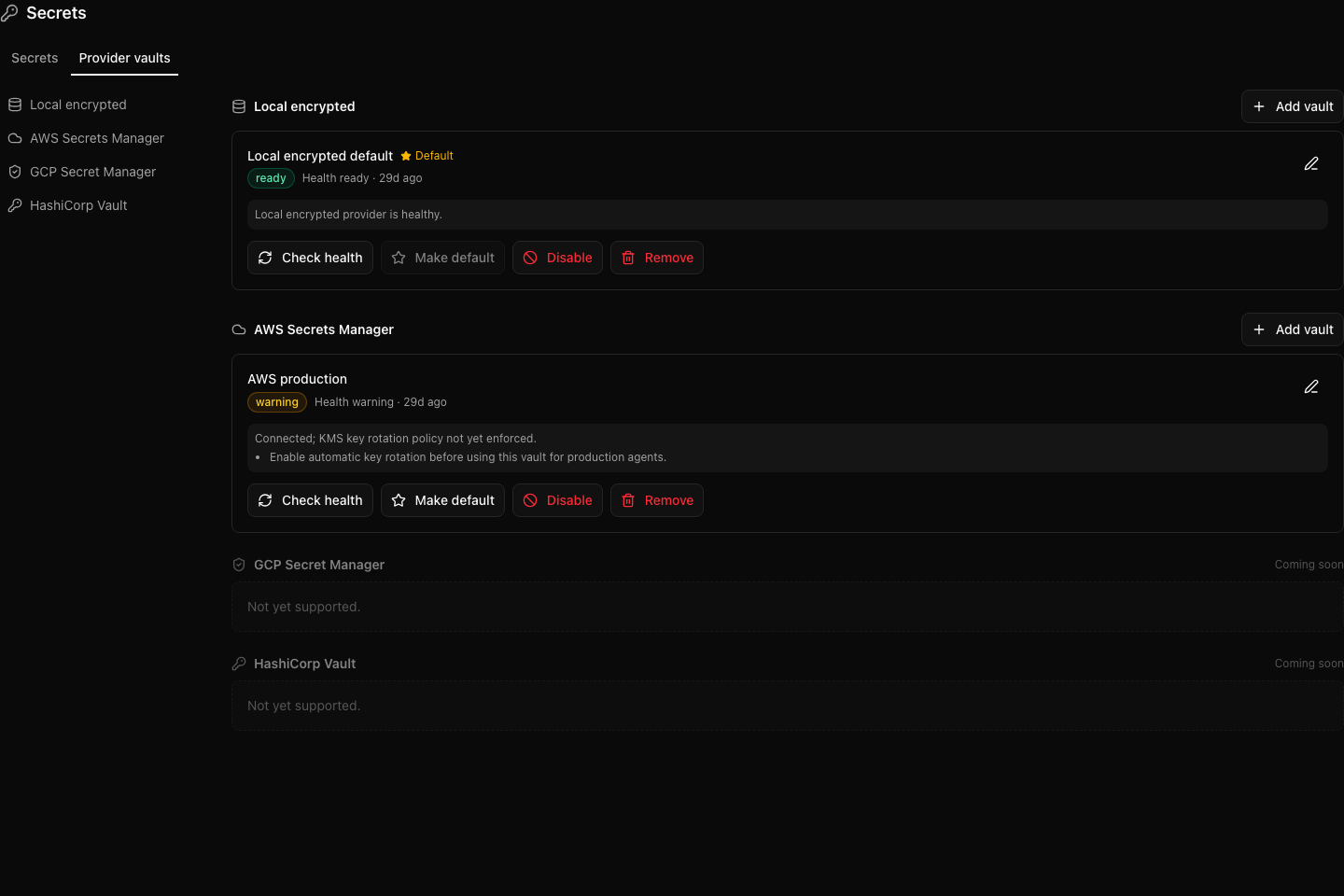
AWS discovery candidate flow:
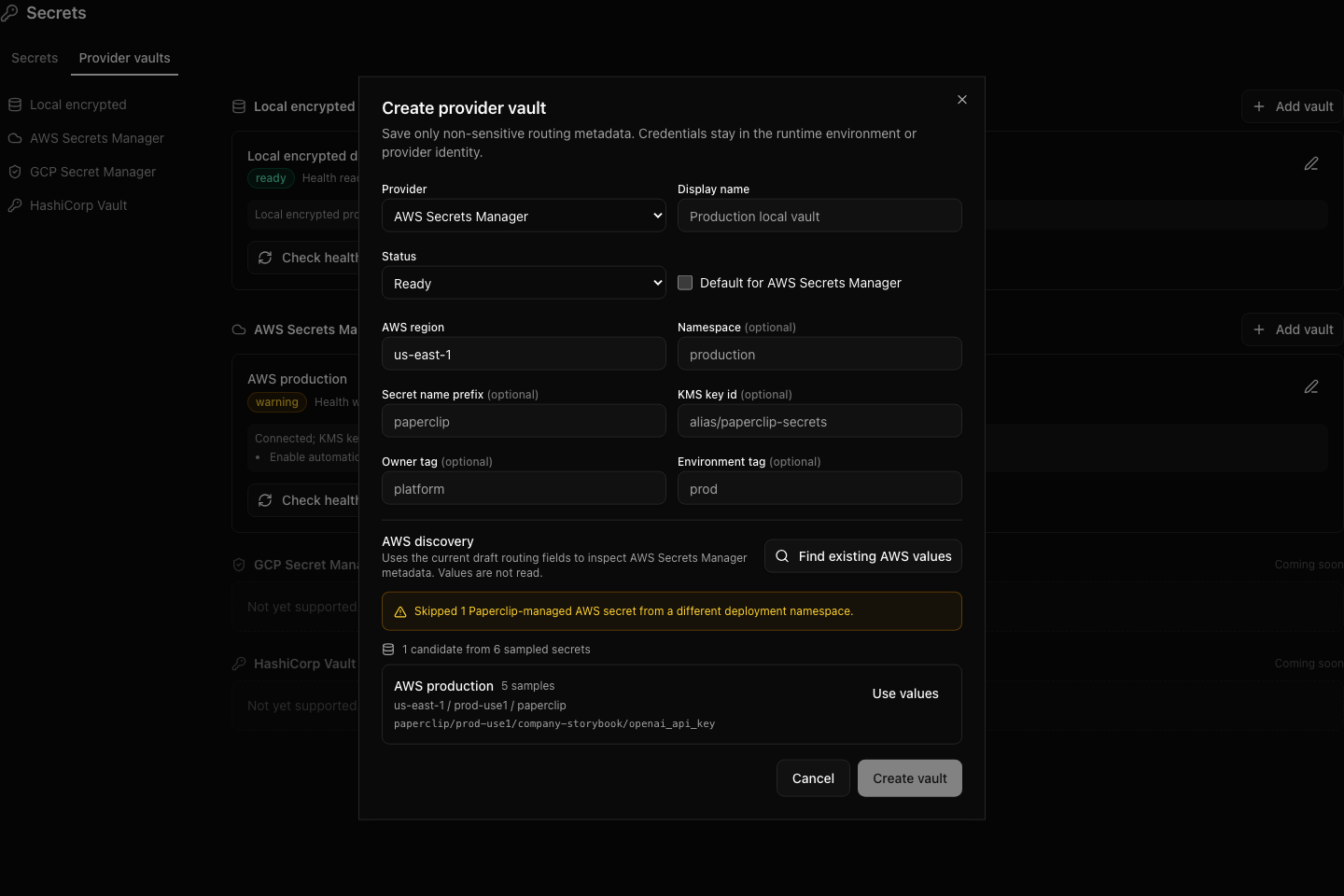
Provider vault removal confirmation:
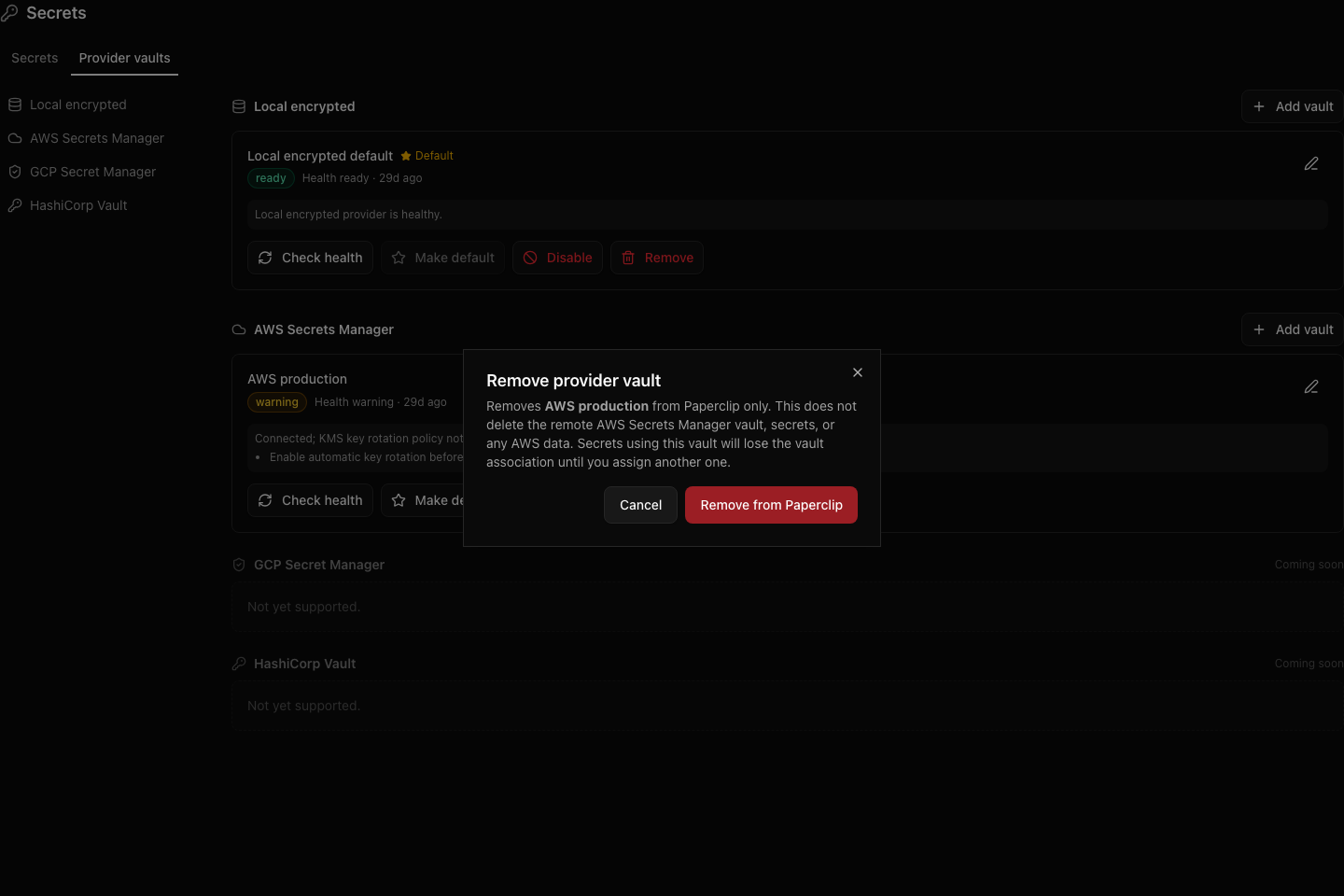
## Risks
- Secret provider metadata handling must remain non-sensitive;
validators reject credential-bearing Vault URLs and sensitive AWS
discovery keys.
- AWS discovery depends on deployment credentials being configured
correctly outside Paperclip-managed company secrets.
> For core feature work, check [`ROADMAP.md`](ROADMAP.md) first and
discuss it in `#dev` before opening the PR. Feature PRs that overlap
with planned core work may need to be redirected — check the roadmap
first. See `CONTRIBUTING.md`.
## Model Used
- OpenAI Codex, GPT-5-based coding agent with local shell/git/tool use.
Exact hosted model ID and context-window size are not exposed by the
local Paperclip adapter runtime.
## Checklist
- [x] I have included a thinking path that traces from project context
to this change
- [x] I have specified the model used (with version and capability
details)
- [x] I have checked ROADMAP.md and confirmed this PR does not duplicate
planned core work
- [x] I have run tests locally and they pass
- [x] I have added or updated tests where applicable
- [x] If this change affects the UI, I have included before/after
screenshots
- [x] I have updated relevant documentation to reflect my changes
- [x] I have considered and documented any risks above
- [x] I will address all Greptile and reviewer comments before
requesting merge
---------
Co-authored-by: Paperclip <noreply@paperclip.ing>
## Thinking Path

> - Paperclip orchestrates AI-agent companies through company-scoped
issues, comments, and issue documents.
> - Issue documents are the durable place where plans, handoffs, and
other work artifacts are revised over time.
> - Some documents need to be preserved as operator-approved snapshots
while agents continue working on the same issue.
> - Without document locking, a later board or agent write can overwrite
the document key that reviewers expected to remain stable.
> - This pull request adds board-managed issue document locks and makes
agent writes to locked keys create a derived document instead of
mutating the locked document.
> - The benefit is safer document handoffs: approved or frozen issue
documents stay immutable until the board explicitly unlocks them.

## What Changed

- Added `locked_at`, `locked_by_agent_id`, and `locked_by_user_id`
document fields plus migration `0085_tranquil_the_executioner.sql`.
- Added document lock/unlock service behavior, route endpoints, activity
events, and locked-document write protections.
- Made agent document writes to locked keys create a new derived key
such as `plan-2` rather than overwriting the locked document.
- Surfaced lock state through shared issue document types, UI API
methods, document header lock controls, and activity formatting.
- Added server and UI tests for lock/unlock behavior, locked document
immutability, and UI action visibility.
- Updated `doc/SPEC-implementation.md` with the V1 document lock
contract and endpoints.

## Verification

- `git rebase public-gh/master` completed cleanly after committing the
branch changes.
- `git diff --check` passed before commit.
- `pnpm run preflight:workspace-links && pnpm exec vitest run
server/src/__tests__/documents-service.test.ts
server/src/__tests__/issue-agent-mutation-ownership-routes.test.ts
ui/src/components/IssueDocumentsSection.test.tsx
ui/src/components/IssueContinuationHandoff.test.tsx
ui/src/lib/document-revisions.test.ts` passed: 5 files, 32 tests.

## Risks

- Medium risk because this changes the document persistence contract and
adds a migration.
- The migration uses `ADD COLUMN IF NOT EXISTS` and guarded foreign-key
creation so it remains safe for users who may have already applied an
earlier copy of the migration.
- Locked documents intentionally reject board edits/deletes/restores
until unlocked; any existing workflows that expected direct overwrite
need to unlock first.
- Agent writes to locked keys now create derived documents, which may
create extra issue documents when agents retry locked writes.

## Model Used

- OpenAI Codex coding agent based on GPT-5, with tool use and local code
execution in the Paperclip worktree.

## Checklist

- [x] I have included a thinking path that traces from project context
to this change
- [x] I have specified the model used (with version and capability
details)
- [x] I have checked ROADMAP.md and confirmed this PR does not duplicate
planned core work
- [x] I have run tests locally and they pass
- [x] I have added or updated tests where applicable
- [ ] If this change affects the UI, I have included before/after
screenshots
- [x] I have updated relevant documentation to reflect my changes
- [x] I have considered and documented any risks above
- [x] I will address all Greptile and reviewer comments before
requesting merge

---------

Co-authored-by: Paperclip <noreply@paperclip.ing>
## Thinking Path
> - Paperclip orchestrates AI-agent companies and needs secrets handling
to work across local development, hosted operators, and governed agent
execution.
> - The affected subsystem is the company-scoped secrets control plane:
database schema, server services/routes, CLI workflows, and the Secrets
settings UI.
> - The gap was that secrets were local-only and operators could not
manage provider vaults or import existing remote references without
exposing plaintext.
> - This branch adds provider vault configuration plus an AWS Secrets
Manager remote-import path while preserving company boundaries, binding
context, and audit trails.
> - I kept the PR to a single branch PR, removed unrelated
lockfile/package drift, rebased the full branch onto the current
`public-gh/master`, and addressed fresh Greptile findings.
> - The benefit is a reviewable implementation of provider-backed
secrets with focused tests covering provider selection, import
conflicts, deleted secret reuse, rotation guards, and AWS signing
behavior.
## What Changed
- Added provider vault support for company secrets, including provider
config storage, default vault handling, health checks, binding usage,
access events, and remote import preview/commit.
- Added an AWS Secrets Manager provider using SigV4 request signing,
bounded request timeouts, namespace guardrails, cached runtime
credential resolution, and external-reference linking without plaintext
reads.
- Added Secrets UI surfaces for vault management and remote import, plus
CLI/API documentation for setup and operations.
- Stabilized routine webhook secret binding paths and SSH
environment-driver fixture bindings discovered during verification.
- Addressed Greptile and CI findings: no lockfile/package drift,
monotonic migration metadata, disabled-vault default races, soft-deleted
secret hiding/recreate behavior, remove behavior with disabled vaults,
soft-deleted external-reference re-import, non-active rotation guards,
managed-secret soft deletion through PATCH, and per-call AWS SDK
credential client churn.
- Rebased this branch onto `public-gh/master` at `0e1a5828` and
force-pushed with lease to keep this as the single PR for the branch.
## Verification
- `git fetch public-gh master`
- `git rebase public-gh/master`
- `git diff --name-only public-gh/master...HEAD | grep
'^pnpm-lock\.yaml$' || true` confirmed `pnpm-lock.yaml` is not in the PR
diff.
- Confirmed migration ordering: master ends at `0081_optimal_dormammu`;
this PR adds `0082_dry_vision` and
`0083_company_secret_provider_configs`.
- Inspected migrations for repeat safety: new tables/indexes use `IF NOT
EXISTS`; foreign keys are guarded by `DO $$ ... IF NOT EXISTS`; column
additions use `ADD COLUMN IF NOT EXISTS`.
- `pnpm -r typecheck` passed before the Greptile follow-up commits.
- `pnpm test:run` ran the full stable Vitest path before the Greptile
follow-up commits; it completed with 3 timing-related failures under
parallel load: `codex-local-execute.test.ts`,
`cursor-local-execute.test.ts`, and `environment-service.test.ts`.
- `pnpm --filter @paperclipai/server exec vitest run
src/__tests__/codex-local-execute.test.ts
src/__tests__/cursor-local-execute.test.ts
src/__tests__/environment-service.test.ts` passed on targeted rerun
(`24/24`).
- `pnpm build` passed before the Greptile follow-up commits. Vite
reported existing chunk-size/dynamic-import warnings.
- After Greptile follow-up commits: `pnpm --filter @paperclipai/server
exec vitest run src/__tests__/secrets-service.test.ts` passed (`26/26`).
- After Greptile follow-up commits: `pnpm --filter @paperclipai/server
exec vitest run src/__tests__/aws-secrets-manager-provider.test.ts
src/__tests__/secrets-service.test.ts` passed (`39/39`).
- After Greptile follow-up commits: `pnpm --filter @paperclipai/server
typecheck` passed.
- Captured Storybook screenshots from `ui/storybook-static` for visual
review.
- Latest PR checks on `5ca3a5cf`: `policy`, serialized server suites
1/4-4/4, `Canary Dry Run`, `e2e`, `security/snyk`, and `Greptile Review`
pass; aggregate `verify` is still registering the completed child
checks.
- Greptile review loop continued through the latest requested pass; all
Greptile review threads are resolved and the latest `Greptile Review`
check on `5ca3a5cf` passed with 0 comments added.
## Screenshots
Before: the provider-vault and remote-import surfaces did not exist on
`master`; these are after-state screenshots from the Storybook fixtures.
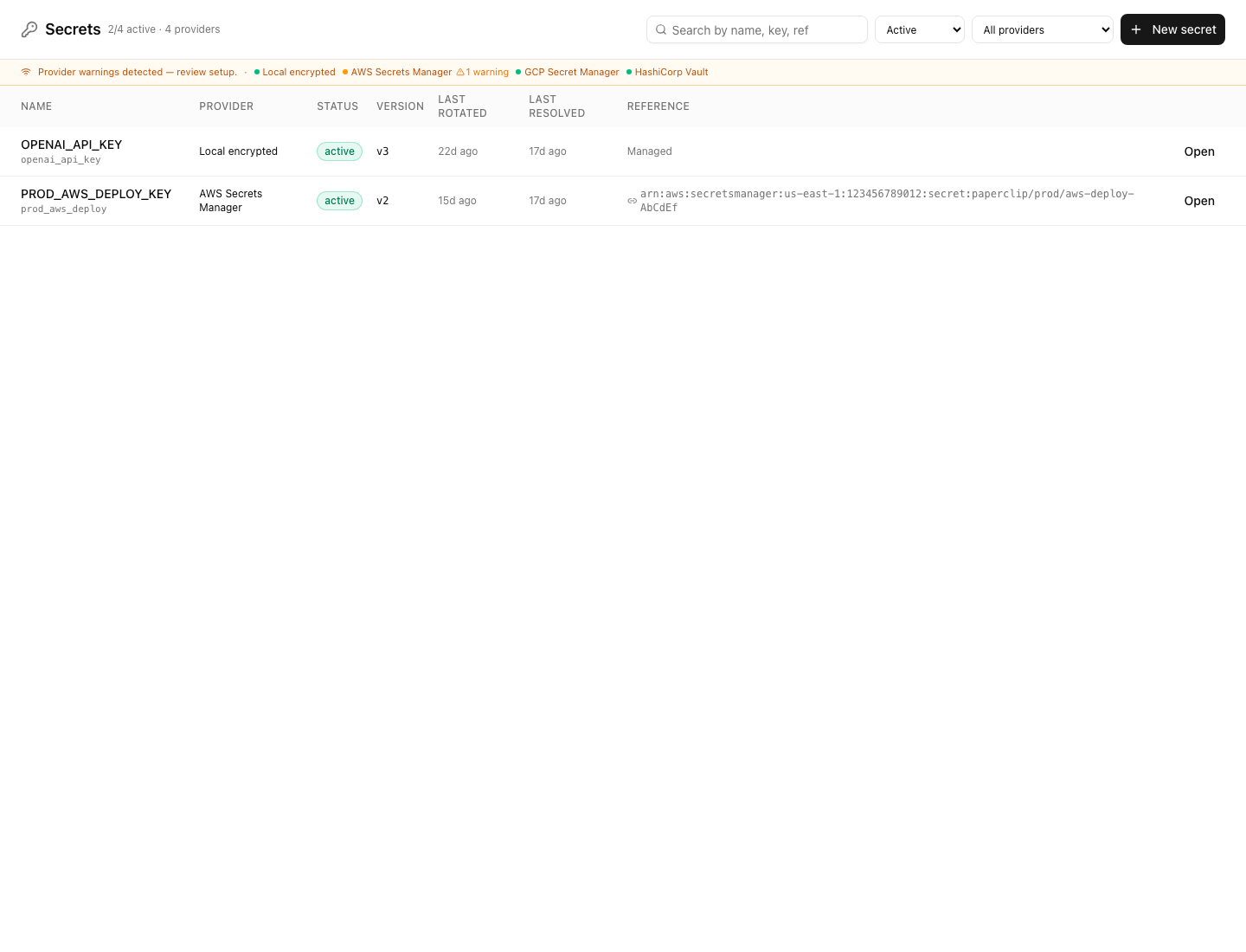
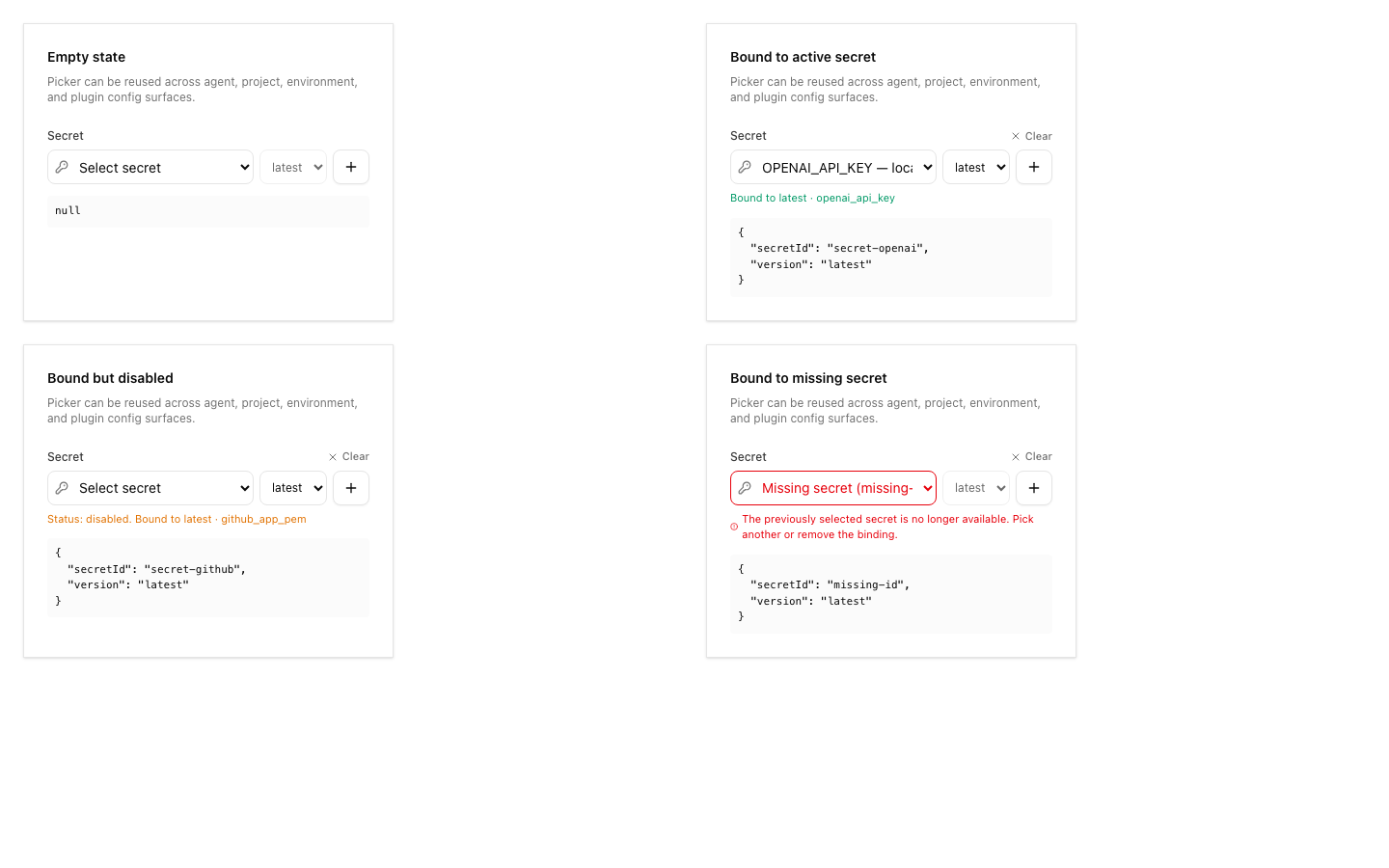
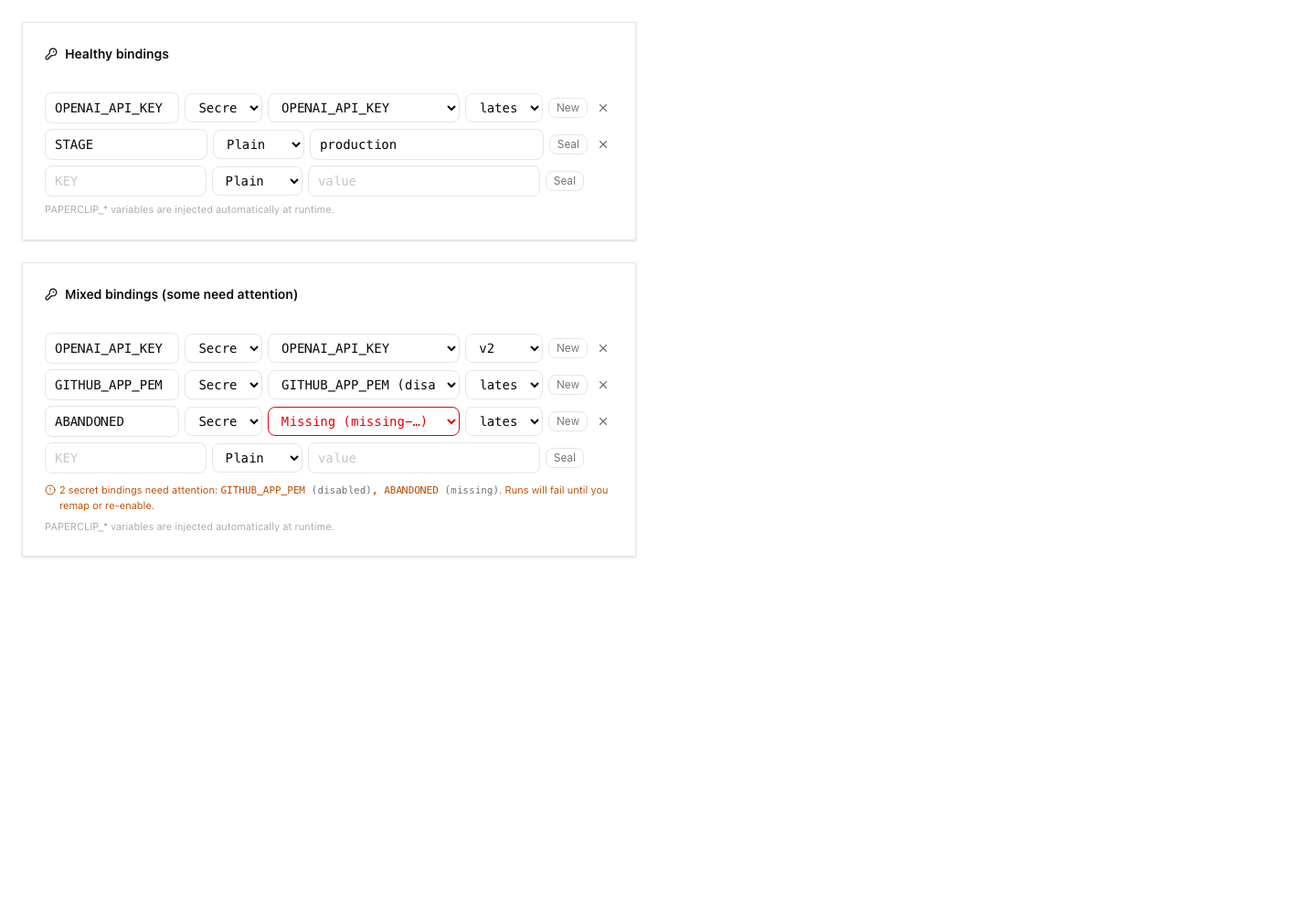
## Risks
- Migration risk: this adds new secret provider tables and extends
existing secret rows. The migrations were checked for monotonic ordering
and idempotent guards, but reviewers should still inspect upgrade
behavior carefully.
- Provider risk: AWS support uses direct SigV4 requests. Automated tests
cover signing, request timeouts, vault-config selection, namespace
guardrails, pending-version archival, sanitized provider errors, and
service-level cleanup paths. A real-vault AWS smoke test remains
deployment validation for an operator with AWS credentials rather than
an unverified merge blocker in this local branch.
- UI risk: the Secrets page and import dialog are large new surfaces;
screenshots are included above for reviewer inspection.
- Verification risk: the full local stable test command hit
parallel-load timing failures, although the exact failed files passed
when rerun directly.
- Operational risk: remote import intentionally avoids plaintext reads;
operators must understand that imported external references resolve at
runtime and may fail if AWS permissions change.
> For core feature work, check [`ROADMAP.md`](ROADMAP.md) first and
discuss it in `#dev` before opening the PR. Feature PRs that overlap
with planned core work may need to be redirected — check the roadmap
first. See `CONTRIBUTING.md`.
## Model Used
- OpenAI Codex, GPT-5 coding agent with local shell/tool use in the
Paperclip worktree. Exact context-window size was not exposed by the
runtime.
## Checklist
- [x] I have included a thinking path that traces from project context
to this change
- [x] I have specified the model used (with version and capability
details)
- [x] I have checked ROADMAP.md and confirmed this PR does not duplicate
planned core work
- [ ] I have run tests locally and they pass
- [x] I have added or updated tests where applicable
- [x] If this change affects the UI, I have included before/after
screenshots
- [x] I have updated relevant documentation to reflect my changes
- [x] I have considered and documented any risks above
- [x] I will address all Greptile and reviewer comments before
requesting merge
---------
Co-authored-by: Paperclip <noreply@paperclip.ing>
Co-authored-by: Claude Sonnet 4.6 <noreply@anthropic.com>
## Thinking Path
> - Paperclip is a control plane for autonomous AI companies.
> - Issues are the core unit of work, and issue comments are how board
users and agents coordinate execution.
> - Some issue conversations need to produce plans and approvals instead
of immediate implementation work.
> - The existing issue contract did not distinguish standard execution
comments from planning-oriented issue work.
> - This pull request adds an issue work-mode contract and board UI
affordances for standard vs planning mode.
> - The benefit is that planning-mode issues can be created, displayed,
discussed, and carried through agent heartbeat context without losing
the normal issue workflow.
## What Changed
- Added `standard` / `planning` issue work-mode contracts across DB,
shared validators/types, server issue flows, plugin protocol, and
adapter heartbeat payloads.
- Added an idempotent `0081_optimal_dormammu` migration for
`issues.work_mode`, ordered after current `public-gh/master` migrations.
- Updated heartbeat/context summaries and issue-thread interaction
behavior so planning work mode is preserved when creating suggested
follow-up issues.
- Added UI support for planning-mode issue creation, issue rows, detail
composer styling, and composer work-mode toggles.
- Added focused server/shared/UI tests plus a Playwright visual
verification spec for planning-mode surfaces.
- Rebased the branch onto current `public-gh/master` and added durable
planning-mode screenshots under `doc/assets/pap-3368/`.
## Verification
- `pnpm --filter @paperclipai/db run check:migrations`
- `pnpm exec vitest run --project @paperclipai/shared
packages/shared/src/validators/issue.test.ts`
- `pnpm exec vitest run --project @paperclipai/server
server/src/__tests__/heartbeat-context-summary.test.ts
server/src/__tests__/issue-thread-interactions-service.test.ts
server/src/__tests__/issues-goal-context-routes.test.ts --pool=forks
--poolOptions.forks.isolate=true`
- `pnpm exec vitest run --project @paperclipai/ui
ui/src/components/IssueChatThread.test.tsx
ui/src/components/NewIssueDialog.test.tsx
ui/src/components/IssueRow.test.tsx ui/src/pages/IssueDetail.test.tsx`
- `pnpm exec vitest run --project @paperclipai/adapter-utils
packages/adapter-utils/src/server-utils.test.ts`
- `PAPERCLIP_E2E_SKIP_LLM=true npx playwright test --config
tests/e2e/playwright.config.ts
tests/e2e/planning-mode-visual-verification.spec.ts`
## Screenshots
Desktop planning detail:
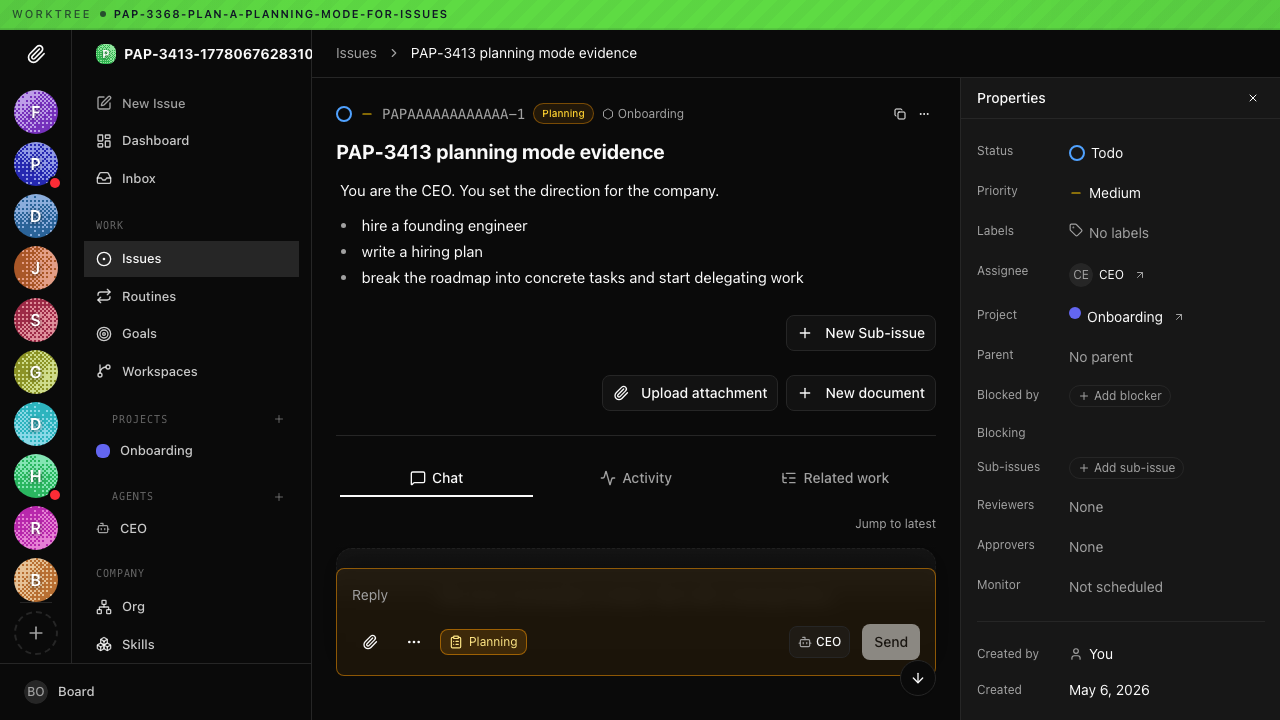
Desktop planning row:
Desktop staged standard toggle:
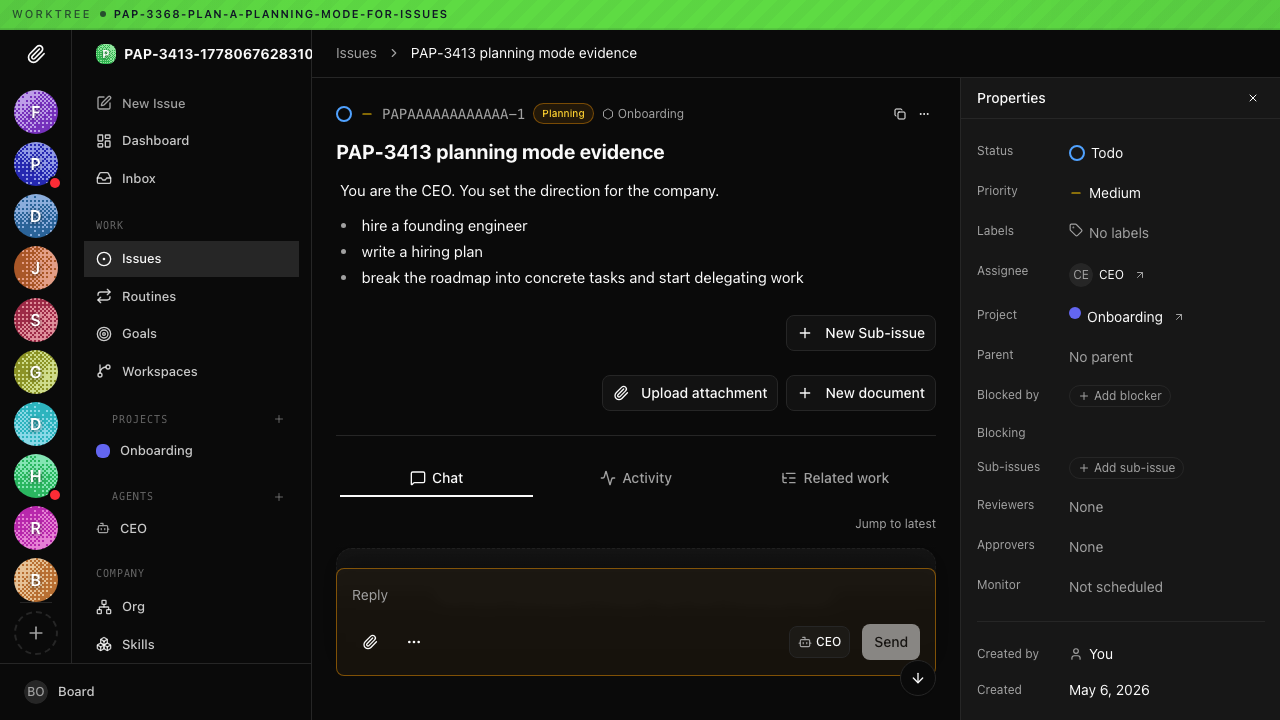
Mobile planning detail:
Mobile planning row:
## Risks
- Medium migration risk: this adds a non-null issue column. The
migration uses `ADD COLUMN IF NOT EXISTS` so installations that applied
an older branch-local migration number can still apply the final
numbered migration safely.
- Medium contract risk: issue payloads, plugin payloads, and adapter
heartbeat payloads now include work mode; compatibility is handled by
defaulting missing values to `standard`.
- UI risk is moderate because composer controls changed; focused
component tests and visual e2e coverage exercise standard vs planning
display and toggle behavior.
> For core feature work, check [`ROADMAP.md`](ROADMAP.md) first and
discuss it in `#dev` before opening the PR. Feature PRs that overlap
with planned core work may need to be redirected — check the roadmap
first. See `CONTRIBUTING.md`.
## Model Used
- OpenAI Codex, GPT-5 coding agent in a local Paperclip worktree, with
shell/tool use. Exact context-window size is not exposed in this
runtime.
## Checklist
- [x] I have included a thinking path that traces from project context
to this change
- [x] I have specified the model used (with version and capability
details)
- [x] I have checked ROADMAP.md and confirmed this PR does not duplicate
planned core work
- [x] I have run tests locally and they pass
- [x] I have added or updated tests where applicable
- [x] If this change affects the UI, I have included before/after
screenshots
- [x] I have updated relevant documentation to reflect my changes
- [x] I have considered and documented any risks above
- [x] I will address all Greptile and reviewer comments before
requesting merge
---------
Co-authored-by: Paperclip <noreply@paperclip.ing>
## Thinking Path

> - Paperclip is the control plane for autonomous AI companies, so
backend task ownership, recovery, review visibility, and company-scoped
limits need to stay enforceable without UI-only coupling.
> - Closed PR #4692 bundled those backend changes with UI workflow,
docs, skills, workflow, and lockfile churn.
> - PAP-2694 asks for a clean backend/control-plane slice from that
closed branch.
> - This branch starts from current `master` and mines only the `cli`,
`packages/db`, `packages/shared`, and `server` contracts/tests needed
for the backend behavior.
> - It explicitly excludes UI workflow/performance work,
`.github/workflows/pr.yml`, `pnpm-lock.yaml`, docs, skills,
package-script, adapter UI build-config, and perf fixture script
changes; the only UI files are fixture/test updates required by the
tightened shared `Company` contract.
> - The benefit is a smaller reviewable PR that preserves the
control-plane fixes while staying under Greptile s 100-file review
limit.

## What Changed

- Added company-scoped attachment-size limits through DB
schema/migrations, shared company portability contracts, CLI
import/export coverage, and server attachment upload enforcement.
- Added productivity review service/API behavior for no-comment streak,
long-active, and high-churn review issues, including request-depth
clamping and issue summary exposure.
- Hardened issue ownership and recovery/control-plane paths: peer-agent
mutation denial, issue tree pause/resume behavior, stranded recovery
origins, and related activity/test coverage.
- Preserved related backend contract updates for routine timestamp
variables and managed agent instruction bundles because they live in
shared/server contracts from the source branch.
- Addressed Greptile feedback by making `Company.attachmentMaxBytes`
non-optional, simplifying review request-depth clamping, fixing the
migration final newline, and enforcing the process-level attachment cap
as the final ceiling for uploads.
- Added minimal company fixtures needed for repo-wide typecheck/build
and kept the PR to 66 changed files with forbidden/non-slice paths
excluded.

## Verification

- `pnpm install --frozen-lockfile`
- `git diff --check origin/master..HEAD`
- `git diff --name-only origin/master..HEAD | wc -l` -> 66 files
- `git diff --name-only origin/master..HEAD -- .github/workflows/pr.yml
pnpm-lock.yaml package.json doc skills .agents scripts
packages/adapters` -> no output
- `pnpm exec vitest run --config vitest.config.ts
packages/shared/src/validators/issue.test.ts
packages/shared/src/routine-variables.test.ts
packages/shared/src/adapter-types.test.ts
cli/src/__tests__/company-import-export-e2e.test.ts
cli/src/__tests__/company.test.ts
server/src/__tests__/productivity-review-service.test.ts
server/src/__tests__/issue-tree-control-service.test.ts
server/src/__tests__/issue-tree-control-routes.test.ts
server/src/__tests__/issue-agent-mutation-ownership-routes.test.ts
server/src/__tests__/issue-attachment-routes.test.ts
server/src/__tests__/heartbeat-process-recovery.test.ts
server/src/__tests__/issues-service.test.ts` -> 12 files, 147 tests
passed
- `pnpm exec vitest run --config vitest.config.ts
cli/src/__tests__/company-delete.test.ts
cli/src/__tests__/company-import-export-e2e.test.ts
server/src/__tests__/productivity-review-service.test.ts` -> 3 files, 18
tests passed
- `pnpm exec vitest run --config vitest.config.ts
server/src/__tests__/issue-attachment-routes.test.ts` -> 1 file, 6 tests
passed
- `pnpm --filter @paperclipai/db typecheck && pnpm --filter
@paperclipai/shared typecheck && pnpm --filter @paperclipai/server
typecheck && pnpm --filter paperclipai typecheck`
- `pnpm --filter @paperclipai/server typecheck`
- `pnpm --filter @paperclipai/ui typecheck && pnpm --filter
@paperclipai/ui build`

## Risks

- Includes migrations `0073_shiny_salo.sql` and
`0074_striped_genesis.sql`; merge ordering matters if another PR adds
migrations first.
- This is intentionally backend-only apart from fixture/test updates
forced by shared type correctness; UI affordances from PR #4692 are not
present here and should land in separate UI slices.
- The worktree install emitted plugin SDK bin-link warnings for unbuilt
plugin packages, but the targeted tests and package typechecks completed
successfully.

> For core feature work, check [`ROADMAP.md`](ROADMAP.md) first and
discuss it in `#dev` before opening the PR. Feature PRs that overlap
with planned core work may need to be redirected; check the roadmap
first. See `CONTRIBUTING.md`.

## Model Used

- OpenAI Codex, GPT-5 coding agent, tool-enabled terminal/GitHub
workflow. Exact runtime context window was not exposed by the harness.

## Checklist

- [x] I have included a thinking path that traces from project context
to this change
- [x] I have specified the model used (with version and capability
details)
- [x] I have checked ROADMAP.md and confirmed this PR does not duplicate
planned core work
- [x] I have run tests locally and they pass
- [x] I have added or updated tests where applicable
- [x] If this change affects the UI, I have included before/after
screenshots
- [x] I have updated relevant documentation to reflect my changes
- [x] I have considered and documented any risks above
- [x] I will address all Greptile and reviewer comments before
requesting merge

---------

Co-authored-by: Paperclip <noreply@paperclip.ing>
## Thinking Path

> - Paperclip orchestrates AI agents for zero-human companies.
> - The board UI is the main operator surface, so its component and
workflow coverage needs to stay reviewable as the product grows.
> - This branch adds Storybook as a dedicated UI reference surface for
core Paperclip screens and interaction patterns.
> - That work spans Storybook infrastructure, app-level provider wiring,
and a large fixture set that can render real control-plane states
without a live backend.
> - The branch also expands coverage across agents, budgets, issues,
chat, dialogs, navigation, projects, and data visualization so future UI
changes have a concrete visual baseline.
> - This pull request packages that Storybook work on top of the latest
`master`, excludes the lockfile from the final diff per repo policy, and
fixes one fixture contract drift caught during verification.
> - The benefit is a single reviewable PR that adds broad UI
documentation and regression-surfacing coverage without losing the
existing branch work.

## What Changed

- Added Storybook 10 wiring for the UI package, including root scripts,
UI package scripts, Storybook config, preview wrappers, Tailwind
entrypoints, and setup docs.
- Added a large fixture-backed data source for Storybook so complex
board states can render without a live server.
- Added story suites covering foundations, status language,
control-plane surfaces, overview, UX labs, agent management, budget and
finance, forms and editors, issue management, navigation and layout,
chat and comments, data visualization, dialogs and modals, and
projects/goals/workspaces.
- Adjusted several UI components for Storybook parity so dialogs, menus,
keyboard shortcuts, budget markers, markdown editing, and related
surfaces render correctly in isolation.
- Rebasing work for PR assembly: replayed the branch onto current
`master`, removed `pnpm-lock.yaml` from the final PR diff, and aligned
the dashboard fixture with the current `DashboardSummary.runActivity`
API contract.

## Verification

- `pnpm --filter @paperclipai/ui typecheck`
- `pnpm --filter @paperclipai/ui build-storybook`
- Manual diff audit after rebase: verified the PR no longer includes
`pnpm-lock.yaml` and now cleanly targets current `master`.
- Before/after UI note: before this branch there was no dedicated
Storybook surface for these Paperclip views; after this branch the local
Storybook build includes the new overview and domain story suites in
`ui/storybook-static`.

## Risks

- Large static fixture files can drift from shared types as dashboard
and UI contracts evolve; this PR already needed one fixture correction
for `runActivity`.
- Storybook bundle output includes some large chunks, so future growth
may need chunking work if build performance becomes an issue.
- Several component tweaks were made for isolated rendering parity, so
reviewers should spot-check key board surfaces against the live app
behavior.

## Model Used

- OpenAI Codex, GPT-5-based coding agent in the Paperclip harness; exact
serving model ID is not exposed in-runtime to the agent.
- Tool-assisted workflow with terminal execution, git operations, local
typecheck/build verification, and GitHub CLI PR creation.
- Context window/reasoning mode not surfaced by the harness.

## Checklist

- [x] I have included a thinking path that traces from project context
to this change
- [x] I have specified the model used (with version and capability
details)
- [x] I have checked ROADMAP.md and confirmed this PR does not duplicate
planned core work
- [x] I have run tests locally and they pass
- [x] I have added or updated tests where applicable
- [ ] If this change affects the UI, I have included before/after
screenshots
- [x] I have updated relevant documentation to reflect my changes
- [x] I have considered and documented any risks above
- [x] I will address all Greptile and reviewer comments before
requesting merge

---------

Co-authored-by: Paperclip <noreply@paperclip.ing>
 Tonio
Tonio
 Devin Foley
 Nicky Leach
 Dotta
Dotta
 scotttong










