Replaces hardcoded TYPE values in ui/src/components/** and ui/src/pages/**
with references to new verbatim CSS custom-property tokens in
ui/src/index.css, via a new committed codemod (scripts/codemod-extract-type.mjs).

- 932 sites rewritten across 143 files:
  - 728 arbitrary font-size Tailwind classes (text-[Npx])
  - 202 arbitrary letter-spacing classes (tracking-[N em])
  - 2 inline-style fontSize string literals
  - 0 leading-[...] sites found (none existed)
- 17 new tokens minted, no normalizing: 8 --fs-* (9/10/11/12/13/14/15px +
  0.7rem, kept in its own unit) and 9 --ls-* (0.08-0.24em, 9 distinct
  values) — the micro type-size and letter-spacing clusters TOKEN-AUDIT.md
  flagged are now materialized as tokens, still un-collapsed pending a
  human scale decision.
- 2 sites allowlisted (both already-documented functional/third-party
  fontSize forms: CompanyEnvironments.tsx xterm.js config, CompanySkills.tsx
  computed Math.round() value) — no new allowlist entries needed since
  neither is a class-string or literal-fontSize site the codemod targets.
- Verified: rg gates clean, pnpm build-storybook exit 0, Storybook visual
  suite 510/510 passed (first attempt), pnpm typecheck exit 0, codemod
  re-run confirmed idempotent (0 sites on second pass).

Co-Authored-By: Claude Fable 5 <noreply@anthropic.com>
## Thinking Path

> - Paperclip is the open source app people use to manage AI agents for
work.
> - Agent runs often need provider credentials, API tokens, and other
environment-bound secrets.
> - Company-level secrets work for shared credentials, but they do not
model values that should differ by human operator.
> - Without a user-scoped model, a run can dispatch without knowing
whether the responsible human has supplied the needed value.
> - Paperclip also needs run attribution to make those user-scoped
runtime checks deterministic and auditable.
> - This pull request adds user-specific secret definitions, per-user
values, environment bindings, responsible-user attribution, and runtime
resolution gates.
> - The benefit is that teams can define the secret once, let each user
provide their own value, and block runs before dispatch when required
user secrets or active definitions are unavailable.

## Linked Issues or Issue Description

Refs #224
Refs #6057

This PR implements user-specific secret support as a core
secret-management capability rather than a one-off adapter setting. It
is related to existing public work on company secrets UI and runtime
secret refs, but is distinct because the value is owned by the
responsible user and resolved at run dispatch time.

Related PR search before opening found existing secrets work such as
#1550, #8256, #8614, #8634, and #8647; none of those add the full
user-secret definition/value/runtime gate covered here.

## What Changed

- Added user-secret definitions and per-user "My secrets" values,
keeping stored values out of access metadata.
- Added `user_secret_ref` environment bindings and UI affordances to
pick them alongside existing secret refs.
- Added responsible-user runtime resolution so user-secret refs resolve
against the human responsible for the run.
- Added pre-dispatch missing-secret gates so runs fail before adapter
dispatch when required user values are absent or definitions are
inactive.
- Added low-trust allowlist hardening for user-secret runtime access.
- Added issue, routine, run, and agent API key responsible-user
attribution and fail-closed dispatch behavior when attribution cannot be
resolved.
- Added denial-copy mapping so responsible-user authorization failures
surface as actionable run outcomes instead of opaque setup failures.
- Added OpenAPI documentation for the user-secret routes.
- Rebases cleanly on current `master`; migrations were renumbered
incrementally as `0128_user_specific_secrets`,
`0129_agent_api_key_responsible_user`, and
`0130_run_responsible_user_invariant` after upstream `0126`/`0127`
migrations.
- Removed previously committed local design screenshots so the PR
contains code/docs/tests only.

## Verification

- PASS: PR head `2527febd106bcf3ca264ca0da7fca491084192d6` is based on
`paperclipai/paperclip:master`.
- PASS: `git diff --check`
- PASS: `git diff --name-only public/master...HEAD | rg
'^(pnpm-lock\\.yaml|\\.github/workflows/|screenshots/)' || true`
produced no files.
- PASS: migration journal audit confirmed unique indexes through `130`
with tail entries `0126_issue_comment_derived_attribution`,
`0127_environment_custom_images_instance_scoped`,
`0128_user_specific_secrets`, `0129_agent_api_key_responsible_user`, and
`0130_run_responsible_user_invariant`.
- PASS: `pnpm --filter @paperclipai/ui typecheck`
- PASS: `pnpm --filter @paperclipai/server typecheck`
- PASS: `pnpm --filter @paperclipai/server exec vitest run
src/__tests__/heartbeat-responsible-user-invariant.test.ts`
- PASS: `pnpm --filter @paperclipai/server exec vitest run
src/__tests__/heartbeat-active-run-output-watchdog.test.ts
src/__tests__/heartbeat-stale-queue-invalidation.test.ts
src/__tests__/heartbeat-workspace-finalize-branch.test.ts
src/__tests__/issue-monitor-scheduler.test.ts`
- PASS: `pnpm --filter @paperclipai/server exec vitest run
src/__tests__/heartbeat-comment-wake-batching.test.ts
src/__tests__/heartbeat-retry-scheduling.test.ts
src/__tests__/heartbeat-accepted-plan-workspace-refresh.test.ts
src/__tests__/heartbeat-plugin-environment.test.ts`
- PASS: `pnpm --filter @paperclipai/server exec vitest run
src/__tests__/low-trust-red-team-routes.test.ts`
- PASS: `pnpm --filter @paperclipai/server exec vitest run
src/__tests__/secrets-service.test.ts` (55 tests)
- PASS: `pnpm vitest run server/src/__tests__/secrets-routes.test.ts
server/src/__tests__/secrets-service.test.ts` (89 tests after final
Greptile cleanup fixes)
- PASS: `pnpm --filter @paperclipai/server exec vitest run
src/__tests__/heartbeat-issue-liveness-escalation.test.ts` (17 tests
after the final rebase CI fix)
- PASS: focused server Vitest batches covering heartbeat recovery,
project env, plugin env, routines, low-trust, pipelines, monitors,
watchdog, and stale queue paths.
- PASS: GitHub checks are green on
`2527febd106bcf3ca264ca0da7fca491084192d6`, including Typecheck +
Release Registry, Build, General tests, serialized server suites, e2e,
Canary Dry Run, verify, security checks, and Greptile Review.
- PASS: Greptile Review completed successfully on
`2527febd106bcf3ca264ca0da7fca491084192d6` with Confidence Score 5/5,
and GraphQL review-thread audit returned zero unresolved non-outdated
threads.

## Risks

- Runtime behavior now depends on a run having a correct responsible
user; missing or incorrect responsibility assignment can block runs
before adapter dispatch.
- `user_secret_ref` bindings intentionally expose metadata without
values, but UI/API callers may need to handle the new binding kind
explicitly.
- External secret providers and IAM policies are not automatically
provisioned by this PR; operators still need to configure provider-side
access for non-local vaults.
- The PR is broad across db/shared/server/UI/runtime paths, so release
validation should include both API and UI secret workflows before merge.
- The migration renumbering is intentionally incremental after upstream
migrations; the branch migrations use guarded
column/table/index/constraint creation so users who tested the older
draft numbering should not hit duplicate DDL for the existing objects.

> For core feature work, check [`ROADMAP.md`](ROADMAP.md) first and
discuss it in `#dev` before opening the PR. Feature PRs that overlap
with planned core work may need to be redirected — check the roadmap
first. See `CONTRIBUTING.md`.

## Model Used

OpenAI Codex, GPT-5-based coding agent (`gpt-5`), Codex local adapter
with shell/tool use and code execution. Context window and internal
reasoning mode are not exposed by the runtime.

## Checklist

- [x] I have included a thinking path that traces from project context
to this change
- [x] I have specified the model used (with version and capability
details)
- [x] I have checked ROADMAP.md and confirmed this PR does not duplicate
planned core work
- [x] I have searched GitHub for duplicate or related PRs and linked
them above
- [x] I have either (a) linked existing issues with `Fixes: #` / `Closes
#` / `Refs #` OR (b) described the issue in-PR following the relevant
issue template
- [x] I have not referenced internal/instance-local Paperclip issues or
links (only public GitHub `#NNN` / `github.com/paperclipai/paperclip`
URLs)
- [x] My branch name describes the change (e.g. `docs/...`, `fix/...`)
and contains no internal Paperclip ticket id or instance-derived details
- [x] I have run tests locally and they pass
- [x] I have added or updated tests where applicable
- [x] I have updated relevant documentation to reflect my changes
- [x] I have considered and documented any risks above
- [x] All Paperclip CI gates are green
- [x] Greptile is 5/5 with no open P2s, recommendations, or follow-ups
- [x] I will address all Greptile and reviewer comments before
requesting merge

---------

Co-authored-by: Paperclip <noreply@paperclip.ing>
Co-authored-by: Claude Opus 4.8 <noreply@anthropic.com>
## Thinking Path

> - Paperclip is the open source control plane people use to manage AI
agents for work.
> - Environment variables and secrets sit in the configuration surfaces
that let agents, projects, routines, and company environments run with
the right runtime inputs.
> - The previous editor was a single legacy component with cramped row
behavior, weak secret conversion affordances, and duplicated handling
across several call sites.
> - Operators need a clearer editor that handles text values, secret
references, draft rows, and sensitive-value warnings consistently
wherever environment variables are configured.
> - This pull request replaces the legacy editor with a reusable
environment variables editor and migrates the existing configuration
surfaces to it.
> - The benefit is a more reliable editing workflow with targeted test
coverage around row state, dotenv parsing, secret selection, and
affected page integrations.

## Linked Issues or Issue Description

No public GitHub issue exists, so this PR describes the issue inline
following the feature request template.

### Subsystem affected

ui/ — React + Vite board UI

### Problem or motivation

Environment variables are edited in several Paperclip configuration
surfaces, including agent config, project properties, stage secrets,
routine sections, company environments, and company settings. The legacy
editor made common operator work difficult: rows could feel cramped,
secret conversion was inconsistent, draft rows and imported dotenv data
were easy to mishandle, and sensitive-value warnings did not have a
consistent place in the workflow.

### Proposed solution

Introduce a reusable environment variables editor component that
consistently supports text values, secret references, draft rows, dotenv
import parsing, sensitive-value hints, secret picking, secret creation,
and conversion to stored secrets. Migrate the existing
environment-variable call sites to the shared editor so behavior and
tests live in one component family.

### Alternatives considered

Keeping the existing `EnvVarEditor` and patching individual call sites
would preserve duplication and leave each surface responsible for its
own row and secret handling. This PR instead centralizes the behavior so
future fixes cover all migrated surfaces.

### Roadmap alignment

Checked `ROADMAP.md`; this does not duplicate a named roadmap item. It
supports the existing local-first and deployment-oriented product
direction by improving the UI where operators configure runtime
environment values.

### Additional context

The PR includes targeted tests for the editor model, dotenv parsing,
sensitive-value detection, component behavior, affected page
integrations, and Greptile review regressions around external saves and
bulk import immutability.

## What Changed

- Replaced the legacy `EnvVarEditor` with a reusable
`environment-variables-editor` component family.
- Added editor model helpers for draft rows, dotenv parsing,
sensitive-value detection, secret picking, secret creation, and
conversion to secret references.
- Migrated agent config, project properties, stage secrets, routine
editable sections, company environments, company settings, design guide
examples, and Storybook stories to the new editor.
- Added targeted tests for the editor model, parsing, sensitive-value
detection, component behavior, and affected company environment/settings
integrations.
- Fixed the company settings test harness to use the repo’s
`flushSync`-based React test helper pattern under the current React
build.
- Addressed Greptile feedback by flushing pending editor drafts before
enclosing form submits or external save-button clicks, cloning
bulk-import rows before mutation, and deferring the overflow
store-as-secret popover open path.

## Verification

- `pnpm exec vitest run
ui/src/components/environment-variables-editor/EnvironmentVariablesEditor.test.tsx
ui/src/pages/CompanyEnvironments.test.tsx
ui/src/components/AgentConfigForm.render.test.tsx` — passed, 3 files /
40 tests.
- Earlier focused Vitest coverage for model, dotenv parsing, sensitive
detection, company environments, and company settings passed, 6 files /
78 tests.
- `pnpm --filter @paperclipai/ui typecheck` — passed.
- GitHub PR checks on head `0aa49c6f8afed1f62d9e26da07fc466fbf299850` —
passed; CI checks green, security review neutral, Greptile check
success.
- Greptile review — 5/5 confidence on head
`0aa49c6f8afed1f62d9e26da07fc466fbf299850`; 0 unresolved review threads.

## Risks

- Medium UI risk: several environment-variable entry surfaces now share
the new editor, so regressions could affect multiple configuration
workflows at once.
- Secret conversion, draft-row behavior, external save flushing, and
bulk import behavior are covered by targeted tests, but reviewer
attention should still focus on manual editing flows, focus retention,
and save/cancel affordances.
- No database or API contract changes.

> For core feature work, check [`ROADMAP.md`](ROADMAP.md) first and
discuss it in `#dev` before opening the PR. Feature PRs that overlap
with planned core work may need to be redirected — check the roadmap
first. See `CONTRIBUTING.md`.

## Model Used

- OpenAI Codex, GPT-5-based coding agent with tool use and local command
execution; medium reasoning mode. Exact context-window metadata is not
exposed in this runtime.

## Checklist

- [x] I have included a thinking path that traces from project context
to this change
- [x] I have specified the model used (with version and capability
details)
- [x] I have checked ROADMAP.md and confirmed this PR does not duplicate
planned core work
- [x] I have searched GitHub for duplicate or related PRs and linked
them above
- [x] I have either (a) linked existing issues with `Fixes: #` / `Closes
#` / `Refs #` OR (b) described the issue in-PR following the relevant
issue template
- [x] I have not referenced internal/instance-local Paperclip issues or
links (only public GitHub `#NNN` / `github.com/paperclipai/paperclip`
URLs)
- [x] My branch name describes the change (e.g. `docs/...`, `fix/...`)
and contains no internal Paperclip ticket id or instance-derived details
- [x] I have run tests locally and they pass
- [x] I have added or updated tests where applicable
- [x] I have updated relevant documentation to reflect my changes
- [x] I have considered and documented any risks above
- [x] All Paperclip CI gates are green
- [x] Greptile is 5/5 with no open P2s, recommendations, or follow-ups
- [x] I will address all Greptile and reviewer comments before
requesting merge

---------

Co-authored-by: Claude Opus 4.8 <noreply@anthropic.com>
Co-authored-by: Paperclip <noreply@paperclip.ing>
## Thinking Path

> - Paperclip is the open source app people use to manage AI agents for
work.
> - Paperclip runs agents through adapters, including built-in local and
gateway-style adapters.
> - Hermes gateway users need to connect Paperclip to an already-running
Hermes API server.
> - The gateway setup flow was missing clear non-local adapter
configuration fields and accepted fewer URL shapes than operators
naturally paste from Hermes.
> - It also surfaced sparse diagnostics when the gateway was unreachable
or when Paperclip generated onboarding prompts for gateway agents.
> - This pull request tightens Hermes gateway configuration, URL
normalization, diagnostics, and onboarding defaults.
> - The benefit is that Hermes gateway setup is easier to complete and
easier to debug without affecting unrelated adapters.

## Linked Issues or Issue Description

No public issue found for this exact follow-up. Related prior/in-flight
Hermes work:

- Refs #2363
- Refs #4359
- Refs #6473

Problem statement:

- **Type:** Adapter follow-up / setup reliability
- **Adapter:** `hermes_gateway`
- **Motivation:** Operators configure `hermes_gateway` against a running
Hermes API server, but the UI and onboarding flow did not expose enough
gateway-specific configuration or diagnostics.
- **Expected behavior:** Paperclip should render the gateway fields,
normalize common Hermes dashboard/API URL inputs, preserve sensible
gateway onboarding defaults, and report reachability failures with
actionable detail.
- **Deployment mode:** Built-in adapter package in the Paperclip
monorepo.

## What Changed

- Added UI config fields for non-local Hermes gateway settings,
including tests for rendering and field behavior.
- Accepted Hermes dashboard URLs by normalizing them to gateway API URLs
for execution.
- Improved gateway reachability and run URL diagnostics.
- Updated Hermes gateway onboarding text/default behavior so join
prompts preserve gateway configuration.
- Added focused server, UI, and adapter tests for the gateway
configuration and onboarding paths.

## Verification

- `pnpm install --frozen-lockfile --prefer-offline`
- `pnpm --filter @paperclipai/hermes-paperclip-adapter exec vitest run
src/gateway/server/execute.test.ts` — 20 passed
- `pnpm exec vitest run
server/src/__tests__/invite-accept-gateway-defaults.test.ts
server/src/__tests__/invite-onboarding-text.test.ts
ui/src/adapters/hermes-gateway/config-fields.test.tsx
ui/src/components/AgentConfigForm.render.test.tsx
ui/src/lib/agent-onboarding-prompt.test.ts` — 23 passed across 5 files
- Confirmed the PR diff excludes `pnpm-lock.yaml` and
`.github/workflows`.

## Risks

Low to moderate risk. The changes are scoped to Hermes gateway
configuration/onboarding and generic non-local adapter field rendering.
The main risk is rejecting an unusual Hermes URL shape that should be
accepted; the normalization tests cover dashboard and API URL variants
added here.

> For core feature work, check [`ROADMAP.md`](ROADMAP.md) first and
discuss it in `#dev` before opening the PR. Feature PRs that overlap
with planned core work may need to be redirected — check the roadmap
first. See `CONTRIBUTING.md`.

## Model Used

OpenAI Codex, GPT-5-based coding agent in a tool-enabled local CLI
environment, with shell/GitHub/Paperclip API access. Exact runtime model
identifier was not exposed in this session.

## Checklist

- [x] I have included a thinking path that traces from project context
to this change
- [x] I have specified the model used (with version and capability
details)
- [x] I have checked ROADMAP.md and confirmed this PR does not duplicate
planned core work
- [x] I have searched GitHub for duplicate or related PRs and linked
them above
- [x] I have either (a) linked existing issues with `Fixes: #` / `Closes
#` / `Refs #` OR (b) described the issue in-PR following the relevant
issue template
- [x] I have not referenced internal/instance-local Paperclip issues or
links (only public GitHub `#NNN` / `github.com/paperclipai/paperclip`
URLs)
- [x] My branch name describes the change (e.g. `docs/...`, `fix/...`)
and contains no internal Paperclip ticket id or instance-derived details
- [x] I have run tests locally and they pass
- [x] I have added or updated tests where applicable
- [x] I have updated relevant documentation to reflect my changes
- [x] I have considered and documented any risks above
- [x] All Paperclip CI gates are green
- [x] Greptile is 5/5 with no open P2s, recommendations, or follow-ups
- [x] I will address all Greptile and reviewer comments before
requesting merge

---------

Co-authored-by: Paperclip <noreply@paperclip.ing>
## Thinking Path

> - Paperclip is the open source app people use to manage AI agents for
work.
> - Agent adapters are the boundary between the control plane and the
runtimes that actually do work.
> - Hermes support needs to be available as first-class local and
gateway adapters while still preserving the adapter-manager override
path for external packages.
> - The adapter work touches runtime execution, UI adapter metadata,
onboarding prompts, scoped credentials, release packaging, and smoke
coverage, so the handoff needs concrete verification rather than only
unit tests.
> - This pull request adds built-in Hermes local and Hermes gateway
support, keeps external adapter overrides compatible, and
documents/tests the gateway flow end to end.
> - The benefit is that operators can hire Hermes-backed agents without
a manual plugin install, while self-hosted installs can still
override/shadow the built-ins through Adapter manager packages.

## Linked Issues or Issue Description

No public GitHub issue exists for this exact Hermes built-in adapter,
gateway onboarding, and release-source work.

Problem description:
- Hermes local and gateway adapters need a public, reviewable source
path in the monorepo so package artifacts and built-in adapter behavior
match the application source.
- Operators need built-in `hermes_local` and `hermes_gateway` adapter
choices without losing the ability to install external Hermes packages
as overrides.
- Gateway onboarding needs secure defaults for API server URLs, API
keys, and generated agent setup text.
- Hermes-originated task bridge credentials need narrower API-key scope
configuration.
- Related public PRs found during duplicate search include #3027, #2363,
#7544, #7950, #8095, and #8543.

## What Changed

- Added the unified Hermes adapter package with local and gateway
server/UI/CLI exports, config schemas, transcript parsing, model
detection, and package metadata.
- Registered `hermes_local` and `hermes_gateway` as built-in adapters
across shared constants, server registries, CLI packaging, and UI
adapter registries.
- Kept the external adapter override path compatible so installed Hermes
packages can shadow built-ins and restore the built-in parser when
disabled.
- Added Hermes gateway onboarding docs, board-operator docs, Docker
smoke assets, and shell smoke harnesses for join/e2e validation.
- Added scoped task-bridge API-key support, authorization checks,
issue-origin handling, and tests for Hermes-created Paperclip tasks.
- Hardened gateway transport and redaction behavior for API keys,
headers, session data, and smoke diagnostics.
- Updated release packaging/bootstrap checks for the Hermes packages
while leaving `pnpm-lock.yaml` out of the PR per repository policy.

## Verification

Targeted local verification recorded before PR handoff:
- `pnpm --filter @paperclipai/hermes-paperclip-adapter exec vitest run
src/gateway/server/execute.test.ts` — 14/14 passed.
- `pnpm test:hermes-gateway-smoke` — 6/6 passed.
- Hermes package typecheck/build checks passed.
- Focused server/UI adapter tests passed — 31/31.
- Release helper Node tests passed — 18/18.
- `git diff --check origin/master..HEAD` passed.

Fresh Docker E2E smoke evidence:
- Ran `pnpm smoke:hermes-gateway-e2e` on 2026-06-26 with a fresh state
directory and fresh Docker container against a live Paperclip dev
server.
- Hermes direct execution reached `completed`.
- Hermes stop/cancel path reached `cancelled`.
- Hermes gateway created a Paperclip task, Paperclip ran the Hermes
agent, and the task reached `done` with the expected marker response.
- Temporary board auth keys, token files, smoke state, and Docker
containers were cleaned up after the run.

PR checks on head `b5eae40ce`:
- GitHub Actions passed: `policy`, `review`, `Typecheck + Release
Registry`, all general test shards, all serialized server shards,
`Build`, `Canary Dry Run`, `e2e`, and aggregate `verify`.
- External checks passed: Snyk and Socket Project Report.
- External Socket Pull Request Alerts remained pending after the
first-party CI matrix completed.

## Risks

- Medium risk: this spans adapter registration, package publishing,
gateway execution, onboarding docs, API-key scoping, and UI adapter
metadata.
- Migration risk is low: the scope-config migration adds a nullable
column and does not rewrite existing keys.
- Gateway execution depends on operator-provided Hermes API
configuration; the smoke covers the Docker gateway path but real
deployments may differ by network/auth setup.
- Direct Greptile review on the latest expanded diff is file-count
limited, although the commitperclip review gate passed.

> For core feature work, check [`ROADMAP.md`](ROADMAP.md) first and
discuss it in `#dev` before opening the PR. Feature PRs that overlap
with planned core work may need to be redirected — check the roadmap
first. See `CONTRIBUTING.md`.

## Model Used

OpenAI Codex, GPT-5 coding agent, tool use enabled in a local repository
workspace. Context window size is not exposed in this environment.

## Checklist

- [x] I have included a thinking path that traces from project context
to this change
- [x] I have specified the model used (with version and capability
details)
- [x] I have checked ROADMAP.md and confirmed this PR does not duplicate
planned core work
- [x] I have searched GitHub for duplicate or related PRs and linked
them above
- [x] I have either (a) linked existing issues with `Fixes: #` / `Closes
#` / `Refs #` OR (b) described the issue in-PR following the relevant
issue template
- [x] I have not referenced internal/instance-local Paperclip issues or
links (only public GitHub `#NNN` / `github.com/paperclipai/paperclip`
URLs)
- [x] My branch name describes the change (e.g. `docs/...`, `fix/...`)
and contains no internal Paperclip ticket id or instance-derived details
- [x] I have run tests locally and they pass
- [x] I have added or updated tests where applicable
- [x] I have updated relevant documentation to reflect my changes
- [x] I have considered and documented any risks above
- [x] All Paperclip CI gates are green
- [x] Commitperclip review gate is green; direct Greptile review is
file-count limited on the latest expanded diff
- [x] I will address all Greptile and reviewer comments before
requesting merge

---------

Co-authored-by: Paperclip <noreply@paperclip.ing>
## Thinking Path

> - Paperclip is the open source app people use to manage AI agents for
work.
> - Agent configuration includes adapter model settings and optional
cheap model profiles used by runtime lanes.
> - The agent configuration screen already exposes a Test action for
adapter environment checks.
> - When a cheap model profile is configured, that Test action only
exercised the primary model configuration.
> - That left users able to save a cheap model profile that had not been
validated by the same configuration test flow.
> - This pull request makes the Test action probe both the primary model
and the configured cheap model.
> - The benefit is earlier feedback when the cheap model is unavailable
or misconfigured.

## Linked Issues or Issue Description

No exact public issue found.

Problem description:
- What happened: the agent configuration Test action validated the
primary adapter model but did not validate an enabled cheap model
profile.
- Expected behavior: when a cheap model is configured and enabled, the
Test action should also test that cheap model using the same environment
selection.
- Steps to reproduce: configure an agent with a primary model and
enabled cheap model profile, then click Test in the agent configuration
UI.
- Paperclip version/commit: current `master` at PR creation.
- Deployment mode: local development UI behavior.

Related public context found during GitHub search:
- #4881 added cheap model profiles for local adapters.
- #6534 is related cheap-primary-model preservation work.
- #6956 tracks broader agent configuration settings exposure.

GitHub searches performed:
- `cheap model config test`
- `AgentConfigForm cheap model`
- `modelProfiles cheap`
- `adapter environment cheap model`

## What Changed

- Updated `AgentConfigForm` so the adapter environment Test action runs
the primary model check first.
- Added a second cheap model check when the cheap profile is enabled and
resolves to a model.
- Built the cheap test payload from the resolved cheap profile config
instead of a model-only override, preserving adapter-default and saved
cheap-profile fields.
- Merged the individual results into a single labeled result so the UI
can show both outcomes together.
- Preserved request/API failures so they still surface through the
existing error UI instead of becoming synthetic adapter checks.
- Added render coverage asserting both primary and cheap test calls,
non-model cheap-profile fields, and request failure handling.

## Verification

- `git diff origin/master...HEAD | rg -n
"(API[_-]?KEY|SECRET|TOKEN|PASSWORD|PRIVATE[_-]?KEY|BEGIN RSA|BEGIN
OPENSSH|Bearer
[A-Za-z0-9._-]+|ghp_[A-Za-z0-9_]+|sk-[A-Za-z0-9]+|AIza[0-9A-Za-z_-]+|OPENAI_API_KEY|ANTHROPIC_API_KEY)"
|| true` produced no matches.
- `git diff --check origin/master...HEAD`
- `pnpm --filter @paperclipai/ui exec vitest run
src/components/AgentConfigForm.render.test.tsx --reporter=dot`
- `pnpm --filter @paperclipai/ui typecheck`
- GitHub PR checks on head `3d9ba15d2` are green, including Build,
Typecheck + Release Registry, General tests, serialized server suites,
e2e, Canary Dry Run, security scans, and policy/review checks.
- Greptile Review passed on head `3d9ba15d2`; all review threads are
resolved.

## Risks

Low risk. The change is limited to the agent configuration UI test
action and its render test. The cheap-model probe now preserves
adapter-default and saved cheap-profile fields, matching the runtime
merge order more closely. The main residual risk is adapter-specific UI
coverage for cheap-profile fields that are stored but not directly
editable in this form.

## Model Used

OpenAI GPT-5 Codex via the Codex local agent environment, with
terminal/tool use for repository inspection, implementation, GitHub CLI
operations, and local verification. Exact context window was not exposed
by the runtime.

## Checklist

- [x] I have included a thinking path that traces from project context
to this change
- [x] I have specified the model used (with version and capability
details)
- [x] I have checked ROADMAP.md and confirmed this PR does not duplicate
planned core work
- [x] I have searched GitHub for duplicate or related PRs and linked
them above
- [x] I have either (a) linked existing issues with `Fixes: #` / `Closes
#` / `Refs #` OR (b) described the issue in-PR following the relevant
issue template
- [x] I have not referenced internal/instance-local Paperclip issues or
links (only public GitHub `#NNN` / `github.com/paperclipai/paperclip`
URLs)
- [x] My branch name describes the change (e.g. `docs/...`, `fix/...`)
and contains no internal Paperclip ticket id or instance-derived details
- [x] I have run tests locally and they pass
- [x] I have added or updated tests where applicable
- [x] I have updated relevant documentation to reflect my changes
- [x] I have considered and documented any risks above
- [x] All Paperclip CI gates are green
- [x] Greptile is 5/5 with no open P2s, recommendations, or follow-ups
- [x] I will address all Greptile and reviewer comments before
requesting merge

---------

Co-authored-by: Paperclip <noreply@paperclip.ing>
## Thinking Path

> - Paperclip is the open source app people use to manage AI agents for
work.
> - Agent configuration is where operators set identity, adapter
behavior, and execution environment defaults.
> - The environment override control should only appear when there is a
meaningful choice beyond the always-available local environment, or when
an existing saved override must remain visible so it can be inspected or
cleared.
> - The previous UI used an "Execution" header, explanatory helper copy,
and verbose inherited-default wording that made the agent config feel
noisier than necessary.
> - This pull request narrows the selector visibility to real
alternatives and forced Kubernetes mode, then updates the visible copy
to match the environment-focused mental model.
> - The benefit is a cleaner agent configuration surface that only asks
operators to make an environment choice when that choice exists.

## Linked Issues or Issue Description

No public GitHub issue exists for this change. Public GitHub searches
for related issues and PRs returned no matches:

- `agent config environment selector`
- `execution environment agent config`

Bug-style issue description:

What happened?

The agent config form could surface an environment override section even
when the operator had no meaningful non-local execution environment
choice. The section was labeled "Execution", included helper/inheritance
text, and described the inherited local default as "Inherit instance
default (Local)".

Expected behavior:

The selector should stay hidden unless there is more than one configured
environment choice, the section should be labeled "Environment", helper
text should be removed, and the inherited default option should read
like `Default: Local`. Existing saved non-local overrides should remain
visible even if the target environment is no longer runnable, so
operators can inspect or clear the stale selection.

Steps to reproduce:

1. Run Paperclip from `master` with environments enabled and only the
implicit local default, or Local plus one runnable non-local
environment.
2. Open an agent configuration form.
3. Inspect the environment override section visibility and copy.

Paperclip version or commit: `0b945f449` / current `master` before this
branch.

Deployment mode: Local dev (`pnpm dev`).

Installation method: Built from source.

Agent adapters involved: Not adapter-specific.

Database mode: Not database-related.

Access context: Board operator UI.

## What Changed

- Shows the environment override selector only for forced Kubernetes
mode, at least one runnable non-local environment, or an existing saved
non-local override.
- Keeps Local out of the runnable environment count so Local-only setups
do not show a redundant selector.
- Preserves stale saved non-local overrides in the selector options so
operators can see and clear them.
- Renames the section header from "Execution" to "Environment".
- Removes the helper/inheritance text above the selector.
- Changes the inherited option copy from `Inherit instance default
(...)` to `Default: ...`.
- Adds focused render tests for Local-only hiding, Local plus one
runnable non-local environment showing the concise selector copy, and
stale non-runnable override recovery.

## Verification

- `pnpm --filter @paperclipai/ui exec vitest run
src/components/AgentConfigForm.render.test.tsx`
- `pnpm --filter @paperclipai/ui typecheck`
- `git diff --check origin/master...HEAD`
- Checked `ROADMAP.md` for overlapping planned core work.
- Searched public GitHub issues and PRs for duplicate or related work;
no matches found.

## Screenshots

Before, when the selector was visible:

```text
Execution
Environment override
Inheriting the instance default: Local.
[Inherit instance default (Local)]
```

After, when Local plus a runnable non-local environment exists:

```text
Environment
Environment override
[Default: Local]
[E2B · sandbox]
```

After, when only Local is configured:

```text
(no Environment section is rendered)
```

## Risks

Low risk. This is isolated to the agent config UI. The main behavioral
risk is hiding the selector in an environment edge case; the current
branch keeps forced Kubernetes mode, runnable non-local environments,
and pre-existing saved non-local overrides visible. The added render
tests cover the Local-only, single non-local alternative, and stale
override cases.

## Model Used

OpenAI Codex local adapter, GPT-5-based Codex coding session. The exact
hosted backend model ID is not exposed in the runtime. Tool use and
local shell execution were enabled.

## Checklist

- [x] I have included a thinking path that traces from project context
to this change
- [x] I have specified the model used (with version and capability
details)
- [x] I have checked ROADMAP.md and confirmed this PR does not duplicate
planned core work
- [x] I have searched GitHub for duplicate or related PRs and linked
them above
- [x] I have either (a) linked existing issues with `Fixes: #` / `Closes
#` / `Refs #` OR (b) described the issue in-PR following the relevant
issue template
- [x] I have not referenced internal/instance-local Paperclip issues or
links (only public GitHub `#NNN` / `github.com/paperclipai/paperclip`
URLs)
- [x] My branch name describes the change (e.g. `docs/...`, `fix/...`)
and contains no internal Paperclip ticket id or instance-derived details
- [x] I have run tests locally and they pass
- [x] I have added or updated tests where applicable
- [x] I have updated relevant documentation to reflect my changes
- [x] I have considered and documented any risks above
- [x] All Paperclip CI gates are green
- [x] Greptile is 5/5 with no open P2s, recommendations, or follow-ups
- [x] I will address all Greptile and reviewer comments before
requesting merge

---------

Co-authored-by: Paperclip <noreply@paperclip.ing>
## Thinking Path

> - Paperclip is the open source app people use to manage AI agents for
work.
> - Agent adapter configuration is where operators edit the runtime
settings that control how each agent is invoked.
> - The adapter form includes a test action so operators can validate
the in-progress configuration before saving it.
> - In edit mode, that test action changed into `Save + Test` when the
form was dirty, which mixed validation with persistence.
> - Operators already have an explicit Save action for committing
adapter changes.
> - This pull request makes the adapter test action test-only so
validation never implicitly saves a dirty draft.
> - The benefit is clearer operator control: Test validates the current
draft, Save persists it.

## Linked Issues or Issue Description

No matching public GitHub issue or in-flight PR was found, so this PR
describes the bug inline.

### Pre-submission checklist

- I searched existing open and closed issues and did not find a
duplicate.
- I can reproduce this behavior on current `master` before this branch.
- I confirmed this originates in the Paperclip UI, not in a specific
local agent CLI or provider configuration.

### What happened?

When editing an existing agent adapter configuration, changing an
adapter setting made the adapter environment test button change from
`Test` to `Save + Test`. Clicking it saved dirty edits before running
the environment test.

### Expected behavior

The test action should always be a test action. Dirty draft values
should be validated without persisting them, and the explicit Save
button should be the only save path.

### Steps to reproduce

1. Open an existing agent adapter configuration.
2. Edit an adapter setting so the form becomes dirty.
3. Observe the adapter environment test action label and behavior.

### Paperclip version or commit

Current `master` before this branch, `c0743482b`.

### Deployment mode

Local dev/private operator UI.

### Installation method

Built from source with pnpm.

### Agent adapter(s) involved

Not adapter-specific. The behavior lives in the shared agent adapter
config form.

### Database mode

Not database-related.

### Access context

Board operator UI.

### Additional context

Public searches performed before opening this PR:

- `adapter test save`
- `Save + Test`
- `AgentConfigForm testEnvironment`
- `adapter configuration test button`

No logs or local config are needed for this UI-only behavior report.

## What Changed

- Removed the helper that converted dirty edit-mode adapter tests into
`Save + Test`.
- Removed the save-before-test helper path so clicking Test only invokes
the adapter environment test mutation.
- Kept draft testing behavior by continuing to build the test payload
from the current in-progress adapter config.
- Dropped unit tests that asserted the old save-and-test behavior.

## Verification

- `pnpm vitest run ui/src/components/AgentConfigForm.test.ts` -> 6/6
passed.
- `pnpm --filter @paperclipai/ui typecheck` was attempted locally and
failed on the existing unrelated
`packages/plugins/sdk/src/ui/components.ts` React module-resolution
error before reaching this change.
- Static review: `Save + Test`, `getAgentConfigTestActionLabel`, and
`runAgentConfigEnvironmentTest` no longer appear in `ui/src`.
- Before/after visual state for the dirty edit-mode adapter test action:
  - Before: `Save + Test`
  - After: `Test`
- PR CI passed: policy, commitperclip review,
typecheck/release-registry, build, general tests, serialized server
suites, e2e, canary dry run, aggregate verify, and security scans.
- Greptile passed with 5/5 confidence. The remaining
screenshot/documentation thread was answered and resolved because this
is a text-only button-label state already captured above.

## Risks

Low risk. This is a narrow UI behavior change in the adapter config
form. The main behavior change is intentional: testing a dirty adapter
draft no longer persists it. If an operator expected Test to save edits,
they must now use the explicit Save button.

## Model Used

- Anthropic Claude via Paperclip `claude_local` produced the initial
implementation commit.
- OpenAI GPT-5 Codex via Paperclip `codex_local` reviewed the change,
amended public commit metadata, pushed the branch, and prepared this
pull request. The adapter did not expose an exact context-window value
in the run payload; tool use and local shell execution were used.

## Checklist

- [x] I have included a thinking path that traces from project context
to this change
- [x] I have specified the model used (with version and capability
details)
- [x] I have checked ROADMAP.md and confirmed this PR does not duplicate
planned core work
- [x] I have searched GitHub for duplicate or related PRs and linked
them above
- [x] I have either (a) linked existing issues with `Fixes: #` / `Closes
#` / `Refs #` OR (b) described the issue in-PR following the relevant
issue template
- [x] I have not referenced internal/instance-local Paperclip issues or
links (only public GitHub `#NNN` / `github.com/paperclipai/paperclip`
URLs)
- [x] My branch name describes the change (e.g. `docs/...`, `fix/...`)
and contains no internal Paperclip ticket id or instance-derived details
- [x] I have run tests locally and they pass
- [x] I have added or updated tests where applicable
- [x] If this change affects the UI, I have included before/after
screenshots
- [x] I have updated relevant documentation to reflect my changes
- [x] I have considered and documented any risks above
- [x] All Paperclip CI gates are green
- [x] Greptile is 5/5 with no open P2s, recommendations, or follow-ups
- [x] I will address all Greptile and reviewer comments before
requesting merge

Co-authored-by: Paperclip <noreply@paperclip.ing>
## Thinking Path

> - Paperclip is the control plane for AI-agent companies, so execution
environment selection has to stay inspectable and predictable across
companies, agents, and runs.
> - The environment subsystem decides where an agent heartbeat actually
runs and how remote sandbox state is realized and restored.
> - That subsystem previously mixed company-scoped environment catalogs
with issue-level environment stamping, so a reassigned issue could keep
executing in the previous assignee's sandbox.
> - That behavior breaks the control-plane contract: changing the
assignee should change the executing agent/environment path unless there
is an explicit current override.
> - Fixing it cleanly required more than a narrow patch; the environment
model had to move to instance scope with a single inherited default and
per-agent override semantics.
> - This pull request rewires the schema, server/API surface, runtime
resolution, and UI around that model, then adds regression coverage for
cross-company inheritance and per-agent isolation.
> - The benefit is that environment choice now follows the approved
instance/agent configuration path instead of stale issue state, while
shared environments only need to be configured once per instance.

## Linked Issues or Issue Description

- No directly matching public GitHub issue or PR was found while
searching for this refactor.

### What happened?

Reassigning work between agents with different execution environments
could keep running in the previous sandbox because environment choice
was stamped onto the issue and outranked the current assignee. The same
subsystem also forced environment catalogs to be duplicated per company
even though the underlying execution environments were instance-wide
resources.

### Expected behavior

Execution should resolve through the current instance and agent
configuration path, with one instance-scoped environment catalog, one
instance default, optional per-agent override, and no stale issue-level
environment authority surviving reassignment.

### Steps to reproduce

1. Configure two agents to use different execution environments.
2. Assign an issue to the first agent so the issue records execution
state in that environment.
3. Reassign the same issue to the second agent and run another
heartbeat.
4. Observe that the pre-fix runtime can still sync or execute in the
original sandbox instead of the second agent's environment.

### Paperclip version or commit

Current `master` before this PR.

### Deployment mode

Self-hosted server.

### Installation method

Built from source (`pnpm dev` / `pnpm build`).

### Agent adapter(s) involved

- Claude Code
- Not adapter-specific (core bug in environment authority / resolution)

### Database mode

External Postgres.

### Access context

Both board reassignment and agent heartbeats were involved.

## What Changed

- Moved environments and their default selection contract to instance
scope in DB/shared types, including the migration that dedupes legacy
per-company environments and seeds the instance local default.
- Reworked environment CRUD/auth flows to use instance-scoped APIs and
added route/service coverage for instance-level environment management.
- Changed runtime resolution to prefer `agent default -> instance
default -> built-in local`, removed issue-level environment stamping
from the active execution path, and isolated sandbox/plugin leases by
`(executionWorkspaceId, agentId)`.
- Added environment env-var runtime precedence so environment-provided
values act as the baseline for agent execution.
- Moved the environment UI into instance settings and updated agent
configuration surfaces to reflect inherit/override behavior.
- Added regression coverage for instance-default inheritance across
companies and for the new runtime resolution behavior.
- Fixed a rebase-only duplicate `enableTaskWatchdogs` flag regression in
instance settings types/validators/services so the branch typechecks
cleanly on current `master`.
- Updated stale server tests so CI matches the shipped instance-scoped
environment contract.

## Verification

- `git diff --check`
- `pnpm --filter @paperclipai/shared typecheck`
- `pnpm --filter @paperclipai/db typecheck`
- `pnpm exec vitest run
server/src/__tests__/environment-runtime-driver-contract.test.ts
server/src/__tests__/agent-permissions-routes.test.ts
server/src/__tests__/environment-routes.test.ts
server/src/__tests__/environment-instance-routes.test.ts
server/src/__tests__/execution-workspace-policy.test.ts
server/src/__tests__/heartbeat-plugin-environment.test.ts
server/src/__tests__/instance-settings-routes.test.ts`

## Risks

- The migration changes environment scope and dedupes existing rows, so
installs with unusual legacy environment combinations should be reviewed
carefully during upgrade.
- Remote execution behavior now depends on instance-default inheritance
semantics instead of issue-level stamping, so any remaining code paths
that still assume issue-scoped environment authority would surface as
follow-up bugs.
- This PR includes both server/runtime behavior and UI relocation, so
reviewers should watch for authorization edge cases around instance
settings and environment management.

> I checked [`ROADMAP.md`](ROADMAP.md). This work fits the existing
Cloud / Sandbox agents direction as a bug-fix/refactor to current
behavior, not a new parallel product surface.

## Model Used

- OpenAI Codex coding agent in this Paperclip/Codex session; GPT-5-class
tool-using model with code execution and shell access. The exact backend
model ID is not exposed to the session runtime.

## Checklist

- [x] I have included a thinking path that traces from project context
to this change
- [x] I have specified the model used (with version and capability
details)
- [x] I have checked ROADMAP.md and confirmed this PR does not duplicate
planned core work
- [x] I have searched GitHub for duplicate or related PRs and linked
them above
- [x] I have either (a) linked existing issues with `Fixes: #` / `Closes
#` / `Refs #` OR (b) described the issue in-PR following the relevant
issue template
- [x] I have not referenced internal/instance-local Paperclip issues or
links (only public GitHub `#NNN` / `github.com/paperclipai/paperclip`
URLs)
- [x] My branch name describes the change (e.g. `docs/...`, `fix/...`)
and contains no internal Paperclip ticket id or instance-derived details
- [x] I have run tests locally and they pass
- [x] I have added or updated tests where applicable
- [ ] If this change affects the UI, I have included before/after
screenshots
- [x] I have updated relevant documentation to reflect my changes
- [x] I have considered and documented any risks above
- [ ] All Paperclip CI gates are green
- [ ] Greptile is 5/5 with no open P2s, recommendations, or follow-ups
- [x] I will address all Greptile and reviewer comments before
requesting merge
## Thinking Path

> - Paperclip is the open source app people use to manage AI agents for
work
> - Creating an agent starts at **New Agent → "manually" → pick an
adapter**, which routes to
`/{company}/agents/new?adapterType=claude_local` and renders the
`NewAgent` page with the `AgentConfigForm`
> - `AgentConfigForm` hands the parent a `triggerTestEnvironment`
callback via an `onTestActionChange` effect so the page can wire up its
"Test"/"Save + Test" button
> - That trigger was rebuilt on every render: it depended on
`runEnvironmentTest`, which is derived from a react-query `useMutation`
result, and `useMutation` returns a **brand-new result object identity
on every render**
> - So the `onTestActionChange` effect re-fired every render and pushed
a new function into the parent's state, producing an infinite `setState`
loop ("Maximum update depth exceeded") that threw during render
> - The app's custom router updates location **without remounting**, and
there was no error boundary around the routed outlet, so the throw left
a dead render tree — a fully **blank page** that stayed blank on
back-navigation until a hard refresh
> - This pull request stabilizes the trigger with a latest-ref pattern
so the effect no longer re-fires, and adds a route-keyed error boundary
so any future render throw degrades to a recoverable error card instead
of a blank screen
> - The benefit is that creating an agent works again, and render-time
failures anywhere in the routed UI are contained and recoverable rather
than silently blanking the app

## Linked Issues or Issue Description

No public GitHub issue exists, so the underlying bug is described inline
following the bug report template
(`.github/ISSUE_TEMPLATE/bug_report.yml`):

### What happened?

In the UI, choosing **New Agent → "manually" → (any adapter, e.g.
Claude)** navigates to the agent-config page and renders a **completely
blank page**. The browser console shows React's `Maximum update depth
exceeded`. Using the back button changes the URL but the page stays
blank until a full hard refresh.

### Expected behavior

Selecting an adapter shows the agent configuration form so the agent can
be created.

### Steps to reproduce

1. Open the app and click **New Agent**.
2. Choose **manually**.
3. Pick an adapter (e.g. Claude / `claude_local`).
4. Observe the blank page (URL becomes
`/{company}/agents/new?adapterType=claude_local`).

### Paperclip version or commit

Reproduces on `master` (base of this PR).

### Deployment mode

Reproduces regardless of deployment mode — it is a client-side render
loop.

### Root cause

`useMutation` returns a new result object identity each render, so the
`runEnvironmentTest`-derived `triggerTestEnvironment` callback was
unstable, which made the `onTestActionChange` effect push a new function
into parent state every render → infinite update loop → render throw →
no boundary → blank tree.

## What Changed

- **`ui/src/components/AgentConfigForm.tsx`** — Stabilize the
environment-test trigger handed to the parent using a latest-ref
pattern: the churny behavior (`runEnvironmentTest`,
`testEnvironmentDisabled`) lives in a `useRef` updated by an effect, and
the exposed `triggerTestEnvironment` is a `useCallback(() =>
triggerRef.current(), [])` with an empty dep array, so its identity is
stable across renders and the `onTestActionChange` effect no longer
re-fires every render.
- **`ui/src/components/RouteErrorBoundary.tsx`** (new) — A route-keyed
React error boundary that catches render throws and renders a
recoverable error card (showing the error message, with "Go back" and
"Reload page" actions). It resets automatically when the route
(`pathname + search`) changes.
- **`ui/src/components/Layout.tsx`** — Wrap the routed `<Outlet />` in
`<RouteErrorBoundary>` so a render throw degrades to the error card
instead of a blank page.
- **`ui/src/components/RouteErrorBoundary.test.tsx`** (new) — Regression
test: a throwing child is contained as a recoverable error card (showing
the message), "Go back" calls `navigate(-1)`, and the boundary resets to
render children again after the route changes.

## Verification

- `npx vitest run ui/src/components/RouteErrorBoundary.test.tsx` → 3
passed (regression test for this fix).
- `npx vitest run ui/src/components/AgentConfigForm.test.ts` → 9 passed.
- `npx tsc -b` in `ui` → 0 errors.
- Manual: ran the dev server, clicked **New Agent → manually → Claude**.
- **Before:** blank page; console logs `Maximum update depth exceeded`;
back button leaves the page blank until hard refresh.
- **After:** the agent configuration form renders normally and the agent
can be created; navigating away and back works without a hard refresh.
- Boundary check: with the loop still in place (pre-fix), the new
boundary catches the throw and shows a recoverable error card instead of
a blank screen; "Go back" / route change resets it.

_Screenshots: the before-state is the React `Maximum update depth
exceeded` error and a blank `/agents/new` page; the after-state is the
rendered agent-config form. Both were observed locally; rendered images
can be attached on request._

## Risks

- **Low risk.** Changes are confined to three UI files with no API,
schema, or behavioral change to agent creation beyond fixing the loop.
- The latest-ref pattern preserves identical runtime behavior of the
test trigger (same guard, same `runEnvironmentTest()` call) — it only
stabilizes the callback identity.
- The error boundary is additive; on the happy path it renders its
children unchanged. Its only behavior is to catch render throws that
previously blanked the app.

## Model Used

Claude (Anthropic), model `claude-opus-4-8` — extended-thinking-capable,
tool-use (file edit, shell, tests). Used to diagnose the infinite render
loop, implement the latest-ref fix and route error boundary, and verify
via local typecheck/tests.

## Checklist

- [x] I have included a thinking path that traces from project context
to this change
- [x] I have specified the model used (with version and capability
details)
- [x] I have checked ROADMAP.md and confirmed this PR does not duplicate
planned core work
- [x] I have searched GitHub for duplicate or related PRs and linked
them above
- [x] I have either (a) linked existing issues with `Fixes: #` / `Closes
#` / `Refs #` OR (b) described the issue in-PR following the relevant
issue template
- [x] I have not referenced internal/instance-local Paperclip issues or
links (only public GitHub `#NNN` / `github.com/paperclipai/paperclip`
URLs)
- [x] I have run tests locally and they pass
- [x] I have added or updated tests where applicable
- [ ] If this change affects the UI, I have included before/after
screenshots (described textually in Verification — see note)
- [ ] I have updated relevant documentation to reflect my changes (N/A —
bug fix, no docs affected)
- [x] I have considered and documented any risks above
- [ ] All Paperclip CI gates are green
- [ ] Greptile is 5/5 with no open P2s, recommendations, or follow-ups
- [x] I will address all Greptile and reviewer comments before
requesting merge
## Thinking Path

> - Paperclip is the control plane people use to create, configure, and
run AI agents for work.
> - This change sits in the server-side agent lifecycle and
secret-binding subsystem, where adapter config `env` entries can
reference company secrets.
> - An incident (while trying to configure a Novita sandbox) showed that
an agent can reach a broken runtime state if `adapterConfig.env`
contains `secret_ref` entries but the matching `company_secret_bindings`
rows are missing.
> - The immediate run-path guard and error-surfacing work made the
failure diagnosable, but they did not fully prevent new broken agents
from being created.
> - The risk came from create and approval flows being responsible for
remembering to sync bindings at each call site, which is easy to miss as
new flows are added.
> - This pull request moves the invariant into `agentService`
create/update/activate paths, keeps the existing hire-flow fix, and adds
regression coverage for create, update, and legacy pending-approval
recovery.
> - The benefit is that agent secret binding integrity is enforced
closer to the data mutation point, so future callers inherit the
protection automatically.

## Linked Issues or Issue Description

Refs #8309

### What happened?
A Paperclip agent could persist `adapterConfig.env` `secret_ref` entries
without matching agent-scoped `company_secret_bindings` rows. When that
happened, the config UI could still look configured, but the real run
path failed pre-dispatch because the secret was not actually bound to
that agent.

### Expected behavior
Every normal agent create, config-update, and pending-approval
activation flow should leave the agent with secret bindings that match
its persisted secret-ref env config.

### Steps to reproduce
1. Create or activate an agent through a flow that persists
`adapterConfig.env` secret refs without synchronizing
`company_secret_bindings`.
2. Observe that the config state can still appear populated.
3. Start a run for that agent.
4. Observe that pre-dispatch binding validation fails because the secret
reference exists but the agent binding does not.

### Deployment mode
Local dev (`pnpm dev`)

### Installation method
Built from source (`pnpm dev` / `pnpm build`)

### Agent adapter(s) involved
- Claude Code
- Not adapter-specific (core bug)

### Database mode
Embedded PGlite / embedded local dev database flow

### Access context
Board (human operator) created or approved the agent; agent runtime
later consumed the config.

### Additional context
This PR focuses on preventing new broken states from normal service
flows and on backfilling the covered legacy pending-approval activation
path.

## What Changed

- Kept the existing branch-local hire-flow fix that synchronized
bindings for route and approval paths.
- Moved the binding integrity invariant into `agentService.create()`,
`agentService.update()` when `adapterConfig` changes, and
`agentService.activatePendingApproval()`.
- Added `server/src/__tests__/agents-service-secret-bindings.test.ts`
covering create-time sync, update-time resync, and backfill for legacy
pending-approval agents.
- Removed now-redundant route-layer and approval-layer binding sync
calls once the service layer became authoritative.
- Simplified the affected unit tests so route/approval tests no longer
assert service-owned binding writes directly.

## Verification

- `pnpm --filter @paperclipai/server typecheck`
- `pnpm exec vitest run
server/src/__tests__/agents-service-secret-bindings.test.ts
server/src/__tests__/approvals-service.test.ts
server/src/__tests__/agent-skills-routes.test.ts`

## Risks

- Low to medium risk.
- This changes where secret-binding synchronization is enforced, so any
unexpected caller that relied on upper-layer manual sync behavior could
behave differently.
- Agent create/update/activation flows now perform binding
synchronization consistently, which adds binding-table writes at those
mutation points.
- This PR does not retroactively scan and heal every already-broken
historical agent row; it prevents and backfills through the covered
service flows.

> For core feature work, check [`ROADMAP.md`](ROADMAP.md) first and
discuss it in `#dev` before opening the PR. Feature PRs that overlap
with planned core work may need to be redirected — check the roadmap
first. See `CONTRIBUTING.md`.

## Model Used

- OpenAI Codex / GPT-5 Codex class model via `codex_local`
- Session model family: GPT-5 Codex
- Tool-assisted coding with shell, git, HTTP, and local test execution
- Reasoning mode: medium interactive tool-use workflow

## Checklist

- [x] I have included a thinking path that traces from project context
to this change
- [x] I have specified the model used (with version and capability
details)
- [x] I have checked ROADMAP.md and confirmed this PR does not duplicate
planned core work
- [x] I have searched GitHub for duplicate or related PRs and linked
them above
- [x] I have either (a) linked existing issues with `Fixes: #` / `Closes
#` / `Refs #` OR (b) described the issue in-PR following the relevant
issue template
- [x] I have run tests locally and they pass
- [x] I have added or updated tests where applicable
- [x] If this change affects the UI, I have included before/after
screenshots
- [x] I have updated relevant documentation to reflect my changes
- [x] I have considered and documented any risks above
- [x] All Paperclip CI gates are green
- [x] Greptile is 5/5 with no open P2s, recommendations, or follow-ups
- [x] I will address all Greptile and reviewer comments before
requesting merge

---------

Co-authored-by: Paperclip <noreply@paperclip.ing>
### Thinking Path
- Paperclip manages AI agent configuration via `AgentConfigForm`
- Agents can be given extra CLI args via a comma-separated input field
- `DraftInput` with `immediate` mode commits on every keystroke
- The `parseCommaArgs` → `formatArgList` round-trip resets the draft via
`useEffect`, corrupting mid-edit input
- Removing `immediate` defers parsing to blur, fixing the corruption
- This matches how all other transformed fields in the form already
behave
### What changed
Removed the `immediate` prop from the Extra args `DraftInput` so the
value is only parsed on blur instead of every keystroke.
### Note
Upon further investigation, the bug only affects **typing** into the
field character by character — the round-trip reformats on each
keystroke and corrupts the value. **Copy-pasting** works fine on master
since it's a single input event. Still worth fixing since users who type
args manually (or edit an existing value) will hit the corruption.
### Test plan
- [ ] Go to any agent's Configuration tab
- [ ] **Type** comma-separated args character by character in the "Extra
args" field (e.g. `--verbose, --foo=bar`)
- [ ] Click elsewhere to blur, then Save
- [ ] Verify via API that `adapterConfig.extraArgs` is a properly split
array (not a mangled single string)
🤖 Generated with [Claude Code](https://claude.com/claude-code)
### Before
trying to type in a comma -> will not appear
copy paste into element -> i guess this works out

### After
typing works and copy paste works as well

Co-authored-by: tvskart <tvskart@users.noreply.github.com>
Co-authored-by: Claude Opus 4.6 (1M context) <noreply@anthropic.com>
## Thinking Path
> - Paperclip is the open source app people use to manage AI agents for
work
> - The execution subsystem runs those agents in environments (local,
ssh, sandbox), and sandbox-provider plugins let an environment
materialize per-run sandboxes
> - Stage 1 (#5790) contributed a first-party Kubernetes
sandbox-provider plugin, but the server core has no way to adopt it
operationally: no per-run adapter selection, no way to force an instance
onto sandboxed execution, no declarative adapter/model configuration,
and the plugin must be installed by hand
> - Without this, a multi-tenant or security-conscious deployment cannot
guarantee that agent runs never execute on the host, and a single
environment cannot serve agents with different harnesses
> - This pull request adds the server + SDK integration: per-run
adapterType on the lease protocol, an env-gated forced-Kubernetes
execution policy with provisioning and a per-run allowlist guard, a
declarative adapter registry and model list, in-cluster env passthrough
for sandbox plugin workers, fail-safe auto-install of the bundled
plugin, and the matching UI affordance
> - The benefit is that sandbox-provider plugins become fully usable for
Kubernetes execution: operators configure everything via environment
variables and GitOps, while self-hosters who set none of the variables
see exactly the behavior they have today
## Linked Issues or Issue Description
Refs #5790 (stage 1 of 3: the Kubernetes sandbox-provider plugin
package).
No existing issue. Feature description: the server core lacks the
integration seams to operate a sandbox-provider plugin as the mandatory
execution path of an instance. This PR is stage 2 of 3 of the staged
Kubernetes contribution; stage 3 will contribute the agent runtime
images and their build pipeline.
## What Changed
One line per piece:
- `packages/plugins/sdk/protocol.ts`: optional `adapterType` on
`PluginEnvironmentAcquireLeaseParams` so a provider can select the
runtime image per run; existing providers simply ignore it
- `server/services/environment-runtime.ts` +
`environment-run-orchestrator.ts`: thread the agent's adapter type into
both lease-acquiring drivers, including the heartbeat path (the two call
sites have historically drifted, hence the pinned test)
- `server/services/environments.ts`: `ensureKubernetesEnvironment` /
`findKubernetesEnvironment`, an idempotent managed Kubernetes
environment per company, identified by a metadata marker and refreshed
(not recreated) on config change; `timeoutMs` rides on the config for
slow cold-start leases
- `server/services/execution-allowlist.ts`: pure (driver, provider,
policy) -> allow/deny guard; `executionMode=kubernetes` only allows the
kubernetes sandbox provider
- `server/services/execution-policy-bootstrap.ts` + startup hook in
`server/index.ts`: parse `PAPERCLIP_EXECUTION_MODE` / `PAPERCLIP_K8S_*`,
persist `executionMode` into instance general settings, and provision
the managed environment for every company; fails loud on
misconfiguration
- `server/services/heartbeat.ts`: when the policy forces Kubernetes, pin
run selection to the managed environment (also overriding any persisted
workspace environment id), refuse to fall back to local, and re-check
the actually acquired environment against the allowlist as defense in
depth
- `server/services/adapter-registry-bootstrap.ts` + shared
`AdapterRegistryEntry` type/validator: declarative `PAPERCLIP_ADAPTERS`
registry (inline JSON or file) that reconciles adapter availability at
startup and rides on the Kubernetes environment config
- `server/services/adapter-models-env.ts` + `adapters/registry.ts`:
`PAPERCLIP_ADAPTER_MODELS` lets an operator declare picker model lists
the server cannot CLI-discover
- `server/services/plugin-loader.ts`: pass
`KUBERNETES_SERVICE_HOST/PORT(_HTTPS)` through to plugin workers that
register environment drivers, so in-cluster API clients can be
constructed; all other host env stays stripped
- `server/app.ts`: fail-safe auto-install of the bundled kubernetes
plugin at boot; no-ops when the bundle is absent and never blocks
startup on error
- `packages/shared` types/validators: `InstanceExecutionMode` on general
settings (optional, strict schema)
- `ui/lib/forced-kubernetes-environment.ts` + `AgentConfigForm`: when
the policy is active, show a read-only Kubernetes environment instead of
the environment picker and default new agents onto the managed
environment
- Tests for every new module plus the adapterType pin in
`heartbeat-plugin-environment` and the managed-environment lifecycle in
`environment-service`
Everything is gated: with `PAPERCLIP_EXECUTION_MODE`,
`PAPERCLIP_ADAPTERS`, and `PAPERCLIP_ADAPTER_MODELS` unset (and no
bundled plugin present), every code path reduces to current behavior.
The per-run `adapterType` is an optional SDK parameter that existing
providers ignore.
## Verification
- `cd server && npx tsc --noEmit`: clean (0 errors); `ui` typecheck also
clean
- Targeted suites all green (11 files, 90 tests): `npx vitest run
server/src/__tests__/heartbeat-plugin-environment.test.ts
server/src/__tests__/environment-service.test.ts
server/src/__tests__/environment-runtime.test.ts
server/src/__tests__/environment-run-orchestrator.test.ts
server/src/__tests__/plugin-database.test.ts
server/src/services/execution-policy-bootstrap.test.ts
server/src/services/execution-allowlist.test.ts
server/src/services/adapter-registry-bootstrap.test.ts
server/src/services/adapter-registry-bootstrap.reconcile.test.ts
server/src/services/adapter-models-env.test.ts
packages/shared/src/validators/adapter-registry.test.ts`
- `npx vitest run ui/src/components/AgentConfigForm.test.ts`: green (6
tests)
- Full `npx vitest run server/src/__tests__`: 2323 passed, 1 skipped;
the only failures (heartbeat-process-recovery pid-retry,
workspace-runtime symbolic-ref/git tests) reproduce identically on
pristine `master` in the same environment, so they are
machine-environment issues unrelated to this change;
`server-startup-feedback-export` needed its `services/index.js` mock
extended with the new export and is green
- This integration has been running in production on a hosted
multi-tenant deployment, where it executes agent runs across five
different harnesses through the stage 1 plugin
## Risks
- Low for existing deployments: every behavior is env-gated and the
defaults preserve current semantics; the auto-install block is wrapped
fail-safe and skips silently when the plugin bundle is absent
- `executionMode` is a new optional field on a strict zod schema; absent
input normalizes exactly as before
- The forced policy intentionally fails runs loudly (rather than falling
back to local) when no managed Kubernetes environment exists; this only
affects instances that explicitly set
`PAPERCLIP_EXECUTION_MODE=kubernetes`
## Model Used
Claude Opus 4.8 (claude-opus-4-8, 1M context), extended thinking,
agentic tool use via Claude Code.
## UI screenshots
The UI change is a new read-only "Execution" section in
`AgentConfigForm`, shown only when the instance execution policy forces
Kubernetes (`executionMode=kubernetes`); there is no "before" state for
it (the section did not exist, and instances without the forced policy
render the existing picker unchanged). Captured from the new Storybook
stories added in this PR (`Product/Agent Management`):
Managed Kubernetes environment present (read-only display, no local/SSH
picker):
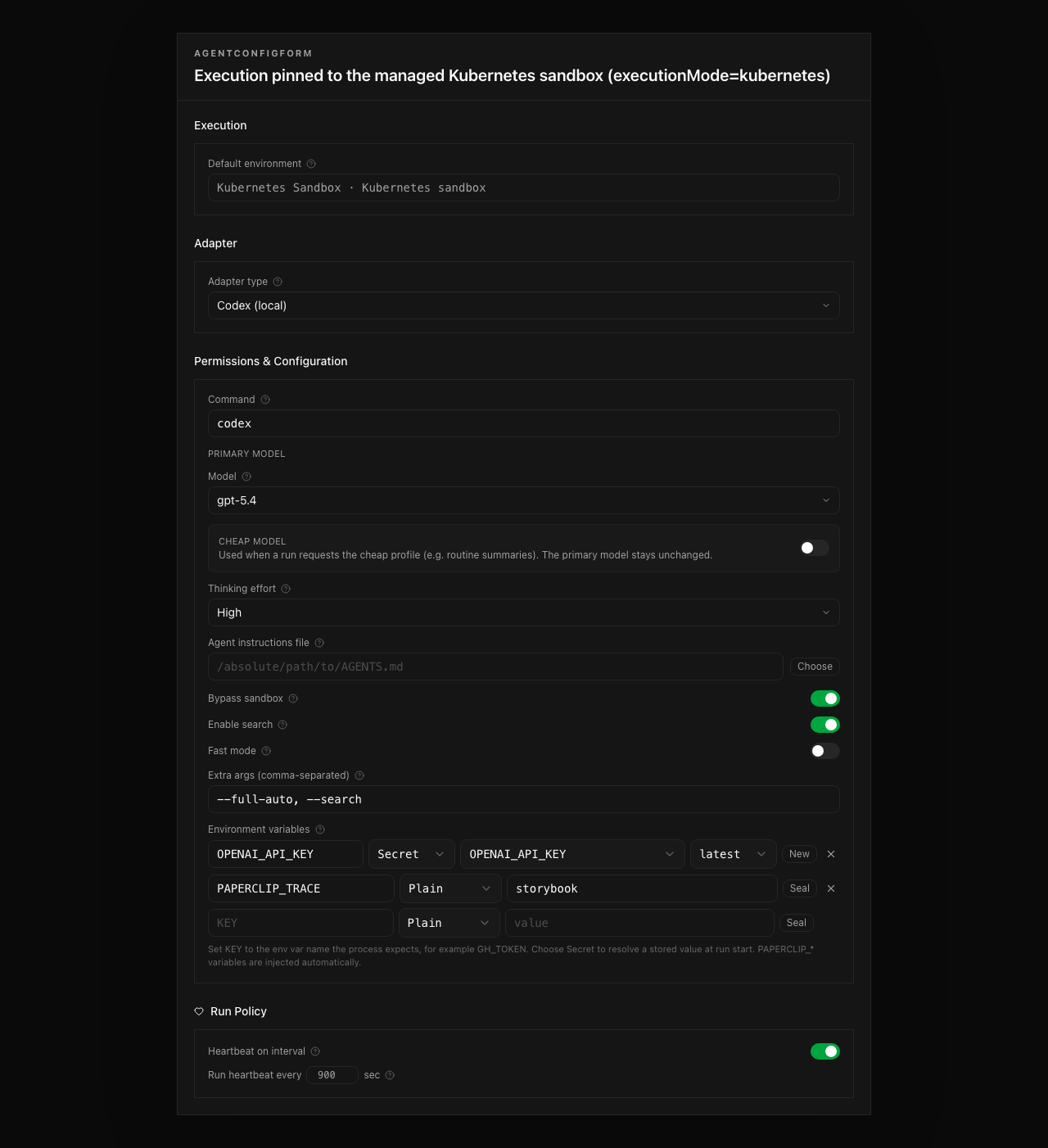
No managed environment available yet (warning notice, no silent local
fallback):
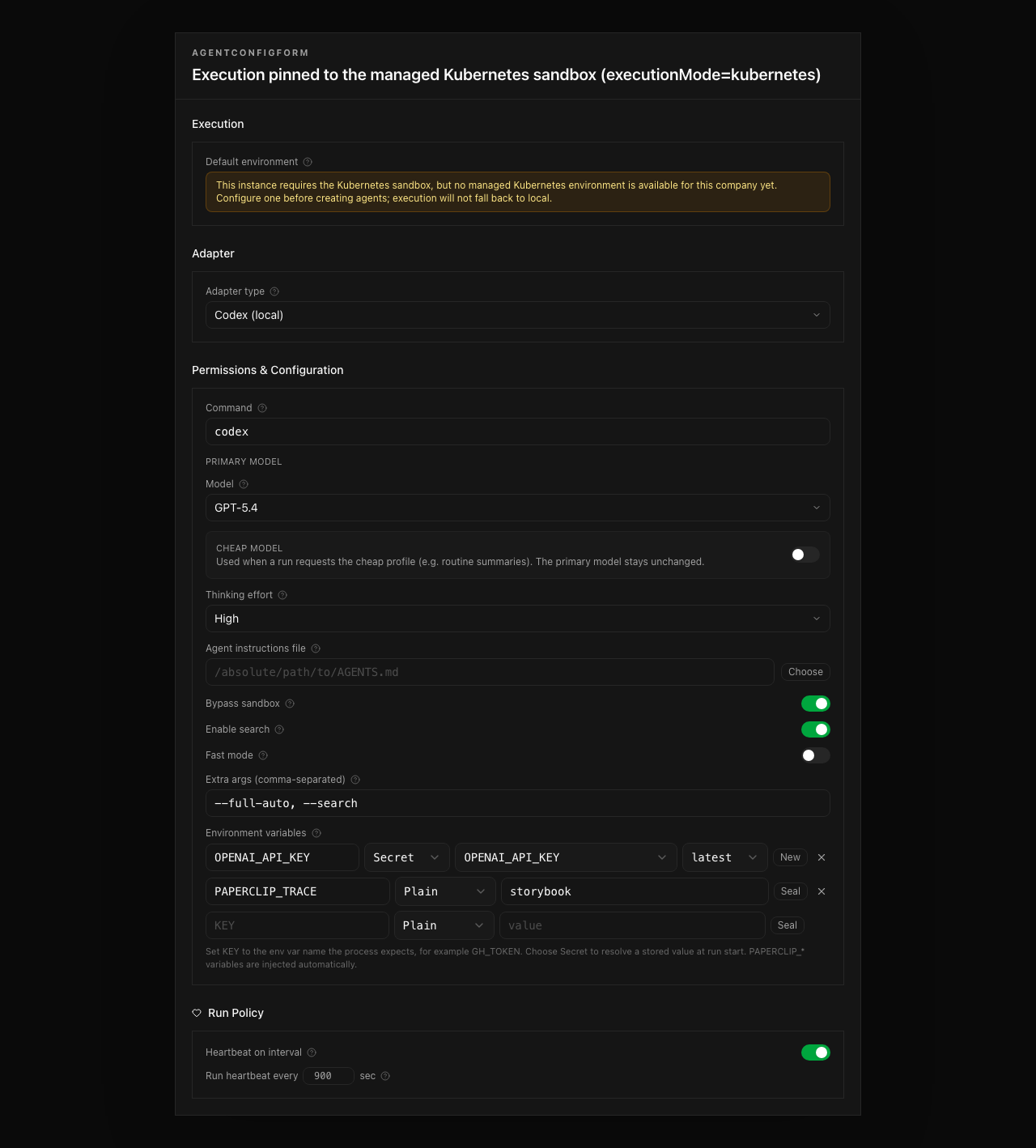
## Checklist
- [x] I have included a thinking path that traces from project context
to this change
- [x] I have specified the model used (with version and capability
details)
- [x] I have checked ROADMAP.md and confirmed this PR does not duplicate
planned core work
- [x] I have searched GitHub for duplicate or related PRs and linked
them above
- [x] I have either (a) linked existing issues with `Fixes: #` / `Closes
#` / `Refs #` OR (b) described the issue in-PR following the relevant
issue template
- [x] I have run tests locally and they pass
- [x] I have added or updated tests where applicable
- [x] If this change affects the UI, I have included before/after
screenshots
- [x] I have updated relevant documentation to reflect my changes
- [x] I have considered and documented any risks above
- [ ] All Paperclip CI gates are green
- [ ] Greptile is 5/5 with no open P2s, recommendations, or follow-ups
- [x] I will address all Greptile and reviewer comments before
requesting merge
🤖 Generated with [Claude Code](https://claude.com/claude-code)
---------
Co-authored-by: Claude Opus 4.8 (1M context) <noreply@anthropic.com>
## Thinking Path
> - Paperclip orchestrates AI agents through pluggable local adapters;
codex_local wraps OpenAI's `codex` CLI.
> - The codex_local adapter declares a hard-coded
`DEFAULT_CODEX_LOCAL_MODEL = "gpt-5.3-codex"` and multiple Paperclip
consumers (UI build-config, server route, OnboardingWizard, NewAgent
form, AgentConfigForm) fall back to it when the operator doesn't pick a
model.
> - That model — and every `*-codex` model plus the older
`gpt-5/5.1/5.2` lines — is API-key-only. Codex CLI rejects them on
ChatGPT subscription auth with "The 'gpt-5.3-codex' model is not
supported when using Codex with a ChatGPT account."
> - Every codex_local agent created through the default onboarding path
inherits this pin and breaks on its first heartbeat for any user authed
via `codex login` (ChatGPT).
> - claude_local already takes the right shape: its build-config only
sets `adapterConfig.model` when the operator actually picked one, and
falls through to whatever default `claude` CLI uses.
> - Codex CLI's own default is auth-mode-aware. ChatGPT-subscription
accounts get `gpt-5.5`; API-key accounts get the codex-tuned default. A
Paperclip-side pin masks this and downgrades whichever group it wasn't
built for.
> - This PR makes codex_local match claude_local's shape: omit
`adapterConfig.model` when the user picks "default," and let the CLI
choose. Subscription users stop breaking; API-key users stop getting
downgraded.
> - The benefit is auth-mode-correct defaults with no Paperclip-side
hard pin, plus future-proofing: when OpenAI bumps the CLI default we
inherit it for free.
## What Changed
- `packages/adapters/codex-local/src/ui/build-config.ts` — only set
`adapterConfig.model` when the operator picked one (parity with
`packages/adapters/claude-local/src/ui/build-config.ts`).
- `server/src/routes/agents.ts` — drop the codex_local-specific
`next.model = DEFAULT_CODEX_LOCAL_MODEL` fallback in
`applyCreateDefaultsByAdapterType`. Bypass-sandbox default is left in
place (security posture, not a model choice).
- `ui/src/pages/NewAgent.tsx`, `ui/src/components/AgentConfigForm.tsx`,
`ui/src/components/OnboardingWizard.tsx` — stop pre-populating the model
field with `DEFAULT_CODEX_LOCAL_MODEL` when the user selects the Codex
adapter. Other adapters' defaults (gemini_local, cursor, opencode_local)
are unchanged.
- `DEFAULT_CODEX_LOCAL_MODEL` is preserved as an exported constant for
downstream consumers / plugin authors who want to opt in to a pin; we
just stop forcing it on operators who didn't ask for one.
- Test: assert `buildCodexLocalConfig` omits `model` when input is
blank.
## Verification
- `pnpm exec vitest run
packages/adapters/codex-local/src/ui/build-config.test.ts
packages/adapters/codex-local/src/server/codex-args.test.ts
server/src/__tests__/adapter-registry.test.ts
server/src/__tests__/heartbeat-model-profile.test.ts
server/src/__tests__/agent-permissions-routes.test.ts` → 74/74 passing
- `pnpm exec vitest run ui/src/lib/duplicate-agent-payload.test.ts
ui/src/lib/acpx-model-filter.test.ts` → passing
- `pnpm tsc --noEmit -p .` → clean
- Live: I separately verified live during initial investigation that on
ChatGPT-subscription auth, `gpt-5.3-codex` is rejected and `gpt-5.5` is
what Codex CLI picks by default. Omitting model lets the CLI handle
that.
## Risks
- Telemetry: any sink that reads `adapterConfig.model` for cost
attribution will now see the empty/omitted case more often. The CLI
emits the actually-used model in its event stream; downstream telemetry
should already read from there for accuracy, but worth a check.
- Operator UX: "default" now means "whatever the CLI picks" instead of a
Paperclip-known model. The selectable catalog still includes `gpt-5.5`,
`gpt-5.4`, `gpt-5.3-codex`, etc. for operators who want to pin
explicitly.
- Existing agents are unaffected — their `adapterConfig.model` is
already set; this only changes the *new-agent* default flow.
## Related work
- Depends on: an open catalog-add PR adding `gpt-5.5` to the selectable
model list and to `CODEX_LOCAL_FAST_MODE_SUPPORTED_MODELS`. Operators
who want to switch to `gpt-5.5` explicitly need that PR merged first;
this PR is the structural change that makes "default" mean "let the CLI
choose."
- Closes#5371 — codex_local default model selection persists
`gpt-5.3-codex` instead of adapter default (this PR is the exact fix
#5371 proposes).
- Related: #5132 (opencode-local: hire-time default model fails on
ChatGPT-OAuth accounts) — same problem shape on a sibling adapter; not
fixed here but worth tracking for a parallel.
- Related: #5939 (codex_local adapter hardcodes `gpt-5.3-codex-spark`
validation, fails on ChatGPT OAuth accounts regardless of configured
model) — separate validation-path bug; not fixed here.
## Model Used
Claude (Sonnet-class), running inside Paperclip as a claude_local
executor.
## Checklist
- [x] I have included a thinking path that traces from project context
to this change
- [x] I have specified the model used (with version and capability
details)
- [x] I have checked ROADMAP.md and confirmed this PR does not duplicate
planned core work
- [x] I have searched GitHub for duplicate or related PRs and linked
them above
- [x] I have either (a) linked existing issues with `Fixes: #` / `Closes
#` / `Refs #` OR (b) described the issue in-PR following the relevant
issue template
- [x] I have run tests locally and they pass
- [x] I have added or updated tests where applicable
- [x] If this change affects the UI, I have included before/after
screenshots
- [x] I have updated relevant documentation to reflect my changes
- [x] I have considered and documented any risks above
- [x] All Paperclip CI gates are green
- [x] Greptile is 5/5 with no open P2s, recommendations, or follow-ups
- [x] I will address all Greptile and reviewer comments before
requesting merge
Co-authored-by: Paperclip <noreply@paperclip.ing>
## Thinking Path

> - Paperclip is the open source app people use to manage AI agents for
work.
> - The board UI is the operator surface where users create, assign,
monitor, and review work items.
> - The product language is moving toward "tasks" for user-facing work
items while the internal API and database still use "issues".
> - PR #7543 bundled this copy migration with broader
information-architecture work, which made the branch too large for
Greptile review.
> - This pull request peels the Issue-to-Task copy migration into a
smaller, independently reviewable change.
> - The benefit is clearer user-facing terminology, less agent confusion
via the Paperclip skill note, and a smaller PR that Greptile can review.

## Linked Issues or Issue Description

Refs #7645
Refs #7543
Refs PAP-10430

This PR was split out of #7543 so the Issue-to-Task copy migration can
be reviewed separately and the remaining IA PR can fall under Greptile's
file limit.

## What Changed

- Preserves Scott Tong's original `PAP-57` copy-only commit, with author
and co-author credit intact, to rename user-facing "Issues" copy to
"Tasks" across the UI while keeping routes/API/internal symbols as
`issue`.
- Updates onboarding and release-smoke browser selectors from `Create &
Open Issue` to `Create & Open Task`.
- Adds a terminology note to `skills/paperclip/SKILL.md` clarifying that
task and issue refer to the same Paperclip work item.
- Resolves the only cherry-pick conflict by keeping current search
artifacts support and changing visible search copy to "tasks".

## Verification

- `pnpm --filter @paperclipai/ui build` passed.
- `NODE_ENV=test pnpm exec vitest run
ui/src/components/IssuesList.test.tsx ui/src/components/Sidebar.test.tsx
ui/src/components/NewIssueDialog.test.tsx
ui/src/pages/IssueDetail.test.tsx` passed: 4 files, 66 tests.
- `git diff --check origin/master...HEAD` passed.
- Diff is 80 files, below Greptile's 100-file limit.
- Before/after UI copy examples: "Issues" -> "Tasks", "New Issue" ->
"New Task", "Create & Open Issue" -> "Create & Open Task".

## Risks

- Medium copy-risk: this intentionally changes user-facing terminology
broadly while keeping internal issue identifiers and routes unchanged.
- Some docs and APIs still say `issue`; the skill note clarifies this so
agents do not treat task and issue as separate entities.
- Browser-level visual validation is expected from CI because this local
container is missing usable browser dependencies.

> For core feature work, check [`ROADMAP.md`](ROADMAP.md) first and
discuss it in `#dev` before opening the PR. Feature PRs that overlap
with planned core work may need to be redirected — check the roadmap
first. See `CONTRIBUTING.md`.

## Model Used

Scott Tong authored the original `PAP-57` copy migration, assisted by
Claude Opus 4.8 and Paperclip agents per the preserved commit metadata.
Codex / GPT-5-class coding agent with shell, GitHub CLI, and repository
access performed the PR split, conflict resolution, skill note, and
verification.

## Checklist

- [x] I have included a thinking path that traces from project context
to this change
- [x] I have specified the model used (with version and capability
details)
- [x] I have checked ROADMAP.md and confirmed this PR does not duplicate
planned core work
- [x] I have searched GitHub for duplicate or related PRs and linked
them above
- [x] I have either (a) linked existing issues with `Fixes: #` / `Closes
#` / `Refs #` OR (b) described the issue in-PR following the relevant
issue template
- [x] I have run tests locally and they pass
- [x] I have added or updated tests where applicable
- [x] If this change affects the UI, I have included before/after
screenshots
- [x] I have updated relevant documentation to reflect my changes
- [x] I have considered and documented any risks above
- [x] All Paperclip CI gates are green
- [x] Greptile is 5/5 with no open P2s, recommendations, or follow-ups
- [x] I will address all Greptile and reviewer comments before
requesting merge

---------

Co-authored-by: scotttong <scott.tong@gmail.com>
Co-authored-by: Claude Opus 4.8 <noreply@anthropic.com>
Co-authored-by: Paperclip <noreply@paperclip.ing>
## Thinking Path

> - Paperclip orchestrates AI-agent companies through adapter-backed
local and external runtimes.
> - The agent configuration UI lets operators choose adapter models and
refresh model lists when adapters support live discovery.
> - Codex already had a live refresh path, but Claude Local only exposed
static fallback models and the UI hid the refresh action for Claude.
> - A newly available Claude Opus model should not require a code
release every time the model catalog changes.
> - This pull request adds Anthropic model discovery for Claude Local,
keeps the static fallback current with Claude Opus 4.8, and exposes the
existing refresh button in the Claude Local dropdown.
> - The benefit is that operators can refresh Claude models from the
same model selector flow they already use for Codex.

## What Changed

- Added `claude-opus-4-8` to the Claude Local fallback model list.
- Added Claude model discovery through Anthropic-compatible `GET
/v1/models` when `ANTHROPIC_API_KEY` is available.
- Added normal cache reuse, forced refresh support, a SHA-256-based
API-key fingerprint for cache keys, and warning logging for discovery
errors before fallback.
- Wired `claude_local.refreshModels` into the server adapter registry.
- Enabled the existing `Refresh models` dropdown action for
`claude_local` in `AgentConfigForm`.
- Added tests for Claude fallback, live discovery, API-failure fallback,
forced refresh, and the UI refresh-button gate.

## Verification

- `pnpm exec vitest run server/src/__tests__/adapter-models.test.ts`
- `pnpm exec vitest run ui/src/components/AgentConfigForm.test.ts`
- `pnpm --filter @paperclipai/adapter-claude-local typecheck`
- `pnpm --filter @paperclipai/server typecheck`
- `pnpm --filter @paperclipai/ui typecheck`
- Greptile review reached Confidence Score: 5/5 on commit `b796cf4f1`
with addressed threads resolved.

UI note: the visible change is a conditional action row inside the
existing model dropdown; the regression test covers that `claude_local`
now receives the refresh action.

## Risks

- Low risk. Without `ANTHROPIC_API_KEY`, Claude Local still uses the
static fallback list.
- If Anthropic model discovery fails or times out, Paperclip falls back
to the existing cached or static list.
- Bedrock environments remain on Bedrock-native model IDs.

## Model Used

OpenAI GPT-5 via Codex local coding agent, with repository file access,
shell command execution, git operations, and targeted test/typecheck
verification. Exact context window is not exposed by the runtime.

## Checklist

- [x] I have included a thinking path that traces from project context
to this change
- [x] I have specified the model used (with version and capability
details)
- [x] I have checked ROADMAP.md and confirmed this PR does not duplicate
planned core work
- [x] I have run tests locally and they pass
- [x] I have added or updated tests where applicable
- [x] If this change affects the UI, I have included before/after
screenshots
- [x] I have updated relevant documentation to reflect my changes
- [x] I have considered and documented any risks above
- [x] I will address all Greptile and reviewer comments before
requesting merge
## Thinking Path

> - Paperclip orchestrates AI agents for zero-human companies
> - There are many adapter types, one per agent-runtime product (Claude,
Codex, OpenCode, Cursor local CLI, etc.)
> - Cursor shipped a public TypeScript SDK on 2026-04-29 that exposes
Cursor's full hosted-agent platform (cloud VMs, harness, MCP, skills,
hooks)
> - Paperclip had no first-class adapter for this — agents that wanted
to use Cursor's managed cloud runtime had to fall back to the local CLI
adapter, which loses the cloud session, streaming, and durable run model
> - This PR adds a new `cursor_cloud` adapter built directly on
`@cursor/sdk`, with Paperclip's heartbeat mapped to Cursor's
durable-agent + per-run model
> - The benefit is that any Paperclip agent can now drive a Cursor cloud
agent across heartbeats with native session reuse, streaming, and
cancellation, while Paperclip remains the source of truth for issue/task
state

## What Changed

- New built-in adapter package `packages/adapters/cursor-cloud` (15
files, ~1.7k LOC) backed by `@cursor/sdk` ^1.0.12
- `src/server/execute.ts` — SDK-first lifecycle: `Agent.create` /
`Agent.resume` / `Agent.getRun` / `agent.send` / `run.stream` /
`run.wait`, with session reuse keyed on the (runtime env type, env name,
repo set) tuple
- `src/server/session.ts` — codec for `cursorAgentId` + `latestRunId` +
repo metadata, persisted in `runtime.sessionParams`
- `src/server/test.ts` — environment probe via `Cursor.me()` and
optional model validation via `Cursor.models.list()`
- `src/ui/parse-stdout.ts` + `src/cli/format-event.ts` — normalize
Cursor SDK message types (`status`, `thinking`, `assistant`, `user`,
`tool_call`, `tool_result`, `result`) into Paperclip transcript events
for the UI and CLI
- Registrations: `packages/shared/src/constants.ts`,
`packages/adapter-utils/src/session-compaction.ts`,
`server/src/adapters/{registry,builtin-adapter-types}.ts`,
`ui/src/adapters/{registry,adapter-display-registry}.ts` +
`ui/src/adapters/cursor-cloud/index.ts`, `cli/src/adapters/registry.ts`,
plus workspace deps in `cli`/`server`/`ui` `package.json`
- `ui/src/components/AgentConfigForm.tsx` — hide local-Cursor
`mode`/thinking-effort field for `cursor_cloud` (different config
surface)
- 11 vitest tests covering execute paths (fresh create, matching-resume,
active-run reattach, non-finished result), session codec round-trip,
transcript parsing, and config building

## Verification

Reviewer steps:

```bash
pnpm install
pnpm --filter @paperclipai/adapter-cursor-cloud typecheck   # → clean
pnpm vitest run packages/adapters/cursor-cloud              # → 11/11 passing
```

End-to-end check against a real Cursor cloud agent (requires
`CURSOR_API_KEY` and Cursor GitHub-app install on the target repo):

1. Create a `cursor_cloud` agent in Paperclip with `repoUrl` set to the
test repo, `repoStartingRef: main`, and `env.CURSOR_API_KEY` set
2. Trigger a heartbeat → adapter calls `Agent.create({ cloud: { env: {
type: "cloud" }, repos: [...] } })`, streams events, terminates on
`finished`
3. Trigger a second heartbeat → adapter calls `Agent.resume` or
`agent.send` follow-up depending on prior-run state, reusing
`cursorAgentId`
4. The Paperclip UI/CLI transcript reflects Cursor `status` / `thinking`
/ `assistant` events as they stream
5. Cancellation from Paperclip maps to `run.cancel()` or Cloud API v1
`cancelRun` for cross-heartbeat cancellation

A direct-SDK smoke run against a real repo (devinfoley/my_test_project @
main) confirmed: `Cursor.me()` ok → `Agent.create` → `agent.send` →
`run.stream()` (30 events) → terminal status `finished` in ~11s.

## Risks

- **New adapter, additive only.** No existing adapter or registry is
replaced; current `cursor` local-CLI adapter is untouched. Default
behavior of any existing agent is unchanged.
- **External dependency on `@cursor/sdk`.** Cursor's SDK is v1.0.x and
may evolve. Mocked unit tests cover the public surface used here; if the
SDK breaks compatibility we update the adapter independently.
- **Cost/budget.** `cursor_cloud` runs on Cursor's billed cloud VMs;
operators must understand they are spending money outside Paperclip's
budget controls when they enable this adapter. Same shape as other
API-billed adapters.
- **No webhook support in V1.** The SDK already provides
stream/wait/cancel/reattach, so V1 does not require a public callback
URL. If a future use case needs out-of-band wakes, we add a Cloud API v1
webhook bridge as a separate change. This is called out in the issue
plan document.
- **Lockfile.** Per repo policy, `pnpm-lock.yaml` is intentionally not
in this PR — CI's lockfile workflow will update it on merge given the
manifest changes.

## Model Used

- Provider: Anthropic Claude (via Claude Code / Paperclip `claude_local`
adapter)
- Model: `claude-opus-4-7` (Claude Opus 4.7), knowledge cutoff January
2026
- Mode: standard tool-use with extended reasoning
- Context: ~200k token window
- Capabilities used: code generation, multi-file edits, shell/test
execution, GitHub PR workflow

## Checklist

- [x] I have included a thinking path that traces from project context
to this change
- [x] I have specified the model used (with version and capability
details)
- [x] I have checked ROADMAP.md and confirmed this PR does not duplicate
planned core work
- [x] I have run tests locally and they pass (11/11 in
`packages/adapters/cursor-cloud`)
- [x] I have added or updated tests where applicable (4 new test files,
11 cases)
- [ ] If this change affects the UI, I have included before/after
screenshots (the only UI change is hiding the local-Cursor mode field on
the `cursor_cloud` adapter — happy to attach a screenshot if the
reviewer wants one)
- [x] I have updated relevant documentation to reflect my changes (issue
plan document supersedes the pre-SDK design; tracked in PAPA-203)
- [x] I have considered and documented any risks above
- [x] I will address all Greptile and reviewer comments before
requesting merge

---------

Co-authored-by: Paperclip <noreply@paperclip.ing>
## Thinking Path

> - Paperclip orchestrates AI agents across several adapter
implementations.
> - ACPX is a local adapter path that can proxy Claude and Codex-style
execution.
> - Its configuration needed stronger schema defaults, provider-aware
model handling, and better UI support.
> - Plugin authors also need clear docs for managed resources.
> - This pull request improves ACPX adapter configuration and documents
plugin-managed resources.
> - The benefit is a more predictable adapter setup path without
changing unrelated control-plane behavior.

## What Changed

- Improved ACPX config schema, execution config handling, UI build
config, and route coverage.
- Added ACPX model filtering support and tests.
- Updated the agent config form and storybook coverage for ACPX
model/provider behavior.
- Expanded plugin authoring documentation for managed resources.

## Verification

- `pnpm install --frozen-lockfile`
- `pnpm exec vitest run server/src/__tests__/acpx-local-execute.test.ts
server/src/__tests__/adapter-routes.test.ts
ui/src/lib/acpx-model-filter.test.ts`

## Risks

- Low-to-medium risk: adapter configuration behavior changes can affect
ACPX users, but the change is isolated to ACPX/plugin-doc surfaces and
covered by targeted adapter tests.

## Model Used

- OpenAI GPT-5 Codex via Paperclip `codex_local` adapter, with
shell/git/GitHub CLI tool use.

## Checklist

- [x] I have included a thinking path that traces from project context
to this change
- [x] I have specified the model used (with version and capability
details)
- [x] I have checked ROADMAP.md and confirmed this PR does not duplicate
planned core work
- [x] I have run tests locally and they pass
- [x] I have added or updated tests where applicable
- [x] If this change affects the UI, I have included before/after
screenshots
- [x] I have updated relevant documentation to reflect my changes
- [x] I have considered and documented any risks above
- [x] I will address all Greptile and reviewer comments before
requesting merge

---------

Co-authored-by: Paperclip <noreply@paperclip.ing>
> **Stacked PR (part 4 of 7).** Depends on:
  - PR #5114
  - PR #5115
  - PR #5116
> Diff against `master` includes commits from earlier PRs in the stack —
the new commit in this PR is the topmost one.

## Thinking Path

> - Paperclip orchestrates AI agents for zero-human companies
> - When creating an OpenCode-local agent, Paperclip currently validates
> `adapterConfig.model` against the *Paperclip host's* `opencode models`
output
> - SSH testing surfaced that this blocks creating an OpenCode agent for
an SSH
> environment: the model that exists on the SSH target isn't visible to
the
> host, so creation fails with "OpenCode requires `adapterConfig.model`
in
> provider/model format" even when the operator picked a real remote
model
> - The initial direction was environment-aware model discovery; the
final
> decision was to keep OpenCode on the same explicit-model pattern as
other
> adapters (default + curated list + manual override) and stop blocking
>   creation on host-side discovery
> - This PR does both: the adapter-models endpoint now accepts
`environmentId` and
> probes against the target environment, and the create-time hard gate
is
> replaced by `requireOpenCodeModelId` which validates `provider/model`
*format*
> without requiring host-local discovery. Test/run-time still surfaces
real
>   auth/availability problems
> - The benefit is that operators can create OpenCode agents for remote
> environments without out-of-band setup, and the model picker in the UI
>   reflects the actually-targeted environment

## What Changed

- Added `requireOpenCodeModelId(input)` in
`opencode-local/src/server/models.ts`,
  exported it from the adapter index
- `ensureOpenCodeModelConfiguredAndAvailable` now delegates the format
check to
  `requireOpenCodeModelId`
- `agentsApi.adapterModels(companyId, adapterType, { environmentId })`
now accepts
  an environment ID and passes it as a query parameter
- `queryKeys.agents.adapterModels` now keys on `(companyId, adapterType,
environmentId)`
- `server/src/routes/agents.ts` reads and validates the new query
parameter,
  forwarding it to the adapter's model probe
- `AgentConfigForm.tsx` and `OnboardingWizard.tsx` build the model query
key from
the currently selected default environment ID and disable autodetect for
  `opencode_local` (model selection is explicit)
- `NewAgent.tsx` simplified — no longer special-cases OpenCode
autodetect
- `company-portability.ts` no longer needs OpenCode-specific autodetect
handling
- Tests added/updated:
  `adapter-model-refresh-routes.test.ts`, `adapter-models.test.ts`,
`agent-permissions-routes.test.ts`,
`opencode-local/src/server/models.test.ts`

## Verification

- `pnpm --filter @paperclipai/server test -- adapter-models
adapter-model-refresh agent-permissions`
- `pnpm --filter @paperclipai/adapter-opencode-local test`
- `pnpm --filter @paperclipai/ui test -- AgentConfigForm
OnboardingWizard NewAgent`
- Manual QA in browser:
1. Boot Paperclip on Tailscale-bound port (so it's reachable from
another
machine), create an OpenCode-local agent, switch the default environment
between two installed sandboxes, and confirm the model list refreshes
     per-environment
  2. Submit with a malformed `provider/model` string and verify the new
     `requireOpenCodeModelId` error surfaces
- Before/after screenshots attached for `AgentConfigForm` model picker

## Risks

- Behavioural shift: switching default environment now triggers a model
refetch.
Should be cheap but introduces a new UI loading state for OpenCode
users.
- Removing dynamic autodetect for OpenCode: if any user configured an
agent
without specifying `model` and relied on autodetect populating it, that
agent
will now fail at submit time. Mitigation: validation error is explicit
and
  actionable.
- New query string parameter on `/api/companies/:id/adapter-models` —
older
clients that omit it still work (parameter is optional and defaults to
null).

## Model Used

- OpenAI GPT-5.4 (reasoning effort: high) via Codex CLI
- Provider: OpenAI
- Used to author the code changes in this PR

## Checklist

- [x] I have included a thinking path that traces from project context
to this change
- [x] I have specified the model used (with version and capability
details)
- [x] I have checked ROADMAP.md and confirmed this PR does not duplicate
planned core work
- [x] I have run tests locally and they pass
- [x] I have added or updated tests where applicable
- [x] If this change affects the UI, I have included before/after
screenshots
- [ ] I have updated relevant documentation to reflect my changes — N/A
- [x] I have considered and documented any risks above
- [x] I will address all Greptile and reviewer comments before
requesting merge
## Thinking Path

> - Paperclip orchestrates AI agents for autonomous companies, and
heartbeat execution is the control-plane loop that keeps assigned work
moving.
> - Max-turn exhaustion is a recoverable local-adapter stop condition
for Claude and Gemini agents when a run needs another heartbeat to
continue safely.
> - The previous behavior could leave max-turn continuation details hard
to inspect, and duplicate/stale continuation wakes could keep running
after issue state changed.
> - The adapter layer also needed to avoid trusting arbitrary
stdout/stderr text as scheduler control metadata.
> - This pull request adds bounded max-turn continuation scheduling,
visible retry state, structured stop metadata handling, and
stale/duplicate continuation guards.
> - The benefit is safer automatic continuation after max-turn stops,
clearer operator visibility, and fewer duplicate or stale agent runs.

## What Changed

- Replaces closed PR #4952, whose head repository was deleted.
- Rebases the recovered max-turn continuation branch onto current
`paperclipai/paperclip:master`.
- Adds max-turn continuation scheduling and retry-state plumbing for
heartbeat runs.
- Adds stale/duplicate continuation suppression when issue status,
ownership, or execution locks change.
- Normalizes Claude/Gemini max-turn detection around structured stop
metadata instead of unstructured stdout/stderr text.
- Surfaces max-turn continuation settings and retry visibility in the
board UI.
- Adds focused server, adapter, and UI tests for max-turn stop metadata,
retry scheduling, stale queued-run invalidation, adapter
parsing/execution, run ledger display, and agent config patching.

## Verification

- `pnpm install --no-frozen-lockfile` to refresh local dependencies
after rebasing onto current `master`.
- `pnpm run preflight:workspace-links && pnpm exec vitest run
server/src/__tests__/claude-local-adapter.test.ts
server/src/__tests__/claude-local-execute.test.ts
server/src/__tests__/gemini-local-adapter.test.ts
server/src/__tests__/gemini-local-execute.test.ts
server/src/__tests__/heartbeat-retry-scheduling.test.ts
server/src/__tests__/heartbeat-stale-queue-invalidation.test.ts
server/src/services/heartbeat-stop-metadata.test.ts
ui/src/components/IssueRunLedger.test.tsx
ui/src/lib/agent-config-patch.test.ts ui/src/lib/runRetryState.test.ts
--testTimeout=20000`
- `pnpm --filter @paperclipai/adapter-claude-local typecheck && pnpm
--filter @paperclipai/adapter-gemini-local typecheck && pnpm --filter
@paperclipai/server typecheck && pnpm --filter @paperclipai/ui
typecheck`
- UI screenshot note: the UI changes are limited to config/ledger state
rendering rather than layout changes; component/unit coverage above
verifies the rendered behavior.

## Risks

- Medium behavior risk: heartbeat retry gating now suppresses max-turn
continuations when issue state or execution locks drift, so any callers
that relied on stale continuations running will now see cancellation
instead.
- Low adapter risk: Claude/Gemini unstructured text no longer triggers
max-turn scheduler metadata, so only structured stop signals and Gemini
exit code 53 are trusted.
- No database migrations.

> For core feature work, check [`ROADMAP.md`](ROADMAP.md) first and
discuss it in `#dev` before opening the PR. Feature PRs that overlap
with planned core work may need to be redirected — check the roadmap
first. See `CONTRIBUTING.md`.

## Model Used

- OpenAI Codex coding agent, GPT-5-class model, tool-enabled local
repository editing and command execution.

## Checklist

- [x] I have included a thinking path that traces from project context
to this change
- [x] I have specified the model used (with version and capability
details)
- [x] I have checked ROADMAP.md and confirmed this PR does not duplicate
planned core work
- [x] I have run tests locally and they pass
- [x] I have added or updated tests where applicable
- [x] If this change affects the UI, I have included before/after
screenshots (not applicable: state/default rendering only; covered by
component/unit tests)
- [x] I have updated relevant documentation to reflect my changes (not
applicable: no user-facing command or docs contract changed)
- [x] I have considered and documented any risks above
- [x] I will address all Greptile and reviewer comments before
requesting merge

---------

Co-authored-by: Paperclip <noreply@paperclip.ing>
## Thinking Path
> - Paperclip orchestrates AI-agent companies through a control plane
that can start, supervise, and recover agent runs.
> - Local adapters are the bridge between Paperclip issues and concrete
agent runtimes such as Claude, Codex, and other ACP-compatible tools.
> - The roadmap calls out broader “bring your own agent” and claw-style
agent support, and ACPX gives Paperclip one path to normalize multiple
ACP agents behind a single adapter.
> - The branch needed to become one reviewable PR against current
`paperclipai/paperclip:master`, without carrying stale base conflicts or
generated lockfile churn.
> - This pull request adds an experimental built-in `acpx_local`
adapter, integrates it through the server/CLI/UI adapter surfaces, and
adds regression coverage for runtime execution, skill sync, stream
parsing, diagnostics, and log redaction.
> - The benefit is that Paperclip can run Claude/Codex/custom ACP agents
through ACPX while keeping operator configuration, skills, logging, and
transcript rendering inside the existing adapter model.
## What Changed
- Added `@paperclipai/adapter-acpx-local` with server execution, config
schema, ACPX session handling, CLI formatting, UI config helpers, and
stdout parsing.
- Registered `acpx_local` across CLI, server, shared constants, UI
adapter metadata, adapter capabilities, and agent creation/editing
surfaces.
- Added ACPX runtime execution support with persistent sessions,
local-agent JWT environment handling, skill snapshots, runtime skill
materialization, and isolation/security regressions.
- Added ACPX adapter diagnostics and marked the adapter experimental in
the UI.
- Added command/env secret redaction for resolved command metadata in
adapter-utils, server event storage, and the Agent Detail invocation UI.
- Added Storybook coverage for ACPX config, transcript rendering, and
skill states, plus PR screenshots under `docs/pr-screenshots/pap-2944/`.
- Rebased the branch onto current `public-gh/master`; `pnpm-lock.yaml`
is intentionally not included and there are no migration/schema changes.
## Verification
- `pnpm exec vitest run
packages/adapters/acpx-local/src/server/execute.test.ts
packages/adapters/acpx-local/src/server/test.test.ts
packages/adapters/acpx-local/src/cli/format-event.test.ts
packages/adapters/acpx-local/src/ui/parse-stdout.test.ts
packages/adapter-utils/src/server-utils.test.ts
server/src/__tests__/redaction.test.ts
server/src/__tests__/acpx-local-execute.test.ts
server/src/__tests__/acpx-local-skill-sync.test.ts
server/src/__tests__/acpx-local-adapter-environment.test.ts
server/src/__tests__/adapter-routes.test.ts
server/src/__tests__/agent-skills-routes.test.ts
ui/src/adapters/metadata.test.ts` — 12 files, 87 tests passed.
- `pnpm --filter @paperclipai/adapter-acpx-local typecheck` — passed.
- `pnpm --filter @paperclipai/server typecheck` — passed.
- `pnpm --filter @paperclipai/ui typecheck` — passed.
- Confirmed PR diff does not include `pnpm-lock.yaml`, database schema
files, or migrations.
Screenshots:


## Risks
- Medium risk: this introduces a new built-in adapter package and
touches runtime execution, adapter registration, agent config, skills,
and transcript rendering.
- ACPX and ACP agent behavior can vary by installed tool versions; the
adapter is marked experimental to set operator expectations.
- `pnpm-lock.yaml` is excluded per repository PR policy, so dependency
lock refresh must be handled by the repo’s automation or maintainers.
- No database migration risk: no schema or migration files changed.
> For core feature work, check [`ROADMAP.md`](ROADMAP.md) first and
discuss it in `#dev` before opening the PR. Feature PRs that overlap
with planned core work may need to be redirected — check the roadmap
first. See `CONTRIBUTING.md`.
## Model Used
- OpenAI Codex coding agent based on GPT-5, with repository tool use,
shell execution, git operations, and local verification. Exact hosted
context window was not exposed in this environment.
## Checklist
- [x] I have included a thinking path that traces from project context
to this change
- [x] I have specified the model used (with version and capability
details)
- [x] I have checked ROADMAP.md and confirmed this PR does not duplicate
planned core work
- [x] I have run tests locally and they pass
- [x] I have added or updated tests where applicable
- [x] If this change affects the UI, I have included before/after
screenshots
- [x] I have updated relevant documentation to reflect my changes
- [x] I have considered and documented any risks above
- [x] I will address all Greptile and reviewer comments before
requesting merge
---------
Co-authored-by: Paperclip <noreply@paperclip.ing>
## Thinking Path

> - Paperclip is a control plane for autonomous AI companies, where
adapters are the boundary between the board, agents, and execution
runtimes.
> - Local adapters currently expose a primary runtime configuration, but
operators often need a cheaper model lane for routine or low-risk work.
> - That cheap lane has to stay adapter-owned: runtime profile settings
should not mutate the primary adapter config or bypass existing
auth/secret mediation.
> - Issue creation also needs an ergonomic way to request primary,
cheap, or custom model behavior for a selected assignee.
> - This pull request adds a first-class `cheap` model profile contract
across adapter capabilities, heartbeat config resolution, agent
configuration, and issue creation.
> - The benefit is cheaper task execution can be configured and
requested explicitly while preserving adapter boundaries, secret
handling, and audit visibility.

## What Changed

- Added adapter model-profile capability metadata and a `cheap` profile
contract for supported local adapters.
- Applied `runtimeConfig.modelProfiles.cheap.adapterConfig` during
heartbeat config resolution, including requested/applied/fallback run
metadata.
- Added agent configuration UI for cheap model profile settings without
writing those settings into primary `adapterConfig`.
- Added New Issue assignee model lane controls for Primary / Cheap /
Custom and request payload handling.
- Added run ledger profile badges and Storybook stories for the new
cheap-lane UI states.
- Added tests for validators, heartbeat model profile application,
permission/secret mediation, UI payload helpers, and run ledger
rendering.
- Added committed UI verification screenshots under
`docs/pr-screenshots/pap-2837/`.
- Addressed Greptile review feedback around cheap-profile defaults,
shared profile types, and fallback test data.

## Verification

Local:

- `pnpm exec vitest run packages/shared/src/validators/issue.test.ts
server/src/__tests__/adapter-registry.test.ts
server/src/__tests__/agent-permissions-routes.test.ts
server/src/__tests__/heartbeat-model-profile.test.ts
ui/src/components/IssueRunLedger.test.tsx
ui/src/lib/agent-config-patch.test.ts
ui/src/lib/issue-assignee-overrides.test.ts
ui/src/lib/new-agent-runtime-config.test.ts` — passed, 8 files / 103
tests.
- `pnpm exec vitest run ui/src/lib/new-agent-runtime-config.test.ts
ui/src/components/IssueRunLedger.test.tsx` — passed after
Greptile/rebase follow-up, 2 files / 17 tests.
- `pnpm --filter @paperclipai/ui typecheck` — passed after
Greptile/rebase follow-up.
- `pnpm -r typecheck` — passed.
- `pnpm build` — passed.
- `pnpm test:run` — did not complete successfully in this local
worktree: it stopped in pre-existing `@paperclipai/adapter-utils`
sandbox/SSH fixture suites outside this PR diff. Failures were 5s local
timeouts plus `git init -b` unsupported by this machine's Git 2.21.0.
The branch-specific targeted suites above passed.
- Branch was fetched/rebased onto `public-gh/master`; `git rev-list
--left-right --count public-gh/master...HEAD` reports `0 9`.

Remote PR checks on latest head
`e30bf399146451c86cee98ed528d51d33fa5af5a`:

- `policy` — passed.
- `verify` — passed.
- `e2e` — passed.
- `Greptile Review` — passed, confidence score 5/5; Greptile review
threads resolved.
- `security/snyk (cryppadotta)` — passed.

Screenshots:

- [New issue cheap lane
desktop](https://github.com/paperclipai/paperclip/blob/PAP-2837-plan-cheap-model-for-adapters-that-can-support-it/docs/pr-screenshots/pap-2837/newissue-cheap-desktop.png)
- [New issue custom lane
desktop](https://github.com/paperclipai/paperclip/blob/PAP-2837-plan-cheap-model-for-adapters-that-can-support-it/docs/pr-screenshots/pap-2837/newissue-custom-desktop.png)
- [New issue unsupported adapter
desktop](https://github.com/paperclipai/paperclip/blob/PAP-2837-plan-cheap-model-for-adapters-that-can-support-it/docs/pr-screenshots/pap-2837/newissue-unsupported-desktop.png)
- [Run ledger model profile badges
desktop](https://github.com/paperclipai/paperclip/blob/PAP-2837-plan-cheap-model-for-adapters-that-can-support-it/docs/pr-screenshots/pap-2837/runledger-profile-badges-desktop.png)
- Mobile variants are also in `docs/pr-screenshots/pap-2837/`.

## Risks

- Medium: heartbeat config mediation now merges runtime model profiles
into adapter configs, so adapter secret normalization and host-command
restrictions must keep covering nested config paths.
- Medium: the UI adds another issue creation choice; unsupported
adapters must keep hiding the cheap lane and preserve primary behavior.
- Low migration risk: no database migration is included.

> For core feature work, check [`ROADMAP.md`](ROADMAP.md) first and
discuss it in `#dev` before opening the PR. Feature PRs that overlap
with planned core work may need to be redirected — check the roadmap
first. See `CONTRIBUTING.md`.

## Model Used

OpenAI Codex coding agent using GPT-5-class reasoning with repo tool use
and command execution. Exact served model/context window was not exposed
by the runtime.

## Checklist

- [x] I have included a thinking path that traces from project context
to this change
- [x] I have specified the model used (with version and capability
details)
- [x] I have checked ROADMAP.md and confirmed this PR does not duplicate
planned core work
- [ ] I have run tests locally and they pass
- [x] I have added or updated tests where applicable
- [x] If this change affects the UI, I have included before/after
screenshots
- [x] I have updated relevant documentation to reflect my changes
- [x] I have considered and documented any risks above
- [x] I will address all Greptile and reviewer comments before
requesting merge

---------

Co-authored-by: Paperclip <noreply@paperclip.ing>
Co-authored-by: Claude Opus 4.7 <noreply@anthropic.com>
## Thinking Path

> - Paperclip's board UI and bundled skills are the operator layer for
configuring agents, routines, issue workflows, and local troubleshooting
loops.
> - The prior rollup mixed this operator polish with database backups,
backend reliability, thread scale, and cost/workflow primitives.
> - This pull request isolates the remaining board QoL, settings,
issue-detail integration, adapter config cleanup, and skills smoke
tooling.
> - It includes some integration-level overlap with the thread and
workflow slices so this branch can run from `origin/master` while still
preserving the full original work.
> - Preferred merge order is the narrower primitives first, then this
integration PR last.
> - The benefit is that reviewers can inspect the user-facing
board/settings/skills layer separately from backend infrastructure
changes.

## What Changed

- Added board/settings polish for agents, routines, company settings,
project workspace detail, and issue detail controls.
- Added agent/routine UI regression tests and New Issue dialog coverage.
- Integrated issue-detail activity/cost/interaction surfaces and leaf
work pause/resume controls.
- Cleaned bundled adapter UI config defaults and onboarding copy.
- Added terminal-bench loop and work-stoppage diagnosis skills plus a
smoke test script.
- Updated attachment type handling and Paperclip skill/API guidance.

## Verification

- `pnpm install --frozen-lockfile`
- `pnpm exec vitest run ui/src/pages/Agents.test.tsx
ui/src/pages/Routines.test.tsx ui/src/components/NewIssueDialog.test.tsx
ui/src/pages/IssueDetail.test.tsx
server/src/__tests__/costs-service.test.ts
server/src/__tests__/issue-thread-interaction-routes.test.ts
server/src/__tests__/issue-thread-interactions-service.test.ts`
- Result: 7 test files passed, 54 tests passed.
- `pnpm run smoke:terminal-bench-loop-skill`
- Result: JSON output included `"ok": true` and `"cleanup": true`.
- UI screenshots not included because verification is focused
component/page coverage for the changed board surfaces.

## Risks

- This is the integration-heavy PR in the split and intentionally
overlaps some component/API primitives with the issue-thread and
workflow PRs so it can run from `origin/master`.
- Preferred merge order: #4859, #4860, #4861, #4862, then this PR last.
If earlier branches merge first, this PR may need a straightforward
conflict refresh in shared UI files.
- The terminal-bench smoke script creates temporary mock issues and
relies on cleanup; the verified run returned `cleanup: true`.

> For core feature work, check [`ROADMAP.md`](ROADMAP.md) first and
discuss it in `#dev` before opening the PR. Feature PRs that overlap
with planned core work may need to be redirected — check the roadmap
first. See `CONTRIBUTING.md`.

## Model Used

- OpenAI Codex, GPT-5.5, code execution and GitHub CLI tool use, medium
reasoning effort.

## Checklist

- [x] I have included a thinking path that traces from project context
to this change
- [x] I have specified the model used (with version and capability
details)
- [x] I have checked ROADMAP.md and confirmed this PR does not duplicate
planned core work
- [x] I have run tests locally and they pass
- [x] I have added or updated tests where applicable
- [x] If this change affects the UI, I have included before/after
screenshots
- [x] I have updated relevant documentation to reflect my changes
- [x] I have considered and documented any risks above
- [x] I will address all Greptile and reviewer comments before
requesting merge

---------

Co-authored-by: Paperclip <noreply@paperclip.ing>
## Thinking Path

> - Paperclip orchestrates AI agents for zero-human companies
> - Agents run inside environments (local, SSH, E2B sandbox)
> - Operators need to configure and manage these environments
> - But environment settings were buried inside the general company
settings page, making them hard to find
> - Additionally, when testing an agent from the configuration form, the
test always ran locally regardless of which environment was selected
> - This PR moves environments into a dedicated top-level company
settings section and wires the "Test Environment" button to run inside
the selected environment
> - The benefit is operators can find and manage environments more
easily, and the test button now validates the actual environment the
agent will use

## What Changed

- Added a dedicated `CompanyEnvironments` settings page with its own
route and sidebar entry
- Updated `CompanySettingsSidebar` and `CompanySettingsNav` to include
the new environments section
- Modified the agent test route (`POST /agents/:id/test`) to accept an
optional `environmentId` parameter
- Updated all adapter `test.ts` handlers to resolve and use the
specified execution target environment
- Added `resolveTestExecutionTarget` to `execution-target.ts` for remote
environment test resolution with cwd fallback
- Moved the "Test Environment" button and its feedback display into the
`NewAgent` page footer for better UX flow

## Verification

- `pnpm test` — all existing and new tests pass
- `pnpm typecheck` — clean
- Manual: navigate to Company Settings, confirm "Environments" appears
as a top-level section
- Manual: configure an agent with a non-local environment, click "Test
Environment", confirm the test runs inside that environment

## Risks

- Low risk. UI-only routing change for the settings page. The
test-in-environment change adds an optional parameter with a local
fallback, so existing behavior is preserved when no environment is
specified.

## Model Used

Codex GPT 5.4 high via Paperclip.

## Checklist

- [x] I have included a thinking path that traces from project context
to this change
- [x] I have specified the model used (with version and capability
details)
- [x] I have checked ROADMAP.md and confirmed this PR does not duplicate
planned core work
- [x] I have run tests locally and they pass
- [x] I have added or updated tests where applicable
- [x] If this change affects the UI, I have included before/after
screenshots
- [x] I have updated relevant documentation to reflect my changes
- [x] I have considered and documented any risks above
- [x] I will address all Greptile and reviewer comments before
requesting merge
## Thinking Path

> - Paperclip is a control plane, so optional execution providers should
sit at the plugin edge instead of hardcoding provider-specific behavior
into core shared/server/ui layers.
> - Sandbox environments are already first-class, and the fake provider
proves the built-in path; the remaining gap was that real providers
still leaked provider-specific config and runtime assumptions into core.
> - That coupling showed up in config normalization, secret persistence,
capabilities reporting, lease reconstruction, and the board UI form
fields.
> - As long as core knew about those provider-shaped details, shipping a
provider as a pure third-party plugin meant every new provider would
still require host changes.
> - This pull request generalizes the sandbox provider seam around
schema-driven plugin metadata and generic secret-ref handling.
> - The runtime and UI now consume provider metadata generically, so
core only special-cases the built-in fake provider while third-party
providers can live entirely in plugins.

## What Changed

- Added generic sandbox-provider capability metadata so plugin-backed
providers can expose `configSchema` through shared environment support
and the environments capabilities API.
- Reworked sandbox config normalization/persistence/runtime resolution
to handle schema-declared secret-ref fields generically, storing them as
Paperclip secrets and resolving them for probe/execute/release flows.
- Generalized plugin sandbox runtime handling so provider validation,
reusable-lease matching, lease reconstruction, and plugin worker calls
all operate on provider-agnostic config instead of provider-shaped
branches.
- Replaced hardcoded sandbox provider form fields in Company Settings
with schema-driven rendering and blocked agent environment selection
from the built-in fake provider.
- Added regression coverage for the generic seam across shared support
helpers plus environment config, probe, routes, runtime, and
sandbox-provider runtime tests.

## Verification

- `pnpm vitest --run packages/shared/src/environment-support.test.ts
server/src/__tests__/environment-config.test.ts
server/src/__tests__/environment-probe.test.ts
server/src/__tests__/environment-routes.test.ts
server/src/__tests__/environment-runtime.test.ts
server/src/__tests__/sandbox-provider-runtime.test.ts`
- `pnpm -r typecheck`

## Risks

- Plugin sandbox providers now depend more heavily on accurate
`configSchema` declarations; incorrect schemas can misclassify
secret-bearing fields or omit required config.
- Reusable lease matching is now metadata-driven for plugin-backed
providers, so providers that fail to persist stable metadata may
reprovision instead of resuming an existing lease.
- The UI form is now fully schema-driven for plugin-backed sandbox
providers; provider manifests without good defaults or descriptions may
produce a rougher operator experience.

## Model Used

- OpenAI Codex via `codex_local`
- Model ID: `gpt-5.4`
- Reasoning effort: `high`
- Context window observed in runtime session metadata: `258400` tokens
- Capabilities used: terminal tool execution, git, and local code/test
inspection

## Checklist

- [x] I have included a thinking path that traces from project context
to this change
- [x] I have specified the model used (with version and capability
details)
- [x] I have checked ROADMAP.md and confirmed this PR does not duplicate
planned core work
- [x] I have run tests locally and they pass
- [x] I have added or updated tests where applicable
- [ ] If this change affects the UI, I have included before/after
screenshots
- [x] I have updated relevant documentation to reflect my changes
- [x] I have considered and documented any risks above
- [x] I will address all Greptile and reviewer comments before
requesting merge
## Thinking Path

> - Paperclip orchestrates AI agents for zero-human companies
> - Adapter execution and retry classification decide whether agent work
pauses, retries, or recovers automatically
> - Transient provider failures need to be classified precisely so
Paperclip does not convert retryable upstream conditions into false hard
failures
> - At the same time, operators need an up-to-date model list for
Codex-backed agents and prompts should nudge agents toward targeted
verification instead of repo-wide sweeps
> - This pull request tightens transient recovery classification for
Claude and Codex, updates the agent prompt guidance, and adds Codex
model refresh support end-to-end
> - The benefit is better automatic retry behavior plus fresher
operator-facing model configuration

## What Changed

- added Codex usage-limit retry-window parsing and Claude extra-usage
transient classification
- normalized the heartbeat transient-recovery contract across adapter
executions and heartbeat scheduling
- documented that deferred comment wakes only reopen completed issues
for human/comment-reopen interactions, while system follow-ups leave
closed work closed
- updated adapter-utils prompt guidance to prefer targeted verification
- added Codex model refresh support in the server route, registry,
shared types, and agent config form
- added adapter/server tests covering the new parsing, retry scheduling,
and model-refresh behavior

## Verification

- `pnpm exec vitest run --project @paperclipai/adapter-utils
packages/adapter-utils/src/server-utils.test.ts`
- `pnpm exec vitest run --project @paperclipai/adapter-claude-local
packages/adapters/claude-local/src/server/parse.test.ts`
- `pnpm exec vitest run --project @paperclipai/adapter-codex-local
packages/adapters/codex-local/src/server/parse.test.ts`
- `pnpm exec vitest run --project @paperclipai/server
server/src/__tests__/adapter-model-refresh-routes.test.ts
server/src/__tests__/adapter-models.test.ts
server/src/__tests__/claude-local-execute.test.ts
server/src/__tests__/codex-local-execute.test.ts
server/src/__tests__/heartbeat-process-recovery.test.ts
server/src/__tests__/heartbeat-retry-scheduling.test.ts`

## Risks

- Moderate behavior risk: retry classification affects whether runs
auto-recover or block, so mistakes here could either suppress needed
retries or over-retry real failures
- Low workflow risk: deferred comment wake reopening is intentionally
scoped to human/comment-reopen interactions so system follow-ups do not
revive completed issues unexpectedly

> For core feature work, check [`ROADMAP.md`](ROADMAP.md) first and
discuss it in `#dev` before opening the PR. Feature PRs that overlap
with planned core work may need to be redirected — check the roadmap
first. See `CONTRIBUTING.md`.

## Model Used

- OpenAI Codex GPT-5-based coding agent with tool use and code execution
in the Codex CLI environment

## Checklist

- [x] I have included a thinking path that traces from project context
to this change
- [x] I have specified the model used (with version and capability
details)
- [x] I have checked ROADMAP.md and confirmed this PR does not duplicate
planned core work
- [x] I have run tests locally and they pass
- [x] I have added or updated tests where applicable
- [ ] If this change affects the UI, I have included before/after
screenshots
- [ ] I have updated relevant documentation to reflect my changes
- [x] I have considered and documented any risks above
- [x] I will address all Greptile and reviewer comments before
requesting merge

---------

Co-authored-by: Paperclip <noreply@paperclip.ing>
## Thinking Path

> - Paperclip orchestrates AI agents for zero-human companies
> - The environments subsystem already models execution environments,
but before this branch there was no end-to-end SSH-backed runtime path
for agents to actually run work against a remote box
> - That meant agents could be configured around environment concepts
without a reliable way to execute adapter sessions remotely, sync
workspace state, and preserve run context across supported adapters
> - We also need environment selection to participate in normal
Paperclip control-plane behavior: agent defaults, project/issue
selection, route validation, and environment probing
> - Because this capability is still experimental, the UI surface should
be easy to hide and easy to remove later without undoing the underlying
implementation
> - This pull request adds SSH environment execution support across the
runtime, adapters, routes, schema, and tests, then puts the visible
environment-management UI behind an experimental flag
> - The benefit is that we can validate real SSH-backed agent execution
now while keeping the user-facing controls safely gated until the
feature is ready to come out of experimentation

## What Changed

- Added SSH-backed execution target support in the shared adapter
runtime, including remote workspace preparation, skill/runtime asset
sync, remote session handling, and workspace restore behavior after
runs.
- Added SSH execution coverage for supported local adapters, plus remote
execution tests across Claude, Codex, Cursor, Gemini, OpenCode, and Pi.
- Added environment selection and environment-management backend support
needed for SSH execution, including route/service work, validation,
probing, and agent default environment persistence.
- Added CLI support for SSH environment lab verification and updated
related docs/tests.
- Added the `enableEnvironments` experimental flag and gated the
environment UI behind it on company settings, agent configuration, and
project configuration surfaces.

## Verification

- `pnpm exec vitest run
packages/adapters/claude-local/src/server/execute.remote.test.ts
packages/adapters/cursor-local/src/server/execute.remote.test.ts
packages/adapters/gemini-local/src/server/execute.remote.test.ts
packages/adapters/opencode-local/src/server/execute.remote.test.ts
packages/adapters/pi-local/src/server/execute.remote.test.ts`
- `pnpm exec vitest run server/src/__tests__/environment-routes.test.ts`
- `pnpm exec vitest run
server/src/__tests__/instance-settings-routes.test.ts`
- `pnpm exec vitest run ui/src/lib/new-agent-hire-payload.test.ts
ui/src/lib/new-agent-runtime-config.test.ts`
- `pnpm -r typecheck`
- `pnpm build`
- Manual verification on a branch-local dev server:
  - enabled the experimental flag
  - created an SSH environment
  - created a Linux Claude agent using that environment
- confirmed a run executed on the Linux box and synced workspace changes
back

## Risks

- Medium: this touches runtime execution flow across multiple adapters,
so regressions would likely show up in remote session setup, workspace
sync, or environment selection precedence.
- The UI flag reduces exposure, but the underlying runtime and route
changes are still substantial and rely on migration correctness.
- The change set is broad across adapters, control-plane services,
migrations, and UI gating, so review should pay close attention to
environment-selection precedence and remote workspace lifecycle
behavior.

## Model Used

- OpenAI Codex via Paperclip's local Codex adapter, GPT-5-class coding
model with tool use and code execution in the local repo workspace. The
local adapter does not surface a more specific public model version
string in this branch workflow.

## Checklist

- [x] I have included a thinking path that traces from project context
to this change
- [x] I have specified the model used (with version and capability
details)
- [x] I have checked ROADMAP.md and confirmed this PR does not duplicate
planned core work
- [x] I have run tests locally and they pass
- [x] I have added or updated tests where applicable
- [ ] If this change affects the UI, I have included before/after
screenshots
- [x] I have updated relevant documentation to reflect my changes
- [x] I have considered and documented any risks above
- [x] I will address all Greptile and reviewer comments before
requesting merge
## Summary

This fixes the Hermes local adapter so that a configured command
override is respected during both environment tests and execution.

## Problem

The Hermes adapter expects `adapterConfig.hermesCommand`, but the
generic local command path in the UI was storing
`adapterConfig.command`.

As a result, changing the command in the UI did not reliably affect
runtime behavior. In real use, the adapter could still fall back to the
default `hermes` binary.

This showed up clearly in setups where Hermes is launched through a
wrapper command rather than installed directly on the host.

## What changed

- switched the Hermes local UI adapter to the Hermes-specific config
builder
- updated the configuration form to read and write `hermesCommand` for
`hermes_local`
- preserved the override correctly in the test-environment path
- added server-side normalization from legacy `command` to
`hermesCommand`

## Compatibility

The server-side normalization keeps older saved agent configs working,
including configs that still store the value under `command`.

## Validation

Validated against a Docker-based Hermes workflow using a local wrapper
exposed through a symlinked command:

- `Command = hermes-docker`
- environment test respects the override
- runs no longer fall back to `hermes`

Typecheck also passed for both UI and server.

Co-authored-by: NoronhaH <NoronhaH@users.noreply.github.com>
## Thinking Path

> - Paperclip orchestrates AI agents for zero-human companies.
> - The heartbeat runtime, agent import path, and agent configuration
defaults determine whether work is dispatched safely and predictably.
> - Several accumulated fixes all touched agent execution recovery, wake
routing, import behavior, and runtime concurrency defaults.
> - Those changes need to land together so the heartbeat service and
agent creation defaults stay internally consistent.
> - This pull request groups the runtime/governance changes from the
split branch into one standalone branch.
> - The benefit is safer recovery for stranded runs, bounded high-volume
reads, imported-agent approval correctness, skill-template support, and
a clearer default concurrency policy.

## What Changed

- Fixed stranded continuation recovery so successful automatic retries
are requeued instead of incorrectly blocking the issue.
- Bounded high-volume issue/log reads across issue, heartbeat, agent,
project, and workspace paths.
- Fixed imported-agent approval and instruction-path permission
handling.
- Quarantined seeded worktree execution state during worktree
provisioning.
- Queued approval follow-up wakes and hardened SQL_ASCII heartbeat
output handling.
- Added reusable agent instruction templates for hiring flows.
- Set the default max concurrent agent runs to five and updated related
UI/tests/docs.

## Verification

- `pnpm install --frozen-lockfile`
- `pnpm exec vitest run server/src/__tests__/company-portability.test.ts
server/src/__tests__/heartbeat-process-recovery.test.ts
server/src/__tests__/heartbeat-comment-wake-batching.test.ts
server/src/__tests__/heartbeat-list.test.ts
server/src/__tests__/issues-service.test.ts
server/src/__tests__/agent-permissions-routes.test.ts
packages/adapter-utils/src/server-utils.test.ts
ui/src/lib/new-agent-runtime-config.test.ts`
- Split integration check: merged this branch first, followed by the
other [PAP-1614](/PAP/issues/PAP-1614) branches, with no merge
conflicts.
- Confirmed this branch does not include `pnpm-lock.yaml`.

## Risks

- Medium risk: touches heartbeat recovery, queueing, and issue list
bounds in central runtime paths.
- Imported-agent and concurrency default behavior changes may affect
existing automation that assumes one-at-a-time default runs.
- No database migrations are included.

> For core feature work, check [`ROADMAP.md`](ROADMAP.md) first and
discuss it in `#dev` before opening the PR. Feature PRs that overlap
with planned core work may need to be redirected — check the roadmap
first. See `CONTRIBUTING.md`.

## Model Used

- OpenAI Codex, GPT-5.4 tool-enabled coding model, agentic
code-editing/runtime with local shell and GitHub CLI access; exact
context window and reasoning mode are not exposed by the Paperclip
harness.

## Checklist

- [x] I have included a thinking path that traces from project context
to this change
- [x] I have specified the model used (with version and capability
details)
- [x] I have checked ROADMAP.md and confirmed this PR does not duplicate
planned core work
- [x] I have run tests locally and they pass
- [x] I have added or updated tests where applicable
- [x] If this change affects the UI, I have included before/after
screenshots
- [x] I have updated relevant documentation to reflect my changes
- [x] I have considered and documented any risks above
- [x] I will address all Greptile and reviewer comments before
requesting merge

---------

Co-authored-by: Paperclip <noreply@paperclip.ing>
## Thinking Path

> - Paperclip orchestrates AI agents via adapters (`claude_local`,
`codex_local`, etc.)
> - Each adapter type has different capabilities — instructions bundles,
skill materialization, local JWT — but these were gated by 5 hardcoded
type lists scattered across server routes and UI components
> - External adapter plugins (e.g. a future `opencode_k8s`) cannot add
themselves to those hardcoded lists without patching Paperclip source
> - The existing `supportsLocalAgentJwt` field on `ServerAdapterModule`
proves the right pattern already exists; it just wasn't applied to the
other capability gates
> - This pull request replaces the 4 remaining hardcoded lists with
declarative capability flags on `ServerAdapterModule`, exposed through
the adapter listing API
> - The benefit is that external adapter plugins can now declare their
own capabilities without any changes to Paperclip source code

## What Changed

- **`packages/adapter-utils/src/types.ts`** — added optional capability
fields to `ServerAdapterModule`: `supportsInstructionsBundle`,
`instructionsPathKey`, `requiresMaterializedRuntimeSkills`
- **`server/src/routes/agents.ts`** — replaced
`DEFAULT_MANAGED_INSTRUCTIONS_ADAPTER_TYPES` and
`ADAPTERS_REQUIRING_MATERIALIZED_RUNTIME_SKILLS` hardcoded sets with
capability-aware helper functions that fall back to the legacy sets for
adapters that don't set flags
- **`server/src/routes/adapters.ts`** — `GET /api/adapters` now includes
a `capabilities` object per adapter (all four flags + derived
`supportsSkills`)
- **`server/src/adapters/registry.ts`** — all built-in adapters
(`claude_local`, `codex_local`, `process`, `cursor`) now declare flags
explicitly
- **`ui/src/adapters/use-adapter-capabilities.ts`** — new hook that
fetches adapter capabilities from the API
- **`ui/src/pages/AgentDetail.tsx`** — replaced hardcoded `isLocal`
allowlist with `capabilities.supportsInstructionsBundle` from the API
- **`ui/src/components/AgentConfigForm.tsx`** /
**`OnboardingWizard.tsx`** — replaced `NONLOCAL_TYPES` denylist with
capability-based checks
- **`server/src/__tests__/adapter-registry.test.ts`** /
**`adapter-routes.test.ts`** — tests covering flag exposure,
undefined-when-unset, and per-adapter values
- **`docs/adapters/creating-an-adapter.md`** — new "Capability Flags"
section documenting all flags and an example for external plugin authors

## Verification

- Run `pnpm test --filter=@paperclip/server -- adapter-registry
adapter-routes` — all new tests pass
- Run `pnpm test --filter=@paperclip/adapter-utils` — existing tests
still pass
- Spin up dev server, open an agent with `claude_local` type —
instructions bundle tab still visible
- Create/open an agent with a non-local type — instructions bundle tab
still hidden
- Call `GET /api/adapters` and verify each adapter includes a
`capabilities` object with the correct flags

## Risks

- **Low risk overall** — all new flags are optional with
backwards-compatible fallbacks to the existing hardcoded sets; no
adapter behaviour changes unless a flag is explicitly set
- Adapters that do not declare flags continue to use the legacy lists,
so there is no regression risk for built-in adapters
- The UI capability hook adds one API call to AgentDetail mount; this is
a pre-existing endpoint, so no new latency path is introduced

## Model Used

- Provider: Anthropic
- Model: Claude Sonnet 4.6 (`claude-sonnet-4-6`)
- Context: 200k token context window
- Mode: Agentic tool use (code editing, bash, grep, file reads)

## Checklist

- [x] I have included a thinking path that traces from project context
to this change
- [x] I have specified the model used (with version and capability
details)
- [x] I have run tests locally and they pass
- [x] I have added or updated tests where applicable
- [ ] If this change affects the UI, I have included before/after
screenshots
- [x] I have updated relevant documentation to reflect my changes
- [x] I have considered and documented any risks above
- [x] I will address all Greptile and reviewer comments before
requesting merge

---------

Co-authored-by: Pawla Abdul (Bot) <pawla@groombook.dev>
Co-authored-by: Paperclip <noreply@paperclip.ing>
Agent configuration edits already had an API path for replacing the full adapterConfig, but the edit form was still sending merge-style patches. That meant clearing the last environment variable serialized as undefined, the key disappeared from JSON, and the server merged the old env bindings back into the saved config.
Build adapter config save payloads as full replacement patches, strip undefined keys before send, and reuse the existing replaceAdapterConfig contract so explicit clears persist correctly. Add regression coverage for the cleared-env case and for adapter-type changes that still need to preserve adapter-agnostic fields.
Fixes#3179
- Fix external adapters (hermes, droid) not auto-selected when
  navigating with ?adapterType= param — was using a stale
  module-level Set built before async adapter registration
- Move SchemaConfigFields to render after thinking effort (same
  visual area as Claude's chrome toggle) instead of bottom of
  config section
- Extract SelectField into its own component to fix React hooks
  order violation when schema fields change between renders
- Add onAdapterChange() subscription in registry.ts so
  registerUIAdapter() notifies components when dynamic parsers
  load, fixing stale parser for old runs
- Add parserTick to both RunTranscriptView and
  useLiveRunTranscripts to force recomputation on parser change
- Plugin loader: install/reload/remove/reinstall external adapters
  from npm packages or local directories
- Plugin store persisted at ~/.paperclip/adapter-plugins.json
- Self-healing UI parser resolution with version caching
- UI: Adapter Manager page, dynamic loader, display registry
  with humanized names for unknown adapter types
- Dev watch: exclude adapter-plugins dir from tsx watcher
  to prevent mid-request server restarts during reinstall
- All consumer fallbacks use getAdapterLabel() for consistent display
- AdapterTypeDropdown uses controlled open state for proper close behavior
- Remove hermes-local from built-in UI (externalized to plugin)
- Add docs for external adapters and UI parser contract
Clearing the extra args field set the overlay value to undefined,
which gets dropped during object spread when building the PATCH
payload. The existing extraArgs from the agent config survived the
merge, making it impossible to clear the field. Use null so the
value explicitly overwrites the existing config entry.
Closes#2350
The MarkdownEditor in the agent Configuration tab crashes when the
Capabilities field is fully cleared. The onChange handler converts empty
strings to null via (v || null), but the eff() overlay function then
returns that null to MDXEditor which expects a string, causing an
unhandled React crash and a blank screen.

Add a null-coalescing fallback (?? "") so MDXEditor always receives a
string.

Co-Authored-By: Claude Opus 4.6 (1M context) <noreply@anthropic.com>
Address Greptile review feedback: the plain-value fallback in emit()
caused the useEffect sync to re-run toRows(), which mapped the plain
binding back to source: "plain", snapping the dropdown back.

Fix: add an emittingRef that distinguishes local emit() calls from
external value changes (like overlay reset after save). When the
change originated from our own emit, skip the re-sync so the
transitioning row stays in "secret" mode while the user picks a secret.

Co-Authored-By: Paperclip <noreply@paperclip.ing>
When changing an env var's type from Plain to Secret in the agent
config form, the row was silently dropped because emit() skipped
secret rows without a secretId. This caused data loss — the variable
disappeared from both the UI and the saved config.

Fix: keep the row as a plain binding during the transition state
until the user selects an actual secret. This preserves the key and
value so nothing is lost.

Co-Authored-By: Paperclip <noreply@paperclip.ing>
- Introduced ReportsToPicker component in AgentConfigForm and NewAgent pages to allow selection of an agent's manager.
- Updated organizational structure documentation to reflect the ability to change an agent's manager post-creation.
- Enhanced error handling in ConfigurationTab to provide user feedback on save failures.
- Add --skill ~/.pi/agent/skills to pi CLI invocation so it loads the paperclip skill
- Enable pi_local in the AgentConfigForm adapter type dropdown (was showing as coming soon)
 scotttong
 Dotta
Dotta
 Devin Foley
 tvskart
 Jannes Stubbemann
 Hiuri Noronha
 Chris Farhood
 Asish Kumar
 dotta
dotta
 plind
plind
 HenkDz
 SparkEros
 Cody (Radius Red)
 Daniel Sousa
 Richard Anaya




