## Thinking Path

> - Paperclip is the open source app people use to manage AI agents for
work
> - Scheduled routines provide recurring control-plane work without
manual intervention
> - The new activity gate can suppress scheduled runs when no external
work occurred
> - The core scheduler and database support landed without a public
create/update contract
> - Agents, operators, and managed plugins need validated fields plus
discoverable semantics to opt in safely
> - This pull request exposes the activity gate through routine APIs,
revisions, plugin contracts, tests, and skill documentation
> - The benefit is backward-compatible control over idle scheduled work
without losing activity-triggered follow-up

## Linked Issues or Issue Description

- Refs #8534

## What Changed

- Added shared activity-gate policy and scope enums with create/PATCH
validation.
- Persisted activity-gate fields through routine creation, updates,
revision snapshots, pipeline snapshots, and revision restores.
- Defaulted legacy revision snapshots during restore and added
regression coverage for pre-field snapshots.
- Extended managed-plugin routine declarations, production
reconciliation, and the SDK test harness to preserve non-default gate
settings.
- Added end-to-end API coverage for create/PATCH/list/detail
round-trips, defaults, and invalid enum rejection.
- Documented schedule-only semantics, activity windows,
own-run/read-action exclusions, scopes, and an hourly quiet-night
watcher example.

## Verification

- `pnpm exec vitest run packages/shared/src/validators/routine.test.ts
server/src/__tests__/routines-service.test.ts
server/src/__tests__/routines-e2e.test.ts`
- `pnpm exec vitest run packages/shared/src/validators/plugin.test.ts
packages/plugins/sdk/tests/testing-actions.test.ts
server/src/__tests__/plugin-managed-routines.test.ts
server/src/__tests__/routines-service.test.ts -t 'activity
gate|preserves declared activity gate settings|resolves routine agent
and project refs'`
- `pnpm exec vitest run ui/src/lib/workspace-routines.test.ts
ui/src/pages/Routines.test.tsx`
- `pnpm --filter @paperclipai/shared typecheck`
- `pnpm --filter @paperclipai/plugin-sdk typecheck`
- `pnpm --filter @paperclipai/server typecheck`
- `pnpm --filter @paperclipai/ui typecheck`
- `pnpm check:token-gates`
- GitHub CI: all final-head checks green; Storybook visual regression
skipped by path rules.
- Greptile: 5/5 with no unresolved review threads.

## Risks

- Low risk: defaults remain `always` and `company`, preserving existing
routine behavior and old revision snapshots.
- Managed plugin manifests can now declare the same validated gate
settings as the public routine API; omitted values retain core defaults.
- Revision snapshots now include the new fields so policy changes are
not lost or treated as no-ops during restore.

> For core feature work, checked `ROADMAP.md`: this extends the existing
Scheduled Routines roadmap item and does not duplicate a separate
planned capability.

## Model Used

- OpenAI GPT-5.5 via Codex CLI, with repository tool use and code
execution; context-window size was not exposed by the runtime.

## Checklist

- [x] I have included a thinking path that traces from project context
to this change
- [x] I have specified the model used (with version and capability
details)
- [x] I have checked ROADMAP.md and confirmed this PR does not duplicate
planned core work
- [x] I have searched GitHub for duplicate or related PRs and linked
them above
- [x] I have either (a) linked existing issues with `Fixes: #` / `Closes
#` / `Refs #` OR (b) described the issue in-PR following the relevant
issue template
- [x] I have not referenced internal/instance-local Paperclip issues or
links (only public GitHub `#NNN` / `github.com/paperclipai/paperclip`
URLs)
- [x] My branch name describes the change (e.g. `docs/...`, `fix/...`)
and contains no internal Paperclip ticket id or instance-derived details
- [x] I have run tests locally and they pass
- [x] I have added or updated tests where applicable
- [x] I have updated relevant documentation to reflect my changes
- [x] I have considered and documented any risks above
- [x] All Paperclip CI gates are green
- [x] Greptile is 5/5 with no open P2s, recommendations, or follow-ups
- [x] I will address all Greptile and reviewer comments before
requesting merge

---------

Co-authored-by: Paperclip <noreply@paperclip.ing>
## Thinking Path

> - Paperclip is the open source app people use to manage AI agents for
work
> - Confinement providers protect agent runs with default-deny network
policies
> - Kubernetes environments currently apply only provider-level,
namespace-wide egress allowances
> - Tasks that legitimately need GitHub or package registries therefore
cannot request narrow access, while network failures do not explain the
governing policy or how to request a grant
> - This pull request adds issue-scoped egress grants that become
workload-owned, run-label-selected policies and carries the effective
grant through lease audit metadata
> - The benefit is that internet-dependent work can run without enabling
broad egress for every concurrent task, and denied requests point
operators to the exact grant path

## Linked Issues or Issue Description

No public issue exists. Related but distinct: Refs #9944, which adds a
provider-wide open-internet posture; this PR keeps provider defaults
narrow and adds per-task grants.

**Problem / motivation**
Kubernetes sandbox egress is configured at the provider/tenant level. A
task that needs to clone from GitHub or install from PyPI cannot request
those destinations without changing the policy for every run in the
tenant namespace. DNS/connectivity failures also surface as generic tool
errors with no policy name or remediation path.

**Proposed solution**
Accept `executionWorkspaceSettings.networkEgress.allowFqdns` and
`allowCidrs`, forward the setting through heartbeat environment
acquisition, and create a workload-owned NetworkPolicy or
CiliumNetworkPolicy selected by `paperclip.io/run-id`. Record the
effective grant in lease activity/metadata, expose policy context
through `PAPERCLIP_NETWORK_EGRESS_*`, and append the grant path to
likely policy-related stderr failures.

**Alternatives considered**
A provider-wide open-internet switch is broader than required and is
already covered by #9944. Mutating the existing namespace policy would
leak each task's destinations to other concurrent runs. Standard
Kubernetes NetworkPolicy cannot enforce FQDNs exactly, so standard mode
uses the existing hardened public-IPv4 TCP 80/443 fallback only for the
selected run; Cilium mode remains exact.

**Roadmap alignment**
This extends the existing cloud/sandbox agent roadmap capability with
task-level control-plane policy and does not duplicate a planned roadmap
item.

## What Changed

- Added validated `networkEgress` grants to issue execution workspace
settings and forwarded them through environment lease acquisition.
- Added workload-owned, run-label-scoped
NetworkPolicy/CiliumNetworkPolicy resources for task FQDN/CIDR grants.
- Added lease audit metadata, sandbox policy environment variables, and
actionable network-denial stderr guidance.
- Added focused parser, manifest, policy creation, and denial-message
tests plus Kubernetes provider documentation.

## Verification

- `pnpm -C packages/shared exec vitest run src/validators/issue.test.ts`
— 27 passed.
- `pnpm -C packages/plugins/sandbox-providers/kubernetes test -- --run
test/unit/network-policy.test.ts test/unit/cilium-network-policy.test.ts
test/unit/scoped-network-egress.test.ts` — 21 passed.
- `pnpm -C server exec vitest run
src/__tests__/execution-workspace-policy.test.ts` — 15 passed.
- `pnpm exec vitest run
server/src/__tests__/heartbeat-plugin-environment.test.ts
server/src/__tests__/environment-runtime.test.ts` — 26 passed.
- `pnpm --dir packages/db build && pnpm --dir packages/shared build &&
pnpm --dir packages/plugins/sdk build` — passed, including migration
safety checks.
- `pnpm --dir packages/plugins/sandbox-providers/kubernetes typecheck &&
pnpm --dir server typecheck` — passed after refreshing the worktree's
frozen offline dependencies.
- End-to-end cluster validation of the `build-cython-ext` benchmark
remains for CI/maintainer Kubernetes infrastructure; the focused tests
assert `github.com` and `pypi.org` produce a policy selected only by the
granted run.

## Risks

- Standard NetworkPolicy cannot express FQDNs, so an FQDN grant allows
hardened public IPv4 TCP 80/443 for that run; use Cilium mode for exact
hostname enforcement.
- The new field is additive and absent by default, so existing runs keep
the current provider-level policy.
- Workload owner references garbage-collect scoped policies with the
Job/Sandbox; a cluster/controller that ignores owner references could
temporarily strand a policy that still selects no future run ID.

> For core feature work, check [`ROADMAP.md`](ROADMAP.md) first and
discuss it in `#dev` before opening the PR. Feature PRs that overlap
with planned core work may need to be redirected — check the roadmap
first. See `CONTRIBUTING.md`.

## Model Used

OpenAI Codex, exact model ID `gpt-5.6-sol`, high reasoning mode, tool
use and code execution. The runtime did not expose a context-window
size.

## Checklist

- [x] I have included a thinking path that traces from project context
to this change
- [x] I have specified the model used (with version and capability
details)
- [x] I have checked ROADMAP.md and confirmed this PR does not duplicate
planned core work
- [x] I have searched GitHub for duplicate or related PRs and linked
them above
- [x] I have either (a) linked existing issues with `Fixes: #` / `Closes
#` / `Refs #` OR (b) described the issue in-PR following the relevant
issue template
- [x] I have not referenced internal/instance-local Paperclip issues or
links (only public GitHub `#NNN` / `github.com/paperclipai/paperclip`
URLs)
- [x] My branch name describes the change (e.g. `docs/...`, `fix/...`)
and contains no internal Paperclip ticket id or instance-derived details
- [x] I have run tests locally and they pass
- [x] I have added or updated tests where applicable
- [x] I have updated relevant documentation to reflect my changes
- [x] I have considered and documented any risks above
- [x] All Paperclip CI gates are green
- [x] Greptile is 5/5 with no open P2s, recommendations, or follow-ups
- [x] I will address all Greptile and reviewer comments before
requesting merge

---------

Co-authored-by: Paperclip <noreply@paperclip.ing>
## Thinking Path

> - Paperclip manages agent execution through heartbeat runs and
adapter-specific sessions
> - Plugins can open an agent session and send a conversational message
through the host service
> - The host previously stored that message only in opaque wake payload
metadata, so local adapters never saw it in their CLI prompt
> - The host also forwarded run log chunks but did not expose the
persisted final assistant text as the session reply
> - This pull request defines both sides of the session contract in the
shared wake renderer and terminal run event
> - The benefit is that local adapters receive the actual conversational
turn and plugins receive one canonical final reply

## Linked Issues or Issue Description

Related context: Refs #629 and Refs #2880 describe adjacent
`claude_local` final-text visibility failures. They concern issue
comments rather than plugin agent sessions, but exercise the same need
for a canonical persisted run summary.

Companion consumer change: paperclipai/paperclip-gateway#3.

Bug description:

- **Observed:** calling the plugin host's
`agents.sessions.sendMessage()` with `prompt: "hello"` woke a
`claude_local` agent, but the generated CLI prompt omitted `hello`. On
completion, the session emitted log chunks and a generic `Run completed`
done event, so callers could not reliably recover the assistant reply.
- **Expected:** the prompt becomes the user-supplied conversational turn
for that agent session, and the successful terminal event carries the
run's canonical final user-facing assistant text.
- **Reproduction:** create a plugin agent session for a local adapter,
call `sendMessage()` with a non-empty prompt, inspect the adapter prompt
and terminal session event.
- **Affected baseline:** `b517b887a` on `master`, local trusted
deployment with plugin host services and `claude_local`; `codex_local`
shared the wake-rendering gap because both use the common Paperclip wake
prompt renderer.

## What Changed

- Added a typed `agentMessage` wake payload rendered by the shared
adapter prompt path used by `claude_local`, `codex_local`, and other
local adapters.
- Labeled session content as user-supplied and explicitly
non-authoritative: it cannot expand authorization, permissions, task
scope, or company boundaries.
- Preserved ordinary heartbeat behavior by omitting the section when no
agent-session message exists.
- Added canonical `finalText` to terminal heartbeat status events from
the already-persisted run summary/result/message.
- Defined successful `AgentSessionEvent.message` as the canonical final
user-facing reply (or `null`) and forwarded it on the terminal `done`
event.
- Added host, wake-renderer, normal-heartbeat, and terminal-reply
regression coverage.

## Verification

- `pnpm exec vitest run packages/adapter-utils/src/server-utils.test.ts
server/src/__tests__/heartbeat-agent-session-message.test.ts
server/src/__tests__/heartbeat-run-status-payload.test.ts
server/src/__tests__/plugin-agent-sessions.test.ts
server/src/__tests__/heartbeat-run-summary.test.ts` — 87 passed.
- `pnpm -r typecheck` — passed across all 31 workspaces.
- `pnpm build` — passed.
- `pnpm test:run` — 2,860 passed, 1 skipped, 3 unrelated failures: two
existing macOS temp-path alias assertions (`/tmp` vs `/private/tmp`) in
workspace branch-containment tests and one reproducible auto-port
runtime-service adoption failure. The same three failures reproduce when
the two files run alone; none touch this change.
- Live Slack verification intentionally remains operator-gated because
it requires rebuilding/restarting the host.

## Risks

- User-controlled chat text now reaches the model prompt, which is an
intentional prompt-injection surface. The renderer labels it as
untrusted conversational content, while the existing plugin/session
company checks and caller authorization remain unchanged.
- `finalText` is added to company-scoped heartbeat status events. It is
derived from the same persisted summary/result/message already used for
run comments; no raw stdout or secrets are added.
- Consumers that ignore the new field remain compatible, and successful
runs without usable final text still emit `message: null`.

> For core feature work, check [`ROADMAP.md`](ROADMAP.md) first and
discuss it in `#dev` before opening the PR. Feature PRs that overlap
with planned core work may need to be redirected — check the roadmap
first. See `CONTRIBUTING.md`.

## Model Used

- OpenAI Codex (GPT-5), agentic reasoning with repository/tool use and
code execution; context-window size is not surfaced in this environment.

## Checklist

- [x] I have included a thinking path that traces from project context
to this change
- [x] I have specified the model used (with version and capability
details)
- [x] I have checked ROADMAP.md and confirmed this PR does not duplicate
planned core work
- [x] I have searched GitHub for duplicate or related PRs and linked
them above
- [x] I have either (a) linked existing issues with `Fixes: #` / `Closes
#` / `Refs #` OR (b) described the issue in-PR following the relevant
issue template
- [x] I have not referenced internal/instance-local Paperclip issues or
links (only public GitHub `#NNN` / `github.com/paperclipai/paperclip`
URLs)
- [x] My branch name describes the change (e.g. `docs/...`, `fix/...`)
and contains no internal Paperclip ticket id or instance-derived details
- [ ] I have run tests locally and they pass
- [x] I have added or updated tests where applicable
- [x] I have updated relevant documentation to reflect my changes
- [x] I have considered and documented any risks above
- [ ] All Paperclip CI gates are green
- [ ] Greptile is 5/5 with no open P2s, recommendations, or follow-ups
- [x] I will address all Greptile and reviewer comments before
requesting merge

---------

Co-authored-by: Paperclip <noreply@paperclip.ing>
## Thinking Path

> - Paperclip is the open source app people use to manage AI agents for
work.
> - First-party **plugins** run as isolated workers spawned by the host
`plugin-loader`, reading company-scoped config through a governed
`ctx.config.get(companyId)` channel.
> - The host→worker `configChanged` RPC carries `{ config, companyId }`,
but the SDK dispatch dropped the scope — `onConfigChanged(newConfig)`
was companyId-blind by design — so a **proactive** worker kept a single
worker-global config.
> - #10092 added a startup replay that fans out **every** stored
company's config through `configChanged`. With no deterministic
ordering, a plugin configured for more than one distinct company ends up
running as whichever DB row was delivered last.
> - That is a latent cross-tenant identity/secret confusion bug: one
company's bot token could be applied to another company's traffic.
> - This pull request threads `companyId` through `onConfigChanged` and
adds a fail-closed cross-tenant guard at the SDK layer, so a
single-tenant worker can never silently collapse to a second company's
config.
> - The benefit is that the config-delivery class is fixed at the SDK
boundary — before any genuinely multi-company proactive plugin ships —
without changing today's single-tenant behavior.

## Linked Issues or Issue Description

No public GitHub issue — describing in-PR (hardening / latent security):

**Latent cross-tenant config collapse.** The worker-side `configChanged`
dispatch forwarded only `config` and dropped `companyId`, so a proactive
plugin kept a single worker-global config. #10092's startup replay
delivers every configured company's config sequentially with no `ORDER
BY`, so a plugin with configs for more than one distinct company would
apply a nondeterministic last-write-wins global config (one tenant's
credential applied to another's traffic).

- Builds on and must merge after #10092.
- Not exploitable today: the only proactive consumer (the chat gateway)
has single-tenant config rows, so last-write-wins is a no-op. This is a
hardening pre-condition before any multi-company proactive plugin ships.

## What Changed

- **Thread scope through:** `onConfigChanged(newConfig, context)` with a
new exported `PluginConfigChangeContext { companyId }`. Backward
compatible — the second arg is optional; existing single-arg
implementations are unaffected.
- **Fail-closed cross-tenant guard** (`worker-rpc-host.ts`): a
single-tenant plugin that receives `configChanged` for a second,
distinct company with a *different* config is rejected with the new
`PLUGIN_RPC_ERROR_CODES.CROSS_TENANT_CONFIG` instead of silently
overwriting the applied tenant's config. Idempotent replays of the
*same* config under a different scope row remain allowed.
- **Opt-in `multiCompanyConfig: true`** on the plugin definition for
plugins that genuinely serve multiple companies from one worker (keying
per-company state on `context.companyId`); the guard is bypassed for
those.
- **Deterministic `ORDER BY companyId`** on `registry.listConfigs`, so
the startup replay binds a single-tenant worker to a stable company
across restarts.
- **Loader visibility:** a `CROSS_TENANT_CONFIG` rejection is logged at
`warn` (was best-effort `debug`) so the misconfiguration is surfaced.
- **Regression test**
(`packages/plugins/sdk/tests/worker-rpc-host.test.ts`): two distinct
companies delivered via the startup-replay path fail closed and stay
bound to the first company; an idempotent same-config replay under a
different scope row is allowed; a `multiCompanyConfig` plugin receives
per-company config with the correct `context.companyId`.

## Verification

- SDK `tsc --noEmit`: clean.
- SDK vitest `worker-rpc-host.test.ts`: 7/7 pass (incl. 3 new). The
two-distinct-company case **fails against pre-fix code** and passes
after the fix.
- #10092 embedded-postgres `plugin-config-startup-delivery.test.ts`: 3/3
pass (unaffected by the new `ORDER BY`).
- Full server `tsc --noEmit` against this SDK: clean.

## Risks

- **Low functional risk.** The second `onConfigChanged` arg is optional
and existing implementations are unchanged. Today's single-tenant
gateway keeps working — idempotent same-config replays are explicitly
allowed, so the go-live is preserved.
- **Behavioral shift on misconfig:** a genuinely multi-company plugin
that has NOT opted into `multiCompanyConfig` now fails closed
(`CROSS_TENANT_CONFIG`) rather than silently collapsing to one tenant.
This is the intended safer default; opt in with `multiCompanyConfig:
true` to serve multiple companies from one worker.
- **Not in scope (residual).** Per-company workers/connections for a
genuinely multi-company gateway increase resource use and are tracked
separately (ties into the #10092 fan-out/timeout follow-up). This PR
fixes the class and fails closed; it does not build multi-tenant
connection management.

## Model Used

Claude — Anthropic `claude-opus-4-8` (Opus 4.8), extended thinking, with
tool use / code execution via Claude Code.

## Checklist

- [x] I have included a thinking path that traces from project context
to this change
- [x] I have specified the model used (with version and capability
details)
- [x] I have checked ROADMAP.md and confirmed this PR does not duplicate
planned core work
- [x] I have searched GitHub for duplicate or related PRs and linked
them above
- [x] I have either (a) linked existing issues with `Fixes:` / `Closes`
/ `Refs` OR (b) described the issue in-PR following the relevant issue
template
- [x] I have not referenced internal/instance-local Paperclip issues or
links (only public GitHub `#NNN` / `github.com/paperclipai/paperclip`
URLs)
- [ ] My branch name describes the change and contains no internal
Paperclip ticket id — branch predates this rule; not renaming an open PR
mid-review
- [x] I have run tests locally and they pass
- [x] I have added or updated tests where applicable
- [ ] I have updated relevant documentation to reflect my changes — no
doc surface; internal SDK/host behavior only
- [x] I have considered and documented any risks above
- [x] All Paperclip CI gates are green
- [x] I will address all Greptile and reviewer comments before
requesting merge

🤖 Generated with [Claude Code](https://claude.com/claude-code)

Co-authored-by: anicca <annica@Michaels-Mac-Studio.local>
Co-authored-by: Paperclip <noreply@paperclip.ing>
Adds the remaining 5 plugin capabilities + 7 worker→host RPC methods (interactions read/respond, approvals read/respond, attachment read) needed by the Slack chat gateway plugin (v0.5.0) to pass manifest capability validation and load.

- Security review: PASS (LOOA-642) after the viewer-role privilege-escalation blocker (LOOA-648) was fixed on this branch (requireActiveHumanMember now rejects viewer on impersonation write-paths, matching assertCompanyAccess).
- CI: Build, Typecheck, all server suites (3/3 + serialized 4/4), workspaces, e2e shard 2/2, and all security scanners (Snyk/Socket/Superagent/Greptile/security-review) green.
- One e2e flake (signoff-policy 'non-participant cannot advance stage') is unrelated: it exercises execution-policy stage advancement (routes/issues.ts, untouched by this PR) and failed on a heartbeat_run_events FK race + 409 checkout conflict.

Unblocks LOOA-629 (Slack gateway go-live) and the interview-ask feature.

Co-Authored-By: Paperclip <noreply@paperclip.ing>
## Thinking Path

> - Paperclip is the open source app people use to manage AI agents for
work
> - AI agents run in sandboxed execution environments (Kubernetes pods,
Daytona workspaces, etc.) and need to sync files between the host and
those environments — for workspace setup, asset delivery, and output
retrieval
> - The existing sync path for Kubernetes uses a base64-over-exec chunk
loop: each ~4 MB chunk requires its own `execInPod` round-trip, so large
syncs balloon into many exec calls with corresponding overhead
> - `execInPod` supports piped stdin/stdout, meaning the full transfer
can be done as a single exec that streams a raw `tar` archive over the
data channel — one round-trip regardless of file size, with nothing
base64-encoded and nothing buffered whole in memory on either side
> - PR-1 (#10013, merged) added the
`onEnvironmentSyncIn`/`onEnvironmentSyncOut` opt-in hook API to the
sandbox provider interface and documented the protocol; PR-2 (#10028,
merged) implemented these hooks for the Daytona provider
> - This pull request implements the same two lifecycle hooks in the
Kubernetes sandbox provider, so workspace/asset file sync streams
through one `execInPod` per operation instead of the chunk loop
> - The benefit is significantly fewer exec round-trips for large syncs
and flat memory use on both host and pod, with security properties
preserved: atomic replace, secret-mode enforcement, path confinement,
TOCTOU-safe snapshot, and member-confinement on host-assembled archives
from sandbox-authored tar output

## Linked Issues or Issue Description

This is the third and final PR in a sequential series:
- Refs #10013 — PR-1: opt-in sync hook API + provider docs (merged)
- Refs #10028 — PR-2: native file-sync lifecycle hooks for Daytona
provider (merged)

**Feature:** Native single-exec file-sync lifecycle hooks for the
Kubernetes sandbox provider.

*Motivation:* The existing Kubernetes sync path encodes files as base64
and loops over `execInPod` one chunk at a time (~4 MB per exec). For
large workspaces or asset sets this is slow and resource-intensive. The
Kubernetes `execInPod` API supports piped stdin/stdout, enabling a
raw-`tar` streaming transfer that needs only one exec regardless of file
count or size and never buffers the whole payload in memory.

*Proposed solution:* Implement `onEnvironmentSyncIn` and
`onEnvironmentSyncOut` in the Kubernetes provider using a streaming
`execInPod` with a tar pipeline — for syncIn the host builds the archive
on disk and streams its raw bytes into the pod's stdin (`head -c
<exact-size> | tar -x`, no base64); for syncOut in-pod `tar` writes to
the exec's stdout and the host streams those bytes straight to a file.
Path confinement, atomic replace, secret-mode enforcement, TOCTOU
protection, and a streamed-bytes fail-closed guard are all enforced.

## What Changed

- **New `src/file-sync.ts`** in
`packages/plugins/sandbox-providers/kubernetes/` — `performSyncIn` and
`performSyncOut` over an injected pod-exec closure, keeping transfer
logic hermetically unit-testable
- **New `execInPodStreaming` in `src/pod-exec.ts`** — a streaming exec
primitive that binds a caller-supplied stdin readable and a stdout
writable to the exec WebSocket data channel, added alongside the
existing `execInPod` (which is unchanged). This lets a transfer stream
raw bytes to/from disk instead of buffering the payload as a single
string
- **Updated `src/plugin.ts`** — registers
`onEnvironmentSyncIn`/`onEnvironmentSyncOut`; resolves the `sandbox-cr`
pod exactly like `onEnvironmentExecute` and delegates; `job` backend
rejects file-sync calls explicitly (out of scope)
- **syncIn path:** host builds the tarball to a temp file → streams its
raw bytes over exec stdin, bounded in-pod by `head -c
<exact-archive-size> | tar -x` (no base64 anywhere) → extract into a
`/proc/self/fd`-pinned reserved `0700` staging dir → `chmod`-before-`mv
-f` atomic replace per file (directory mappings use
`followSymlinks`→`-h`)
- **syncOut path:** in-pod validate + realpath-snapshot each source
(closes the validation→copy TOCTOU window) → single-exec `tar -c`
streamed over exec stdout → host streams that stdout straight to a temp
file through a byte-counting transform → member-confined extraction of
the sandbox-authored archive
- **Security properties:** secret files land at requested mode with no
widened window; every interpolated path is shell-quoted and confined
lexically plus via in-pod `realpath`; the outbound stream is bounded by
a **streamed-bytes disk guard** (`MAX_SYNC_OUTPUT_BYTES`, 8 GiB default,
per-call overridable) that fails the transfer closed — writing no target
file — if an untrusted pod emits more bytes than allowed. Neither host
nor pod buffers the whole payload, so there is no in-memory size cap on
the transfer
- **No changes** to `execInPod`, `wrapCommandWithEnv`, or
`FastUploadInterceptor` (the `environmentExecute` path is untouched)
- **No dependency or lockfile changes**
- **New tests** in `test/unit/file-sync.test.ts` (atomic-replace, `0600`
secret mode, symlink preserve/deref, dir-mapping, exclude,
path-confinement rejection, streamed-output guard fail-closed) and
`test/unit/pod-exec.test.ts` (streaming stdin/stdout, caller-sink error
fail-closed), plus extended `test/unit/plugin.test.ts`

## Follow-up: Legacy Job-Lease Base64 Fallback Fix

Addresses the Greptile 4/5 blocking finding ("Handle existing job
leases", `server/src/services/environment-runtime.ts`).

Job leases provisioned before the `nativeFileSyncUnsupported` metadata
flag existed carry `backend: "job"` but no flag, so `supportsSync()`
treated them as native-capable and routed their sync to the pod-exec
hook — which the job backend rejects (it has no exec channel) instead of
using the byte-identical base64 fallback. The fix adds a
belt-and-suspenders gate on the persisted `backend === "job"` field
alongside the existing `nativeFileSyncUnsupported` flag check, so
pre-existing job leases continue syncing via the base64 fallback after
deployment. No behaviour change for `sandbox-cr` leases.

## Verification

- `pnpm --filter @paperclipai/sandbox-provider-kubernetes test` — 19
files / 182 tests green, including the existing `upload-interceptor` and
`pod-exec` suites
- `tsc --noEmit` in the kubernetes package — 0 errors
- The sync hooks are opt-in; existing `environmentExecute` behaviour is
unaffected and tested by the unchanged existing suites

## Risks

- **Opt-in only:** `onEnvironmentSyncIn`/`onEnvironmentSyncOut` are
registered conditionally; providers that do not register them fall back
to the existing chunk loop. No regression risk on the existing path.
- **Shell-injection surface:** all path interpolation uses
shell-quoting; paths are additionally confined lexically and via in-pod
`realpath` before use.
- **TOCTOU on syncOut:** the in-pod snapshot validates and records file
metadata before the tar call, closing the window between validation and
copy.
- **Archive member confinement:** host-side reassembly rejects any tar
member whose resolved path escapes the target directory, preventing a
malicious in-pod tar from writing outside the intended destination.
- **Untrusted-output volume:** an over-large outbound stream trips the
streamed-bytes disk guard and fails closed (no target written and the
temp sink is swept) rather than filling host disk or memory; the guard
bounds disk unconditionally and bounds memory insofar as WebSocket
write-backpressure holds.

## Model Used

Anthropic Claude Sonnet 4.6 (`claude-sonnet-4-6`) — produced by a
Claude-based AI agent using agentic tool use and multi-step code
generation. 200K context window, extended reasoning, code execution and
verification capabilities.

## Checklist

- [x] I have included a thinking path that traces from project context
to this change
- [x] I have specified the model used (with version and capability
details)
- [x] I have checked ROADMAP.md and confirmed this PR does not duplicate
planned core work
- [x] I have searched GitHub for duplicate or related PRs and linked
them above
- [x] I have either (a) linked existing issues with `Fixes: #` / `Closes
#` / `Refs #` OR (b) described the issue in-PR following the relevant
issue template
- [x] I have not referenced internal/instance-local Paperclip issues or
links (only public GitHub `#NNN` / `github.com/paperclipai/paperclip`
URLs)
- [x] My branch name describes the change (e.g. `docs/...`, `fix/...`)
and contains no internal Paperclip ticket id or instance-derived details
- [x] I have run tests locally and they pass
- [x] I have added or updated tests where applicable
- [x] I have updated relevant documentation to reflect my changes
- [x] I have considered and documented any risks above
- [x] All Paperclip CI gates are green
- [x] Greptile is 5/5 with no open P2s, recommendations, or follow-ups
- [x] I will address all Greptile and reviewer comments before
requesting merge

---------

Co-authored-by: Harold Kim <harold@paperclip.ing>
Co-authored-by: Paperclip <noreply@paperclip.ing>
## Thinking Path

> - Paperclip is an open-source AI-agent management platform; agents run
tasks inside sandboxed environments (Daytona, Kubernetes, E2B, etc.)
> - The control-plane ↔ sandbox file-transfer path flows through the
`environmentExecute` seam in `protocol.ts` — the only verb available to
plugins — which forces a base64-over-exec chunked loop for every file
move: workspace files, assets, Codex home sync
> - This transport is correct and safe, but it bypasses provider-native
bulk/streaming APIs (Daytona `uploadFiles`, K8s `FastUploadInterceptor`
/ volume mounts), leaving significant throughput on the table for large
workspaces
> - The right fix is an opt-in seam extension: providers with faster
native transfer declare two optional verbs; providers that do not opt in
stay on the existing fallback with zero code or behavior change required
> - This PR adds the first layer of that extension — two optional verbs
(`environmentSyncIn` / `environmentSyncOut`) in the plugin SDK, the
runtime plumbing to prefer the native path for the two clean
destroy-then-replace cases, and a doc for the contract
> - The core correctness invariant is byte-identical fallback: if no
provider opts in, execution is exactly what ships today;
`assertSyncOperationsConfined` enforces host-side path confinement for
providers that do opt in
> - No provider advertises the verbs yet → zero production behavior
change; future PRs wire up Daytona and K8s providers against this
contract

## Linked Issues or Issue Description

No public GitHub issue exists for this feature. Description follows the
`feature_request` issue template:

**Subsystem affected:**
packages/plugins — plugin system; packages/adapter-utils — adapter
runtime; server/ — EnvironmentRuntimeService

**Problem or motivation:**
Sandbox file transfers currently always use a base64-over-exec chunked
loop regardless of what the underlying provider supports. For workspaces
larger than a few MB this becomes the dominant wall-clock cost of every
sandbox run, and it bypasses bulk/stream APIs that providers like
Daytona already expose natively.

**Proposed solution:**
Add two optional, opt-in plugin hooks — `onEnvironmentSyncIn` /
`onEnvironmentSyncOut` — to the plugin SDK. When a provider defines both
hooks and both are advertised via the existing `supportedMethods`
negotiation, the runtime prefers the native path for the two clean
destroy-then-replace transfer cases; all other cases fall back to the
existing byte-identical base64 transport.

**Alternatives considered:**
An unconditional verb would require every provider to implement or stub
the verb. The opt-in / `METHOD_NOT_IMPLEMENTED` pattern (already used by
`environmentExecute`) preserves backward compatibility with zero
provider changes required.

**Roadmap alignment:**
Consistent with the ✅ "Cloud / Sandbox agents" and ✅ "Plugin system"
milestones; extends the plugin seam rather than adding
control-plane-level logic.

**Additional context:**
Searched open pull requests and issues for duplicate sandbox file-sync /
native-transfer work; none found.

## What Changed

- **`packages/plugins/sdk`**
- `protocol.ts`: two new optional `HostToWorkerMethods` —
`environmentSyncIn` / `environmentSyncOut` — plus generic
`SyncOperation`, `SyncFileMapping`, and `SyncOutcome` types
- `define-plugin.ts`: optional `onEnvironmentSyncIn` /
`onEnvironmentSyncOut` fields on `PluginDefinition`; worker advertises
each verb only when its hook is defined (else `METHOD_NOT_IMPLEMENTED`,
mirroring `environmentExecute`)
  - `worker-rpc-host.ts`: route new verbs to plugin hooks
  - `index.ts`: re-export new public types
- **`packages/adapter-utils`**
- `command-managed-runtime.ts`: expose optional `syncIn` / `syncOut` on
`CommandManagedRuntimeRunner` (available only when both verbs are
advertised); add `assertSyncOperationsConfined` host-side
path-confinement guard
- `sandbox-managed-runtime.ts`: `SandboxManagedRuntimeClient` gains
optional `syncIn` / `syncOut`; orchestrator prefers native path for
default-provision asset inbound and workspace-download-into-fresh-dir
outbound; all other paths keep the existing base64 fallback
- `sandbox-file-sync.test.ts` (new): 234-line characterization suite —
native-opt-in branch, fallback branch, `assertSyncOperationsConfined`
escape-path rejection, `followSymlinks` → tar `-h`
- `command-managed-runtime.test.ts`: negotiation + native-sync +
confinement tests
- **`server/src/services/environment-runtime.ts`**:
`EnvironmentRuntimeService` delegates to `syncIn` / `syncOut`, gated on
advertised support
- **`server/src/services/environment-execution-target.ts`**: minor
typing fix alongside the new verbs
- **`doc/plugins/SANDBOX_FILE_SYNC_HOOKS.md`** (new): documents the full
contract — opt-in / no-op guarantee, operation ordering,
provider-may-tar, atomicity, `followSymlinks`, secret modes (0600, no
window), path confinement, `operationId` opacity, resource bounds,
shell-quoting

## Verification

```bash
# SDK suite
pnpm --filter packages/plugins/sdk test

# Adapter-utils suite (includes new sandbox-file-sync characterization tests)
pnpm --filter packages/adapter-utils test
# Expected: 255 pass / 4 skip

# Type-check across affected packages
pnpm --filter packages/plugins/sdk typecheck
pnpm --filter packages/adapter-utils typecheck
# Server changed-file spot check:
cd server && npx tsc --noEmit --skipLibCheck 2>&1 | grep -E "environment-(runtime|execution-target)" | head -20
```

Key behavioral invariant to spot-check: with no provider opting in (the
current state), run any sandbox task and confirm file-transfer behavior
is byte-for-byte identical to what the pre-PR code produces. The
characterization tests assert this at the unit level.

## Risks

- **Zero production risk today**: no provider advertises
`environmentSyncIn` / `environmentSyncOut`, so the new code paths are
unreachable in production; all real traffic stays on the existing base64
fallback
- **Path confinement**: `assertSyncOperationsConfined` rejects any
`targetPath` that escapes the declared root — this is the primary
security boundary for future providers. The test suite covers
escape-path rejection
- **Atomicity**: the contract delegates atomicity to providers; the doc
explicitly calls out that directory-level ops are not guaranteed atomic
- **Secret transport**: credential assets (e.g., Codex `auth.json`,
directory mappings) continue to use the existing tar path — they do not
go through the new verbs in any current provider

> For core feature work, check [`ROADMAP.md`](ROADMAP.md) first and
discuss it in `#dev` before opening the PR. Feature PRs that overlap
with planned core work may need to be redirected — check the roadmap
first. See `CONTRIBUTING.md`.

## Model Used

Provider: Anthropic
Model: `claude-sonnet-4-6` (Claude Sonnet 4.6)
Context window: 200 K tokens
Capabilities: extended tool use, multi-file code generation, agentic
reasoning via the Paperclip agent framework

## Checklist

- [x] I have included a thinking path that traces from project context
to this change
- [x] I have specified the model used (with version and capability
details)
- [x] I have checked ROADMAP.md and confirmed this PR does not duplicate
planned core work
- [x] I have searched GitHub for duplicate or related PRs and linked
them above
- [x] I have either (a) linked existing issues with `Fixes: #` /
`Closes: #` / `Refs: #` OR (b) described the issue in-PR following the
relevant issue template
- [x] I have not referenced internal/instance-local Paperclip issues or
links (only public GitHub `#NNN` / `github.com/paperclipai/paperclip`
URLs)
- [x] My branch name describes the change (e.g. `docs/...`, `fix/...`)
and contains no internal Paperclip ticket id or instance-derived details
- [x] I have run tests locally and they pass
- [x] I have added or updated tests where applicable
- [x] I have updated relevant documentation to reflect my changes
- [x] I have considered and documented any risks above
- [x] All Paperclip CI gates are green
- [x] Greptile is 5/5 with no open P2s, recommendations, or follow-ups
- [x] I will address all Greptile and reviewer comments before
requesting merge

---------

Co-authored-by: Harold Kim <harold@paperclip.ing>
Co-authored-by: Paperclip <noreply@paperclip.ing>
Bumps [@codemirror/language](https://github.com/codemirror/language)
from 6.12.3 to 6.12.4.
<details>
<summary>Commits</summary>
<ul>
<li>See full diff in <a
href="https://github.com/codemirror/language/commits">compare
view</a></li>
</ul>
</details>
<br />
[](https://docs.github.com/en/github/managing-security-vulnerabilities/about-dependabot-security-updates#about-compatibility-scores)
Dependabot will resolve any conflicts with this PR as long as you don't
alter it yourself. You can also trigger a rebase manually by commenting
`@dependabot rebase`.
[//]: # (dependabot-automerge-start)
[//]: # (dependabot-automerge-end)
---
<details>
<summary>Dependabot commands and options</summary>
<br />
You can trigger Dependabot actions by commenting on this PR:
- `@dependabot rebase` will rebase this PR
- `@dependabot recreate` will recreate this PR, overwriting any edits
that have been made to it
- `@dependabot show <dependency name> ignore conditions` will show all
of the ignore conditions of the specified dependency
- `@dependabot ignore this major version` will close this PR and stop
Dependabot creating any more for this major version (unless you reopen
the PR or upgrade to it yourself)
- `@dependabot ignore this minor version` will close this PR and stop
Dependabot creating any more for this minor version (unless you reopen
the PR or upgrade to it yourself)
- `@dependabot ignore this dependency` will close this PR and stop
Dependabot creating any more for this dependency (unless you reopen the
PR or upgrade to it yourself)
</details>
Signed-off-by: dependabot[bot] <support@github.com>
Co-authored-by: dependabot[bot] <49699333+dependabot[bot]@users.noreply.github.com>
## Thinking Path

> - Paperclip is the open source app people use to manage AI agents for
work
> - Governed MCP access spans contracts, runtime enforcement, adapters,
UI surfaces, and operator verification
> - The parity reference PR #9534 is too large for effective automated
or human review
> - The feature therefore needs a linear stack whose individual diffs
stay below the 100-file review limit
> - This pull request is split 2/8 and focuses on database schema and
shared governance contracts
> - The benefit is a standalone, testable review boundary while
preserving byte-for-byte parity at the top of the stack

## Linked Issues or Issue Description

- Related parity reference: #9534
- Problem: The governed access model needs additive persistence and
synchronized shared types before server enforcement can compile.
- Proposed solution: Adds migrations 0148–0169, tool-access and Smoke
Lab schema, shared types/validators/gallery helpers, and the minimal
compile-required contract consumers identified by boundary testing.
- Alternatives considered: keeping #9534 as one 403-file review, or
rewriting the feature to manufacture seams; both were rejected in favor
of path extraction plus compile-driven boundary moves.
- Roadmap alignment: this advances the existing governed MCP/tool-access
work already represented by #9534; it does not introduce a separate
roadmap initiative.
- Stack position: base branch is `pap10341-split/01-demo-servers`.
- Merge policy: merge bottom-up, in order, only after the complete
eight-PR stack has been reviewed and the top-of-stack parity gate
remains empty.
- Requested review: QA for migrations/validators; Greptile on every PR.

## What Changed

- Adds migrations 0148–0169, tool-access and Smoke Lab schema, shared
types/validators/gallery helpers, and the minimal compile-required
contract consumers identified by boundary testing.
- Keeps this PR below 100 changed files and independently typecheckable.
- Preserves the final tree from #9534 when combined with the other seven
stack levels.

## Verification

- `pnpm typecheck` — passed, including migration numbering and safety
checks
- `pnpm --filter @paperclipai/db test` — passed
- `pnpm --filter @paperclipai/shared test` — passed

## Risks

- Migration or contract mistakes could affect every upper layer; all
migrations are additive/idempotent and compile consumers are included in
this boundary.
- Stack risk: merging out of order can expose incomplete layers;
mitigate by following the documented bottom-up merge policy.
- Parity risk: later edits to an intermediate branch can drift from
#9534; mitigate by re-running the empty top-of-stack diff before merge.

> For core feature work, check [`ROADMAP.md`](ROADMAP.md) first and
discuss it in `#dev` before opening the PR. Feature PRs that overlap
with planned core work may need to be redirected — check the roadmap
first. See `CONTRIBUTING.md`.

## Model Used

- OpenAI Codex, exact model ID `gpt-5.4`; runtime-managed context
window; medium reasoning with repository, shell, Git, GitHub CLI, and
code-execution tools enabled.

## Checklist

- [x] I have included a thinking path that traces from project context
to this change
- [x] I have specified the model used (with version and capability
details)
- [x] I have checked ROADMAP.md and confirmed this PR does not duplicate
planned core work
- [x] I have searched GitHub for duplicate or related PRs and linked
them above
- [x] I have either (a) linked existing issues with `Fixes: #` / `Closes
#` / `Refs #` OR (b) described the issue in-PR following the relevant
issue template
- [x] Internal references are omitted except the execution-plan link
explicitly required for this coordinated split stack
- [x] My branch name describes the change and contains no internal
Paperclip ticket id or instance-derived details
- [x] I have run tests locally and they pass
- [x] I have added or updated tests where applicable
- [x] I have updated relevant documentation to reflect my changes
- [x] I have considered and documented any risks above
- [ ] All Paperclip CI gates are green
- [ ] Greptile is 5/5 with no open P2s, recommendations, or follow-ups
- [x] I will address all Greptile and reviewer comments before
requesting merge


## Stack Coordination

- Internal execution plan:
[PAP-13874](/PAP/issues/PAP-13874#document-plan)
- Parity reference: #9534
- Stack: #9556 → #9557 → #9558 → #9559 → #9560 → #9561 → #9562 → #9563
- Merge bottom-up only after full-stack review and an empty parity diff
at #9563.

---------

Co-authored-by: Paperclip <noreply@paperclip.ing>
## Thinking Path

> - Paperclip is the open source app people use to manage AI agents for
work
> - Agent adapters (Claude, Codex, Gemini) default to the ACP engine
lane, which needs a live bidirectional stdio session with the agent
process
> - Sandbox execution targets only exposed one-shot command execution,
so every ACP-capable adapter refused remote targets and fell back to the
CLI lane with a "supports only the local Paperclip host" warning
> - Running agents in sandboxes is a core deployment mode, and losing
ACP there means losing streaming updates, structured events, and
default-lane parity with local runs
> - This pull request adds a provider-agnostic process-session bridge
that relays the ACP stdio session into the sandbox over the existing
sandbox runner contract, and updates the adapters to use it
> - The benefit is that the default ACP lane now behaves the same on the
local host and in any sandbox provider, with CLI fallback reserved for
targets that genuinely cannot host a bidirectional session

## Linked Issues or Issue Description

No existing public issue covers this; inline description following the
feature request template:

**Problem or motivation**

Configuring an ACP-capable adapter (e.g. Claude) with a sandbox
environment made every run fall back to the CLI lane with the warning
"Claude ACP currently supports only the local Paperclip host, but this
run targets a remote environment." The ACP engine only knew how to spawn
a local subprocess, while sandbox providers only expose one-shot command
execution — so there was no way to hold the bidirectional stdio session
ACP requires.

**Proposed solution**

Add a process-session bridge in `adapter-utils`: a local ACPX-spawnable
proxy script connects to a token-authenticated loopback TCP server,
which relays JSON-framed stdin/stdout/stderr events to and from a small
relay script executed inside the sandbox via the provider's ordinary
runner. Claude/Codex/Gemini adapters now treat sandbox targets with a
runner as ACP-capable, resolve agent commands against the remote target,
and fall back to CLI only when the sandbox exposes no bidirectional
path. The sandbox callback bridge injects a run-scoped API endpoint and
bridge token so the agent inside the sandbox can reach Paperclip
(including work-product handoffs) without ever receiving the host run
JWT.

**Alternatives considered**

A provider-specific lane was prototyped first: Daytona minting SSH
access metadata at lease time, converted into an SSH execution target.
It was dropped because it only worked for providers able to advertise
SSH, added per-provider surface area, and left every other sandbox
provider on the CLI fallback. The merged design rides the one-shot
runner contract all providers already implement; a regression test pins
that sandbox targets stay on the bridge lane even when lease metadata
advertises SSH access.

**Roadmap alignment**

Directly advances the "Cloud / Sandbox agents" roadmap item — agents
running in remote and sandboxed environments keep the same control-plane
behavior as local ones. No overlap with other planned core work.

## What Changed

- `packages/adapter-utils/src/execution-target.ts`: new
`startAdapterExecutionTargetProcessSessionBridge()` plus helpers —
writes a token-authenticated local proxy script (spawnable by ACPX) and
a remote relay script synced into the sandbox, with a loopback TCP
server streaming JSON-framed stdio between them; events emitted before
the ACP client attaches are buffered so none are lost.
- `packages/adapter-utils/src/acpx-engine/execute.ts`: the ACP engine
can execute against remote sandbox targets through the bridge instead of
requiring a local subprocess, including remote cwd/env shaping.
- `packages/adapter-utils/src/sandbox-callback-bridge.ts`:
sandbox-scoped API bridging extended to allow work-product handoffs; the
sandbox payload env carries a bridge token, never the host run JWT.
- `packages/adapters/claude-local`, `codex-local`, `gemini-local`
(`src/server/acp.ts`): default-lane selection no longer rejects all
remote targets; command resolution is remote-aware
(`ensureAdapterExecutionTargetCommandResolvable`,
`resolveAdapterExecutionTargetCwd`); the fallback reason is now scoped
to sandboxes that expose only one-shot execution.
- `server/src/__tests__/environment-execution-target.test.ts`: pins that
sandbox targets resolve to the bridge lane, including when lease
metadata advertises SSH access.
- Non-sandbox remote targets (e.g. SSH) keep the CLI lane: the ACP
engine's remote transport is sandbox-only, so default-lane selection
falls back for those targets across all three adapters, and tests
covering CLI-specific remote behavior pin `engine: "cli"` explicitly.
- The bridge authenticates loopback connections before they can own the
session or receive buffered output (token required, idle unauthenticated
peers dropped), and remote event writes are serialized so the exit event
always lands after stdout/stderr have drained.
- Daytona plugin: formatting-only residue from the earlier iteration; no
functional change.

## Verification

- `vitest run` over the touched suites —
`packages/adapter-utils/src/acpx-engine/execute.test.ts`,
`packages/adapter-utils/src/execution-target-sandbox.test.ts`,
`packages/adapter-utils/src/sandbox-callback-bridge.test.ts`, the three
adapter `acp.test.ts` files, and
`server/src/__tests__/environment-execution-target.test.ts` — 102 tests
pass.
- End to end: with a Claude agent configured on a Daytona sandbox
environment, the primary-model test now selects the default ACP lane (no
fallback warning), and the full round trip (wake → sandbox execution →
API bridge → comment post) was exercised twice from inside a live
sandbox.

## Risks

- Behavioral shift: adapters that previously always fell back to CLI on
sandbox targets now default to ACP there; `engine=cli` still pins the
CLI lane explicitly.
- The bridge relays stdio as JSON lines over loopback TCP guarded by a
per-session random token; the remote relay runs inside the sandbox under
the provider's runner. Providers with slow one-shot execution will see
higher session startup latency — the CLI fallback remains for genuinely
incapable targets.
- No schema or migration changes.

## Model Used

- Claude Fable 5 (`claude-fable-5`, Anthropic) — extended thinking
enabled, agentic tool use via the Claude Agent SDK harness;
implementation iterated with local Vitest verification.

## Checklist

- [x] I have included a thinking path that traces from project context
to this change
- [x] I have specified the model used (with version and capability
details)
- [x] I have checked ROADMAP.md and confirmed this PR does not duplicate
planned core work
- [x] I have searched GitHub for duplicate or related PRs and linked
them above
- [x] I have either (a) linked existing issues with `Fixes: #` / `Closes
#` / `Refs #` OR (b) described the issue in-PR following the relevant
issue template
- [x] I have not referenced internal/instance-local Paperclip issues or
links (only public GitHub `#NNN` / `github.com/paperclipai/paperclip`
URLs)
- [x] My branch name describes the change (e.g. `docs/...`, `fix/...`)
and contains no internal Paperclip ticket id or instance-derived details
- [x] I have run tests locally and they pass
- [x] I have added or updated tests where applicable
- [x] I have updated relevant documentation to reflect my changes (no
shipped docs describe the old local-only ACP limitation)
- [x] I have considered and documented any risks above
- [x] All Paperclip CI gates are green
- [x] Greptile is 5/5 with no open P2s, recommendations, or follow-ups
- [x] I will address all Greptile and reviewer comments before
requesting merge

---------

Co-authored-by: Cody <noreply@paperclip.ing>
Co-authored-by: Cody <cody@paperclip.local>
## Thinking Path

> - Paperclip is the open source app people use to manage AI agents for
work
> - Sandbox environments can capture reusable custom images (provider
snapshots) so agents boot with pre-installed tools and CLI logins
> - The custom-image runtime fingerprint check included provider
secret-ref paths (e.g. the Daytona `apiKey`), while capture-time
fingerprinting excluded them, so any config carrying a credential never
matched its captured snapshot
> - As a result, agent config tests and environment probes silently
booted the provider base image instead of the snapshot, test sandboxes
were deleted before operators could inspect them, and any environment
save orphaned the snapshot without warning
> - The UI compounded the confusion by displaying an internal template
id that matches nothing in the provider dashboard
> - This pull request aligns runtime fingerprints with capture-time
exclusions, re-stamps fingerprints on saves that cannot affect the
snapshot (warning when they can), archives test/probe sandboxes instead
of deleting them, and surfaces the provider snapshot ref in the UI
> - The benefit is that custom images actually apply to config tests and
probes, survive unrelated config edits, and are debuggable against the
provider dashboard

## Linked Issues or Issue Description

No public GitHub issue exists for this; describing it in-PR per the bug
template. Related: Refs #9329 (saved-environment probe company context —
this branch carries an equivalent fix), Refs #8794 (introduced reusable
sandbox custom images).

**What happened?**

With a Daytona environment whose provider config stores the API key as a
secret reference and an active captured custom-image snapshot:

- Agent config tests and environment probes booted the provider base
image (`daytonaio/sandbox:0.8.0`) instead of the captured snapshot, so
CLI upgrades/logins baked into the snapshot were missing and the probe
reported "login required" and an outdated CLI.
- The environment card showed an internal template id (e.g.
`b5be03e1-ca5…`) that does not correspond to any snapshot name in the
provider dashboard, making the active image impossible to correlate.
- Test/probe sandboxes were deleted immediately after the run, so the
sandbox a test used could not be inspected afterwards.
- Saving the environment config (even fields unrelated to the image)
changed the stored fingerprint, silently detaching the snapshot with no
warning.

**Expected behavior**

Config tests and probes boot the captured snapshot when one is active;
the UI shows the provider-facing snapshot/template ref; test sandboxes
stay inspectable for a short window; unrelated config edits keep the
snapshot linked, and edits that genuinely invalidate it produce an
explicit warning.

**Steps to reproduce**

1. Configure a sandbox environment on Daytona with the API key stored as
a company secret reference.
2. Capture a custom image snapshot from the environment page and mark it
active (e.g. after installing/logging into a CLI in the setup sandbox).
3. Run the agent config test or an environment probe: the sandbox boots
the base image, not the snapshot, and the sandbox is deleted immediately
after the test.
4. Save the environment config with an unrelated field change: the
snapshot silently stops applying.

**Paperclip version or commit**

`master` at the merge-base of this branch.

**Deployment mode**

Self-hosted local instance (macOS, pnpm dev server) with the Daytona
sandbox provider plugin.

## What Changed

- Runtime custom-image fingerprint checks now exclude provider
secret-ref paths, matching capture-time exclusions, so configs carrying
credentials match their captured snapshots
(`environment-custom-image-runtime.ts`).
- Agent config tests and saved-environment probes force fresh,
non-reused sandboxes and pass company context so lease-backed probes can
resolve company secrets and boot the real snapshot
(`environment-probe.ts`, `routes/agents.ts`, `routes/environments.ts`).
- Test/probe sandboxes are released by archiving (stop + 60-minute
provider-side auto-delete) instead of immediate deletion, so operators
can inspect the exact sandbox a test used (Daytona plugin).
- On environment PATCH save, changes that cannot affect the captured
snapshot re-stamp the template's source fingerprint so the snapshot
stays linked; boot-source or provider-identity changes (new manifest
field `templateIdentityPaths`) mark the template detached and the save
response reports it (`environment-custom-images.ts`, shared plugin
types/validators).
- The custom-image overview exposes `activeTemplateMatchesConfig`; the
environments UI shows the provider snapshot/template ref (internal id
moved to a tooltip), warns via toast when a save detaches the snapshot,
and shows a persistent "Not in use" warning when the active template no
longer matches the saved config (`CompanyEnvironments.tsx`,
`api/environments.ts`).

## Verification

- `pnpm vitest run
server/src/__tests__/environment-custom-images-service.test.ts
server/src/__tests__/environment-probe.test.ts
server/src/__tests__/environment-routes.test.ts
server/src/__tests__/agent-test-environment-routes.test.ts` — server
coverage for fingerprint exclusions, re-stamp/detach on save, probe
company context, and fresh-sandbox test behavior.
- `pnpm vitest run
packages/plugins/sandbox-providers/daytona/src/plugin.test.ts` —
archive-on-release and snapshot ref handling.
- `pnpm vitest run ui/src/pages/CompanyEnvironments.test.tsx` — snapshot
ref display, detach toast, and "Not in use" warning.
- Manually verified end-to-end on a live self-hosted instance against
real Daytona: config test boots the captured snapshot (CLI login and
version persist), the test sandbox remains visible in the provider
dashboard as archived, and saving unrelated fields keeps the snapshot
applied.

## Risks

- Fingerprint exclusion widening: a provider credential rotation alone
no longer detaches a captured snapshot; that is the intended behavior
(the snapshot content does not depend on the credential), and
provider-identity fields (e.g. Daytona `apiUrl`) still detach via
`templateIdentityPaths`.
- Archived test sandboxes consume provider-side resources for up to
their auto-delete window instead of being freed immediately; bounded (60
minutes) and only for test/probe sandboxes.
- New optional manifest field `templateIdentityPaths` is
backward-compatible; providers that omit it keep current matching
behavior.

## Model Used

- Claude Fable 5 (`claude-fable-5`), extended thinking, agentic tool use
via Claude Code / Claude Agent SDK.

## Checklist

- [x] I have included a thinking path that traces from project context
to this change
- [x] I have specified the model used (with version and capability
details)
- [x] I have checked ROADMAP.md and confirmed this PR does not duplicate
planned core work
- [x] I have searched GitHub for duplicate or related PRs and linked
them above
- [x] I have either (a) linked existing issues with `Fixes: #` / `Closes
#` / `Refs #` OR (b) described the issue in-PR following the relevant
issue template
- [x] I have not referenced internal/instance-local Paperclip issues or
links (only public GitHub `#NNN` / `github.com/paperclipai/paperclip`
URLs)
- [x] My branch name describes the change (e.g. `docs/...`, `fix/...`)
and contains no internal Paperclip ticket id or instance-derived details
- [x] I have run tests locally and they pass
- [x] I have added or updated tests where applicable
- [x] I have updated relevant documentation to reflect my changes
- [x] I have considered and documented any risks above
- [x] All Paperclip CI gates are green
- [x] Greptile is 5/5 with no open P2s, recommendations, or follow-ups
- [x] I will address all Greptile and reviewer comments before
requesting merge
## Thinking Path

> - Paperclip is the open source app people use to manage AI agents for
work.
> - Paperclip agents can load repository and catalog skills, and Codex
renders skill names and frontmatter descriptions into startup context.
> - Long descriptions consume the fixed skill metadata budget before
Codex can use the progressively disclosed skill bodies.
> - The repo `.agents/skills` descriptions and a few shipped catalog
descriptions had grown into operational documentation instead of short
trigger metadata.
> - This pull request keeps the strongest trigger language in
frontmatter while leaving detailed procedures in each skill body.
> - The benefit is lower prompt overhead, more reliable skill
triggering, and a regression guard that prevents description drift from
returning.

## Linked Issues or Issue Description

No public GitHub issue found for this maintenance item.

### Pre-submission checklist

- [x] I have searched existing open and closed issues and this is not a
duplicate.
- [x] I am working against `master`.
- [x] I have confirmed the issue originates in Paperclip's shipped skill
metadata, not in a local agent adapter or provider.

### What happened?

Codex startup renders discovered skill names and frontmatter
descriptions into a fixed skill metadata budget. Several repository
skill descriptions and one shipped catalog description had grown into
long-form operational guidance, which can force Codex to truncate
descriptions before the model has enough trigger signal to select the
right skill.

### Expected behavior

Skill frontmatter descriptions should stay short trigger summaries: one
capability sentence plus a “use when” clause. Detailed procedures should
stay in the skill body and load only after the skill triggers.

### Steps to reproduce

1. Inspect `.agents/skills/*/SKILL.md` and
`packages/skills-catalog/catalog/**/SKILL.md` frontmatter descriptions.
2. Measure folded YAML `description` values.
3. Observe descriptions above the intended short-trigger range,
including descriptions above 300 characters.
4. Run the new shipped catalog test to verify future descriptions stay
capped.

### Paperclip version or commit

Reproduced on `master` at `cc81eefb6047d8eaf57faf785f421c03dc97073c`.

### Deployment mode

Local dev / source checkout metadata inspection. This is not
database-related.

### Installation method

Built from source.

### Agent adapter(s) involved

Codex, because Codex startup uses the skill metadata prompt budget. The
metadata source itself is core repository/catalog content.

### Database mode

Not database-related.

### Access context

Not applicable; this is static repository metadata.

### Node.js version

`v22.22.2` in the verification environment.

### Operating system

Linux container environment.

### Relevant logs or output

Final measurement after this PR: 29 source `SKILL.md` files, max
description length 215 chars, 5,449 total description chars, estimated
1,363 description tokens at 4 chars/token.

### Relevant config

None.

### Additional context

The shipped catalog manifest was regenerated so the generated package
metadata matches the edited catalog `SKILL.md` sources.

### Privacy checklist

- [x] I have reviewed all pasted output for PII and redacted where
necessary.

## What Changed

- Shortened long `.agents/skills/*/SKILL.md` frontmatter descriptions to
concise capability plus use-when trigger clauses.
- Shortened the over-budget shipped skills catalog descriptions for
wireframe, Paperclip capsules, and reflection coach.
- Regenerated `packages/skills-catalog/generated/catalog.json` so
shipped metadata matches source skill frontmatter.
- Added a Vitest regression guard that caps repo skill source
descriptions and generated catalog descriptions at 300 characters.

## Verification

- `pnpm --filter @paperclipai/skills-catalog build:manifest`
- `pnpm --filter @paperclipai/skills-catalog test` — 5 files passed, 19
tests passed
- `pnpm --filter @paperclipai/skills-catalog typecheck`
- Final measurement: 29 source `SKILL.md` files, max description length
215 chars, 5,449 total description chars, estimated 1,363 description
tokens at 4 chars/token.

Note: the clean PR worktree was created from `origin/master` and
contains only this commit, but it does not have `node_modules`; running
`pnpm --filter @paperclipai/skills-catalog test` there failed at
tool/package resolution (`vitest`, `tsc`, `@paperclipai/shared`). The
dependency-equipped workspace passed the commands above before the
commit was cherry-picked onto the clean branch.

## Risks

Low risk. This changes skill metadata and tests only. The main risk is
over-trimming a useful trigger phrase, mitigated by keeping explicit
“use when” clauses and leaving detailed guidance in the skill bodies.

> For core feature work, check [`ROADMAP.md`](ROADMAP.md) first and
discuss it in `#dev` before opening the PR. Feature PRs that overlap
with planned core work may need to be redirected — check the roadmap
first. See `CONTRIBUTING.md`.

## Model Used

OpenAI GPT-5 Codex coding agent via Paperclip/Codex, with shell and
file-edit tool use. Exact API model ID and context window were not
exposed in the runtime.

## Checklist

- [x] I have included a thinking path that traces from project context
to this change
- [x] I have specified the model used (with version and capability
details)
- [x] I have checked ROADMAP.md and confirmed this PR does not duplicate
planned core work
- [x] I have searched GitHub for duplicate or related PRs and linked
them above
- [x] I have either (a) linked existing issues with `Fixes: #` / `Closes
#` / `Refs #` OR (b) described the issue in-PR following the relevant
issue template
- [x] I have not referenced internal/instance-local Paperclip issues or
links (only public GitHub `#NNN` / `github.com/paperclipai/paperclip`
URLs)
- [x] My branch name describes the change (e.g. `docs/...`, `fix/...`)
and contains no internal Paperclip ticket id or instance-derived details
- [x] I have run tests locally and they pass
- [x] I have added or updated tests where applicable
- [x] I have updated relevant documentation to reflect my changes
- [x] I have considered and documented any risks above
- [ ] All Paperclip CI gates are green
- [ ] Greptile is 5/5 with no open P2s, recommendations, or follow-ups
- [x] I will address all Greptile and reviewer comments before
requesting merge

---------

Co-authored-by: Paperclip <noreply@paperclip.ing>
## Thinking Path

> - Paperclip is the open source app people use to manage AI agents for
work
> - The Daytona sandbox provider executes agent commands inside
ephemeral Daytona workspaces via `executeCommand`
> - Git operations inside these workspaces can block indefinitely when
remotes are unreachable or when git prompts for credentials
interactively (e.g. via askpass or terminal prompts)
> - When git blocks, it consumes the full 900s adapter RPC ceiling,
which surfaces as a hard timeout crash on the Paperclip side rather than
an actionable error
> - This PR adds noninteractive credential defaults and a 120s cap on
detected Git network subcommands so stalled operations fail fast with a
useful message
> - The benefit is that engineers and agents see an actionable error
pointing at missing credentials or unreachable remotes instead of an
opaque 900s RPC crash

## Linked Issues or Issue Description

<!-- No public GitHub issue exists for this internal infrastructure fix.
Describing the issue inline. -->

**Bug: Daytona sandbox Git network commands stall for up to 900
seconds**

**What happened?**
`executeCommand` hangs for the full 900 s adapter RPC ceiling when a
Daytona workspace git network command (push/fetch/pull/clone) prompts
for credentials interactively or the remote is unreachable. The command
blocks silently for up to 900 s then crashes with a generic timeout
error that names no actionable root cause.

**Steps to reproduce**
Run any agent handoff that includes a `git push`, `git fetch`, or `git
pull` to a remote inside a Daytona workspace where the remote is
unreachable or credentials are missing.

**Expected behavior**
Command fails fast (within ~120 s) with an actionable error naming the
unreachable remote or the missing noninteractive credential.

**Deployment mode**
Daytona sandbox provider (`packages/plugins/sandbox-providers/daytona`).
Root cause: Daytona one-shot execution wrappers did not set
`GIT_TERMINAL_PROMPT=0`, `GCM_INTERACTIVE=Never`, or disabled askpass
helpers, so git blocked waiting for interactive terminal input; no
per-operation timeout existed for network-bound git subcommands.

## What Changed

- Added `GIT_TERMINAL_PROMPT=0`, `GCM_INTERACTIVE=Never`,
`GIT_ASKPASS=echo`, `SSH_ASKPASS=echo`, `SSH_ASKPASS_REQUIRE=force` to
all Daytona one-shot execution wrapper invocations so git never blocks
waiting for a credential prompt; callers may override via the `env`
parameter
- Detects Git network subcommands (`push`, `fetch`, `pull`, `ls-remote`,
`clone`, `remote update`, `submodule update`) and caps their timeout at
120 s instead of the full 900 s adapter RPC ceiling
- Returns an actionable timeout message that names the unreachable
remote or the missing noninteractive credential rather than propagating
the raw SDK error
- Adds two new Vitest tests: one verifying noninteractive credential
defaults are injected, one verifying the 120 s network cap and the
improved timeout message

## Verification

- `corepack pnpm exec vitest run
packages/plugins/sandbox-providers/daytona/src/plugin.test.ts --config
packages/plugins/sandbox-providers/daytona/vitest.config.ts` — 40 tests
pass
- `corepack pnpm exec tsc -p tsconfig.json --noEmit` from
`packages/plugins/sandbox-providers/daytona` — clean
- `corepack pnpm check:no-git-push` — clean

> **Known CI note:** The standalone provider package is intentionally
excluded from the root workspace. Direct `corepack pnpm test` from the
provider directory fails before running tests due to Vitest
tsconfig-root resolution in a grafted checkout. The root-config Vitest
invocation above is the passing test signal.

## Risks

- **Low overall risk.** The new `GIT_TERMINAL_PROMPT=0` / askpass
defaults only affect Daytona one-shot execution; they do not touch any
shared git config or host environment.
- Callers that previously relied on interactive credential prompts
inside Daytona (an unlikely pattern for agent workspaces) will now fail
fast instead of prompting — this is the intended behavior.
- The 120 s network timeout applies only when the command string starts
with a recognized git network subcommand, so non-network git operations
and all non-git commands are unaffected.
- No PII, telemetry schema, crypto, auth flow, or new external endpoint
changes.

## Model Used

Claude Sonnet 4.6 (`claude-sonnet-4-6`) — extended thinking mode, tool
use, code execution. Anthropic Claude running via Paperclip Claude Code
adapter.

## Checklist

- [x] I have included a thinking path that traces from project context
to this change
- [x] I have specified the model used (with version and capability
details)
- [x] I have checked ROADMAP.md and confirmed this PR does not duplicate
planned core work
- [x] I have searched GitHub for duplicate or related PRs and linked
them above
- [x] I have either (a) linked existing issues with `Fixes: #` / `Closes
#` / `Refs #` OR (b) described the issue in-PR following the relevant
issue template
- [x] I have not referenced internal/instance-local Paperclip issues or
links (only public GitHub `#NNN` / `github.com/paperclipai/paperclip`
URLs)
- [x] My branch name describes the change (e.g. `docs/...`, `fix/...`)
and contains no internal Paperclip ticket id or instance-derived details
- [x] I have run tests locally and they pass
- [x] I have added or updated tests where applicable
- [x] I have updated relevant documentation to reflect my changes
- [x] I have considered and documented any risks above
- [ ] All Paperclip CI gates are green
- [ ] Greptile is 5/5 with no open P2s, recommendations, or follow-ups
- [ ] I will address all Greptile and reviewer comments before
requesting merge

---------

Co-authored-by: Harold Kim <harold.kim@paperclip.ing>
Co-authored-by: Paperclip <noreply@paperclip.ing>
## Thinking Path
> - Paperclip is the open source app people use to manage AI agents for
work.
> - Adapter packages are the bridge between the control plane and local
agent harnesses such as Claude Code, Codex, and Gemini CLI.
> - ACP support was concentrated in a separate `acpx_local` adapter,
which made ACP feel like a separate agent choice instead of an execution
capability of the harness adapters.
> - Claude, Codex, and Gemini now have ACP-capable harnesses, so the
native adapter should own ACP selection, fallback, config, transcript
parsing, and environment diagnostics.
> - The standalone ACPX adapter still needs a compatibility path for
existing rows, but it should not be offered as an active adapter for new
agents.
> - This pull request moves the shared ACP runtime into
`@paperclipai/acpx-engine`, wires Claude/Codex/Gemini local adapters to
prefer ACP when prerequisites are available, and retires `acpx_local` to
a tombstone.
> - The benefit is one adapter per harness, richer ACP transcripts by
default where possible, and a migration path for existing Claude/Codex
ACPX agents.
## Linked Issues or Issue Description
Closes#5932 — the broken default `acpx_local` Claude path is replaced
by native `claude_local` ACP support, existing Claude/Codex ACPX rows
migrate to native adapters, and new agents no longer choose the
standalone ACPX adapter.
Refs #4893 — original merged ACPX local adapter runtime that this PR
replaces with native per-harness ACP engines.
Refs #6590 — prior ACPX-Claude seamlessness work folded into the new
native Claude ACP path.
Refs #197 — related open generic ACP/Kiro adapter work; this PR does not
close it because Kiro/custom generic ACP remains a separate adapter
decision.
Refs #7018 — related Kimi-specific `acpx_local` shell failure; this PR
retires the built-in standalone adapter but does not add a native Kimi
adapter.
Refs #8864 — related ACPX prompt/API guidance PR; this PR moves runtime
guidance into the shared/native ACP engine path instead of the old
standalone adapter.
Refs #8881 — related `acpx_local` POSIX shell failure from the old
`acpx` pin; this PR updates ACP dependencies but does not claim
custom/OMP ACP support as a first-class native adapter.
Refs #8964 — related open `acpx_local` stderr cleanup PR; this PR makes
the old runtime path obsolete for new agents but keeps it as a
non-closing reference.
Problem description:
- The standalone `acpx_local` adapter duplicates Claude/Codex agent
choices that already have first-class local adapters.
- ACP should be an execution engine capability of each harness adapter
when the underlying harness supports ACP.
- Existing `acpx_local` agents should either migrate to native harness
adapters or fail with an explicit retirement message instead of silently
falling back to the process adapter.
## What Changed
- Added `@paperclipai/acpx-engine` as the shared ACP execution,
session-codec, CLI formatter, and UI parser package.
- Wired `claude_local`, `codex_local`, and `gemini_local` to auto-select
ACP by default when prerequisites pass, with `engine=cli` opt-out and
`engine=acp` strict mode.
- Added ACP config schema/UI fields, environment checks, session-codec
preservation, transcript parsing, and adapter capability metadata for
the native adapters.
- Retired `acpx_local` to a server tombstone, removed its
UI/package/runtime image surface, and added a migration for existing
Claude/Codex ACPX agents.
- Updated package manifests, lockfile, release tooling, docs, Kubernetes
sandbox defaults, and tests.
## Verification
- `corepack pnpm --filter @paperclipai/acpx-engine typecheck`
- `corepack pnpm --filter @paperclipai/adapter-claude-local typecheck`
- `corepack pnpm --filter @paperclipai/adapter-codex-local typecheck`
- `corepack pnpm --filter @paperclipai/adapter-gemini-local typecheck`
- `corepack pnpm --filter @paperclipai/acpx-engine exec vitest run`
- `corepack pnpm --filter @paperclipai/adapter-claude-local exec vitest
run src/server/acp.test.ts src/server/execute.acp-fallback.test.ts
src/ui/build-config.test.ts`
- `corepack pnpm --filter @paperclipai/adapter-codex-local exec vitest
run src/server/acp.test.ts src/ui/build-config.test.ts`
- `corepack pnpm --filter @paperclipai/adapter-gemini-local exec vitest
run src/server/acp.test.ts src/ui/build-config.test.ts
src/ui/parse-stdout.test.ts`
- `corepack pnpm --filter @paperclipai/plugin-sdk ensure-build-deps &&
corepack pnpm --filter @paperclipai/server exec tsc --noEmit`
- `corepack pnpm --filter @paperclipai/server exec vitest run
src/__tests__/adapter-routes.test.ts
src/__tests__/adapter-session-codecs.test.ts
src/__tests__/adapter-models.test.ts`
- `corepack pnpm --filter @paperclipai/ui typecheck`
- `corepack pnpm --filter @paperclipai/ui exec vitest run
src/adapters/metadata.test.ts
src/adapters/adapter-display-registry.test.ts
src/components/AgentConfigForm.test.ts
src/components/AgentConfigForm.render.test.tsx
src/components/transcript/RunTranscriptView.test.tsx`
- `node --test scripts/bootstrap-npm-package.test.mjs
scripts/release-package-map.test.mjs
scripts/verify-release-registry-state.test.mjs`
Note: the server typecheck script calls `pnpm` internally; this dev
shell exposes pnpm through Corepack only, so I ran the two script steps
manually with `corepack pnpm`.
## Risks
- Migration changes existing `acpx_local` Claude/Codex agents to native
adapter types and clears old ACPX task sessions/runtime state.
- Custom ACP commands remain on the retired tombstone and will need a
separate future adapter/plugin path.
- ACP auto-selection depends on local Node and ACP server command
prerequisites; remote and unsupported environments fall back to CLI
unless `engine=acp` is explicit.
- `@paperclipai/acpx-engine` is a new public package and needs npm
trusted-publishing bootstrap before release automation can publish it.
> For core feature work, check [`ROADMAP.md`](ROADMAP.md) first and
discuss it in `#dev` before opening the PR. Feature PRs that overlap
with planned core work may need to be redirected — check the roadmap
first. See `CONTRIBUTING.md`.
## Model Used
OpenAI GPT-5 via Codex coding agent. Exact hosted model build and
context-window size are not exposed in this runtime. Tool use included
shell execution, repository editing, GitHub CLI operations, and local
test/typecheck execution.
## Checklist
- [x] I have included a thinking path that traces from project context
to this change
- [x] I have specified the model used (with version and capability
details)
- [x] I have checked ROADMAP.md and confirmed this PR does not duplicate
planned core work
- [x] I have searched GitHub for duplicate or related PRs and linked
them above
- [x] I have either (a) linked existing issues with `Fixes: #` / `Closes
#` / `Refs #` OR (b) described the issue in-PR following the relevant
issue template
- [x] I have not referenced internal/instance-local Paperclip issues or
links (only public GitHub `#NNN` / `github.com/paperclipai/paperclip`
URLs)
- [x] My branch name describes the change (e.g. `docs/...`, `fix/...`)
and contains no internal Paperclip ticket id or instance-derived details
- [x] I have run tests locally and they pass
- [x] I have added or updated tests where applicable
- [x] I have updated relevant documentation to reflect my changes
- [x] I have considered and documented any risks above
- [x] All Paperclip CI gates are green
- [x] Greptile is 5/5 with no open P2s, recommendations, or follow-ups
- [x] I will address all Greptile and reviewer comments before
requesting merge
---------
Co-authored-by: Paperclip <noreply@paperclip.ing>
## Thinking Path

> - Paperclip is the open source app people use to manage AI agents for
work.
> - Agent runs often need provider credentials, API tokens, and other
environment-bound secrets.
> - Company-level secrets work for shared credentials, but they do not
model values that should differ by human operator.
> - Without a user-scoped model, a run can dispatch without knowing
whether the responsible human has supplied the needed value.
> - Paperclip also needs run attribution to make those user-scoped
runtime checks deterministic and auditable.
> - This pull request adds user-specific secret definitions, per-user
values, environment bindings, responsible-user attribution, and runtime
resolution gates.
> - The benefit is that teams can define the secret once, let each user
provide their own value, and block runs before dispatch when required
user secrets or active definitions are unavailable.

## Linked Issues or Issue Description

Refs #224
Refs #6057

This PR implements user-specific secret support as a core
secret-management capability rather than a one-off adapter setting. It
is related to existing public work on company secrets UI and runtime
secret refs, but is distinct because the value is owned by the
responsible user and resolved at run dispatch time.

Related PR search before opening found existing secrets work such as
#1550, #8256, #8614, #8634, and #8647; none of those add the full
user-secret definition/value/runtime gate covered here.

## What Changed

- Added user-secret definitions and per-user "My secrets" values,
keeping stored values out of access metadata.
- Added `user_secret_ref` environment bindings and UI affordances to
pick them alongside existing secret refs.
- Added responsible-user runtime resolution so user-secret refs resolve
against the human responsible for the run.
- Added pre-dispatch missing-secret gates so runs fail before adapter
dispatch when required user values are absent or definitions are
inactive.
- Added low-trust allowlist hardening for user-secret runtime access.
- Added issue, routine, run, and agent API key responsible-user
attribution and fail-closed dispatch behavior when attribution cannot be
resolved.
- Added denial-copy mapping so responsible-user authorization failures
surface as actionable run outcomes instead of opaque setup failures.
- Added OpenAPI documentation for the user-secret routes.
- Rebases cleanly on current `master`; migrations were renumbered
incrementally as `0128_user_specific_secrets`,
`0129_agent_api_key_responsible_user`, and
`0130_run_responsible_user_invariant` after upstream `0126`/`0127`
migrations.
- Removed previously committed local design screenshots so the PR
contains code/docs/tests only.

## Verification

- PASS: PR head `2527febd106bcf3ca264ca0da7fca491084192d6` is based on
`paperclipai/paperclip:master`.
- PASS: `git diff --check`
- PASS: `git diff --name-only public/master...HEAD | rg
'^(pnpm-lock\\.yaml|\\.github/workflows/|screenshots/)' || true`
produced no files.
- PASS: migration journal audit confirmed unique indexes through `130`
with tail entries `0126_issue_comment_derived_attribution`,
`0127_environment_custom_images_instance_scoped`,
`0128_user_specific_secrets`, `0129_agent_api_key_responsible_user`, and
`0130_run_responsible_user_invariant`.
- PASS: `pnpm --filter @paperclipai/ui typecheck`
- PASS: `pnpm --filter @paperclipai/server typecheck`
- PASS: `pnpm --filter @paperclipai/server exec vitest run
src/__tests__/heartbeat-responsible-user-invariant.test.ts`
- PASS: `pnpm --filter @paperclipai/server exec vitest run
src/__tests__/heartbeat-active-run-output-watchdog.test.ts
src/__tests__/heartbeat-stale-queue-invalidation.test.ts
src/__tests__/heartbeat-workspace-finalize-branch.test.ts
src/__tests__/issue-monitor-scheduler.test.ts`
- PASS: `pnpm --filter @paperclipai/server exec vitest run
src/__tests__/heartbeat-comment-wake-batching.test.ts
src/__tests__/heartbeat-retry-scheduling.test.ts
src/__tests__/heartbeat-accepted-plan-workspace-refresh.test.ts
src/__tests__/heartbeat-plugin-environment.test.ts`
- PASS: `pnpm --filter @paperclipai/server exec vitest run
src/__tests__/low-trust-red-team-routes.test.ts`
- PASS: `pnpm --filter @paperclipai/server exec vitest run
src/__tests__/secrets-service.test.ts` (55 tests)
- PASS: `pnpm vitest run server/src/__tests__/secrets-routes.test.ts
server/src/__tests__/secrets-service.test.ts` (89 tests after final
Greptile cleanup fixes)
- PASS: `pnpm --filter @paperclipai/server exec vitest run
src/__tests__/heartbeat-issue-liveness-escalation.test.ts` (17 tests
after the final rebase CI fix)
- PASS: focused server Vitest batches covering heartbeat recovery,
project env, plugin env, routines, low-trust, pipelines, monitors,
watchdog, and stale queue paths.
- PASS: GitHub checks are green on
`2527febd106bcf3ca264ca0da7fca491084192d6`, including Typecheck +
Release Registry, Build, General tests, serialized server suites, e2e,
Canary Dry Run, verify, security checks, and Greptile Review.
- PASS: Greptile Review completed successfully on
`2527febd106bcf3ca264ca0da7fca491084192d6` with Confidence Score 5/5,
and GraphQL review-thread audit returned zero unresolved non-outdated
threads.

## Risks

- Runtime behavior now depends on a run having a correct responsible
user; missing or incorrect responsibility assignment can block runs
before adapter dispatch.
- `user_secret_ref` bindings intentionally expose metadata without
values, but UI/API callers may need to handle the new binding kind
explicitly.
- External secret providers and IAM policies are not automatically
provisioned by this PR; operators still need to configure provider-side
access for non-local vaults.
- The PR is broad across db/shared/server/UI/runtime paths, so release
validation should include both API and UI secret workflows before merge.
- The migration renumbering is intentionally incremental after upstream
migrations; the branch migrations use guarded
column/table/index/constraint creation so users who tested the older
draft numbering should not hit duplicate DDL for the existing objects.

> For core feature work, check [`ROADMAP.md`](ROADMAP.md) first and
discuss it in `#dev` before opening the PR. Feature PRs that overlap
with planned core work may need to be redirected — check the roadmap
first. See `CONTRIBUTING.md`.

## Model Used

OpenAI Codex, GPT-5-based coding agent (`gpt-5`), Codex local adapter
with shell/tool use and code execution. Context window and internal
reasoning mode are not exposed by the runtime.

## Checklist

- [x] I have included a thinking path that traces from project context
to this change
- [x] I have specified the model used (with version and capability
details)
- [x] I have checked ROADMAP.md and confirmed this PR does not duplicate
planned core work
- [x] I have searched GitHub for duplicate or related PRs and linked
them above
- [x] I have either (a) linked existing issues with `Fixes: #` / `Closes
#` / `Refs #` OR (b) described the issue in-PR following the relevant
issue template
- [x] I have not referenced internal/instance-local Paperclip issues or
links (only public GitHub `#NNN` / `github.com/paperclipai/paperclip`
URLs)
- [x] My branch name describes the change (e.g. `docs/...`, `fix/...`)
and contains no internal Paperclip ticket id or instance-derived details
- [x] I have run tests locally and they pass
- [x] I have added or updated tests where applicable
- [x] I have updated relevant documentation to reflect my changes
- [x] I have considered and documented any risks above
- [x] All Paperclip CI gates are green
- [x] Greptile is 5/5 with no open P2s, recommendations, or follow-ups
- [x] I will address all Greptile and reviewer comments before
requesting merge

---------

Co-authored-by: Paperclip <noreply@paperclip.ing>
Co-authored-by: Claude Opus 4.8 <noreply@anthropic.com>
## Thinking Path

> - Paperclip is the open source app people use to manage AI agents for
work
> - The inbox is where operators quickly scan which issues are active,
blocked, or waiting for attention
> - A blocked parent can still have active descendant work, but the
inbox previously depended on only loaded rows to infer that state
> - That made collapsed or partially loaded issue trees look more stuck
than they really were
> - This pull request carries live descendant summary data through the
issue list API and inbox UI
> - The benefit is a more accurate blocked-inbox signal, so operators
can distinguish truly stalled work from blocked parents that still have
live child activity

## Linked Issues or Issue Description

No public GitHub issue was found for this exact inbox descendant-status
polish.

Feature request fields:

**Subsystem affected**
Cross-cutting: `server/`, `packages/shared`, plugin/MCP API surfaces,
and `ui/` inbox rendering.

**Problem or motivation**
Inbox rows need to show when blocked or collapsed parents still have
live descendant work, even when the live child row is not loaded in the
current client tree. Without a server-provided descendant summary, a
parent can look stalled even though active work continues below it.

**Proposed solution**
Expose an optional live descendant count on issue list results, request
it from inbox views, and use it to render covered blocked status and
live-below indicators. Keep the field opt-in so other issue list callers
keep their existing payload shape and query cost.

**Alternatives considered**
Relying only on client-loaded subtree state was ruled out because it
misses collapsed or unloaded descendants. Always returning the count was
also avoided because most list callers do not need this extra summary.

**Roadmap alignment**
This is scoped operator-visibility polish for the existing inbox. It
does not duplicate a named `ROADMAP.md` milestone.

**Additional context**
The recursive summary query is guarded against parent cycles, and the UI
still falls back to loaded subtree live counts when server summary data
is absent or stale.

## What Changed

- Added optional `includeLiveDescendantSummary` support to issue list
contracts, SDK surfaces, MCP tools, routes, services, and tests.
- Added `liveDescendantCount` to issue list results when requested.
- Updated inbox and blocked-inbox queries to request live descendant
summaries.
- Updated inbox row status rendering so blocked parents with live
descendants show covered blocker treatment without duplicating the
live-below chip.
- Hardened live descendant summary traversal against parent cycles and
preserved the loaded-subtree fallback path for blocked inbox rows.
- Added focused tests for the API parameter, service behavior, helper
logic, cycle handling, and inbox UI query/rendering behavior.

## Verification

- `pnpm exec vitest run
server/src/__tests__/issue-list-assignee-filter-routes.test.ts
ui/src/lib/inbox-live-descendants.test.ts
ui/src/components/IssueColumns.test.tsx
ui/src/components/BlockedInboxView.test.tsx ui/src/pages/Inbox.test.tsx`
- `pnpm --filter @paperclipai/ui typecheck`
- Rebased cleanly onto current upstream `master` before pushing.
- Confirmed the branch diff does not include `pnpm-lock.yaml` or
`.github/workflows/*` changes.

## Risks

Low to moderate risk. The new descendant count is opt-in on list
requests, but it adds query work when the inbox asks for it. The
recursive traversal now tracks visited ancestors to avoid cycle
failures. The UI uses the server count as a supplement to existing
loaded-tree state, so stale or absent counts fall back to the prior
behavior.

> For core feature work, check [`ROADMAP.md`](ROADMAP.md) first and
discuss it in `#dev` before opening the PR. Feature PRs that overlap
with planned core work may need to be redirected — check the roadmap
first. See `CONTRIBUTING.md`.

## Model Used

OpenAI Codex, GPT-5 coding agent, tool-enabled with local shell and git
access. Reasoning mode and context window are managed by the
Paperclip/Codex runtime.

## Checklist

- [x] I have included a thinking path that traces from project context
to this change
- [x] I have specified the model used (with version and capability
details)
- [x] I have checked ROADMAP.md and confirmed this PR does not duplicate
planned core work
- [x] I have searched GitHub for duplicate or related PRs and linked
them above
- [x] I have either (a) linked existing issues with `Fixes: #` / `Closes
#` / `Refs #` OR (b) described the issue in-PR following the relevant
issue template
- [x] I have not referenced internal/instance-local Paperclip issues or
links (only public GitHub `#NNN` / `github.com/paperclipai/paperclip`
URLs)
- [x] My branch name describes the change (e.g. `docs/...`, `fix/...`)
and contains no internal Paperclip ticket id or instance-derived details
- [x] I have run tests locally and they pass
- [x] I have added or updated tests where applicable
- [x] I have updated relevant documentation to reflect my changes
- [x] I have considered and documented any risks above
- [x] All Paperclip CI gates are green
- [x] Greptile is 5/5 with no open P2s, recommendations, or follow-ups
- [x] I will address all Greptile and reviewer comments before
requesting merge
Bumps @pierre/diffs from 1.1.22 to 1.2.11.
[](https://docs.github.com/en/github/managing-security-vulnerabilities/about-dependabot-security-updates#about-compatibility-scores)
Dependabot will resolve any conflicts with this PR as long as you don't
alter it yourself. You can also trigger a rebase manually by commenting
`@dependabot rebase`.
[//]: # (dependabot-automerge-start)
[//]: # (dependabot-automerge-end)
---
<details>
<summary>Dependabot commands and options</summary>
<br />
You can trigger Dependabot actions by commenting on this PR:
- `@dependabot rebase` will rebase this PR
- `@dependabot recreate` will recreate this PR, overwriting any edits
that have been made to it
- `@dependabot show <dependency name> ignore conditions` will show all
of the ignore conditions of the specified dependency
- `@dependabot ignore this major version` will close this PR and stop
Dependabot creating any more for this major version (unless you reopen
the PR or upgrade to it yourself)
- `@dependabot ignore this minor version` will close this PR and stop
Dependabot creating any more for this minor version (unless you reopen
the PR or upgrade to it yourself)
- `@dependabot ignore this dependency` will close this PR and stop
Dependabot creating any more for this dependency (unless you reopen the
PR or upgrade to it yourself)
</details>
Signed-off-by: dependabot[bot] <support@github.com>
Co-authored-by: dependabot[bot] <49699333+dependabot[bot]@users.noreply.github.com>
Bumps [@codemirror/state](https://github.com/codemirror/state) from
6.5.4 to 6.7.0.
<details>
<summary>Changelog</summary>
<p><em>Sourced from <a
href="https://github.com/codemirror/state/blob/main/CHANGELOG.md">@codemirror/state's
changelog</a>.</em></p>
<blockquote>
<h2>6.6.0 (2026-03-12)</h2>
<h3>New features</h3>
<p><code>EditorSelection.range</code> now takes an optional
<code>assoc</code> argument.</p>
<p><code>SelectionRange.extend</code> can now be given a third argument
to specify associativity.</p>
</blockquote>
</details>
<details>
<summary>Commits</summary>
<ul>
<li>See full diff in <a
href="https://github.com/codemirror/state/commits">compare view</a></li>
</ul>
</details>
<br />
[](https://docs.github.com/en/github/managing-security-vulnerabilities/about-dependabot-security-updates#about-compatibility-scores)
Dependabot will resolve any conflicts with this PR as long as you don't
alter it yourself. You can also trigger a rebase manually by commenting
`@dependabot rebase`.
[//]: # (dependabot-automerge-start)
[//]: # (dependabot-automerge-end)
---
<details>
<summary>Dependabot commands and options</summary>
<br />
You can trigger Dependabot actions by commenting on this PR:
- `@dependabot rebase` will rebase this PR
- `@dependabot recreate` will recreate this PR, overwriting any edits
that have been made to it
- `@dependabot show <dependency name> ignore conditions` will show all
of the ignore conditions of the specified dependency
- `@dependabot ignore this major version` will close this PR and stop
Dependabot creating any more for this major version (unless you reopen
the PR or upgrade to it yourself)
- `@dependabot ignore this minor version` will close this PR and stop
Dependabot creating any more for this minor version (unless you reopen
the PR or upgrade to it yourself)
- `@dependabot ignore this dependency` will close this PR and stop
Dependabot creating any more for this dependency (unless you reopen the
PR or upgrade to it yourself)
</details>
Signed-off-by: dependabot[bot] <support@github.com>
Co-authored-by: dependabot[bot] <49699333+dependabot[bot]@users.noreply.github.com>
## Thinking Path

> - Paperclip is the open source app people use to manage AI agents for
work.
> - A growing part of that work runs in sandboxed environments rather
than on the operator's local machine.
> - Today sandbox providers can start fresh workspaces and run probes,
but they do not have a shared contract for capturing and reusing
prepared sandbox state.
> - Operators need a way to set up tools, credentials, and project
dependencies once, then reuse that prepared image for later agent runs.
> - This pull request adds reusable sandbox custom images across the
provider contract, server runtime, and board UI.
> - It also keeps probes and sandbox copy flows aligned with
pre-authenticated/custom-image environments.
> - The benefit is faster, more reliable sandbox runs without repeatedly
rebuilding the same environment setup.

## Linked Issues or Issue Description

No public GitHub issue was found for this change. Inline feature request
follows.

### Problem or motivation

Sandboxed agents need reusable prepared runtime state so repeated runs
do not require manual setup every time. Operators often need system
packages, CLIs, SDKs, dependency caches, credentials, and project
tooling available before an agent can work productively.

### Proposed solution

Add a provider-level custom-image capability, server-side setup/capture
lifecycle, Daytona/fake provider support, and board UI controls for
creating, testing, selecting, and deleting custom images.

### Alternatives considered

Leaving this as provider-specific setup outside Paperclip would keep the
control plane blind to image state and would not give agents consistent
environment metadata. Re-running setup commands for every lease is
simpler, but slower and less reliable for interactive or credentialed
setup.

### Roadmap alignment

Checked `ROADMAP.md`; this aligns with the Cloud / Sandbox agents
roadmap area and does not duplicate any related public issue or PR found
by search.

Additional context:
- Subsystem affected: cross-cutting (`packages/db`, `packages/shared`,
`packages/plugins`, `server`, `ui`).
- Duplicate search: searched GitHub for `sandbox custom image` and
`sandbox template environment`; no related public issues or PRs were
found.

## What Changed

- Added custom-image shared types, validators, constants, API paths, and
database schema/migration.
- Added server services/routes for custom-image templates and setup
sessions, including runtime cleanup and provider metadata handling.
- Extended plugin/sandbox provider capabilities for interactive setup,
template capture, and template deletion.
- Implemented custom-image support in the fake sandbox provider and
Daytona provider.
- Updated environment runtime/config handling so active custom images
flow into leases, probes, and agent execution.
- Added board UI controls and API client support for custom-image setup,
capture, selection, status, and error states.
- Hardened sandbox copy/probe behavior for insecure clipboard contexts
and pre-authenticated sandbox images.
- Added targeted coverage across shared validators, DB schema, server
routes/services, provider plugins, adapter probes, and UI flows.

## Verification

- `pnpm install --frozen-lockfile --ignore-scripts`
- `pnpm vitest run
packages/adapters/claude-local/src/server/test.probe.test.ts
packages/adapters/claude-local/src/server/test.ts
packages/adapters/codex-local/src/server/test.remote.test.ts
packages/adapters/codex-local/src/server/test.ts`
- `pnpm --filter @paperclipai/adapter-claude-local typecheck`
- `pnpm --filter @paperclipai/adapter-codex-local typecheck`
- `pnpm vitest run
packages/db/src/environment-custom-images-schema.test.ts
packages/shared/src/environment-custom-images.test.ts
packages/shared/src/validators/plugin.test.ts
server/src/__tests__/environment-custom-images-service.test.ts
server/src/__tests__/workspace-runtime.test.ts
packages/plugins/sandbox-providers/daytona/src/plugin.test.ts
ui/src/pages/CompanyEnvironments.test.tsx
ui/src/pages/CompanySettings.test.tsx`
- `pnpm -r typecheck`
- `pnpm build`
- `rm -rf packages/db/dist && pnpm test:run`
- Public-safety scan of the final diff found no internal Paperclip issue
links, private instance URLs, or real secret patterns.

## Risks

- Adds a database migration and new environment runtime tables, so
migration ordering and rollback need care.
- Provider implementations may differ in how reliably they can
capture/delete images; unsupported providers surface capability-gated UI
states.
- Custom-image state can contain operator-prepared tooling and
credentials inside the provider image, so providers must enforce their
own access controls and cleanup semantics.
- Broad surface area across shared contracts, server runtime, plugins,
adapters, and UI means CI and Greptile review should be watched closely.

> For core feature work, check [`ROADMAP.md`](ROADMAP.md) first and
discuss it in `#dev` before opening the PR. Feature PRs that overlap
with planned core work may need to be redirected — check the roadmap
first. See `CONTRIBUTING.md`.

## Model Used

OpenAI GPT-5 (`gpt-5`) via Codex CLI with tool use and code execution.
Assisted with branch cleanup, conflict resolution, local verification,
and PR preparation. Earlier branch implementation work was assisted by
Paperclip-managed Claude/Codex agents.

## Checklist

- [x] I have included a thinking path that traces from project context
to this change
- [x] I have specified the model used (with version and capability
details)
- [x] I have checked ROADMAP.md and confirmed this PR does not duplicate
planned core work
- [x] I have searched GitHub for duplicate or related PRs and linked
them above
- [x] I have either (a) linked existing issues with `Fixes: #` / `Closes
#` / `Refs #` OR (b) described the issue in-PR following the relevant
issue template
- [x] I have not referenced internal/instance-local Paperclip issues or
links (only public GitHub `#NNN` / `github.com/paperclipai/paperclip`
URLs)
- [x] My branch name describes the change (e.g. `docs/...`, `fix/...`)
and contains no internal Paperclip ticket id or instance-derived details
- [x] I have run tests locally and they pass
- [x] I have added or updated tests where applicable
- [x] I have updated relevant documentation to reflect my changes
- [x] I have considered and documented any risks above
- [ ] All Paperclip CI gates are green
- [ ] Greptile is 5/5 with no open P2s, recommendations, or follow-ups
- [x] I will address all Greptile and reviewer comments before
requesting merge

---------

Co-authored-by: Paperclip <noreply@paperclip.ing>
## Thinking Path

> - Paperclip is the open source app people use to manage AI agents for
work
> - Agents and board users operate inside a company-scoped control plane
where permissions decide which mutating actions they can perform
> - Company skills are part of the reusable agent-company setup surface,
but skill mutation had been coupled to broader agent-creation authority
> - That coupling meant importing or managing skills required a
permission that also implies hiring power, which is broader than the
operation needs
> - Paperclip already has a grant-based permission vocabulary, so skill
mutation should be authorized through a dedicated `skills:create`
capability while preserving existing default behavior for trusted agents
> - This pull request adds the skill creation permission contract,
enforces it on company skill mutations, exposes it in agent permission
management, and documents the changed CLI/API expectations
> - The benefit is a narrower, auditable permission path for skill
import/create/update/delete flows without forcing agents to receive
broader agent-creation authority

## Linked Issues or Issue Description

No public issue is linked.

Problem: company skill mutation APIs were effectively tied to broader
agent creation authority. This PR splits skill mutation authorization
onto the public `skills:create` permission while keeping existing
default skill creation behavior for agents unless explicitly disabled.

Related public PR found during duplicate search: #5330. That PR uses an
older `canManageSkills` shape; this PR implements the `skills:create`
grant path instead.

## What Changed

- Added `skills:create` to shared permission constants and agent
permission types/validators as `canCreateSkills`.
- Backfilled default human/member role grants for `skills:create`.
- Updated company skill mutation routes to require board/user or agent
access to `skills:create`, while preserving legacy/default agent
behavior through `canCreateSkills` unless explicitly disabled.
- Updated agent permission update handling, UI permission controls,
duplicate-agent payloads, plugin SDK fixtures, and agent detail API
surfaces for `canCreateSkills`.
- Added regression coverage for skill route authorization, permission
schema/default behavior, invite grants, omitted permission updates, and
duplicate-agent payloads.
- Updated CLI and Paperclip skill documentation for the new skill
creation permission.

## Verification

- `pnpm exec vitest run
server/src/__tests__/agent-permissions-service.test.ts
server/src/__tests__/agent-permissions-routes.test.ts
server/src/__tests__/company-skills-routes.test.ts
server/src/__tests__/invite-join-grants.test.ts
ui/src/lib/duplicate-agent-payload.test.ts` — 5 files, 90 tests passed.
- `pnpm --filter @paperclipai/shared typecheck && pnpm --filter
@paperclipai/server typecheck && pnpm --filter @paperclipai/ui
typecheck` — passed.
- `pnpm test:run ...changed files...` was attempted first, but the
stable wrapper rejects explicit file arguments; direct Vitest was used
for the same targeted files.

## Risks

- Moderate authorization risk: this changes the gate for company skill
mutations, so the tests cover board grant checks, agent explicit grant
checks, legacy default allowance, and explicit denial.
- Migration/backfill risk is low: the migration only grants
`skills:create` to existing human roles that already need broad
management capability.
- UI/API compatibility risk is low: `canCreateSkills` remains default-on
for full agent permissions, and the update validator preserves omitted
values so unrelated permission edits do not re-enable disabled skill
creation.

> For core feature work, check [`ROADMAP.md`](ROADMAP.md) first and
discuss it in `#dev` before opening the PR. Feature PRs that overlap
with planned core work may need to be redirected — check the roadmap
first. See `CONTRIBUTING.md`.

## Model Used

OpenAI Codex, GPT-5 coding agent with terminal/tool use enabled.

## Checklist

- [x] I have included a thinking path that traces from project context
to this change
- [x] I have specified the model used (with version and capability
details)
- [x] I have checked ROADMAP.md and confirmed this PR does not duplicate
planned core work
- [x] I have searched GitHub for duplicate or related PRs and linked
them above
- [x] I have either (a) linked existing issues with `Fixes: #` / `Closes
#` / `Refs #` OR (b) described the issue in-PR following the relevant
issue template
- [x] I have not referenced internal/instance-local Paperclip issues or
links (only public GitHub `#NNN` / `github.com/paperclipai/paperclip`
URLs)
- [x] My branch name describes the change (e.g. `docs/...`, `fix/...`)
and contains no internal Paperclip ticket id or instance-derived details
- [x] I have run tests locally and they pass
- [x] I have added or updated tests where applicable
- [x] I have updated relevant documentation to reflect my changes
- [x] I have considered and documented any risks above
- [x] All Paperclip CI gates are green
- [x] Greptile is 5/5 with no open P2s, recommendations, or follow-ups
- [x] I will address all Greptile and reviewer comments before
requesting merge

---------

Co-authored-by: Paperclip <noreply@paperclip.ing>
## Thinking Path

> - Paperclip is the open source app people use to manage AI agents for
work
> - Agents run their work inside sandboxes, provisioned through
pluggable sandbox-provider plugins; the Daytona plugin is one of them
> - Daytona bills storage against an org-wide disk quota, and a
*stopped* sandbox still counts against that quota — only an *archived*
sandbox is moved to cold storage and stops counting
> - The Daytona plugin created sandboxes without supplying any
auto-stop/auto-archive/auto-delete intervals, so Daytona fell back to
its own defaults (archive after 7 days, never auto-delete)
> - When in-product cleanup fails or never runs (crashed runs, failed
lease destroys, orphaned probes), stopped sandboxes then sit for a week
at a few GiB each until the org storage quota fills and blocks all
workers
> - This pull request makes the Daytona plugin apply quota-safe defaults
on create (auto-stop 15m, auto-archive 60m, auto-delete 7d) so every
sandbox eventually leaves the disk quota on its own, even when our own
cleanup fails
> - The benefit is that the storage quota no longer fills from
leaked/idle sandboxes, while operators keep full control to override the
intervals per environment

## Linked Issues or Issue Description

No public GitHub issue. Describing in-PR (bug report):

### What happened

Running many agents in Daytona sandboxes eventually exhausted the org's
storage quota, and Daytona returned an out-of-disk error that blocked
all sandbox creation. Root cause: a *stopped* Daytona sandbox still
consumes disk quota; only an *archived* sandbox is moved to cold storage
and frees it. The plugin created sandboxes without specifying
auto-stop/auto-archive/auto-delete intervals, so Daytona used its
built-in defaults (auto-archive after 7 days, auto-delete disabled). Any
sandbox that our own cleanup failed to remove — or that was orphaned by
a crashed run — therefore lingered for up to a week, accumulating until
the quota filled.

### Expected behavior

Idle/leaked sandboxes should leave the storage quota automatically
within a short window, without relying solely on in-product cleanup
succeeding.

### Steps to reproduce

1. Configure the Daytona sandbox provider with no explicit
auto-stop/auto-archive/auto-delete intervals.
2. Run many agent sandboxes over time (or leak some via crashed/failed
runs that skip in-product cleanup).
3. Observe stopped-but-not-archived sandboxes accumulating against the
org's 30 GiB storage quota until Daytona returns an out-of-disk error
and blocks new sandbox creation.

### Deployment mode

Self-hosted Paperclip using the Daytona sandbox-provider plugin.

## What Changed

- `daytona/src/plugin.ts`: `parseDriverConfig` now defaults
`autoStopInterval` → 15 min, `autoArchiveInterval` → 60 min,
`autoDeleteInterval` → 7 days when the value is unset. Explicit
per-environment values (including `0` and `-1`) are preserved and passed
through unchanged.
- `daytona/src/manifest.ts`: documents the new defaults and the quota
rationale on each field, and sets the manifest `default` so the values
surface in the environment configuration screen where operators can
override them.
- `daytona/src/plugin.test.ts`: adds tests covering the new defaults and
that explicit values / disabling sentinels (`0`, `-1`) are respected.

## Verification

```
pnpm --filter @paperclipai/plugin-daytona test
```

- 24 tests pass, including the new default-behavior tests.
- Confirmed an explicit `autoArchiveInterval: 0` / `autoDeleteInterval:
-1` in config is still forwarded unchanged (defaults only apply when the
field is absent).

## Risks

Low risk. Behavior change is limited to sandboxes created with no
explicit interval config: they now auto-stop/archive/delete on
Daytona-managed timers instead of Daytona's longer built-in defaults.
Auto-archive is reversible (resuming an archived sandbox restores it).
The only persistent action is auto-delete, which is a 7-day backstop for
sandboxes nobody resumes, matching prior intent. Any environment that
needs long-lived warm sandboxes can override the intervals (including
disabling them with `0`/`-1`).

## Model Used

Claude Opus (claude-opus-4-8), via the Paperclip agent harness with tool
use. Extended reasoning enabled.

## Checklist

- [x] I have included a thinking path that traces from project context
to this change
- [x] I have specified the model used (with version and capability
details)
- [x] I have checked ROADMAP.md and confirmed this PR does not duplicate
planned core work
- [x] I have searched GitHub for duplicate or related PRs and linked
them above
- [x] I have either (a) linked existing issues with `Fixes: #` / `Closes
#` / `Refs #` OR (b) described the issue in-PR following the relevant
issue template
- [x] I have not referenced internal/instance-local Paperclip issues or
links (only public GitHub `#NNN` / `github.com/paperclipai/paperclip`
URLs)
- [x] My branch name describes the change (e.g. `docs/...`, `fix/...`)
and contains no internal Paperclip ticket id or instance-derived details
- [x] I have run tests locally and they pass
- [x] I have added or updated tests where applicable
- [ ] I have updated relevant documentation to reflect my changes
- [x] I have considered and documented any risks above
- [ ] All Paperclip CI gates are green
- [ ] Greptile is 5/5 with no open P2s, recommendations, or follow-ups
- [ ] I will address all Greptile and reviewer comments before
requesting merge
## Thinking Path

> - Paperclip is the open source app people use to manage AI agents for
work.
> - Remote sandbox providers are part of the execution environment layer
that lets agents run outside the local host.
> - The Daytona sandbox-provider plugin exposes CPU, memory, disk, and
GPU settings so operators can request larger execution sandboxes.
> - The plugin was forwarding resource settings through snapshot/default
creation, but Daytona rejects resource overrides on that path.
> - Image-backed Daytona creation does support resource settings, so
Paperclip should only send those values when an image is configured.
> - This pull request makes the Daytona contract explicit in validation
and runtime acquisition.
> - The benefit is that operators get a clear Paperclip error for
unsupported snapshot/default resource configs, while image-backed
sandboxes still receive the requested allocation.

## Linked Issues or Issue Description

No public GitHub issue exists.

### What happened?

Daytona sandbox environments can be configured with CPU/memory/disk/GPU
resource settings, but snapshot/default Daytona sandbox creation rejects
those resource overrides. Paperclip could pass unsupported resource
fields through to Daytona and surface an opaque provider error.

### Expected behavior

Paperclip should only send resource fields on Daytona creation paths
that support them, and it should reject unsupported resource
configurations before creating a sandbox.

### Steps to reproduce

1. Configure a Daytona sandbox environment with resource values such as
`cpu: 4` and `memory: 4`.
2. Leave the environment on snapshot/default creation by not setting an
image.
3. Acquire a Daytona sandbox lease.
4. Observe Daytona reject the resource override on the snapshot/default
path.

### Paperclip version or commit

Reproduced against the current Daytona sandbox-provider plugin behavior
before this PR. This PR fixes the contract in the plugin code and tests.

### Deployment mode

Local authenticated Paperclip instance using the Daytona sandbox
provider.

Additional scope:
- Daytona provider only.
- No schema changes.
- No non-Daytona provider changes.

Related search performed:
- `gh search issues "Daytona resources snapshot
repo:paperclipai/paperclip" --limit 10`
- `gh search prs "Daytona resources snapshot repo:paperclipai/paperclip"
--limit 10`

## What Changed

- Restrict Daytona `resources` create params to image-backed sandbox
creation.
- Add validation/runtime guard for resource settings without an image.
- Keep image-backed resource metadata and reusable-lease sentinel
behavior covered by tests.
- Update Daytona plugin tests for image-backed resources and
snapshot/default rejection.

## Verification

- `pnpm -C packages/plugins/sandbox-providers/daytona test`
- `pnpm -C packages/plugins/sandbox-providers/daytona build`
- Manual Daytona SDK probe in a local authenticated instance:
image-backed creation with `daytonaio/sandbox:0.8.0` returned a 4 CPU /
4 GiB sandbox and deleted cleanly.
- Greptile Review: 5/5, no inline comments.

## Risks

- Existing Daytona environments that set resource values while relying
on snapshot/default creation will now fail validation/acquisition with a
clear error instead of calling Daytona and failing there.
- Operators who need custom resource sizes should use image-backed
creation or a provider-side resource-sized snapshot workflow.
- Low migration risk: no database schema changes and no changes to
non-Daytona providers.

> For core feature work, check [`ROADMAP.md`](ROADMAP.md) first and
discuss it in `#dev` before opening the PR. Feature PRs that overlap
with planned core work may need to be redirected — check the roadmap
first. See `CONTRIBUTING.md`.

## Model Used

OpenAI Codex, GPT-5 coding agent. Exact context window is not exposed in
this environment. Tool-enabled workflow with shell, GitHub CLI, database
inspection, and local test/build execution.

## Checklist

- [x] I have included a thinking path that traces from project context
to this change
- [x] I have specified the model used (with version and capability
details)
- [x] I have checked ROADMAP.md and confirmed this PR does not duplicate
planned core work
- [x] I have searched GitHub for duplicate or related PRs and linked
them above
- [x] I have either (a) linked existing issues with `Fixes: #` / `Closes
#` / `Refs #` OR (b) described the issue in-PR following the relevant
issue template
- [x] I have not referenced internal/instance-local Paperclip issues or
links (only public GitHub `#NNN` / `github.com/paperclipai/paperclip`
URLs)
- [x] My branch name describes the change (e.g. `docs/...`, `fix/...`)
and contains no internal Paperclip ticket id or instance-derived details
- [x] I have run tests locally and they pass
- [x] I have added or updated tests where applicable
- [x] I have updated relevant documentation to reflect my changes
- [x] I have considered and documented any risks above
- [x] All Paperclip CI gates are green
- [x] Greptile is 5/5 with no open P2s, recommendations, or follow-ups
- [x] I will address all Greptile and reviewer comments before
requesting merge

---------

Co-authored-by: Claude <noreply@paperclip.ing>
## Thinking Path

> - Paperclip is the open source app people use to manage AI agents for
work.
> - The board UI, plugin examples, and plugin SDK all share the same
React dependency graph.
> - Dependabot PR #8471 raised `react` and `@types/react`, but left
`react-dom` and `@types/react-dom` on older 19.x ranges.
> - That let dependency resolution install incompatible React runtime
versions, which makes React refuse to run and breaks UI-oriented test
suites.
> - Current PR policy keeps `pnpm-lock.yaml` owned by CI for
non-dependabot authors, so this PR updates manifests and lets CI
regenerate the lockfile artifact.
> - This pull request replaces #8471 with a complete React toolchain
alignment across the package manifests it touched.
> - The benefit is a single React 19.2.7 runtime graph that keeps
dependency consumers from deduping onto a stale `react-dom` patch.

## Linked Issues or Issue Description

Refs #8471

This PR replaces #8471, which updated `react` and `@types/react` but
left `react-dom` and `@types/react-dom` behind. The resulting dependency
graph can install mismatched `react` and `react-dom` versions, producing
React's incompatible-version runtime error in UI tests.

## What Changed

- Aligned `react-dom` package ranges to `^19.2.7` anywhere the React
dependency set is present.
- Aligned `@types/react-dom` package ranges to the 19.2 line.
- Kept the `react@^19.2.7` and `@types/react@^19.2.17` bumps from #8471.
- Added root pnpm overrides for `react` and `react-dom` so peer-only
consumers resolve to the same 19.2.7 runtime instead of a stale patch.
- Left `pnpm-lock.yaml` out of the PR, per the PR workflow policy; CI
regenerates and shares the lockfile artifact when manifests change.

## Verification

- `cd ui && NODE_ENV=test npx vitest run` passed locally before handoff:
243 files / 1739 tests.
- `NODE_ENV=development pnpm install --lockfile-only --ignore-scripts
--no-frozen-lockfile` passed locally on the rebased branch.
- Confirmed regenerated `pnpm-lock.yaml` resolves `react` and
`react-dom` to 19.2.7 and contains no `react@19.2.4` /
`react-dom@19.2.4` entries.
- GitHub Actions are green on this PR, including `policy`, `Typecheck +
Release Registry`, all general test shards, `Build`, `e2e`, and
`verify`.
- Greptile completed at 5/5 with zero unresolved threads.

## Risks

Low risk. This is a dependency-version alignment only, but React
dependency changes can expose package-manager resolution issues. The
root overrides intentionally constrain the React runtime pair to the
same patch version to avoid that class of failure.

## Model Used

OpenAI Codex based on GPT-5, using command-line tool execution and
GitHub CLI operations in a Paperclip-managed workspace.

## Checklist

- [x] I have included a thinking path that traces from project context
to this change
- [x] I have specified the model used (with version and capability
details)
- [x] I have checked ROADMAP.md and confirmed this PR does not duplicate
planned core work
- [x] I have searched GitHub for duplicate or related PRs and linked
them above
- [x] I have either (a) linked existing issues with `Fixes: #` / `Closes
#` / `Refs #` OR (b) described the issue in-PR following the relevant
issue template
- [x] I have not referenced internal/instance-local Paperclip issues or
links (only public GitHub `#NNN` / `github.com/paperclipai/paperclip`
URLs)
- [x] My branch name describes the change (e.g. `docs/...`, `fix/...`)
and contains no internal Paperclip ticket id or instance-derived details
- [x] I have run tests locally and they pass
- [x] I have added or updated tests where applicable
- [x] I have updated relevant documentation to reflect my changes
- [x] I have considered and documented any risks above
- [x] All Paperclip CI gates are green
- [x] Greptile is 5/5 with no open P2s, recommendations, or follow-ups
- [x] I will address all Greptile and reviewer comments before
requesting merge

Co-authored-by: Paperclip <noreply@paperclip.ing>
[//]: # (dependabot-start)
⚠️ **Dependabot is rebasing this PR** ⚠️
Rebasing might not happen immediately, so don't worry if this takes some
time.
Note: if you make any changes to this PR yourself, they will take
precedence over the rebase.
---
[//]: # (dependabot-end)
Bumps [esbuild](https://github.com/evanw/esbuild) from 0.28.0 to 0.28.1.
<details>
<summary>Release notes</summary>
<p><em>Sourced from <a
href="https://github.com/evanw/esbuild/releases">esbuild's
releases</a>.</em></p>
<blockquote>
<h2>v0.28.1</h2>
<ul>
<li>
<p>Disallow <code>\</code> in local development server HTTP requests (<a
href="https://github.com/evanw/esbuild/security/advisories/GHSA-g7r4-m6w7-qqqr">GHSA-g7r4-m6w7-qqqr</a>)</p>
<p>This release fixes a security issue where HTTP requests to esbuild's
local development server could traverse outside of the serve directory
on Windows using a <code>\</code> backslash character. It happened due
to the use of Go's <code>path.Clean()</code> function, which only
handles Unix-style <code>/</code> characters. HTTP requests with paths
containing <code>\</code> are no longer allowed.</p>
<p>Thanks to <a
href="https://github.com/dellalibera"><code>@dellalibera</code></a> for
reporting this issue.</p>
</li>
<li>
<p>Add integrity checks to the Deno API (<a
href="https://github.com/evanw/esbuild/security/advisories/GHSA-gv7w-rqvm-qjhr">GHSA-gv7w-rqvm-qjhr</a>)</p>
<p>The previous release of esbuild added integrity checks to esbuild's
npm install script. This release also adds integrity checks to esbuild's
Deno install script. Now esbuild's Deno API will also fail with an error
if the downloaded esbuild binary contains something other than the
expected content.</p>
<p>Note that esbuild's Deno API installs from
<code>registry.npmjs.org</code> by default, but allows the
<code>NPM_CONFIG_REGISTRY</code> environment variable to override this
with a custom package registry. This change means that the esbuild
executable served by <code>NPM_CONFIG_REGISTRY</code> must now match the
expected content.</p>
<p>Thanks to <a
href="https://github.com/sondt99"><code>@sondt99</code></a> for
reporting this issue.</p>
</li>
<li>
<p>Avoid inlining <code>using</code> and <code>await using</code>
declarations (<a
href="https://redirect.github.com/evanw/esbuild/issues/4482">#4482</a>)</p>
<p>Previously esbuild's minifier sometimes incorrectly inlined
<code>using</code> and <code>await using</code> declarations into
subsequent uses of that declaration, which then fails to dispose of the
resource correctly. This bug happened because inlining was done for
<code>let</code> and <code>const</code> declarations by avoiding doing
it for <code>var</code> declarations, which no longer worked when more
declaration types were added. Here's an example:</p>
<pre lang="js"><code>// Original code
{
using x = new Resource()
x.activate()
}
<p>// Old output (with --minify)<br />
new Resource().activate();</p>
<p>// New output (with --minify)<br />
{using e=new Resource;e.activate()}<br />
</code></pre></p>
</li>
<li>
<p>Fix module evaluation when an error is thrown (<a
href="https://redirect.github.com/evanw/esbuild/issues/4461">#4461</a>,
<a
href="https://redirect.github.com/evanw/esbuild/pull/4467">#4467</a>)</p>
<p>If an error is thrown during module evaluation, esbuild previously
didn't preserve the state of the module for subsequent module
references. This was observable if <code>import()</code> or
<code>require()</code> is used to import a module multiple times. The
thrown error is supposed to be thrown by every call to
<code>import()</code> or <code>require()</code>, not just the first.
With this release, esbuild will now throw the same error every time you
call <code>import()</code> or <code>require()</code> on a module that
throws during its evaluation.</p>
</li>
<li>
<p>Fix some edge cases around the <code>new</code> operator (<a
href="https://redirect.github.com/evanw/esbuild/issues/4477">#4477</a>)</p>
<p>Previously esbuild incorrectly printed certain edge cases involving
complex expressions inside the target of a <code>new</code> expression
(specifically an optional chain and/or a tagged template literal). The
generated code for the <code>new</code> target was not correctly wrapped
with parentheses, and either contained a syntax error or had different
semantics. These edge cases have been fixed so that they now correctly
wrap the <code>new</code> target in parentheses. Here is an example of
some affected code:</p>
<pre lang="js"><code>// Original code
new (foo()`bar`)()
new (foo()?.bar)()
<p>// Old output<br />
new foo()<code>bar</code>();<br />
new (foo())?.bar();</p>
<p></code></pre></p>
</li>
</ul>
<!-- raw HTML omitted -->
</blockquote>
<p>... (truncated)</p>
</details>
<details>
<summary>Changelog</summary>
<p><em>Sourced from <a
href="https://github.com/evanw/esbuild/blob/main/CHANGELOG.md">esbuild's
changelog</a>.</em></p>
<blockquote>
<h2>0.28.1</h2>
<ul>
<li>
<p>Disallow <code>\</code> in local development server HTTP requests (<a
href="https://github.com/evanw/esbuild/security/advisories/GHSA-g7r4-m6w7-qqqr">GHSA-g7r4-m6w7-qqqr</a>)</p>
<p>This release fixes a security issue where HTTP requests to esbuild's
local development server could traverse outside of the serve directory
on Windows using a <code>\</code> backslash character. It happened due
to the use of Go's <code>path.Clean()</code> function, which only
handles Unix-style <code>/</code> characters. HTTP requests with paths
containing <code>\</code> are no longer allowed.</p>
<p>Thanks to <a
href="https://github.com/dellalibera"><code>@dellalibera</code></a> for
reporting this issue.</p>
</li>
<li>
<p>Add integrity checks to the Deno API (<a
href="https://github.com/evanw/esbuild/security/advisories/GHSA-gv7w-rqvm-qjhr">GHSA-gv7w-rqvm-qjhr</a>)</p>
<p>The previous release of esbuild added integrity checks to esbuild's
npm install script. This release also adds integrity checks to esbuild's
Deno install script. Now esbuild's Deno API will also fail with an error
if the downloaded esbuild binary contains something other than the
expected content.</p>
<p>Note that esbuild's Deno API installs from
<code>registry.npmjs.org</code> by default, but allows the
<code>NPM_CONFIG_REGISTRY</code> environment variable to override this
with a custom package registry. This change means that the esbuild
executable served by <code>NPM_CONFIG_REGISTRY</code> must now match the
expected content.</p>
<p>Thanks to <a
href="https://github.com/sondt99"><code>@sondt99</code></a> for
reporting this issue.</p>
</li>
<li>
<p>Avoid inlining <code>using</code> and <code>await using</code>
declarations (<a
href="https://redirect.github.com/evanw/esbuild/issues/4482">#4482</a>)</p>
<p>Previously esbuild's minifier sometimes incorrectly inlined
<code>using</code> and <code>await using</code> declarations into
subsequent uses of that declaration, which then fails to dispose of the
resource correctly. This bug happened because inlining was done for
<code>let</code> and <code>const</code> declarations by avoiding doing
it for <code>var</code> declarations, which no longer worked when more
declaration types were added. Here's an example:</p>
<pre lang="js"><code>// Original code
{
using x = new Resource()
x.activate()
}
<p>// Old output (with --minify)<br />
new Resource().activate();</p>
<p>// New output (with --minify)<br />
{using e=new Resource;e.activate()}<br />
</code></pre></p>
</li>
<li>
<p>Fix module evaluation when an error is thrown (<a
href="https://redirect.github.com/evanw/esbuild/issues/4461">#4461</a>,
<a
href="https://redirect.github.com/evanw/esbuild/pull/4467">#4467</a>)</p>
<p>If an error is thrown during module evaluation, esbuild previously
didn't preserve the state of the module for subsequent module
references. This was observable if <code>import()</code> or
<code>require()</code> is used to import a module multiple times. The
thrown error is supposed to be thrown by every call to
<code>import()</code> or <code>require()</code>, not just the first.
With this release, esbuild will now throw the same error every time you
call <code>import()</code> or <code>require()</code> on a module that
throws during its evaluation.</p>
</li>
<li>
<p>Fix some edge cases around the <code>new</code> operator (<a
href="https://redirect.github.com/evanw/esbuild/issues/4477">#4477</a>)</p>
<p>Previously esbuild incorrectly printed certain edge cases involving
complex expressions inside the target of a <code>new</code> expression
(specifically an optional chain and/or a tagged template literal). The
generated code for the <code>new</code> target was not correctly wrapped
with parentheses, and either contained a syntax error or had different
semantics. These edge cases have been fixed so that they now correctly
wrap the <code>new</code> target in parentheses. Here is an example of
some affected code:</p>
<pre lang="js"><code>// Original code
new (foo()`bar`)()
new (foo()?.bar)()
<p>// Old output<br />
new foo()<code>bar</code>();<br />
new (foo())?.bar();<br />
</code></pre></p>
</li>
</ul>
<!-- raw HTML omitted -->
</blockquote>
<p>... (truncated)</p>
</details>
<details>
<summary>Commits</summary>
<ul>
<li><a
href="bb9db84c02"><code>bb9db84</code></a>
publish 0.28.1 to npm</li>
<li><a
href="9ff053e53b"><code>9ff053e</code></a>
security: add integrity checks to the Deno API</li>
<li><a
href="0a9bf2135b"><code>0a9bf21</code></a>
enforce non-negative size in gzip parser</li>
<li><a
href="e2a1a71320"><code>e2a1a71</code></a>
security: forbid <code>\\</code> in local dev server requests</li>
<li><a
href="83a2cbfc35"><code>83a2cbf</code></a>
fix <a
href="https://redirect.github.com/evanw/esbuild/issues/4482">#4482</a>:
don't inline <code>using</code> declarations</li>
<li><a
href="308ad745d8"><code>308ad74</code></a>
fix <a
href="https://redirect.github.com/evanw/esbuild/issues/4471">#4471</a>:
renaming of nested <code>var</code> declarations</li>
<li><a
href="f013f5f99a"><code>f013f5f</code></a>
fix some typos</li>
<li><a
href="aafd6e48b1"><code>aafd6e4</code></a>
chore: fix some minor issues in comments (<a
href="https://redirect.github.com/evanw/esbuild/issues/4462">#4462</a>)</li>
<li><a
href="15300c30b5"><code>15300c3</code></a>
follow up: cjs evaluation fixes</li>
<li><a
href="1bda0c31d7"><code>1bda0c3</code></a>
fix <a
href="https://redirect.github.com/evanw/esbuild/issues/4461">#4461</a>,
fix <a
href="https://redirect.github.com/evanw/esbuild/issues/4467">#4467</a>:
esm evaluation fixes</li>
<li>Additional commits viewable in <a
href="https://github.com/evanw/esbuild/compare/v0.28.0...v0.28.1">compare
view</a></li>
</ul>
</details>
<br />
[](https://docs.github.com/en/github/managing-security-vulnerabilities/about-dependabot-security-updates#about-compatibility-scores)
Dependabot will resolve any conflicts with this PR as long as you don't
alter it yourself. You can also trigger a rebase manually by commenting
`@dependabot rebase`.
[//]: # (dependabot-automerge-start)
[//]: # (dependabot-automerge-end)
---
<details>
<summary>Dependabot commands and options</summary>
<br />
You can trigger Dependabot actions by commenting on this PR:
- `@dependabot rebase` will rebase this PR
- `@dependabot recreate` will recreate this PR, overwriting any edits
that have been made to it
- `@dependabot show <dependency name> ignore conditions` will show all
of the ignore conditions of the specified dependency
- `@dependabot ignore this major version` will close this PR and stop
Dependabot creating any more for this major version (unless you reopen
the PR or upgrade to it yourself)
- `@dependabot ignore this minor version` will close this PR and stop
Dependabot creating any more for this minor version (unless you reopen
the PR or upgrade to it yourself)
- `@dependabot ignore this dependency` will close this PR and stop
Dependabot creating any more for this dependency (unless you reopen the
PR or upgrade to it yourself)
</details>
Signed-off-by: dependabot[bot] <support@github.com>
Co-authored-by: dependabot[bot] <49699333+dependabot[bot]@users.noreply.github.com>
Bumps [@codemirror/view](https://github.com/codemirror/view) from
6.39.15 to 6.43.1.
<details>
<summary>Changelog</summary>
<p><em>Sourced from <a
href="https://github.com/codemirror/view/blob/main/CHANGELOG.md">@codemirror/view's
changelog</a>.</em></p>
<blockquote>
<h2>6.41.0 (2026-04-01)</h2>
<h3>Bug fixes</h3>
<p>Fix an issue where <code>EditorView.posAtCoords</code> could
incorrectly return a position near a higher element on the line, in
mixed-font-size lines.</p>
<p>Expand the workaround for the Webkit bug that causes nonexistent
selections to stay visible to be active on non-Safari Webkit
browsers.</p>
<h3>New features</h3>
<p>The new <code>EditorView.cursorScrollMargin</code> facet can now be
used to configure the extra space used when scrolling the cursor into
view.</p>
<h2>6.40.0 (2026-03-12)</h2>
<h3>Bug fixes</h3>
<p>Fix a bug that caused Shift-Enter/Backspace/Delete on iOS to lose the
shift modifier when delivered to key event handlers.</p>
<p>Fix an issue where <code>EditorView.moveVertically</code> could move
to the wrong place in wrapped lines with a large line height.</p>
<p>Make sure the selection head associativity is properly set for mouse
selections made with shift held down.</p>
<h3>New features</h3>
<p><code>WidgetType.updateDOM</code> is now called with the previous
widget value as third argument.</p>
<h2>6.39.17 (2026-03-10)</h2>
<h3>Bug fixes</h3>
<p>Improve touch tap-selection on line wrapping boundaries.</p>
<p>Make <code>drawSelection</code> draw our own selection handles on
iOS.</p>
<p>Fix an issue where <code>posAtCoords</code>, when querying line
wrapping points, got confused by extra empty client rectangles produced
by Safari.</p>
<h2>6.39.16 (2026-03-02)</h2>
<h3>Bug fixes</h3>
<p>Perform scroll stabilization on the document or wrapping scrollable
elements, when the user scrolls the editor.</p>
<p>Fix an issue where changing decorations right before a composition
could end up corrupting the visible DOM.</p>
<p>Fix an issue where some types of text input over a selection would be
read as happening in wrong position.</p>
</blockquote>
</details>
<details>
<summary>Commits</summary>
<ul>
<li>See full diff in <a
href="https://github.com/codemirror/view/commits">compare view</a></li>
</ul>
</details>
<br />
[](https://docs.github.com/en/github/managing-security-vulnerabilities/about-dependabot-security-updates#about-compatibility-scores)
Dependabot will resolve any conflicts with this PR as long as you don't
alter it yourself. You can also trigger a rebase manually by commenting
`@dependabot rebase`.
[//]: # (dependabot-automerge-start)
[//]: # (dependabot-automerge-end)
---
<details>
<summary>Dependabot commands and options</summary>
<br />
You can trigger Dependabot actions by commenting on this PR:
- `@dependabot rebase` will rebase this PR
- `@dependabot recreate` will recreate this PR, overwriting any edits
that have been made to it
- `@dependabot show <dependency name> ignore conditions` will show all
of the ignore conditions of the specified dependency
- `@dependabot ignore this major version` will close this PR and stop
Dependabot creating any more for this major version (unless you reopen
the PR or upgrade to it yourself)
- `@dependabot ignore this minor version` will close this PR and stop
Dependabot creating any more for this minor version (unless you reopen
the PR or upgrade to it yourself)
- `@dependabot ignore this dependency` will close this PR and stop
Dependabot creating any more for this dependency (unless you reopen the
PR or upgrade to it yourself)
</details>
Signed-off-by: dependabot[bot] <support@github.com>
Co-authored-by: dependabot[bot] <49699333+dependabot[bot]@users.noreply.github.com>
## Thinking Path

> - Paperclip is the open source control plane people use to coordinate
AI agents, issues, approvals, comments, and work products.
> - The involved subsystem is issue context: markdown links, issue
properties, related work, lists, filters, inbox/sidebar status, and
plugin-provided external context.
> - The gap is that URLs to external systems currently remain mostly
plain links, so humans and agents must manually open them to understand
status, identity, and liveness.
> - This matters because external work objects such as GitHub issues and
pull requests are part of the operational state of a Paperclip company.
> - The implementation keeps core provider-neutral: shared contracts,
storage, sync, routes, and UI surfaces live in core while providers can
contribute detection and status resolution.
> - This pull request adds the external object reference foundation,
GitHub provider support, issue-surface rendering, filters,
sidebar/list/inbox signals, and test/story coverage.
> - The benefit is that linked external work becomes inspectable
Paperclip context without hardcoding every provider directly into the
UI.

## Linked Issues or Issue Description

No public GitHub issue exists for this work.

Feature request:

- Problem: URLs in Paperclip issues, comments, documents, and related
surfaces do not expose provider status or object identity inline.
- Proposed behavior: detect supported external object URLs, persist
normalized references, refresh provider status, and render concise
status-aware links across issue surfaces.
- Users affected: board users, agents, and maintainers who triage issues
containing external work links.
- Acceptance: external object references are company-scoped,
provider-extensible, visible in key issue surfaces, filterable where
relevant, and covered by focused shared/server/UI tests.

Related PR search:

- No open duplicate PRs found for `external object references`.
- Closed related prior attempt: #4556.

## What Changed

- Added shared external-object contracts, validators, status/liveness
helpers, and plugin protocol declarations.
- Added database schema and additive migrations for external objects,
source mentions, and display metadata.
- Added server services/routes for detecting, syncing, summarizing,
refreshing, and resolving external objects across issues, documents,
comments, projects, and plugins.
- Added a GitHub external-object provider plus plugin SDK authoring
docs.
- Wired UI presentation across markdown links, comments, issue chat,
documents, properties, related work, issue rows, filters, inbox/sidebar
badges, and Storybook stories.
- Rebasing cleanup: moved the branch onto current `master`, repaired
stale worktree provision config, hardened environment-sensitive
tests/mocks, and removed committed screenshot artifacts from the PR
branch to keep the reviewable file set below tool limits.

## Verification

- `pnpm exec vitest run packages/shared/src/external-objects.test.ts
server/src/__tests__/external-object-routes.test.ts
server/src/__tests__/external-objects-service.test.ts
ui/src/components/ExternalObjectPill.test.tsx
ui/src/lib/external-objects.test.ts` passed after rebasing: 5 files, 56
tests.
- Historical branch verification before this PR creation included `pnpm
test:run`, `pnpm -r typecheck`, and `pnpm build`; this PR body does not
claim those were rerun after the final rebase.

## Risks

- Medium: this adds a new cross-surface sync path on
issue/document/comment writes. The implementation uses safe sync
wrappers so external-object failures warn instead of blocking core
mutations.
- Medium: the migrations introduce new tables and indexes. They are
additive and company-scoped.
- Medium: provider-specific URL parsing can miss or misclassify edge
cases. Shared canonicalization tests and provider tests cover current
GitHub shapes.
- Low: UI badge/filter behavior could add visual noise for object-heavy
issues; component tests and Storybook stories cover the intended
surfaces.

> Roadmap checked: `ROADMAP.md` references the plugin system as the
current extension path and does not list a duplicate core feature.
Related long-range docs discuss external references, work products,
preview URLs, and plugin extension points; this PR implements the scoped
external-object reference foundation.

## Model Used

OpenAI Codex, GPT-5 coding-agent runtime, with shell and GitHub CLI tool
use. Reasoning mode: medium. Exact deployed runtime model ID and context
window were not exposed in the environment.

## Checklist

- [x] I have included a thinking path that traces from project context
to this change
- [x] I have specified the model used (with version and capability
details)
- [x] I have checked ROADMAP.md and confirmed this PR does not duplicate
planned core work
- [x] I have searched GitHub for duplicate or related PRs and linked
them above
- [x] I have either (a) linked existing issues with `Fixes: #` / `Closes
#` / `Refs #` OR (b) described the issue in-PR following the relevant
issue template
- [x] I have not referenced internal/instance-local Paperclip issues or
links (only public GitHub `#NNN` / `github.com/paperclipai/paperclip`
URLs)
- [x] My branch name describes the change (e.g. `docs/...`, `fix/...`)
and contains no internal Paperclip ticket id or instance-derived details
- [x] I have run tests locally and they pass
- [x] I have added or updated tests where applicable
- [x] I have updated relevant documentation to reflect my changes
- [x] I have considered and documented any risks above
- [x] All Paperclip CI gates are green
- [x] Greptile is 5/5 with no open P2s, recommendations, or follow-ups
- [x] I will address all Greptile and reviewer comments before
requesting merge

---------

Co-authored-by: Paperclip <noreply@paperclip.ing>
## Thinking Path

> - Paperclip is the open source app people use to manage AI agents for
work
> - Environments are configured through a JSON-schema-driven form
(`JsonSchemaForm`), and each sandbox provider (here, Daytona) supplies a
manifest describing its fields
> - In the Daytona environment config form, the "memory" field rendered
as a free-text input; on save the value round-tripped to `0`, producing
a server-side "number must be greater than zero" error even when the
user typed a valid number like `2`
> - Rather than patch the free-text input, memory is now a true dropdown
of the sandbox sizes Daytona actually supports, so an invalid value can
no longer be typed or coerced
> - The dropdown leads with a blank "None" row that is selected by
default (meaning "not configured — use Daytona's defaults"); `0` is
never offered because it is not a valid configuration
> - The benefit is that operators pick a valid memory size from a
constrained list, it saves correctly as an integer, and leaving it unset
cleanly omits the field instead of submitting `0`

## Linked Issues or Issue Description

No public GitHub issue exists; describing the bug inline per the bug
report template.

### What happened?

In the Daytona environment configuration form, the memory field is a
free-text input labelled "gigabytes of RAM". Entering a value such as
`2` and saving coerced the value to `0`, and the server rejected the
save with "the number must be greater than zero". There was no way to
enter a valid memory size through the form.

### Expected behavior

Selecting a valid memory size (e.g. `2`) keeps that value and saves
cleanly as an integer. Leaving memory unset is valid and submits no
value (Daytona defaults apply). `0` is never selectable.

### Steps to reproduce

1. Open the environment configuration form for a Daytona sandbox
provider.
2. In the memory field, type `2`.
3. Click Save.
4. Observe the value becomes `0` and the form errors with "the number
must be greater than zero".

## What Changed

- Daytona manifest: `memory` is now an `enum` of the supported sandbox
sizes `[1, 2, 4, 8]` (GiB). It stays optional, so "not configured"
remains valid. `0` is not in the list.
- `JsonSchemaForm` `EnumField`: optional enums now render a leading
blank **None** row that is selected by default when no value is set,
letting the user express "not configured" and clear a previous selection
(Radix `Select` forbids an empty-string item value, so the unset state
maps to a sentinel that translates back to `undefined`).
- `JsonSchemaForm` `EnumField`: when every enum option is numeric, the
selected value is coerced back to a number on change so the payload
keeps the schema's integer type (a stringified `"2"` would otherwise
fail server-side integer validation — this is what fixes the original
bug for the dropdown path).
- Tests: added `EnumField` coverage in `JsonSchemaForm.test.tsx` (blank
row present, no `0`, blank selected by default, numeric coercion, blank
→ unset) and Daytona manifest coverage in the plugin test (memory enum
is `[1,2,4,8]`, excludes `0`, stays optional).

## Verification

- `cd ui && npx vitest run src/components/JsonSchemaForm.test.tsx
src/pages/CompanyEnvironments.test.tsx` → 16/16 passing (14 + 2).
- `vitest run` in `packages/plugins/sandbox-providers/daytona` → 19/19
passing (incl. 3 new manifest tests).
- `cd ui && npx tsc --noEmit` → clean.
- Behavior: the memory field now renders as a dropdown showing **None /
1 / 2 / 4 / 8**, with **None** selected by default. Picking `2` stores
the integer `2`; picking **None** clears the field so it is omitted from
the payload (no `0`, no "must be greater than zero" error).

## Risks

- Low risk. The blank-row + numeric-coercion changes live in
`EnumField`. The blank row is only added for **optional** enums
(required enums are unaffected); numeric coercion only triggers when
every option is numeric, so existing string enums (`egressMode`,
`backend`, `sessionStrategy`) are unchanged. The manifest change is
scoped to the Daytona provider.

## Model Used

Claude (Anthropic), Opus-class model, used via the Paperclip agent
workflow (author + reviewer agents) with tool use and code execution.

## Checklist

- [x] I have included a thinking path that traces from project context
to this change
- [x] I have specified the model used (with version and capability
details)
- [x] I have checked ROADMAP.md and confirmed this PR does not duplicate
planned core work
- [x] I have searched GitHub for duplicate or related PRs and linked
them above (none found)
- [x] I have either (a) linked existing issues with `Fixes: #` / `Closes
#` / `Refs #` OR (b) described the issue in-PR following the relevant
issue template
- [x] I have not referenced internal/instance-local Paperclip issues or
links
- [x] My branch name describes the change and contains no internal
Paperclip ticket id
- [x] I have run tests locally and they pass
- [x] I have added or updated tests where applicable
- [x] I have considered and documented any risks above
- [x] I will address all Greptile and reviewer comments before
requesting merge
## Thinking Path

> - Paperclip is the control plane for AI-agent companies, so execution
environment selection has to stay inspectable and predictable across
companies, agents, and runs.
> - The environment subsystem decides where an agent heartbeat actually
runs and how remote sandbox state is realized and restored.
> - That subsystem previously mixed company-scoped environment catalogs
with issue-level environment stamping, so a reassigned issue could keep
executing in the previous assignee's sandbox.
> - That behavior breaks the control-plane contract: changing the
assignee should change the executing agent/environment path unless there
is an explicit current override.
> - Fixing it cleanly required more than a narrow patch; the environment
model had to move to instance scope with a single inherited default and
per-agent override semantics.
> - This pull request rewires the schema, server/API surface, runtime
resolution, and UI around that model, then adds regression coverage for
cross-company inheritance and per-agent isolation.
> - The benefit is that environment choice now follows the approved
instance/agent configuration path instead of stale issue state, while
shared environments only need to be configured once per instance.

## Linked Issues or Issue Description

- No directly matching public GitHub issue or PR was found while
searching for this refactor.

### What happened?

Reassigning work between agents with different execution environments
could keep running in the previous sandbox because environment choice
was stamped onto the issue and outranked the current assignee. The same
subsystem also forced environment catalogs to be duplicated per company
even though the underlying execution environments were instance-wide
resources.

### Expected behavior

Execution should resolve through the current instance and agent
configuration path, with one instance-scoped environment catalog, one
instance default, optional per-agent override, and no stale issue-level
environment authority surviving reassignment.

### Steps to reproduce

1. Configure two agents to use different execution environments.
2. Assign an issue to the first agent so the issue records execution
state in that environment.
3. Reassign the same issue to the second agent and run another
heartbeat.
4. Observe that the pre-fix runtime can still sync or execute in the
original sandbox instead of the second agent's environment.

### Paperclip version or commit

Current `master` before this PR.

### Deployment mode

Self-hosted server.

### Installation method

Built from source (`pnpm dev` / `pnpm build`).

### Agent adapter(s) involved

- Claude Code
- Not adapter-specific (core bug in environment authority / resolution)

### Database mode

External Postgres.

### Access context

Both board reassignment and agent heartbeats were involved.

## What Changed

- Moved environments and their default selection contract to instance
scope in DB/shared types, including the migration that dedupes legacy
per-company environments and seeds the instance local default.
- Reworked environment CRUD/auth flows to use instance-scoped APIs and
added route/service coverage for instance-level environment management.
- Changed runtime resolution to prefer `agent default -> instance
default -> built-in local`, removed issue-level environment stamping
from the active execution path, and isolated sandbox/plugin leases by
`(executionWorkspaceId, agentId)`.
- Added environment env-var runtime precedence so environment-provided
values act as the baseline for agent execution.
- Moved the environment UI into instance settings and updated agent
configuration surfaces to reflect inherit/override behavior.
- Added regression coverage for instance-default inheritance across
companies and for the new runtime resolution behavior.
- Fixed a rebase-only duplicate `enableTaskWatchdogs` flag regression in
instance settings types/validators/services so the branch typechecks
cleanly on current `master`.
- Updated stale server tests so CI matches the shipped instance-scoped
environment contract.

## Verification

- `git diff --check`
- `pnpm --filter @paperclipai/shared typecheck`
- `pnpm --filter @paperclipai/db typecheck`
- `pnpm exec vitest run
server/src/__tests__/environment-runtime-driver-contract.test.ts
server/src/__tests__/agent-permissions-routes.test.ts
server/src/__tests__/environment-routes.test.ts
server/src/__tests__/environment-instance-routes.test.ts
server/src/__tests__/execution-workspace-policy.test.ts
server/src/__tests__/heartbeat-plugin-environment.test.ts
server/src/__tests__/instance-settings-routes.test.ts`

## Risks

- The migration changes environment scope and dedupes existing rows, so
installs with unusual legacy environment combinations should be reviewed
carefully during upgrade.
- Remote execution behavior now depends on instance-default inheritance
semantics instead of issue-level stamping, so any remaining code paths
that still assume issue-scoped environment authority would surface as
follow-up bugs.
- This PR includes both server/runtime behavior and UI relocation, so
reviewers should watch for authorization edge cases around instance
settings and environment management.

> I checked [`ROADMAP.md`](ROADMAP.md). This work fits the existing
Cloud / Sandbox agents direction as a bug-fix/refactor to current
behavior, not a new parallel product surface.

## Model Used

- OpenAI Codex coding agent in this Paperclip/Codex session; GPT-5-class
tool-using model with code execution and shell access. The exact backend
model ID is not exposed to the session runtime.

## Checklist

- [x] I have included a thinking path that traces from project context
to this change
- [x] I have specified the model used (with version and capability
details)
- [x] I have checked ROADMAP.md and confirmed this PR does not duplicate
planned core work
- [x] I have searched GitHub for duplicate or related PRs and linked
them above
- [x] I have either (a) linked existing issues with `Fixes: #` / `Closes
#` / `Refs #` OR (b) described the issue in-PR following the relevant
issue template
- [x] I have not referenced internal/instance-local Paperclip issues or
links (only public GitHub `#NNN` / `github.com/paperclipai/paperclip`
URLs)
- [x] My branch name describes the change (e.g. `docs/...`, `fix/...`)
and contains no internal Paperclip ticket id or instance-derived details
- [x] I have run tests locally and they pass
- [x] I have added or updated tests where applicable
- [ ] If this change affects the UI, I have included before/after
screenshots
- [x] I have updated relevant documentation to reflect my changes
- [x] I have considered and documented any risks above
- [ ] All Paperclip CI gates are green
- [ ] Greptile is 5/5 with no open P2s, recommendations, or follow-ups
- [x] I will address all Greptile and reviewer comments before
requesting merge
## Thinking Path

> - Paperclip is the open source app people use to manage AI agents for
work
> - Sandbox-provider plugins (cloudflare, daytona, e2b, exe-dev,
kubernetes, modal, novita) and `plugin-workspace-diff` are published as
standalone npm packages, but during local dev they need the in-repo
`@paperclipai/plugin-sdk` symlinked in
> - Each of these plugins shipped a `postinstall` lifecycle script that
traversed *out* of its own package directory (`node
../../../../scripts/link-plugin-dev-sdk.mjs`) to do that linking
> - The publishable manifest is built by a `prepack` whitelist that
drops the `scripts` field, so npm consumers don't see the postinstall
today — but that safety property depends entirely on `prepack` running
on every publish. A publish that skips lifecycle scripts would ship a
tarball whose postinstall escapes its package directory at consumer
install time
> - This pull request removes the escape-the-package-dir lifecycle
script from every plugin source manifest and moves the dev linking to a
single root-level postinstall that iterates the excluded plugin
directories itself
> - The benefit is that plugin tarballs can no longer carry an
install-time script that reaches outside their own directory, regardless
of whether `prepack` runs

## Linked Issues or Issue Description

This is a follow-up hardening change flagged during review of the Novita
sandbox provider PR (#7595).

**Problem (security):** Excluded plugin packages each carried
`"postinstall": "node ../../../../scripts/link-plugin-dev-sdk.mjs"`. The
relative path traverses outside the package root. Today the published
manifest is sanitized by a `prepack` whitelist that drops `scripts`, so
consumers are unaffected in the normal publish path. The risk is that
this is a defense-in-depth gap: if a publish ever skips lifecycle
scripts (e.g. `npm publish --ignore-scripts` is *not* used, or a tool
publishes the raw manifest), the tarball would ship a postinstall that
runs out-of-tree code at the consumer's install time.

## What Changed

- Added a single root `package.json` `postinstall`: `node
scripts/link-plugin-dev-sdk.mjs`.
- Rewrote `scripts/link-plugin-dev-sdk.mjs` to iterate the excluded
plugin directories itself (`packages/plugins/sandbox-providers/*` + the
orchestration smoke example) instead of relying on each plugin to invoke
it from its own cwd. Preserves both prior behaviors: leave a real
installed SDK dir alone, and skip when already correctly symlinked
(idempotent).
- Removed `scripts.postinstall` from all 7 sandbox-provider plugins
(cloudflare, daytona, e2b, exe-dev, kubernetes, modal, novita).
- Removed `scripts.postinstall` from `plugin-workspace-diff` (a pnpm
workspace member — pnpm already links the SDK, so the script was a no-op
there).

## Verification

- `node scripts/link-plugin-dev-sdk.mjs` from repo root: links the SDK
into the excluded plugins and reports skipped (already-linked) dirs;
re-running is idempotent.
- `grep -r "link-plugin-dev-sdk" packages/plugins/*/package.json
packages/plugins/sandbox-providers/*/package.json` returns no matches —
no plugin source manifest references the linker any longer.
- All affected `package.json` files re-validated as parseable JSON.

## Risks

Low risk. Dev-only tooling: the linker only runs at the repo root during
local install and only touches `node_modules/@paperclipai/plugin-sdk`
symlinks inside excluded plugin dirs. No change to published plugin
behavior or runtime code. Worst case if the root postinstall failed to
run, local dev of an excluded plugin would not find the SDK symlink —
easily re-run manually.

## Model Used

Claude Opus (claude-opus-4-8), extended reasoning, with tool use / code
execution in an agentic coding harness.

## Checklist

- [x] I have included a thinking path that traces from project context
to this change
- [x] I have specified the model used (with version and capability
details)
- [x] I have checked ROADMAP.md and confirmed this PR does not duplicate
planned core work
- [x] I have searched GitHub for duplicate or related PRs and linked
them above
- [x] I have either (a) linked existing issues OR (b) described the
issue in-PR following the relevant issue template
- [x] I have run tests locally and they pass
- [x] I have added or updated tests where applicable (added
`scripts/link-plugin-dev-sdk.test.js`, wired into
`test:release-registry`)
- [ ] If this change affects the UI, I have included before/after
screenshots (N/A — no UI change)
- [ ] I have updated relevant documentation to reflect my changes (N/A)
- [x] I have considered and documented any risks above
- [x] All Paperclip CI gates are green
- [x] Greptile is 5/5 with no open P2s, recommendations, or follow-ups
- [x] I will address all Greptile and reviewer comments before
requesting merge

Co-authored-by: Paperclip <noreply@paperclip.ing>
## Thinking Path
> - Paperclip is the open source app people use to manage AI agents for
work.
> - Paperclip already separates agent adapters from execution
environments, so agents can run locally, over SSH, or through sandbox
providers.
> - Sandbox provider plugins let Paperclip add new cloud runtimes
without changing each agent adapter.
> - Novita Agent Sandbox is a cloud runtime for AI agent workloads with
isolated filesystems, command execution, templates, timeout controls,
and pause/resume behavior.
> - Paperclip currently has sandbox provider examples for Daytona and
Cloudflare, but not Novita.
> - This pull request adds a Novita sandbox provider plugin using the
existing provider-plugin lifecycle.
> - The benefit is that Paperclip users can run existing adapters such
as Codex, Claude, Gemini, OpenCode, Cursor, or ACPX inside Novita Agent
Sandbox environments.
## Linked Issues or Issue Description
Fixes#7596
## What Changed
- Added `packages/plugins/sandbox-providers/novita` as a standalone
sandbox provider plugin package.
- Registered provider key `novita` with `kind: "sandbox_provider"` and
`environment.drivers.register` capability.
- Implemented Novita environment lifecycle hooks: validate config,
probe, acquire lease, resume lease, release lease, destroy lease,
realize workspace, and execute commands.
- Added config support for `apiKey`, `domain`, `template`,
`requestedCwd`, `timeoutMs`, `requestTimeoutMs`, `secure`, `autoPause`,
and `reuseLease`.
- Added README documentation for setup, configuration, and lifecycle
behavior.
- Added tests for manifest shape, config parsing, safe shell command
wrapping, stdin delimiter safety, and env-key validation.
## Verification
From `packages/plugins/sandbox-providers/novita`:
- `pnpm typecheck`
- `pnpm test`
The tests avoid live Novita API calls and cover the provider's static
contract and command-wrapping behavior. Live end-to-end verification
requires a Paperclip instance with the plugin installed and a Novita API
key configured as either a Paperclip secret or `NOVITA_API_KEY` in the
worker environment.
## Risks
- This adds a new direct dependency on the Novita Sandbox JS SDK
(`novita-sandbox`). Socket/Snyk should review the package as part of
normal dependency checks.
- The implementation relies on Novita SDK command execution semantics;
live provider behavior should be verified with a real Novita sandbox
before marking the plugin production-ready.
- `reuseLease` maps Paperclip release behavior to Novita `betaPause()`.
If pause is unavailable for a selected template, the plugin falls back
to best-effort kill during release.
- Low migration risk for existing users because this is a new standalone
provider plugin and does not change existing adapters or built-in
providers.
> For core feature work, check [`ROADMAP.md`](ROADMAP.md) first and
discuss it in `#dev` before opening the PR. Feature PRs that overlap
with planned core work may need to be redirected — check the roadmap
first. See `CONTRIBUTING.md`.
## Model Used
OpenAI GPT-5 Codex via Codex CLI, with repository file access, shell
command execution, GitHub CLI/API usage, and local TypeScript/Vitest
verification. Web and local documentation context were used for Novita
Sandbox SDK/API behavior.
## Checklist
- [x] I have included a thinking path that traces from project context
to this change
- [x] I have specified the model used (with version and capability
details)
- [x] I have checked ROADMAP.md and confirmed this PR does not duplicate
planned core work
- [x] I have searched GitHub for duplicate or related PRs and linked
them above
- [x] I have either (a) linked existing issues with `Fixes: #` / `Closes
#` / `Refs #` OR (b) described the issue in-PR following the relevant
issue template
- [x] I have run tests locally and they pass
- [x] I have added or updated tests where applicable
- [ ] If this change affects the UI, I have included before/after
screenshots
- [x] I have updated relevant documentation to reflect my changes
- [x] I have considered and documented any risks above
- [ ] All Paperclip CI gates are green
- [ ] Greptile is 5/5 with no open P2s, recommendations, or follow-ups
- [x] I will address all Greptile and reviewer comments before
requesting merge
---------
Co-authored-by: Paperclip <noreply@paperclip.ing>
Co-authored-by: Devin Foley <devin@paperclip.ing>
## Thinking Path

> - Paperclip orchestrates AI agents for zero-human companies
> - The plugin subsystem persists state into four tables
(`plugin_entities`, `plugin_job_runs`, `plugin_logs`,
`plugin_webhook_deliveries`) and those rows currently have no notion of
an owning tenant — so company-deletion doesn't cascade plugin state, and
operators have no way to query "what does this plugin own for company
X?"
> - The fix is one thin slice of tenant-isolation hygiene that doesn't
change any external API: add a nullable `company_id` FK with `ON DELETE
CASCADE` to the four plugin tables, index it, and scope the
`plugin_entities` external-id uniqueness per-tenant
> - The benefit is plugin-row tenant attribution + cascade cleanup, with
zero impact on single-tenant local-first deploys (`NULL` continues to
mean instance-scope)

> **Rebase note (scope narrowed):** This PR originally also hardened the
schedulers (`heartbeat.tickTimers` / `resumeQueuedRuns` /
`enqueueWakeup` and `routines.tickScheduledTriggers`) to skip archived
companies. That half has since landed on `master` via #7478 (`93206f73`,
"Stop archived companies from waking agents") with a stricter
implementation (`status != 'active'` plus a skipped-request audit row).
On rebase those changes were dropped as redundant — `heartbeat.ts` and
`routines.ts` are now identical to `master`, and the scheduler-specific
tests were removed. **This PR is now DB-only.**

## Linked Issues or Issue Description

No existing issue covers this directly — problem described in-PR:

- Four plugin tables (`plugin_entities`, `plugin_job_runs`,
`plugin_logs`, `plugin_webhook_deliveries`) persist rows with no notion
of an owning tenant.
- Company deletion therefore does not cascade plugin state, and
operators have no way to query "what does this plugin own for company
X?"
- One thin slice of tenant-isolation hygiene fixes this without changing
any external API: a nullable `company_id` FK with `ON DELETE CASCADE`,
an index, and per-tenant scoping of the `plugin_entities` external-id
uniqueness.
- Part of the multi-tenant hardening initiative alongside #3967
(cross-tenant 404 oracle) and #5864 (per-company JWT keys).

## What Changed

**Schema (`packages/db/src/schema/plugin_*.ts`):**
- Nullable `companyId` FK with `onDelete: "cascade"` added to
`plugin_entities`, `plugin_job_runs`, `plugin_logs`,
`plugin_webhook_deliveries`.
- A btree index on each new `company_id` column (`<table>_company_idx`).
- `plugin_entities_external_idx` rescoped from `(plugin_id, entity_type,
external_id)` to `(company_id, plugin_id, entity_type, external_id)` and
switched to `UNIQUE … NULLS NOT DISTINCT` so instance-scope rows
(`company_id IS NULL`) keep their dedup guarantee while tenants get
their own namespace.

**Migration:**
- `0095_plugin_company_id_tenant_isolation.sql` — 14 statements: 4
column adds + 4 FK constraints (`ON DELETE CASCADE`) + 4 indexes +
drop/recreate of the external-id unique constraint.
- Journal entry + regenerated `0095_snapshot.json`.

**Tests:**
- `server/src/__tests__/plugin-tenant-isolation.test.ts` — `NULL`
preserves backward compat; `CASCADE` on company delete across all four
tables; per-tenant external-id namespacing; NULL-NULL collision rejected
(`NULLS NOT DISTINCT`).

## Verification

- `pnpm --filter @paperclipai/db run check:migrations` — pass.
- `pnpm --filter @paperclipai/db typecheck` (`tsc`) — pass.
- `vitest run plugin-tenant-isolation` — **4/4 pass** (embedded Postgres
applies `0095` and exercises cascade + NULLS NOT DISTINCT).

## Notes

- **Clean snapshot, no drift.** The earlier revision of this PR shipped
a ~17.6k-line meta snapshot that was almost entirely pre-existing drift.
On rebase the migration was renumbered (the old `0090_brainy_darkhawk`
collided with `master`'s `0090_resource_memberships … 0094`) and
regenerated from the current `master` baseline via `drizzle-kit
generate`. The result is a 14-statement migration containing **only**
the plugin-table changes — no unrelated drift.
- **Backward-compatible.** `NULL company_id` continues to mean
instance-scope (cron jobs, public webhooks). No new env vars, no API
surface change. Single-tenant local-first deploys unaffected.

## Risks

- **Migration is additive and nullable** — `0095` adds nullable
`company_id` columns, FK constraints, and indexes; existing rows stay
valid (`NULL` keeps meaning instance-scope) and no backfill is required.
- **`ON DELETE CASCADE` is a behavioral change**: deleting a company now
removes its plugin rows across all four tables. Intended (it is the
point of the PR), but operators relying on plugin rows surviving company
deletion would be affected. Covered by the cascade tests.
- **Uniqueness semantics change on `plugin_entities`**: the external-id
constraint is rescoped per-tenant and switched to `UNIQUE … NULLS NOT
DISTINCT`, so two instance-scope rows (`company_id IS NULL`) with the
same external id are now rejected instead of coexisting. Covered by the
NULL-NULL collision test.
- **No API surface change, no new env vars.** Single-tenant local-first
deploys unaffected.

(Section added retroactively to match the PR template; distilled from
the What Changed / Notes sections above.)

## Model Used

Same authoring setup as #5864 (same series, same day): Claude Opus 4.7
(1M context), extended thinking mode. (Section added retroactively.)

## Checklist

- [x] I have searched GitHub for duplicate or related PRs and linked
them above
- [x] Tests run locally and pass (plugin-tenant-isolation 4/4)
- [x] `check:migrations` + db typecheck pass
- [x] No UI changes
- [x] Migration carries only the intended changes (no snapshot drift)
- [x] Scheduler half dropped as superseded by #7478

Part of the multi-tenant hardening initiative — see also #3967
(cross-tenant 404 oracle) and #5864 (per-company JWT keys).

---------

Co-authored-by: Claude Opus 4.7 (1M context) <noreply@anthropic.com>
Co-authored-by: Devin Foley <devin@paperclip.ing>
Co-authored-by: Paperclip <noreply@paperclip.ing>
## Thinking Path

Production e2e on the merged #5790 plugin failed on every fresh lease
with "Failed to install the adapter runtime command" for a harness that
was present in the runtime image. Tracing the lease showed the first
exec resolved no pod: the exact-label fallback added during the #5790
review queries `agents.x-k8s.io/sandbox-name=<name>`, but the
kubernetes-sigs agent-sandbox controller labels pods only with
`agents.x-k8s.io/sandbox-name-hash` (see `sandboxLabel` in its
`controllers/sandbox_controller.go`) and NAMES the backing pod exactly
after the Sandbox CR. The selector matches nothing, `findPodForSandbox`
returns null, execute returns "podName could not be resolved", and
adapter-utils misreports it as a missing runtime command.

## What Changed

Between the `status.podName` read and the label fallback, try an
exact-name pod GET (`readNamespacedPod({namespace, name})`). This is
collision-free, so the original review concern (name-prefix matching
execing into a concurrent sandbox's pod) stays honored. A 404 falls
through to the existing full-name label selector for controller versions
that do set such a label. Non-404 errors propagate unchanged.

## Verification

- New unit test pins the controller reality: pod named exactly like the
sandbox, only a `sandbox-name-hash` label, no full-name label; fails
before the fix, passes after.
- Review-feedback round: the primary-path test now asserts the
exact-name GET is never called, and a new test covers non-404 error
propagation (403 rejects, no fallback). 153/153 plugin tests green, tsc
clean.
- Production-verified on our deployment: agent runs were broken on every
fresh lease before this patch and complete end-to-end after it (gVisor
sandbox pool, agent-sandbox controller v0.4.6; verified run with cost
event and agent reply on a fresh tenant).

## Risks

Low: one additional pod GET per first-exec on a fresh lease, only when
`status.podName` is unset. Non-404 errors from the GET propagate
unchanged (now test-pinned).

## Issue

No existing issue; the defect is described in full under Thinking Path
(introduced by the review-round fallback change in #5790, first hit in
production e2e on 2026-06-11).

## Model Used

Claude Fable 5 (claude-fable-5, Claude Code CLI, extended reasoning,
tool use)

## Duplicate search

Searched open and closed PRs for `findPodForSandbox`,
`sandbox-name-hash`, and pod-resolution fixes; no duplicate found.
Related parent: #5790 (introduced the fallback this PR repairs).

## Checklist

- [x] I have included a thinking path that traces from project context
to this change
- [x] I have specified the model used (with version and capability
details)
- [x] I have checked ROADMAP.md and confirmed this PR does not duplicate
planned core work
- [x] I have searched GitHub for duplicate or related PRs and linked
them above
- [x] I have either (a) linked existing issues with `Fixes: #` / `Closes
#` / `Refs #` OR (b) described the issue in-PR following the relevant
issue template
- [x] I have run tests locally and they pass
- [x] I have added or updated tests where applicable
- [x] If this change affects the UI, I have included before/after
screenshots (no UI change)
- [x] I have updated relevant documentation to reflect my changes (code
comments; no doc surface affected)
- [x] I have considered and documented any risks above
- [x] All Paperclip CI gates are green
- [x] Greptile is 5/5 with no open P2s, recommendations, or follow-ups
- [x] I will address all Greptile and reviewer comments before
requesting merge

🤖 Generated with [Claude Code](https://claude.com/claude-code)
## Thinking Path

> - Paperclip is the open source app people use to manage AI agents for
work.
> - Agents increasingly depend on reusable skills, so the control plane
needs a first-class way to browse, inspect, install, version, and attach
those skills.
> - The old skills surface was mostly operational plumbing; it did not
give operators a store-like discovery flow, canonical detail URLs, rich
source/version context, or creation paths.
> - The backend also needed stronger contracts around company skill
metadata, versions, install counts, runtime materialization, and adapter
skill preferences.
> - This pull request builds the Skills Store foundation across DB,
shared contracts, server routes/services, UI, and Storybook.
> - The benefit is a more inspectable, operator-friendly skill workflow
that still preserves company-scoped control-plane boundaries and agent
runtime behavior.

## Linked Issues or Issue Description

No GitHub issue exists for this Paperclip work item. Paperclip task
refs: PAP-10846 and PAP-10921.

Feature request:
Paperclip operators need a single Skills Store experience where company
skills can be discovered, inspected, created, versioned, installed, and
attached to agents without relying on scattered operational screens or
implicit runtime state.

Related PR search:
- Searched GitHub for `Skills Store`, `company skills`, and `skill
detail`.
- Found several open skills-related PRs such as #7809 and #4409, but no
duplicate PR for this end-to-end Skills Store branch.

## What Changed

- Added the Skills Store backend foundation: company skill schema
fields, migrations, shared types/validators, and expanded server skill
routes/services.
- Added skill discovery, category navigation, canonical skill detail
routes, tabs, source attribution, version snapshots/diffs, install count
backfill, and creation flows.
- Updated agent skill preference handling so version selections survive
runtime mention injection and runtime skill materialization honors
pinned versions.
- Preserved unversioned skill assignments as live/current selections
instead of silently pinning them to the current version at assignment
time.
- Added focused regression coverage for company skill routes/services,
route helpers, UI behavior, skill version diffs, and runtime skill
version pins.
- Added Storybook coverage for Skills Store discovery/detail states and
updated the main layout navigation.
- Addressed Greptile findings around version creation races,
soft-deleted comments, fork metadata scoping, GitHub skill directory
fallback, runtime snapshot materialization, shared runtime
skill-selection helpers, and version-assignment semantics.

## Verification

- `pnpm exec vitest run
server/src/__tests__/heartbeat-project-env.test.ts
server/src/__tests__/heartbeat-runtime-skills.test.ts`
- `pnpm exec vitest run
packages/shared/src/validators/company-skill.test.ts`
- `pnpm exec vitest run server/src/__tests__/company-portability.test.ts
server/src/__tests__/company-skills-service.test.ts`
- `pnpm exec vitest run
cli/src/__tests__/company-import-export-e2e.test.ts`
- `pnpm exec vitest run
server/src/__tests__/agent-skills-routes.test.ts`
- `pnpm exec vitest run server/src/__tests__/openapi-routes.test.ts`
- `pnpm exec vitest run
server/src/__tests__/company-skills-service.test.ts
server/src/__tests__/company-skills-routes.test.ts
server/src/__tests__/heartbeat-runtime-skills.test.ts`
- `pnpm exec vitest run
server/src/__tests__/company-skills-service.test.ts`
- `pnpm exec vitest run ui/src/components/IssueProperties.test.tsx -t
"edits existing custom assignee model options from the properties pane"`
- `pnpm --filter @paperclipai/server typecheck`
- GitHub checks are green on `0823957a2`: Build, Canary Dry Run, General
tests, Typecheck + Release Registry, serialized server suites, e2e,
policy/review, Socket, Snyk, and aggregate `verify`.
- Greptile Review succeeded on `0823957a2` with `40 files reviewed, 0
comments added`; GitHub unresolved review threads: 0.

Not run in this heartbeat:
- Browser screenshot capture for the UI changes. This PR intentionally
omits screenshots per the Paperclip task direction not to add design
screenshots/images.

## Risks

- Broad feature branch touching DB, shared contracts, server, and UI;
reviewers should still scan merge conflicts carefully if `master` moves
again before landing.
- Skill version/runtime behavior is sensitive: pinned skill versions
must stay pinned while default selections should continue following the
current version.
- UI polish should get normal reviewer/browser attention before merge
because this PR includes a large Skills Store surface and screenshots
were intentionally omitted.

> For core feature work, check [`ROADMAP.md`](ROADMAP.md) first and
discuss it in `#dev` before opening the PR. Feature PRs that overlap
with planned core work may need to be redirected — check the roadmap
first. See `CONTRIBUTING.md`.

## Model Used

OpenAI Codex, GPT-5-based coding agent with tool use and local command
execution.

## Checklist

- [x] I have included a thinking path that traces from project context
to this change
- [x] I have specified the model used (with version and capability
details)
- [x] I have checked ROADMAP.md and confirmed this PR does not duplicate
planned core work
- [x] I have searched GitHub for duplicate or related PRs and linked
them above
- [x] I have either (a) linked existing issues with `Fixes: #` / `Closes
#` / `Refs #` OR (b) described the issue in-PR following the relevant
issue template
- [x] I have run tests locally and they pass
- [x] I have added or updated tests where applicable
- [ ] If this change affects the UI, I have included before/after
screenshots (intentionally omitted per PAP-10921 direction)
- [ ] I have updated relevant documentation to reflect my changes
- [x] I have considered and documented any risks above
- [x] All Paperclip CI gates are green
- [x] Greptile is 5/5 with no open P2s, recommendations, or follow-ups
- [x] I will address all Greptile and reviewer comments before
requesting merge

---------

Co-authored-by: Paperclip <noreply@paperclip.ing>
Co-authored-by: Claude Opus 4.8 <noreply@anthropic.com>
## Thinking Path
> - Paperclip is the open source app people use to manage AI agents for
work
> - The execution subsystem runs those agents in environments (local,
ssh, sandbox), and sandbox-provider plugins let an environment
materialize per-run sandboxes
> - Stage 1 (#5790) contributed a first-party Kubernetes
sandbox-provider plugin, but the server core has no way to adopt it
operationally: no per-run adapter selection, no way to force an instance
onto sandboxed execution, no declarative adapter/model configuration,
and the plugin must be installed by hand
> - Without this, a multi-tenant or security-conscious deployment cannot
guarantee that agent runs never execute on the host, and a single
environment cannot serve agents with different harnesses
> - This pull request adds the server + SDK integration: per-run
adapterType on the lease protocol, an env-gated forced-Kubernetes
execution policy with provisioning and a per-run allowlist guard, a
declarative adapter registry and model list, in-cluster env passthrough
for sandbox plugin workers, fail-safe auto-install of the bundled
plugin, and the matching UI affordance
> - The benefit is that sandbox-provider plugins become fully usable for
Kubernetes execution: operators configure everything via environment
variables and GitOps, while self-hosters who set none of the variables
see exactly the behavior they have today
## Linked Issues or Issue Description
Refs #5790 (stage 1 of 3: the Kubernetes sandbox-provider plugin
package).
No existing issue. Feature description: the server core lacks the
integration seams to operate a sandbox-provider plugin as the mandatory
execution path of an instance. This PR is stage 2 of 3 of the staged
Kubernetes contribution; stage 3 will contribute the agent runtime
images and their build pipeline.
## What Changed
One line per piece:
- `packages/plugins/sdk/protocol.ts`: optional `adapterType` on
`PluginEnvironmentAcquireLeaseParams` so a provider can select the
runtime image per run; existing providers simply ignore it
- `server/services/environment-runtime.ts` +
`environment-run-orchestrator.ts`: thread the agent's adapter type into
both lease-acquiring drivers, including the heartbeat path (the two call
sites have historically drifted, hence the pinned test)
- `server/services/environments.ts`: `ensureKubernetesEnvironment` /
`findKubernetesEnvironment`, an idempotent managed Kubernetes
environment per company, identified by a metadata marker and refreshed
(not recreated) on config change; `timeoutMs` rides on the config for
slow cold-start leases
- `server/services/execution-allowlist.ts`: pure (driver, provider,
policy) -> allow/deny guard; `executionMode=kubernetes` only allows the
kubernetes sandbox provider
- `server/services/execution-policy-bootstrap.ts` + startup hook in
`server/index.ts`: parse `PAPERCLIP_EXECUTION_MODE` / `PAPERCLIP_K8S_*`,
persist `executionMode` into instance general settings, and provision
the managed environment for every company; fails loud on
misconfiguration
- `server/services/heartbeat.ts`: when the policy forces Kubernetes, pin
run selection to the managed environment (also overriding any persisted
workspace environment id), refuse to fall back to local, and re-check
the actually acquired environment against the allowlist as defense in
depth
- `server/services/adapter-registry-bootstrap.ts` + shared
`AdapterRegistryEntry` type/validator: declarative `PAPERCLIP_ADAPTERS`
registry (inline JSON or file) that reconciles adapter availability at
startup and rides on the Kubernetes environment config
- `server/services/adapter-models-env.ts` + `adapters/registry.ts`:
`PAPERCLIP_ADAPTER_MODELS` lets an operator declare picker model lists
the server cannot CLI-discover
- `server/services/plugin-loader.ts`: pass
`KUBERNETES_SERVICE_HOST/PORT(_HTTPS)` through to plugin workers that
register environment drivers, so in-cluster API clients can be
constructed; all other host env stays stripped
- `server/app.ts`: fail-safe auto-install of the bundled kubernetes
plugin at boot; no-ops when the bundle is absent and never blocks
startup on error
- `packages/shared` types/validators: `InstanceExecutionMode` on general
settings (optional, strict schema)
- `ui/lib/forced-kubernetes-environment.ts` + `AgentConfigForm`: when
the policy is active, show a read-only Kubernetes environment instead of
the environment picker and default new agents onto the managed
environment
- Tests for every new module plus the adapterType pin in
`heartbeat-plugin-environment` and the managed-environment lifecycle in
`environment-service`
Everything is gated: with `PAPERCLIP_EXECUTION_MODE`,
`PAPERCLIP_ADAPTERS`, and `PAPERCLIP_ADAPTER_MODELS` unset (and no
bundled plugin present), every code path reduces to current behavior.
The per-run `adapterType` is an optional SDK parameter that existing
providers ignore.
## Verification
- `cd server && npx tsc --noEmit`: clean (0 errors); `ui` typecheck also
clean
- Targeted suites all green (11 files, 90 tests): `npx vitest run
server/src/__tests__/heartbeat-plugin-environment.test.ts
server/src/__tests__/environment-service.test.ts
server/src/__tests__/environment-runtime.test.ts
server/src/__tests__/environment-run-orchestrator.test.ts
server/src/__tests__/plugin-database.test.ts
server/src/services/execution-policy-bootstrap.test.ts
server/src/services/execution-allowlist.test.ts
server/src/services/adapter-registry-bootstrap.test.ts
server/src/services/adapter-registry-bootstrap.reconcile.test.ts
server/src/services/adapter-models-env.test.ts
packages/shared/src/validators/adapter-registry.test.ts`
- `npx vitest run ui/src/components/AgentConfigForm.test.ts`: green (6
tests)
- Full `npx vitest run server/src/__tests__`: 2323 passed, 1 skipped;
the only failures (heartbeat-process-recovery pid-retry,
workspace-runtime symbolic-ref/git tests) reproduce identically on
pristine `master` in the same environment, so they are
machine-environment issues unrelated to this change;
`server-startup-feedback-export` needed its `services/index.js` mock
extended with the new export and is green
- This integration has been running in production on a hosted
multi-tenant deployment, where it executes agent runs across five
different harnesses through the stage 1 plugin
## Risks
- Low for existing deployments: every behavior is env-gated and the
defaults preserve current semantics; the auto-install block is wrapped
fail-safe and skips silently when the plugin bundle is absent
- `executionMode` is a new optional field on a strict zod schema; absent
input normalizes exactly as before
- The forced policy intentionally fails runs loudly (rather than falling
back to local) when no managed Kubernetes environment exists; this only
affects instances that explicitly set
`PAPERCLIP_EXECUTION_MODE=kubernetes`
## Model Used
Claude Opus 4.8 (claude-opus-4-8, 1M context), extended thinking,
agentic tool use via Claude Code.
## UI screenshots
The UI change is a new read-only "Execution" section in
`AgentConfigForm`, shown only when the instance execution policy forces
Kubernetes (`executionMode=kubernetes`); there is no "before" state for
it (the section did not exist, and instances without the forced policy
render the existing picker unchanged). Captured from the new Storybook
stories added in this PR (`Product/Agent Management`):
Managed Kubernetes environment present (read-only display, no local/SSH
picker):
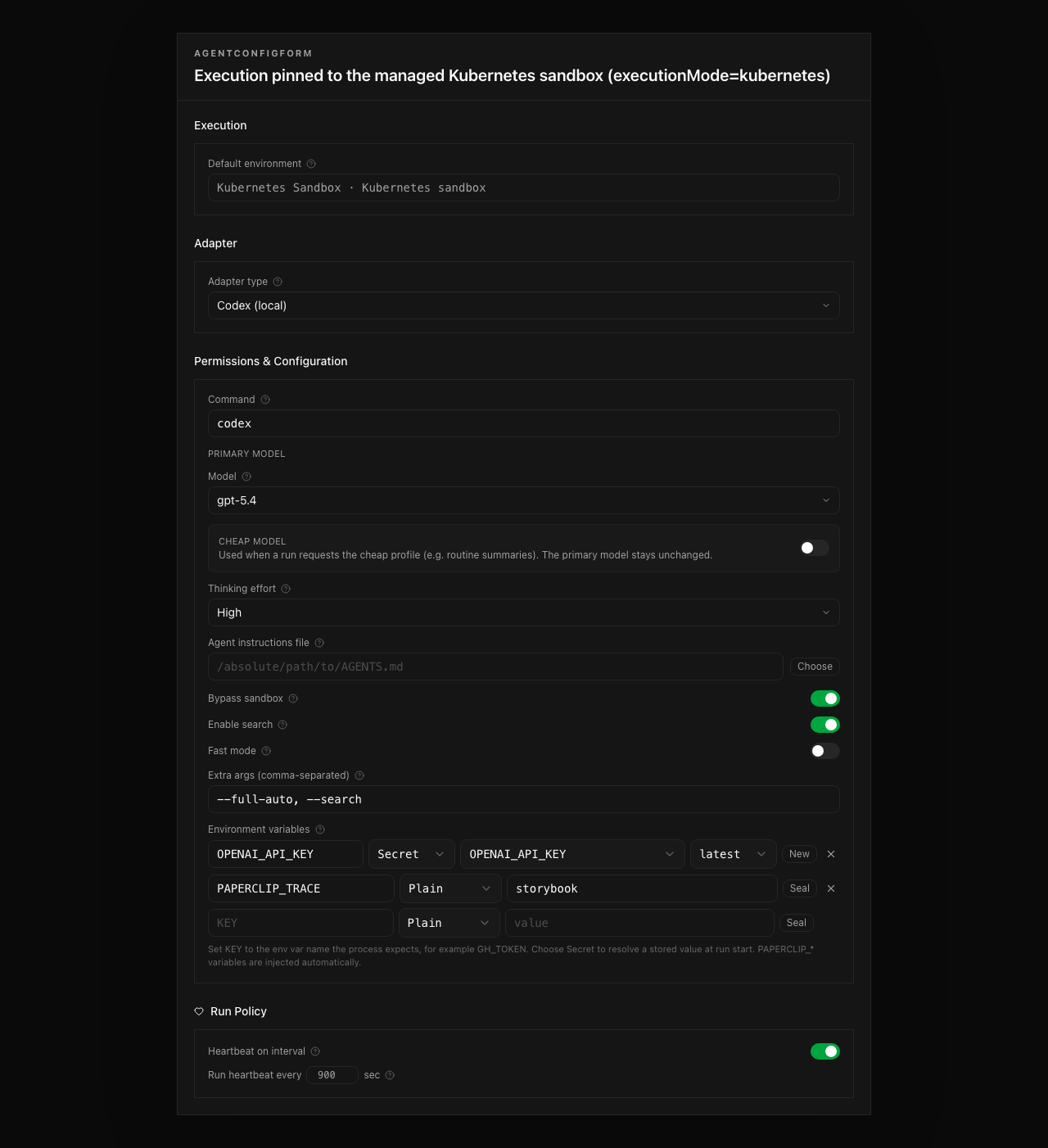
No managed environment available yet (warning notice, no silent local
fallback):
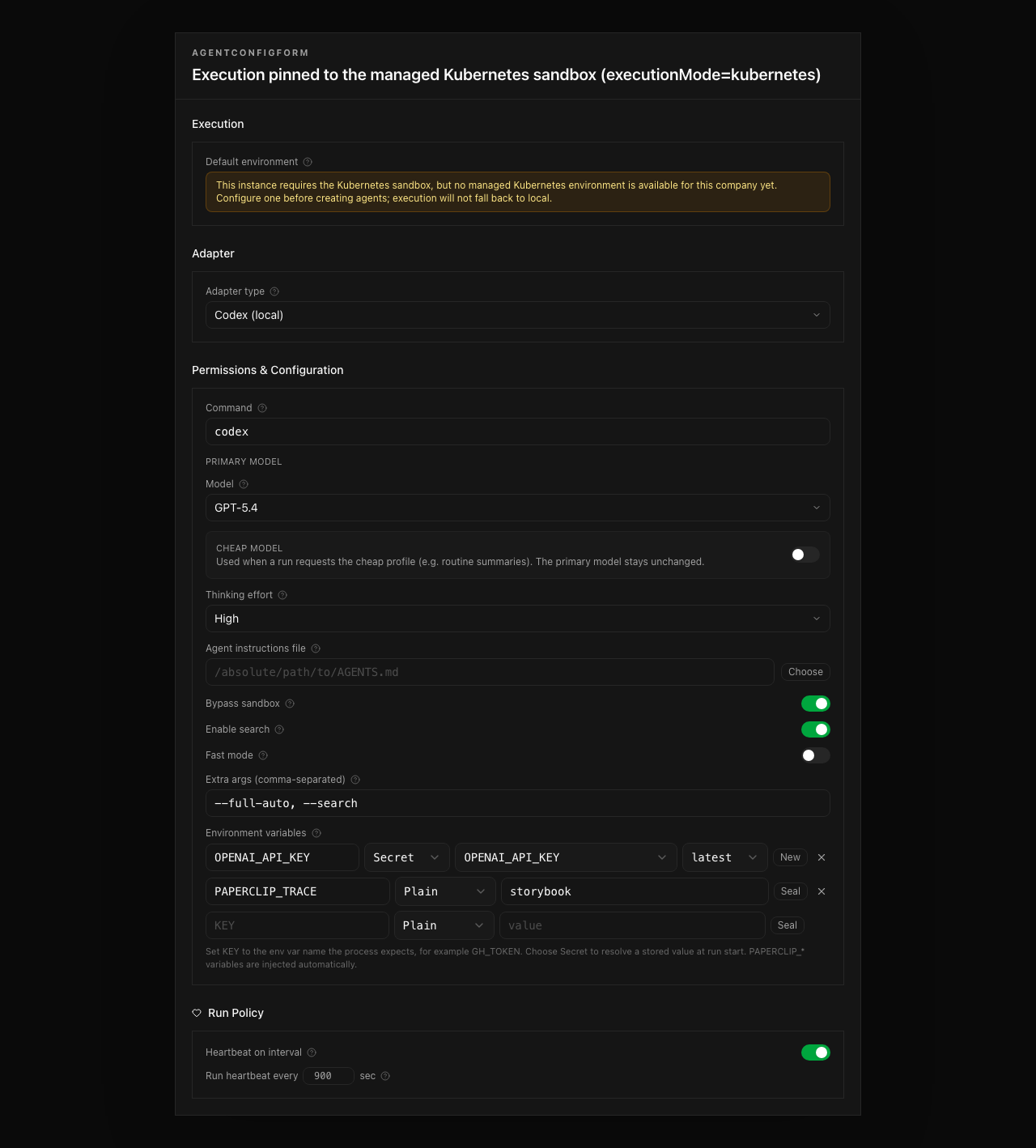
## Checklist
- [x] I have included a thinking path that traces from project context
to this change
- [x] I have specified the model used (with version and capability
details)
- [x] I have checked ROADMAP.md and confirmed this PR does not duplicate
planned core work
- [x] I have searched GitHub for duplicate or related PRs and linked
them above
- [x] I have either (a) linked existing issues with `Fixes: #` / `Closes
#` / `Refs #` OR (b) described the issue in-PR following the relevant
issue template
- [x] I have run tests locally and they pass
- [x] I have added or updated tests where applicable
- [x] If this change affects the UI, I have included before/after
screenshots
- [x] I have updated relevant documentation to reflect my changes
- [x] I have considered and documented any risks above
- [ ] All Paperclip CI gates are green
- [ ] Greptile is 5/5 with no open P2s, recommendations, or follow-ups
- [x] I will address all Greptile and reviewer comments before
requesting merge
🤖 Generated with [Claude Code](https://claude.com/claude-code)
---------
Co-authored-by: Claude Opus 4.8 (1M context) <noreply@anthropic.com>
## Thinking Path

> - Paperclip is the open source app people use to manage AI agents for
work
> - Sandbox providers are the seam that lets agent runs execute in
isolated environments; today the only first-party remote provider is
Daytona, a hosted third-party service
> - Self-hosters running Paperclip on their own infrastructure (often
Kubernetes already) have no first-party way to run agent sandboxes on a
cluster they control
> - That gap matters for teams with data-residency, sovereignty, or cost
constraints who cannot or will not send workloads to a hosted sandbox
service
> - This pull request adds a Kubernetes sandbox-provider plugin as a
standalone, workspace-excluded package: it implements every
SandboxProvider hook the Daytona provider does, on infrastructure the
operator owns
> - The benefit is that any Paperclip deployment with a Kubernetes
cluster gets multi-tenant, network-isolated, quota-bounded agent
sandboxes with zero new external dependencies

## Linked Issues or Issue Description

No existing issue. Following the feature template:

- **Problem:** Paperclip's remote sandbox execution requires a hosted
third-party provider. Self-hosters cannot run agent sandboxes on their
own Kubernetes clusters with a first-party provider.
- **Proposed solution:** A `@paperclipai/plugin-kubernetes`
sandbox-provider plugin with two backends: long-lived sandboxes via the
[kubernetes-sigs/agent-sandbox](https://github.com/kubernetes-sigs/agent-sandbox)
CRD (multi-command exec, adapter-install pattern) and one-shot
`batch/v1` Jobs (stable APIs only, no extra controllers).
- **Alternatives considered:** Driving kubectl from a generic shell
provider (no lifecycle/lease semantics), or requiring a hosted provider
(exactly the constraint this removes).

## What Changed

This is **stage 1 of 3** of a staged contribution (direction agreed with
maintainers): the plugin package alone. Stage 2 (server integration:
lease params, provider registration) and stage 3 (agent runtime images +
CI) are companion PRs that will be cross-linked from a comment here.

- New package `packages/plugins/sandbox-providers/kubernetes`
(workspace-excluded, like the path already carved out in
`pnpm-workspace.yaml`): src, unit + kind integration tests, operator
prerequisite manifests, README, smoke-test guide
- Implements the full SandboxProvider hook surface the Daytona provider
implements: `validateConfig`, `probe`, `acquireLease`, `resumeLease`,
`releaseLease`, `destroyLease`, `realizeWorkspace`, `execute`
- Two backends: `sandbox-cr` (default; long-lived pod via the
agent-sandbox `Sandbox` CR, supports multi-command exec) and `job`
(one-shot `batch/v1` Job; nothing beyond k8s 1.27+ required)
- Per-run adapter resolution: one environment serves mixed harnesses;
the per-run `adapterType` hint is read through a local optional type
extension, so the plugin typechecks and builds against the current
plugin SDK and simply falls back to the environment's configured default
adapter until stage 2 lands
- Exec-env wrapping: the Kubernetes exec API carries no environment, so
commands are wrapped to receive the run's env
- Fast-upload interception for workspace realization, scoped per lease
- Per-tenant isolation: derived namespace per company, RBAC,
ResourceQuota, restricted-PSS pod security (runAsNonRoot, drop ALL,
seccomp RuntimeDefault, no SA token automount)
- Network egress policy in two flavors: native `NetworkPolicy` and
`CiliumNetworkPolicy` (FQDN allowlists)
- Image allowlist with glob matching, registry override, and per-run
image override validation
- Per-run Kubernetes Secrets carrying agent credentials, ownerRef'd to
the Job or Sandbox CR for cascade GC

## Verification

- Standalone build, exactly as the README documents:
  ```bash
  cd packages/plugins/sandbox-providers/kubernetes
  pnpm install --ignore-workspace
  pnpm test        # 147 unit tests, 17 files, all green
  pnpm typecheck   # clean against the in-repo plugin SDK on master
pnpm build # dist/ emitted, manifest + worker entrypoints present
  ```
- A kind-cluster end-to-end integration test is included
(`RUN_K8S_INTEGRATION_TESTS=1 pnpm test
test/integration/end-to-end-run.test.ts`)
- Beyond CI: this provider has been verified in a production
multi-tenant deployment against five harnesses (opencode, pi, codex,
gemini, claude code) with real billed runs

## Risks

- **Zero behavior change for any existing deployment.** The package is
workspace-excluded; nothing in the server imports or loads it until
stage 2's integration lands. No existing code paths are touched.
- The default `sandbox-cr` backend depends on an alpha CRD
(`agents.x-k8s.io/v1alpha1`); the README flags this and the `job`
backend uses only stable APIs as a fallback.
- Risk surface is confined to deployments that explicitly install and
configure the plugin.
- The default runtime images (`ghcr.io/paperclipai/agent-runtime-*`) are
published by the stage 3 companion PR (#7934); until that lands,
deployments must point `runtimeImage` at their own images.

## Model Used

Claude Opus 4.8 (1M context), extended thinking, with tool use (Claude
Code).

## Checklist

- [x] I have included a thinking path that traces from project context
to this change
- [x] I have specified the model used (with version and capability
details)
- [x] I have checked ROADMAP.md and confirmed this PR does not duplicate
planned core work
- [x] I have searched GitHub for duplicate or related PRs and linked
them above
- [x] I have either (a) linked existing issues with `Fixes: #` / `Closes
#` / `Refs #` OR (b) described the issue in-PR following the relevant
issue template
- [x] I have run tests locally and they pass
- [x] I have added or updated tests where applicable
- [ ] If this change affects the UI, I have included before/after
screenshots (no UI changes)
- [x] I have updated relevant documentation to reflect my changes
- [x] I have considered and documented any risks above
- [ ] All Paperclip CI gates are green (pending this push)
- [ ] Greptile is 5/5 with no open P2s, recommendations, or follow-ups
- [x] I will address all Greptile and reviewer comments before
requesting merge

---------

Co-authored-by: Claude Opus 4.8 (1M context) <noreply@anthropic.com>
## Thinking Path

> - Paperclip is the open source control plane people use to manage AI
agents, work, and company context.
> - The board UI sidebar is the main way operators keep orientation
across companies, projects, agents, issues, and settings.
> - The existing fixed expanded sidebar competes with route-specific
navigation, especially company settings and plugin routes that bring
their own contextual sidebar.
> - A collapsible primary rail preserves global navigation while giving
contextual pages more horizontal room.
> - This pull request adds a persisted collapsed rail, hover/focus peek,
keyboard toggle, and a secondary sidebar takeover model for settings and
plugin `routeSidebar` surfaces.
> - The benefit is a denser board shell that keeps the app rail
available without replacing it when a route needs its own navigation.

## Linked Issues or Issue Description

Paperclip issue: PAP-10638 Create collapsible sidebar branch.

Related GitHub PR found during duplicate search: #3838
(`feat/collapsible-sidebar`) covers a similar sidebar area but is a
different head branch and implementation. This PR intentionally packages
the work from `PAP-10638-collapsable-sidebar` into one reviewable
branch.

Problem description:

The board shell needs a first-class collapsed sidebar mode. Contextual
surfaces such as company settings and plugin route sidebars should not
replace the global app sidebar; they should collapse the app sidebar to
a rail and render their contextual navigation beside it.

## What Changed

- Added desktop collapsed/sidebar-peek state to `SidebarContext`,
including persisted user pins, route collapse requests, and forced
collapse for secondary-sidebar routes.
- Replaced the old resizable sidebar pane with `SidebarShell`, which
supports a fixed 64px rail, persisted expanded width, keyboard/pointer
resizing, and hover/focus peek overlay behavior.
- Updated `Sidebar`, sidebar nav items, project/agent sections, badges,
and account/company menu presentation for expanded, collapsed, and
peeking states.
- Added `RequestCollapsedSidebar` and `SecondarySidebar` so routes and
plugin `routeSidebar` slots can request contextual sidebar layouts
without replacing the primary app sidebar.
- Wired company settings and plugin route sidebars into the
secondary-pane takeover model.
- Added focused Vitest coverage for sidebar state precedence, shell
sizing, nav item rail rendering, keyboard shortcuts, layout takeover
behavior, and route collapse requests.
- Updated plugin authoring docs/spec references for route sidebar
behavior.

## Verification

Targeted local verification passed:

```sh
NODE_ENV=test pnpm run preflight:workspace-links && NODE_ENV=test pnpm exec vitest run ui/src/context/SidebarContext.test.tsx ui/src/components/SidebarShell.test.tsx ui/src/components/Sidebar.test.tsx ui/src/components/Layout.test.tsx ui/src/components/RequestCollapsedSidebar.test.tsx ui/src/components/SidebarNavItem.test.tsx ui/src/components/SidebarAgents.test.tsx ui/src/components/SidebarProjects.test.tsx ui/src/components/KeyboardShortcutsCheatsheet.test.tsx ui/src/hooks/useKeyboardShortcuts.test.tsx
```

Result: 10 test files passed, 88 tests passed.

Additional follow-up verification passed after review fixes:

```sh
NODE_ENV=test pnpm run preflight:workspace-links && NODE_ENV=test pnpm exec vitest run ui/src/components/Layout.test.tsx ui/src/context/SidebarContext.test.tsx && pnpm --filter /ui typecheck
```

Result: 2 test files passed, 28 tests passed, and UI typecheck passed.

Latest PR-head remote checks: Paperclip PR workflow, Snyk, Socket, and
Greptile are green; commitperclip `review` is cancelled in its
security-gate step after filing a non-blocking neutral `security-review`
check.

Notes:

- A direct run without `NODE_ENV=test` loads React's production build in
this workspace, where `act` is unavailable; the command above matches
the repo stable runner's test environment.
- I did not run Playwright/browser e2e or full workspace build/typecheck
in this PR-creation heartbeat.
- QA screenshots are attached in
https://github.com/paperclipai/paperclip/pull/7824#issuecomment-4661968387
for expanded, collapsed rail, hover peek, and settings secondary-sidebar
states.

## Risks

- Medium UI layout risk: this changes the board shell and primary
sidebar composition across many routes.
- Local storage migration risk is low: new collapsed state uses a new
key and existing width storage remains scoped to the sidebar width.
- Plugin route risk: plugin `routeSidebar` slots now render as secondary
panes on desktop, so plugin authors should confirm their route sidebar
content fits a 240px contextual pane.
- Mobile risk appears low because mobile keeps the drawer model and
gates collapsed/peek behavior to desktop.

> For core feature work, check [`ROADMAP.md`](ROADMAP.md) first and
discuss it in `#dev` before opening the PR. Feature PRs that overlap
with planned core work may need to be redirected — check the roadmap
first. See `CONTRIBUTING.md`.

## Model Used

OpenAI Codex coding agent based on GPT-5, with local shell/git/GitHub
CLI tool use. Exact service-side model identifier and context window
were not exposed in this runtime.

## Checklist

- [x] I have included a thinking path that traces from project context
to this change
- [x] I have specified the model used (with version and capability
details)
- [x] I have checked ROADMAP.md and confirmed this PR does not duplicate
planned core work
- [x] I have searched GitHub for duplicate or related PRs and linked
them above
- [x] I have either (a) linked existing issues with `Fixes: #` / `Closes
#` / `Refs #` OR (b) described the issue in-PR following the relevant
issue template
- [x] I have run tests locally and they pass
- [x] I have added or updated tests where applicable
- [x] If this change affects the UI, I have included before/after
screenshots
- [x] I have updated relevant documentation to reflect my changes
- [x] I have considered and documented any risks above
- [ ] All Paperclip CI gates are green
- [x] Greptile is 5/5 with no open P2s, recommendations, or follow-ups
- [x] I will address all Greptile and reviewer comments before
requesting merge

---------

Co-authored-by: Claude Opus 4.8 <noreply@anthropic.com>
Co-authored-by: Paperclip <noreply@paperclip.ing>
## Thinking Path

> - Paperclip is the open source app people use to manage AI agents for
work.
> - The board UI is the control surface for issues, projects, agents,
goals, workspaces, and operator settings.
> - The existing navigation and list surfaces make several
high-frequency workflows feel harder to scan than they should,
especially around projects and agents.
> - The product direction is to improve those surfaces without breaking
the existing route model or forcing a new IA on every operator at once.
> - This pull request now keeps the dependent IA, project identity, and
agent-list visual refresh work together while the Issue-to-Task copy
migration is split into #7651.
> - The benefit is a clearer left nav, better project identity, denser
agent/project list rows, and brand-aligned status treatment while
preserving the classic default experience behind a flag.

## Linked Issues or Issue Description

Refs #7645
Refs #7651

Internal planning/work references: PAP-53, PAP-56, PAP-58, PAP-59,
PAP-60, PAP-61, PAP-68, PAP-69, PAP-70, PAP-71, PAP-72, PAP-75, PAP-76,
PAP-80, PAP-85, PAP-86, PAP-87, PAP-88, PAP-89.

## What Changed

- Adds `enableStreamlinedLeftNavigation`, defaulting off, and gates
sidebar presentation so classic navigation remains the default.
- Adds project icon persistence, validation, portability, picker UI, and
`ProjectTile` rendering while defaulting new projects to neutral gray.
- Adds projects-list task-count and budget summary data with focused
server/shared/UI coverage.
- Refreshes agent list rows, row actions, active/recent sidebar
behavior, and status capsule/chip styling for the approved brand state
system.
- Removes the placeholder Conference room and Artifacts nav/routes from
the finalized experimental nav direction.
- Removes `pnpm-lock.yaml` and the Issue-to-Task copy migration from
this PR diff; the copy migration now lives in #7651.

## Verification

- Existing branch verification from the authored commits: UI typecheck,
targeted unit tests, and light/dark visual checks for `/agents`, agent
detail, and design-guide status states.
- Maintainer cleanup verification on `75e34e5`: `git diff --check
origin/master...HEAD` passed, the `design/` diff is empty, and the PR
diff is 61 files, below Greptile's 100-file review limit.
- `pnpm --filter @paperclipai/ui build` passed.
- `NODE_ENV=test pnpm exec vitest run
ui/src/components/Sidebar.test.tsx` passed: 1 file, 8 tests.
- CI and Greptile should rerun on the latest push.

## Risks

- Broad UI surface area: the experimental flag keeps the classic nav
default, but changed shared components such as `EntityRow`,
`ProjectTile`, and agent status badges could affect multiple pages.
- Database migration: `projects.icon` is additive and nullable, but
migration ordering and portability import/export must stay aligned.
- The Issue-to-Task copy migration is now separated into #7651, so
reviewers should evaluate this PR as IA/project/agent presentation work
only.
- Visual regressions are possible across smaller widths because the PR
intentionally changes dense list-row layouts.

## Model Used

Claude Opus 4.8 assisted the original feature commits.
Paperclip-Paperclip agents assisted some planning/design commits. Codex
/ GPT-5-class coding agent with shell, GitHub CLI, and repository access
performed this PR-readiness cleanup and split.

## Checklist

- [x] I have included a thinking path that traces from project context
to this change
- [x] I have specified the model used (with version and capability
details)
- [x] I have checked ROADMAP.md and confirmed this PR does not duplicate
planned core work
- [x] I have searched GitHub for duplicate or related PRs and linked
them above
- [x] I have either (a) linked existing issues with `Fixes: #` / `Closes
#` / `Refs #` OR (b) described the issue in-PR following the relevant
issue template
- [x] I have run tests locally and they pass
- [x] I have added or updated tests where applicable
- [x] If this change affects the UI, I have included before/after
screenshots
- [x] I have updated relevant documentation to reflect my changes
- [x] I have considered and documented any risks above
- [x] All Paperclip CI gates are green
- [x] Greptile is 5/5 with no open P2s, recommendations, or follow-ups
- [x] I will address all Greptile and reviewer comments before
requesting merge

---------

Co-authored-by: Paperclip <noreply@paperclip.ing>
Co-authored-by: Claude Opus 4.8 <noreply@anthropic.com>
Co-authored-by: Dotta <bippadotta@protonmail.com>
## Thinking Path

> - Paperclip is the open source app people use to manage AI agents for
work.
> - Agent work is coordinated through issues, comments, interactions,
and approval-style handoffs.
> - Existing issue-thread interactions could ask questions, suggest
tasks, and request confirmation, but they did not support a structured
checkbox confirmation payload for choosing one or more options.
> - That gap made board/user confirmations harder to validate
consistently across API callers, plugin helpers, CLI tooling, and the
UI.
> - This pull request adds the shared checkbox confirmation contract,
server handling, client helpers, and issue-thread UI needed to render
and submit structured selections.
> - The benefit is that agents can request bounded multi-select
confirmations in the same audited issue-thread flow as other Paperclip
interactions.

## Linked Issues or Issue Description

- No public GitHub issue found for this exact branch. Internal Paperclip
issue: PAP-10415 / PAP-10441 requested creating this PR for the checkbox
confirmation issue-thread UI component work.
- GitHub duplicate search performed for checkbox confirmation /
issue-thread interaction PRs; no matching open PR was found.
- Related issue search result `#7497` was unrelated company file cleanup
work, so it is not linked as a related issue.

## What Changed

- Added shared types, validators, constants, and tests for
`request_checkbox_confirmation` interactions.
- Extended server issue-thread interaction service and routes for
checkbox confirmation creation, validation, expiration, and response
handling.
- Added CLI, MCP, and plugin SDK helper coverage so external callers can
create the new interaction shape consistently.
- Updated the issue-thread interaction UI to render checkbox
confirmations with min/max bounds, selection summaries, stale-target
states, and accept/decline flows.
- Documented the checkbox confirmation interaction contract in the
Paperclip skill/API reference.

## Verification

- Rebased cleanly on `paperclipai/paperclip` `master` fetched into
`public-gh/master` at `a4fa0eaf5`.
- Confirmed the PR diff does not include `pnpm-lock.yaml` or
`.github/workflows` changes.
- Ran focused tests with `NODE_ENV=test`:

```sh
NODE_ENV=test pnpm run preflight:workspace-links
NODE_ENV=test pnpm exec vitest run packages/shared/src/issue-thread-interactions.test.ts server/src/__tests__/issue-thread-interaction-routes.test.ts server/src/__tests__/issue-thread-interactions-service.test.ts ui/src/components/IssueThreadInteractionCard.test.tsx ui/src/lib/issue-thread-interactions.test.ts cli/src/__tests__/issue-subresources.test.ts cli/src/__tests__/project-goal.test.ts packages/mcp-server/src/tools.test.ts packages/plugins/sdk/tests/testing-actions.test.ts
```

Result: 8 test files passed, 78 tests passed.
- CI on latest head `63b9e55` is green.
- Greptile Review passed on latest head; GraphQL review-thread check
shows all Greptile threads resolved.

## Risks

- Medium surface area because the interaction contract touches shared
validators, server routes/services, UI rendering, CLI, MCP, plugin SDK
helpers, and docs.
- No database migrations are included.
- `pnpm-lock.yaml` is intentionally excluded per repository lockfile
policy.
- UI screenshots are not attached because the task explicitly requested
not to add design screenshots or images unless they were part of the
work; component tests cover the new rendering and interaction states.

> For core feature work, check [`ROADMAP.md`](ROADMAP.md) first and
discuss it in `#dev` before opening the PR. Feature PRs that overlap
with planned core work may need to be redirected — check the roadmap
first. See `CONTRIBUTING.md`.

## Model Used

- OpenAI Codex coding agent based on GPT-5, with repository file access,
shell command execution, git/GitHub CLI tooling, and Paperclip
control-plane API access. Exact hosted model ID/context-window metadata
is not exposed inside this runtime.

## Checklist

- [x] I have included a thinking path that traces from project context
to this change
- [x] I have specified the model used (with version and capability
details)
- [x] I have checked ROADMAP.md and confirmed this PR does not duplicate
planned core work
- [x] I have searched GitHub for duplicate or related PRs and linked
them above
- [x] I have either (a) linked existing issues with `Fixes: #` / `Closes
#` / `Refs #` OR (b) described the issue in-PR following the relevant
issue template
- [x] I have run tests locally and they pass
- [x] I have added or updated tests where applicable
- [ ] If this change affects the UI, I have included before/after
screenshots
- [x] I have updated relevant documentation to reflect my changes
- [x] I have considered and documented any risks above
- [x] All Paperclip CI gates are green
- [x] Greptile is 5/5 with no open P2s, recommendations, or follow-ups
- [x] I will address all Greptile and reviewer comments before
requesting merge

---------

Co-authored-by: Paperclip <noreply@paperclip.ing>
## Thinking Path
> - Paperclip orchestrates AI agents for zero-human companies
> - Test infrastructure across server, ui, packages/* runs on Vitest
> - Dependabot opened a narrow bump (3.2.4 → 3.2.6), but the wider
workspace is on 3.2.4 and the major-version bridge to v4 needs a
coordinated change set across configs and tests
> - Staying on 3.x indefinitely leaves us behind on Vitest 4 (perf,
pool, and config improvements) and forces repeated patch-only dependabot
churn
> - This pull request upgrades Vitest to 4.1.8 across the workspace,
updates `server/vitest.config.ts` and `scripts/run-vitest-stable.mjs`
for the new API, and adjusts two UI tests for the new assertion
semantics
> - The benefit is a single, coherent Vitest 4 upgrade that supersedes
#7570 and gets us on the supported major line
## What Changed
- Bump `vitest` from `3.2.4` to `4.1.8` across root, `server`, `ui`, and
all `packages/*` (including plugin examples and sandbox providers)
- Update `server/vitest.config.ts` for Vitest 4 config surface
- Update `scripts/run-vitest-stable.mjs` to match the new runner
behavior
- Adjust `ui/src/components/CommentThread.test.tsx` and
`ui/src/components/MarkdownEditor.test.tsx` for Vitest 4 matcher/timing
semantics
- Refresh `pnpm-lock.yaml`
## Verification
- `pnpm install` resolves cleanly with the new lockfile
- `pnpm -w -r test` (server, ui, packages) runs under Vitest 4.1.8
## Risks
- Major-version Vitest bump: behavioral changes in pools, fake timers,
and matcher strictness can surface flake. Test config and the two UI
tests were updated to match v4 semantics; broader test runs should be
watched on CI before merge.
- Supersedes dependabot PR #7570 (3.2.4 → 3.2.6); that PR should be
closed.
## Model Used
- Claude (Anthropic) — `claude-opus-4-7`, extended thinking, tool use
enabled
## Checklist
- [x] I have included a thinking path that traces from project context
to this change
- [x] I have specified the model used (with version and capability
details)
- [x] I have checked ROADMAP.md and confirmed this PR does not duplicate
planned core work
- [ ] I have run tests locally and they pass
- [ ] I have added or updated tests where applicable
- [ ] If this change affects the UI, I have included before/after
screenshots
- [ ] I have updated relevant documentation to reflect my changes
- [x] I have considered and documented any risks above
- [x] I will address all Greptile and reviewer comments before
requesting merge
Closes#7570
Bumps [@codemirror/language](https://github.com/codemirror/language)
from 6.12.1 to 6.12.3.
<details>
<summary>Changelog</summary>
<p><em>Sourced from <a
href="https://github.com/codemirror/language/blob/main/CHANGELOG.md">@codemirror/language's
changelog</a>.</em></p>
<blockquote>
<h2>6.12.3 (2026-03-25)</h2>
<h3>Bug fixes</h3>
<p>Fix a crash in <code>bracketMatching</code> when composing at end of
document.</p>
<h2>6.12.2 (2026-02-25)</h2>
<h3>Bug fixes</h3>
<p>Make sure brackets are highlighted in the initial editor state.</p>
<p>Pause bracket matching updates during composition, to avoid
disrupting Mobile Safari's fragile composition handling.</p>
</blockquote>
</details>
<details>
<summary>Commits</summary>
<ul>
<li><a
href="f5af31eed7"><code>f5af31e</code></a>
Mark version 6.12.3</li>
<li><a
href="371c9ba6be"><code>371c9ba</code></a>
Fix bogus bracket highlighting being generated at end of document</li>
<li><a
href="9531899bd8"><code>9531899</code></a>
Remove duplicated slash in forum url in README</li>
<li><a
href="2f4e7014a5"><code>2f4e701</code></a>
Fix forum link in readme</li>
<li><a
href="b5cd54b2ff"><code>b5cd54b</code></a>
Mark version 6.12.2</li>
<li><a
href="5f86763640"><code>5f86763</code></a>
Pause bracket matching updates during composition</li>
<li><a
href="af8dca9d06"><code>af8dca9</code></a>
Properly show matched brackets in the initial editor state</li>
<li><a
href="693a25efaa"><code>693a25e</code></a>
Use git+https format for package.json repository field</li>
<li>See full diff in <a
href="https://github.com/codemirror/language/compare/6.12.1...6.12.3">compare
view</a></li>
</ul>
</details>
<br />
[](https://docs.github.com/en/github/managing-security-vulnerabilities/about-dependabot-security-updates#about-compatibility-scores)
Dependabot will resolve any conflicts with this PR as long as you don't
alter it yourself. You can also trigger a rebase manually by commenting
`@dependabot rebase`.
[//]: # (dependabot-automerge-start)
[//]: # (dependabot-automerge-end)
---
<details>
<summary>Dependabot commands and options</summary>
<br />
You can trigger Dependabot actions by commenting on this PR:
- `@dependabot rebase` will rebase this PR
- `@dependabot recreate` will recreate this PR, overwriting any edits
that have been made to it
- `@dependabot show <dependency name> ignore conditions` will show all
of the ignore conditions of the specified dependency
- `@dependabot ignore this major version` will close this PR and stop
Dependabot creating any more for this major version (unless you reopen
the PR or upgrade to it yourself)
- `@dependabot ignore this minor version` will close this PR and stop
Dependabot creating any more for this minor version (unless you reopen
the PR or upgrade to it yourself)
- `@dependabot ignore this dependency` will close this PR and stop
Dependabot creating any more for this dependency (unless you reopen the
PR or upgrade to it yourself)
</details>
Signed-off-by: dependabot[bot] <support@github.com>
Co-authored-by: dependabot[bot] <49699333+dependabot[bot]@users.noreply.github.com>
 Dotta
Dotta
 Michael Nguyen
 Nicky Leach
 dependabot[bot]
 Devin Foley
 Alex
Alex
 Jannes Stubbemann
 scotttong
 Dotta
Dotta

