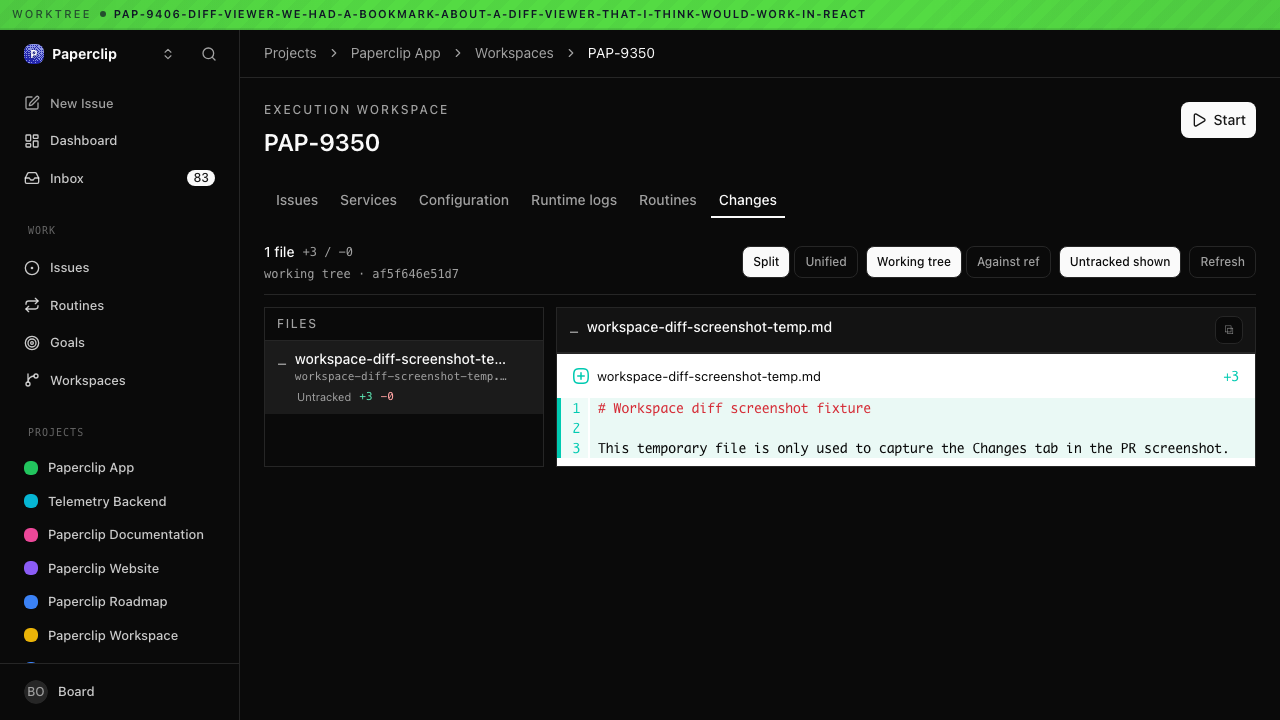
## Thinking Path

> - Paperclip is the open source app people use to manage AI agents for
work.
> - Agent authentication uses server sessions, plugin workers, and
browser login panels.
> - A page reload loses an active login session, and one worker permits
only one login terminal.
> - These limits cause lost work and prevent two owners from logging in
through one worker.
> - This pull request lets the browser resume active sessions and lets
workers serve concurrent login terminals.
> - The benefit is reliable login recovery with a bounded process-wide
route limit.

## Linked Issues or Issue Description

**What existing behavior does this improve?**

It improves agent credential login recovery and concurrent login
terminal handling.

**Subsystem affected**

Cross-cutting (multiple of the above).

**Current behavior**

A page reload loses the active login session. A shared plugin worker
rejects a second login terminal.

**Proposed behavior**

The browser reads and resumes the owner's active session. A worker
supports multiple login terminal routes under a process-wide ceiling.

**Reason and benefit**

Owners keep login progress after a reload. Two owners can log in through
one worker without removing the route limit.

**Breaking changes**

None. The change adds owner-scoped read routes and changes login
terminal concurrency.

## What Changed

- Replace the single worker login route with maps keyed by host route
and worker session identifiers.
- Add a process-wide login route ceiling and release each reserved slot
on every exit path.
- Add owner-scoped active-session reads with consistent negative
responses and private cache control.
- Keep the device-login prompt while the session has an active public
status.
- Add a durable setup-token cancel fallback for a lost in-memory
session.
- Resume active sessions when the agent configuration or onboarding
panel mounts.
- Remove routine unmount cancellation and keep explicit Cancel behavior.

## Verification

- `pnpm --filter @paperclip/server test` — server route, service, and
plugin-worker-manager suites.
- `pnpm --filter @paperclip/plugin-sdk test` — worker RPC host suite.
- `cd ui && npx vitest run
src/components/AgentConfigForm.render.test.tsx
src/components/OnboardingWizard.test.tsx`.
- `cd ui && npx tsc -b`.
- `tests/e2e/onboarding.spec.ts` — reload during login.
- CI must pass on this pull request.

## Risks

The change affects agent authentication and the sandbox-to-host
boundary. Route cleanup must release every reserved slot. Owner checks
must prevent cross-owner session access. Tests cover route cleanup,
owner scope, reload recovery, and concurrent worker routes.

## Model Used

Codex, OpenAI GPT-5, tool use and code review support. The
implementation author owns the exact model details for the code changes.

## Checklist

- [x] I have included a thinking path that traces from project context
to this change
- [x] I have specified the model used (with version and capability
details)
- [x] I have checked ROADMAP.md and confirmed this PR does not duplicate
planned core work
- [x] I have searched GitHub for duplicate or related PRs and linked
them above
- [x] I have described the issue in-PR with the relevant issue-template
fields
- [x] I have not referenced internal/instance-local Paperclip issues or
links
- [x] My branch name describes the change and contains no internal
Paperclip ticket id
- [x] I have run tests locally and they pass
- [x] I have added or updated tests where applicable
- [x] I have updated relevant documentation to reflect my changes
- [x] I have considered and documented risks above
- [x] All Paperclip CI gates are green
- [x] Greptile is 5/5 with no open P2s, recommendations, or follow-ups
- [x] I will address all Greptile and reviewer comments before
requesting merge

---------

Co-authored-by: Paperclip <noreply@paperclip.ing>
## Thinking Path

> - Paperclip is the open source app people use to manage AI agents for
work.
> - Paperclip Runner gives native runs a durable and governed execution
path.
> - The current native path runs on the control-plane host.
> - Remote environments need an authenticated execution-target contract.
> - The contract must not change direct adapters or enable new runtimes
by default.
> - This pull request adds the remote execution substrate and Daytona
ingress.
> - The benefit is a bounded base for later remote runner transport
work.

## Linked Issues or Issue Description

Refs #12616.
Refs #12352.

**Subsystem affected**

Cross-cutting. This change touches runner transport, server
orchestration, plugin contracts, and shared settings.

**Problem or motivation**

Native execution cannot resolve an authenticated runner ingress through
a remote environment. The server also lacks one provider-neutral
contract for remote execution targets.

**Proposed solution**

Add a default-off runner preview ingress capability. Add
transport-neutral runner connectivity. Add remote execution target and
lifecycle handling. Add a Daytona ingress implementation with redacted
credentials.

**Alternatives considered**

A provider-specific server path would duplicate orchestration and
authorization. A public endpoint without an environment contract would
weaken the trust boundary.

**Roadmap alignment**

This work supports the Cloud and Sandbox agents milestone. It also
supports self-healing runs and governed tool access.

## What Changed

- Added execution-target traits for local, SSH, and sandbox
environments.
- Added plugin RPC contracts for runner ingress endpoints.
- Added authenticated Daytona preview ingress.
- Added transport-neutral PRP outbound connections.
- Added remote runner artifact verification and fail-closed provider
selection.
- Added bounded native session resume, cancellation, and lifecycle
recovery.
- Preserved Codex-only selection for fresh experimental runner starts.
- Preserved all direct adapter execution and finalization paths.
- Removed stale Pi provider-pack requirements that security review
rejected.
- Kept the rollout controls off by default.
- Did not change pnpm-lock.yaml, Cargo, database migrations, or GitHub
workflows.

## Verification

- GitHub Actions will run the repository test, typecheck, build,
security, and policy gates.
- Focused tests cover ingress validation, redaction, execution targets,
remote lifecycle, cancellation, resume, and legacy adapter selection.
- Local tests were not run. The requested verification policy uses
GitHub Actions for this series.
- `git diff --check origin/master...HEAD` passes.
- The diff contains 52 files.

## Risks

- Remote execution crosses a trust boundary.
- The implementation validates target capabilities, artifact digests,
provider-pack pins, and connection metadata.
- The feature remains default-off.
- Fresh native selection remains Codex-only.
- Existing direct adapters remain on the legacy path.
- This PR does not yet make remote Codex runnable. The next PR adds the
Rust WSS and TLS transport.

## Model Used

OpenAI Codex with GPT-5.6. The work used high-reasoning agent mode,
repository tools, GitHub tools, and parallel code-audit agents.

## Checklist

- [x] I have included a thinking path that traces from project context
to this change
- [x] I have specified the model used (with version and capability
details)
- [x] I have checked ROADMAP.md and confirmed this PR does not duplicate
planned core work
- [x] I have searched GitHub for duplicate or related PRs and linked
them above
- [x] I have either (a) linked existing issues with Fixes: / Closes /
Refs OR (b) described the issue in-PR following the relevant issue
template
- [x] I have not referenced internal or instance-local Paperclip issues
or links
- [x] My branch name describes the change and contains no internal
Paperclip ticket id
- [ ] I have run tests locally and they pass
- [x] I have added or updated tests where applicable
- [x] I have updated relevant documentation to reflect my changes
- [x] I have considered and documented risks above
- [ ] All Paperclip CI gates are green
- [ ] Greptile is 5/5 with no open P2s, recommendations, or follow-ups
- [x] I will address all Greptile and reviewer comments before
requesting merge
## Thinking Path

> - Paperclip is the open source app people use to manage AI agents for
work
> - Sandbox providers carry agent work through controlled execution
channels
> - The Daytona callback bridge uses a bespoke line-framed protocol over
its duplex channel
> - The bespoke protocol adds framing work and does not use the Node
transport that already supports multiplexed streams
> - This pull request carries raw bytes across the channel, adds a Node
HTTP/2 bridge, and selects it for Daytona
> - The benefit is one authenticated, multiplexed callback session with
queue_v1 as the bounded fallback

## Linked Issues or Issue Description

**Subsystem affected**

The packages/plugins Daytona provider and the shared duplex execution
path.

**Problem or motivation**

The Daytona callback bridge uses a bespoke line-framed protocol over the
provider duplex channel. This adds protocol work and limits stream
handling.

**Proposed solution**

Carry raw bytes through the cross-layer channel. Add an authenticated
Node HTTP/2 host server and sandbox client gateway. Select http2_v1 for
Daytona and retain queue_v1 as the fallback.

**Alternatives considered**

Keep the current duplex_v1 protocol. This keeps the bespoke framing path
and does not provide one HTTP/2 session for callback streams.

**Roadmap alignment**

ROADMAP.md lists Daytona under cloud and sandbox agents. This change
improves the shipped Daytona provider path.

**Additional context**

The branch adds no dependency. Node 24 provides the http2 module. The
host token check and canonical path parser remain the single dispatch
path.

## What Changed

- Carry raw Uint8Array chunks through the adapter, plugin, worker,
runtime, and Daytona layers.
- Encode bytes as base64 only across the JSON-RPC hop, because JSON has
no binary type.
- Add the bounded host HTTP/2 server and the in-sandbox HTTP/2 client
gateway.
- Authenticate every stream with the per-run bridge token before route
work.
- Parse the path once and reuse the canonical result for route and
forwarding work.
- Select http2_v1 for Daytona and fall back once to queue_v1 when the
client preface is absent.
- Add transport, session, stream, and fallback telemetry.
- Mark HTTP/2 as the preferred transport and queue_v1 as the
soft-deprecated fallback.

## Verification

- `npx vitest run packages/adapter-utils/src` — 990 passed and 4
skipped.
- `npx vitest run
server/src/__tests__/plugin-worker-manager-duplex.test.ts` — 32 passed.
- `npx vitest run --config
packages/plugins/sandbox-providers/daytona/vitest.config.ts` — 220
passed and 6 skipped.
- `npx tsc --noEmit` in `packages/adapter-utils`, `packages/shared`,
`packages/plugins/sdk`, and `server` — clean.
- No `package.json` or `pnpm-lock.yaml` file changed.
- The live Daytona test skips when `DAYTONA_API_KEY` is absent.
- The root `npx tsc --noEmit` command has a pre-existing missing
`packages/adapters/droid-local` reference on this branch and on
`master`.

## Risks

- The transport change affects several duplex layers and could expose
byte-boundary errors.
- A missing HTTP/2 client preface falls back once to queue_v1 and
records `preface_missing`.
- The host token check and canonical path parser must remain on the
shared dispatch path.
- The live Daytona test needs `DAYTONA_API_KEY` and does not run in this
agent sandbox.

## Model Used

OpenAI GPT-5, tool-enabled coding agent with repository inspection,
GitHub CLI, and shell execution.

## Checklist

- [x] I have included a thinking path that traces from project context
to this change
- [x] I have specified the model used (with version and capability
details)
- [x] I have checked ROADMAP.md and confirmed this PR does not duplicate
planned core work
- [x] I have searched GitHub for duplicate or related PRs and linked
them above
- [x] I have either (a) linked existing issues with `Fixes: #` / `Closes
#` / `Refs #` OR (b) described the issue in-PR following the relevant
issue template
- [x] I have not referenced internal/instance-local Paperclip issues or
links (only public GitHub `#NNN` / `github.com/paperclipai/paperclip`
URLs)
- [x] My branch name describes the change (e.g. `docs/...`, `fix/...`)
and contains no internal Paperclip ticket id or instance-derived details
- [x] I have run tests locally and they pass
- [x] I have added or updated tests where applicable
- [x] I have updated relevant documentation to reflect my changes
- [x] I have considered and documented any risks above
- [x] All Paperclip CI gates are green
- [x] Greptile is 5/5 with no open P2s, recommendations, or follow-ups
- [x] I will address all Greptile and reviewer comments before
requesting merge

---------

Co-authored-by: Paperclip <noreply@paperclip.ing>
## Thinking Path

> - Paperclip is the open source app people use to manage AI agents for
work
> - Agent adapters use provider-specific login flows
> - Codex device login needs a live pseudo-terminal (PTY), while the
shared channel still uses Claude-specific names
> - The old streamed-exec path does not provide the prompt transport
that Codex needs
> - This pull request moves Codex device login to the shared login PTY
and removes the dead streamed-exec path
> - The benefit is one controlled login transport with fail-closed
capability checks and safer credential reads

## Linked Issues or Issue Description

**Problem or motivation**

Codex device login used a streamed-exec path that did not provide the
required prompt transport. The shared login channel also exposed
Claude-specific names outside Claude code.

**Expected behavior**

The host selects a fixed login command from trusted adapter data. Codex
login uses the provider login PTY. Providers without that capability
fail closed.

**Proposed solution**

Use a server-controlled session home, create and validate it as a fresh
0700 directory, read credentials from one validated descriptor, and
rename shared channel names to the neutral login PTY family.

**Alternatives considered**

Keep the shared login PTY as the single transport. Do not keep the
removed streamed-exec path because it cannot provide the required prompt
transport.

**Roadmap alignment**

This change supports the planned login transport work. It does not add a
separate roadmap item.

## What Changed

- Route Codex device login through the shared login PTY transport.
- Select the login command from a closed internal command key.
- Carry a server-controlled session home through the launch contract.
- Create and validate the session home as a fresh 0700 directory owned
by the login user.
- Read the credential file with descriptor-relative, no-follow path
walking and final descriptor checks.
- Gate the login route and run lease on the provider login PTY
capability.
- Rename shared channel names to the neutral login PTY family.
- Remove the streamed-exec transport value, selector field, driver
branch, and related tests.
- Hide Codex login in the user interface when the provider lacks the
login PTY capability.

## Verification

- Server unit suites pass: 89/89.
- Adapter-utils suites pass: 262/262.
- Codex-local suites pass: 326/326.
- Credential-read reader suite passes: 20/20.
- Daytona login PTY suite passes: 30/30.
- Device-login suites pass: 56/56.
- TypeScript checks pass for server, adapter-utils, and UI.
- GitHub Actions must pass after pull request creation.
- Greptile review must reach 5/5 with no open P2 findings,
recommendations, or follow-ups.

## Risks

- Providers without a login PTY capability lose Codex login support by
design.
- The credential read rejects invalid ownership, mode, type, path, and
size.
- The launch-time sandbox directory race remains outside the threat
model because the login runs inside the sandbox and a hostile sandbox
already controls its credential.

## Model Used

OpenAI Codex, GPT-5, tool use and code review assistance. The exact
context window and reasoning mode are not exposed by the runtime.

## Checklist

- [x] I have included a thinking path that traces from project context
to this change
- [x] I have specified the model used (with version and capability
details)
- [x] I have checked ROADMAP.md and confirmed this PR does not duplicate
planned core work
- [x] I have searched GitHub for duplicate or related PRs and linked
them above
- [x] I have either (a) linked existing issues with `Fixes: #` / `Closes
#` / `Refs #` OR (b) described the issue in-PR following the relevant
issue template
- [x] I have not referenced internal/instance-local Paperclip issues or
links (only public GitHub `#NNN` / `github.com/paperclipai/paperclip`
URLs)
- [x] My branch name describes the change (e.g. `docs/...`, `fix/...`)
and contains no internal Paperclip ticket id or instance-derived details
- [x] I have run tests locally and they pass
- [x] I have added or updated tests where applicable
- [x] I have updated relevant documentation to reflect my changes
- [x] I have considered and documented any risks above
- [x] All Paperclip CI gates are green
- [x] Greptile is 5/5 with no open P2s, recommendations, or follow-ups
- [x] I will address all Greptile and reviewer comments before
requesting merge

---------

Co-authored-by: Paperclip <noreply@paperclip.ing>
## Thinking Path

> - Paperclip is the open source app people use to manage AI agents for
work
> - Paperclip runs agent work through adapters and sandbox providers
> - The Daytona duplex path sends host input through a provider
pseudo-terminal WebSocket
> - Large messages exceed the provider limit, and a transport close can
look like a process exit
> - This pull request chunks UTF-8 input and carries transport-close
state through the duplex path
> - The benefit is reliable large input and accurate loss reporting

## Linked Issues or Issue Description

**What happened?**

The Daytona duplex path sent a full input payload as one WebSocket
message. A payload above the provider limit closed the channel. The wait
path also mapped a non-numeric exit result to a process exit without
exit data.

**Expected behavior**

The provider must receive large input as ordered UTF-8 chunks. A
transport close without exit data must record `transport_closed`, while
a numeric exit must record `provider_exit`.

**Steps to reproduce**

1. Start a Daytona duplex session.
2. Send an input payload larger than 65536 bytes.
3. Observe that one message closes the provider channel.
4. End a session without a numeric exit code.
5. Observe that the loss reason reports a process exit.

**Paperclip version or commit**

Commit `1761e79ec9097c65d94f90a8ba20416f8ab718a6`.

**Deployment mode**

Built from source with the Daytona sandbox provider.

## What Changed

- Add a shared UTF-8 byte chunker with a 32768-byte cap.
- Route both Daytona pseudo-terminal write paths through the chunker.
- Preserve multi-byte UTF-8 sequences across read-side chunks.
- Carry an explicit `transportClosed` state through the worker and host
wait paths.
- Record `transport_closed` for a reason-less transport close and
`provider_exit` for a numeric exit.
- Keep orderly completion suppression for both exit paths.

## Verification

- The Daytona plugin suite passes 194 tests.
- The adapter-utils broker, codec, and telemetry suites pass 73 tests.
- The plugin SDK duplex and worker RPC host suites pass 37 tests.
- The server plugin worker manager duplex suite passes 78 tests.
- The execution target sandbox and ACPX execute suites pass 257 tests.
- TypeScript checks pass for adapter-utils, plugin SDK, server, and the
standalone Daytona plugin.

## Risks

The chunk size adds a loop for large input payloads. The 32768-byte cap
stays below the provider limit. The optional loss field preserves
compatibility for other providers.

## Model Used

OpenAI Codex, GPT-5, extended reasoning, tool use, and code execution.
The runtime does not expose a separate context-window value.

## Checklist

- [x] I have included a thinking path that traces from project context
to this change
- [x] I have specified the model used (with version and capability
details)
- [x] I have checked ROADMAP.md and confirmed this PR does not duplicate
planned core work
- [x] I have searched GitHub for duplicate or related PRs and linked
them above
- [x] I have either (a) linked existing issues with `Fixes: #` /
`Closes: #` / `Refs: #` OR (b) described the issue in-PR following the
relevant issue template
- [x] I have not referenced internal/instance-local Paperclip issues or
links (only public GitHub `#NNN` / `github.com/paperclipai/paperclip`
URLs)
- [x] My branch name describes the change (e.g. `docs/...`, `fix/...`)
and contains no internal Paperclip ticket id or instance-derived details
- [x] I have run tests locally and they pass
- [x] I have added or updated tests where applicable
- [x] I have updated relevant documentation to reflect my changes
- [x] I have considered and documented any risks above
- [x] All Paperclip CI gates are green
- [x] Greptile is 5/5 with no open P2s, recommendations, or follow-ups
- [x] I will address all Greptile and reviewer comments before
requesting merge

---------

Co-authored-by: Paperclip <noreply@paperclip.ing>
## Thinking Path

> - Paperclip is the open source app people use to manage AI agents for
work.
> - Sandbox adapters provide controlled execution for untrusted provider
environments.
> - The sandbox channel needs one persistent duplex transport with
strict host control.
> - The transport must remain off unless the instance setting and
provider capability both allow it.
> - The host must detect loss, bound resource use, and expose only safe
telemetry.
> - This pull request adds the broker, gated selection, kill-switch
wiring, fixed observability, and real-process proof.
> - The benefit is safer sandbox execution with bounded failure behavior
and inspectable transport results.

## Linked Issues or Issue Description

No public issue exists for this change. The related pull requests are
#11738 and #11750.

**Problem or motivation**

The sandbox duplex channel needs a host-controlled broker, strict
transport gates, bounded provider input, and safe loss telemetry.
Without these controls, a provider can cause replay, resource growth,
unsafe endpoint selection, or data exposure through telemetry.

**Proposed solution**

Add a host broker with nested time limits, request limits, one-shot
loss, and per-id deduplication. Select duplex transport only when the
instance setting and provider capability both equal true. Assign the
endpoint and nonce on the host. Reject invalid readiness data and use
the file bridge on failure. Add fixed redacted telemetry and a
real-process end-to-end test harness.

**Alternatives considered**

Keep the file bridge as the only transport. This avoids new channel
behavior but does not provide persistent duplex operation for supported
sandbox providers.

**Roadmap alignment**

This change supports the Cloud / Sandbox agents section in ROADMAP.md.

## What Changed

- Add the duplex bridge broker with bounded forward, response, and
gateway wait budgets.
- Bound concurrent requests, lifetime requests, and request-id bytes
before retention or forwarding.
- Select duplex transport only when both required gates are true.
- Assign the loopback port and nonce on the host and enforce a
liveness-only READY frame.
- Fall back to the file bridge after invalid readiness, contamination,
bind failure, or timeout.
- Carry the kill switch through the server, acpx engine, and six local
adapters.
- Add fixed, redacted duplex telemetry with a provider allowlist.
- Add a real-process end-to-end harness for readiness, round trips,
loss, and teardown.
- Add regression coverage for limits, loss, UTF-8 splits, concurrency,
and telemetry dimensions.

## Verification

- Adapter-utils, server, and Daytona typechecks pass locally.
- Adapter-utils tests pass, including the codec, broker,
execution-target sandbox, and real-process harness.
- Server kill-switch tests pass.
- Live Daytona tests pass with the required provider key and skip
without that key.
- The root pnpm-lock.yaml file has no diff.
- The branch contains ten commits after origin/master.

## Risks

- Duplex transport remains disabled unless both gates equal true.
- A provider remains an untrusted boundary and needs least-privilege
credentials and quotas.
- The server telemetry recorder stays deferred; the default recorder
does nothing.
- A provider that pre-binds the host port causes a fail-closed fallback
to the file bridge.
- The change adds no database migration and changes no root lockfile.

## Model Used

OpenAI GPT-5, exact model family GPT-5, large context window, reasoning,
and tool use. The model assisted with Git handoff validation and PR
preparation. The implementation commits came from the engineering
worktree.

## Checklist

- [x] I have included a thinking path that traces from project context
to this change
- [x] I have specified the model used (with version and capability
details)
- [x] I have checked ROADMAP.md and confirmed this PR does not duplicate
planned core work
- [x] I have searched GitHub for duplicate or related PRs and linked
them above
- [x] I have either (a) linked existing issues with Fixes: # / Closes #
/ Refs # OR (b) described the issue in-PR following the relevant issue
template
- [x] I have not referenced internal/instance-local Paperclip issues or
links (only public GitHub #NNN / github.com/paperclipai/paperclip URLs)
- [x] My branch name describes the change (e.g. docs/... or fix/...) and
contains no internal Paperclip ticket id or instance-derived details
- [x] I have run tests locally and they pass
- [x] I have added or updated tests where applicable
- [x] I have updated relevant documentation to reflect my changes
- [x] I have considered and documented any risks above
- [x] All Paperclip CI gates are green
- [x] Greptile is 5/5 with no open P2s, recommendations, or follow-ups
- [x] I will address all Greptile and reviewer comments before
requesting merge
- [x] I searched the GitHub PR list for similar PRs and confirmed this
is not a duplicate

---------

Co-authored-by: Paperclip <noreply@paperclip.ing>
## Thinking Path

> - Paperclip is an open source app that manages AI agents for work
> - Paperclip runs agents in local and remote sandbox environments
> - A sandbox needs a bounded channel for commands and asynchronous
input
> - Daytona needs a real pseudo-terminal transport for this channel
> - The sandbox gateway also needs a mode that handles channel loss
safely
> - This pull request adds the Daytona transport and gateway mode behind
a default-off kill switch
> - The benefit is a tested foundation for later transport selection

## Linked Issues or Issue Description

**Subsystem affected**

Cross-cutting (multiple of the above): sandbox providers, plugin SDK,
server settings, and shared types.

**Problem or motivation**

The merged sandbox protocol has no runtime transport for Daytona. The
generated sandbox gateway also has no duplex mode. A later
transport-selection change needs both parts and a safe per-run gate.

**Proposed solution**

Add a Daytona `duplexCommandStream` transport over a raw
pseudo-terminal. Add a generated gateway mode named `duplex_v1`. Add the
`enableSandboxDuplexBridge` setting with a default value of `false`.
Keep transport selection disabled until a later pull request.

**Alternatives considered**

Keep the protocol unused until the transport-selection change. This
would delay provider tests and leave the gateway path without direct
coverage.

**Roadmap alignment**

This change supports the completed Roadmap item for cloud and sandbox
agents. It extends the merged sandbox channel foundation in pull request
#11738.

**Additional context**

The Daytona provider remains an untrusted boundary. Deployments must use
least-privilege provider credentials and provider-side quota controls.
Operators must name an owner for duplex telemetry retention before
rollout.

## What Changed

- Add the Daytona `duplexCommandStream` capability over a raw
pseudo-terminal.
- Add a launch wrapper that disables echo and newline translation for
NDJSON frames.
- Close channels on lease release, destroy, resume of a stopped worker,
and worker shutdown.
- Declare the capability in the Daytona manifest and set
`PLUGIN_VERSION` to `0.1.5`.
- Add the worker-to-host notification sink at `ctx.duplexChannel.data`
and `ctx.duplexChannel.exit`.
- Add the generated sandbox gateway mode
`PAPERCLIP_API_BRIDGE_MODE=duplex_v1`.
- Add channel-loss results of `409 outcome_indeterminate` and `503
bridge_unavailable`.
- Add the per-run setting `enableSandboxDuplexBridge`, with a default
value of `false`.
- Add unit tests, generated-source codec tests, lifecycle tests, and a
credential-gated live Daytona test.

## Verification

- Daytona suite: 185 tests pass.
- Adapter utilities: 754 tests pass and 4 tests skip.
- Plugin SDK: 62 tests pass.
- Shared package: 28 tests pass.
- Server duplex tests pass.
- Shared, plugin SDK, server, and Daytona TypeScript checks pass.
- The live Daytona test passes 3 cases when `DAYTONA_API_KEY` is set.
- The live Daytona test skips 3 cases without `DAYTONA_API_KEY`.
- CI must run the full workspace typecheck, test, and build gates after
PR creation.

## Risks

- The Daytona control plane and pseudo-terminal remain untrusted
boundaries.
- The duplex gateway changes behavior only when the mode and per-run
setting enable it.
- A lost channel fails requests without replay, so callers must handle
indeterminate outcomes.
- The transport-selection change must require both `duplexCommandStream
=== true` and `enableSandboxDuplexBridge === true`.
- The provider credential and quota limits need operator control before
rollout.

## Model Used

OpenAI Codex, GPT-5, tool use and code execution.

## Checklist

- [x] I have included a thinking path that traces from project context
to this change
- [x] I have specified the model used (with version and capability
details)
- [x] I have checked ROADMAP.md and confirmed this PR does not duplicate
planned core work
- [x] I have searched GitHub for duplicate or related PRs and linked
them above
- [x] I have either (a) linked existing issues with `Fixes: #` /
`Closes: #` / `Refs: #` OR (b) described the issue in-PR following the
relevant issue template
- [x] I have not referenced internal/instance-local Paperclip issues or
links (only public GitHub `#NNN` / `github.com/paperclipai/paperclip`
URLs)
- [x] My branch name describes the change (e.g. `docs/...`, `fix/...`)
and contains no internal Paperclip ticket id or instance-derived details
- [x] I have run tests locally and they pass
- [x] I have added or updated tests where applicable
- [x] I have updated relevant documentation to reflect my changes
- [x] I have considered and documented any risks above
- [x] All Paperclip CI gates are green
- [x] Greptile is 5/5 with no open P2s, recommendations, or follow-ups
- [x] I will address all Greptile and reviewer comments before
requesting merge

---------

Co-authored-by: Paperclip <noreply@paperclip.ing>
## Thinking Path

> - Paperclip provides a control plane for companies that run AI agents.
> - Sandboxed agents need a safe execution path for persistent command
streams.
> - The existing callback transport does not provide a bounded, generic
duplex route.
> - The host must control capability access, route identity, protocol
limits, and close behavior.
> - This pull request adds an opt-in duplex command-stream foundation
across the sandbox layers.
> - The feature stays inert because no current provider declares the
capability.

## Linked Issues or Issue Description

**Subsystem affected**

Cross-cutting (multiple of the above)

**Problem or motivation**

Sandbox command execution needs a persistent host-to-sandbox stream. The
current callback bridge uses a file transport and does not provide this
generic route.

**Proposed solution**

Add a fail-closed provider capability, generic worker protocol messages,
a host-owned bounded route, cross-layer service mediation, and a
versioned newline-delimited frame codec.

**Alternatives considered**

Keep the file transport and add feature-specific commands. This does not
provide one reusable duplex contract or host-owned route bounds.

**Roadmap alignment**

This work supports the completed Cloud / Sandbox agents roadmap area and
the safe autonomy goal in the product definition.

**Additional context**

The change passed a two-stage security review. The final code review
verdict was approve after fixes for active-stream bounds and
service-layer capability mediation.

## What Changed

- Add the opt-in `duplexCommandStream` provider capability with
fail-closed narrowing.
- Add duplex open, write, stop, and close requests and data and exit
notifications to the plugin worker protocol.
- Add a host-owned route with bounds for chunk size, cumulative bytes,
lifetime, protocol errors, pending requests, and pre-bind buffering.
- Add close acknowledgement handling with worker retirement when the
close remains unconfirmed.
- Wire `openDuplexChannel` through the execution target, runtime
service, and plugin worker.
- Add a versioned frame codec with shared wire-compatibility vectors and
split UTF-8 handling.

## Verification

- `server/src/__tests__/plugin-worker-manager-duplex.test.ts` passes 18
tests.
- `server/src/__tests__/environment-execution-target-duplex.test.ts`
passes 11 tests.
- `packages/adapter-utils/src/duplex-frame-codec.test.ts` passes 38
tests.
- `server/src/__tests__/sandbox-capability-contract.test.ts` passes 15
tests.
- Setup-token pseudo-terminal regression tests pass 47 tests.
- Server TypeScript check passes.
- Continuous integration will run the full required test, typecheck,
build, and policy checks.

## Risks

- Providers that opt into the capability must implement the complete
worker protocol.
- Route limit defaults can close a stream when a workload exceeds the
configured bounds.
- The capability remains disabled for current providers, so current
production behavior does not change.

## Model Used

OpenAI GPT-5 (`gpt-5`), with tool use and code execution. The model
reviewed and prepared this pull request from the supplied implementation
and verification record.

## Checklist

- [x] I have included a thinking path that traces from project context
to this change
- [x] I have specified the model used (with version and capability
details)
- [x] I have checked ROADMAP.md and confirmed this PR does not duplicate
planned core work
- [x] I have searched GitHub for duplicate or related PRs and linked
them above
- [x] I have either (a) linked existing issues with `Fixes: #` /
`Closes: #` / `Refs: #` OR (b) described the issue in-PR following the
relevant issue template
- [x] I have not referenced internal/instance-local Paperclip issues or
links (only public GitHub `#NNN` / `github.com/paperclipai/paperclip`
URLs)
- [x] My branch name describes the change (e.g. `docs/...`, `fix/...`)
and contains no internal Paperclip ticket id or instance-derived details
- [x] I have run tests locally and they pass
- [x] I have added or updated tests where applicable
- [x] I have updated relevant documentation to reflect my changes
- [x] I have considered and documented any risks above
- [x] All Paperclip CI gates are green
- [x] Greptile is 5/5 with no open P2s, recommendations, or follow-ups
- [x] I will address all Greptile and reviewer comments before
requesting merge

---------

Co-authored-by: Paperclip <noreply@paperclip.ing>
## Thinking Path

> - Paperclip is the open source app people use to manage AI agents for
work
> - The Claude local adapter supports subscription login through a
sandbox
> - The new-agent page must show login before the user creates an agent
> - Test results must not expose raw sandbox diagnostics or secret
values
> - This pull request adds the login UI to both Test lanes and closes
the diagnostic boundary
> - The branch also adds durable cleanup recovery for failed sandbox
teardown
> - Reusable sandboxes must retain both their recorded teardown
configuration and a valid lifecycle path until destruction succeeds
> - The benefit is a usable login flow with fixed public checks,
redacted server logs, and recoverable sandbox cleanup

## Linked Issues or Issue Description

Related public work:
[#9488](https://github.com/paperclipai/paperclip/pull/9488) adds
first-class recognition for `CLAUDE_CODE_OAUTH_TOKEN` in headless and
remote runs. Related public issue:
[#2681](https://github.com/paperclipai/paperclip/issues/2681) requests
Claude Code subscription support. This pull request adds the login
transport and new-agent UI flow that those changes do not provide.

**Subsystem affected:** Claude local adapter, server login probes,
sandbox provider setup, cleanup recovery, and the new-agent UI.

**Problem or motivation:** The Test lanes did not show the sandbox login
panel in all supported cases. Test results also exposed raw probe
diagnostics, and JSON escapes could end secret redaction early.

**Proposed solution:** Surface the login capability through the bundled
provider manifest. Prepare the same probe runtime in the ACP lane. Send
diagnostics only to redacted server logs. Keep Test checks on fixed
public messages. Normalize login URL hints to allowlisted HTTPS Claude
and Anthropic hosts. Consume JSON escapes during redaction. Preserve
failed sandbox cleanup state across retries and restarts, and prevent
deletion from severing the lifecycle context of a live reusable sandbox.

**Alternatives considered:** Keep raw diagnostics in Test checks or
trust login URL text from the sandbox. Both choices increase information
exposure. Keep separate probe behavior in the ACP lane. That choice
would leave the two Test lanes inconsistent.

## What Changed

- Surface the sandbox login panel on both Test lanes.
- Reconcile the bundled Daytona plugin manifest so
`supportsSetupTokenLogin` reaches the UI capability gate.
- Prepare the ACP Test lane with the same probe runtime as the CLI Test
lane.
- Add the `claude_acp_login_probe_unavailable` warning when the ACP
probe cannot run.
- Send raw sandbox diagnostics only to redacted server logs.
- Keep Test checks on fixed public messages in the ACP, managed-config,
and CLI paths.
- Normalize login URL hints to allowlisted HTTPS Claude and Anthropic
hosts.
- Redact JSON and escaped-JSON secret values, including escaped quotes
and backslashes.
- Preserve orphan cleanup records across provider failures, restarts,
and unavailable plugins.
- Atomically block environment deletion while a live reusable sandbox
lease still depends on it.
- Verify pending cleanup destroys plugin sandboxes with the provider
configuration recorded on the lease, even after the current environment
configuration changes.

## Verification

- Head under review: `506b7fa2d83c36bfa5fd722ee9d95b0c7431c241`.
- Focused environment route/service/runtime coverage passes: 196 tests
across 3 files.
- `pnpm -r typecheck` passes.
- `pnpm build` passes.
- The full Vitest run completed with 4,754 passing and 28 failing tests.
All 23 source-test failures reproduce unchanged on parent head
`58cfe61a33191ce03d965d65085d26064b4888ba`; the other 5 are duplicate
executions from stale `server/dist` output. The failures are unrelated
macOS path/listener and scheduler-fixture failures, so there is no new
bad commit for bisect to localize.
- All required CI checks pass for the current head, including build,
typecheck/release registry, all server and workspace shards, serialized
server suites, canary, and e2e.
- A fresh Greptile review for `506b7fa2d83c36bfa5fd722ee9d95b0c7431c241`
reports 5/5, “safe to merge,” with no blocking failure remaining.

## Risks

- A probe or redaction change could hide useful server diagnostics.
- An allowlist change could reject a valid Claude login URL.
- Cleanup recovery changes could affect provider teardown ordering.
- An environment with a live reusable sandbox can no longer be deleted
until the owning issue or execution workspace completes teardown.
- The implementation keeps public Test messages fixed and sends detail
to redacted server logs.

## Model Used

OpenAI GPT-5 via Codex — exact model ID: GPT-5; tool use and code
execution enabled; extended reasoning enabled. The implementation author
used AI-assisted development.

## Checklist

- [x] I have included a thinking path that traces from project context
to this change
- [x] I have specified the model used (with version and capability
details)
- [x] I have checked ROADMAP.md and confirmed this PR does not duplicate
planned core work
- [x] I have searched GitHub for duplicate or related PRs and linked
them above
- [x] I have either (a) linked existing issues with `Fixes: #` /
`Closes: #` / `Refs: #` OR (b) described the issue in-PR following the
relevant issue template
- [x] I have not referenced internal/instance-local Paperclip issues or
links (only public GitHub `#NNN` / `github.com/paperclipai/paperclip`
URLs)
- [x] My branch name describes the change (e.g. `docs/...`, `fix/...`)
and contains no internal Paperclip ticket id or instance-derived details
- [x] I have run tests locally and documented the result
- [x] I have added or updated tests where applicable
- [x] I have updated relevant documentation or confirmed no separate
documentation change is needed
- [x] I have considered and documented any risks above
- [x] All Paperclip CI gates are green
- [x] Greptile is 5/5 with no open P2s, recommendations, or follow-ups
- [x] I will address all Greptile and reviewer comments before
requesting merge

---------

Co-authored-by: Paperclip <noreply@paperclip.ing>
## Thinking Path

> - Paperclip is the open source app that manages AI agents for work
> - Sandbox providers let agents run in remote and isolated environments
> - Daytona session commands need a path that sends agent output to the
host without host polling
> - Host polling adds delay and repeats provider output work
> - This pull request adds typed execute.log notifications and a log
sink for incremental output
> - This pull request adds an optional ACP session stream with
final-result replay protection
> - The benefit is lower output delay while the default flags keep
current behavior unchanged

## Linked Issues or Issue Description

**Subsystem affected**

Cross-cutting. The change spans the plugin SDK, Daytona provider,
adapter utilities, and server execution services.

**Problem or motivation**

The Daytona ACP bridge polls a host output file while an agent command
runs. This adds delay and can repeat work. The host also needs a safe
route for provider output chunks.

**Proposed solution**

Add a typed `execute.log` notification with host-issued invocation
correlation. Add an ordered log sink to the environment execute path.
Add an optional ACP session-log path that parses newline-delimited JSON
frames and removes the host output poll for that path.

**Alternatives considered**

Keep the output-file poll as the only path. This keeps the current
behavior but does not provide timely output. The new path stays behind
flags, so the existing path remains the default fallback.

**Roadmap alignment**

This change supports the shipped Cloud / Sandbox agents milestone in
`ROADMAP.md`, including Daytona support.

## What Changed

- Add the typed `execute.log` worker-to-host notification and
company-scoped host route.
- Add ordered `stdout` and `stderr` chunk delivery before the final
execute result.
- Add the Daytona session log sink and the optional ACP streamed session
path.
- Add monotonic frame handling so live and final output reach the host
once.
- Keep `useLogStream` and `streamAgentSessionOutput` off by default.
- Add unit and integration coverage for the notification, execution
target, runtime, and Daytona paths.

## Verification

- Run adapter-utils tests: 445 tests pass locally.
- Run server environment tests: 73 tests pass locally.
- Run Daytona plugin tests: 131 tests pass locally.
- Run TypeScript checks for shared, adapter-utils, and server.
- Review the pull request checks after GitHub completes them.
- All required GitHub checks pass on the current head.

## Risks

The new paths change output delivery only when a feature flag enables
them. The final execute result remains available for parsing and
fallback. The main risk is a provider stream or frame-order error; the
final-result parser limits that risk.

## Model Used

OpenAI Codex, GPT-5, tool use and code execution. The runtime did not
supply a context-window value.

## Checklist

- [x] I have included a thinking path that traces from project context
to this change
- [x] I have specified the model used (with version and capability
details)
- [x] I have checked ROADMAP.md and confirmed this PR does not duplicate
planned core work
- [x] I have searched GitHub for duplicate or related PRs and linked
them above
- [x] I have either (a) linked existing issues with `Fixes: #` / `Closes
#` / `Refs #` OR (b) described the issue in-PR following the relevant
issue template
- [x] I have not referenced internal/instance-local Paperclip issues or
links (only public GitHub `#NNN` / `github.com/paperclipai/paperclip`
URLs)
- [x] My branch name describes the change (e.g. `docs/...`, `fix/...`)
and contains no internal Paperclip ticket id or instance-derived details
- [x] I have run tests locally and they pass
- [x] I have added or updated tests where applicable
- [x] I have updated relevant documentation to reflect my changes

No operator documentation change applies because both new flags remain
disabled by default.
- [x] I have considered and documented any risks above
- [x] All Paperclip CI gates are green
- [x] Greptile is 5/5 with no open P2s, recommendations, or follow-ups
- [x] I will address all Greptile and reviewer comments before
requesting merge

---------

Co-authored-by: Paperclip <noreply@paperclip.ing>
## Thinking Path

> - Paperclip keeps company work visible and governed.
> - Sandbox agents run serial sync work across worker and host
boundaries.
> - The current span path hid real wall-clock time for that sync work.
> - The host needs safe timestamps if it wants true span width.
> - This pull request carries worker timestamps, validates them, and
records the real duration.
> - The benefit is clearer operator visibility for sandbox sync work.

## Linked Issues or Issue Description

**Subsystem affected**
Cross-cutting. This touches `packages/plugins`, `server`, and the
Daytona plugin test surface.

**Problem or motivation**
Sandbox sync spans opened and closed in one host call. The native width
stayed near zero, so the real time spent in serial round trips was hard
to see.

**Proposed solution**
Carry worker start and end times across the span record protocol.
Validate the pair at the host boundary. Record the host span with the
true duration when the pair is safe.

**Alternatives considered**
Keep the numeric duration only. That keeps the data, but it does not
widen the span and it does not show the real wall-clock time.

**Roadmap alignment**
This fits the `Cloud / Sandbox agents` and `Artifacts & Work Products`
areas in `ROADMAP.md`. I found no other roadmap item that covers this
span-width gap.

**Additional context**
The host allowlist stays narrow. Unknown names still map to
`sandbox.provider.other`. Invalid timestamp pairs still fall back to the
synchronous path.

Related public PRs: none found.

## What Changed

- Added optional `startTimeMs` and `endTimeMs` fields to the
`span.record` protocol.
- Captured start and end times in the worker tracer and sent them to the
host.
- Validated host timestamps with finite, ordered, bounded checks before
span reconstruction.
- Extended the host allowlist to the sandbox sync command names.
- Wrapped each inbound sync round trip in its own named span.
- Added tests for the worker path, host boundary, host recorder, and
Daytona sync flow.

## Verification

- `pnpm --filter @paperclipai/plugins-sdk test`
- `pnpm --filter @paperclipai/server test`
- `pnpm --filter @paperclipai/daytona-plugin test`
- `pnpm --filter @paperclipai/server tsc --noEmit` still shows
pre-existing `drizzle-orm` duplicate-declaration errors in this sandbox.
The changed files do not touch those lines.
- GitHub checks are green.
- Greptile review is 5/5.
- No open review threads remain.

## Risks

- A bad timestamp pair can fall back to the synchronous path.
- The host clock gate can reject spans if the pair is stale, reversed,
or too large.
- The new worker fields change the wire protocol, but the public plugin
tracer contract stays the same.

## Model Used

OpenAI GPT-5, tool-enabled.

## Checklist

- [x] I have included a thinking path that traces from project context
to this change
- [x] I have specified the model used with version and capability
details
- [x] I have checked ROADMAP.md and confirmed this PR does not duplicate
planned core work
- [x] I have searched GitHub for duplicate or related PRs and linked
them above
- [x] I have either linked existing issues with `Fixes: #` / `Closes #`
/ `Refs #` or described the issue in-PR following the relevant issue
template
- [x] I have not referenced internal or instance-local Paperclip issues
or links
- [x] My branch name describes the change and contains no internal
Paperclip ticket id or instance-derived details
- [x] I have run tests locally and they pass
- [x] I have added or updated tests where applicable
- [x] I have updated relevant documentation to reflect my changes
- [x] I have considered and documented any risks above
- [x] All Paperclip CI gates are green
- [x] Greptile is 5/5 with no open P2s, recommendations, or follow-ups
- [x] I will address all Greptile and reviewer comments before
requesting merge

---------

Co-authored-by: Paperclip <noreply@paperclip.ing>
## Thinking Path

> - Paperclip uses pull requests to ship control-plane changes with
review and audit.
> - This change extends sandbox provider telemetry.
> - The first PR added startup and exec spans.
> - This PR adds provider spans for cache hits, plugin tracer flow, and
Daytona file sync steps.
> - The host must keep the trust boundary and reject unsafe span data.
> - The result is fuller OTel coverage with bounded labels and safe
parentage.

## Linked Issues or Issue Description

**Problem or motivation**

Sandbox provider telemetry lacks an explicit cache-hit signal, plugin
span context, and file-sync pack and transfer spans.
The current proxy for a cache hit is fragile.
The plugin SDK also needs a safe tracer surface and a per-call parent
context.

**Proposed solution**

Add an explicit `cacheHit` flag from the Daytona sandbox handle lookup.
Expose `ctx.tracer` on the plugin context and pass a `traceparent`
string with each call.
Record provider spans on the host with allowlist clamping and capability
checks.
Wrap Daytona file sync pack and transfer steps in spans.

**Alternatives considered**

Keep the old `providerGetMs == 0` proxy.
Reject that path because the cache-hit decision belongs at the handle
lookup, not in a timing proxy.

The host stays the trust boundary for worker span data.
It clamps labels, rejects bad parent data, and gates the worker-to-host
span RPC by capability.
A security review completed before this PR opened.

## What Changed

- Added an explicit `cacheHit` flag from the Daytona sandbox handle
lookup.
- Added `ctx.tracer` on the plugin context and a `traceparent` field in
the per-call context.
- Added host-side span recording with attribute clamping and capability
checks.
- Wrapped Daytona file sync pack and transfer steps in spans.
- Added tests for the host trust boundary, the plugin tracer no-op path,
and the Daytona span paths.

## Verification

- `pnpm --filter @paperclipai/plugin-daytona exec vitest run`
- `pnpm --filter @paperclipai/plugin-sdk exec vitest run`
- `pnpm --filter @paperclipai/server exec vitest run
plugin-host-services environment-execution-target instrumentation
plugin-worker-manager`
- `tsc --noEmit` for server, plugin-sdk, and adapter-utils

## Risks

- Span data now crosses the worker boundary, so the host allowlist and
capability gate must stay strict.
- The `traceparent` path must stay valid and host-owned.
- Daytona file sync spans must not add new round trips.

## Model Used

OpenAI Codex, GPT-5, tool use.

## Checklist

- [x] I have included a thinking path that traces from project context
to this change
- [x] I have specified the model used with version and capability
details
- [x] I have checked ROADMAP.md and confirmed this PR does not duplicate
planned core work
- [x] I have searched GitHub for duplicate or related PRs and linked
them above
- [x] I have either linked existing issues with `Fixes:` / `Closes:` /
`Refs:` or described the issue in the PR body
- [x] I have not referenced internal or instance-local Paperclip issues
or links
- [x] My branch name describes the change and contains no internal
Paperclip ticket id or instance-derived details
- [x] I have run tests locally and they pass
- [x] I have added or updated tests where applicable
- [x] I have updated relevant documentation to reflect my changes
- [x] I have considered and documented any risks above
- [x] All Paperclip CI gates are green
- [x] Greptile is 5/5 with no open P2s, recommendations, or follow-ups
- [x] I will address all Greptile and reviewer comments before
requesting merge

---------

Co-authored-by: Paperclip <noreply@paperclip.ing>
## Thinking Path

> - Paperclip is the open source app people use to manage AI agents for
work.
> - First-party **plugins** run as isolated workers spawned by the host
`plugin-loader`, reading company-scoped config through a governed
`ctx.config.get(companyId)` channel.
> - The host→worker `configChanged` RPC carries `{ config, companyId }`,
but the SDK dispatch dropped the scope — `onConfigChanged(newConfig)`
was companyId-blind by design — so a **proactive** worker kept a single
worker-global config.
> - #10092 added a startup replay that fans out **every** stored
company's config through `configChanged`. With no deterministic
ordering, a plugin configured for more than one distinct company ends up
running as whichever DB row was delivered last.
> - That is a latent cross-tenant identity/secret confusion bug: one
company's bot token could be applied to another company's traffic.
> - This pull request threads `companyId` through `onConfigChanged` and
adds a fail-closed cross-tenant guard at the SDK layer, so a
single-tenant worker can never silently collapse to a second company's
config.
> - The benefit is that the config-delivery class is fixed at the SDK
boundary — before any genuinely multi-company proactive plugin ships —
without changing today's single-tenant behavior.

## Linked Issues or Issue Description

No public GitHub issue — describing in-PR (hardening / latent security):

**Latent cross-tenant config collapse.** The worker-side `configChanged`
dispatch forwarded only `config` and dropped `companyId`, so a proactive
plugin kept a single worker-global config. #10092's startup replay
delivers every configured company's config sequentially with no `ORDER
BY`, so a plugin with configs for more than one distinct company would
apply a nondeterministic last-write-wins global config (one tenant's
credential applied to another's traffic).

- Builds on and must merge after #10092.
- Not exploitable today: the only proactive consumer (the chat gateway)
has single-tenant config rows, so last-write-wins is a no-op. This is a
hardening pre-condition before any multi-company proactive plugin ships.

## What Changed

- **Thread scope through:** `onConfigChanged(newConfig, context)` with a
new exported `PluginConfigChangeContext { companyId }`. Backward
compatible — the second arg is optional; existing single-arg
implementations are unaffected.
- **Fail-closed cross-tenant guard** (`worker-rpc-host.ts`): a
single-tenant plugin that receives `configChanged` for a second,
distinct company with a *different* config is rejected with the new
`PLUGIN_RPC_ERROR_CODES.CROSS_TENANT_CONFIG` instead of silently
overwriting the applied tenant's config. Idempotent replays of the
*same* config under a different scope row remain allowed.
- **Opt-in `multiCompanyConfig: true`** on the plugin definition for
plugins that genuinely serve multiple companies from one worker (keying
per-company state on `context.companyId`); the guard is bypassed for
those.
- **Deterministic `ORDER BY companyId`** on `registry.listConfigs`, so
the startup replay binds a single-tenant worker to a stable company
across restarts.
- **Loader visibility:** a `CROSS_TENANT_CONFIG` rejection is logged at
`warn` (was best-effort `debug`) so the misconfiguration is surfaced.
- **Regression test**
(`packages/plugins/sdk/tests/worker-rpc-host.test.ts`): two distinct
companies delivered via the startup-replay path fail closed and stay
bound to the first company; an idempotent same-config replay under a
different scope row is allowed; a `multiCompanyConfig` plugin receives
per-company config with the correct `context.companyId`.

## Verification

- SDK `tsc --noEmit`: clean.
- SDK vitest `worker-rpc-host.test.ts`: 7/7 pass (incl. 3 new). The
two-distinct-company case **fails against pre-fix code** and passes
after the fix.
- #10092 embedded-postgres `plugin-config-startup-delivery.test.ts`: 3/3
pass (unaffected by the new `ORDER BY`).
- Full server `tsc --noEmit` against this SDK: clean.

## Risks

- **Low functional risk.** The second `onConfigChanged` arg is optional
and existing implementations are unchanged. Today's single-tenant
gateway keeps working — idempotent same-config replays are explicitly
allowed, so the go-live is preserved.
- **Behavioral shift on misconfig:** a genuinely multi-company plugin
that has NOT opted into `multiCompanyConfig` now fails closed
(`CROSS_TENANT_CONFIG`) rather than silently collapsing to one tenant.
This is the intended safer default; opt in with `multiCompanyConfig:
true` to serve multiple companies from one worker.
- **Not in scope (residual).** Per-company workers/connections for a
genuinely multi-company gateway increase resource use and are tracked
separately (ties into the #10092 fan-out/timeout follow-up). This PR
fixes the class and fails closed; it does not build multi-tenant
connection management.

## Model Used

Claude — Anthropic `claude-opus-4-8` (Opus 4.8), extended thinking, with
tool use / code execution via Claude Code.

## Checklist

- [x] I have included a thinking path that traces from project context
to this change
- [x] I have specified the model used (with version and capability
details)
- [x] I have checked ROADMAP.md and confirmed this PR does not duplicate
planned core work
- [x] I have searched GitHub for duplicate or related PRs and linked
them above
- [x] I have either (a) linked existing issues with `Fixes:` / `Closes`
/ `Refs` OR (b) described the issue in-PR following the relevant issue
template
- [x] I have not referenced internal/instance-local Paperclip issues or
links (only public GitHub `#NNN` / `github.com/paperclipai/paperclip`
URLs)
- [ ] My branch name describes the change and contains no internal
Paperclip ticket id — branch predates this rule; not renaming an open PR
mid-review
- [x] I have run tests locally and they pass
- [x] I have added or updated tests where applicable
- [ ] I have updated relevant documentation to reflect my changes — no
doc surface; internal SDK/host behavior only
- [x] I have considered and documented any risks above
- [x] All Paperclip CI gates are green
- [x] I will address all Greptile and reviewer comments before
requesting merge

🤖 Generated with [Claude Code](https://claude.com/claude-code)

Co-authored-by: anicca <annica@Michaels-Mac-Studio.local>
Co-authored-by: Paperclip <noreply@paperclip.ing>
Adds the remaining 5 plugin capabilities + 7 worker→host RPC methods (interactions read/respond, approvals read/respond, attachment read) needed by the Slack chat gateway plugin (v0.5.0) to pass manifest capability validation and load.

- Security review: PASS (LOOA-642) after the viewer-role privilege-escalation blocker (LOOA-648) was fixed on this branch (requireActiveHumanMember now rejects viewer on impersonation write-paths, matching assertCompanyAccess).
- CI: Build, Typecheck, all server suites (3/3 + serialized 4/4), workspaces, e2e shard 2/2, and all security scanners (Snyk/Socket/Superagent/Greptile/security-review) green.
- One e2e flake (signoff-policy 'non-participant cannot advance stage') is unrelated: it exercises execution-policy stage advancement (routes/issues.ts, untouched by this PR) and failed on a heartbeat_run_events FK race + 409 checkout conflict.

Unblocks LOOA-629 (Slack gateway go-live) and the interview-ask feature.

Co-Authored-By: Paperclip <noreply@paperclip.ing>
## Thinking Path

> - Paperclip is an open-source AI-agent management platform; agents run
tasks inside sandboxed environments (Daytona, Kubernetes, E2B, etc.)
> - The control-plane ↔ sandbox file-transfer path flows through the
`environmentExecute` seam in `protocol.ts` — the only verb available to
plugins — which forces a base64-over-exec chunked loop for every file
move: workspace files, assets, Codex home sync
> - This transport is correct and safe, but it bypasses provider-native
bulk/streaming APIs (Daytona `uploadFiles`, K8s `FastUploadInterceptor`
/ volume mounts), leaving significant throughput on the table for large
workspaces
> - The right fix is an opt-in seam extension: providers with faster
native transfer declare two optional verbs; providers that do not opt in
stay on the existing fallback with zero code or behavior change required
> - This PR adds the first layer of that extension — two optional verbs
(`environmentSyncIn` / `environmentSyncOut`) in the plugin SDK, the
runtime plumbing to prefer the native path for the two clean
destroy-then-replace cases, and a doc for the contract
> - The core correctness invariant is byte-identical fallback: if no
provider opts in, execution is exactly what ships today;
`assertSyncOperationsConfined` enforces host-side path confinement for
providers that do opt in
> - No provider advertises the verbs yet → zero production behavior
change; future PRs wire up Daytona and K8s providers against this
contract

## Linked Issues or Issue Description

No public GitHub issue exists for this feature. Description follows the
`feature_request` issue template:

**Subsystem affected:**
packages/plugins — plugin system; packages/adapter-utils — adapter
runtime; server/ — EnvironmentRuntimeService

**Problem or motivation:**
Sandbox file transfers currently always use a base64-over-exec chunked
loop regardless of what the underlying provider supports. For workspaces
larger than a few MB this becomes the dominant wall-clock cost of every
sandbox run, and it bypasses bulk/stream APIs that providers like
Daytona already expose natively.

**Proposed solution:**
Add two optional, opt-in plugin hooks — `onEnvironmentSyncIn` /
`onEnvironmentSyncOut` — to the plugin SDK. When a provider defines both
hooks and both are advertised via the existing `supportedMethods`
negotiation, the runtime prefers the native path for the two clean
destroy-then-replace transfer cases; all other cases fall back to the
existing byte-identical base64 transport.

**Alternatives considered:**
An unconditional verb would require every provider to implement or stub
the verb. The opt-in / `METHOD_NOT_IMPLEMENTED` pattern (already used by
`environmentExecute`) preserves backward compatibility with zero
provider changes required.

**Roadmap alignment:**
Consistent with the ✅ "Cloud / Sandbox agents" and ✅ "Plugin system"
milestones; extends the plugin seam rather than adding
control-plane-level logic.

**Additional context:**
Searched open pull requests and issues for duplicate sandbox file-sync /
native-transfer work; none found.

## What Changed

- **`packages/plugins/sdk`**
- `protocol.ts`: two new optional `HostToWorkerMethods` —
`environmentSyncIn` / `environmentSyncOut` — plus generic
`SyncOperation`, `SyncFileMapping`, and `SyncOutcome` types
- `define-plugin.ts`: optional `onEnvironmentSyncIn` /
`onEnvironmentSyncOut` fields on `PluginDefinition`; worker advertises
each verb only when its hook is defined (else `METHOD_NOT_IMPLEMENTED`,
mirroring `environmentExecute`)
  - `worker-rpc-host.ts`: route new verbs to plugin hooks
  - `index.ts`: re-export new public types
- **`packages/adapter-utils`**
- `command-managed-runtime.ts`: expose optional `syncIn` / `syncOut` on
`CommandManagedRuntimeRunner` (available only when both verbs are
advertised); add `assertSyncOperationsConfined` host-side
path-confinement guard
- `sandbox-managed-runtime.ts`: `SandboxManagedRuntimeClient` gains
optional `syncIn` / `syncOut`; orchestrator prefers native path for
default-provision asset inbound and workspace-download-into-fresh-dir
outbound; all other paths keep the existing base64 fallback
- `sandbox-file-sync.test.ts` (new): 234-line characterization suite —
native-opt-in branch, fallback branch, `assertSyncOperationsConfined`
escape-path rejection, `followSymlinks` → tar `-h`
- `command-managed-runtime.test.ts`: negotiation + native-sync +
confinement tests
- **`server/src/services/environment-runtime.ts`**:
`EnvironmentRuntimeService` delegates to `syncIn` / `syncOut`, gated on
advertised support
- **`server/src/services/environment-execution-target.ts`**: minor
typing fix alongside the new verbs
- **`doc/plugins/SANDBOX_FILE_SYNC_HOOKS.md`** (new): documents the full
contract — opt-in / no-op guarantee, operation ordering,
provider-may-tar, atomicity, `followSymlinks`, secret modes (0600, no
window), path confinement, `operationId` opacity, resource bounds,
shell-quoting

## Verification

```bash
# SDK suite
pnpm --filter packages/plugins/sdk test

# Adapter-utils suite (includes new sandbox-file-sync characterization tests)
pnpm --filter packages/adapter-utils test
# Expected: 255 pass / 4 skip

# Type-check across affected packages
pnpm --filter packages/plugins/sdk typecheck
pnpm --filter packages/adapter-utils typecheck
# Server changed-file spot check:
cd server && npx tsc --noEmit --skipLibCheck 2>&1 | grep -E "environment-(runtime|execution-target)" | head -20
```

Key behavioral invariant to spot-check: with no provider opting in (the
current state), run any sandbox task and confirm file-transfer behavior
is byte-for-byte identical to what the pre-PR code produces. The
characterization tests assert this at the unit level.

## Risks

- **Zero production risk today**: no provider advertises
`environmentSyncIn` / `environmentSyncOut`, so the new code paths are
unreachable in production; all real traffic stays on the existing base64
fallback
- **Path confinement**: `assertSyncOperationsConfined` rejects any
`targetPath` that escapes the declared root — this is the primary
security boundary for future providers. The test suite covers
escape-path rejection
- **Atomicity**: the contract delegates atomicity to providers; the doc
explicitly calls out that directory-level ops are not guaranteed atomic
- **Secret transport**: credential assets (e.g., Codex `auth.json`,
directory mappings) continue to use the existing tar path — they do not
go through the new verbs in any current provider

> For core feature work, check [`ROADMAP.md`](ROADMAP.md) first and
discuss it in `#dev` before opening the PR. Feature PRs that overlap
with planned core work may need to be redirected — check the roadmap
first. See `CONTRIBUTING.md`.

## Model Used

Provider: Anthropic
Model: `claude-sonnet-4-6` (Claude Sonnet 4.6)
Context window: 200 K tokens
Capabilities: extended tool use, multi-file code generation, agentic
reasoning via the Paperclip agent framework

## Checklist

- [x] I have included a thinking path that traces from project context
to this change
- [x] I have specified the model used (with version and capability
details)
- [x] I have checked ROADMAP.md and confirmed this PR does not duplicate
planned core work
- [x] I have searched GitHub for duplicate or related PRs and linked
them above
- [x] I have either (a) linked existing issues with `Fixes: #` /
`Closes: #` / `Refs: #` OR (b) described the issue in-PR following the
relevant issue template
- [x] I have not referenced internal/instance-local Paperclip issues or
links (only public GitHub `#NNN` / `github.com/paperclipai/paperclip`
URLs)
- [x] My branch name describes the change (e.g. `docs/...`, `fix/...`)
and contains no internal Paperclip ticket id or instance-derived details
- [x] I have run tests locally and they pass
- [x] I have added or updated tests where applicable
- [x] I have updated relevant documentation to reflect my changes
- [x] I have considered and documented any risks above
- [x] All Paperclip CI gates are green
- [x] Greptile is 5/5 with no open P2s, recommendations, or follow-ups
- [x] I will address all Greptile and reviewer comments before
requesting merge

---------

Co-authored-by: Harold Kim <harold@paperclip.ing>
Co-authored-by: Paperclip <noreply@paperclip.ing>
## Thinking Path

> - Paperclip is the open source app people use to manage AI agents for
work
> - Governed MCP access spans contracts, runtime enforcement, adapters,
UI surfaces, and operator verification
> - The parity reference PR #9534 is too large for effective automated
or human review
> - The feature therefore needs a linear stack whose individual diffs
stay below the 100-file review limit
> - This pull request is split 2/8 and focuses on database schema and
shared governance contracts
> - The benefit is a standalone, testable review boundary while
preserving byte-for-byte parity at the top of the stack

## Linked Issues or Issue Description

- Related parity reference: #9534
- Problem: The governed access model needs additive persistence and
synchronized shared types before server enforcement can compile.
- Proposed solution: Adds migrations 0148–0169, tool-access and Smoke
Lab schema, shared types/validators/gallery helpers, and the minimal
compile-required contract consumers identified by boundary testing.
- Alternatives considered: keeping #9534 as one 403-file review, or
rewriting the feature to manufacture seams; both were rejected in favor
of path extraction plus compile-driven boundary moves.
- Roadmap alignment: this advances the existing governed MCP/tool-access
work already represented by #9534; it does not introduce a separate
roadmap initiative.
- Stack position: base branch is `pap10341-split/01-demo-servers`.
- Merge policy: merge bottom-up, in order, only after the complete
eight-PR stack has been reviewed and the top-of-stack parity gate
remains empty.
- Requested review: QA for migrations/validators; Greptile on every PR.

## What Changed

- Adds migrations 0148–0169, tool-access and Smoke Lab schema, shared
types/validators/gallery helpers, and the minimal compile-required
contract consumers identified by boundary testing.
- Keeps this PR below 100 changed files and independently typecheckable.
- Preserves the final tree from #9534 when combined with the other seven
stack levels.

## Verification

- `pnpm typecheck` — passed, including migration numbering and safety
checks
- `pnpm --filter @paperclipai/db test` — passed
- `pnpm --filter @paperclipai/shared test` — passed

## Risks

- Migration or contract mistakes could affect every upper layer; all
migrations are additive/idempotent and compile consumers are included in
this boundary.
- Stack risk: merging out of order can expose incomplete layers;
mitigate by following the documented bottom-up merge policy.
- Parity risk: later edits to an intermediate branch can drift from
#9534; mitigate by re-running the empty top-of-stack diff before merge.

> For core feature work, check [`ROADMAP.md`](ROADMAP.md) first and
discuss it in `#dev` before opening the PR. Feature PRs that overlap
with planned core work may need to be redirected — check the roadmap
first. See `CONTRIBUTING.md`.

## Model Used

- OpenAI Codex, exact model ID `gpt-5.4`; runtime-managed context
window; medium reasoning with repository, shell, Git, GitHub CLI, and
code-execution tools enabled.

## Checklist

- [x] I have included a thinking path that traces from project context
to this change
- [x] I have specified the model used (with version and capability
details)
- [x] I have checked ROADMAP.md and confirmed this PR does not duplicate
planned core work
- [x] I have searched GitHub for duplicate or related PRs and linked
them above
- [x] I have either (a) linked existing issues with `Fixes: #` / `Closes
#` / `Refs #` OR (b) described the issue in-PR following the relevant
issue template
- [x] Internal references are omitted except the execution-plan link
explicitly required for this coordinated split stack
- [x] My branch name describes the change and contains no internal
Paperclip ticket id or instance-derived details
- [x] I have run tests locally and they pass
- [x] I have added or updated tests where applicable
- [x] I have updated relevant documentation to reflect my changes
- [x] I have considered and documented any risks above
- [ ] All Paperclip CI gates are green
- [ ] Greptile is 5/5 with no open P2s, recommendations, or follow-ups
- [x] I will address all Greptile and reviewer comments before
requesting merge


## Stack Coordination

- Internal execution plan:
[PAP-13874](/PAP/issues/PAP-13874#document-plan)
- Parity reference: #9534
- Stack: #9556 → #9557 → #9558 → #9559 → #9560 → #9561 → #9562 → #9563
- Merge bottom-up only after full-stack review and an empty parity diff
at #9563.

---------

Co-authored-by: Paperclip <noreply@paperclip.ing>
## Thinking Path

> - Paperclip is the open source app people use to manage AI agents for
work.
> - A growing part of that work runs in sandboxed environments rather
than on the operator's local machine.
> - Today sandbox providers can start fresh workspaces and run probes,
but they do not have a shared contract for capturing and reusing
prepared sandbox state.
> - Operators need a way to set up tools, credentials, and project
dependencies once, then reuse that prepared image for later agent runs.
> - This pull request adds reusable sandbox custom images across the
provider contract, server runtime, and board UI.
> - It also keeps probes and sandbox copy flows aligned with
pre-authenticated/custom-image environments.
> - The benefit is faster, more reliable sandbox runs without repeatedly
rebuilding the same environment setup.

## Linked Issues or Issue Description

No public GitHub issue was found for this change. Inline feature request
follows.

### Problem or motivation

Sandboxed agents need reusable prepared runtime state so repeated runs
do not require manual setup every time. Operators often need system
packages, CLIs, SDKs, dependency caches, credentials, and project
tooling available before an agent can work productively.

### Proposed solution

Add a provider-level custom-image capability, server-side setup/capture
lifecycle, Daytona/fake provider support, and board UI controls for
creating, testing, selecting, and deleting custom images.

### Alternatives considered

Leaving this as provider-specific setup outside Paperclip would keep the
control plane blind to image state and would not give agents consistent
environment metadata. Re-running setup commands for every lease is
simpler, but slower and less reliable for interactive or credentialed
setup.

### Roadmap alignment

Checked `ROADMAP.md`; this aligns with the Cloud / Sandbox agents
roadmap area and does not duplicate any related public issue or PR found
by search.

Additional context:
- Subsystem affected: cross-cutting (`packages/db`, `packages/shared`,
`packages/plugins`, `server`, `ui`).
- Duplicate search: searched GitHub for `sandbox custom image` and
`sandbox template environment`; no related public issues or PRs were
found.

## What Changed

- Added custom-image shared types, validators, constants, API paths, and
database schema/migration.
- Added server services/routes for custom-image templates and setup
sessions, including runtime cleanup and provider metadata handling.
- Extended plugin/sandbox provider capabilities for interactive setup,
template capture, and template deletion.
- Implemented custom-image support in the fake sandbox provider and
Daytona provider.
- Updated environment runtime/config handling so active custom images
flow into leases, probes, and agent execution.
- Added board UI controls and API client support for custom-image setup,
capture, selection, status, and error states.
- Hardened sandbox copy/probe behavior for insecure clipboard contexts
and pre-authenticated sandbox images.
- Added targeted coverage across shared validators, DB schema, server
routes/services, provider plugins, adapter probes, and UI flows.

## Verification

- `pnpm install --frozen-lockfile --ignore-scripts`
- `pnpm vitest run
packages/adapters/claude-local/src/server/test.probe.test.ts
packages/adapters/claude-local/src/server/test.ts
packages/adapters/codex-local/src/server/test.remote.test.ts
packages/adapters/codex-local/src/server/test.ts`
- `pnpm --filter @paperclipai/adapter-claude-local typecheck`
- `pnpm --filter @paperclipai/adapter-codex-local typecheck`
- `pnpm vitest run
packages/db/src/environment-custom-images-schema.test.ts
packages/shared/src/environment-custom-images.test.ts
packages/shared/src/validators/plugin.test.ts
server/src/__tests__/environment-custom-images-service.test.ts
server/src/__tests__/workspace-runtime.test.ts
packages/plugins/sandbox-providers/daytona/src/plugin.test.ts
ui/src/pages/CompanyEnvironments.test.tsx
ui/src/pages/CompanySettings.test.tsx`
- `pnpm -r typecheck`
- `pnpm build`
- `rm -rf packages/db/dist && pnpm test:run`
- Public-safety scan of the final diff found no internal Paperclip issue
links, private instance URLs, or real secret patterns.

## Risks

- Adds a database migration and new environment runtime tables, so
migration ordering and rollback need care.
- Provider implementations may differ in how reliably they can
capture/delete images; unsupported providers surface capability-gated UI
states.
- Custom-image state can contain operator-prepared tooling and
credentials inside the provider image, so providers must enforce their
own access controls and cleanup semantics.
- Broad surface area across shared contracts, server runtime, plugins,
adapters, and UI means CI and Greptile review should be watched closely.

> For core feature work, check [`ROADMAP.md`](ROADMAP.md) first and
discuss it in `#dev` before opening the PR. Feature PRs that overlap
with planned core work may need to be redirected — check the roadmap
first. See `CONTRIBUTING.md`.

## Model Used

OpenAI GPT-5 (`gpt-5`) via Codex CLI with tool use and code execution.
Assisted with branch cleanup, conflict resolution, local verification,
and PR preparation. Earlier branch implementation work was assisted by
Paperclip-managed Claude/Codex agents.

## Checklist

- [x] I have included a thinking path that traces from project context
to this change
- [x] I have specified the model used (with version and capability
details)
- [x] I have checked ROADMAP.md and confirmed this PR does not duplicate
planned core work
- [x] I have searched GitHub for duplicate or related PRs and linked
them above
- [x] I have either (a) linked existing issues with `Fixes: #` / `Closes
#` / `Refs #` OR (b) described the issue in-PR following the relevant
issue template
- [x] I have not referenced internal/instance-local Paperclip issues or
links (only public GitHub `#NNN` / `github.com/paperclipai/paperclip`
URLs)
- [x] My branch name describes the change (e.g. `docs/...`, `fix/...`)
and contains no internal Paperclip ticket id or instance-derived details
- [x] I have run tests locally and they pass
- [x] I have added or updated tests where applicable
- [x] I have updated relevant documentation to reflect my changes
- [x] I have considered and documented any risks above
- [ ] All Paperclip CI gates are green
- [ ] Greptile is 5/5 with no open P2s, recommendations, or follow-ups
- [x] I will address all Greptile and reviewer comments before
requesting merge

---------

Co-authored-by: Paperclip <noreply@paperclip.ing>
## Thinking Path

> - Paperclip is the open source control plane people use to coordinate
AI agents, issues, approvals, comments, and work products.
> - The involved subsystem is issue context: markdown links, issue
properties, related work, lists, filters, inbox/sidebar status, and
plugin-provided external context.
> - The gap is that URLs to external systems currently remain mostly
plain links, so humans and agents must manually open them to understand
status, identity, and liveness.
> - This matters because external work objects such as GitHub issues and
pull requests are part of the operational state of a Paperclip company.
> - The implementation keeps core provider-neutral: shared contracts,
storage, sync, routes, and UI surfaces live in core while providers can
contribute detection and status resolution.
> - This pull request adds the external object reference foundation,
GitHub provider support, issue-surface rendering, filters,
sidebar/list/inbox signals, and test/story coverage.
> - The benefit is that linked external work becomes inspectable
Paperclip context without hardcoding every provider directly into the
UI.

## Linked Issues or Issue Description

No public GitHub issue exists for this work.

Feature request:

- Problem: URLs in Paperclip issues, comments, documents, and related
surfaces do not expose provider status or object identity inline.
- Proposed behavior: detect supported external object URLs, persist
normalized references, refresh provider status, and render concise
status-aware links across issue surfaces.
- Users affected: board users, agents, and maintainers who triage issues
containing external work links.
- Acceptance: external object references are company-scoped,
provider-extensible, visible in key issue surfaces, filterable where
relevant, and covered by focused shared/server/UI tests.

Related PR search:

- No open duplicate PRs found for `external object references`.
- Closed related prior attempt: #4556.

## What Changed

- Added shared external-object contracts, validators, status/liveness
helpers, and plugin protocol declarations.
- Added database schema and additive migrations for external objects,
source mentions, and display metadata.
- Added server services/routes for detecting, syncing, summarizing,
refreshing, and resolving external objects across issues, documents,
comments, projects, and plugins.
- Added a GitHub external-object provider plus plugin SDK authoring
docs.
- Wired UI presentation across markdown links, comments, issue chat,
documents, properties, related work, issue rows, filters, inbox/sidebar
badges, and Storybook stories.
- Rebasing cleanup: moved the branch onto current `master`, repaired
stale worktree provision config, hardened environment-sensitive
tests/mocks, and removed committed screenshot artifacts from the PR
branch to keep the reviewable file set below tool limits.

## Verification

- `pnpm exec vitest run packages/shared/src/external-objects.test.ts
server/src/__tests__/external-object-routes.test.ts
server/src/__tests__/external-objects-service.test.ts
ui/src/components/ExternalObjectPill.test.tsx
ui/src/lib/external-objects.test.ts` passed after rebasing: 5 files, 56
tests.
- Historical branch verification before this PR creation included `pnpm
test:run`, `pnpm -r typecheck`, and `pnpm build`; this PR body does not
claim those were rerun after the final rebase.

## Risks

- Medium: this adds a new cross-surface sync path on
issue/document/comment writes. The implementation uses safe sync
wrappers so external-object failures warn instead of blocking core
mutations.
- Medium: the migrations introduce new tables and indexes. They are
additive and company-scoped.
- Medium: provider-specific URL parsing can miss or misclassify edge
cases. Shared canonicalization tests and provider tests cover current
GitHub shapes.
- Low: UI badge/filter behavior could add visual noise for object-heavy
issues; component tests and Storybook stories cover the intended
surfaces.

> Roadmap checked: `ROADMAP.md` references the plugin system as the
current extension path and does not list a duplicate core feature.
Related long-range docs discuss external references, work products,
preview URLs, and plugin extension points; this PR implements the scoped
external-object reference foundation.

## Model Used

OpenAI Codex, GPT-5 coding-agent runtime, with shell and GitHub CLI tool
use. Reasoning mode: medium. Exact deployed runtime model ID and context
window were not exposed in the environment.

## Checklist

- [x] I have included a thinking path that traces from project context
to this change
- [x] I have specified the model used (with version and capability
details)
- [x] I have checked ROADMAP.md and confirmed this PR does not duplicate
planned core work
- [x] I have searched GitHub for duplicate or related PRs and linked
them above
- [x] I have either (a) linked existing issues with `Fixes: #` / `Closes
#` / `Refs #` OR (b) described the issue in-PR following the relevant
issue template
- [x] I have not referenced internal/instance-local Paperclip issues or
links (only public GitHub `#NNN` / `github.com/paperclipai/paperclip`
URLs)
- [x] My branch name describes the change (e.g. `docs/...`, `fix/...`)
and contains no internal Paperclip ticket id or instance-derived details
- [x] I have run tests locally and they pass
- [x] I have added or updated tests where applicable
- [x] I have updated relevant documentation to reflect my changes
- [x] I have considered and documented any risks above
- [x] All Paperclip CI gates are green
- [x] Greptile is 5/5 with no open P2s, recommendations, or follow-ups
- [x] I will address all Greptile and reviewer comments before
requesting merge

---------

Co-authored-by: Paperclip <noreply@paperclip.ing>
## Thinking Path

> - Paperclip is the open source app people use to manage AI agents for
work.
> - Agent work is coordinated through issues, comments, interactions,
and approval-style handoffs.
> - Existing issue-thread interactions could ask questions, suggest
tasks, and request confirmation, but they did not support a structured
checkbox confirmation payload for choosing one or more options.
> - That gap made board/user confirmations harder to validate
consistently across API callers, plugin helpers, CLI tooling, and the
UI.
> - This pull request adds the shared checkbox confirmation contract,
server handling, client helpers, and issue-thread UI needed to render
and submit structured selections.
> - The benefit is that agents can request bounded multi-select
confirmations in the same audited issue-thread flow as other Paperclip
interactions.

## Linked Issues or Issue Description

- No public GitHub issue found for this exact branch. Internal Paperclip
issue: PAP-10415 / PAP-10441 requested creating this PR for the checkbox
confirmation issue-thread UI component work.
- GitHub duplicate search performed for checkbox confirmation /
issue-thread interaction PRs; no matching open PR was found.
- Related issue search result `#7497` was unrelated company file cleanup
work, so it is not linked as a related issue.

## What Changed

- Added shared types, validators, constants, and tests for
`request_checkbox_confirmation` interactions.
- Extended server issue-thread interaction service and routes for
checkbox confirmation creation, validation, expiration, and response
handling.
- Added CLI, MCP, and plugin SDK helper coverage so external callers can
create the new interaction shape consistently.
- Updated the issue-thread interaction UI to render checkbox
confirmations with min/max bounds, selection summaries, stale-target
states, and accept/decline flows.
- Documented the checkbox confirmation interaction contract in the
Paperclip skill/API reference.

## Verification

- Rebased cleanly on `paperclipai/paperclip` `master` fetched into
`public-gh/master` at `a4fa0eaf5`.
- Confirmed the PR diff does not include `pnpm-lock.yaml` or
`.github/workflows` changes.
- Ran focused tests with `NODE_ENV=test`:

```sh
NODE_ENV=test pnpm run preflight:workspace-links
NODE_ENV=test pnpm exec vitest run packages/shared/src/issue-thread-interactions.test.ts server/src/__tests__/issue-thread-interaction-routes.test.ts server/src/__tests__/issue-thread-interactions-service.test.ts ui/src/components/IssueThreadInteractionCard.test.tsx ui/src/lib/issue-thread-interactions.test.ts cli/src/__tests__/issue-subresources.test.ts cli/src/__tests__/project-goal.test.ts packages/mcp-server/src/tools.test.ts packages/plugins/sdk/tests/testing-actions.test.ts
```

Result: 8 test files passed, 78 tests passed.
- CI on latest head `63b9e55` is green.
- Greptile Review passed on latest head; GraphQL review-thread check
shows all Greptile threads resolved.

## Risks

- Medium surface area because the interaction contract touches shared
validators, server routes/services, UI rendering, CLI, MCP, plugin SDK
helpers, and docs.
- No database migrations are included.
- `pnpm-lock.yaml` is intentionally excluded per repository lockfile
policy.
- UI screenshots are not attached because the task explicitly requested
not to add design screenshots or images unless they were part of the
work; component tests cover the new rendering and interaction states.

> For core feature work, check [`ROADMAP.md`](ROADMAP.md) first and
discuss it in `#dev` before opening the PR. Feature PRs that overlap
with planned core work may need to be redirected — check the roadmap
first. See `CONTRIBUTING.md`.

## Model Used

- OpenAI Codex coding agent based on GPT-5, with repository file access,
shell command execution, git/GitHub CLI tooling, and Paperclip
control-plane API access. Exact hosted model ID/context-window metadata
is not exposed inside this runtime.

## Checklist

- [x] I have included a thinking path that traces from project context
to this change
- [x] I have specified the model used (with version and capability
details)
- [x] I have checked ROADMAP.md and confirmed this PR does not duplicate
planned core work
- [x] I have searched GitHub for duplicate or related PRs and linked
them above
- [x] I have either (a) linked existing issues with `Fixes: #` / `Closes
#` / `Refs #` OR (b) described the issue in-PR following the relevant
issue template
- [x] I have run tests locally and they pass
- [x] I have added or updated tests where applicable
- [ ] If this change affects the UI, I have included before/after
screenshots
- [x] I have updated relevant documentation to reflect my changes
- [x] I have considered and documented any risks above
- [x] All Paperclip CI gates are green
- [x] Greptile is 5/5 with no open P2s, recommendations, or follow-ups
- [x] I will address all Greptile and reviewer comments before
requesting merge

---------

Co-authored-by: Paperclip <noreply@paperclip.ing>
## Thinking Path

> - Paperclip orchestrates AI-agent companies through a company-scoped
control plane.
> - Plugins extend that control plane, but plugin workers still call
back into host APIs.
> - Those worker-to-host calls need the same company boundary guarantees
as normal API routes.
> - Plugin action handlers also need authenticated actor context from
the host instead of trusting caller-supplied params.
> - This pull request hardens plugin bridge/action scope and keeps
plugin operation issues out of normal issue surfaces.
> - The benefit is safer plugin execution with clearer authorization
boundaries and better test coverage.

## What Changed

- Added host-owned invocation context plumbing for nested plugin worker
calls.
- Added actor context to plugin `performAction` calls and test harness
helpers.
- Enforced company invocation scope on worker-to-host calls and filtered
company lists to the active invocation scope.
- Extended plugin action route tests for board and agent actor context,
spoofed company params, and cross-company rejection.
- Extended plugin worker manager coverage for invocation-scope
propagation.
- Filtered typed and legacy plugin operation issue origins from default
issue/inbox lists.

## Verification

- `pnpm --filter @paperclipai/plugin-sdk build`
- `NODE_ENV=test pnpm exec vitest run
packages/plugins/sdk/tests/host-client-factory.test.ts
packages/plugins/sdk/tests/testing-actions.test.ts
server/src/__tests__/plugin-routes-authz.test.ts
server/src/__tests__/plugin-worker-manager.test.ts
server/src/__tests__/issues-service.test.ts`

Note: embedded Postgres issue-service tests reported host-level Postgres
init skip for 47 tests; the non-embedded targeted tests passed.

## Risks

- Medium: plugin host authorization paths are sensitive, and external
plugins may rely on previously loose company params.
- Mitigation: the change only tightens calls when the host attached a
company invocation scope and includes explicit tests for board, agent,
and nested worker calls.

> For core feature work, check [`ROADMAP.md`](ROADMAP.md) first and
discuss it in `#dev` before opening the PR. Feature PRs that overlap
with planned core work may need to be redirected — check the roadmap
first. See `CONTRIBUTING.md`.

## Model Used

- OpenAI GPT-5 Codex via `codex_local`, tool-enabled coding session;
exact context window not exposed by this runtime.

## Checklist

- [x] I have included a thinking path that traces from project context
to this change
- [x] I have specified the model used (with version and capability
details)
- [x] I have checked ROADMAP.md and confirmed this PR does not duplicate
planned core work
- [x] I have run tests locally and they pass
- [x] I have added or updated tests where applicable
- [x] If this change affects the UI, I have included before/after
screenshots
- [x] I have updated relevant documentation to reflect my changes
- [x] I have considered and documented any risks above
- [x] I will address all Greptile and reviewer comments before
requesting merge
## Thinking Path

> - Paperclip orchestrates AI agents for zero-human companies by keeping
task ownership, approvals, and operator control inside one control
plane.
> - Agent permissions and plugin-hosted company settings sit on the
boundary between autonomy and governance.
> - V1 needs scoped task assignment rules, plugin extension points, and
clearer company access surfaces without weakening company boundaries.
> - The branch builds the core authorization service, plugin SDK/host
APIs, and UI simplifications needed to support those controls.
> - Paperclip EE plugin surfaces were intentionally moved out of this
core PR per review direction, so this PR now carries only the public
core/plugin infrastructure work.
> - The latest updates preserve the PAP-9937 branch changes that belong
in this PR, remove the `design/` artifacts, and exclude the experimental
`plugin-briefs` package.
> - Greptile feedback was applied through the authorization/audit paths
and the final cleanup commit was re-reviewed at 5/5 with no unresolved
Greptile threads.
> - The benefit is safer assignment control with extension hooks for
richer permission products while preserving simple defaults for normal
operators.

## What Changed

- Added scoped task-assignment authorization decisions and routed
issue/agent assignment mutations through the authorization service.
- Added plugin SDK and host APIs for company settings slots,
authorization policy/grant management, assignment previews, and bridge
invocation scope propagation.
- Simplified core company access UI and moved advanced controls behind
plugin-provided settings surfaces.
- Added retry-now affordances for blocked issue next-step notices.
- Added protected-assignment enforcement for persisted
agent/project/issue policies, including explicit-grant fallback
behavior.
- Added incremental principal-access compatibility backfill for active
agent memberships and role-default human permission grants.
- Added the Markdown code block wrap action fix from the latest branch
changes.
- Removed `design/` artifacts from the PR and removed
`packages/plugins/plugin-briefs` from the final diff.
- Addressed Greptile feedback for plugin actor sanitization, legacy
membership handling, audit pagination, unknown grant-scope metadata, and
startup test mocks.

## Verification

- `pnpm exec vitest run server/src/__tests__/access-service.test.ts
server/src/__tests__/company-portability.test.ts` -> 2 files passed, 54
tests passed.
- `pnpm exec vitest run
server/src/__tests__/server-startup-feedback-export.test.ts
server/src/__tests__/access-service.test.ts
server/src/__tests__/company-portability.test.ts` -> 3 files passed, 62
tests passed.
- `pnpm exec vitest run
server/src/__tests__/authorization-service.test.ts
server/src/__tests__/plugin-access-authorization-host-services.test.ts
server/src/__tests__/server-startup-feedback-export.test.ts` -> 3 files
passed, 28 tests passed.
- `pnpm --filter @paperclipai/server typecheck` -> passed.
- `git diff --check` -> passed.
- `node ./scripts/check-docker-deps-stage.mjs` -> passed.
- `CI=true pnpm install --frozen-lockfile --ignore-scripts` -> passed
with no lockfile update.
- `pnpm exec vitest run
ui/src/components/MarkdownBody.interaction.test.tsx` -> 1 test passed.
- `git ls-files design packages/plugins/plugin-briefs | wc -l` -> 0.
- GitHub CI on `40cd83b53` -> all checks passed, merge state `CLEAN`.
- Greptile on `40cd83b53` -> 5/5, 102 files reviewed, 0
comments/annotations added, 0 unresolved review threads.
- Confirmed the PR diff contains no `design/`,
`packages/plugins/plugin-briefs`, `pnpm-lock.yaml`, or
`.github/workflows` changes.

## Risks

- Medium: task assignment authorization paths are behaviorally stricter
for protected/private policy data, so existing plugin-authored policies
may block assignment until explicit grants or approval flows are
configured.
- Medium: plugin-host authorization APIs expand the surface area
available to trusted plugins and need careful review for company
scoping.
- Low: startup now performs a principal-access compatibility backfill,
but the migration and runtime backfill use conflict-tolerant inserts.

> For core feature work, check [`ROADMAP.md`](ROADMAP.md) first and
discuss it in `#dev` before opening the PR. Feature PRs that overlap
with planned core work may need to be redirected — check the roadmap
first. See `CONTRIBUTING.md`.

## Model Used

- OpenAI Codex, GPT-5 coding agent, tool-enabled workflow with shell,
git, and GitHub CLI access.

## Checklist

- [x] I have included a thinking path that traces from project context
to this change
- [x] I have specified the model used (with version and capability
details)
- [x] I have checked ROADMAP.md and confirmed this PR does not duplicate
planned core work
- [x] I have run tests locally and they pass
- [x] I have added or updated tests where applicable
- [x] If this change affects the UI, I have included before/after
screenshots
- [x] I have updated relevant documentation to reflect my changes
- [x] I have considered and documented any risks above
- [x] I will address all Greptile and reviewer comments before
requesting merge

---------

Co-authored-by: Paperclip <noreply@paperclip.ing>
## Thinking Path

> - Paperclip orchestrates AI agents for zero-human companies.
> - Operators need to inspect what agents changed inside execution and
project workspaces.
> - The existing workspace detail views did not provide a first-party
rich diff surface for staged, unstaged, head, renamed, binary,
oversized, and untracked changes.
> - The plugin system is the intended extension point for optional rich
UI surfaces.
> - This pull request adds a workspace diff plugin plus host services
and shared contracts so Changes tabs can render workspace diffs through
plugin slots.
> - The diff-renderer dependency should stay owned by the plugin package
rather than the core UI app.
> - The dependency surface must stay aligned with repository PR policy,
including intentionally omitting `pnpm-lock.yaml` from the PR.
> - The benefit is a more reviewable workspace surface without
hard-coding the renderer into every page.

## What Changed

- Added `@paperclipai/plugin-workspace-diff`, including diff
normalization, plugin manifest/worker/UI entrypoints, and focused plugin
tests.
- Kept `@pierre/diffs` scoped to `@paperclipai/plugin-workspace-diff`;
removed the core UI lab diff-renderer surface and direct UI package
dependency.
- Added shared workspace diff types and validators, plus plugin SDK
surface for workspace diff host services.
- Added server workspace diff service support and route coverage for
execution/project workspace diff flows.
- Wired Execution Workspace and Project Workspace Changes tabs to load
the diff plugin, including loading/error fallback behavior.
- Added UI tests and fixtures for the Changes tabs and plugin bridge
behavior.
- Added the new plugin package manifest to the Docker deps stage so PR
policy can validate dependency coverage.
- Addressed review hardening around empty untracked patches, workspace
path exposure, project workspace read capability checks, and default
base refs.

## Verification

- `pnpm --filter @paperclipai/plugin-workspace-diff test`
- `pnpm exec vitest run
packages/shared/src/validators/workspace-diff.test.ts
server/src/__tests__/workspace-diff-service.test.ts
ui/src/pages/ProjectWorkspaceDetail.test.tsx
ui/src/pages/ExecutionWorkspaceDetail.test.tsx`
- `pnpm exec vitest run ui/src/plugins/bridge.test.ts
server/src/__tests__/workspace-runtime-routes-authz.test.ts`
- `pnpm --filter @paperclipai/shared typecheck`
- `pnpm --filter @paperclipai/plugin-workspace-diff typecheck`
- `pnpm --filter @paperclipai/server typecheck`
- `pnpm --filter @paperclipai/ui typecheck`
- `node ./scripts/check-docker-deps-stage.mjs`
- Browser screenshot captured from the local worktree dev server:
https://files.catbox.moe/ofdpsp.png
- Confirmed branch is rebased onto `public-gh/master`,
`.github/workflows/pr.yml` is not included in the PR diff,
`ui/package.json` is not included in the PR diff, and `pnpm-lock.yaml`
is not included in the PR diff.

## Risks

- Medium UI integration risk: the Changes tab depends on the plugin slot
and host diff service path.
- Medium dependency risk: this adds `@pierre/diffs` in the plugin
package, but `pnpm-lock.yaml` is intentionally omitted per packaging
instructions because repository automation manages lockfile updates.
- Current CI blocker: downstream frozen installs fail until the
repository policy path for new plugin package dependencies is chosen.
- Diff rendering edge cases are covered for common working-tree and head
diff states, but very large repositories may still expose performance
limits.
- No migrations are included.

> For core feature work, check [`ROADMAP.md`](ROADMAP.md) first and
discuss it in `#dev` before opening the PR. Feature PRs that overlap
with planned core work may need to be redirected — check the roadmap
first. See `CONTRIBUTING.md`.

## Model Used

- OpenAI Codex, GPT-5 class coding model, tool-enabled local execution
environment. Exact context window was not exposed by the runtime.

## Checklist

- [x] I have included a thinking path that traces from project context
to this change
- [x] I have specified the model used (with version and capability
details)
- [x] I have checked ROADMAP.md and confirmed this PR does not duplicate
planned core work
- [x] I have run tests locally and they pass
- [x] I have added or updated tests where applicable
- [x] If this change affects the UI, I have included before/after
screenshots
- [x] I have updated relevant documentation to reflect my changes
- [x] I have considered and documented any risks above
- [x] I will address all Greptile and reviewer comments before
requesting merge

---------

Co-authored-by: Paperclip <noreply@paperclip.ing>
## Thinking Path

> - Paperclip is the control plane for autonomous AI-agent companies.
> - Plugins are the extension point for adding capabilities without
expanding the core product surface.
> - Local plugin development needed a tighter CLI-first loop so plugin
authors can scaffold, run, install, inspect, and reload plugins without
reaching into internal package paths.
> - The server plugin install path also needed local-path handling that
keeps plugin identity, dashboard routes, and development watchers
coherent.
> - This pull request adds the CLI scaffold/install workflow, fixes the
server and SDK edge cases that blocked that loop, and updates the
agent-facing plugin creation skill and docs.
> - The benefit is that contributors can develop plugins from local
folders with a documented, repeatable happy path.

## What Changed

- Added `paperclipai plugin init` coverage and CLI wiring for local
plugin scaffolding.
- Improved local plugin install handling, plugin key route resolution,
dashboard capability behavior, and dev watcher startup/reload behavior.
- Fixed plugin SDK worker entrypoint validation for symlinked package
layouts.
- Added targeted tests for plugin init, server plugin authz/watcher
behavior, SDK worker host validation, and the authoring smoke example.
- Added a short local plugin development guide and refreshed the plugin
authoring guide plus `paperclip-create-plugin` skill instructions.

## Verification

- `pnpm run preflight:workspace-links && pnpm --filter
@paperclipai/plugin-sdk build && pnpm --filter
@paperclipai/create-paperclip-plugin typecheck && pnpm --filter
paperclipai typecheck && pnpm --filter @paperclipai/plugin-sdk typecheck
&& pnpm --filter @paperclipai/server typecheck`
- `pnpm exec vitest run --project paperclipai
cli/src/__tests__/plugin-init.test.ts`
- `pnpm exec vitest run --project @paperclipai/plugin-sdk
packages/plugins/sdk/tests/worker-rpc-host.test.ts`
- `pnpm exec vitest run --project @paperclipai/server
server/src/__tests__/plugin-dev-watcher.test.ts --pool=forks
--poolOptions.forks.isolate=true`
- `pnpm exec vitest run --project @paperclipai/server
server/src/__tests__/plugin-routes-authz.test.ts --pool=forks
--poolOptions.forks.isolate=true`
- `pnpm --dir packages/plugins/examples/plugin-authoring-smoke-example
test`
- Confirmed `pnpm-lock.yaml` is not included in the PR diff.

## Risks

- Medium risk: this touches plugin install routing, CLI command
behavior, and the local development watcher.
- Local path plugin installs execute trusted local code by design; the
new docs call out that trust boundary.
- No database migrations are included.

> For core feature work, check [`ROADMAP.md`](ROADMAP.md) first and
discuss it in `#dev` before opening the PR. Feature PRs that overlap
with planned core work may need to be redirected — check the roadmap
first. See `CONTRIBUTING.md`.

## Model Used

- OpenAI Codex, GPT-5 coding agent, tool-enabled local shell and git
workflow, medium reasoning effort. Context window details were not
exposed in this runtime.

## Checklist

- [x] I have included a thinking path that traces from project context
to this change
- [x] I have specified the model used (with version and capability
details)
- [x] I have checked ROADMAP.md and confirmed this PR does not duplicate
planned core work
- [x] I have run tests locally and they pass
- [x] I have added or updated tests where applicable
- [x] If this change affects the UI, I have included before/after
screenshots
- [x] I have updated relevant documentation to reflect my changes
- [x] I have considered and documented any risks above
- [x] I will address all Greptile and reviewer comments before
requesting merge

UI screenshots: not applicable; this PR changes CLI/server/plugin docs
and tests, not board UI rendering.

---------

Co-authored-by: Paperclip <noreply@paperclip.ing>
## Thinking Path

> - Paperclip orchestrates AI agents for zero-human companies.
> - The plugin system needs host contracts and runtime support before
large plugins can integrate cleanly.
> - The source branch mixed the LLM Wiki package with supporting
host/runtime work, managed plugin skills, root-level storage spaces, and
a bookmarks reference plugin.
> - [PAP-9173](/PAP/issues/PAP-9173) asked for the current branch to be
split by file boundary: plugin package separately from everything else.
> - [PAP-9188](/PAP/issues/PAP-9188) clarified that LLM Wiki may have
plugin-local spaces, but Paperclip core should not reorganize top-level
local storage into spaces.
> - Follow-up review clarified that the bookmarks example should not
ship in this PR either.
> - This pull request contains the
non-`packages/plugins/plugin-llm-wiki/` host/runtime work, keeps runtime
state under the selected Paperclip instance root, and no longer includes
the bookmarks example.

## What Changed

- Added/updated plugin host contracts, SDK types, worker RPC plumbing,
managed plugin skill support, and related server tests.
- Removed the bookmarks example plugin package and its
bundled-example/workspace references.
- Removed the root-level local spaces CLI/migration surface and restored
instance-root runtime defaults for config, db, logs, storage, secrets,
workspaces, projects, and adapter homes.
- Replaced shared root `space-paths` helpers with `home-paths` helpers
for core runtime storage.
- Tightened stranded recovery unique-conflict detection so concurrent
recovery scans reuse the raced recovery issue when Postgres errors are
wrapped.
- Kept `packages/plugins/plugin-llm-wiki/` out of this PR diff;
plugin-local spaces remain in the stacked plugin-only PR.

## Verification

- `pnpm exec vitest run cli/src/__tests__/data-dir.test.ts
cli/src/__tests__/home-paths.test.ts cli/src/__tests__/onboard.test.ts
packages/shared/src/home-paths.test.ts
packages/db/src/runtime-config.test.ts
server/src/__tests__/agent-instructions-service.test.ts
server/src/__tests__/claude-local-execute.test.ts
server/src/__tests__/codex-local-execute.test.ts`
- `pnpm exec vitest run packages/db/src/runtime-config.test.ts`
- `pnpm exec vitest run
server/src/__tests__/plugin-routes-authz.test.ts`
- `pnpm --filter @paperclipai/server typecheck`
- `pnpm exec vitest run
server/src/__tests__/heartbeat-process-recovery.test.ts -t "reuses the
raced stranded recovery issue"` skipped locally because embedded
Postgres did not initialize on this macOS temp host; the code path was
typechecked and is covered by Linux CI.
- Boundary check: no core references remain for `PAPERCLIP_SPACE_ID`,
`spaces migrate-default`, `@paperclipai/shared/space-paths`,
`registerSpacesCommands`, or the removed bookmarks example.
- Previous PR head `4f23e034` had green GitHub checks: `verify`, all
four serialized server shards, `e2e`, `Canary Dry Run`, `policy`, Snyk,
and `Greptile Review`. Current head `582f466d` is re-running checks
after the bookmarks deletion.

## Risks

- Plugin host changes touch shared runtime paths, so regressions would
most likely appear in adapter startup, plugin loading, or local dev path
defaults.
- Removing the bookmarks example also removes one demonstration of
plugin database namespaces plus local-folder persistence; remaining
plugin examples still cover bundled example discovery and plugin host
flows.
- The plugin package itself is intentionally deferred to the stacked
plugin-only PR, where LLM Wiki plugin-local spaces live.
- Existing installs that tested the transient root-level spaces CLI
should stop using it; this PR intentionally removes that unsupported
migration surface before merge.

> For core feature work, check [`ROADMAP.md`](ROADMAP.md) first and
discuss it in `#dev` before opening the PR. Feature PRs that overlap
with planned core work may need to be redirected — check the roadmap
first. See `CONTRIBUTING.md`.

## Model Used

- OpenAI GPT-5 Codex via Codex CLI, tool use and local code execution
enabled; context window not exposed.

## Checklist

- [x] I have included a thinking path that traces from project context
to this change
- [x] I have specified the model used (with version and capability
details)
- [x] I have checked ROADMAP.md and confirmed this PR does not duplicate
planned core work
- [x] I have run tests locally and they pass, except where noted above
for host-specific embedded Postgres initialization
- [x] I have added or updated tests where applicable
- [x] If this change affects the UI, I have included before/after
screenshots
- [x] I have updated relevant documentation to reflect my changes
- [x] I have considered and documented any risks above
- [x] I will address all Greptile and reviewer comments before
requesting merge

Stacked follow-up: PR #5592 contains only
`packages/plugins/plugin-llm-wiki/` and targets this branch.

---------

Co-authored-by: Paperclip <noreply@paperclip.ing>
## Thinking Path
> - Paperclip is a control plane for autonomous AI companies.
> - Issues are the core unit of work, and issue comments are how board
users and agents coordinate execution.
> - Some issue conversations need to produce plans and approvals instead
of immediate implementation work.
> - The existing issue contract did not distinguish standard execution
comments from planning-oriented issue work.
> - This pull request adds an issue work-mode contract and board UI
affordances for standard vs planning mode.
> - The benefit is that planning-mode issues can be created, displayed,
discussed, and carried through agent heartbeat context without losing
the normal issue workflow.
## What Changed
- Added `standard` / `planning` issue work-mode contracts across DB,
shared validators/types, server issue flows, plugin protocol, and
adapter heartbeat payloads.
- Added an idempotent `0081_optimal_dormammu` migration for
`issues.work_mode`, ordered after current `public-gh/master` migrations.
- Updated heartbeat/context summaries and issue-thread interaction
behavior so planning work mode is preserved when creating suggested
follow-up issues.
- Added UI support for planning-mode issue creation, issue rows, detail
composer styling, and composer work-mode toggles.
- Added focused server/shared/UI tests plus a Playwright visual
verification spec for planning-mode surfaces.
- Rebased the branch onto current `public-gh/master` and added durable
planning-mode screenshots under `doc/assets/pap-3368/`.
## Verification
- `pnpm --filter @paperclipai/db run check:migrations`
- `pnpm exec vitest run --project @paperclipai/shared
packages/shared/src/validators/issue.test.ts`
- `pnpm exec vitest run --project @paperclipai/server
server/src/__tests__/heartbeat-context-summary.test.ts
server/src/__tests__/issue-thread-interactions-service.test.ts
server/src/__tests__/issues-goal-context-routes.test.ts --pool=forks
--poolOptions.forks.isolate=true`
- `pnpm exec vitest run --project @paperclipai/ui
ui/src/components/IssueChatThread.test.tsx
ui/src/components/NewIssueDialog.test.tsx
ui/src/components/IssueRow.test.tsx ui/src/pages/IssueDetail.test.tsx`
- `pnpm exec vitest run --project @paperclipai/adapter-utils
packages/adapter-utils/src/server-utils.test.ts`
- `PAPERCLIP_E2E_SKIP_LLM=true npx playwright test --config
tests/e2e/playwright.config.ts
tests/e2e/planning-mode-visual-verification.spec.ts`
## Screenshots
Desktop planning detail:
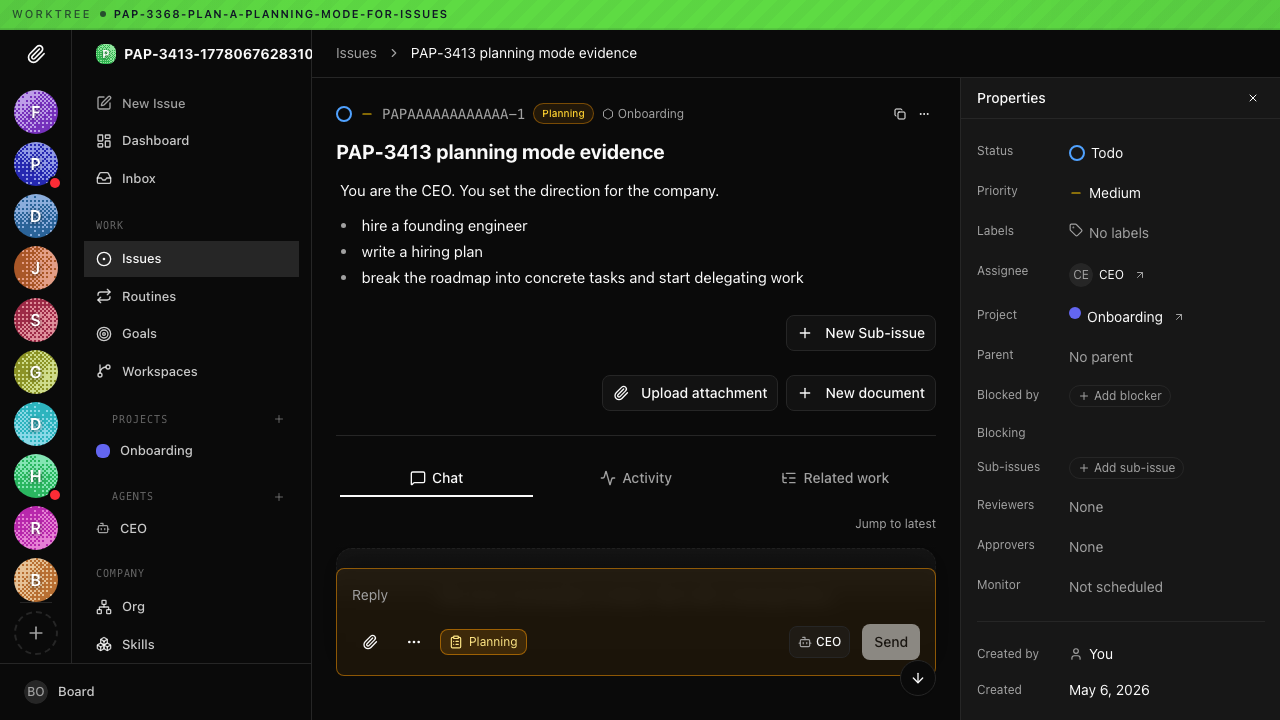
Desktop planning row:
Desktop staged standard toggle:
Mobile planning detail:
Mobile planning row:
## Risks
- Medium migration risk: this adds a non-null issue column. The
migration uses `ADD COLUMN IF NOT EXISTS` so installations that applied
an older branch-local migration number can still apply the final
numbered migration safely.
- Medium contract risk: issue payloads, plugin payloads, and adapter
heartbeat payloads now include work mode; compatibility is handled by
defaulting missing values to `standard`.
- UI risk is moderate because composer controls changed; focused
component tests and visual e2e coverage exercise standard vs planning
display and toggle behavior.
> For core feature work, check [`ROADMAP.md`](ROADMAP.md) first and
discuss it in `#dev` before opening the PR. Feature PRs that overlap
with planned core work may need to be redirected — check the roadmap
first. See `CONTRIBUTING.md`.
## Model Used
- OpenAI Codex, GPT-5 coding agent in a local Paperclip worktree, with
shell/tool use. Exact context-window size is not exposed in this
runtime.
## Checklist
- [x] I have included a thinking path that traces from project context
to this change
- [x] I have specified the model used (with version and capability
details)
- [x] I have checked ROADMAP.md and confirmed this PR does not duplicate
planned core work
- [x] I have run tests locally and they pass
- [x] I have added or updated tests where applicable
- [x] If this change affects the UI, I have included before/after
screenshots
- [x] I have updated relevant documentation to reflect my changes
- [x] I have considered and documented any risks above
- [x] I will address all Greptile and reviewer comments before
requesting merge
---------
Co-authored-by: Paperclip <noreply@paperclip.ing>
## Thinking Path

> - Paperclip orchestrates AI agents for zero-human companies
> - The plugin system is the extension boundary for optional product
capabilities
> - Rich plugins need more than a worker entrypoint: they need scoped
database storage, local project folders, managed agents/routines, host
navigation, and reusable UI components
> - The LLM Wiki work exposed those missing host surfaces while keeping
plugin code outside the core control plane
> - This pull request expands the core plugin host, SDK, server APIs,
and UI bridge so plugins can declare and use those surfaces
> - The benefit is that future plugins can integrate with Paperclip
through documented, validated contracts instead of bespoke server or UI
imports

## What Changed

- Added plugin-managed database namespaces and migration tracking,
including Drizzle schema/migration files and SQL validation for
namespace isolation.
- Added server support for plugin local folders, managed agents, managed
routines, scoped plugin APIs, and plugin operation visibility.
- Expanded shared plugin manifest/types/validators and SDK
host/testing/UI exports for richer plugin surfaces.
- Added reusable UI pieces for file trees, managed routines, resizable
sidebars, route sidebars, and plugin bridge initialization.
- Updated plugin docs and example plugins to use the expanded host and
SDK surface.

## Verification

- `pnpm install --frozen-lockfile`
- `pnpm run preflight:workspace-links && pnpm exec vitest run
packages/shared/src/validators/plugin.test.ts
server/src/__tests__/plugin-database.test.ts
server/src/__tests__/plugin-local-folders.test.ts
server/src/__tests__/plugin-managed-agents.test.ts
server/src/__tests__/plugin-managed-routines.test.ts
server/src/__tests__/plugin-orchestration-apis.test.ts
ui/src/api/plugins.test.ts ui/src/components/FileTree.test.tsx
ui/src/components/ResizableSidebarPane.test.tsx
ui/src/pages/PluginPage.test.tsx ui/src/plugins/bridge.test.ts` passed:
11 files, 67 tests.
- Confirmed this PR changes 89 files and does not include
`pnpm-lock.yaml` or `.github/workflows/*`.

## Risks

- Medium: this expands plugin host contracts across db/shared/server/ui
and includes a new core migration (`0076_useful_elektra.sql`).
- The plugin database namespace validator is intentionally restrictive;
plugin authors may need follow-up affordances for SQL patterns that
remain blocked.
- Merge this before the LLM Wiki plugin PR so the plugin can resolve the
new SDK and host APIs.

> For core feature work, check [`ROADMAP.md`](ROADMAP.md) first and
discuss it in `#dev` before opening the PR. Feature PRs that overlap
with planned core work may need to be redirected — check the roadmap
first. See `CONTRIBUTING.md`.

## Model Used

- OpenAI Codex, GPT-5 coding agent, tool-enabled shell/git/GitHub
workflow. Context window size was not exposed by the runtime.

## Checklist

- [x] I have included a thinking path that traces from project context
to this change
- [x] I have specified the model used (with version and capability
details)
- [x] I have checked ROADMAP.md and confirmed this PR does not duplicate
planned core work
- [x] I have run tests locally and they pass
- [x] I have added or updated tests where applicable
- [x] If this change affects the UI, I have included before/after
screenshots
- [x] I have updated relevant documentation to reflect my changes
- [x] I have considered and documented any risks above
- [x] I will address all Greptile and reviewer comments before
requesting merge

---------

Co-authored-by: Paperclip <noreply@paperclip.ing>
## Thinking Path

> - Paperclip orchestrates AI agents for zero-human companies.
> - The environment/runtime layer decides where agent work executes and
how the control plane reaches those runtimes.
> - Today Paperclip can run locally and over SSH, but sandboxed
execution needs a first-class environment model instead of one-off
adapter behavior.
> - We also want sandbox providers to be pluggable so the core does not
hardcode every provider implementation.
> - This branch adds the Sandbox environment path, the provider
contract, and a deterministic fake provider plugin.
> - That required synchronized changes across shared contracts, plugin
SDK surfaces, server runtime orchestration, and the UI
environment/workspace flows.
> - The result is that sandbox execution becomes a core control-plane
capability while keeping provider implementations extensible and
testable.

## What Changed

- Added sandbox runtime support to the environment execution path,
including runtime URL discovery, sandbox execution targeting,
orchestration, and heartbeat integration.
- Added plugin-provider support for sandbox environments so providers
can be supplied via plugins instead of hardcoded server logic.
- Added the fake sandbox provider plugin with deterministic behavior
suitable for local and automated testing.
- Updated shared types, validators, plugin protocol definitions, and SDK
helpers to carry sandbox provider and workspace-runtime contracts across
package boundaries.
- Updated server routes and services so companies can create sandbox
environments, select them for work, and execute work through the sandbox
runtime path.
- Updated the UI environment and workspace surfaces to expose sandbox
environment configuration and selection.
- Added test coverage for sandbox runtime behavior, provider seams,
environment route guards, orchestration, and the fake provider plugin.

## Verification

- Ran locally before the final fixture-only scrub:
  - `pnpm -r typecheck`
  - `pnpm test:run`
  - `pnpm build`
- Ran locally after the final scrub amend:
  - `pnpm vitest run server/src/__tests__/runtime-api.test.ts`
- Reviewer spot checks:
  - create a sandbox environment backed by the fake provider plugin
  - run work through that environment
- confirm sandbox provider execution does not inherit host secrets
implicitly

## Risks

- This touches shared contracts, plugin SDK plumbing, server runtime
orchestration, and UI environment/workspace flows, so regressions would
likely show up as cross-layer mismatches rather than isolated type
errors.
- Runtime URL discovery and sandbox callback selection are sensitive to
host/bind configuration; if that logic is wrong, sandbox-backed
callbacks may fail even when execution succeeds.
- The fake provider plugin is intentionally deterministic and
test-oriented; future providers may expose capability gaps that this
branch does not yet cover.

## Model Used

- OpenAI Codex coding agent on a GPT-5-class backend in the
Paperclip/Codex harness. Exact backend model ID is not exposed
in-session. Tool-assisted workflow with shell execution, file editing,
git history inspection, and local test execution.

## Checklist

- [x] I have included a thinking path that traces from project context
to this change
- [x] I have specified the model used (with version and capability
details)
- [x] I have checked ROADMAP.md and confirmed this PR does not duplicate
planned core work
- [x] I have run tests locally and they pass
- [x] I have added or updated tests where applicable
- [ ] If this change affects the UI, I have included before/after
screenshots
- [x] I have updated relevant documentation to reflect my changes
- [x] I have considered and documented any risks above
- [x] I will address all Greptile and reviewer comments before
requesting merge
## Thinking Path

> - Paperclip orchestrates AI agents for zero-human companies.
> - Operators supervise that work through issues, comments, approvals,
and the board UI.
> - Some agent proposals need structured board/user decisions, not
hidden markdown conventions or heavyweight governed approvals.
> - Issue-thread interactions already provide a natural thread-native
surface for proposed tasks and questions.
> - This pull request extends that surface with request confirmations,
richer interaction cards, and agent/plugin/MCP helpers.
> - The benefit is that plan approvals and yes/no decisions become
explicit, auditable, and resumable without losing the single-issue
workflow.

## What Changed

- Added persisted issue-thread interactions for suggested tasks,
structured questions, and request confirmations.
- Added board UI cards for interaction review, selection, question
answers, and accept/reject confirmation flows.
- Added MCP and plugin SDK helpers for creating interaction cards from
agents/plugins.
- Updated agent wake instructions, onboarding assets, Paperclip skill
docs, and public docs to prefer structured confirmations for
issue-scoped decisions.
- Rebased the branch onto `public-gh/master` and renumbered branch
migrations to `0063` and `0064`; the idempotency migration uses `ADD
COLUMN IF NOT EXISTS` for old branch users.

## Verification

- `git diff --check public-gh/master..HEAD`
- `pnpm exec vitest run packages/adapter-utils/src/server-utils.test.ts
packages/mcp-server/src/tools.test.ts
packages/shared/src/issue-thread-interactions.test.ts
ui/src/lib/issue-thread-interactions.test.ts
ui/src/lib/issue-chat-messages.test.ts
ui/src/components/IssueThreadInteractionCard.test.tsx
ui/src/components/IssueChatThread.test.tsx
server/src/__tests__/issue-thread-interaction-routes.test.ts
server/src/__tests__/issue-thread-interactions-service.test.ts
server/src/services/issue-thread-interactions.test.ts` -> 9 files / 79
tests passed
- `pnpm -r typecheck` -> passed, including `packages/db` migration
numbering check

## Risks

- Medium: this adds a new issue-thread interaction model across
db/shared/server/ui/plugin surfaces.
- Migration risk is reduced by placing this branch after current master
migrations (`0063`, `0064`) and making the idempotency column add
idempotent for users who applied the old branch numbering.
- UI interaction behavior is covered by component tests, but this PR
does not include browser screenshots.

> For core feature work, check [`ROADMAP.md`](ROADMAP.md) first and
discuss it in `#dev` before opening the PR. Feature PRs that overlap
with planned core work may need to be redirected — check the roadmap
first. See `CONTRIBUTING.md`.

## Model Used

- OpenAI Codex, GPT-5-class coding agent runtime. Exact model ID and
context window are not exposed in this Paperclip run; tool use and local
shell/code execution were enabled.

## Checklist

- [x] I have included a thinking path that traces from project context
to this change
- [x] I have specified the model used (with version and capability
details)
- [x] I have checked ROADMAP.md and confirmed this PR does not duplicate
planned core work
- [x] I have run tests locally and they pass
- [x] I have added or updated tests where applicable
- [ ] If this change affects the UI, I have included before/after
screenshots
- [x] I have updated relevant documentation to reflect my changes
- [x] I have considered and documented any risks above
- [x] I will address all Greptile and reviewer comments before
requesting merge

---------

Co-authored-by: Paperclip <noreply@paperclip.ing>
## Thinking Path

> - Paperclip orchestrates AI agents for zero-human companies.
> - The plugin system is the extension path for optional capabilities
that should not require core product changes for every integration.
> - Plugins need scoped host APIs for issue orchestration, documents,
wakeups, summaries, activity attribution, and isolated database state.
> - Without those host APIs, richer plugins either cannot coordinate
Paperclip work safely or need privileged core-side special cases.
> - This pull request adds the plugin orchestration host surface, scoped
route dispatch, a database namespace layer, and a smoke plugin that
exercises the contract.
> - The benefit is a broader plugin API that remains company-scoped,
auditable, and covered by tests.

## What Changed

- Added plugin orchestration host APIs for issue creation, document
access, wakeups, summaries, plugin-origin activity, and scoped API route
dispatch.
- Added plugin database namespace tables, schema exports, migration
checks, and idempotent replay coverage under migration
`0059_plugin_database_namespaces`.
- Added shared plugin route/API types and validators used by server and
SDK boundaries.
- Expanded plugin SDK types, protocol helpers, worker RPC host behavior,
and testing utilities for orchestration flows.
- Added the `plugin-orchestration-smoke-example` package to exercise
scoped routes, restricted database namespaces, issue orchestration,
documents, wakeups, summaries, and UI status surfaces.
- Kept the new orchestration smoke fixture out of the root pnpm
workspace importer so this PR preserves the repository policy of not
committing `pnpm-lock.yaml`.
- Updated plugin docs and database docs for the new orchestration and
database namespace surfaces.
- Rebased the branch onto `public-gh/master`, resolved conflicts, and
removed `pnpm-lock.yaml` from the final PR diff.

## Verification

- `pnpm install --frozen-lockfile`
- `pnpm --filter @paperclipai/db typecheck`
- `pnpm exec vitest run packages/db/src/client.test.ts`
- `pnpm exec vitest run server/src/__tests__/plugin-database.test.ts
server/src/__tests__/plugin-orchestration-apis.test.ts
server/src/__tests__/plugin-routes-authz.test.ts
server/src/__tests__/plugin-scoped-api-routes.test.ts
server/src/__tests__/plugin-sdk-orchestration-contract.test.ts`
- From `packages/plugins/examples/plugin-orchestration-smoke-example`:
`pnpm exec vitest run --config ./vitest.config.ts`
- `pnpm --dir
packages/plugins/examples/plugin-orchestration-smoke-example run
typecheck`
- `pnpm --filter @paperclipai/server typecheck`
- PR CI on latest head `293fc67c`: `policy`, `verify`, `e2e`, and
`security/snyk` all passed.

## Risks

- Medium risk: this expands plugin host authority, so route auth,
company scoping, and plugin-origin activity attribution need careful
review.
- Medium risk: database namespace migration behavior must remain
idempotent for environments that may have seen earlier branch versions.
- Medium risk: the orchestration smoke fixture is intentionally excluded
from the root workspace importer to avoid a `pnpm-lock.yaml` PR diff;
direct fixture verification remains listed above.
- Low operational risk from the PR setup itself: the branch is rebased
onto current `master`, the migration is ordered after upstream
`0057`/`0058`, and `pnpm-lock.yaml` is not in the final diff.

> For core feature work, check [`ROADMAP.md`](ROADMAP.md) first and
discuss it in `#dev` before opening the PR. Feature PRs that overlap
with planned core work may need to be redirected — check the roadmap
first. See `CONTRIBUTING.md`.

Roadmap checked: this work aligns with the completed Plugin system
milestone and extends the plugin surface rather than duplicating an
unrelated planned core feature.

## Model Used

- OpenAI Codex, GPT-5-based coding agent in a tool-enabled CLI
environment. Exact hosted model build and context-window size are not
exposed by the runtime; reasoning/tool use were enabled for repository
inspection, editing, testing, git operations, and PR creation.

## Checklist

- [x] I have included a thinking path that traces from project context
to this change
- [x] I have specified the model used (with version and capability
details)
- [x] I have checked ROADMAP.md and confirmed this PR does not duplicate
planned core work
- [x] I have run tests locally and they pass
- [x] I have added or updated tests where applicable
- [x] If this change affects the UI, I have included before/after
screenshots (N/A: no core UI screen change; example plugin UI contract
is covered by tests)
- [x] I have updated relevant documentation to reflect my changes
- [x] I have considered and documented any risks above
- [x] I will address all Greptile and reviewer comments before
requesting merge

---------

Co-authored-by: Paperclip <noreply@paperclip.ing>
- Plugin loader: install/reload/remove/reinstall external adapters
  from npm packages or local directories
- Plugin store persisted at ~/.paperclip/adapter-plugins.json
- Self-healing UI parser resolution with version caching
- UI: Adapter Manager page, dynamic loader, display registry
  with humanized names for unknown adapter types
- Dev watch: exclude adapter-plugins dir from tsx watcher
  to prevent mid-request server restarts during reinstall
- All consumer fallbacks use getAdapterLabel() for consistent display
- AdapterTypeDropdown uses controlled open state for proper close behavior
- Remove hermes-local from built-in UI (externalized to plugin)
- Add docs for external adapters and UI parser contract
Expose telemetry.track through the plugin SDK and server host bridge, forward plugin-prefixed events into the shared telemetry client, and demonstrate the capability in the kitchen sink example.\n\nCo-Authored-By: Paperclip <noreply@paperclip.ing>
Wire issue document list/get/upsert/delete operations through the
JSON-RPC protocol so plugins can manage issue documents with the same
capabilities available via the REST API.
Fixes#940
- Add scopedBus.clear() in dispose() to prevent subscription accumulation
  on worker crash/restart cycles
- Use two-arg subscribe() overload when filter is null instead of passing
  empty object; fix filter type to include null
- Update ASCII flow diagram: onEvent is a notification, not request/response
Plugin workers register event handlers via `ctx.events.on()` in the SDK,
but these subscriptions were never forwarded to the host process. The host
sends events via `notifyWorker("onEvent", ...)` which produces a JSON-RPC
notification (no `id`), but the worker only dispatched `onEvent` as a
request handler — notifications were silently dropped.

Changes:
- Add `events.subscribe` RPC method so workers can register subscriptions
  on the host-side event bus during setup
- Handle `onEvent` notifications in the worker notification dispatcher
  (previously only `agents.sessions.event` was handled)
- Add `events.subscribe` to HostServices interface, capability map, and
  host client handler
- Add `subscribe` handler in host services that registers on the scoped
  plugin event bus and forwards matched events to the worker
 Nicky Leach
 Dotta
Dotta
 Michael Nguyen
 Devin Foley
 HenkDz
 dotta
dotta
 Justin Miller
 HD
HD
 Dotta
Dotta