## Thinking Path

> - Paperclip is the open source app people use to manage AI agents for
work.
> - Managed worktree services run isolated Paperclip instances with
cloned databases.
> - A reachable service was reported as ready even when its database,
runtime identity, or login path was not usable.
> - The first candidate added verified database seeding and managed
repair in #11665.
> - This pull request consolidates that candidate with signed login
handoff and a complete readiness contract.
> - Post-QA fixes close five defects in repair identity, repair
responses, UI retry, seed journal handling, and seed-source trust.
> - The benefit is a workspace that either opens safely or reports one
accurate recovery action.

## Linked Issues or Issue Description

No public GitHub issue exists for this work, so the problem is described
here.

**What happened**

Managed workspace URLs could return HTTP 200 and report ready while
login failed. QA also found cases where repair used the wrong instance
identity, returned a generic error, left the UI stuck, rejected a safe
journal lag, or trusted a mutable workspace manifest.

**Expected behavior**

Opening a ready workspace signs the board user in to the correct
isolated instance. Provisioning and repair use a registered source and
report a structured recovery state.

**Actual behavior**

Entry depended on a password copied into the clone. Several failure
paths could publish stale readiness, hide the repair precondition, or
trust state that the workspace could modify.

**Additional context**

This pull request includes the commits first published in #11665. That
pull request keeps the original base head for review history. This
consolidated pull request is the merge candidate. Related open readiness
work includes #11575 and #11621.

## What Changed

- Adds a short-lived, signed, single-use login ticket. It binds the
user, workspace, instance, and runtime origin.
- Exchanges the ticket through Better Auth. It creates the session and
cookie through the supported adapter path.
- Adds protected workspace readiness fields for the database, clone
data, login handoff, seed phase, and runtime identity.
- Fails readiness closed when the guest has no company or
execution-workspace binding.
- Binds ticket issuance to the exact cloned user and active company
membership selected for the handoff.
- Verifies every current active board identity through the exact-user
handoff before publication or reuse.
- Gates managed runtime publication on the readiness contract and the
recorded worktree instance identity.
- Refreshes runtime work products from the live runtime row after a port
change.
- Adds one workspace access card with ready, degraded, repairing, and
failed states.
- Uses the runtime response identity for repair. It returns structured
repair precondition errors.
- Lets a valid source journal lag converge during provisioning.
- Binds seed and repair manifests to a source registered outside the
agent-writable worktree.
- Clears recovered UI errors so a successful retry can open the
workspace.
- Makes runtime tests register canonical sources and avoid ports owned
by live host listeners.
- Keeps Vitest on source suites when compiled `dist` trees exist.
- Isolates CLI and adapter tests from ambient AWS and runtime API
environment variables.
- Preserves a 404 response for cross-company workspace ID lookups before
runtime authorization.
- Makes concurrent single-flight coverage independent of
path-canonicalization scheduling order.

## Verification

The following checks passed on the integrated head:

```sh
pnpm -r typecheck
pnpm build
pnpm check:token-gates
pnpm --filter @paperclipai/db check:migrations
```

- The server source lane passed 420 files and 4,953 tests. Five tests
were skipped.
- The CLI lane passed 57 files and 385 tests.
- The database lane passed 26 files and 97 tests.
- The shared package passed 58 files and 506 tests.
- The adapter utility lane passed 640 tests. Four tests were skipped.
- The Claude adapter passed 220 tests. One test was skipped.
- The Codex adapter passed 323 tests.
- The OpenClaw adapter passed 13 tests.
- The OpenCode adapter passed 42 tests.
- The plugin SDK passed 45 tests.
- The workspace runtime suite passed 124 tests.
- The caller-scoped readiness and handoff suite passed 52 tests.
- The workspace provisioning shell suite passed 7 tests.
- The runtime exposure suite passed 17 tests while live host mappings
occupied fixed test ports.
- `git diff --check` passed and the worktree is clean.

The serialized route lane will run in GitHub CI with its normal shards.
No deployment or active-workspace migration was performed.

## Risks

- This is a medium-risk authentication and runtime-readiness change.
- The login ticket uses exact origin, workspace, instance, and user
binding. It has a short expiry and a one-time nonce.
- Runtime publication is stricter. A real readiness, identity, per-user
handoff, or control-plane database disagreement now blocks publication.
- This pull request supersedes #11665 as the merge candidate. Close
#11665 after this pull request merges.
- No new database migration is included. The lockfile and workflow files
are unchanged.
- Deployment and active-workspace migration are intentionally outside
this pull request.

> For core feature work, check [`ROADMAP.md`](ROADMAP.md) first and
discuss it in `#dev` before opening the PR. Feature PRs that overlap
with planned core work may need to be redirected — check the roadmap
first. See `CONTRIBUTING.md`.

## Model Used

Claude Opus 5 (`claude-opus-5[1m]`), 1M context, extended thinking, tool
use, and code execution produced the main candidate. OpenAI GPT-5
(`gpt-5`) through Codex, with agentic reasoning, tool use, and code
execution, integrated the post-QA fixes and hardened the test gates. The
Codex context-window size was not exposed.

## Checklist

- [x] I have included a thinking path that traces from project context
to this change
- [x] I have specified the model used (with version and capability
details)
- [x] I have checked ROADMAP.md and confirmed this PR does not duplicate
planned core work
- [x] I have searched GitHub for duplicate or related PRs and linked
them above
- [x] I have either (a) linked existing issues with `Fixes: #` / `Closes
#` / `Refs #` OR (b) described the issue in-PR following the relevant
issue template
- [x] I have not referenced internal/instance-local Paperclip issues or
links (only public GitHub `#NNN` / `github.com/paperclipai/paperclip`
URLs)
- [x] My branch name describes the change (e.g. `docs/...`, `fix/...`)
and contains no internal Paperclip ticket id or instance-derived details
- [x] I have run tests locally and they pass
- [x] I have added or updated tests where applicable
- [x] I have updated relevant documentation to reflect my changes
- [x] I have considered and documented any risks above
- [x] All Paperclip CI gates are green
- [x] Greptile is 5/5 with no open P2s, recommendations, or follow-ups
- [x] I will address all Greptile and reviewer comments before
requesting merge

---------

Co-authored-by: Paperclip <noreply@paperclip.ing>
<!-- Simplified Technical English (ASD-STE100). -->

> **Stacked pull request.** This targets #11524. Merge #11524 first.
Review only the second commit, `feat(runtime): managed Tailscale HTTPS
lifecycle...`.

## Thinking Path

> - Paperclip is the open source app people use to manage AI agents for
work
> - Paperclip starts and supervises managed runtime services, so an
agent's branch can be previewed while the agent works
> - The previous pull request added the host broker, the shared
contract, and the database columns, but no code used them
> - A managed runtime can only be exposed over HTTPS if it holds a
stable loopback port pair for the whole life of the service. The current
control path cannot promise this: two controls can race the same
execution workspace, a stranded control can stay `running` forever, and
a start can adopt a port it does not own
> - This pull request adds the HTTPS lifecycle and the control-path
hardening that the lifecycle depends on
> - The benefit is that a managed preview becomes reachable from another
device, and a managed control now always reaches a terminal state

## Linked Issues or Issue Description

No public GitHub issue exists. The change follows the feature request
template.

**Subsystem affected**

Managed workspace runtime services, workspace operations, the execution
workspace routes, and the workspace runtime UI.

**Problem or motivation**

A managed runtime service is reachable only on loopback, so a preview
cannot be opened from a phone or a second computer. Exposing it safely
needs an exclusively held port pair. Three existing gaps block that.
Overlapping controls can race the same workspace. A control whose owner
dies stays `running` and blocks the lane forever. Port allocation does
not confirm that the process holding a port is the process Paperclip
spawned.

**Proposed solution**

Add the exposure lifecycle on top of the broker from #11524: reserve
before spawn, expose after readiness, validate the public URL, and
remove on stop. In the same change, make managed controls mutually
exclusive per workspace, give each control a durable issue-owned lease
and a terminal state, and verify port ownership before use.

**Alternatives considered**

- Add HTTPS exposure without the control hardening. This was rejected
because a raced or stranded control makes exposure point at the wrong
process.
- Guard the lane with an in-memory lock only. This was rejected because
the lock does not survive a server restart, so the lane can be lost or
double-claimed.
- Trust the requested bind address. This was rejected because a checkout
that predates managed HTTPS overwrites `PAPERCLIP_BIND` from its own
`--bind` argument, and then binds the wildcard address.

**Roadmap alignment**

This completes the managed workspace runtime capability that already
exists. It adds no new product surface beyond the HTTPS link.

**Additional context**

This is the second of three pull requests. The third adds central
mediation of leased port pairs.

## What Changed

Exposure lifecycle:

- Add the server-side broker client and the exposure lifecycle manager.
The manager reserves the mapping before spawn, exposes after backend
readiness, validates the public URL, and removes the mapping on stop.
- Default managed worktree runtimes to `tailscale_https`, read exposure
intent from legacy `expose` blocks, and backfill runtimes that are still
HTTP-only.
- Verify listener ownership for the app port and its Vite HMR companion
before the broker is asked to expose anything. An unrelated listener on
either port fails the start closed.
- Force the loopback bind through argv instead of environment hints.
Leave a non-Paperclip service's `--bind` argument alone.
- Probe loopback for readiness instead of the public URL, and give Vite
HMR its own loopback-bound server in middleware mode.
- Preserve operator-declared Serve mappings across the managed
lifecycle, so cleanup never removes a mapping that Paperclip did not
create.
- Name which listener predicate denied an expose, so an operator can act
on the message.

Control-path hardening:

- Make `start`, `stop`, `restart`, and job `run` mutually exclusive per
execution workspace. An overlap gets `409
workspace_runtime_control_in_progress`, and authorization is still
checked first.
- Take a durable exclusivity lease on the execution workspace, owned by
the controlling issue. A different issue gets `409
workspace_runtime_lease_conflict` before any operation is recorded.
Board and operator actions bypass the lease.
- Give every control a terminal state. Each control stamps its owning
process and pid, heartbeats while it runs, and has a wall-clock ceiling.
Recovery of a stranded control uses a compare-and-swap on `updated_at`,
so a live owner is never stolen.
- Bound readiness probes, verify allocated port ownership on POSIX and
Windows, harden sibling port allocation, and reconcile desired runtimes
on server startup.
- Surface exposure state and bounded runtime errors in the workspace
runtime UI.
- Record the new behavior in `doc/DEVELOPING.md`.

## Verification

Focused checks, all run on this branch:

- `npx tsc --noEmit -p server/tsconfig.json` — 139 errors, exactly the
count on `master`. All 139 come from the unbuilt
`@paperclipai/plugin-sdk` package.
- `pnpm --filter @paperclipai/ui typecheck` — clean.
- Server suites, 177 tests pass across 9 files:
`workspace-runtime.test.ts`, `workspace-runtime-leases.test.ts`,
`workspace-runtime-control-recovery.test.ts`,
`execution-workspace-runtime-control-conflict.test.ts`,
`execution-workspace-runtime-lease-route.test.ts`,
`workspace-operations-reconciliation.test.ts`,
`workspace-runtime-start-terminality.test.ts`, `app-hmr-port.test.ts`,
and `workspace-runtime-ready-comment.test.ts`.
- Exposure unit suites, 77 tests pass: `src/services/runtime-exposure/`
and `workspace-runtime-exposure-backfill.test.ts`.
- UI: `WorkspaceRuntimeControls.test.tsx` and
`WorkspaceServiceControlBar.test.tsx` — 34 tests pass.

**One suite is red on the development host and is expected to be green
in CI.** `server/src/services/workspace-runtime-exposure.test.ts` has 10
failures on the machine used to write this branch. The cause is host
contamination, not the code. That machine already runs an HTTPS canary
that holds ports 42000, 42001, 52000, and 52001 on a tailnet address.
The suite allocates from the same range, so the new listener-ownership
check correctly reports:

```
listener_ownership_mismatch — port 42000 is bound to 100.123.243.20, 127.0.0.1,
fd7a:115c:a1e0:0:0:0:dd3a:f314 ... instead of loopback only
```

A CI runner has no listener on those ports, so the check sees loopback
only and the suite passes. Please confirm this from the CI result on
this pull request rather than from a local run on a host that already
exposes a managed runtime. This is a real weakness of the current test
fixture, and the third pull request in the series removes it by
allocating the pair through a central mediator instead of a stubbed
availability check.

`workspace-runtime-https-live-exercise.test.ts` needs a live `tailscale`
host and was not run locally.

## Risks

- This is the behavior-bearing pull request of the three, so it carries
the most risk.
- Two new `409` responses appear on managed control routes. A caller
that assumed a control always starts must handle a conflict. Board and
operator actions are deliberately exempt, so an agent lease cannot lock
an operator out.
- Managed worktree runtimes now default to `tailscale_https`. If the
host has no working broker, the start fails closed and reports the
exposure failure instead of silently serving plain HTTP. This is
intended, and it is the reason the failure message names the denying
predicate.
- Startup reconciliation touches persisted runtime rows. It is scoped to
desired state and does not resurrect a service that never came up.
- The lease has a 30-minute time to live and explicit release paths, so
a crashed owner cannot hold a lane forever.
- No migration runs in this pull request. The tables and columns land in
#11524.

> For core feature work, check [`ROADMAP.md`](ROADMAP.md) first and
discuss it in `#dev` before opening the PR.

## Model Used

Claude Opus 5 (`claude-opus-5`), 1M context window, extended thinking,
with tool use and code execution.

## Checklist

- [x] I have included a thinking path that traces from project context
to this change
- [x] I have specified the model used (with version and capability
details)
- [x] I have checked ROADMAP.md and confirmed this PR does not duplicate
planned core work
- [x] I have searched GitHub for duplicate or related PRs and linked
them above
- [x] I have either (a) linked existing issues with `Fixes: #` / `Closes
#` / `Refs #` OR (b) described the issue in-PR following the relevant
issue template
- [x] I have not referenced internal/instance-local Paperclip issues or
links (only public GitHub `#NNN` / `github.com/paperclipai/paperclip`
URLs)
- [x] My branch name describes the change (e.g. `docs/...`, `fix/...`)
and contains no internal Paperclip ticket id or instance-derived details
- [x] I have run tests locally and they pass, with the one
host-contaminated suite explained above
- [x] I have added or updated tests where applicable
- [x] I have updated relevant documentation to reflect my changes
- [x] I have considered and documented any risks above
- [ ] All Paperclip CI gates are green
- [ ] Greptile is 5/5 with no open P2s, recommendations, or follow-ups
- [x] I will address all Greptile and reviewer comments before
requesting merge
## Thinking Path

> - Paperclip is the open source app people use to manage AI agents for
work
> - Issue execution uses isolated workspaces that hold the issue
worktree
> - A terminal issue can leave its isolated workspace archived and
unable to resume
> - The existing closed-workspace guards returned a conflict and gave
the user no self-serve recovery
> - This pull request reopens the same isolated workspace row and
rebuilds its worktree
> - The benefit is that resume, checkout, and comment actions can
continue without a new workspace row

## Linked Issues or Issue Description

**Problem or motivation**

A terminal issue can point to an archived isolated execution workspace.
Resume, checkout, and comment actions then stop with a conflict.

**What happened?**

A terminal issue kept its issue-to-workspace link after the isolated
workspace reached a closed status. The guarded actions returned HTTP 409
instead of restoring access.

**Expected behavior**

The next authorized resume, checkout, or comment action reopens the same
isolated workspace row. The action rebuilds the worktree and then
continues.

**Steps to reproduce**

1. Create an issue that uses an isolated execution workspace.
2. Move the issue to a terminal state and let the workspace archive.
3. Try to resume the issue or add a comment.
4. Observe the closed-workspace conflict.

**Paperclip version or commit**

e6e79f458e

**Deployment mode**

Built from source with pnpm.

**Proposed solution**

Reopen the closed isolated workspace in place. Rebuild the worktree
before the route reports success.

**Alternatives considered**

Create a new workspace row. This would require repointing the issue link
and would not preserve access for issues that share the original row.

**Roadmap alignment**

ROADMAP.md has no matching reopen item.

## What Changed

- Reopen closed isolated workspace rows in place and rebuild their
worktrees.
- Use the reopen path from resume, checkout, and comment guards.
- Return a clear error when the rebuild fails and keep the workspace
closed.
- Fence terminal reaping and archive cleanup while a reopen is in
flight.
- Update the comment composer to allow the next action to reopen the
workspace.
- Add service and route tests for reopen, scope, failure, and lifecycle
races.

## Verification

- Server TypeScript check passes with the tsc --noEmit command.
- UI TypeScript check passes with the tsc --noEmit command.
- Seventy-two server tests pass across the affected test files.
- The isolated worktree UI test suite has a dependency mismatch and
fails before tests run with the error TypeError: act is not a function.
- CI confirms the UI test job after a clean dependency install.

## Risks

The reopen path changes behavior for closed isolated workspaces. A
rebuild failure returns an error and keeps the row closed. Lifecycle
locks and generation checks protect the worktree from stale cleanup. The
UI test mismatch needs CI confirmation.

## Model Used

OpenAI Codex, GPT-5, with tool use and code review assistance. The
runtime did not provide the context window size.

## Checklist

- [x] I have included a thinking path that traces from project context
to this change
- [x] I have specified the model used (with version and capability
details)
- [x] I have checked ROADMAP.md and confirmed this PR does not duplicate
planned core work
- [x] I have searched GitHub for duplicate or related PRs and linked
them above
- [x] I have either (a) linked existing issues with Fixes: # / Closes #
/ Refs # OR (b) described the issue in-PR following the relevant issue
template
- [x] I have not referenced internal/instance-local Paperclip issues or
links (only public GitHub references)
- [x] My branch name describes the change and contains no internal
Paperclip ticket id or instance-derived details
- [x] I have run tests locally and they pass
- [x] I have added or updated tests where applicable
- [x] I have updated relevant documentation to reflect my changes
- [x] I have considered and documented any risks above
- [x] All Paperclip CI gates are green
- [x] Greptile is 5/5 with no open P2s, recommendations, or follow-ups
- [x] I will address all Greptile and reviewer comments before
requesting merge

---------

Co-authored-by: Paperclip <noreply@paperclip.ing>
## Thinking Path

> - Paperclip is the open source app people use to manage AI agents for
work.
> - Execution workspaces are the bridge between Paperclip's control
plane and a local agent's checked-out repository state.
> - When a workspace is restored after a failed or interrupted run, the
recorded branch can disagree with the branch currently checked out on
disk.
> - A clean branch mismatch can be reconciled safely, but a dirty
mismatch needs a lossless path that does not discard uncommitted agent
work.
> - This pull request adds a quarantine-and-restore path that saves
dirty work to a rescue branch, restores the recorded branch, and exposes
the repair from the board UI and run page.
> - The benefit is that operators can recover wedged execution
workspaces without losing work or moving another live branch
unexpectedly.

## Linked Issues or Issue Description

No public GitHub issue exists for this workspace-recovery failure, so
this PR includes the bug report inline.

**What happened**

A git worktree-backed execution workspace could become wedged when
Paperclip expected one branch but found a different checked-out branch
with dirty tracked or untracked files. The existing safe repair path
refused the restore, leaving the source task blocked with no lossless
one-click recovery path.

**Expected behavior**

Paperclip should preserve dirty work before restoring the recorded
workspace branch. If another live workspace claims the checked-out
branch, or an attached runtime service is active, the repair should
refuse with clear operator-facing evidence instead of risking work loss
or file contention.

**Steps to reproduce**

Create a git worktree execution workspace whose persisted branch name
differs from the checked-out branch, add dirty tracked or untracked
files in that worktree, then trigger workspace validation or use the
branch reconcile endpoint. Before this change, the dirty mismatch
remained blocked because Paperclip had no quarantine restore mode.

**Paperclip version or commit**

Observed on the pre-fix workspace-recovery implementation. Verified on
this PR head after rebasing onto current `master`.

**Deployment mode**

Local trusted development/worktree deployments using git worktree
execution workspaces and optional workspace runtime services.

## What Changed

- Added dirty-worktree quarantine repair that creates a rescue branch,
commits dirty tracked and untracked files there, restores the recorded
branch, writes audit comments/activity, and preserves the live foreign
branch ref.
- Added `quarantine_restore` branch reconcile API support,
recovery-action resolution, source-task wake behavior, execution-review
preservation, claimant refusal, runtime-service refusal, and coverage
for the non-transactional git ordering.
- Added board UI controls for the repair action in the recovery card
plus a compact failed-run workspace recovery surface that uses the same
reconcile handlers.
- Hardened Greptile follow-up cases by best-effort restoring the
recorded branch after a mid-sequence rescue commit failure and by
refusing quarantine restore while attached runtime services are active.

## Verification

- `pnpm exec vitest run
server/src/__tests__/execution-workspaces-service.test.ts -t
"quarantine_restore"`
- `pnpm exec vitest run server/src/__tests__/workspace-runtime.test.ts
-t "workspace dirty quarantine branch repair"`
- `pnpm exec vitest run
server/src/__tests__/heartbeat-workspace-finalize-branch.test.ts -t
"repairs clean unrecorded branch drift|adopts unrecorded forward branch
drift"`
- `pnpm exec vitest run
server/src/__tests__/workspace-runtime-routes-authz.test.ts`
- `pnpm --filter @paperclipai/server typecheck`
- Earlier PR verification covered the route, service, heartbeat, UI
component, and run-page recovery surfaces; Cutter posted public preview
screenshots for the repair popover and run-page panel at
https://github.com/paperclipai/paperclip/pull/9297#issuecomment-4926934211.
- GitHub PR checks are green on
`dcac76b05f4cf6e1ee16544c2831d83c7857e475`.
- Greptile is 5/5 with zero annotations and no unresolved review threads
on `dcac76b05f4cf6e1ee16544c2831d83c7857e475`.

## Risks

- Moderate risk because the change intentionally runs git commands
against local worktrees; the implementation refuses dirty repair when
another claimant or active runtime service is detected and records
rescue refs for auditability.
- Compatibility / release-note callout for self-hosted operators:
existing instances that left `enableWorkspaceBranchReconcileForward`
unset now get automatic forward branch reconciliation during heartbeat
workspace recovery. Operators who want the previous advisory-only
behavior can set `experimental.enableWorkspaceBranchReconcileForward` to
`false`; dirty quarantine repair can likewise be disabled with
`experimental.enableWorkspaceDirtyQuarantineRepair: false`.
- If the git rescue succeeds but a later database write fails, the
worktree may already be restored while the recovery action remains open;
this ordering is documented in code because git side effects cannot
participate in the database transaction.
- UI risk is limited to the workspace recovery surfaces and covered by
component tests plus the existing Cutter visual preview.

## Model Used

OpenAI Codex coding agent based on GPT-5, with repository tool use,
shell execution, and local test execution. Earlier preserved commits on
this branch also show Claude Code / Claude Opus 4.8 assistance in their
commit metadata.

## Checklist

- [x] I have included a thinking path that traces from project context
to this change
- [x] I have specified the model used (with version and capability
details)
- [x] I have checked ROADMAP.md and confirmed this PR does not duplicate
planned core work
- [x] I have searched GitHub for duplicate or related PRs and linked
them above
- [x] I have either (a) linked existing issues with `Fixes: #` / `Closes
#` / `Refs #` OR (b) described the issue in-PR following the relevant
issue template
- [x] I have not referenced internal/instance-local Paperclip issues or
links (only public GitHub `#NNN` / `github.com/paperclipai/paperclip`
URLs)
- [x] Branch naming exception documented: this PR preserves the existing
worktree branch requested for publication while keeping the PR title and
body public-facing
- [x] I have run tests locally and they pass
- [x] I have added or updated tests where applicable
- [x] I have updated relevant documentation to reflect my changes
- [x] I have considered and documented any risks above
- [x] All Paperclip CI gates are green
- [x] Greptile is 5/5 with no open P2s, recommendations, or follow-ups
- [x] I will address all Greptile and reviewer comments before
requesting merge

---------

Co-authored-by: Paperclip <noreply@paperclip.ing>
Co-authored-by: Claude Opus 4.8 <noreply@anthropic.com>
## Thinking Path

> - Paperclip is an open-source app that lets teams run AI agents for
work tasks; each agent session uses an execution workspace — a git
checkout — to track the agent's active code state.
> - Every execution workspace has an expected target branch
(`PAPERCLIP_WORKSPACE_BRANCH`). The workspace git HEAD should always
point to that branch so agents commit in the right place.
> - When workspace git HEAD diverges from the expected branch — for
example after a harness branch-name fix or an accidental `checkout -b`
during a CI-retrigger — the discrepancy must be corrected before agents
can continue safely.
> - Operators (board users) need a controlled, audited path to reconcile
a workspace's live branch back to the expected target, with an override
escape-hatch for cases where the normal forward path is blocked.
> - This pull request adds a board-only `POST
/api/execution-workspaces/:id/reconcile-branch` service operation and
route that validates safety preconditions, resolves matching
recovery-action fingerprints, posts source-issue audit comments, and
records the reconciliation outcome.
> - The benefit is that operators can correct branch divergence through
the API with a full audit trail, instead of via raw database edits.

## Linked Issues or Issue Description

No public GitHub issue exists for this change. Context below follows the
feature-request template format.

**Subsystem affected**

server/ — REST API & orchestration services; packages/shared — request
validation.

**Problem or motivation**

Execution workspaces have an expected branch record that must match the
checked-out worktree branch. When the live git branch and stored branch
record drift apart, operators currently lack a first-class, audited API
to reconcile the record. The fallback is manual database repair or
workspace replacement, both of which are risky and hard to audit.

**Proposed solution**

Add a board-only execution workspace branch reconciliation operation.
`forward` mode re-inspects the server-side git state and only updates
the branch record when the stored branch is an ancestor of the
checked-out branch. `override` mode is a break-glass path that requires
board access and an operator reason. Both modes require a clean, idle
workspace, write audit details, post a source-issue audit comment, and
resolve the matching workspace-validation recovery action.

**Alternatives considered**

Manual database edit (no durable audit trail and easy to mistype),
recreating the workspace (heavier operational disruption), or trusting
client-supplied ancestry evidence (unsafe because the server must verify
the git state itself).

**Roadmap alignment**

This is incremental hardening for execution-workspace recovery and
operator controls. It does not duplicate a public roadmap item.

**Additional context**

The endpoint is intended for operator recovery, not normal agent control
flow, so the generated OpenAPI metadata and runtime route both classify
it as board-only.
## What Changed

- Added `reconcileExecutionWorkspaceBranchSchema` discriminated-union
validator (`forward` with optional reason, `override` requiring a
non-empty reason string) to
`packages/shared/src/validators/execution-workspace.ts`
- Exported `ReconcileExecutionWorkspaceBranch` type and the new schema
from the shared package index
- Added board-only reconcile-branch service operation in the execution
workspaces service: safety checks, recovery-action fingerprint
resolution, source-issue audit comment, and outcome recording
- Added clean-worktree and stopped-runtime-service preconditions before
branch-record mutation.
- Marked the reconcile route as board-only in OpenAPI generated auth
metadata.
- Added `POST /api/execution-workspaces/:id/reconcile-branch` route
wired to the new service operation with board-permission gate
- Extended `execution-workspaces-routes.test.ts` and
`execution-workspaces-service.test.ts` to cover: safety-check rejection,
override-reason validation, audit-comment posting, and recovery-action
fingerprint resolution (2 files / 19 tests)

## Verification

```sh
pnpm --filter @paperclipai/shared typecheck
pnpm --filter @paperclipai/server typecheck
pnpm exec vitest run server/src/__tests__/execution-workspaces-routes.test.ts server/src/__tests__/execution-workspaces-service.test.ts
pnpm exec vitest run server/src/__tests__/execution-workspaces-service.test.ts server/src/__tests__/openapi-routes.test.ts
```

## Risks

- **Board-only gate:** the operation is gated behind the board
permission; no agent can trigger it without operator authorization.
- **Override requires reason:** the `override` mode requires a non-empty
reason string so every bypass is audited.
- **Idempotent recovery-action resolution:** re-running with the same
fingerprint is safe; duplicate resolution is a no-op.
- **No execution-state mutation:** the route records a reconciliation
intent and updates the branch record; it does not restart the workspace
or modify running agent state.
- Overall risk: **low**.

## Model Used

- Provider: Anthropic
- Model ID: `claude-sonnet-4-6` (Claude Sonnet 4.6)
- Context window: 200 K tokens
- Capabilities: tool use, code execution, multi-turn context

Follow-up safety commit:
- Provider: OpenAI
- Model ID: `codex` / GPT-5 with tool use and code execution

## Checklist

- [x] I have included a thinking path that traces from project context
to this change
- [x] I have specified the model used (with version and capability
details)
- [x] I have checked ROADMAP.md and confirmed this PR does not duplicate
planned core work
- [x] I have searched GitHub for duplicate or related PRs and linked
them above
- [x] I have either (a) linked existing issues with `Fixes: #` /
`Closes: #` / `Refs: #` OR (b) described the issue in-PR following the
relevant issue template
- [x] I have not referenced internal/instance-local Paperclip issues or
links (only public GitHub `#NNN` / `github.com/paperclipai/paperclip`
URLs)
- [x] My branch name describes the change
(`feat/execution-workspace-branch-reconciliation-route`) and contains no
internal Paperclip ticket id or instance-derived details
- [x] I have run tests locally and they pass
- [x] I have added or updated tests where applicable
- [x] I have updated relevant documentation to reflect my changes
- [x] I have considered and documented any risks above
- [x] All Paperclip CI gates are green
- [x] Greptile is 5/5 with no open P2s, recommendations, or follow-ups
- [x] I will address all Greptile and reviewer comments before
requesting merge

---------

Co-authored-by: Paperclip <noreply@paperclip.ing>
## Thinking Path

> - Paperclip is the open source app people use to manage AI agents for
work.
> - The execution workspace subsystem powers project and workspace views
by listing runtime state, branch metadata, issue links, and status
summaries.
> - The existing workspace views relied on broad list data that can grow
expensive as a company accumulates many workspaces and linked issues.
> - That makes the Workspaces page and project workspace cards slower
than necessary because the UI does not always need the full workspace
detail payload up front.
> - This pull request adds a bounded overview contract for workspace
listings and moves the relevant UI surfaces to that cheaper path.
> - The benefit is faster workspace loading while preserving detail
fetches for pages that actually need full workspace data.

## Linked Issues or Issue Description

No public GitHub issue exists for this change. Inline bug report follows
the repository bug template.

### What happened?

Workspace index-style screens can load too much execution workspace
detail before the user asks for it. Several UI surfaces used fuller
workspace data paths for summary displays, which can make workspace
loading slower as workspace history grows.

### Expected behavior

Overview screens should request a bounded summary payload, while detail
screens should keep using the full workspace detail endpoint.

### Steps to reproduce

1. Run Paperclip from source with enough execution workspace history to
make workspace lists non-trivial.
2. Open the Workspaces page or a project workspace summary card.
3. Observe that summary UI needs only bounded workspace metadata but can
depend on broader workspace payloads.

### Paperclip version or commit

`master` at the time this branch was prepared.

### Deployment mode

Local dev (`pnpm dev`)

## What Changed

- Added shared types, validators, and path constants for bounded
execution workspace overviews.
- Added server service and route support for overview queries with
bounded linked issue/runtime metadata.
- Updated workspace overview UI API calls, query keys, breadcrumbs,
quicklooks, close dialogs, project summaries, and detail links to
consume the cheaper overview shape where appropriate.
- Added regression coverage for the new server route/service behavior
and the UI overview consumers.
- Registered the new workspace overview route in the generated OpenAPI
spec.
- Kept overview totals aligned with the project join and preserved
project slug links in workspace headers.

## Verification

- `pnpm exec vitest run
server/src/__tests__/execution-workspaces-service.test.ts
server/src/__tests__/execution-workspaces-routes.test.ts
ui/src/api/execution-workspaces.test.ts
ui/src/components/ProjectWorkspaceSummaryCard.test.tsx
ui/src/pages/Workspaces.test.tsx`
- `pnpm --filter @paperclipai/shared typecheck && pnpm --filter
@paperclipai/server typecheck && pnpm --filter @paperclipai/ui
typecheck`
- `pnpm exec vitest run server/src/__tests__/openapi-routes.test.ts
server/src/__tests__/execution-workspaces-routes.test.ts
server/src/__tests__/execution-workspaces-service.test.ts`
- `pnpm test:run:serialized -- --shard-index 1 --shard-count 4`

## Risks

Low to medium risk. The change introduces a new overview contract across
shared/server/ui layers, so the main risk is a mismatch between summary
and detail payload expectations. The added route/service/UI tests cover
the intended split, and full detail pages continue using the detail
path.

> For core feature work, check [`ROADMAP.md`](ROADMAP.md) first and
discuss it in `#dev` before opening the PR. Feature PRs that overlap
with planned core work may need to be redirected — check the roadmap
first. See `CONTRIBUTING.md`.

## Model Used

OpenAI Codex, GPT-5-based coding agent with repository tool use and
local command execution. Exact served model identifier and context
window were not exposed in this session.

## Checklist

- [x] I have included a thinking path that traces from project context
to this change
- [x] I have specified the model used (with version and capability
details)
- [x] I have checked ROADMAP.md and confirmed this PR does not duplicate
planned core work
- [x] I have searched GitHub for duplicate or related PRs and linked
them above
- [x] I have either (a) linked existing issues with `Fixes: #` / `Closes
#` / `Refs #` OR (b) described the issue in-PR following the relevant
issue template
- [x] I have not referenced internal/instance-local Paperclip issues or
links (only public GitHub `#NNN` / `github.com/paperclipai/paperclip`
URLs)
- [x] My branch name describes the change (e.g. `docs/...`, `fix/...`)
and contains no internal Paperclip ticket id or instance-derived details
- [x] I have run tests locally and they pass
- [x] I have added or updated tests where applicable
- [x] I have updated relevant documentation to reflect my changes
- [x] I have considered and documented any risks above
- [x] All Paperclip CI gates are green
- [x] Greptile is 5/5 with no open P2s, recommendations, or follow-ups
- [x] I will address all Greptile and reviewer comments before
requesting merge

---------

Co-authored-by: Paperclip <noreply@paperclip.ing>
## Thinking Path
> - Paperclip is a control plane for AI-agent companies, so execution
policy and trust boundaries are part of the product's safety contract.
> - Low-trust review work needs narrower authority than normal
same-company agents because hostile PRs, comments, attachments, and
generated output can carry prompt-injection payloads.
> - The current V1 shape gives trusted workers broad company context,
which is useful for normal execution but too permissive for a reviewer
assigned to hostile content.
> - This branch adds a `low_trust_review` preset, source-trust tagging,
route-level containment, and quarantine handling so low-trust output
does not automatically flow into higher-trust wake context.
> - The branch has been rebased onto current `origin/master`, and the
low-trust migration was renumbered to `0097_low_trust_source_trust.sql`
to avoid collisions with existing `0091` through `0096` migrations.
> - Greptile feedback was addressed by tightening low-trust detection,
preserving project-level trust policy checks, fixing issue-kind
promotion lookup, removing duplicate post-lease isolation assertion,
documenting fail-closed source-trust behavior, bounding ancestry checks,
enforcing runtime issue context for CEOs, awaiting accepted-plan monitor
authorization, and making low-trust issue source-trust tagging atomic.
> - The benefit is a first production slice of deny-by-default review
containment with regression coverage for the main control-plane pivot
surfaces.
Fixes#7531.
## What Changed
- Added shared trust-policy types and validators, plus
database/source-trust fields for issues, comments, documents, and work
products.
- Implemented server enforcement for low-trust issue scope, agent
self-view redaction, secret/plugin/runtime denial paths, promotion
checks, and quarantined continuation/wake context.
- Added focused low-trust regression tests for resolver behavior, source
trust, route authorization, heartbeat preflight ordering, runtime
containment, and quarantine redaction.
- Added board UI affordances for selecting/reviewing the low-trust
preset and surfacing source-trust badges in relevant issue views.
- Added `doc/LOW-TRUST-PRESETS.md`, updated
`doc/SPEC-implementation.md`, and committed the low-trust review
contract plan under `doc/plans/`.
- Rebasing note: the original `0097_low_trust_source_trust.sql`
migration was renamed to `0097_low_trust_source_trust.sql`; the SQL uses
`ADD COLUMN IF NOT EXISTS` so users who already applied the old-numbered
migration are not broken by the renumbered migration.
## Verification
- Rebased branch onto current `origin/master` and force-pushed with
lease to `origin/PAP-10211-low-trust-agent` at head `2719f31e3`.
- Confirmed the PR diff does not include `pnpm-lock.yaml` or
`.github/workflows` changes.
- Resolved upstream UI/comment conflicts by preserving deleted-comment
tombstone behavior and low-trust source-trust badges/metadata.
- Renumbered the low-trust source-trust migration to
`0097_low_trust_source_trust.sql`; the SQL uses `ADD COLUMN IF NOT
EXISTS` so users who already applied an old-numbered copy are not
broken.
- `pnpm exec vitest run ui/src/lib/issue-chat-messages.test.ts
server/src/__tests__/heartbeat-workspace-session.test.ts`
- `pnpm exec vitest run server/src/__tests__/source-trust.test.ts
server/src/__tests__/workspace-runtime-service-authz.test.ts
ui/src/lib/trust-policy-ui.test.ts
ui/src/components/TrustPresetSection.test.tsx`
- `pnpm run typecheck:build-gaps`
- `git diff --check`
- GitHub checks pass on head `2719f31e3`: build, typecheck/release
registry, general tests, serialized server suites, e2e, canary, verify,
policy/review, Socket, and Snyk.
- Greptile Review passes with Confidence Score 5/5 and zero unresolved
Greptile review threads.
- No design screenshots/images were added because the task explicitly
says not to add them unless they are specifically part of the work.
## Risks
- Medium risk: this touches shared trust-policy contracts, server
authorization paths, heartbeat context generation, migration metadata,
and UI preset controls.
- Low-trust containment is intentionally deny-by-default; legitimate
future review workflows may need explicit allowlisted exceptions.
- Plugin/runtime/security surfaces are broad, so regression tests cover
the current known routes but future integrations must route through the
same containment layer.
- The PR is ready for review; GitHub checks are green and Greptile is
5/5.
> For core feature work, check [`ROADMAP.md`](ROADMAP.md) first and
discuss it in `#dev` before opening the PR. Feature PRs that overlap
with planned core work may need to be redirected — check the roadmap
first. See `CONTRIBUTING.md`.
## Model Used
- OpenAI Codex, GPT-5 coding agent, tool-enabled shell and GitHub CLI
workflow.
## Checklist
- [x] I have included a thinking path that traces from project context
to this change
- [x] I have specified the model used (with version and capability
details)
- [x] I have checked ROADMAP.md and confirmed this PR does not duplicate
planned core work
- [x] I have run tests locally and they pass
- [x] I have added or updated tests where applicable
- [x] UI changes are covered by focused tests; no screenshots were added
per task instruction not to add design images unless specifically
required
- [x] I have updated relevant documentation to reflect my changes
- [x] I have considered and documented any risks above
- [x] I will address all Greptile and reviewer comments before
requesting merge
---------
Co-authored-by: Paperclip <noreply@paperclip.ing>
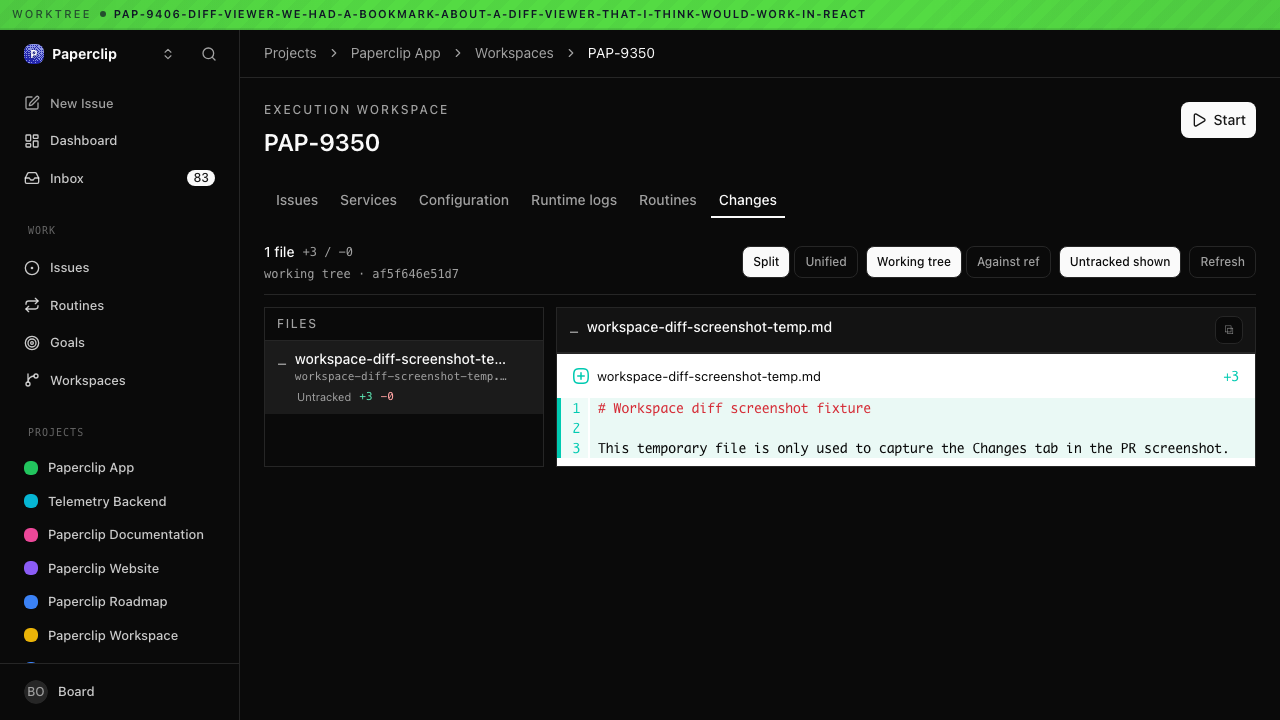
## Thinking Path

> - Paperclip orchestrates AI agents for zero-human companies.
> - Operators need to inspect what agents changed inside execution and
project workspaces.
> - The existing workspace detail views did not provide a first-party
rich diff surface for staged, unstaged, head, renamed, binary,
oversized, and untracked changes.
> - The plugin system is the intended extension point for optional rich
UI surfaces.
> - This pull request adds a workspace diff plugin plus host services
and shared contracts so Changes tabs can render workspace diffs through
plugin slots.
> - The diff-renderer dependency should stay owned by the plugin package
rather than the core UI app.
> - The dependency surface must stay aligned with repository PR policy,
including intentionally omitting `pnpm-lock.yaml` from the PR.
> - The benefit is a more reviewable workspace surface without
hard-coding the renderer into every page.

## What Changed

- Added `@paperclipai/plugin-workspace-diff`, including diff
normalization, plugin manifest/worker/UI entrypoints, and focused plugin
tests.
- Kept `@pierre/diffs` scoped to `@paperclipai/plugin-workspace-diff`;
removed the core UI lab diff-renderer surface and direct UI package
dependency.
- Added shared workspace diff types and validators, plus plugin SDK
surface for workspace diff host services.
- Added server workspace diff service support and route coverage for
execution/project workspace diff flows.
- Wired Execution Workspace and Project Workspace Changes tabs to load
the diff plugin, including loading/error fallback behavior.
- Added UI tests and fixtures for the Changes tabs and plugin bridge
behavior.
- Added the new plugin package manifest to the Docker deps stage so PR
policy can validate dependency coverage.
- Addressed review hardening around empty untracked patches, workspace
path exposure, project workspace read capability checks, and default
base refs.

## Verification

- `pnpm --filter @paperclipai/plugin-workspace-diff test`
- `pnpm exec vitest run
packages/shared/src/validators/workspace-diff.test.ts
server/src/__tests__/workspace-diff-service.test.ts
ui/src/pages/ProjectWorkspaceDetail.test.tsx
ui/src/pages/ExecutionWorkspaceDetail.test.tsx`
- `pnpm exec vitest run ui/src/plugins/bridge.test.ts
server/src/__tests__/workspace-runtime-routes-authz.test.ts`
- `pnpm --filter @paperclipai/shared typecheck`
- `pnpm --filter @paperclipai/plugin-workspace-diff typecheck`
- `pnpm --filter @paperclipai/server typecheck`
- `pnpm --filter @paperclipai/ui typecheck`
- `node ./scripts/check-docker-deps-stage.mjs`
- Browser screenshot captured from the local worktree dev server:
https://files.catbox.moe/ofdpsp.png
- Confirmed branch is rebased onto `public-gh/master`,
`.github/workflows/pr.yml` is not included in the PR diff,
`ui/package.json` is not included in the PR diff, and `pnpm-lock.yaml`
is not included in the PR diff.

## Risks

- Medium UI integration risk: the Changes tab depends on the plugin slot
and host diff service path.
- Medium dependency risk: this adds `@pierre/diffs` in the plugin
package, but `pnpm-lock.yaml` is intentionally omitted per packaging
instructions because repository automation manages lockfile updates.
- Current CI blocker: downstream frozen installs fail until the
repository policy path for new plugin package dependencies is chosen.
- Diff rendering edge cases are covered for common working-tree and head
diff states, but very large repositories may still expose performance
limits.
- No migrations are included.

> For core feature work, check [`ROADMAP.md`](ROADMAP.md) first and
discuss it in `#dev` before opening the PR. Feature PRs that overlap
with planned core work may need to be redirected — check the roadmap
first. See `CONTRIBUTING.md`.

## Model Used

- OpenAI Codex, GPT-5 class coding model, tool-enabled local execution
environment. Exact context window was not exposed by the runtime.

## Checklist

- [x] I have included a thinking path that traces from project context
to this change
- [x] I have specified the model used (with version and capability
details)
- [x] I have checked ROADMAP.md and confirmed this PR does not duplicate
planned core work
- [x] I have run tests locally and they pass
- [x] I have added or updated tests where applicable
- [x] If this change affects the UI, I have included before/after
screenshots
- [x] I have updated relevant documentation to reflect my changes
- [x] I have considered and documented any risks above
- [x] I will address all Greptile and reviewer comments before
requesting merge

---------

Co-authored-by: Paperclip <noreply@paperclip.ing>
## Thinking Path

> - Paperclip orchestrates AI agents for zero-human companies
> - A fast-moving control plane needs stable local tests and repeatable
local maintenance tools so contributors can safely split and review work
> - Several route suites needed stronger isolation, Codex manual model
selection needed a faster-mode option, and local browser cleanup missed
Playwright's headless shell binary
> - Storybook static output also needed to be preserved as a generated
review artifact from the working branch
> - This pull request groups the test/local-dev maintenance pieces so
they can be reviewed separately from product runtime changes
> - The benefit is more predictable contributor verification and cleaner
local maintenance without mixing these changes into feature PRs

## What Changed

- Added stable Vitest runner support and serialized route/authz test
isolation.
- Fixed workspace runtime authz route mocks and stabilized
Claude/company-import related assertions.
- Allowed Codex fast mode for manually selected models.
- Broadened the agent browser cleanup script to detect
`chrome-headless-shell` as well as Chrome for Testing.
- Preserved generated Storybook static output from the source branch.

## Verification

- `pnpm exec vitest run
src/__tests__/workspace-runtime-routes-authz.test.ts
src/__tests__/claude-local-execute.test.ts --config vitest.config.ts`
from `server/` passed: 2 files, 19 tests.
- `pnpm exec vitest run src/server/codex-args.test.ts --config
vitest.config.ts` from `packages/adapters/codex-local/` passed: 1 file,
3 tests.
- `bash -n scripts/kill-agent-browsers.sh &&
scripts/kill-agent-browsers.sh --dry` passed; dry-run detected
`chrome-headless-shell` processes without killing them.
- `test -f ui/storybook-static/index.html && test -f
ui/storybook-static/assets/forms-editors.stories-Dry7qwx2.js` passed.
- `git diff --check public-gh/master..pap-2228-test-local-maintenance --
. ':(exclude)ui/storybook-static'` passed.
- `pnpm exec vitest run
cli/src/__tests__/company-import-export-e2e.test.ts --config
cli/vitest.config.ts` did not complete in the isolated split worktree
because `paperclipai run` exited during build prep with `TS2688: Cannot
find type definition file for 'react'`; this appears to be caused by the
worktree dependency symlink setup, not the code under test.
- Confirmed this PR does not include `pnpm-lock.yaml`.

## Risks

- Medium risk: the stable Vitest runner changes how route/authz tests
are scheduled.
- Generated `ui/storybook-static` files are large and contain minified
third-party output; `git diff --check` reports whitespace inside those
generated assets, so reviewers may choose to drop or regenerate that
artifact before merge.
- No database migrations.

> For core feature work, check [`ROADMAP.md`](ROADMAP.md) first and
discuss it in `#dev` before opening the PR. Feature PRs that overlap
with planned core work may need to be redirected — check the roadmap
first. See `CONTRIBUTING.md`.

## Model Used

- OpenAI Codex coding agent based on GPT-5, with shell, git, Paperclip
API, and GitHub CLI tool use in the local Paperclip workspace.

## Checklist

- [x] I have included a thinking path that traces from project context
to this change
- [x] I have specified the model used (with version and capability
details)
- [x] I have checked ROADMAP.md and confirmed this PR does not duplicate
planned core work
- [x] I have run tests locally and they pass
- [x] I have added or updated tests where applicable
- [x] If this change affects the UI, I have included before/after
screenshots
- [x] I have updated relevant documentation to reflect my changes
- [x] I have considered and documented any risks above
- [x] I will address all Greptile and reviewer comments before
requesting merge

Note: screenshot checklist item is not applicable to source UI behavior;
the included Storybook static output is generated artifact preservation
from the source branch.

---------

Co-authored-by: Paperclip <noreply@paperclip.ing>
## Thinking Path

> - Paperclip orchestrates AI agents for zero-human companies
> - Operators rely on issue, inbox, and routine views to understand what
the company is doing in real time
> - Those views need to stay fast and readable even when issue lists,
markdown comments, and run metadata get large
> - The current branch had a coherent set of UI and live-update
improvements spread across issue search, issue detail rendering, routine
affordances, and workspace lookups
> - This pull request groups those board-facing changes into one
standalone branch that can merge independently of the heartbeat/runtime
work
> - The benefit is a faster, clearer issue and routine workflow without
changing the underlying task model

## What Changed

- Show routine execution issues by default and rename the filter to
`Hide routine runs` so the default state no longer looks like an active
filter.
- Show the routine name in the run dialog and tighten the issue
properties pane with a workspace link, copy-on-click behavior, and an
inline parent arrow.
- Reduce issue detail rerenders, keep queued issue chat mounted, improve
issues page search responsiveness, and speed up issues first paint.
- Add inbox "other search results", refresh visible issue runs after
status updates, and optimize workspace lookups through summary-mode
execution workspace queries.
- Improve markdown wrapping and scrolling behavior for long strings and
self-comment code blocks.
- Relax the markdown sanitizer assertion so the test still validates
safety after the new wrap-friendly inline styles.

## Verification

- `pnpm vitest run ui/src/components/IssuesList.test.tsx
ui/src/lib/inbox.test.ts ui/src/pages/Issues.test.tsx
ui/src/context/BreadcrumbContext.test.tsx
ui/src/context/LiveUpdatesProvider.test.ts
ui/src/components/MarkdownBody.test.tsx
ui/src/api/execution-workspaces.test.ts
server/src/__tests__/execution-workspaces-routes.test.ts`

## Risks

- This touches several issue-facing UI surfaces at once, so regressions
would most likely show up as stale rendering, search result mismatches,
or small markdown presentation differences.
- The workspace lookup optimization depends on the summary-mode route
shape staying aligned between server and UI.

## Model Used

- OpenAI Codex, GPT-5-based coding agent in the Codex CLI environment.
Exact backend model deployment ID was not exposed in-session.
Tool-assisted editing and shell execution were used.

## Checklist

- [x] I have included a thinking path that traces from project context
to this change
- [x] I have specified the model used (with version and capability
details)
- [x] I have run tests locally and they pass
- [x] I have added or updated tests where applicable
- [ ] If this change affects the UI, I have included before/after
screenshots
- [x] I have updated relevant documentation to reflect my changes
- [x] I have considered and documented any risks above
- [x] I will address all Greptile and reviewer comments before
requesting merge

---------

Co-authored-by: Paperclip <noreply@paperclip.ing>
 Dotta
Dotta
 Nicky Leach