## Thinking Path

> - Paperclip is the open source app people use to manage AI agents for
work
> - Environments define where agent runs execute: local, SSH, or
provider sandboxes
> - Operators can create and edit environments, but the UI has no way to
delete one
> - The server already exposes `DELETE /environments/:id` and a
delete-blast-radius preflight, but no UI consumes them, and a delete
blocked by reusable sandbox leases gives the operator no path forward
> - This pull request adds the delete flow to the environment
configuration page: a preflight-driven modal that reassigns dependent
agents, names the workspaces that hold blocking sandbox leases, and can
destroy those sandboxes with explicit consent
> - The benefit is that operators can retire stale environments from the
UI without database surgery, and dependent agents move to a chosen
replacement instead of silently falling back

## Linked Issues or Issue Description

Refs #8554
Refs #11124

**Subsystem affected**

Environments (server routes, environment runtime service, and the
environment settings UI).

**Problem or motivation**

The environment configuration page has no delete control. The server
delete endpoint exists, but nothing in the UI calls it. When reusable
sandbox leases block a delete, the 409 error names no owner, so the
operator cannot find the blocking workspace. Agents that use the
environment as their default lose it silently through the FK `on delete
set null`.

**Proposed solution**

Add a delete button with a confirmation modal on the environment edit
page. The modal reads the delete-blast-radius preflight. It offers a
dropdown to reassign dependent agents to another environment before the
delete. It lists each workspace that holds a blocking reusable sandbox
lease, with a link. When those leases are the only blocker, the confirm
button destroys the sandboxes inline
(`?destroyReusableSandboxLeases=true`) and then deletes. A failed
teardown falls back to `pending_cleanup` for the sweep, so no sandbox is
orphaned.

## What Changed

- `ui/src/pages/CompanyEnvironments.tsx`: delete button on the edit page
header, confirmation modal with agent reassignment select, lease-holder
list, impact notes, and a consent-labeled destroy-and-delete action
- `ui/src/api/environments.ts`: `deleteBlastRadius` and `remove` client
methods; `remove` takes an optional `destroyReusableSandboxLeases` flag
- `server/src/routes/environments.ts`: `DELETE /environments/:id`
accepts `?destroyReusableSandboxLeases=true`; it destroys the
environment's reusable sandbox leases first, but only when those leases
are the sole delete blocker, then re-checks the blast radius before it
deletes
- `server/src/services/environment-runtime.ts`: new
`destroyReusableSandboxLeasesForEnvironment` — destroys every reusable
sandbox lease an environment still owns while the environment config
(provider credentials) is still available
- `server/src/services/environments.ts`: the delete blast radius now
returns `reusableSandboxLeaseHolders` (lease id, workspace, issue) so
clients can name what blocks a delete
- `packages/shared/src/types/environment.ts`:
`EnvironmentDeleteReusableLeaseHolder` type on the blast radius
- Tests: route gating for the consent flag (destroy runs, mixed-blocker
rejection, surviving-lease rejection), runtime destroy scoped to an
environment, blast-radius holder join, and UI tests for the reassignment
flow, holder links, and the consent button

## Verification

- `npx vitest run server/src/__tests__/environment-routes.test.ts
server/src/__tests__/environment-service.test.ts
server/src/__tests__/environment-runtime.test.ts
ui/src/pages/CompanyEnvironments.test.tsx`
- Manual: open Settings → Environments → edit an environment. The trash
icon opens the modal. With agents on the environment, pick a
reassignment target and confirm; agents move and the environment
deletes. With reusable sandbox leases, the modal names the holding
workspaces and the confirm button reads "Destroy N sandboxes and
delete".

## Risks

- The consented path destroys provider sandboxes. It runs only when
reusable leases are the sole blocker, so a delete that would still be
rejected never destroys anything. A failed teardown routes to
`pending_cleanup` and the delete stays blocked until the sweep resolves
it.
- Agent reassignment issues one PATCH per agent from the client. A
mid-sequence failure leaves some agents reassigned; the reassignments
are valid on their own and the UI refreshes to the actual state.
- Hard blockers (managed local, instance default, pending cleanup) keep
the existing 409 behavior and disable the confirm button.

## Model Used

- Claude (Anthropic) — Fable 5, model id `claude-fable-5`, extended
thinking, agentic tool use via Claude Code CLI.

## Checklist

- [x] I have included a thinking path that traces from project context
to this change
- [x] I have specified the model used (with version and capability
details)
- [x] I have checked ROADMAP.md and confirmed this PR does not duplicate
planned core work
- [x] I have searched GitHub for duplicate or related PRs and linked
them above
- [x] I have either (a) linked existing issues with `Fixes: #` / `Closes
#` / `Refs #` OR (b) described the issue in-PR following the relevant
issue template
- [x] I have not referenced internal/instance-local Paperclip issues or
links (only public GitHub `#NNN` / `github.com/paperclipai/paperclip`
URLs)
- [x] My branch name describes the change (e.g. `docs/...`, `fix/...`)
and contains no internal Paperclip ticket id or instance-derived details
- [x] I have run tests locally and they pass
- [x] I have added or updated tests where applicable
- [ ] I have updated relevant documentation to reflect my changes
- [x] I have considered and documented any risks above
- [ ] All Paperclip CI gates are green
- [ ] Greptile is 5/5 with no open P2s, recommendations, or follow-ups
- [x] I will address all Greptile and reviewer comments before
requesting merge
## Thinking Path

> - Paperclip is the open source app people use to manage AI agents for
work
> - The Claude local adapter supports subscription login through a
sandbox
> - The new-agent page must show login before the user creates an agent
> - Test results must not expose raw sandbox diagnostics or secret
values
> - This pull request adds the login UI to both Test lanes and closes
the diagnostic boundary
> - The branch also adds durable cleanup recovery for failed sandbox
teardown
> - Reusable sandboxes must retain both their recorded teardown
configuration and a valid lifecycle path until destruction succeeds
> - The benefit is a usable login flow with fixed public checks,
redacted server logs, and recoverable sandbox cleanup

## Linked Issues or Issue Description

Related public work:
[#9488](https://github.com/paperclipai/paperclip/pull/9488) adds
first-class recognition for `CLAUDE_CODE_OAUTH_TOKEN` in headless and
remote runs. Related public issue:
[#2681](https://github.com/paperclipai/paperclip/issues/2681) requests
Claude Code subscription support. This pull request adds the login
transport and new-agent UI flow that those changes do not provide.

**Subsystem affected:** Claude local adapter, server login probes,
sandbox provider setup, cleanup recovery, and the new-agent UI.

**Problem or motivation:** The Test lanes did not show the sandbox login
panel in all supported cases. Test results also exposed raw probe
diagnostics, and JSON escapes could end secret redaction early.

**Proposed solution:** Surface the login capability through the bundled
provider manifest. Prepare the same probe runtime in the ACP lane. Send
diagnostics only to redacted server logs. Keep Test checks on fixed
public messages. Normalize login URL hints to allowlisted HTTPS Claude
and Anthropic hosts. Consume JSON escapes during redaction. Preserve
failed sandbox cleanup state across retries and restarts, and prevent
deletion from severing the lifecycle context of a live reusable sandbox.

**Alternatives considered:** Keep raw diagnostics in Test checks or
trust login URL text from the sandbox. Both choices increase information
exposure. Keep separate probe behavior in the ACP lane. That choice
would leave the two Test lanes inconsistent.

## What Changed

- Surface the sandbox login panel on both Test lanes.
- Reconcile the bundled Daytona plugin manifest so
`supportsSetupTokenLogin` reaches the UI capability gate.
- Prepare the ACP Test lane with the same probe runtime as the CLI Test
lane.
- Add the `claude_acp_login_probe_unavailable` warning when the ACP
probe cannot run.
- Send raw sandbox diagnostics only to redacted server logs.
- Keep Test checks on fixed public messages in the ACP, managed-config,
and CLI paths.
- Normalize login URL hints to allowlisted HTTPS Claude and Anthropic
hosts.
- Redact JSON and escaped-JSON secret values, including escaped quotes
and backslashes.
- Preserve orphan cleanup records across provider failures, restarts,
and unavailable plugins.
- Atomically block environment deletion while a live reusable sandbox
lease still depends on it.
- Verify pending cleanup destroys plugin sandboxes with the provider
configuration recorded on the lease, even after the current environment
configuration changes.

## Verification

- Head under review: `506b7fa2d83c36bfa5fd722ee9d95b0c7431c241`.
- Focused environment route/service/runtime coverage passes: 196 tests
across 3 files.
- `pnpm -r typecheck` passes.
- `pnpm build` passes.
- The full Vitest run completed with 4,754 passing and 28 failing tests.
All 23 source-test failures reproduce unchanged on parent head
`58cfe61a33191ce03d965d65085d26064b4888ba`; the other 5 are duplicate
executions from stale `server/dist` output. The failures are unrelated
macOS path/listener and scheduler-fixture failures, so there is no new
bad commit for bisect to localize.
- All required CI checks pass for the current head, including build,
typecheck/release registry, all server and workspace shards, serialized
server suites, canary, and e2e.
- A fresh Greptile review for `506b7fa2d83c36bfa5fd722ee9d95b0c7431c241`
reports 5/5, “safe to merge,” with no blocking failure remaining.

## Risks

- A probe or redaction change could hide useful server diagnostics.
- An allowlist change could reject a valid Claude login URL.
- Cleanup recovery changes could affect provider teardown ordering.
- An environment with a live reusable sandbox can no longer be deleted
until the owning issue or execution workspace completes teardown.
- The implementation keeps public Test messages fixed and sends detail
to redacted server logs.

## Model Used

OpenAI GPT-5 via Codex — exact model ID: GPT-5; tool use and code
execution enabled; extended reasoning enabled. The implementation author
used AI-assisted development.

## Checklist

- [x] I have included a thinking path that traces from project context
to this change
- [x] I have specified the model used (with version and capability
details)
- [x] I have checked ROADMAP.md and confirmed this PR does not duplicate
planned core work
- [x] I have searched GitHub for duplicate or related PRs and linked
them above
- [x] I have either (a) linked existing issues with `Fixes: #` /
`Closes: #` / `Refs: #` OR (b) described the issue in-PR following the
relevant issue template
- [x] I have not referenced internal/instance-local Paperclip issues or
links (only public GitHub `#NNN` / `github.com/paperclipai/paperclip`
URLs)
- [x] My branch name describes the change (e.g. `docs/...`, `fix/...`)
and contains no internal Paperclip ticket id or instance-derived details
- [x] I have run tests locally and documented the result
- [x] I have added or updated tests where applicable
- [x] I have updated relevant documentation or confirmed no separate
documentation change is needed
- [x] I have considered and documented any risks above
- [x] All Paperclip CI gates are green
- [x] Greptile is 5/5 with no open P2s, recommendations, or follow-ups
- [x] I will address all Greptile and reviewer comments before
requesting merge

---------

Co-authored-by: Paperclip <noreply@paperclip.ing>
## Thinking Path

> - Paperclip is the open source app people use to manage AI agents for
work
> - Environments give each agent run an execution target: the local
host, SSH, or a sandbox provider
> - A managed deployment can provision one platform-managed sandbox
environment through the `PAPERCLIP_MANAGED_CONFIG` `environments`
section
> - That row is fully locked today. A tenant cannot add environment
variables for their agents. There is also no way to hide local execution
— run selection falls back to the local row
> - A platform that manages the sandbox for its tenants needs both: the
tenant adds env vars (and nothing else), and local execution is neither
visible nor reachable
> - This pull request opens exactly one tenant edit (env vars) on the
managed sandbox row, and adds an `enableManagedSandboxOnly` mode that
hides local and makes run selection fail closed
> - The benefit is a complete managed-sandbox experience with no change
for self-hosted instances

## Linked Issues or Issue Description

**Subsystem affected**

Environments (managed sandbox provisioning, environment routes, run
environment selection) and the environments UI.

**Problem or motivation**

Platform-provisioned sandbox environments
(`metadata.managedByPaperclip`) reject every write on cloud-managed
instances. Agents often need environment variables inside their sandbox.
The tenant has no way to set them on the managed row. Separately, an
operator cannot remove local execution: the environment list always
shows the local row, and run selection falls back to it when no default
is set.

**Proposed solution**

Allow an envVars-only PATCH on the managed sandbox row, and echo those
env vars back for editing. Add a managed-tier feature
(`enableManagedSandboxOnly`) that hides the local environment from all
read surfaces and redirects local-landing run selection to the managed
sandbox environment, failing closed when it is unavailable.

**Alternatives considered**

UI-only hiding of the local row. This was rejected: it does not stop a
run from resolving to local, so it is presentation without enforcement.
Full unlock of the managed row was also rejected: name, driver, and
config stay platform-owned so boot reconciliation cannot fight tenant
edits.

## What Changed

- `server/src/routes/environments.ts`: the platform-provisioned write
floor admits an envVars-only PATCH on the generalized managed sandbox
row (sandbox driver, `managedByPaperclip`, not legacy kubernetes-marker
rows). Name, driver, config, status, metadata, and DELETE stay rejected.
The read floor stops blanking env vars on that row; credential-shaped
config keys stay redacted for every actor. Legacy kubernetes-marker rows
keep the full floor.
- Same file: under `enableManagedSandboxOnly`, the environments list and
the by-id read omit the local row for every actor, including instance
admins.
- `server/src/services/execution-workspace-policy.ts`:
`resolveExecutionWorkspaceEnvironmentId` gains the managed-sandbox-only
inputs. A selection that lands on the local environment is redirected to
the managed sandbox environment. With no active managed row it throws
`ManagedSandboxUnavailableError` — never local. Non-local selections
(ssh, user-created sandboxes) are untouched.
- `server/src/services/heartbeat.ts`: the run path reads the flag, looks
up the managed row (`findManagedSandboxEnvironment`, new read-only
finder in `environments.ts`), and passes both to the resolver. Mirrors
the forced-kubernetes precedent, which keeps precedence when both
regimes are on.
- `server/src/services/managed-environments.ts`: after a successful
reconcile, the instance default environment moves to the managed sandbox
row when the current default is unset, local, or dangling. A
tenant-chosen custom environment is never overridden.
- `packages/shared`: new `enableManagedSandboxOnly` key (schema default
false, catalog tier `managed`, cloudDefault false, selfHostedDefault
false) and the matching interface field.
- UI: managed rows show a "Managed by Paperclip" lock badge; editing one
opens a dedicated env-vars-only editor that sends the one PATCH shape
the server admits (the old full form failed with a 403 on save). New
`ui/src/lib/managed-sandbox-environment.ts` mirrors the local filter for
cached lists (applied in the project picker; the agent picker already
excluded local). The experimental settings page gains the toggle at its
alphabetical card position. `environmentsApi.update` now declares the
`envVars` field it already sent.
- Tests: environment route floor coverage (envVars-only accepted, mixed
bodies rejected, legacy rows still blanked and locked, local hidden and
404 under the flag, self-hosted unchanged), an embedded-postgres service
test pinning that boot reconciliation never touches tenant env vars,
resolver redirect/fail-closed cases, managed-environments
default-stamping cases, and UI lib/settings tests.

## Verification

- `pnpm --filter @paperclipai/server exec vitest run
src/__tests__/environment-routes.test.ts
src/__tests__/environment-service.test.ts
src/__tests__/execution-workspace-policy.test.ts
src/services/managed-environments.test.ts` — all pass.
- `pnpm --filter @paperclipai/shared exec vitest run` — 425 pass
(catalog/schema default parity is pinned by an existing test).
- `pnpm --filter @paperclipai/ui exec tsc --noEmit` and the affected UI
suites (CompanyEnvironments, InstanceExperimentalSettings incl.
card-order test, new lib test) — all pass.
- Full workspace `pnpm test`: 3,414 passed. 17 files report failures on
this machine; the identical 17 fail on a clean `origin/master` worktree
in the same environment (git-worktree/skills/embedded-postgres
environment dependencies and plugin-SDK zero-test collections). One
additional file (`issue-monitor-scheduler.test.ts`) failed one
timing-sensitive test in one of two full-suite runs and passes 7/7 in
isolation on this branch — a flake in a domain this diff does not touch.
The branch introduces no new failures.
- Self-hosted zero-delta: every new behavior is gated on the
cloud-managed instance check or the new flag, which defaults to false in
schema and catalog; pinned by the "does not floor platform-marked rows
on self-hosted instances" and flag-off tests.

## Risks

- Behavior is opt-in twice over: the write-floor exception applies only
to rows the managed-config provisioner stamps, and the hiding/forcing
applies only when `enableManagedSandboxOnly` is on (default false
everywhere). Self-hosted instances see no change.
- The env-vars echo is scoped to the generalized managed sandbox row;
legacy kubernetes-marker rows keep the blanket floor because
pre-generalization builds may have written platform values there.
- Fail-closed run selection means a managed instance with the flag on
and an archived managed row (provider plugin down) refuses runs with a
precise error instead of running locally. That is the intended posture.

## Model Used

Claude Fable 5 (`claude-fable-5`), extended thinking, agentic tool use
via Claude Code CLI.

## Checklist

- [x] I have included a thinking path that traces from project context
to this change
- [x] I have specified the model used (with version and capability
details)
- [x] I have checked ROADMAP.md and confirmed this PR does not duplicate
planned core work
- [x] I have searched GitHub for duplicate or related PRs and linked
them above
- [x] I have either (a) linked existing issues with `Fixes: #` / `Closes
#` / `Refs #` OR (b) described the issue in-PR following the relevant
issue template
- [x] I have not referenced internal/instance-local Paperclip issues or
links (only public GitHub `#NNN` / `github.com/paperclipai/paperclip`
URLs)
- [x] My branch name describes the change (e.g. `docs/...`, `fix/...`)
and contains no internal Paperclip ticket id or instance-derived details
- [x] I have run tests locally and they pass
- [x] I have added or updated tests where applicable
- [x] I have updated relevant documentation to reflect my changes
- [x] I have considered and documented any risks above
- [x] All Paperclip CI gates are green
- [x] Greptile is 5/5 with no open P2s, recommendations, or follow-ups
- [x] I will address all Greptile and reviewer comments before
requesting merge
## Thinking Path

> - Paperclip is the open source app people use to manage AI agents for
work
> - Paperclip creates a managed sandbox environment for each company
during boot
> - Operators can change environment fields after Paperclip creates the
environment
> - The boot reconciler replaced those changes without checking for
drift
> - This pull request adds stock hashes and transactional drift
reconciliation
> - The benefit is that Paperclip can update untouched stock fields
without losing operator work

## Linked Issues or Issue Description

**What happened?**

The managed sandbox boot reconciler rewrote the stock description,
configuration, metadata, and status on every start. It did not detect
operator changes first. A restart could therefore remove an operator's
changes.

**Expected behavior**

Paperclip must preserve operator changes by default. It must update an
untouched stock environment when Paperclip ships new stock values. It
must perform each row update and stock-hash update atomically.

**Steps to reproduce**

1. Start Paperclip and let it create the managed sandbox environment.
2. Change one Paperclip-owned stock field on that environment.
3. Restart Paperclip.
4. Observe that the previous reconciler replaced the change.

**Paperclip version or commit**

This bug reproduces on `master` before this change.

**Deployment mode**

Local development and self-hosted server boot are affected.

## What Changed

- Add a shared deterministic stock-hash and drift classifier for
built-in resources.
- Track the managed sandbox stock hash with the company-scoped built-in
resource binding.
- Reconcile the environment and its stock metadata in one transaction
with a row lock.
- Preserve operator-modified and unmanaged rows and report their skipped
update state.
- Use archive ownership tokens so provider recovery reactivates only
Paperclip-archived rows and preserves later operator archive decisions.
- Keep operator-owned environment variables and unrelated metadata out
of the stock fingerprint.
- Add activity records for managed environment creation, updates,
skipped drift, tracking initialization, and archive changes.
- Add regression tests for current stock, available stock updates,
operator drift, unmanaged rows, archive and reactivation, user-owned
fields, and concurrent reconciliation.

## Verification

- `pnpm -r typecheck`
- `pnpm build`
- `env -u AWS_ACCESS_KEY_ID -u AWS_SECRET_ACCESS_KEY pnpm test:run --
--mode serialized` (128 suites passed)
- Repository general server, UI, CLI, shared, skills catalog, database,
adapter, plugin SDK, and plugin creator projects passed. Two
embedded-Postgres tests exceeded the host's five-second default under
the aggregate run and passed in the complete database project with
`--testTimeout=20000`. One timing-sensitive sandbox stream test passed
on its focused retry.
- Focused managed-environment unit and integration coverage passed: 49
tests across the drift classifier, boot report, and environment service
suites.

## Risks

- The main risk is an incorrect ownership boundary in the stock
fingerprint. The fingerprint includes only Paperclip-owned stock fields.
Tests confirm that environment variables and unrelated metadata survive
reconciliation.
- Concurrent reconciliation could otherwise overwrite a late operator
edit. The implementation locks the environment row and updates the row
and hash binding in one transaction. A concurrency test covers this
path.
- There is no schema migration. Existing managed rows initialize
tracking without replacing their current values.

> For core feature work, check [`ROADMAP.md`](ROADMAP.md) first and
discuss it in `#dev` before opening the PR. Feature PRs that overlap
with planned core work may need to be redirected — check the roadmap
first. See `CONTRIBUTING.md`.

## Model Used

OpenAI GPT-5 Codex. The exact serving snapshot and context-window size
were not exposed. The model used reasoning, repository tools, code
execution, and test execution.

## Checklist

- [x] I have included a thinking path that traces from project context
to this change
- [x] I have specified the model used (with version and capability
details)
- [x] I have checked ROADMAP.md and confirmed this PR does not duplicate
planned core work
- [x] I have searched GitHub for duplicate or related PRs and linked
them above
- [x] I have either (a) linked existing issues with `Fixes: #` / `Closes
#` / `Refs #` OR (b) described the issue in-PR following the relevant
issue template
- [x] I have not referenced internal/instance-local Paperclip issues or
links (only public GitHub `#NNN` / `github.com/paperclipai/paperclip`
URLs)
- [x] My branch name describes the change (e.g. `docs/...`, `fix/...`)
and contains no internal Paperclip ticket id or instance-derived details
- [x] I have run tests locally and they pass
- [x] I have added or updated tests where applicable
- [x] I have updated relevant documentation to reflect my changes
- [x] I have considered and documented any risks above
- [x] All Paperclip CI gates are green
- [x] Greptile is 5/5 with no open P2s, recommendations, or follow-ups
- [x] I will address all Greptile and reviewer comments before
requesting merge

---------

Co-authored-by: Paperclip <noreply@paperclip.ing>
## Thinking Path

> - Paperclip is the open source app people use to manage AI agents for
work.
> - Operators use the same board application in self-hosted and
Paperclip Cloud deployments.
> - A Cloud tenant contains one company, so an in-app company switch
does not change the active Cloud stack.
> - Cloud operators need the sidebar and company surfaces to use the
signed-in user's stack portfolio.
> - The server must derive Cloud identity and links from trusted
instance context instead of client input.
> - This pull request adds canonical Cloud context, a trusted stack
portfolio proxy, and Cloud-aware navigation.
> - The benefit is consistent stack switching on Cloud while self-hosted
company behavior stays unchanged.

## Linked Issues or Issue Description

**Subsystem affected**

Cross-cutting: server REST routes and the React board UI.

**Problem or motivation**

A Cloud-managed instance contains one company. The existing company
switcher could only switch records inside that tenant. It could not move
the operator to another Cloud stack. The existing header also gave long
organization names too little width.

**Proposed solution**

Expose a canonical public Cloud context in health data. Add a trusted
server proxy for the current user's stack portfolio. Use that data in
the board UI to switch stacks with top-level navigation. Keep the
existing company behavior on self-hosted instances. Move search into the
navigation and keep long organization names inside the sidebar panel.

**Alternatives considered**

An in-app `/stacks` route was rejected because Cloud tenant hosts
reserve that path and stack selection must wake or authenticate another
tenant. Client-supplied user identity was rejected because the server
can derive the trusted Cloud actor.

**Roadmap alignment**

This change advances the Cloud deployments milestone. It keeps the
product local-first and Cloud-ready without changing the self-hosted
mental model.

## What Changed

- Added canonical Cloud instance context and public health metadata.
- Added a Cloud-only stack portfolio proxy with trusted actor forwarding
and per-user caching.
- Prevented normal company creation on Cloud-managed instances.
- Switched the sidebar and Companies page from company actions to stack
actions on Cloud.
- Added full-page stack navigation and Cloud create-stack links.
- Moved search into the sidebar navigation so the organization name
keeps more width.
- Added truncation and hover recovery for long organization and stack
names.
- Added server and UI regression coverage for Cloud and self-hosted
behavior.
- Updated the implementation specification for the Cloud contracts.

## Verification

- `node scripts/check-token-gates.mjs` passed. All three token gates are
clean.
- `pnpm --dir server exec vitest run src/__tests__/health.test.ts
src/__tests__/cloud-instance.test.ts src/__tests__/cloud-routes.test.ts
src/__tests__/company-cloud-floor.test.ts
src/__tests__/company-portability-routes.test.ts` passed: 5 files and 66
tests.
- `pnpm --dir ui exec vitest run
src/components/SidebarCompanyMenu.test.tsx` passed: 1 file and 11 tests.
- Pre-PR QA report `7da87ca7` passed all 8 acceptance criteria with real
HTTP route factories and real Chromium screenshots in Cloud and
self-hosted modes.
- Security reviews passed for the canonical Cloud context and stack
portfolio proxy.

## Risks

- Cloud stack switching depends on the configured Cloud application and
tenant portfolio URLs.
- The new health `cloud` block is public by design, but it contains only
canonical public instance metadata.
- The stack proxy fails closed on self-hosted instances and derives the
user identity from the trusted actor.
- Self-hosted navigation and company creation retain their existing
paths and behavior.

> For core feature work, check [`ROADMAP.md`](ROADMAP.md) first and
discuss it in `#dev` before opening the PR. Feature PRs that overlap
with planned core work may need to be redirected — check the roadmap
first. See `CONTRIBUTING.md`.

## Model Used

- OpenAI Codex, model `gpt-5`. The run used reasoning, repository tools,
shell execution, and GitHub integration. The deployment did not expose
its context-window size.

## Checklist

- [x] I have included a thinking path that traces from project context
to this change
- [x] I have specified the model used (with version and capability
details)
- [x] I have checked ROADMAP.md and confirmed this PR does not duplicate
planned core work
- [x] I have searched GitHub for duplicate or related PRs and linked
them above
- [x] I have either (a) linked existing issues with `Fixes: #` / `Closes
#` / `Refs #` OR (b) described the issue in-PR following the relevant
issue template
- [x] I have not referenced internal/instance-local Paperclip issues or
links (only public GitHub `#NNN` / `github.com/paperclipai/paperclip`
URLs)
- [x] My branch name describes the change (e.g. `docs/...`, `fix/...`)
and contains no internal Paperclip ticket id or instance-derived details
- [x] I have run tests locally and they pass
- [x] I have added or updated tests where applicable
- [x] I have updated relevant documentation to reflect my changes
- [x] I have considered and documented any risks above
- [x] All Paperclip CI gates are green
- [x] Greptile is 5/5 with no open P2s, recommendations, or follow-ups
- [x] I will address all Greptile and reviewer comments before
requesting merge

---------

Co-authored-by: Paperclip <noreply@paperclip.ing>
## Thinking Path

> - Paperclip is the open source app people use to manage AI agents for
work
> - Agents can run inside environments (SSH boxes, sandbox providers); a
sandbox environment's config can reference stored company secrets (for
example a provider API key) through `format: "secret-ref"` fields
> - Environments are instance-scoped and shared by every company on an
instance, but `company_secret_bindings` rows are company-scoped, and the
environment routes synced config-derived bindings under one guessed
"context company" resolved from the environment's existing bindings
> - When a save re-pointed a secret-ref field at a secret owned by a
different company, the binding sync threw after the config row had
already been persisted: the config referenced the new secret, the
binding still pointed at the old one, every later lease acquisition
failed with `Secret is not bound to environment:<id> at apiKey`, and the
stale cross-company binding made every later save fail with a
company-context conflict — with no route-level way to recover
> - This pull request makes config-derived bindings follow the company
that owns each referenced secret, and makes the environment write and
its binding syncs atomic
> - The benefit is that environment saves can no longer strand an
environment in a half-updated state that breaks all of its runs

## Linked Issues or Issue Description

Refs #10577 (companion UX change: the editor state that nudges operators
into this sequence).

**What happened?**

Saving an environment whose secret-ref config field points at a secret
owned by a different company than the environment's existing binding
partially applied: the config row updated, the binding sync failed
server-side, and the environment was left referencing a secret it has no
binding for. Every run that leased the environment then failed with
`lease_acquire_failed: ... Secret is not bound to environment:<id> at
apiKey`, and every later save of the environment returned 409
`Environment secret bindings already use a different company context.` —
with no route-level way to recover.

**Steps to reproduce**

1. On an instance with two companies, create a sandbox environment from
company A with a picker-bound API-key secret owned by A (the binding
lands in A).
2. From company B, create a new secret and re-point the environment's
API-key field at it, then save.
3. The save persists the config but the binding sync throws, so no
binding for B's secret exists.
4. Run any agent that uses the environment, or try to save the
environment again.

**Expected behavior**

The save either fully applies (config and bindings consistent) or fully
fails. Re-pointing a config secret ref to a secret owned by another
company moves the binding with the secret.

**Paperclip version**

Reproduced on current `master` (also present on recent release images).

**Deployment mode**

Multi-company server deployment (any mode with more than one company on
the instance).

## What Changed

- New `secretService.replaceSecretRefsForInstanceTarget`: writes each
config-derived binding under the company that owns the referenced
secret, replaces all non-`env.*` bindings of the target across every
company, and validates every ref (secret exists, not deleted,
config-path and projection-class rules) before any row is written.
`env.*` env-var bindings stay company-scoped and untouched.
- The environment create and update routes now run the environment write
and its binding syncs inside one `db.transaction`, threading the
transaction through new optional executor seams on
`environmentService.create/update` and the existing `SecretBindingDb`
seam pattern, so an invalid ref rolls the whole save back instead of
leaving a half-updated environment.
- `resolveEnvironmentSecretContextCompanyId` no longer lets existing
bindings veto the caller's context (the 409s above); it now only picks
where new raw-pasted secrets are created and how env-var bindings and
probes resolve: explicit route/query company first, then the single
company the bindings live in, then the actor's company.

## Verification

- `cd server && pnpm vitest run src/__tests__/environment-routes.test.ts
src/__tests__/environment-instance-routes.test.ts
src/__tests__/secrets-service.test.ts
src/__tests__/environment-custom-image-routes.test.ts` (165 tests,
includes new coverage below)
- New embedded-Postgres tests prove: a re-point moves the binding to the
new secret's company and deletes the stale row; refs across several
companies each bind under their own secret's company; an unknown secret
ref rejects without touching existing bindings; `env.*` rows survive
config-ref replacement.
- New route tests prove: a cross-company re-point that previously 409'd
now saves, with the update and binding replacement on the same
transaction executor; a failing ref surfaces as 422.
- `cd server && pnpm run typecheck`

## Risks

- Behavioral shift: environment saves no longer 409 on a company-context
mismatch between the caller and existing bindings; bindings follow the
referenced secret's company instead. Environment routes are
instance-admin gated, and instance admins already had access to every
company's secrets by passing the company explicitly, so this removes an
ordering trap rather than widening access.
- Runtime lease resolution is unchanged: a run still resolves
environment secrets under the run's own company, so an environment
referencing company B's secret still only leases for company B runs
(fail-closed as before).
- The delete route's per-company binding cleanup is unchanged.

## Model Used

Claude Fable 5 (`claude-fable-5`, Anthropic) via Claude Code — extended
thinking, agentic tool use (file edits, vitest/tsc runs). No other
models involved.

## Checklist

- [x] I have included a thinking path that traces from project context
to this change
- [x] I have specified the model used (with version and capability
details)
- [x] I have checked ROADMAP.md and confirmed this PR does not duplicate
planned core work
- [x] I have searched GitHub for duplicate or related PRs and linked
them above
- [x] I have either (a) linked existing issues with `Fixes: #` / `Closes
#` / `Refs #` OR (b) described the issue in-PR following the relevant
issue template
- [x] I have not referenced internal/instance-local Paperclip issues or
links (only public GitHub `#NNN` / `github.com/paperclipai/paperclip`
URLs)
- [x] My branch name describes the change (e.g. `docs/...`, `fix/...`)
and contains no internal Paperclip ticket id or instance-derived details
- [x] I have run tests locally and they pass
- [x] I have added or updated tests where applicable
- [x] I have updated relevant documentation to reflect my changes
- [x] I have considered and documented any risks above
- [ ] All Paperclip CI gates are green
- [ ] Greptile is 5/5 with no open P2s, recommendations, or follow-ups
- [x] I will address all Greptile and reviewer comments before
requesting merge
## Thinking Path

> - Paperclip is the open source app people use to manage AI agents for
work
> - Cloud-managed instances authenticate tenant users through a
trusted-header path (`resolveCloudTenantActor`) that deliberately never
grants `instance_admin`, so every tenant user is company-scoped
> - On a dedicated (single-owner) managed instance that leaves the
paying owner unable to administer their own instance: instance settings,
the environments admin surface, and the custom sandbox image flow are
all instance-admin gated (the environments UI can't even show the
provider/image of the platform sandbox because the restricted read view
blanks `config` entirely)
> - Re-granting the old blanket `instance_user_roles` row would repeat
the mistake the shared-pool hardening fixed: DB rows go stale, resurrect
via restores, and elevate through every auth path
> - This pull request elevates only the stack `owner`, computed per
request at the trusted-header boundary behind a new managed-tier feature
flag, and ships that elevation together with code floors on the
platform-owned surfaces an instance admin must not control on a managed
instance
> - The benefit is that dedicated-stack owners can administer their own
instance while platform credentials, execution policy, backups, and
runtime code-install stay platform-owned, and self-hosted behavior is
unchanged

## Linked Issues or Issue Description

No public GitHub issue exists for this change; the underlying issue is
described here following the feature-request template.

### Problem or motivation

- On cloud-managed instances, tenant users resolved from trusted headers
are always company-scoped. For dedicated instances with a single paying
owner, the owner cannot reach any instance-admin surface of their own
instance (instance settings, environments administration, custom image
setup), and the restricted environment read view hides even structural
fields like the sandbox provider and image.
- The previous hardening intentionally removed blanket elevation (and
purges stale `instance_user_roles` rows on every trusted-header
authentication). That protection must not regress for shared
multi-tenant pools.

### Proposed solution

- Owner-only, computed, flag-gated elevation plus code floors on
platform-owned surfaces, in one PR so the elevation can never ship
without the floors.

### Alternatives considered

- Re-inserting an `instance_user_roles` row for owners (the
pre-hardening model): rejected — DB rows go stale, survive restores, and
elevate through every auth path; #7525 removed exactly this.
- Widening only the environments read view without any elevation:
rejected — it fixes one screen but still leaves a dedicated-instance
owner unable to administer instance settings or custom images.
- Elevating additional stack roles (`member`/`admin`/`support`):
rejected — only the owner has an ownership claim over the whole
instance; other roles stay company-scoped.

### Roadmap alignment

- Extends the shipped "Cloud deployments" roadmap work (multi-tenant
isolation, company-scoped cloud tenants, managed-instance bootstrap)
without overlapping planned core items, and leaves self-hosted behavior
unchanged.

## What Changed

- **New feature key** `enableOwnerInstanceAdmin` (`packages/shared`):
boolean flag in `instanceExperimentalSettingsSchema`, catalog tier
`managed`, `cloudDefault: true`, `selfHostedDefault: false`. Inert on
self-hosted instances — the elevation path only exists behind the cloud
tenant trust token.
- **Computed elevation** (`server/src/middleware/auth.ts`):
`resolveCloudTenantActor` now returns `isInstanceAdmin: true` only when
the trusted-header stack role is `owner` **and** the flag is enabled.
The flag is resolved through the instance-settings service so the
managed-config overlay applies (the control plane can disable elevation
fleet-wide without touching tenant databases; a DB row edit or restore
cannot resurrect it). Resolution fails closed on settings read errors.
The `instance_user_roles` never-insert and the per-request stale-row
purge are byte-identical. `member`/`admin`/`support` stack roles stay
company-scoped.
- **Authorization guard split**
(`server/src/services/authorization.ts`): the blanket-allow now trusts
the actor's *computed* `isInstanceAdmin` flag (only the attested
resolver can set it for `cloud_tenant` actors) while keeping the
`instance_user_roles` DB lookup excluded for `cloud_tenant` — a stale or
hand-inserted role row still elevates nothing.
- **Floor F1 — platform environment credentials**
(`server/src/routes/environments.ts`): on cloud-managed instances,
platform-provisioned environment rows (`managedByPaperclip` marker, plus
the legacy managed-Kubernetes marker) use a single floored view for
every reader on all environment routes (list, get, create, update,
delete responses): `envVars` are never echoed and credential-shaped
`config` keys (reusing the managed-config
`SECRET_LIKE_CONFIG_KEY_PATTERN`) are dropped — for **all** actors
including instance admins — while structural config (provider, image,
template, region, …) and the managed markers stay visible. This also
fixes the environments UI for managed sandboxes, which previously lost
the provider/image entirely in the restricted view. The floor also
covers writes: `PATCH /environments/:id` and `DELETE /environments/:id`
on a platform-provisioned row are rejected (403,
`environment_platform_managed`) for every actor including instance
admins, and the guard binds to the persisted row's markers so a patch
cannot strip the managed marker to lift the floor. The one recovery path
is a metadata-only PATCH that solely clears the marker keys
(null/false), for rows stamped through the old unrestricted API before
the markers became reserved — and it never applies to a row whose slot
markers are live platform state: the single local row
(`environments_local_driver_idx`), which `ensureLocalEnvironment` adopts
and stamps on cloud-managed instances from every caller (company
creation, the heartbeat, run orchestration), and the single marked
sandbox row (`environments_managed_sandbox_idx`) while a managed-sandbox
bootstrap path is configured (managed-config `environments` section or
`PAPERCLIP_EXECUTION_MODE=kubernetes`) and the provisioner therefore
adopts and refreshes it on every boot. Clearing a live slot row's
markers would let the next write reclassify it as tenant-managed and
bypass the floor; conversely, when no sandbox provisioning path is
configured the platform holds no claim on any sandbox row, so a platform
marker there is stale by definition and the recovery patch applies.
Every marker outside a live slot is clearable, so no legacy row is ever
locked permanently. Custom-image setup and probes on the platform
sandbox stay available to instance admins — those are the owner-facing
flows this elevation exists for. The marker keys themselves are
reserved: client create/update payloads that set `managedByPaperclip` or
`managedKubernetesSandbox` are rejected (422,
`environment_platform_marker_reserved`) on cloud-managed instances, so a
tenant row can never be stamped platform-provisioned through the API and
self-locked behind the write floor (the provisioner writes markers at
the service layer, not through these routes). Tenant-created
environments are otherwise unaffected.
- **Floor F2 — executionMode**
(`server/src/routes/instance-settings.ts`): on cloud-managed instances,
`PATCH /instance/settings/general` rejects writes that would change
`executionMode` (403, `execution_mode_platform_managed`). Same-value
echoes pass so settings forms that submit the full general-settings
object keep working. The boot-time execution-policy bootstrap path is
untouched (it calls the service directly).
- **Floor F3 — manual database backups**
(`server/src/routes/instance-database-backups.ts`): floored off on
cloud-managed instances (403, `database_backups_platform_managed`);
backups are platform-owned there, and the result would also echo a
server-side filesystem path.
- **Floor F4 — adapter code install** (`server/src/routes/adapters.ts`):
`POST /adapters/install` and `POST /adapters/:type/reinstall` are
floored off on cloud-managed instances (403,
`adapter_install_platform_managed`). Adapter packages execute in the
server process, so a runtime install would let an instance admin read
the platform trust anchors out of the process environment. This mirrors
the existing bundled-only plugin install floor; adapter code on managed
instances comes bundled with the platform image.

## Instance-admin surface audit

Before widening who can hold `isInstanceAdmin`, every
instance-admin-gated surface in `server/src` was enumerated and reviewed
for whether its response or side effects could echo process environment
values or platform credentials (tenant trust token, JWT signing keys,
database connection strings, provider API keys): 29 distinct gate
definitions covering ~90+ call sites, in four groups — sole
instance-admin gates (12), instance-admin-or-company-permission gates
(10), response-shaping/scope-widening sites (6), and the central
`allow_instance_admin` short-circuit in the authorization service (58
`decide()` call sites).

Findings and dispositions:
- **Environment read/write responses** exposed platform sandbox
`envVars`/credential-shaped config to instance admins → closed by floor
F1.
- **Manual backup trigger** echoed a server filesystem path and triggers
a platform-owned operation → closed by floor F3.
- **Adapter install/reinstall** loads externally fetched code into the
server process (indirect, complete env exposure) → closed by floor F4.
The sibling plugin-install path already had a bundled-only floor on
managed instances and needed no change.
- **Token-minting surfaces** (gateway tokens, custom-image
terminal/connection tokens) mint credentials scoped to the instance's
own resources, not platform trust anchors → acceptable for an
owner-admin of a dedicated instance; unchanged.
- All remaining gated surfaces return ordinary instance-scoped business
data; none echo `process.env` or platform secrets directly. OAuth client
secrets are referenced by env-var *name* only; SSH private keys are
stored as secret refs before persistence and are not echoed.

Operational note for managed platforms: this model assumes the process
environment of a managed instance holds only that instance's own
credentials. Platform operators should keep provider credentials
per-instance (never fleet-shared) since an instance admin ultimately
controls in-process code on their own instance.

## Verification

- `pnpm vitest run server/src/middleware/cloud-tenant-actor.test.ts` —
resolver matrix: owner × flag on/off, flag via managed overlay
(on-over-DB-off and off-over-DB-on), member/admin/support × flag on,
no-token self-hosted, fail-closed settings read, purge still runs and no
role row is ever inserted (14 tests).
- `pnpm vitest run server/src/__tests__/authorization-service.test.ts` —
computed flag elevates a `cloud_tenant` actor; a stale
`instance_user_roles` row still never does; `session` actors unchanged
(full suite, embedded Postgres).
- `pnpm vitest run server/src/__tests__/environment-routes.test.ts` —
F1: no secret echo to admins on get/list, structural config visible to
restricted readers, platform-row PATCH/DELETE rejected for admins
(including a marker-stripping patch), marker-clear recovery allowed for
stale legacy rows and for a marked sandbox row when no provisioning path
is configured, but refused on the managed local row and on the sandbox
slot row under a managed-config `environments` entry or the forced
kubernetes execution mode, client marker-stamping creates/patches
rejected, tenant rows still readable and writable, self-hosted
read+write regression (60 tests).
- `pnpm vitest run server/src/__tests__/environment-service.test.ts` —
`ensureLocalEnvironment` adopts a pre-existing local row on
cloud-managed instances (marker stamped, other metadata preserved,
idempotent — no rewrite on re-ensure) and leaves self-hosted rows
untouched (22 tests, embedded Postgres).
- `pnpm vitest run server/src/__tests__/instance-settings-routes.test.ts
server/src/__tests__/instance-database-backups-routes.test.ts` — F2
change-vs-echo matrix incl. self-hosted regression; F3 floor for both
admin shapes (32 tests).
- `pnpm vitest run server/src/__tests__/adapter-routes-authz.test.ts` —
F4 floor; self-hosted install/reinstall behavior unchanged (existing
cases).
- `pnpm vitest run server/src/__tests__/first-admin-claim.test.ts
server/src/__tests__/bootstrap-claim-routes.test.ts
server/src/__tests__/managed-config.test.ts
server/src/__tests__/health.test.ts
server/src/__tests__/instance-settings-managed-overlay.test.ts
server/src/services/managed-environments.test.ts
server/src/services/execution-policy-bootstrap.test.ts` — first-admin
bootstrap gate and managed-config behavior unchanged (91 tests).
- `pnpm vitest run packages/shared/src/feature-catalog.test.ts` —
catalog/schema sync tests cover the new key (selfHostedDefault must
equal the schema default).
- `pnpm run typecheck` — all 31 workspace projects clean.

## Risks

- Self-hosted behavior is unchanged: every floor binds to
`isCloudManagedInstance()` (tenant trust token present), the new flag
defaults off with no elevation path, and regression tests pin the
self-hosted branches.
- The elevation is fail-closed and stateless: turning the flag off
(managed overlay or DB) de-elevates on the next request; there is no
role row to clean up and restores cannot resurrect elevation.
- On a cloud-managed instance a pre-existing unmarked local row is
adopted (stamped `managedByPaperclip`) by the next ensure and becomes
platform-owned — the intended managed-product semantic: the platform
owns the single local slot. Self-hosted instances are untouched.
- F1 widens restricted readers' view of platform-provisioned rows from
fully blanked `config`/`metadata` to structural-only `config` plus
markers. Platform-delivered config is guaranteed secret-free by the
managed-config contract (secret-shaped keys fail startup), and the floor
re-drops secret-shaped keys defensively.
- One extra instance-settings read per trusted-header request for
owner-role actors (the resolver already performs several queries per
request).

## Model Used

Claude Fable 5 (Anthropic) — model id `claude-fable-5`, extended
thinking enabled, agentic tool use via Claude Code; read-only explore
subagents on the same model were used for the surface audit sweep.

## Checklist

- [x] I have included a thinking path that traces from project context
to this change
- [x] I have specified the model used (with version and capability
details)
- [x] I have checked ROADMAP.md and confirmed this PR does not duplicate
planned core work
- [x] I have searched GitHub for duplicate or related PRs and linked
them above
- [x] I have either (a) linked existing issues with `Fixes: #` / `Closes
#` / `Refs #` OR (b) described the issue in-PR following the relevant
issue template
- [x] I have not referenced internal/instance-local Paperclip issues or
links (only public GitHub `#NNN` / `github.com/paperclipai/paperclip`
URLs)
- [x] My branch name describes the change (e.g. `docs/...`, `fix/...`)
and contains no internal Paperclip ticket id or instance-derived details
- [x] I have run tests locally and they pass
- [x] I have added or updated tests where applicable
- [x] I have updated relevant documentation to reflect my changes
- [x] I have considered and documented any risks above
- [x] All Paperclip CI gates are green
- [ ] Greptile is 5/5 with no open P2s, recommendations, or follow-ups
- [x] I will address all Greptile and reviewer comments before
requesting merge

---------

Co-authored-by: Paperclip <noreply@paperclip.ing>
## Thinking Path

> - Paperclip is the open source app people use to manage AI agents for
work
> - Hosted/managed deployments configure instances entirely from the
control plane: `PAPERCLIP_MANAGED_CONFIG` already delivers feature flags
and `plugins.autoInstall` (bundled sandbox provider plugins), parsed
fail-closed at boot
> - A plugin alone is not usable for execution: runs need an
instance-level `driver: "sandbox"` environment row pointing at the
provider, and today only Kubernetes has a boot path for that
(`PAPERCLIP_EXECUTION_MODE` → `ensureKubernetesEnvironment`); every
other provider requires a manual product-API call the control plane
cannot make on a managed instance
> - Adding one `ensureXxxEnvironment` per provider would multiply
near-identical boot hooks and env-var surfaces
> - This pull request generalizes the existing Kubernetes machinery: the
managed-config document gains an optional `environments` section that
declares a sandbox environment for any bundled provider, ensured
idempotently at boot by a provider-agnostic service function (the
Kubernetes hook becomes a thin wrapper over it)
> - The benefit is that a managed fleet can provision any sandbox
provider (Daytona, Modal, E2B, …) purely from configuration — no
per-provider code, no manual API calls, no secrets in the document —
while self-hosted behavior is untouched

## Linked Issues or Issue Description

No public issue exists. Refs #10157 (the cloud image variant that
bundles sandbox provider plugins — this PR is the configuration half
that makes an installed provider usable).

**Problem (feature-request shape):** on a managed instance the control
plane can auto-install a bundled sandbox provider plugin via
`PAPERCLIP_MANAGED_CONFIG.plugins.autoInstall`, but cannot create the
environment row that makes the provider schedulable. The only boot-time
environment provisioning is Kubernetes-specific
(`PAPERCLIP_EXECUTION_MODE=kubernetes` + `PAPERCLIP_K8S_*`). A generic,
config-driven path is needed so any bundled provider can be provisioned
without per-plugin code or manual API calls.

## What Changed

- `server/src/services/managed-config.ts`: optional `environments`
top-level section — `[{ name, description?, provider, config? }]` —
validated fail-closed: unknown keys, more than one entry (the DB permits
exactly one Paperclip-managed sandbox row,
`environments_managed_sandbox_idx`), a `provider` not present in
`plugins.autoInstall`, `config.provider`, or secret-looking config keys
at any depth (`api_key`/`token`/`secret`/`password`/`credential`) all
refuse startup. Absent section ⇒ `environments: []`, so pre-section
documents keep booting newer builds.
- `server/src/services/environments.ts`: new provider-agnostic
`ensureManagedSandboxEnvironment({ name, description?, provider,
config?, extraMetadata? })` — idempotently owns the single managed
sandbox row: refreshes name/description/config each call, adopts the
slot across provider switches (dropping the stale
`managedKubernetesSandbox` marker), adopts a same-name unmanaged sandbox
row (stamping it managed) instead of colliding on
`environments_name_idx` every boot, and falls back to keeping the
current name if the desired name belongs to a different row.
`ensureKubernetesEnvironment` is now a thin wrapper that pins `provider:
"kubernetes"` and stamps the legacy marker.
- `server/src/services/managed-environments.ts` (new):
`applyManagedEnvironments` boot step — no-op for self-hosted/empty;
throws (fail startup) when `PAPERCLIP_EXECUTION_MODE` is also set, since
both would own the same managed sandbox row; otherwise ensures each
declared environment fail-safe per entry (log + continue boot, matching
bundled-plugin provisioning posture).
- `server/src/index.ts`: runs the new boot step right after the
execution-policy bootstrap, before the heartbeat resumes queued runs.
- `server/src/services/index.ts`: exports `applyManagedEnvironments` and
`ManagedEnvironmentSpec`.
- Secrets stay out of the document by construction: provider credentials
reach managed instances only as process env vars (each provider's
documented fallback, e.g. `DAYTONA_API_KEY` for the Daytona plugin).

## Verification

```sh
cd server
pnpm exec tsc --noEmit -p tsconfig.json
pnpm exec vitest run \
  src/__tests__/managed-config.test.ts \
  src/services/managed-environments.test.ts \
  src/services/execution-policy-bootstrap.test.ts \
  src/__tests__/environment-service.test.ts \
  src/__tests__/environment-instance-routes.test.ts \
  src/__tests__/environment-routes.test.ts \
  src/__tests__/plugin-install-guard.test.ts \
  src/__tests__/environment-execution-target.test.ts \
  src/__tests__/instance-settings-managed-overlay.test.ts \
  src/__tests__/bundled-plugins.test.ts
```

All pass locally (typecheck clean; environment-service suite runs
against embedded Postgres and exercises the refactored Kubernetes
wrapper plus the new generic ensure: create/refresh, provider switch,
unmanaged-row adoption, name-conflict fallback). New tests cover the
parser (12 cases incl. secret-key rejection at depth) and the boot step
(no-op, mutual exclusion, pass-through, fail-safe).

## Risks

- **Self-hosted: none intended.** Without `PAPERCLIP_MANAGED_CONFIG`
nothing new executes; the `PAPERCLIP_EXECUTION_MODE=kubernetes` path is
regression-covered by the existing bootstrap/service/route suites (all
green).
- **Behavioral shift in `ensureKubernetesEnvironment` (deliberate):** it
now also refreshes `name`/`description` to their managed defaults each
boot (desired-state semantics, same as config today) and adopts a
`managedByPaperclip` sandbox row that lacks the Kubernetes marker —
previously that state made the ensure throw every boot.
- **New startup failure modes are all explicit misconfigurations**
(malformed section, provider not auto-installed, secret in config,
execution-mode conflict) and fail with precise errors; DB-side ensure
failures never block boot (fail-safe per entry, logged).
- No migrations; no API surface changes.

## Model Used

Claude Fable 5 (Anthropic, model ID `claude-fable-5`) with extended
thinking and tool use, driving the change end-to-end inside a Claude
Code / agent-harness session (code, tests, and verification runs).

## Checklist

- [x] I have included a thinking path that traces from project context
to this change
- [x] I have specified the model used (with version and capability
details)
- [x] I have checked ROADMAP.md and confirmed this PR does not duplicate
planned core work
- [x] I have searched GitHub for duplicate or related PRs and linked
them above
- [x] I have either (a) linked existing issues with `Fixes: #` / `Closes
#` / `Refs #` OR (b) described the issue in-PR following the relevant
issue template
- [x] I have not referenced internal/instance-local Paperclip issues or
links (only public GitHub `#NNN` / `github.com/paperclipai/paperclip`
URLs)
- [x] My branch name describes the change (e.g. `docs/...`, `fix/...`)
and contains no internal Paperclip ticket id or instance-derived details
- [x] I have run tests locally and they pass
- [x] I have added or updated tests where applicable
- [x] I have updated relevant documentation to reflect my changes (the
managed-config module header is the contract doc)
- [x] I have considered and documented any risks above
- [ ] All Paperclip CI gates are green
- [ ] Greptile is 5/5 with no open P2s, recommendations, or follow-ups
- [x] I will address all Greptile and reviewer comments before
requesting merge
## Thinking Path
> - Paperclip manages AI agents that each have an associated execution
environment (local, Kubernetes, etc.)
> - Instance administrators can create and delete environments;
currently the DELETE endpoint has no protection against deleting managed
or in-use environments
> - Deleting the managed local environment or the instance-default
environment would break all agents using those environments with no path
to recovery
> - The endpoint also suffered a TOCTOU race: a check-then-delete
pattern allowed the managed-local or default guard to pass if the
environment's role changed between the read and the delete
> - This pull request adds a blast-radius read endpoint so admins can
preview impact, hard-blocks the dangerous deletes atomically, cleans up
all dependent references after a valid delete, and fixes a concurrent
creation race in ensureLocalEnvironment
## Linked Issues or Issue Description
Fixes#9251
## What Changed
- **New endpoint** `GET /api/environments/:id/delete-blast-radius`
(instance-admin gated): returns reference counts (agent defaults,
workspace selections, issue selections, project selections, secret
bindings, active leases, active setup sessions) and blocking reasons —
no config, env-var values, or secret data returned.
- **Atomic delete guard** `environmentService.removeIfDeletable(id)`:
performs the DELETE with an inline `WHERE driver != 'local' AND NOT
EXISTS (instanceSettings where defaultEnvironmentId = id)` predicate,
eliminating the TOCTOU race between the app-level check and the DB
write.
- **Route hardening**: `DELETE /environments/:id` now calls
`getDeleteBlastRadius` first (app-level check + logging), then calls
`removeIfDeletable` (atomic guard). If the atomic guard returns null the
route fetches a fresh blast-radius snapshot and rejects with a 409
Conflict carrying `deleteBlockedReasons`.
- **Reference cleanup on valid delete**: after a successful delete, the
route clears environment selections on all company execution workspaces,
issues, and projects; syncs env-var secret bindings to `{}` (removing
bindings for the deleted environment); syncs config secret refs to `[]`
for the environment target; and removes the SSH private-key secret if
one was stored.
- **Race fix in `ensureLocalEnvironment`**: the insert-or-nothing path
now catches a `environments_name_idx` unique-constraint violation and
falls through to the existing SELECT, treating the name conflict as
idempotent.
- **Shared types**: `EnvironmentDeleteBlastRadius` and
`EnvironmentDeleteBlockedReason` exported from `@paperclipai/shared`.
- **OpenAPI**: registers the new blast-radius endpoint; updates the
delete-environment response schema to document 403/404/409.
- **Tests**: 56 existing environment-route and service tests continue to
pass; new service-level regression tests assert the atomic guard rejects
`local`-driver environments and instance-default environments and
succeeds for deletable ones.
## Verification
```
corepack pnpm exec vitest run \
server/src/__tests__/environment-routes.test.ts \
server/src/__tests__/environment-service.test.ts
# 56 tests, all passing
corepack pnpm --filter @paperclipai/shared typecheck
node scripts/ensure-plugin-build-deps.mjs
cd server && ../node_modules/.bin/tsc --noEmit
```
## Risks
- **Blast-radius endpoint auth**: guarded by
`assertCanAccessInstanceEnvironments`, the same gate as the existing
environment-list and delete routes. Non-admin callers receive 401/403
before any data is returned.
- **Atomic guard may reject a delete that the app-level check passed**:
this is intentional — it means the environment became protected between
the read and the write. The caller receives a fresh blast-radius
snapshot explaining why.
- **Secret cleanup ordering**: cleanup runs after the atomic DELETE
succeeds, in parallel across companies. If cleanup partially fails the
environment row is already gone; partial-cleanup state is recoverable by
re-running the sync operations. Risk: low — these are idempotent
upsert/sync operations.
- **ensureLocalEnvironment race fix**: swapping a unique-constraint
error for an idempotent SELECT adds one extra query on the conflict
path. This path is rare (only fires during concurrent boot) and is
significantly safer than the previous behavior.
- **No migration**: all changes are application-level; no schema changes
required.
## Model Used
- Provider: Anthropic
- Model: claude-sonnet-4-6 (Claude Sonnet 4.6)
- Context window: 200k tokens
- Mode: agentic tool use via Paperclip agent system (Claude Code)
## Checklist
- [x] I have included a thinking path that traces from project context
to this change
- [x] I have specified the model used (with version and capability
details)
- [x] I have checked ROADMAP.md and confirmed this PR does not duplicate
planned core work
- [x] I have searched GitHub for duplicate or related PRs and linked
them above
- [x] I have either (a) linked existing issues with `Fixes: #` / `Closes
#` / `Refs #` OR (b) described the issue in-PR following the relevant
issue template
- [x] I have not referenced internal/instance-local Paperclip issues or
links (only public GitHub `#NNN` / `github.com/paperclipai/paperclip`
URLs)
- [x] My branch name describes the change (e.g. `fix/...`) and contains
no internal Paperclip ticket id or instance-derived details
- [x] I have run tests locally and they pass
- [x] I have added or updated tests where applicable
- [ ] I have updated relevant documentation to reflect my changes
- [x] I have considered and documented any risks above
- [ ] All Paperclip CI gates are green
- [ ] Greptile is 5/5 with no open P2s, recommendations, or follow-ups
- [ ] I will address all Greptile and reviewer comments before
requesting merge
---------
Co-authored-by: Priya Raman <priya.raman@paperclip.ing>
Co-authored-by: Paperclip <noreply@paperclip.ing>
Co-authored-by: Harold Kim <harold.kim@paperclip.ing>
## Thinking Path

> - Paperclip is the control plane for AI-agent companies, so execution
environment selection has to stay inspectable and predictable across
companies, agents, and runs.
> - The environment subsystem decides where an agent heartbeat actually
runs and how remote sandbox state is realized and restored.
> - That subsystem previously mixed company-scoped environment catalogs
with issue-level environment stamping, so a reassigned issue could keep
executing in the previous assignee's sandbox.
> - That behavior breaks the control-plane contract: changing the
assignee should change the executing agent/environment path unless there
is an explicit current override.
> - Fixing it cleanly required more than a narrow patch; the environment
model had to move to instance scope with a single inherited default and
per-agent override semantics.
> - This pull request rewires the schema, server/API surface, runtime
resolution, and UI around that model, then adds regression coverage for
cross-company inheritance and per-agent isolation.
> - The benefit is that environment choice now follows the approved
instance/agent configuration path instead of stale issue state, while
shared environments only need to be configured once per instance.

## Linked Issues or Issue Description

- No directly matching public GitHub issue or PR was found while
searching for this refactor.

### What happened?

Reassigning work between agents with different execution environments
could keep running in the previous sandbox because environment choice
was stamped onto the issue and outranked the current assignee. The same
subsystem also forced environment catalogs to be duplicated per company
even though the underlying execution environments were instance-wide
resources.

### Expected behavior

Execution should resolve through the current instance and agent
configuration path, with one instance-scoped environment catalog, one
instance default, optional per-agent override, and no stale issue-level
environment authority surviving reassignment.

### Steps to reproduce

1. Configure two agents to use different execution environments.
2. Assign an issue to the first agent so the issue records execution
state in that environment.
3. Reassign the same issue to the second agent and run another
heartbeat.
4. Observe that the pre-fix runtime can still sync or execute in the
original sandbox instead of the second agent's environment.

### Paperclip version or commit

Current `master` before this PR.

### Deployment mode

Self-hosted server.

### Installation method

Built from source (`pnpm dev` / `pnpm build`).

### Agent adapter(s) involved

- Claude Code
- Not adapter-specific (core bug in environment authority / resolution)

### Database mode

External Postgres.

### Access context

Both board reassignment and agent heartbeats were involved.

## What Changed

- Moved environments and their default selection contract to instance
scope in DB/shared types, including the migration that dedupes legacy
per-company environments and seeds the instance local default.
- Reworked environment CRUD/auth flows to use instance-scoped APIs and
added route/service coverage for instance-level environment management.
- Changed runtime resolution to prefer `agent default -> instance
default -> built-in local`, removed issue-level environment stamping
from the active execution path, and isolated sandbox/plugin leases by
`(executionWorkspaceId, agentId)`.
- Added environment env-var runtime precedence so environment-provided
values act as the baseline for agent execution.
- Moved the environment UI into instance settings and updated agent
configuration surfaces to reflect inherit/override behavior.
- Added regression coverage for instance-default inheritance across
companies and for the new runtime resolution behavior.
- Fixed a rebase-only duplicate `enableTaskWatchdogs` flag regression in
instance settings types/validators/services so the branch typechecks
cleanly on current `master`.
- Updated stale server tests so CI matches the shipped instance-scoped
environment contract.

## Verification

- `git diff --check`
- `pnpm --filter @paperclipai/shared typecheck`
- `pnpm --filter @paperclipai/db typecheck`
- `pnpm exec vitest run
server/src/__tests__/environment-runtime-driver-contract.test.ts
server/src/__tests__/agent-permissions-routes.test.ts
server/src/__tests__/environment-routes.test.ts
server/src/__tests__/environment-instance-routes.test.ts
server/src/__tests__/execution-workspace-policy.test.ts
server/src/__tests__/heartbeat-plugin-environment.test.ts
server/src/__tests__/instance-settings-routes.test.ts`

## Risks

- The migration changes environment scope and dedupes existing rows, so
installs with unusual legacy environment combinations should be reviewed
carefully during upgrade.
- Remote execution behavior now depends on instance-default inheritance
semantics instead of issue-level stamping, so any remaining code paths
that still assume issue-scoped environment authority would surface as
follow-up bugs.
- This PR includes both server/runtime behavior and UI relocation, so
reviewers should watch for authorization edge cases around instance
settings and environment management.

> I checked [`ROADMAP.md`](ROADMAP.md). This work fits the existing
Cloud / Sandbox agents direction as a bug-fix/refactor to current
behavior, not a new parallel product surface.

## Model Used

- OpenAI Codex coding agent in this Paperclip/Codex session; GPT-5-class
tool-using model with code execution and shell access. The exact backend
model ID is not exposed to the session runtime.

## Checklist

- [x] I have included a thinking path that traces from project context
to this change
- [x] I have specified the model used (with version and capability
details)
- [x] I have checked ROADMAP.md and confirmed this PR does not duplicate
planned core work
- [x] I have searched GitHub for duplicate or related PRs and linked
them above
- [x] I have either (a) linked existing issues with `Fixes: #` / `Closes
#` / `Refs #` OR (b) described the issue in-PR following the relevant
issue template
- [x] I have not referenced internal/instance-local Paperclip issues or
links (only public GitHub `#NNN` / `github.com/paperclipai/paperclip`
URLs)
- [x] My branch name describes the change (e.g. `docs/...`, `fix/...`)
and contains no internal Paperclip ticket id or instance-derived details
- [x] I have run tests locally and they pass
- [x] I have added or updated tests where applicable
- [ ] If this change affects the UI, I have included before/after
screenshots
- [x] I have updated relevant documentation to reflect my changes
- [x] I have considered and documented any risks above
- [ ] All Paperclip CI gates are green
- [ ] Greptile is 5/5 with no open P2s, recommendations, or follow-ups
- [x] I will address all Greptile and reviewer comments before
requesting merge
## Thinking Path

> - Paperclip is the open source app people use to manage AI agents for
work.
> - The `server/services/environments.ts` module lazily provisions a
managed Kubernetes sandbox environment for each company on first
heartbeat. Idempotency relies on `ensureKubernetesEnvironment` returning
the single managed row per company.
> - The `(company_id, driver)` unique index in the `environments` schema
is partial on `driver='local'` only, so two concurrent callers (e.g.
simultaneous first heartbeats from a freshly synced tenant) can both
insert a `driver='sandbox'` row before either sees the other.
> - The function tried to converge after the race by re-reading, picking
the oldest managed row as winner, and deleting the loser. Under
autocommit + read-committed, each post-insert SELECT is a fresh snapshot
— A may not see B's row, B may not see A's, so both pick their own and
neither deletes. Two rows survive.
> - The same race fired in CI as `expected 2 to be 1` at
`environment-service.test.ts:293`, gating multiple unrelated PRs on
retries.
> - This pull request encodes the operator-level invariant ("at most one
Paperclip-managed sandbox row per company") at the DB layer with a
partial unique index, then switches `ensureKubernetesEnvironment` to
`INSERT … ON CONFLICT DO NOTHING` keyed on that index. Losers re-read
the surviving row.
> - The benefit is the race is impossible by construction — no
application-side convergence loop, no test flake, and any future
`ensureXyzSandboxEnvironment` that sets `managedByPaperclip=true`
inherits the invariant for free.

## Linked Issues or Issue Description

Paperclip issue: PAPA-783 — implement managed-sandbox dedup fix (phase 2
of the approved plan on the parent flake-investigation issue).

This is the phase-2 fix for the flaky `environmentService > deduplicates
concurrent managed Kubernetes environment creation` test introduced by
`4ad94d0bd` (PR #7938). Failing CI runs since then on at least PRs
#7595, #8233, #8215, #8212. The plan was reviewed and approved on the
parent issue before implementation.

Closely related (not duplicates):
- PR #7938 — introduced the test and the in-process convergence loop
being replaced here.
- PR #7595, PR #8233, PR #8215, PR #8212 — downstream PRs affected by
the flake; one of them will be rebased onto this fix as the acceptance
gate.

## What Changed

- `packages/db/src/schema/environments.ts`: added
`environments_company_managed_sandbox_idx`, a partial unique index on
`(company_id) WHERE driver='sandbox' AND
(metadata->>'managedByPaperclip')::boolean = true`. The umbrella
`managedByPaperclip` predicate covers any current or future
Paperclip-managed sandbox flavor without needing a new index per
provider.
- `packages/db/src/migrations/0102_managed_sandbox_dedup_index.sql`:
one-shot dedup `DELETE` keeping the oldest managed-sandbox row per
`company_id` (scoped to `driver='sandbox' AND managedByPaperclip=true`),
`RAISE NOTICE` if any duplicates were removed, then `CREATE UNIQUE INDEX
IF NOT EXISTS environments_company_managed_sandbox_idx`. `CONCURRENTLY`
is omitted because the codebase's migration runner wraps each file in a
transaction (see `applyPendingMigrationsManually`); the table holds 1–3
rows per company, so the short lock is acceptable and consistent with
every other migration in the repo.
- `server/src/services/environments.ts`: `ensureKubernetesEnvironment`
now uses `INSERT … ON CONFLICT DO NOTHING` keyed on the new index. On
conflict it re-reads the surviving managed-sandbox row and returns it.
Drops the post-insert convergence (re-read by `createdAt ASC, id ASC`,
delete the loser) and the trailing comment that flagged "until a partial
unique index is added via migration" as the proper long-term fix.
- Unused `asc` import removed from
`server/src/services/environments.ts`.

## Verification

Local (matches the success criteria in the issue body):

```
$ cd server
$ passes=0; for i in $(seq 1 20); do
    pnpm vitest run src/__tests__/environment-service.test.ts -t "deduplicates concurrent" \
      && passes=$((passes+1)) || break
  done; echo "$passes/20"
20/20

$ passes=0; for i in $(seq 1 10); do
    pnpm vitest run src/__tests__/environment-service.test.ts \
      && passes=$((passes+1)) || break
  done; echo "$passes/10"
10/10
```

Adversarial fan-out stress (temporarily bumped `Array.from({ length: 8
}, …)` to `length: 32` on both dedup tests; reverted before commit):

```
$ # both dedup tests fan-out-of-32, 10 iterations
10/10
```

Two ensure paths exist in the parent plan, but only
`ensureKubernetesEnvironment` is on `master`.
`ensureManagedSandboxEnvironment` (referenced by the approved plan as
commit `dce9a9622`) lives only on an unmerged feature branch, not
master. The plan's helper-extraction and symmetric dedup test for that
path are deferred to whichever PR lands the second ensure path — it
inherits the same DB invariant by setting `managedByPaperclip=true`.
Discrepancy was flagged on the issue thread before implementation.

Typecheck:

```
$ pnpm -C server typecheck
ok
```

## Risks

Low risk.

- **Migration safety.** `IF NOT EXISTS` on the index makes the migration
idempotent. The dedup `DELETE` is bounded to rows matching the
managed-sandbox predicate; in production this should be a no-op (no race
has been reported in the wild — only in CI). On dev/CI DBs that already
accumulated duplicates, the migration emits a `NOTICE` reporting the
count.
- **No `CONCURRENTLY`.** The migration runner wraps each `.sql` file in
a transaction, which is incompatible with `CREATE INDEX CONCURRENTLY`.
The `environments` table holds 1–3 rows per company and the row count is
bounded by company count; the short ACCESS EXCLUSIVE during `CREATE
UNIQUE INDEX` is acceptable here and matches every other index migration
in the repo.
- **Predicate scope.** The partial index predicate matches exactly the
rows that `ensureKubernetesEnvironment` writes (`driver='sandbox'` with
`metadata.managedByPaperclip=true`). Tenant-created sandbox envs (via
`svc.create`) do not set this marker and are not covered — no false
positives, no surprise constraint violations on unrelated inserts.

## Model Used

Claude (Anthropic), `claude-opus-4-7`. Tool use: code edit + bash +
filesystem search; no extended-thinking mode.

## Checklist

- [x] I have included a thinking path that traces from project context
to this change
- [x] I have specified the model used (with version and capability
details)
- [x] I have checked ROADMAP.md and confirmed this PR does not duplicate
planned core work
- [x] I have searched GitHub for duplicate or related PRs and linked
them above
- [x] I have either (a) linked existing issues with `Fixes: #` / `Closes
#` / `Refs #` OR (b) described the issue in-PR following the relevant
issue template
- [x] I have run tests locally and they pass
- [x] I have added or updated tests where applicable
- [x] If this change affects the UI, I have included before/after
screenshots
- [x] I have updated relevant documentation to reflect my changes
- [x] I have considered and documented any risks above
- [ ] All Paperclip CI gates are green
- [ ] Greptile is 5/5 with no open P2s, recommendations, or follow-ups
- [ ] I will address all Greptile and reviewer comments before
requesting merge

Co-authored-by: Paperclip <noreply@paperclip.ing>
## Thinking Path
> - Paperclip is the open source app people use to manage AI agents for
work
> - The execution subsystem runs those agents in environments (local,
ssh, sandbox), and sandbox-provider plugins let an environment
materialize per-run sandboxes
> - Stage 1 (#5790) contributed a first-party Kubernetes
sandbox-provider plugin, but the server core has no way to adopt it
operationally: no per-run adapter selection, no way to force an instance
onto sandboxed execution, no declarative adapter/model configuration,
and the plugin must be installed by hand
> - Without this, a multi-tenant or security-conscious deployment cannot
guarantee that agent runs never execute on the host, and a single
environment cannot serve agents with different harnesses
> - This pull request adds the server + SDK integration: per-run
adapterType on the lease protocol, an env-gated forced-Kubernetes
execution policy with provisioning and a per-run allowlist guard, a
declarative adapter registry and model list, in-cluster env passthrough
for sandbox plugin workers, fail-safe auto-install of the bundled
plugin, and the matching UI affordance
> - The benefit is that sandbox-provider plugins become fully usable for
Kubernetes execution: operators configure everything via environment
variables and GitOps, while self-hosters who set none of the variables
see exactly the behavior they have today
## Linked Issues or Issue Description
Refs #5790 (stage 1 of 3: the Kubernetes sandbox-provider plugin
package).
No existing issue. Feature description: the server core lacks the
integration seams to operate a sandbox-provider plugin as the mandatory
execution path of an instance. This PR is stage 2 of 3 of the staged
Kubernetes contribution; stage 3 will contribute the agent runtime
images and their build pipeline.
## What Changed
One line per piece:
- `packages/plugins/sdk/protocol.ts`: optional `adapterType` on
`PluginEnvironmentAcquireLeaseParams` so a provider can select the
runtime image per run; existing providers simply ignore it
- `server/services/environment-runtime.ts` +
`environment-run-orchestrator.ts`: thread the agent's adapter type into
both lease-acquiring drivers, including the heartbeat path (the two call
sites have historically drifted, hence the pinned test)
- `server/services/environments.ts`: `ensureKubernetesEnvironment` /
`findKubernetesEnvironment`, an idempotent managed Kubernetes
environment per company, identified by a metadata marker and refreshed
(not recreated) on config change; `timeoutMs` rides on the config for
slow cold-start leases
- `server/services/execution-allowlist.ts`: pure (driver, provider,
policy) -> allow/deny guard; `executionMode=kubernetes` only allows the
kubernetes sandbox provider
- `server/services/execution-policy-bootstrap.ts` + startup hook in
`server/index.ts`: parse `PAPERCLIP_EXECUTION_MODE` / `PAPERCLIP_K8S_*`,
persist `executionMode` into instance general settings, and provision
the managed environment for every company; fails loud on
misconfiguration
- `server/services/heartbeat.ts`: when the policy forces Kubernetes, pin
run selection to the managed environment (also overriding any persisted
workspace environment id), refuse to fall back to local, and re-check
the actually acquired environment against the allowlist as defense in
depth
- `server/services/adapter-registry-bootstrap.ts` + shared
`AdapterRegistryEntry` type/validator: declarative `PAPERCLIP_ADAPTERS`
registry (inline JSON or file) that reconciles adapter availability at
startup and rides on the Kubernetes environment config
- `server/services/adapter-models-env.ts` + `adapters/registry.ts`:
`PAPERCLIP_ADAPTER_MODELS` lets an operator declare picker model lists
the server cannot CLI-discover
- `server/services/plugin-loader.ts`: pass
`KUBERNETES_SERVICE_HOST/PORT(_HTTPS)` through to plugin workers that
register environment drivers, so in-cluster API clients can be
constructed; all other host env stays stripped
- `server/app.ts`: fail-safe auto-install of the bundled kubernetes
plugin at boot; no-ops when the bundle is absent and never blocks
startup on error
- `packages/shared` types/validators: `InstanceExecutionMode` on general
settings (optional, strict schema)
- `ui/lib/forced-kubernetes-environment.ts` + `AgentConfigForm`: when
the policy is active, show a read-only Kubernetes environment instead of
the environment picker and default new agents onto the managed
environment
- Tests for every new module plus the adapterType pin in
`heartbeat-plugin-environment` and the managed-environment lifecycle in
`environment-service`
Everything is gated: with `PAPERCLIP_EXECUTION_MODE`,
`PAPERCLIP_ADAPTERS`, and `PAPERCLIP_ADAPTER_MODELS` unset (and no
bundled plugin present), every code path reduces to current behavior.
The per-run `adapterType` is an optional SDK parameter that existing
providers ignore.
## Verification
- `cd server && npx tsc --noEmit`: clean (0 errors); `ui` typecheck also
clean
- Targeted suites all green (11 files, 90 tests): `npx vitest run
server/src/__tests__/heartbeat-plugin-environment.test.ts
server/src/__tests__/environment-service.test.ts
server/src/__tests__/environment-runtime.test.ts
server/src/__tests__/environment-run-orchestrator.test.ts
server/src/__tests__/plugin-database.test.ts
server/src/services/execution-policy-bootstrap.test.ts
server/src/services/execution-allowlist.test.ts
server/src/services/adapter-registry-bootstrap.test.ts
server/src/services/adapter-registry-bootstrap.reconcile.test.ts
server/src/services/adapter-models-env.test.ts
packages/shared/src/validators/adapter-registry.test.ts`
- `npx vitest run ui/src/components/AgentConfigForm.test.ts`: green (6
tests)
- Full `npx vitest run server/src/__tests__`: 2323 passed, 1 skipped;
the only failures (heartbeat-process-recovery pid-retry,
workspace-runtime symbolic-ref/git tests) reproduce identically on
pristine `master` in the same environment, so they are
machine-environment issues unrelated to this change;
`server-startup-feedback-export` needed its `services/index.js` mock
extended with the new export and is green
- This integration has been running in production on a hosted
multi-tenant deployment, where it executes agent runs across five
different harnesses through the stage 1 plugin
## Risks
- Low for existing deployments: every behavior is env-gated and the
defaults preserve current semantics; the auto-install block is wrapped
fail-safe and skips silently when the plugin bundle is absent
- `executionMode` is a new optional field on a strict zod schema; absent
input normalizes exactly as before
- The forced policy intentionally fails runs loudly (rather than falling
back to local) when no managed Kubernetes environment exists; this only
affects instances that explicitly set
`PAPERCLIP_EXECUTION_MODE=kubernetes`
## Model Used
Claude Opus 4.8 (claude-opus-4-8, 1M context), extended thinking,
agentic tool use via Claude Code.
## UI screenshots
The UI change is a new read-only "Execution" section in
`AgentConfigForm`, shown only when the instance execution policy forces
Kubernetes (`executionMode=kubernetes`); there is no "before" state for
it (the section did not exist, and instances without the forced policy
render the existing picker unchanged). Captured from the new Storybook
stories added in this PR (`Product/Agent Management`):
Managed Kubernetes environment present (read-only display, no local/SSH
picker):
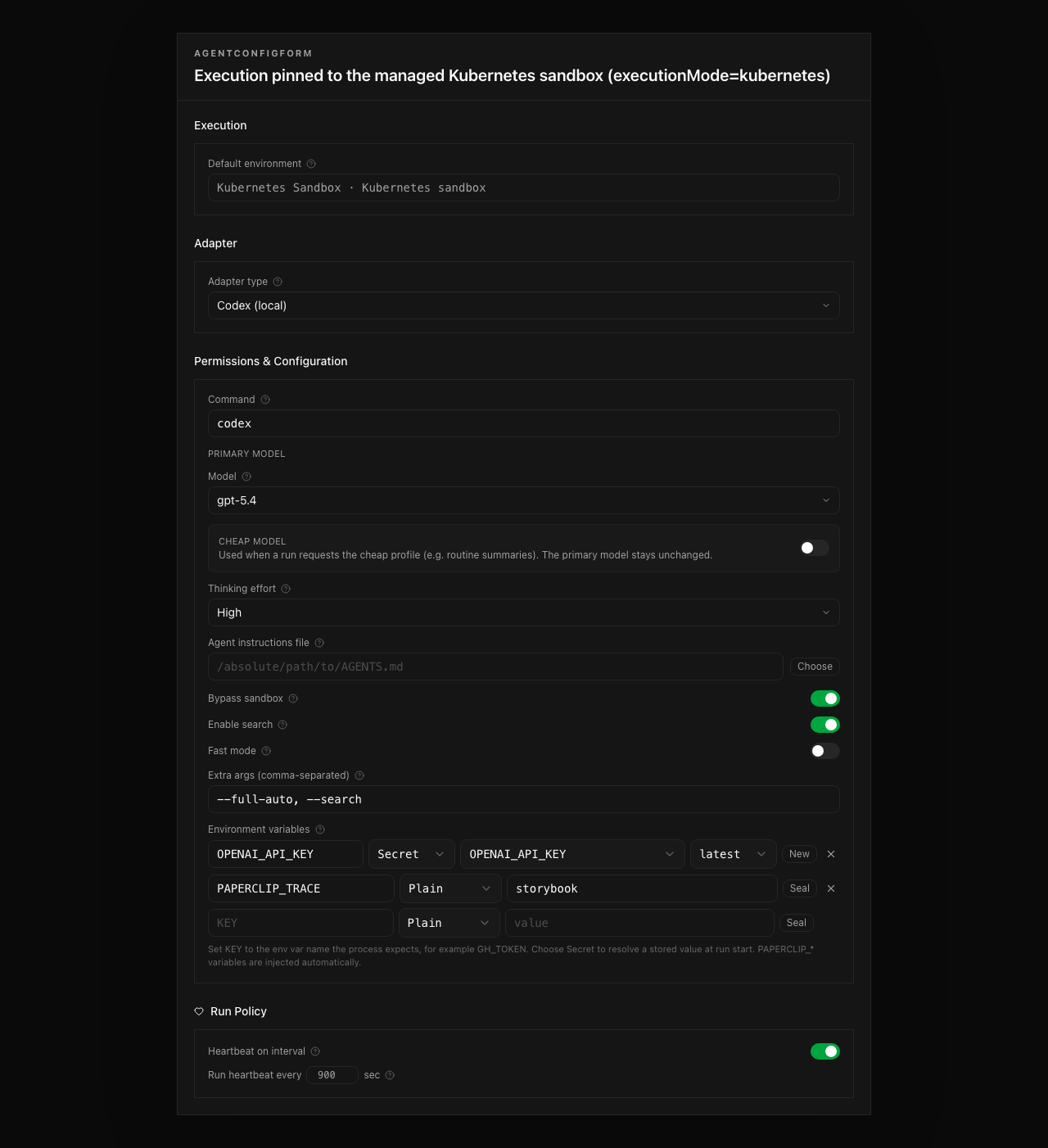
No managed environment available yet (warning notice, no silent local
fallback):
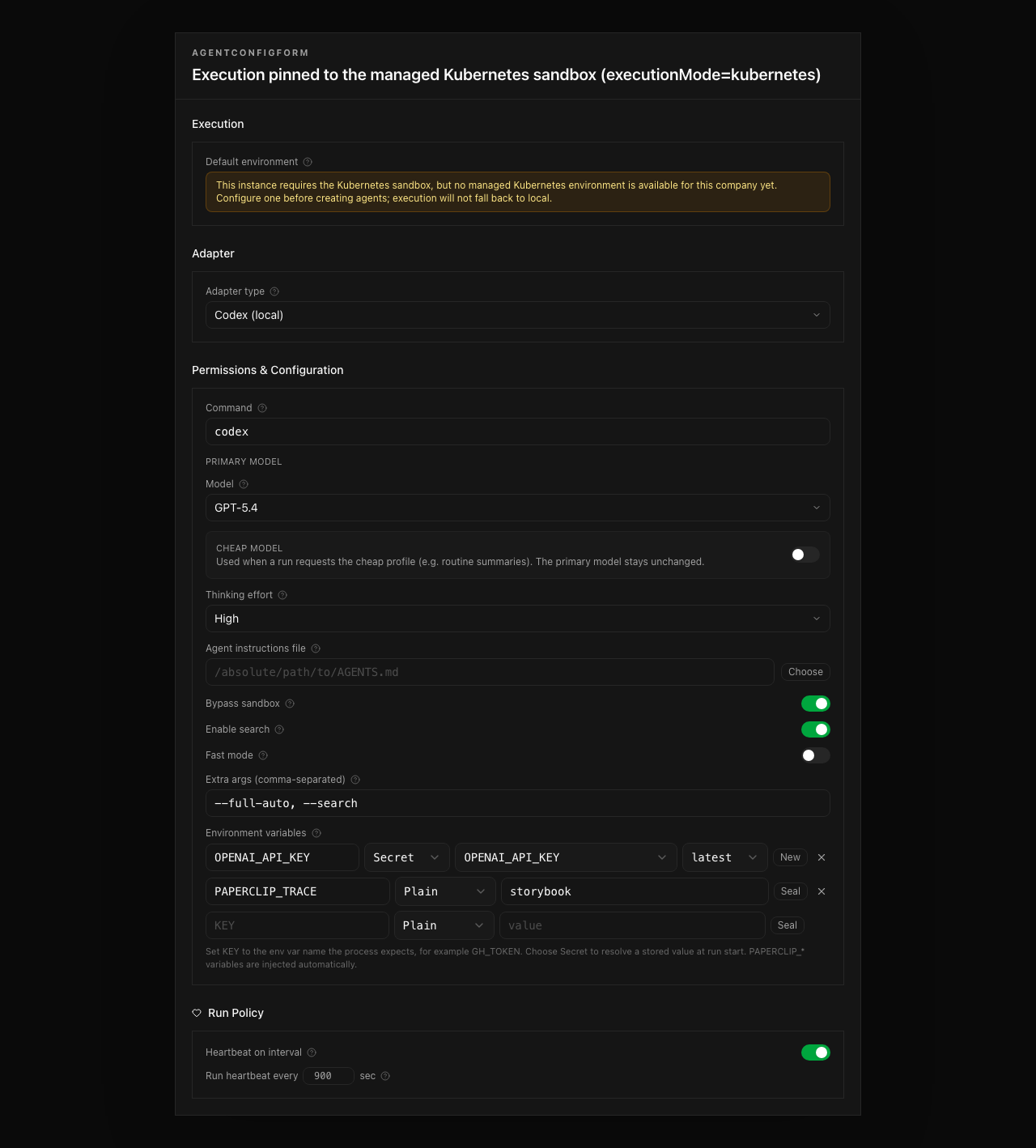
## Checklist
- [x] I have included a thinking path that traces from project context
to this change
- [x] I have specified the model used (with version and capability
details)
- [x] I have checked ROADMAP.md and confirmed this PR does not duplicate
planned core work
- [x] I have searched GitHub for duplicate or related PRs and linked
them above
- [x] I have either (a) linked existing issues with `Fixes: #` / `Closes
#` / `Refs #` OR (b) described the issue in-PR following the relevant
issue template
- [x] I have run tests locally and they pass
- [x] I have added or updated tests where applicable
- [x] If this change affects the UI, I have included before/after
screenshots
- [x] I have updated relevant documentation to reflect my changes
- [x] I have considered and documented any risks above
- [ ] All Paperclip CI gates are green
- [ ] Greptile is 5/5 with no open P2s, recommendations, or follow-ups
- [x] I will address all Greptile and reviewer comments before
requesting merge
🤖 Generated with [Claude Code](https://claude.com/claude-code)
---------
Co-authored-by: Claude Opus 4.8 (1M context) <noreply@anthropic.com>
## Thinking Path

> - Paperclip orchestrates AI agents for zero-human companies.
> - The environment/runtime layer decides where agent work executes and
how the control plane reaches those runtimes.
> - Today Paperclip can run locally and over SSH, but sandboxed
execution needs a first-class environment model instead of one-off
adapter behavior.
> - We also want sandbox providers to be pluggable so the core does not
hardcode every provider implementation.
> - This branch adds the Sandbox environment path, the provider
contract, and a deterministic fake provider plugin.
> - That required synchronized changes across shared contracts, plugin
SDK surfaces, server runtime orchestration, and the UI
environment/workspace flows.
> - The result is that sandbox execution becomes a core control-plane
capability while keeping provider implementations extensible and
testable.

## What Changed

- Added sandbox runtime support to the environment execution path,
including runtime URL discovery, sandbox execution targeting,
orchestration, and heartbeat integration.
- Added plugin-provider support for sandbox environments so providers
can be supplied via plugins instead of hardcoded server logic.
- Added the fake sandbox provider plugin with deterministic behavior
suitable for local and automated testing.
- Updated shared types, validators, plugin protocol definitions, and SDK
helpers to carry sandbox provider and workspace-runtime contracts across
package boundaries.
- Updated server routes and services so companies can create sandbox
environments, select them for work, and execute work through the sandbox
runtime path.
- Updated the UI environment and workspace surfaces to expose sandbox
environment configuration and selection.
- Added test coverage for sandbox runtime behavior, provider seams,
environment route guards, orchestration, and the fake provider plugin.

## Verification

- Ran locally before the final fixture-only scrub:
  - `pnpm -r typecheck`
  - `pnpm test:run`
  - `pnpm build`
- Ran locally after the final scrub amend:
  - `pnpm vitest run server/src/__tests__/runtime-api.test.ts`
- Reviewer spot checks:
  - create a sandbox environment backed by the fake provider plugin
  - run work through that environment
- confirm sandbox provider execution does not inherit host secrets
implicitly

## Risks

- This touches shared contracts, plugin SDK plumbing, server runtime
orchestration, and UI environment/workspace flows, so regressions would
likely show up as cross-layer mismatches rather than isolated type
errors.
- Runtime URL discovery and sandbox callback selection are sensitive to
host/bind configuration; if that logic is wrong, sandbox-backed
callbacks may fail even when execution succeeds.
- The fake provider plugin is intentionally deterministic and
test-oriented; future providers may expose capability gaps that this
branch does not yet cover.

## Model Used

- OpenAI Codex coding agent on a GPT-5-class backend in the
Paperclip/Codex harness. Exact backend model ID is not exposed
in-session. Tool-assisted workflow with shell execution, file editing,
git history inspection, and local test execution.

## Checklist

- [x] I have included a thinking path that traces from project context
to this change
- [x] I have specified the model used (with version and capability
details)
- [x] I have checked ROADMAP.md and confirmed this PR does not duplicate
planned core work
- [x] I have run tests locally and they pass
- [x] I have added or updated tests where applicable
- [ ] If this change affects the UI, I have included before/after
screenshots
- [x] I have updated relevant documentation to reflect my changes
- [x] I have considered and documented any risks above
- [x] I will address all Greptile and reviewer comments before
requesting merge
## Thinking Path

> - Paperclip orchestrates AI agents for zero-human companies
> - The environments subsystem already models execution environments,
but before this branch there was no end-to-end SSH-backed runtime path
for agents to actually run work against a remote box
> - That meant agents could be configured around environment concepts
without a reliable way to execute adapter sessions remotely, sync
workspace state, and preserve run context across supported adapters
> - We also need environment selection to participate in normal
Paperclip control-plane behavior: agent defaults, project/issue
selection, route validation, and environment probing
> - Because this capability is still experimental, the UI surface should
be easy to hide and easy to remove later without undoing the underlying
implementation
> - This pull request adds SSH environment execution support across the
runtime, adapters, routes, schema, and tests, then puts the visible
environment-management UI behind an experimental flag
> - The benefit is that we can validate real SSH-backed agent execution
now while keeping the user-facing controls safely gated until the
feature is ready to come out of experimentation

## What Changed

- Added SSH-backed execution target support in the shared adapter
runtime, including remote workspace preparation, skill/runtime asset
sync, remote session handling, and workspace restore behavior after
runs.
- Added SSH execution coverage for supported local adapters, plus remote
execution tests across Claude, Codex, Cursor, Gemini, OpenCode, and Pi.
- Added environment selection and environment-management backend support
needed for SSH execution, including route/service work, validation,
probing, and agent default environment persistence.
- Added CLI support for SSH environment lab verification and updated
related docs/tests.
- Added the `enableEnvironments` experimental flag and gated the
environment UI behind it on company settings, agent configuration, and
project configuration surfaces.

## Verification

- `pnpm exec vitest run
packages/adapters/claude-local/src/server/execute.remote.test.ts
packages/adapters/cursor-local/src/server/execute.remote.test.ts
packages/adapters/gemini-local/src/server/execute.remote.test.ts
packages/adapters/opencode-local/src/server/execute.remote.test.ts
packages/adapters/pi-local/src/server/execute.remote.test.ts`
- `pnpm exec vitest run server/src/__tests__/environment-routes.test.ts`
- `pnpm exec vitest run
server/src/__tests__/instance-settings-routes.test.ts`
- `pnpm exec vitest run ui/src/lib/new-agent-hire-payload.test.ts
ui/src/lib/new-agent-runtime-config.test.ts`
- `pnpm -r typecheck`
- `pnpm build`
- Manual verification on a branch-local dev server:
  - enabled the experimental flag
  - created an SSH environment
  - created a Linux Claude agent using that environment
- confirmed a run executed on the Linux box and synced workspace changes
back

## Risks

- Medium: this touches runtime execution flow across multiple adapters,
so regressions would likely show up in remote session setup, workspace
sync, or environment selection precedence.
- The UI flag reduces exposure, but the underlying runtime and route
changes are still substantial and rely on migration correctness.
- The change set is broad across adapters, control-plane services,
migrations, and UI gating, so review should pay close attention to
environment-selection precedence and remote workspace lifecycle
behavior.

## Model Used

- OpenAI Codex via Paperclip's local Codex adapter, GPT-5-class coding
model with tool use and code execution in the local repo workspace. The
local adapter does not surface a more specific public model version
string in this branch workflow.

## Checklist

- [x] I have included a thinking path that traces from project context
to this change
- [x] I have specified the model used (with version and capability
details)
- [x] I have checked ROADMAP.md and confirmed this PR does not duplicate
planned core work
- [x] I have run tests locally and they pass
- [x] I have added or updated tests where applicable
- [ ] If this change affects the UI, I have included before/after
screenshots
- [x] I have updated relevant documentation to reflect my changes
- [x] I have considered and documented any risks above
- [x] I will address all Greptile and reviewer comments before
requesting merge
## Thinking Path

> - Paperclip orchestrates AI agents for zero-human companies.
> - Every heartbeat run needs a concrete place where the agent's adapter
process executes.
> - Today that execution location is implicitly the local machine, which
makes it hard to track, audit, and manage as a first-class runtime
concern.
> - The first step is to represent the current local execution path
explicitly without changing how users experience agent runs.
> - This pull request adds core Environment and Environment Lease
records, then routes existing local heartbeat execution through a
default `Local` environment.
> - The benefit is that local runs remain behavior-preserving while the
system now has durable environment identity, lease lifecycle tracking,
and activity records for execution placement.

## What Changed

- Added `environments` and `environment_leases` database tables, schema
exports, and migration `0065_environments.sql`.
- Added shared environment constants, TypeScript types, and validators
for environment drivers, statuses, lease policies, lease statuses, and
cleanup states.
- Added `environmentService` for listing, reading, creating, updating,
and ensuring company-scoped environments.
- Added environment lease lifecycle operations for acquire, metadata
update, single-lease release, and run-wide release.
- Updated heartbeat execution to lazily ensure a company-scoped default
`Local` environment before adapter execution.
- Updated heartbeat execution to acquire an ephemeral local environment
lease, write `paperclipEnvironment` into the run context snapshot, and
release active leases during run finalization.
- Added activity log events for environment lease acquisition and
release.
- Added tests for environment service behavior and the local heartbeat
environment lifecycle.
- Added a CI-follow-up heartbeat guard so deferred issue comment wakes
are promoted before automatic missing-comment retries, with focused
batching test coverage.

## Verification

Local verification run for this branch:

- `pnpm -r typecheck`
- `pnpm build`
- `pnpm exec vitest run server/src/__tests__/environment-service.test.ts
server/src/__tests__/heartbeat-local-environment.test.ts --pool=forks`

Additional reviewer/CI verification:

- Confirm `pnpm-lock.yaml` is not modified.
- Confirm `pnpm test:run` passes in CI.
- Confirm `PAPERCLIP_E2E_SKIP_LLM=true pnpm run test:e2e` passes in CI.
- Confirm a local heartbeat run creates one active `Local` environment
when needed, records one lease for the run, releases the lease when the
run finishes, and includes `paperclipEnvironment` in the run context
snapshot.

Screenshots: not applicable; this PR has no UI changes.

## Risks

- Migration risk: introduces two new tables and a new migration journal
entry. Review should verify company scoping, indexes, foreign keys, and
enum defaults are correct.
- Lifecycle risk: heartbeat finalization now releases environment leases
in addition to existing runtime cleanup. A finalization bug could leave
stale active leases or mark a failed run's lease incorrectly.
- Behavior-preservation risk: local adapter execution should remain
unchanged apart from environment bookkeeping. Review should pay
attention to the heartbeat path around context snapshot updates and
final cleanup ordering.
- Activity volume risk: each heartbeat run now logs lease acquisition
and release events, increasing activity log volume by two records per
run.

## Model Used

OpenAI GPT-5.4 via Codex CLI. Capabilities used: repository inspection,
TypeScript implementation review, local test/build execution, and
PR-description drafting.

## Checklist

- [x] I have included a thinking path that traces from project context
to this change
- [x] I have run tests locally and they pass
- [x] I have added or updated tests where applicable
- [x] If this change affects the UI, I have included before/after
screenshots (N/A: no UI changes)
- [x] I have updated relevant documentation to reflect my changes (N/A:
no user-facing docs or commands changed)
- [x] I have considered and documented any risks above
- [x] I will address all Greptile and reviewer comments before
requesting merge
 Devin Foley
 Nicky Leach
 Dotta
Dotta
 Jannes Stubbemann

