## Why

### Problem

The dashboard page takes ~4 seconds to load for users with many balance
records. Profiling revealed 29 queries across the initial page load + 3
separate API calls, a 576 KB wasted payload from unused bank records,
and a critical 3.7s bottleneck in `BalanceLookup` correlated subqueries.

## What

### Changes

**Query optimizations:**
- Replace correlated `MAX()` subqueries in `BalanceLookup` with
derived-table `joinSub` pattern — **48x faster** (3,693ms → 77ms) on
accounts with thousands of balance records
- Replace `whereHas` (EXISTS subqueries) with JOINs in
`DashboardAnalyticsController` and `CashflowAnalyticsController` — ~3x
faster per query
- Cache encryption check results in `HandleInertiaRequests` middleware
to avoid 2 duplicate queries per request

**Payload & request reduction:**
- Remove dead `banks` query from `DashboardController` (2,365 records,
576 KB never used by frontend)
- Remove duplicate `categories` and `accounts` queries already provided
by middleware shared props
- Consolidate 3 separate `fetch()` API calls into Inertia v2
`Inertia::defer()` props grouped under `'dashboard'` (single follow-up
request with skeleton fallbacks)

**Frontend:**
- Replace `useDashboardData` fetch hook with `usePage()` props +
`<Deferred>` components
- Convert `CashflowSummaryCard` from internal fetch to prop-based
- Use `router.reload({ only: [...] })` for balance update refetch

### Performance summary

| Metric | Before | After |
|--------|--------|-------|
| Initial page queries | 16 | 12 |
| Follow-up HTTP requests | 3 separate API calls | 1 Inertia deferred |
| BalanceLookup time | 3,693ms | 77ms |
| Wasted payload | 576 KB | 0 |

## Verification

### Tests

All 633 feature tests pass, including 40 dashboard/cashflow-specific
tests.
## Why

The `/accounts` page was making two extra client-side API calls via the
`useDashboardData()` hook:
- `/api/dashboard/net-worth-evolution` (~14.5s in dev)
- `/api/dashboard/top-categories` (~119ms, completely unused on this
page)

The backend logic itself is fast (~34ms), but the full middleware stack
cost of extra HTTP roundtrips in the dev environment was adding
significant overhead.

## What

### Backend (`AccountController.php`)
- Added `ExchangeRateService` constructor injection
- Added `Inertia::defer()` prop `accountMetrics` to the `index()` action
- Added `getAccountMetrics()`, `formatMonth()`, `convertBalance()`
private methods
- Uses `BalanceLookup::forAccounts()` for efficient batch loading (2 SQL
queries regardless of account count)

### Frontend (`Accounts/Index.tsx`)
- Removed `useDashboardData()` hook import and usage
- Added `accountMetrics` as an optional deferred prop (undefined until
resolved)
- Loading state derived from `!accountMetrics`, which naturally drives
the existing `loading` prop on `AccountListCard` (skeleton UI already
existed)
- Added `handleBalanceUpdated` callback using `router.reload({ only:
['accountMetrics'] })` for targeted refresh

## Verification

### Tests
- 3 new Pest tests covering deferred prop behavior:
- `accounts index defers account metrics` — verifies metrics are missing
from initial response, present after `loadDeferredProps()`, with correct
balance values
- `accounts index deferred metrics includes invested amount for
investment accounts` — verifies invested amount for investment account
types
- `accounts index deferred metrics returns null invested amount for
non-investment accounts` — verifies non-investment accounts get null
invested amount
- All 15 tests in `AccountControllerTest.php` pass
## Summary

- Adds `Savings` to the list of account types that support invested
amount tracking, alongside `Investment` and `Retirement`
- Decouples `supportsInvestedAmount()` from
`NON_TRANSACTIONAL_ACCOUNT_TYPES` in TypeScript, since savings accounts
are transactional but now also support invested amount tracking
- Updates unit tests to reflect savings accounts supporting invested
amounts

This enables remunerated savings accounts to track invested money vs.
current balance to visualize gains/losses — the same way investment and
pension accounts already do.
## Why

Investment and retirement accounts show balance over time, but there's
no way to see how much money was actually put in versus how much is
current value. Users can't tell at a glance whether their investments
are up or down.

## What

Adds an "invested amount" tracking system across the full stack:

**Backend**
- New `invested_amount` column on `account_balances` (nullable
bigInteger, cents, per-date)
- Auto-sync from providers: Indexa Capital (instruments_cost +
cash_amount), Bitpanda (fiat deposit/withdrawal history), Binance
(90-day windowed deposit/withdrawal with crypto→fiat conversion)
- Manual input support via Update Balance dialog
- Historical invested amount data in all balance evolution APIs (net
worth, account detail)

**Frontend**
- Dashed line on sparkline charts (dashboard + accounts page) showing
per-point historical invested amount alongside balance
- Dashed line on account detail charts (daily AreaChart + monthly
ComposedChart)
- Tooltips with labeled rows: Balance, Invested, Gain/loss (color-coded)
- Invested amount column in balances history modal
- Invested amount field in balance import wizard (CSV mapping)
- Demo account seeder updated with invested amount data

## Screenshots
<img width="1301" height="750" alt="image"
src="https://github.com/user-attachments/assets/0f05ecd0-8b98-47b4-9fa4-027f0311e3bb"
/>
<img width="744" height="374" alt="image"
src="https://github.com/user-attachments/assets/c4daa816-dee0-4f94-957f-317a13bc80d5"
/>
<img width="1267" height="738" alt="image"
src="https://github.com/user-attachments/assets/21df350c-6954-4ff5-8b3c-b858df3a8b3a"
/>
<img width="1301" height="828" alt="image"
src="https://github.com/user-attachments/assets/16f5f021-a926-4e8e-a999-c4ca32d1ea3d"
/>
<img width="1274" height="845" alt="image"
src="https://github.com/user-attachments/assets/62f2dfc0-04f0-4bdb-b072-cf7cd1be77d3"
/>
## Why

### Problem

The cashflow breakdown cards (Income Sources / Expense Categories)
overflow the viewport width on mobile devices. The row items (icon,
category name, trend indicator, percentage, amount) don't fit within the
narrow mobile viewport because all non-name elements are `shrink-0`,
leaving insufficient space.

Additionally, a leftover `bg-red-500` debug class was present on the
breakdown cards grid container.

## What

### Changes

- Restructured breakdown card rows into two groups (label side / data
side) with `max-w-[60%]` on the label group so the category name
truncates with ellipsis before pushing data off-screen
- Added `overflow-hidden` to the row flex container to prevent content
spilling
- Hidden the percentage text label on mobile (`hidden sm:inline`) — the
progress bar still conveys this visually
- Removed leftover `bg-red-500` debug class from the cashflow page grid
- Switched breakdown cards grid to explicit `grid-cols-1` on mobile for
clarity

## Verification

### Manual

Tested visually on mobile viewport — breakdown cards now fit within the
screen width, matching the Dashboard's TopCategoriesCard behavior.
## Why

### Problem

Users with accounts in multiple currencies see raw balances on the net
worth chart without any conversion. A user with a USD-denominated
profile who also holds EUR and GBP accounts sees misleading totals — the
chart simply sums cents across currencies as if they were the same unit.

## What

### Changes

- **`ExchangeRateService`** — New service that wraps
`CurrencyConversionService` with DB-level caching. Checks the
`exchange_rates` table first, falls back to the external CDN API on
cache miss, and stores the full rate blob for future lookups.
- **`exchange_rates` migration + model** — New table with
`(base_currency, date)` unique constraint storing JSON rate blobs.
Includes factory.
- **`CurrencyConversionService`** — Made `getRatesForCurrency()` public
so `ExchangeRateService` can delegate to it.
- **`DashboardAnalyticsController`** — `netWorthEvolution` and
`netWorthDailyEvolution` endpoints now convert every account balance
from `account.currency_code` to `user.currency_code`. Response includes
`currency_code` field and `_original` data for foreign-currency
accounts.
- **Future date capping** — `ExchangeRateService::getRates()` caps any
future date to today, since the currency API only serves historical
rates. Prevents 500 errors when the chart requests end-of-month rates
for the current (incomplete) month.
- **Frontend charts** — Simplified to single-currency display. Removed
multi-currency `TotalDisplay` component; the chart header and tooltip
now show amounts in the user's currency. Foreign-currency accounts show
their original amount inline in the tooltip (e.g., "€2,000.00 →
$2,222.22").
- **`valueFormatter` type fix** — Changed return type from `string` to
`React.ReactNode` in chart component interfaces to match actual usage
with `AmountDisplay`.

## Screenshot
<img width="1266" height="649" alt="image"
src="https://github.com/user-attachments/assets/6f661840-3f65-49fe-9948-d4cfd6c6ef0e"
/>
## Summary

Adds daily granularity support to the dashboard Net Worth Evolution
chart, mirroring the daily balance feature added for individual account
pages in #135.

## Why

The net worth chart only supported monthly granularity, making it
impossible to see short-term net worth fluctuations. Users who track
daily balances need a way to visualize day-over-day net worth changes
across all accounts.

## Screenshots
<img width="1263" height="714" alt="image"
src="https://github.com/user-attachments/assets/646e7e21-5c1b-42dc-9a20-5e9b6d5d72b4"
/>
<img width="1261" height="715" alt="image"
src="https://github.com/user-attachments/assets/b9fe5080-55f3-485a-a566-1d25d83518c7"
/>
## Summary

- Adds a **Monthly / Daily granularity toggle** to the account balance
evolution chart on account pages
- Daily view renders as an **area chart** (line with gradient fill)
showing the last 30 days, while monthly keeps the existing bar chart
- All 3 chart view modes (stacked, period-over-period,
period-over-period %) work in both granularities
- Chart view toggle **tooltips update dynamically** based on granularity
(e.g. "Month over month change" → "Day over day change")
- Backend fills gaps in sparse `account_balances` data by carrying
forward the last known balance day-by-day
- Includes 3 new Pest tests for the daily endpoint (data points,
gap-filling, forbidden access)

## Screenshot
<img width="1271" height="743" alt="image"
src="https://github.com/user-attachments/assets/cca7a7ad-bdcc-45d2-a5e1-47b1cb855d49"
/>
<img width="1274" height="755" alt="image"
src="https://github.com/user-attachments/assets/14e1f2d8-41cd-49cc-b0f4-307edb847af8"
/>
## Summary

- Adds a vertical dashed reference line on the budget spending chart
indicating the current day within the period
- The marker only appears when today falls within the budget period date
range
- Adapts to both display modes: uses the day index (`Day N`) when a
previous period is shown, or the ISO date when showing a single period

## Screenshot

<!-- Add screenshot here -->
## Summary

- Adds proper flex overflow constraints (`min-w-0`, `shrink-0`) to the
account list card so long account names truncate with ellipsis instead
of overflowing the container.
- Adds `whitespace-nowrap` to the trend indicator component to keep "vs
last month" always on a single line.

## Changes

### `account-list-card.tsx`
- Added `min-w-0` to the left-side flex containers (account name area)
so the flexbox allows shrinking below content width
- Added `shrink-0` to the BankLogo and the right-side balance container
to prevent them from being compressed

### `amount-trend-indicator.tsx`
- Added `whitespace-nowrap` to the trend indicator wrapper so "vs last
month" always stays on a single line
## Summary

- Add Bitpanda as a new exchange provider using a single API key
(`X-Api-Key` header) to sync crypto and fiat wallet balances
- Follow the same architecture as Binance: provider string on
`banking_connections`, dedicated API client, balance sync service,
controller, form request, job wiring, factory state, route, and frontend
dialog
- Convert crypto wallet balances to the user's target currency via
`CurrencyConversionService`; fiat wallets are added directly or
converted if in a different currency
- Bitpanda appears in all countries in the connect dialog (same as
Binance)
- 18 new tests covering controller validation, balance sync scenarios,
sync job delegation, expiry handling, and email suppression
## Summary

- Adds Binance as a third banking provider alongside EnableBanking and
Indexa Capital
- Binance appears in the institution list for **all countries**, with
the full list sorted alphabetically
- Creates a single "Crypto Portfolio" investment account with total
portfolio value converted to the user's preferred currency
- Supports direct fiat pairs (e.g. BTCEUR), USD stablecoin 1:1 mapping,
and USDT fallback conversion

## Changes

- **Migration**: adds encrypted `api_secret` column to
`banking_connections`
- **BinanceClient**: HMAC-SHA256 authenticated API client for account
data and ticker prices
- **BinanceBalanceSyncService**: converts all non-zero balances to fiat
via direct pairs or USDT fallback
- **BinanceController + ConnectBinanceRequest**: validates credentials,
creates connection and single account
- **SyncBankingConnectionJob**: new `syncBinance()` branch
- **AccountMappingController**: Binance uses Investment account type
- **Frontend**: Binance institution for all countries, API Key + Secret
form fields, alphabetically sorted list
- **Factory**: `binance()` state on `BankingConnectionFactory`

## Test plan

- [x] `BinanceControllerTest` — 6 tests (valid connection, invalid
credentials, account-mapping flag, feature flag, validation, user
currency)
- [x] `BinanceBalanceSyncTest` — 7 tests (direct EUR pair, USDT
fallback, USD stablecoins, locked balances, same-date update, empty
balances, missing external ID)
- [x] Full test suite passes (545 tests)
- [x] Manual: open connection dialog → select any country → Binance
appears alphabetically → select Binance → API Key + Secret form →
connect
## Summary

- Allow users to connect their Indexa Capital (Spanish robo-advisor)
account via API token
- Adds "Indexa Capital" option when selecting Spain in the bank
connection dialog
- Token-based auth flow: user enters API token (instead of OAuth
redirect), validated against Indexa API, stored encrypted
- Syncs portfolio balance only (no transactions) from the
`/accounts/{id}/performance` endpoint
- Accounts created as `Investment` type
- Reuses existing account mapping flow when the `account-mapping`
feature flag is active
- Disconnect flow skips session revocation for Indexa (no OAuth session
to revoke)

## New files
- `IndexaCapitalClient` — HTTP client for Indexa Capital API
(`X-AUTH-TOKEN`)
- `IndexaCapitalBalanceSyncService` — Syncs portfolio value into
`account_balances`
- `IndexaCapitalController` — Token validation + connection creation
- `ConnectIndexaCapitalRequest` — Form request validation
- Migration adding encrypted `api_token` column to `banking_connections`

## Test plan
- [x] 6 controller tests (connect, invalid token, mapping, feature flag,
validation, multi-account)
- [x] 4 balance sync tests (sync, update, skip, missing field)
- [x] 3 sync job tests (balance-only, no expire, no email for Indexa)
- [x] 1 disconnect test (no revokeSession for Indexa)
- [x] All 530 existing tests still pass
## Summary
- Make the description column fill all remaining space on md+ screens by
replacing fixed `max-w` breakpoints with `md:w-full md:min-w-0
md:overflow-hidden`
- Eliminates horizontal scrolling on md, lg, and xl viewports without
modifying other columns

## Test plan
- [x] Verify no horizontal scroll on md (768px), lg (1024px), and xl
(1280px) viewports
- [x] Verify description text truncates correctly with ellipsis
- [x] Verify mobile/sm behavior is unchanged (max-w-[200px] /
sm:max-w-[400px])
- [x] Verify labels and notes still display within the description cell
## Summary

- **Server-side filtering/sorting/search**: With encryption removed, all
transaction filtering, sorting, and full-text search (LIKE on
description + notes) now happens via SQL queries instead of client-side
IndexedDB with decryption
- **Cursor pagination**: Transactions are returned with cursor-based
pagination (default 50 per page, "Load More" pattern) instead of loading
all into IndexedDB
- **Removed IndexedDB dependency**: The main transactions page no longer
depends on Dexie/IndexedDB for data or sync — other pages (categorize,
accounts/show, budgets/show) are unaffected and will be migrated
separately

## Changes

| File | Change |
|------|--------|
| `app/Models/Transaction.php` | Added `scopeApplyFilters` query scope |
| `app/Http/Requests/IndexTransactionRequest.php` | New form request for
filter validation |
| `app/Http/Controllers/TransactionController.php` | Server-filtered
cursor-paginated index, refactored bulkUpdate to reuse scope |
| `resources/js/pages/transactions/index.tsx` | Major rewrite —
server-driven filtering, sorting, pagination via `router.visit()` |
| `resources/js/components/transactions/transaction-filters.tsx` |
Search always enabled (removed encryption key dependency) |
| `resources/js/types/transaction.ts` | Added `ServerTransaction` type |
| `resources/js/contexts/sync-context.tsx` | Simplified — removed
transaction sync service |
| `tests/Feature/TransactionFilterTest.php` | 20 new Pest tests for all
filter scenarios |

## Test plan

- [x] Run `php artisan test` — all 523+ tests pass
- [x] Navigate to `/transactions` — paginated results load from server
- [x] Apply each filter type (date, amount, category, account, label,
search) and verify server round-trip
- [x] Test "uncategorized" category filter
- [x] Test combined filters
- [x] Test sorting by date, amount, description (ascending/descending)
- [x] Test "Load More" button for cursor pagination
- [x] Test bulk operations (select some → update, select all filtered →
update)
- [x] Verify URL persistence (refresh page with filters in URL)
- [x] Test search on both description and notes fields
## Summary

- Add `GET /api/transactions?encrypted=true` endpoint for paginated
listing of encrypted transactions
- Add `PATCH /api/transactions/bulk` endpoint for batch-updating
decrypted transaction data (max 50 per request, bypasses model events)
- Add `useDecryptTransactions` hook that mirrors the existing account
name decryption flow: fetches encrypted transactions page-by-page,
decrypts `description`/`notes` client-side via Web Crypto API, sends
plaintext back and clears IVs
- Wire the hook into `AppSidebarLayout` so decryption runs automatically
when the user unlocks their encryption key
- Once all transactions (and accounts) are decrypted, the encryption key
button in the header disappears automatically

## Test plan

- [x] 11 Pest tests covering encrypted/plaintext filtering, pagination,
user scoping, bulk update, authorization, validation, nullable notes,
guest access, and no-model-events behavior
- [x] Manual: create encrypted transactions, unlock encryption key,
verify transactions get decrypted and the key button disappears
## Summary
- Redesign the landing page with a screenshot-driven layout replacing
placeholder icons
- Add real screenshots (light + dark mode) for all feature sections:
accounts, transactions, privacy, import, budgets (list, detail, edit),
and cashflow
- Update fonts to IBM Plex and refine section spacing, testimonials,
pricing, and FAQ

## Test plan
- [ ] Verify all feature screenshots load correctly in both light and
dark mode
- [ ] Check responsive layout across mobile, tablet, and desktop
- [ ] Confirm lazy loading works for images below the fold
## Summary

- Removes the `plaintext-transactions` Pennant feature flag — plaintext
is now the default for all users
- Removes encryption guards and `isPlaintext` conditionals from
transaction create/edit/import flows, keeping only the plaintext code
paths
- Makes `EncryptionKeyButton` conditional — only shown when user has
legacy encrypted accounts or transactions
- Removes encryption onboarding steps (`step-encryption-explained`,
`step-encryption-setup`) and related state/props
- Updates landing page to replace E2E encryption marketing with
privacy-first messaging ("Your Data, Your Rules" section)
- Updates privacy policy to replace E2E encryption claims with accurate
security language (encryption at rest, TLS in transit, no third-party
sharing)
- Cleans up tests to remove feature flag assertions and
`Feature::activate()` calls

**22 files changed, 145 insertions, 730 deletions**

## Test plan

- [x] Create a transaction without encryption key unlocked — should
succeed
- [x] EncryptionKeyButton should not appear in header for users with no
encrypted data
- [x] EncryptionKeyButton should appear for users with legacy encrypted
transactions/accounts
- [x] Landing page has no E2E encryption references, shows new privacy
section
- [x] Onboarding flow has no encryption setup steps
- [x] Privacy policy reflects accurate security language
- [x] Frontend builds successfully (`bun run build`)
- [x] All linting passes (`bun run lint`, `vendor/bin/pint --dirty`)
During the onboarding, you create your account but, sometimes it does
not appear on the next import transaction step. With this changes we are
reloading them.
## Summary

- Send a queued email notification to users after subsequent bank syncs
when new transactions are found
- Email includes a per-bank breakdown of imported transaction counts
with a link to the transactions page
- Skips notification on first sync and when zero new transactions are
created

## Test plan

- [x] Sends email when new transactions are synced on subsequent sync
- [x] Does not send email on first sync
- [x] Does not send email when zero new transactions
- [x] Aggregates multiple accounts under same bank
- [x] Lists different banks separately in email
- [x] Existing sync job tests still pass
## Summary
- When a user cancels the bank authorization flow (e.g. clicks cancel on
the bank's page), the pending `BankingConnection` is now soft-deleted so
it doesn't remain stuck in `pending` status
- Flash messages (`success`/`error`) are now shared with the frontend
via Inertia shared data
- The connections settings page shows a toast notification with the
error message on redirect

## Test plan
- [ ] Start a bank connection flow, cancel on the bank's authorization
page, and verify:
  - A toast error appears on the connections page
  - The pending connection is removed from the list
- [x] Complete a successful bank connection and verify the success toast
appears
- [x] Run `php artisan test
tests/Feature/OpenBanking/AuthorizationControllerTest.php`
## Summary

- Replaces the simple confirmation dialog for bulk transaction deletion
with a type-to-confirm modal requiring users to type `delete X
transactions` (where X is the count) before the delete button enables
- Removes the admin-only restriction on bulk delete — now available to
all users
- Single-transaction delete keeps the existing simple AlertDialog
## Summary
- Remove the `budgets` Pennant feature flag — budgets is now enabled for
all users
- Delete `EnsureBudgetsFeature` middleware and its route guard
- Remove `budgets` from shared Inertia features and the `Features`
TypeScript interface
- Remove all `Feature::for($user)->activate('budgets')` calls from tests
- Delete `BudgetFeatureFlagTest` and feature-disabled test cases from
`BudgetsFeatureNavigationTest`
## Summary

- Adds **EnableBanking** as the first open banking provider, allowing
users to connect real bank accounts and automatically sync transactions
and balances
- Uses a **`BankingProviderInterface`** contract so future providers
(Plaid, GoCardless, etc.) can be added by implementing the same
interface
- Feature-flagged behind the **`open-banking`** Pennant flag (default:
off)
- Connected accounts are **unencrypted** and transactions have `source =
'enablebanking'`

### What's included

**Backend:**
- `BankingProviderInterface` contract + `EnableBankingProvider`
implementation (JWT RS256 auth)
- `BankingConnection` model with full lifecycle (pending →
awaiting_mapping → active → expired/revoked/error)
- `TransactionSyncService` — pagination, deduplication by
`external_transaction_id`, amount/date mapping
- `BalanceSyncService` — preferred balance type selection (CLBD → ITAV
fallback)
- Authorization flow: start auth → bank redirect → callback → session
creation → account mapping → sync
- `SyncBankingConnectionJob` (unique per connection, 3 retries) +
scheduled every 6 hours
- `banking:sync` artisan command
- 5 migrations: `banking_connections` table, account fields, transaction
`external_transaction_id`, `pending_accounts_data`, `linked_at`

**Frontend:**
- Manual vs Connected account choice in the create account dialog
- Multi-step bank connection dialog (country → bank selection →
confirmation → redirect)
- Account mapping page — map discovered bank accounts to existing
accounts, create new ones, or skip
- Settings/Connections page with status badges, sync/disconnect actions
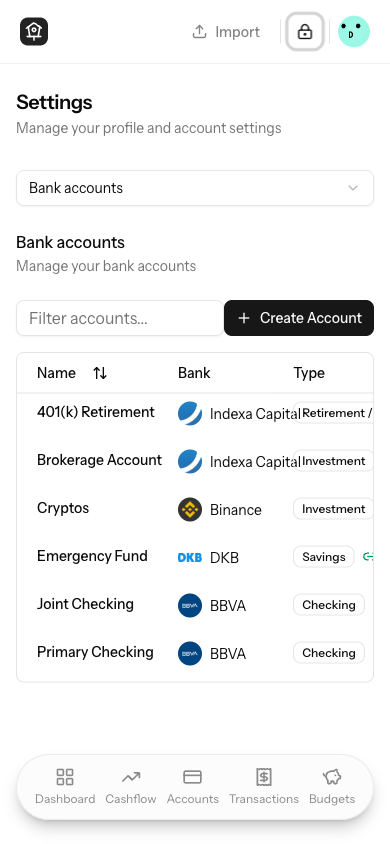
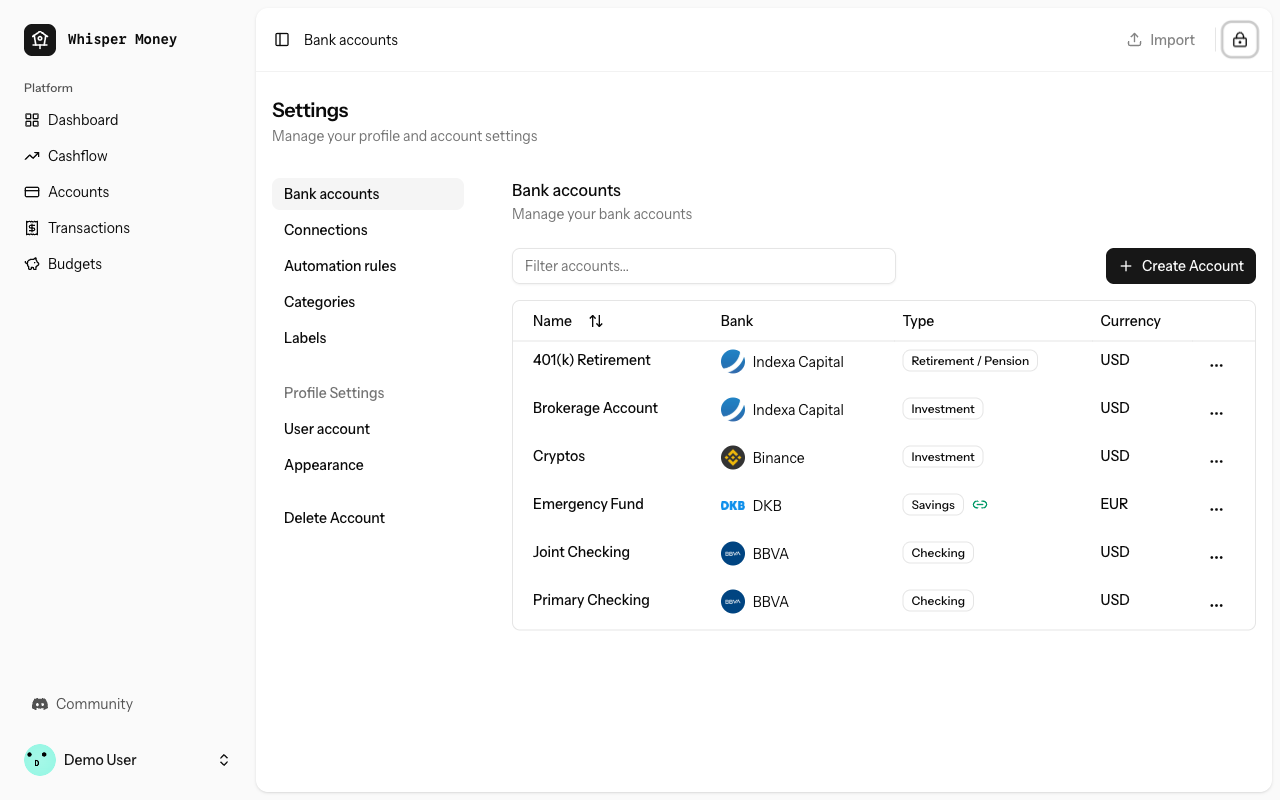
- "Connected" badge on linked accounts in settings

**Tests:**
- 49 tests covering feature flags, controllers, account mapping,
transaction sync, balance sync, deduplication, and pagination

### Feature Flags

This PR introduces **two Pennant feature flags**:

1. **`open-banking`** — Gates the entire open banking feature
(institutions endpoint, authorization flow, connections page). When
disabled, all open banking routes return 404.

2. **`account-mapping`** — Controls whether users see an intermediate
account mapping step after connecting a bank. When **enabled**, users
are redirected to a mapping page where they can choose to create new
accounts, link to existing ones, or skip each discovered bank account.
When **disabled**, all discovered accounts are automatically created
(original behavior). Linked accounts only sync transactions from their
last transaction date and only update the current balance from the
provider (no historical balance calculation or daily balance tracking).

Enable per-user:
```bash
php artisan feature:enable open-banking user@example.com
php artisan feature:enable account-mapping user@example.com
```

Enable for all users:
```bash
php artisan feature:enable open-banking all
php artisan feature:enable account-mapping all
```

## Test plan

- [x] Enable feature flag: `php artisan feature:enable open-banking`
- [x] Verify "Connected" option appears in create account dialog
- [x] Start authorization flow and verify redirect to bank
- [x] With `account-mapping` **disabled**: verify callback creates
accounts directly and dispatches sync
- [x] With `account-mapping` **enabled**: verify callback redirects to
mapping page
- [x] Test mapping page: create new, link to existing, and skip actions
- [x] Verify linked accounts sync only from last transaction date and
only update current balance
- [x] Verify connections page shows "Setup Required" badge for
awaiting_mapping status
- [x] Run `php artisan banking:sync` and verify transactions sync
- [x] Verify connections page shows status, sync, and disconnect actions
- [x] Run full test suite: `php artisan test --compact`
## Summary
- When CSV dates are ambiguous (e.g. `05/03/2024` parses as both
DD-MM-YYYY and MM-DD-YYYY), the auto-detection heuristic now uses the
user's locale preference as a tie-breaker instead of relying on array
order
- Adds `getLocaleDateFormat()` helper that maps locale strings to their
expected date format (US → MM-DD-YYYY, most others → DD-MM-YYYY, CJK →
YYYY-MM-DD)
- Passes locale from Inertia shared props to both transaction and
balance import flows
Closes#100
## Test plan
- [x] Added 15 Vitest tests for `getLocaleDateFormat` and
`autoDetectDateFormat` with locale tie-breaking
- [ ] Manual test: Import CSV with ambiguous dates (day ≤ 12) using a
non-US locale, verify DD-MM-YYYY is preferred
- [ ] Manual test: Import CSV with unambiguous dates (day > 12), verify
locale does NOT override correct detection
## Summary

- Adds `plaintext-transactions` Pennant feature flag (defaults to
`false` / encryption ON)
- When active, new transactions are stored as plaintext (no client-side
encryption)
- Existing encrypted transactions continue to work — detection is based
on `description_iv` being NULL (plaintext) vs present (encrypted)
- Migration makes `description_iv` nullable on the transactions table

## Changes

**Backend:**
- Feature flag definition in `AppServiceProvider`, shared via
`HandleInertiaRequests`
- `StoreTransactionRequest` / `UpdateTransactionRequest` conditionally
require `description_iv`
- `TransactionFactory` gains a `plaintext()` state

**Frontend:**
- Edit dialog and import drawer skip encryption when flag is active
- `EncryptedTransactionDescription` renders plaintext directly when IV
is null
- All decryption loops handle both encrypted and plaintext transactions
- Rule re-evaluation stores notes as plaintext when flag is active

## Test plan

- [x] Run `php artisan migrate` to apply the migration
- [x] Activate flag: `php artisan feature:enable plaintext-transactions
all`
- [ ] Create a transaction — verify description is stored as plaintext
in DB (`description_iv` is NULL)
- [ ] Deactivate flag: `php artisan feature:disable
plaintext-transactions all`
- [ ] Create a transaction — verify encryption is still required (422
without IV)
- [x] Verify old encrypted transactions still display correctly
- [ ] Run `php artisan test --compact
tests/Feature/PlaintextTransactionsTest.php`
## Summary

- Store account names in plaintext instead of encrypting them
client-side. Encryption remains only for transaction descriptions and
notes.
- Existing encrypted account names are silently migrated when the user
unlocks their encryption key, via a new `useDecryptAccountNames` hook
that calls API endpoints to update each account.
- New `AccountName` component handles rendering both encrypted (legacy)
and plaintext accounts across the app.

## Test plan

- [x] Create a new account — name should be stored in plaintext
(`encrypted = false`, `name_iv = null`)
- [x] Unlock encryption key with existing encrypted accounts — they
should auto-migrate silently
- [x] After migration, verify accounts show `encrypted = false` in DB
and names are readable plaintext
- [x] Edit a migrated account — should work without encryption
- [x] Verify all account name displays work across dashboard, account
details, transactions, settings
## Summary

- Replaces Valet/Traefik with Docker-based infrastructure: Caddy (HTTPS
reverse proxy), MySQL, Redis, Mailhog
- PHP runs natively on the host via `composer run dev` — Caddy proxies
to `host.docker.internal:8000`
- PHP container available under `--profile full` for self-hosting via
`setup.sh`
- Vite dev server serves over HTTPS using mkcert certs to avoid
mixed-content issues
- `.env.example` defaults updated for host-based dev workflow (127.0.0.1
+ forwarded ports)
- Deletes obsolete `traefik/` directory

## Test plan

- [x] `docker compose up -d` starts caddy, mysql, redis, mailhog (NOT
php)
- [x] `composer run dev` serves PHP on :8000, Vite on :5173 with HTTPS
- [x] `https://whisper.money.local` loads correctly via Caddy
- [x] Vite HMR works (edit a React component, see hot reload)
- [x] `php artisan test --compact` passes
- [x] `docker compose --profile full up -d` also starts the PHP
container
## Summary
- Fixed undefined `formatDate` reference that crashed the component when
existing transactions loaded, preventing the collapsible from ever
appearing
- Imported `Transaction` type from the correct module
(`@/types/transaction` instead of `@/services/transaction-sync`)
- Removed unnecessary `parseInt` on the already-numeric `amount` field
## Summary

- Detects Android and iOS visitors on the landing page hero section
- Replaces the **Get Started** and **Check Demo** buttons with a single
**Install App** button on mobile
- **Android**: Captures the `beforeinstallprompt` event and triggers the
native PWA installation prompt when tapped
- **iOS**: Opens a dialog with step-by-step instructions (tap Share icon
→ Add to Home Screen)
- Desktop visitors see the original buttons unchanged

## New files

- `resources/js/hooks/use-pwa-install.ts` — Hook that detects platform
(Android/iOS), captures the `beforeinstallprompt` event, and exposes
`promptInstall()`
- `resources/js/components/landing/install-app-button.tsx` — Install
button component with iOS instructions dialog

## Screenshots
| Android & iOS | iOS Instructions |
|--------|--------|
| <img width="1082" height="2402" alt="localhost_8000_(Pixel 7)"
src="https://github.com/user-attachments/assets/bd42c24a-8a82-4f42-9f5f-c13bd5505836"
/> | <img width="1170" height="2532" alt="localhost_8000_(iPhone 12
Pro)"
src="https://github.com/user-attachments/assets/c4ec136f-46f1-44a5-a96a-d7afd41c6015"
/> |
## Summary
- Enables `MustVerifyEmail` on the `User` model so new users must verify
their email before accessing protected routes
- Unverified users are redirected to `/email/verify` when attempting to
access routes behind the `verified` middleware (subscribe, onboarding,
dashboard)
- A verification email is automatically sent on registration via Fortify
## Screenshot

## Video
https://github.com/whisper-money/whisper-money/raw/mail-verification/storage/videos/ac0945c527f014b9cd657f18c911f496.webm
## Test plan
- [x] New test: registration sends a `VerifyEmail` notification
- [x] New test: newly registered users have `email_verified_at` as null
- [x] New test: unverified users are redirected to `verification.notice`
from protected routes (subscribe, onboarding, dashboard)
- [x] New test: verified users are not redirected to verification notice
- [x] Existing email verification and notification tests still pass (31
auth tests, 52 settings tests)
- [x] Browser walkthrough: registration → redirected to `/email/verify`
page with "Resend verification email" button
 Víctor Falcón