Budget email notifications shipped opt-in, then #733 turned all three on
by default. The per-transaction notice is the wrong one to force on: it
emails on **every single transaction** assigned to a budget, and a
catch-all budget matches all of them. This puts it back to opt-in and
leaves the limit alerts (close to limit, over limit) on by default.

## Why a second migration instead of editing the first one

`2026_07_24_100000_enable_budget_notifications_by_default` **has already
run in production** (batch 76). Laravel never re-runs an applied
migration, so editing it in place would have been inert: 382 budgets and
174 settings rows would keep the flag on, and the `user_settings` column
default would stay `true`.

That default matters beyond new signups: every settings controller
writes its own column through `setting()->updateOrCreate(...)`, so a
user who merely changed their chart colour scheme would get a settings
row with `budget_notify_on_new_transaction = 1` filled in by MySQL —
silently opted in, with the checkbox rendering as checked.

So the original migration is restored to its merged form and a new one
resets the flag: column default back to `false`, plus a one-off reset of
existing `user_settings` and `budgets` rows. It uses the query builder,
so `updated_at` is untouched — same as the force-enable did. 381 of the
382 affected budgets had not been touched by their owner since the
deploy, so the reset undoes a force-enable rather than a user's choice.

## Changes

- New migration resetting
`user_settings.budget_notify_on_new_transaction` (default + rows) and
`budgets.notify_on_new_transaction`.
- `BudgetController::store` and
`NotificationPreferenceController::index` fall back to `false` for the
per-transaction flag when a user has no settings row.
- `UserSettingFactory` matches the new default.

Users who want the per-transaction notice can still turn it on per
budget, or as their default for new budgets, in Settings →
Notifications.

## QA

Ran the migration against a real database and checked the end state:
`budget_notify_on_new_transaction` default `0` with all 151 settings
rows and 333 budgets reset, both limit flags default `1` and left on.

Then drove real transactions through the listener and queue on a live
budget (limit €300) and read the resulting mail off Mailhog:

| Event | Spent / limit | Email |
| --- | --- | --- |
| New transaction, default settings | €50 / €300 | none |
| Reaches 90% | €270 / €300 | «Presupuesto de Ocio» está cerca de su
límite |
| Exceeds the limit | €320 / €300 | «Presupuesto de Ocio» ha superado su
límite |
| New transaction, after opting in | €10 / €5000 | Nueva transacción en
«Presupuesto de Ocio» |

Assignment still happens in every case — only the email is suppressed.
265 tests green across the Budget/Setting/Notification suites, including
new assertions that the rendered defaults have the per-transaction flag
off and that a settings row created without the budget columns does not
opt the user in.
## What

Follow-up to #731 (per-budget email notifications). Two changes:

1. **Enable budget email notifications by default.** They shipped opt-in
with every toggle defaulting to `false`, so no one received them. They
are now on by default.
2. **Coalesce budget alerts into one email per transaction.** A single
transaction that crossed a budget's limit could send two emails for the
same budget (the "new transaction" notice *and* the over/close-limit
alert). Now at most one email is sent per budget per assignment.

## Enable by default

- `user_settings.budget_notify_on_*` column defaults flipped to `true`,
and **all existing `user_settings` and `budgets` rows are backfilled to
`true`** so current users and budgets start notifying — not just new
ones.
- `BudgetController::store` and
`NotificationPreferenceController::index` fall back to `true` when a
user has no settings row yet.
- `UserSettingFactory` reflects the new default.
- The `budgets` columns keep their own `false` DB default on purpose:
new budgets are seeded from the user's `user_settings` defaults at
creation, so only the one-off backfill is needed there.

## Coalescing

`BudgetNotificationService::processPeriod` now sends **at most one email
per budget per transaction assignment**, picking the most severe
applicable event with priority **over-limit > close-to-limit >
new-transaction**, and passes the triggering transaction through to
whichever fires. So a transaction that pushes a budget over its limit
produces a single over-limit email that still names the transaction and
shows how far over the budget is.

Preserved from #731: the atomic per-period `close_to_limit_notified` /
`over_limit_notified` claim (one email per crossing, safe under
concurrent workers), the reset-and-re-notify path when spending drops
back below the threshold, and the no-emails-on-historical-backfill
guarantee. Coalescing is **per budget** — a transaction matching two
different budgets still sends one email to each.

## Trade-offs (deliberate)

- **`notify_on_new_transaction` is on by default**, which means one
email per transaction assigned to any budget (no batching yet — flagged
in #731). A catch-all budget matches every expense, so this can be
high-volume; the whole-user-base backfill also produces a send spike on
first sync after deploy. Batching the new-transaction type into a daily
digest (mirroring the bank-sync digest) is the natural follow-up if
volume proves noisy.
- The migration backfill is intentionally unconditional and one-way for
data: `down()` restores the column defaults but not the backfilled row
values.

## Every email links to the settings page

Each budget email already carries a "Manage notifications in
notification settings" link (`route('notifications.index')`) so users
can turn any of them off. A render-test assertion now locks this in.

## Tests

- Coalescing: a single limit-crossing transaction sends exactly one
over-limit email that references the triggering transaction.
- On-by-default: a new budget created without custom preferences enables
all three types.
- All existing #731 sending/preference tests still pass (dedup,
re-notify after drop, no-limit budgets, historical backfill sends
nothing, enabling while already over).

QA (backend): rendered the coalesced over-limit email and confirmed it
names the transaction, shows "Over by", and links to the settings page;
verified the migration backfill flips pre-existing `false` rows to
`true` against a real DB.
## What

Adds opt-in **email notifications per budget** for three events, plus a
dedicated **Notifications** settings page.

Each budget can independently enable:
- **New transaction** — a transaction was assigned to the budget
- **Close to limit** — spending crossed 90% of the limit
- **Over limit** — spending reached/passed the limit

A **Default (new budgets)** row lets you set the toggles that newly
created budgets inherit.

The existing *bank-transactions-synced* email toggle was **moved** from
the account page into this new Notifications page, so all email
preferences live in one place.

## UI

`Settings → Notifications`: one "Email notifications" section containing
the bank-sync toggle and a "Budgets" table (rows = Default + each
budget, columns = the three events).

<img width="1265" height="638" alt="budget-notifications-settings"
src="https://github.com/user-attachments/assets/b8386410-98dd-4a5e-9dee-6e5bf7effa31"
/>

## How it works

- Notifications fire from the **live transaction-assignment path**
(`BudgetTransactionService::assignTransaction`, already a queued
listener), never from historical backfill when a budget is created.
- Only the budget's **current period** is considered (the emails
describe the live "available before the limit" state).
- **New transaction** fires for a genuinely newly-assigned transaction;
the email includes the transaction.
- **Close/over** use two atomic per-period flags
(`close_to_limit_notified` / `over_limit_notified`) flipped with a
compare-and-set `UPDATE`, so exactly one email is sent per crossing even
under concurrent queue workers. The flags reset once spending drops back
below the close threshold, so a later crossing can notify again.
- Budgets with no limit (`allocated_amount <= 0`) never send close/over
emails; the "new transaction" email for such a budget omits the
limit/available rows.
- Every email shows the budget's current status (period, spent, limit,
available or over-by). Subcopy links back to the Notifications page.
- New budgets inherit the user's default toggles at creation time.

## Data model

- `budgets`: `notify_on_new_transaction`, `notify_on_close_to_limit`,
`notify_on_over_limit` (default `false`)
- `user_settings`: `budget_notify_on_*` defaults for new budgets
(default `false`)
- `budget_periods`: `close_to_limit_notified`, `over_limit_notified`
(dedup flags)

## Deliberate decisions

- **Threshold is a fixed 90%** for "close to limit" (not configurable) —
kept simple; easy to make per-budget later if requested.
- **"New transaction" sends one email per assigned transaction.** It is
opt-in and defaults to off. A bank sync importing many matching
transactions into an opted-in budget will therefore send several emails;
if this proves noisy we can batch per sync run (mirroring the daily
bank-sync digest). Flagged here rather than pre-building batching.
- **Limit basis is `allocated_amount`** (matches the budget
cards/spending chart), carry-over excluded.

## Tests

- Preference endpoints: page renders budgets + defaults, per-budget
toggle update, cross-user update forbidden, user-settings defaults
update, new budget inherits defaults.
- Sending: new-transaction opt-in/out, over-limit send, close-limit at
90%, no-resend dedup, re-notify after dropping below and crossing again,
no-limit budget skips close/over, historical backfill sends nothing,
notify after enabling the preference while already over. Plus a render
test covering all three email variants.

## Notes

- CI-enforced `es.json` keys for the new page and emails are included.
- All new PHP follows existing mail/queue conventions (`ShouldQueue`
mailable, `emails` queue, `RateLimited` middleware).
## Summary
Adds **catch-all budgets** — a budget flagged `is_catch_all` absorbs
every expense-category transaction not already claimed by another
(non-catch-all) budget, so out-of-budget spending is still tracked.

## Changes
- Migration: `is_catch_all` boolean (default false) on `budgets`.
- `Budget` model: fillable + boolean cast.
- `BudgetTransactionService`: a catch-all budget matches expense
transactions whose `category_id` is not claimed by any non-catch-all
budget; period assignment mirrors the same rule.
- `BudgetController`: supports the flag.

## Notes
- Pre-existing WIP committed as-is; CI is the validation gate.

🤖 Generated with [Claude Code](https://claude.com/claude-code)

---------

Co-authored-by: Claude Opus 4.8 (1M context) <noreply@anthropic.com>
Co-authored-by: Víctor Falcón <victoor89@gmail.com>
## What

Standardizes how models are serialized across web, API, and Sync
responses by relying on Eloquent `$hidden` + accessors on the models
themselves, instead of ad-hoc `select` scopes and per-controller field
picking.

Touches 9 models (`Account`, `Bank`, `Budget`, `Category`, `Label`,
`LoanDetail`, `RealEstateDetail`, `Transaction`, plus pivot hiding) and
the controllers/middleware that consumed the old ad-hoc shapes.

## Why

- Single source of truth for response shape lives on the model, aligned
with Wayfinder model typegen.
- Removes duplicated field-selection logic scattered across controllers.
- Continues the duplication-removal PR series (#475–#483).

## How

- Hide internal columns and pivots via `$hidden`; expose computed fields
via accessors.
- Controllers return full models / load full relations rather than
hand-picked columns.
- `HandleInertiaRequests` slimmed down to match.

## Notes for reviewers

- Per-commit breakdown: each model standardized in its own commit for
easy review.
- Tests added/updated for each model to assert the serialized shape
(hidden columns absent, relations present).
- Full suite: 1382 passed / 1 skipped / 0 failed. `pint` clean.
## What

When deleting a transaction that belongs to a **manual**
(non-bank-connected) account, the user can now opt to update the
account's **current balance** for today, so it stays accurate without
re-syncing.

- Deleting an **expense** (amount < 0) → balance **increases** by the
amount.
- Deleting **income** (amount > 0) → balance **decreases** by the
amount.
- Formula: `new_balance = current_balance − transaction.amount`. If
today has no balance row, it's seeded from the latest known balance.
- Available for **single delete** and **bulk delete** (a checkbox in the
confirmation dialog).
- Connected accounts are never touched — their balances come from bank
sync.
- On the account page, the balance display refreshes automatically after
the delete (no page reload).

## How

- New `ManualBalanceAdjuster` service; `TransactionController@destroy`
calls it when the request carries `update_balance` and the account is
manual.
- Frontend `transactionSyncService.delete/deleteMany` accept an
`updateBalance` option; both delete dialogs show the checkbox only when
a manual account is affected.
- `TransactionList` gains an `onBalanceUpdated` callback;
`Accounts/Show` uses it to bump the balance chart's refresh key.
- Added `banking_connection_id` to the accounts payload (transactions,
budgets, and the shared Inertia props feeding accounts/show) so the
frontend can identify manual accounts.

<img width="896" height="400" alt="image"
src="https://github.com/user-attachments/assets/e7f35ccb-13a1-40a1-bf04-615752bddf1a"
/>
## Summary

Adds nested categories (parent → child, up to **3 levels**) across the
app. Children inherit their parent's type and cashflow direction, and
every category selector now renders the hierarchy as an indented tree.
Gated behind the `CategoryTree` Pennant flag (off by default).

## Backend

- **Migration**: nullable self-referencing `parent_id`; uniqueness
scoped per-parent via a `parent_unique_marker` virtual column (root
names stay unique). New composite unique created before dropping the old
one so the `user_id` FK keeps a supporting index.
- **`CategoryTree` service**: descendant/ancestor resolution, depth &
cycle checks, type cascade, subtree deletion.
- **Validation**: depth limit, cycle prevention, inherited + locked
child type.
- **Delete strategies**: reparent (default), promote to root, or cascade
(uncategorizes affected transactions).
- **Transaction filter** expands a selected parent to its descendants.
- **Cashflow Sankey & breakdown** roll up to top-level parents with
click-to-drill (children + a parent "direct" node).
- **Budgets** tracking a parent also count their children's
transactions.
- **Unified** the frontend category query behind
`Category::forDisplay()` / `FRONTEND_COLUMNS` (8 call sites) so every
selector receives the full Category shape, including `parent_id`.

## Frontend

- New `category-tree.ts` helpers (build/flatten/descendants/path,
tree-aware selection toggle + tri-state).
- **Settings page**: indented tree, sortable by name/color/type
(siblings sorted, hierarchy preserved), parent picker, delete-strategy
dialog.
- **Combobox** (transaction table cell + edit/create modal + parent
picker): indented tree, search keeps matches with their ancestors.
- **Transaction filter**: indented tree, tri-state cascading selection
(parent ↔ children), themed checkboxes, selected branches float to top
on open, ancestor-aware search.
- **Categorizer palette** and **budget multi-select**: same indented
tree + ancestor-aware search.
- **Sankey**: click a parent node to drill into its children, with
breadcrumb.
- Pennant `CategoryTree` flag gates the parent UI.

## Tests

- Pest: model/validation, delete strategies, filter expansion, cashflow
rollup/drill, budget child inclusion.
- Vitest: tree-aware selection logic.
- All green; Pint / ESLint / Prettier clean.

## Rollout

Flag is off by default — enable per user with:
\`\`\`
php artisan feature:enable "App\\Features\\CategoryTree" you@example.com
\`\`\`
## What

The "public banks + user's own banks" query was repeated in **5
controllers** (Transaction ×2, Settings/Bank, Budget, Cashflow,
Onboarding).

New `Bank::availableForUser($user)` scope; all 5 sites use it.

Bonus: the Onboarding variant had no `where()` grouping around
`whereNull/orWhere` — harmless today (no other constraints) but a latent
precedence bug. The scope always groups.

## Stats

- **-31 / +24 lines**, 5 call sites → 1 definition

## Checks

- `php artisan test
--filter="Bank|Transaction|Budget|Cashflow|Onboarding"` — 612 passed
(2707 assertions), 1 skipped
- `vendor/bin/pint --dirty` — pass

Part of duplication-removal series (#475–#479).
## Summary

Budgets previously tracked a single category **or** label (mutually
exclusive). This lets a budget span **multiple** categories and labels
at once, all pooling spend against one allocated amount per period.

Scope decided with the requester:
- **Shared pool** — one allocated amount; any tracked category/label
counts against it.
- **Multi categories + multi labels** on a single budget.
- **Create-only** — tracking is chosen at creation and locked afterward
(edit dialog shows it read-only).

## Changes

**Backend**
- New `budget_category` + `budget_label` pivot tables; data migration
copies existing `category_id`/`label_id` into them, then drops those
columns.
- `Budget` model: `categories()` / `labels()` belongsToMany.
- `BudgetTransactionService` matches transactions across **all** tracked
categories OR labels (live assignment + historical backfill).
- `StoreBudgetRequest` accepts `category_ids` / `label_ids` arrays,
requires ≥1 across both, validates ownership. `update` no longer touches
tracking.

**Frontend**
- Reusable `MultiSelect` (popover + command + badge).
- Create dialog uses multi-selects; cards and show page render tracked
categories/labels as badges; edit dialog shows them read-only.
- Dexie bumped to v10 (drops unused per-category allocations table, adds
`budget_labels`).

## Testing
- Updated all budget/transaction/listener/browser tests for the pivot
model; added cases for multi-category matching, mixed category+label
pooling, and store validation (empty selection + foreign-ownership).
- Added the new `__()` strings to `lang/es.json`.
- Local `pint`, `lint`, `format` pass. Relying on CI for the full suite.
## Why merge this

Production bug
**[PHP-LARAVEL-1B](https://whisper-money.sentry.io/issues/PHP-LARAVEL-1B)**
— `/budgets/{budget}` throws a 500 (`UniqueConstraintViolationException`
on `budget_periods_budget_id_start_date_unique`) for the affected user.
Page is unusable for them until fixed.

## Root cause

The Custom period type let users create budgets with arbitrary
`period_duration`. Combined with `calculatePeriodDates()`'s day-of-month
snap (`startDate->day(period_start_day)`), short durations produced
periods where `end_date == start_date == period_start_day`. On the next
visit after that day, regeneration computed a new period whose start
snapped backward to the same day → unique key collision.

Concrete trace from the Sentry event:

- Budget: `Seguro de Salud`, `period_type=custom, period_duration=1,
period_start_day=1`, created `2026-05-05`.
- Initial period created at budget creation: `start=2026-05-01,
end=2026-05-01` (already 4 days stale because Custom snapped
`now()=05-05` back to day 1, then `addDays(1).subDay()` produced same
date).
- Today `05-05` → `getCurrentPeriod()` returns null → `generatePeriod()`
snaps back to `05-01` again → `INSERT (budget_id, 05-01)` → 1062.

Verified in prod DB: this is the **only** budget in the entire database
with `period_type='custom'` and the only period row with `end_date <=
start_date`.

## Fix

Custom is the only period type that exposes this snap-back collision
(Monthly/Weekly/Biweekly all use a self-consistent advance). It also has
no defensible UX — every legitimate use case is covered by
Monthly/Weekly/Biweekly. So we remove it end-to-end:

- `BudgetPeriodType::Custom` enum case dropped.
- `BudgetPeriodService`: Custom branches removed from
`calculatePeriodDates()` and `calculateNextPeriodStartDate()`.
- `Budget` model: `period_duration` removed from `$fillable` and
`casts()`.
- `StoreBudgetRequest` / `UpdateBudgetRequest`: `period_duration` rule
removed.
- `BudgetController`: `period_duration` no longer passed in
store/update.
- Create + edit budget dialogs: Custom option and `period_duration`
input removed.
- `ResetDemoAccountCommand`: Custom switch case removed.
- `BudgetFactory`: `custom()` state and `period_duration` default
removed.
- `types/budget.ts`: `'custom'` removed from `BUDGET_PERIOD_TYPES` and
`Budget.period_duration` field dropped.
- Migration `2026_05_05_132023_convert_custom_budgets_to_monthly`:
rewrites any existing `custom` rows to `monthly` with
`period_duration=null, period_start_day=1` so the dropped enum case
can't crash on hydration.

Period generation logic for Monthly/Weekly/Biweekly is **unchanged**.

## Manual prod cleanup (separate, after merge)

The single buggy budget in prod will be deleted manually:

```sql
DELETE FROM budget_periods WHERE id = '019df7fd-6073-731b-9c08-f3723515292b';
DELETE FROM budgets WHERE id = '019df7fd-6071-7219-b190-ece22ccdb63f';
```

## Tests

`tests/Feature/BudgetPeriodServiceTest.php` covers Monthly + Weekly
advance and Monthly first-period generation. Existing
`BudgetPeriodDateTest` unaffected.

## Risk

- `period_duration` column kept in DB (nullable) to avoid data loss; no
migration needed.
- Migration ensures any environment with `period_type='custom'` rows is
converted before the enum case is removed, preventing hydration errors.
- No customers actively rely on Custom: prod query confirmed only the
single broken budget uses it, and that one is being deleted.

Fixes PHP-LARAVEL-1B
## Why

### Problem

Users viewing a budget had no way to look back at historical periods —
the show page always displayed the current period with no navigation.
The cashflow page's period selector also used a different visual style
(loose buttons with gaps) compared to the new grouped button pattern
established for budgets.

## What

### Changes

- **Budget period navigation**: new `BudgetPeriodNavigation` component
renders a `ButtonGroup` with `[<] [date range] [>]` buttons. Clicking
the label returns to the current period; arrows navigate between
existing periods.
- **Backend**: `BudgetController::show` accepts an optional
`?period=<uuid>` query param to serve a specific period. Future periods
are blocked at the query level on both direct access and `nextPeriod`
resolution.
- **Dropdown**: removed the split `ButtonGroup` from the budget header;
"Edit budget" and "Delete budget" now live together in a single `˅`
dropdown.
- **Cashflow period selector**: updated `PeriodNavigation` to use
`ButtonGroup` + `size="icon"` buttons to match the same visual style.
- **Tests**: 4 new feature tests covering period navigation,
future-period blocking, cross-budget access (404), and `nextPeriod`
boundary behaviour.

## Verification
<img width="921" height="683" alt="image"
src="https://github.com/user-attachments/assets/ceb5f70b-a15a-4a36-ae49-5d84054a62f9"
/>
## Summary

- Store account names in plaintext instead of encrypting them
client-side. Encryption remains only for transaction descriptions and
notes.
- Existing encrypted account names are silently migrated when the user
unlocks their encryption key, via a new `useDecryptAccountNames` hook
that calls API endpoints to update each account.
- New `AccountName` component handles rendering both encrypted (legacy)
and plaintext accounts across the app.

## Test plan

- [x] Create a new account — name should be stored in plaintext
(`encrypted = false`, `name_iv = null`)
- [x] Unlock encryption key with existing encrypted accounts — they
should auto-migrate silently
- [x] After migration, verify accounts show `encrypted = false` in DB
and names are readable plaintext
- [x] Edit a migrated account — should work without encryption
- [x] Verify all account name displays work across dashboard, account
details, transactions, settings
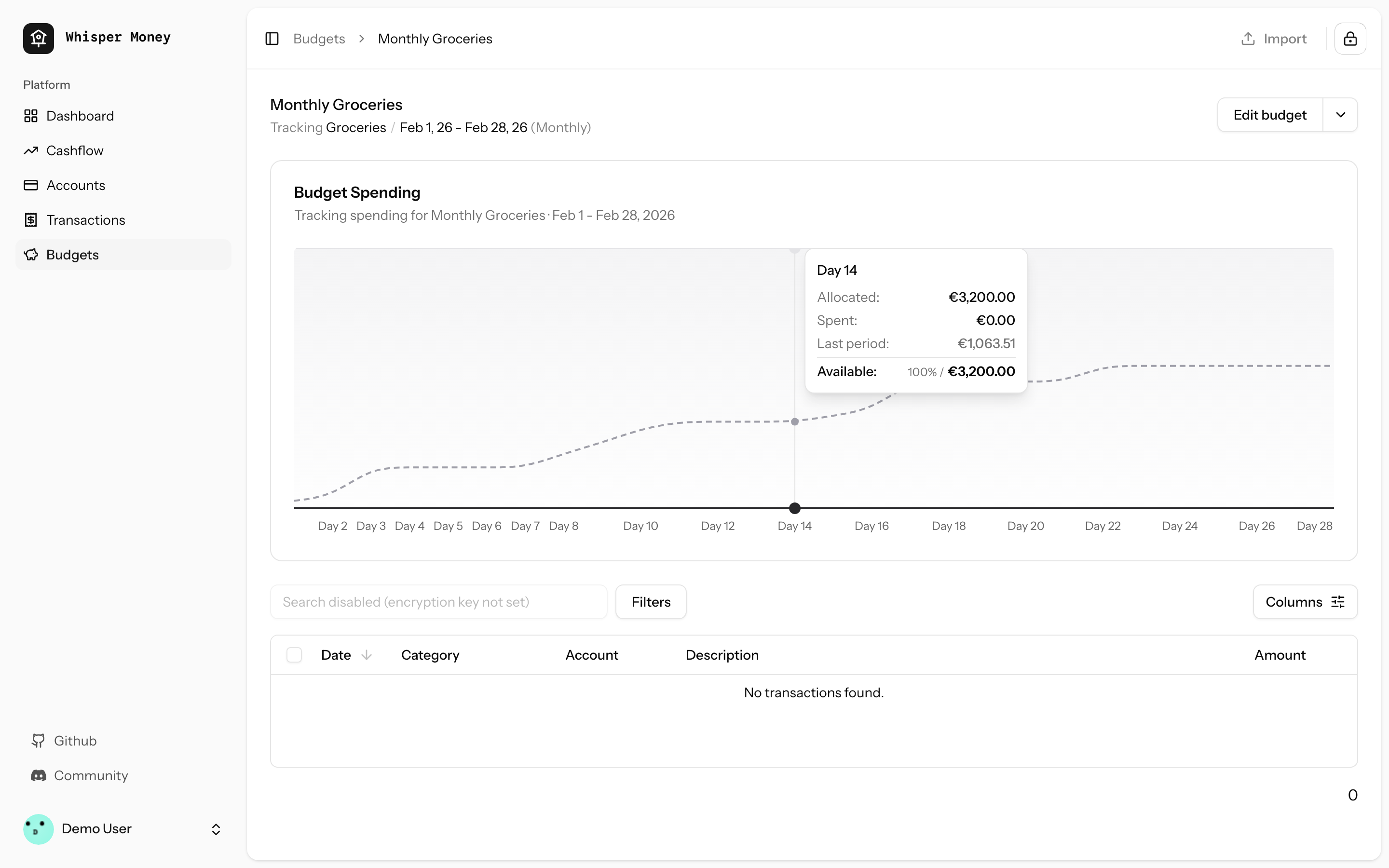
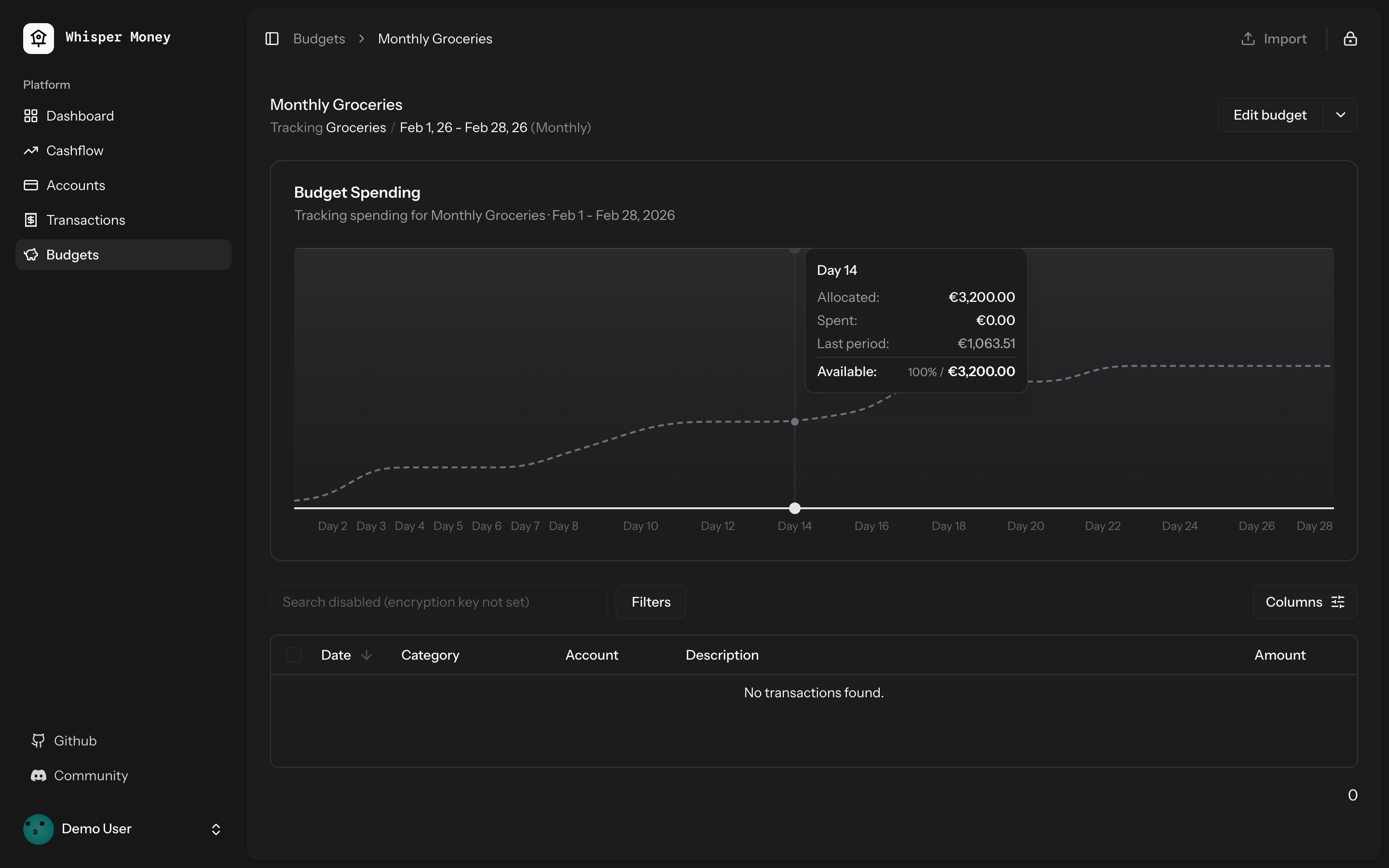
## Summary
- Load the previous budget period (with transactions) in
`BudgetController::show()` and pass it to the frontend
- Overlay previous period's cumulative spending as a dashed line on the
budget spending chart
- Use day-of-period alignment (Day 1, Day 2...) when comparing so
periods of different lengths align
- Tooltip shows both "Spent" (current) and "Last period" values when
hovering
- Chart now shows the full period timeline (not just up to today)
- When no previous period exists, chart behavior is unchanged
## Screenshots
### Light mode
### Dark mode
## Test plan
- [x] Tests pass: `php artisan test --compact
tests/Feature/BudgetTest.php` (9 tests)
- [x] Pint formatting passes
- [x] ESLint + Prettier pass
- [ ] Manual: view a budget with a prior period — dashed line appears
- [ ] Manual: view a budget with no prior period — chart unchanged
## Summary

- Budget periods use `date` columns (`start_date`, `end_date`) but
queries compared them against `now()` which includes a time component
(e.g. `2026-01-31 15:30:00`). MySQL converts the date to midnight for
comparison, so `end_date >= now()` evaluates to `'2026-01-31 00:00:00'
>= '2026-01-31 15:30:00'` → **false** — causing "No active period" on
the last day of every period.
- Replaced `now()` with `today()` (date-only) in all budget period date
comparisons across `Budget::getCurrentPeriod()`,
`BudgetController::index()`, and `GenerateBudgetPeriods` command.

## Test plan

- [x] Added 4 Pest tests covering the edge case (last day at various
times, first day at end of day, index/show endpoints)
- [x] All existing budget tests pass
## Overview

We're excited to introduce budgeting capabilities to Whisper Money! This
feature helps you take control of your finances by setting spending
limits and tracking your progress over time.

## Screenshots
<img width="1316" height="793" alt="image"
src="https://github.com/user-attachments/assets/ac394d36-cded-4ea4-9883-120785e260f1"
/>
<img width="1315" height="907" alt="image"
src="https://github.com/user-attachments/assets/7c682474-5aa7-4388-b626-29b56f5ebbef"
/>
<img width="1315" height="992" alt="image"
src="https://github.com/user-attachments/assets/21eace45-23c6-472d-9aa0-0feb6db3fba4"
/>

## What's New

### Create Flexible Budgets
- Set budgets for specific categories or labels
- Choose from monthly, weekly, bi-weekly, or custom periods
- Set your own budget start date for better alignment with your pay
schedule

### Track Your Spending
- Visual spending charts show how much you've spent vs. your budget
- See at a glance which budgets are on track and which need attention
- View all transactions that count toward each budget

### Smart Budget Management
- **Carry Over**: Unused budget amounts automatically roll into the next
period
- **Reset**: Unused amounts return to your available money pool
- Edit or delete budgets anytime as your needs change

### Easy Access
- New Budgets section in the main navigation
- Quick overview cards showing budget status
- Detailed budget pages with spending history and transaction lists

## How It Works

1. Create a budget by selecting a category or label and setting your
spending limit
2. Your transactions are automatically matched to relevant budgets
3. Track your progress with visual charts and spending summaries
4. Adjust your budgets as needed to stay on track with your financial
goals

This feature is now available behind a feature flag and can be enabled
for users who want to start budgeting their expenses.
 Víctor Falcón
 Toni Grunwald

