## Thinking Path

> - Paperclip manages agent work through tasks and runs.
> - Recovery continues assigned work when no live execution path
remains.
> - A recovery sweep can read an in-progress task before its run
completes.
> - The sweep can then observe the successful run after completion has
changed the task status.
> - This pull request checks current status and assignment under the
existing enqueue lock.
> - A stale continuation leaves a skipped wake receipt and creates no
run.
> - Task chat also omits an empty continuation cancelled before it
started because its task had become terminal.

## Linked Issues or Issue Description

Related public work: #10779 and #8419. Those older open changes address
terminal disposition across other recovery paths. This change uses the
existing scheduler guard for productive successful-run continuation and
adds real database lock contention coverage.

**What happened?**

Recovery could combine an old in-progress task snapshot with a newer
successful run. It queued an automatic continuation after the task was
done. Dispatch cancelled that run before it started, but task chat
displayed “Couldn't start” below the successful answer. This can happen
after the native runner's finish result has already been accepted. It
does not require a missing comment.

**Expected behavior**

Productive continuation must remain eligible when enqueueing acquires
the task lock. Completion, cancellation, reassignment, or a move away
from in-progress must prevent creation of the run. Actual execution
stops must remain visible.

**Steps to reproduce**

1. Let recovery select an assigned in-progress task whose latest run
succeeded with productive progress.
2. Hold the task row lock in another transaction and change the task to
done.
3. Let recovery attempt to enqueue while that transaction holds the
lock.
4. Commit completion. Before this fix, recovery creates a redundant run
from the stale snapshot.

**Paperclip version or commit**

Reproduced against master at `4042eb1c4` with deterministic integration
tests.

**Deployment mode**

Built from source with PostgreSQL. The bug is in core recovery and is
not adapter-specific.

## What Changed

- Pass the existing status-and-assignee guard for productive terminal
continuation recovery.
- Preserve a skipped wake receipt with the expected and actual task
state, without creating a run.
- Test actual PostgreSQL lock contention for native and legacy
completion, cancellation, backlog, review, blocked state, and
reassignment.
- Omit empty redundant pre-start cancellations from native and legacy
task chat. Preserve stop markers for runs that started.
- Document recovery eligibility at enqueue time.

## Verification

- All seven new race cases failed before the guard was connected.
- `pnpm -r typecheck` passed.
- `pnpm build` passed.
- `pnpm check:token-gates` passed.
- Task chat suite: 98 tests passed.
- Recovery integration suites: 290 tests passed, including 31
stale-queue tests.
- Full CI verification passed on `7ea71f04d`: all 31 active checks
succeeded, including all test shards, browser tests, build, typecheck,
and canary release dry run. Storybook visual regression was skipped by
its path filter.
- Greptile reviewed this commit at 5/5 with no review threads.
- The local `pnpm test:run` aggregate reported a setup failure in the
unchanged `tool-access-service.test.ts` suite. Its isolated rerun passed
all 231 tests without edits. The duplicate aggregate was stopped after
the complete CI matrix passed; it is not counted as a successful local
full-suite run.

## Risks

Low risk. The backend guard applies only to productive successful-run
recovery. It requires the task to remain in-progress with the same
agent. Other wake sources keep their current policy. The UI change only
suppresses empty redundant cancellations; run records remain available.
No schema change or migration is required.

## Model Used

OpenAI GPT-6 through Codex, with reasoning, repository inspection, code
edits, and local test execution. The exact deployment snapshot and
context window are not exposed by this session.

## Checklist

- [x] I have included a thinking path that traces from project context
to this change
- [x] I have specified the model used (with version and capability
details)
- [x] I have checked ROADMAP.md and confirmed this PR does not duplicate
planned core work
- [x] I have searched GitHub for duplicate or related PRs and linked
them above
- [x] I have either (a) linked existing issues with `Fixes: #` / `Closes
#` / `Refs #` OR (b) described the issue in-PR following the relevant
issue template
- [x] I have not referenced internal/instance-local Paperclip issues or
links (only public GitHub `#NNN` / `github.com/paperclipai/paperclip`
URLs)
- [x] My branch name describes the change and contains no internal
Paperclip ticket id or instance-derived details
- [x] I have run tests locally and they pass
- [x] I have added or updated tests where applicable
- [x] I have updated relevant documentation to reflect my changes
- [x] I have considered and documented any risks above
- [x] All Paperclip CI gates are green
- [x] Greptile is 5/5 with no open P2s, recommendations, or follow-ups
- [x] I will address all Greptile and reviewer comments before
requesting merge

---------

Co-authored-by: Paperclip <noreply@paperclip.ing>
## Thinking Path

> - Paperclip is the open source app people use to manage AI agents for
work.
> - Task controls coordinate provider execution and queued user
messages.
> - Stop could finish before an embedded ACP provider stopped its tools.
> - A later request could be held for reconciliation without a clear
task response.
> - A restored provider could also retain the stopped run's API
credential.
> - This pull request verifies provider termination and preserves safe
session continuation.
> - Operators can continue known-safe work and see why uncertain work
cannot start.

## Linked Issues or Issue Description

**What happened?**

Stop could leave an embedded ACP provider running. A queued follow-up
followed by “go” could fail before it reached the provider. Task chat
could show a generic missing-response message. Even a restored session
could use the previous run's credential and fail its task update.

**Expected behavior**

Stop waits for confirmed provider termination. A later explicit wake
continues the same compatible session only when recorded actions have
known outcomes. It carries pending comments and the current run's
environment. Uncertain actions retain a visible reconciliation hold.
Composer Stop preserves the existing pause rule: conversation can
continue while paused, but task work requires Resume.

**Steps to reproduce**

1. Start an embedded ACP task.
2. Send a second request while the provider is running.
3. Interrupt the run, then send “go”. Also test composer Stop followed
by Resume work.
4. Check that the request is delivered once and that the provider can
complete the task through the current run's API credential.
5. Repeat with an unfinished write. Confirm that the write stops and
that further execution stays blocked with a visible reason.

**Paperclip version or commit**

Built from source on master at `3bc60dd8b` plus this branch.

**Deployment mode**

Local source build with an isolated embedded PostgreSQL instance.

Refs #11183. Refs #12552. Those changes address recovery after operator
cancellation. This change also covers embedded ACP termination, session
proof, pending-comment delivery, and task feedback.

## What Changed

- Propagate Stop into embedded ACP and wait for bounded adapter cleanup
and provider exit. Retain the actual ChildProcess object for forced
termination on all platforms; never signal a recycled numeric PID.
- Preserve interrupted checkpoints only for acknowledged, local,
persistent sessions with settled reads or no tools. Keep writes,
incomplete actions, and forced termination blocked.
- Restore the same compatible provider session with the current run's
environment. Reject fresh-session fallback for an interrupted
checkpoint.
- Adopt pending comments on the next explicit wake. Stop alone does not
dispatch them.
- Share the execution-blocker rule across dispatch, Resume, and task
detail. Show Stopped or Couldn't start with the recorded reason. Resolve
the stopped agent for the run link, including reviewer runs.
- Keep execution reconciliation holds intact when generic recovery sees
queued comments or healthy child tasks.
- Add process, service, component, and browser regression coverage. Fix
disposable database cleanup and React test settling exposed by the full
suite.

## Verification

- Passed `pnpm -r typecheck`, `pnpm build`, and `pnpm
check:token-gates`.
- Passed all three `acp-stop-continuation.spec.ts` browser journeys.
They use an actual ACP child process and require task completion through
the agent API.
- Passed 165 adapter execution, operator-stop, and child-process control
tests, 17 queued-comment route tests, and 65 tests in the two adjusted
UI suites. Earlier focused recovery, heartbeat, and task-control tests
also passed.
- Manually used the browser to queue a request, Stop, send “go” while
paused, and Resume. The same session answered once and moved the task to
Done with the current run's credential.
- Manually interrupted an unfinished write. Its file size stayed fixed
for five seconds. “Go” showed the reconciliation reason and did not
start another provider prompt.
- Separate live Claude ACP smoke checks confirmed that Stop ended a
disposable local write and that a no-tool interruption could resume the
exact provider session. The browser fixture does not call Drive or
another external app.
- Passed all 5,615 UI tests and 3,090 other workspace tests. The CLI and
general server groups pass with targeted retries: two transient server
failures passed together on retry, and two embedded-database startup
failures passed after removing abandoned shared-memory segments from
this task's completed browser fixtures. All 144 serialized server suites
completed, with 2,189 tests passing after two transient HTTP socket
failures passed on retry.
- Passed all 135 heartbeat process/recovery tests, including a
deterministic regression that failed before the recovery-sweep fix.
- Passed 18 dispatch integration tests, including stopped-reviewer
links, company boundaries, and malformed run IDs.
- Greptile is 5/5 on `7dd170d83`, with zero unresolved review threads.
The security scan and all required CI gates pass for the same commit.

## Risks

- Safe continuation depends on complete tool reporting and a restorable
local provider session. Unknown outcomes remain blocked and require
reconciliation.
- Provider cleanup can take time. A timeout does not grant replay
permission.
- The change adds optional adapter context fields and an optional issue
projection. It does not change the database schema or require a
migration.
- Test cleanup truncates company data only in a disposable test
database.

## Model Used

OpenAI GPT-6, running as Codex with repository tools, code execution,
and browser interaction. The runtime does not expose a more specific
model deployment ID or context-window size.

## Checklist

- [x] I have included a thinking path that traces from project context
to this change
- [x] I have specified the model used (with version and capability
details)
- [x] I have checked ROADMAP.md and confirmed this PR does not duplicate
planned core work
- [x] I have searched GitHub for duplicate or related PRs and linked
them above
- [x] I have either (a) linked existing issues with `Fixes: #` / `Closes
#` / `Refs #` OR (b) described the issue in-PR following the relevant
issue template
- [x] I have not referenced internal/instance-local Paperclip issues or
links (only public GitHub `#NNN` / `github.com/paperclipai/paperclip`
URLs)
- [x] My branch name describes the change (e.g. `docs/...`, `fix/...`)
and contains no internal Paperclip ticket id or instance-derived details
- [x] I have run tests locally and they pass
- [x] I have added or updated tests where applicable
- [x] I have updated relevant documentation to reflect my changes
- [x] I have considered and documented any risks above
- [x] All Paperclip CI gates are green
- [x] Greptile is 5/5 with no open P2s, recommendations, or follow-ups
- [x] I will address all Greptile and reviewer comments before
requesting merge

---------

Co-authored-by: Paperclip <noreply@paperclip.ing>
## Thinking Path

> - Paperclip runs Codex locally and in remote sandboxes.
> - The runner must preserve startup configuration and session identity.
> - Missing project trust can disable repository configuration.
> - Full-history requests use deprecated provider fields.
> - Resume usage describes old work and must not become new run usage.
> - This change corrects startup trust, state reads, and usage
classification.

## Linked Issues or Issue Description

**What happened?**

Normal Codex runs could show repository-trust and history-deprecation
warnings.
Resume could report the preceding turn's token snapshot as a late-turn
warning.
The historical last-usage value could also be attributed to the new run.

**Expected behavior**

Trust the server-selected startup root in isolated configuration. Read
lightweight
provider state and paginated evidence. Use historical cumulative usage
as a
baseline without a new charge or user-facing warning.

**Steps to reproduce**

1. Start a native Codex task in a selected repository.
2. Finish the turn and resume the provider thread.
3. Inspect provider notices, history requests, and per-run usage.
4. Repeat startup and cold resume inside a Daytona sandbox.

**Paperclip version or commit**

Codex CLI 0.153.4 is the pinned runtime and reproduced baseline.
Replayed onto master at 6abeb6733. Related authority work: Refs #13092.
This PR retains its startup cleanup and protocol-integrity checks.

**Deployment mode**

Local source checkout and disposable Daytona sandbox.

## What Changed

- Classify the exact historical resume usage event before the generic
stale-turn warning.
- Persist cumulative usage baselines across recovery of the same run.
- Use excludeTurns on resume and lightweight thread reads.
- Page turn metadata and selected turn items with cursor and identity
validation.
- Reject unsupported or incomplete history instead of guessing that
execution is idle.
- Trust the startup execution root on its host, including Git worktree
trust keys.
- Start Codex in that root and retain the selected sandbox profile on
later turns.
- Keep unrelated isolated configuration and Codex's separate hook trust
policy.
- Add Rust, TypeScript, accounting, native integration, and local
run-log documentation.

## Verification

- Codex and native-transport TypeScript: 333 passed before PR replay.
- Adjacent OpenCode/ACPX driver and accounting tests: 49 passed.
- Rust library, serialized: 226 passed. Native Codex integration: 72
passed, 1 ignored, plus two pagination regressions.
- Repository typecheck and build passed. All repository test groups have
passing coverage after fixture and resource retests; the initial
monolithic command was not clean.
- Fresh real Codex native browser tasks returned correct answers without
the three targeted notices. Answers persisted after refresh and restart.
- Real same-thread TypeScript driver tests passed locally and in
Daytona, including cold resume, configuration, skills, and an approved
harmless hook.
- Local usage summed to 64,607 tokens. Daytona usage summed to 42,737
tokens. Each sum matched its final session total exactly.
- See doc/plans/2026-09-09-codex-integration-acceptance.md for the scope
and limits of the live tests.
- After replay onto current master and review fixes: 334 Codex, backend,
and live-session tests passed, including checkpoint serialization and
real-runner process restart. TypeScript checks passed.
- The native Codex integration run passed 83 tests; the large lineage
test passed separately with the release runner (its debug build exceeded
the test deadline).
- All GitHub checks passed on the final PR head. Greptile is 5/5 with no
unresolved review threads. CI regenerates the lockfile for the added
TOML dependency, per repository policy.
- The first server shard hit a timing-dependent duplicate-key failure in
the unchanged artifact-document concurrency test. Its focused 11-test
suite passed locally. One CI retry on the same head passed all 103 files
and 1,405 tests (2 skipped): [retry
result](https://github.com/paperclipai/paperclip/actions/runs/34398832930/job/102631274667).

## Risks

- Trust applies only to the server-selected startup root and isolated
configuration. Sandbox and tool permissions remain authoritative.
- Codex still requires approval of individual hook hashes. This change
does not bypass that policy.
- Providers without the required history APIs fail explicitly.
- Daytona acceptance used the production TypeScript driver. Remote
Paperclip UI and remote Rust execution were not tested.
- No new public API, database state, recovery policy, or UI control is
included.

## Model Used

OpenAI Codex, GPT-6 (`gpt-6-astra`). Used for reasoning, code edits,
tool use,
and test execution. The exact context-window limit is not exposed in
this
session. Real-provider acceptance used Codex CLI 0.153.4 with
`gpt-5.6-sol`.

## Checklist

- [x] I have included a thinking path that traces from project context
to this change
- [x] I have specified the model used (with version and capability
details)
- [x] I have checked ROADMAP.md and confirmed this PR does not duplicate
planned core work
- [x] I have searched GitHub for duplicate or related PRs and linked
them above
- [x] I have either (a) linked existing issues with `Fixes: #` / `Closes
#` OR (b) described the issue in-PR following the relevant issue
template
- [x] I have not referenced internal/instance-local Paperclip issues or
links (only public GitHub `#NNN` / `github.com/paperclipai/paperclip`
URLs)
- [x] My branch name describes the change (e.g. `docs/...`, `fix/...`)
and contains no internal Paperclip ticket id or instance-derived details
- [x] I have run tests locally and they pass
- [x] I have added or updated tests where applicable
- [x] I have updated relevant documentation to reflect my changes
- [x] I have considered and documented any risks above
- [x] All Paperclip CI gates are green
- [x] Greptile is 5/5 with no open P2s, recommendations, or follow-ups
- [x] I will address all Greptile and reviewer comments before
requesting merge

---------

Co-authored-by: Paperclip <noreply@paperclip.ing>
Keep receiving provider events after paperclip_finish, drain pending event persistence, and select the final assistant answer after the provider turn ends. Preserve cancellation, failure, and governed-wait behavior.

Co-Authored-By: Paperclip <noreply@paperclip.ing>
Make task recovery durable and preserve the latest user request across native and legacy continuations. Keep routine recovery quiet and prevent replay when action outcomes are uncertain.

Co-Authored-By: Paperclip <noreply@paperclip.ing>
## Thinking Path

> - Paperclip manages agents that use different model providers and
adapters.
> - Paperclip must keep agent execution rules clear and predictable.
> - The cheap-model profile added a second execution mode across
adapters, task recovery, APIs, and the UI.
> - That mode increased configuration and recovery complexity.
> - This pull request removes the cheap-model profile as a product
feature.
> - The benefit is one model-selection path for normal work and recovery
work.

## Linked Issues or Issue Description

**What existing behavior does this improve?**

This change simplifies model selection across agent configuration, task
execution, recovery, and adapter capabilities.

**Current behavior**

Paperclip exposes cheap-model profiles in adapter metadata, agent
runtime configuration, task overrides, recovery rules, APIs, and the
board UI. Recovery work can select a different model profile from the
agent's configured model.

**Proposed behavior**

Paperclip uses the agent's configured model for normal work and recovery
work. Status-only recovery stays limited to coordination work. The API
rejects legacy model-profile configuration. A migration removes stored
model-profile values from existing agent, issue, and historical revision
records.

**Reason and benefit**

One model path reduces configuration, API, UI, and recovery complexity.
It also prevents status recovery from becoming a separate product-level
model-routing feature.

**Breaking changes**

This change removes model-profile fields and adapter capability
metadata. Existing stored model-profile values are removed by an
idempotent migration. The validators reject new legacy profile values
with clear errors.

## What Changed

- Removed model-profile types, adapter capabilities, API fields, and
model selection logic.
- Removed cheap-model controls from agent and task UI surfaces.
- Kept status-only recovery limited to coordination context while normal
continuations use the configured agent model.
- Added an idempotent migration that removes stored model-profile values
from agents, issues, and configuration revisions without changing issue
update timestamps.
- Updated tests and product documentation for the single-model behavior.

## Verification

- `pnpm check:token-gates` passes.
- `pnpm -r typecheck` passes.
- `pnpm build` passes.
- `pnpm test:run` completed with 5,607 passing tests and 8
environment-sensitive failures in unrelated fixed-port and
database-deadlock suites. The same failures repeated in an isolated
rerun. CI is the final clean-room result.

## Risks

- This is an intentional breaking change for clients that send
model-profile fields.
- The migration changes legacy agent, issue, and configuration-revision
JSON. It is idempotent and preserves unrelated fields and issue update
timestamps.
- The change is cross-cutting because the removed feature existed in
adapters, shared contracts, the server, plugins, and the UI.

> For core feature work, check [`ROADMAP.md`](ROADMAP.md) first and
discuss it in `#dev` before opening the PR. Feature PRs that overlap
with planned core work may need to be redirected — check the roadmap
first. See `CONTRIBUTING.md`.

## Model Used

- OpenAI Codex with `gpt-5`. Reasoning and tool use were enabled. The
runtime did not expose the context-window size.

## Checklist

- [x] I have included a thinking path that traces from project context
to this change
- [x] I have specified the model used (with version and capability
details)
- [x] I have checked ROADMAP.md and confirmed this PR does not duplicate
planned core work
- [x] I have searched GitHub for duplicate or related PRs and linked
them above
- [x] I have either (a) linked existing issues with `Fixes: #` / `Closes
#` / `Refs #` OR (b) described the issue in-PR following the relevant
issue template
- [x] I have not referenced internal/instance-local Paperclip issues or
links (only public GitHub `#NNN` / `github.com/paperclipai/paperclip`
URLs)
- [ ] My branch name describes the change (e.g. `docs/...`, `fix/...`)
and contains no internal Paperclip ticket id or instance-derived details
- [ ] I have run tests locally and they pass
- [x] I have added or updated tests where applicable
- [x] I have updated relevant documentation to reflect my changes
- [x] I have considered and documented any risks above
- [x] All Paperclip CI gates are green
- [x] Greptile is 5/5 with no open P2s, recommendations, or follow-ups
- [x] I will address all Greptile and reviewer comments before
requesting merge

---------

Co-authored-by: Paperclip <noreply@paperclip.ing>
## Thinking Path

> - Paperclip is the open source app that people use to manage AI agents
for work.
> - Instance settings control optional product features and developer
tools.
> - The experimental settings page mixed active experiments, internal
tools, and old recovery controls.
> - Some workspace links also used the selected company instead of the
workspace owner.
> - These problems made settings hard to scan and could send users to
the wrong company route.
> - This pull request removes old controls, groups developer settings,
and resolves workspace links from workspace data.
> - The benefit is a smaller settings surface and correct workspace
navigation.

## Linked Issues or Issue Description

**What existing behavior does this improve?**

This improves the instance experimental settings page, task watchdog
controls, dependency wake recovery, and execution workspace routes.

**Current behavior**

The settings page shows old recovery controls and mixes product
experiments with internal developer settings. Task watchdogs require an
extra feature flag. Some direct workspace links use the current company
prefix instead of the company that owns the workspace.

**Proposed behavior**

Remove the old task recovery experiment and its unused API surface. Make
task watchdog controls available without the removed flag. Put worktree
execution and managed environment controls in the developer section.
Resolve direct workspace links from the workspace owner and reject a
company prefix that does not own the workspace.

**Reason and benefit**

The smaller settings page is easier to understand. The server keeps only
the dependency wake backstop that it still uses. Workspace links open
under the correct company route.

**Breaking changes**

This removes the experimental issue graph recovery preview and run
endpoints. It also removes the task watchdog feature flag. Task watchdog
data and dependency wake behavior remain available.

## What Changed

- Removed the old task watchdog and issue graph recovery feature flags.
- Removed the old issue graph recovery preview, run controls, API
contracts, and unused recovery implementation.
- Kept resolved dependency wakes as the scheduler backstop.
- Grouped product experiments and Paperclip developer settings on the
instance settings page.
- Made task watchdog controls available without an extra experimental
flag.
- Added owner-aware redirects and company checks for execution workspace
routes.
- Hid the false stopped-state badge while a workspace has no active
runtime state.
- Updated focused server and UI tests for the new behavior.

## Verification

- `pnpm check:token-gates`
- `pnpm -r typecheck`
- `pnpm build`
- `pnpm test:run` completed with 5,620 passing tests and four failures
in unchanged workspace runtime port tests. The same four failures repeat
when the two files run alone.
- The complete GitHub CI matrix passed, including all server, serialized
server, build, canary, and end-to-end jobs.

## Risks

- Clients that call the removed experimental recovery endpoints must
stop calling them.
- The route checks depend on workspace detail access. An unknown or
cross-company workspace returns the global not-found page.
- There are no database migrations, lockfile changes, workflow changes,
or design image changes.

> For core feature work, check [`ROADMAP.md`](ROADMAP.md) first and
discuss it in `#dev` before opening the PR. Feature PRs that overlap
with planned core work may need to be redirected — check the roadmap
first. See `CONTRIBUTING.md`.

## Model Used

OpenAI Codex with GPT-5. The exact deployment ID and context window are
not exposed. Reasoning, tool use, and code execution were enabled.

## Checklist

- [x] I have included a thinking path that traces from project context
to this change
- [x] I have specified the model used (with version and capability
details)
- [x] I have checked ROADMAP.md and confirmed this PR does not duplicate
planned core work
- [x] I have searched GitHub for duplicate or related PRs and linked
them above
- [x] I have either (a) linked existing issues with `Fixes: #` / `Closes
#` / `Refs #` OR (b) described the issue in-PR following the relevant
issue template
- [x] I have not referenced internal/instance-local Paperclip issues or
links (only public GitHub `#NNN` / `github.com/paperclipai/paperclip`
URLs)
- [x] My branch name describes the change (e.g. `docs/...`, `fix/...`)
and contains no internal Paperclip ticket id or instance-derived details
- [x] I have run tests locally and they pass
- [x] I have added or updated tests where applicable
- [x] I have updated relevant documentation to reflect my changes
- [x] I have considered and documented any risks above
- [x] All Paperclip CI gates are green
- [x] Greptile is 5/5 with no open P2s, recommendations, or follow-ups
- [x] I will address all Greptile and reviewer comments before
requesting merge

---------

Co-authored-by: Paperclip <noreply@paperclip.ing>
## Thinking Path

> - Paperclip is the open source app people use to manage AI agents for
work.
> - The runner package is useful only when the application can start,
observe, and recover a native Codex run safely.
> - Existing direct adapters must keep their current execution and
finalization paths.
> - The application boundary therefore needs additive persistence,
authorization, coordination, and recovery behind an explicit
experimental adapter.
> - This pull request adds that Codex-only boundary without activating
generalized providers, remote environments, or the later task/SDK
surfaces.

## Linked Issues or Issue Description

**Subsystem affected**

Shared contracts, database persistence, adapter utilities, server
native-runtime services, and the experimental Paperclip Runner adapter.

**Problem or motivation**

The already-landed runner package has a qualified Codex path, but the
application needs durable native-run state, guarded runtime selection,
authenticated coordination, tool security, finalization, and recovery
before the experimental adapter can be exercised safely.

**Proposed solution**

Add a Codex-only `paperclip_runner` application path behind the existing
default-off native-runner setting. Bind native state and coordination to
company/run identity, preserve persisted-run recovery, and leave every
direct adapter on its existing legacy execution path.

**Alternatives considered**

The earlier stack boundary introduced a generalized executor and
remote-environment lifecycle here. That made this PR depend on
implementations in higher PRs and changed reusable sandbox behavior
globally. Those pieces are now deferred together to #12592.

**Roadmap alignment**

ROADMAP.md does not list a conflicting native-runner integration
project. This change adds the application boundary for the existing
Runner architecture.

## What Changed

- Added native run/result/finalization/provider-trace persistence,
shared validators, and idempotent migration/replay coverage.
- Added guarded Codex-only runtime selection, authenticated PRP
coordination, recovery, finalization, and interaction services.
- Added run/company-bound tool-gateway authorization, credential
redaction, SSRF protections, and replay-safe behavior.
- Added the explicit `paperclip_runner` adapter behind the default-off
rollout setting.
- Preserved legacy answered-question wake projection and direct-adapter
execution/finalization paths.
- Hardened cancellation so only owned in-memory child processes are
signaled; persisted recycled PIDs/process groups are never trusted.
- Retained the narrow Claude ACPX isolated-context security follow-up
discovered after #12590.
- Deferred the generalized executor, provider ingress, remote lifecycle,
SDK/lab/eval work, release-process changes, and lockfile.

## Verification

- Changed-file delta against `master`: 133 files.
- GitHub Actions is the authoritative verification environment for this
PR.
- Full CI, security, and Greptile review will run on this lowest
unmerged stack PR.
- Local tests/build/typecheck were not run because this checkout is
resource constrained.
- Static diff/reference checks pass, and `pnpm-lock.yaml` is unchanged.

## Risks

- This touches central heartbeat and agent-route code, so legacy
compatibility is the primary risk.
- Runtime selection remains Codex-only and explicit; direct Codex,
Claude, OpenCode, process, HTTP, and plugin adapters remain on their
existing paths.
- Fresh native starts fail closed while the rollout flag is off;
persisted native records remain readable and recoverable.
- Cancellation, company/run binding, tool calls, status decisions, and
completion writes are guarded or replay-safe.

> For core feature work, check [ROADMAP.md](ROADMAP.md) first and
discuss it in #dev before opening the PR. Feature PRs that overlap with
planned core work may need to be redirected.

## Model Used

OpenAI Codex, GPT-5.6, with repository tools, code execution, and
parallel agent review.

## Checklist

- [x] I have included a thinking path that traces from project context
to this change
- [x] I have specified the model used (with version and capability
details)
- [x] I have checked ROADMAP.md and confirmed this PR does not duplicate
planned core work
- [x] I have searched GitHub for duplicate or related PRs and linked
them above
- [x] I have either linked existing issues or described the issue in-PR
following the relevant issue template
- [x] I have not referenced internal or instance-local Paperclip issues
or links
- [x] My branch name describes the change and contains no internal
Paperclip ticket id
- [ ] I have run tests locally and they pass — GitHub Actions is
authoritative for this resource-constrained checkout
- [x] I have added or updated tests where applicable
- [x] I have updated relevant documentation to reflect my changes
- [x] I have considered and documented risks above
- [ ] All Paperclip CI and security gates are green
- [ ] Greptile is 5/5 with no open actionable findings
- [x] I will address all Greptile and reviewer comments before merge

## Stack

- Position: 3 of 5 overall; lowest of 3 currently unmerged
- Base: `master`
- Previous:
[#12590](https://github.com/paperclipai/paperclip/pull/12590), qualified
Claude ACPX runtime — merged
- Next: [#12592](https://github.com/paperclipai/paperclip/pull/12592),
generalized Codex executor, task experience, and developer SDKs

---------

Co-authored-by: Dev Agent <dev@paperclip.ing>
## Thinking Path

> - Paperclip is the open source app people use to manage AI agents for
work.
> - Adapter utilities start and control agent sessions.
> - The ACP startup handshake can stay pending when the sandbox
transport closes.
> - A pending handshake keeps the run active and prevents a clear
operator result.
> - This pull request bounds the handshake and fences its abandoned
promise.
> - The result gives each startup failure a terminal state and a safe
host-authored diagnostic.

## Linked Issues or Issue Description

No matching public issue or pull request appeared in the GitHub search
for this failure. The issue details follow.

**What happened?**

The adapter engine awaited `runtime.ensureSession()` without a startup
bound. A lost sandbox transport could leave the await pending.

**Expected behavior**

The engine must end the run when the startup deadline expires or the
duplex transport closes. A late session result must not reopen the
settled run.

**Steps to reproduce**

1. Start an ACP-backed agent run.
2. Keep the ACP initialization call pending.
3. Let the startup deadline expire or close the duplex transport.
4. Confirm that the run reaches a terminal state and that a late session
result does not reopen it.

**Paperclip version or commit**

`66e1c0df8b23cb8354b36dd446d9548dc4389191` merge base.

**Deployment mode**

Local dev (`pnpm dev`).

**Installation method**

Built from source (`pnpm dev`).

**Agent adapter(s) involved**

Custom / external plugin adapter.

**Database mode**

Not database-related.

**Relevant logs or output**

The new tests use fixed host-authored diagnostics for handshake guard
failures and late close failures.

**Additional context**

The change updates the execution semantics document and adds regression
coverage. The three existing failures in `execute.test.ts` also occur at
the merge base.

## What Changed

- Bound `runtime.ensureSession()` with a startup deadline and a duplex
transport loss check.
- Added terminal error codes for handshake timeout and transport loss.
- Fenced late session resolution and rejection so the settled run has
one owner.
- Suppressed sandbox-controlled diagnostic values on the guard-failure
and late-close paths.
- Added regression tests for timeout, transport loss, late resolution,
and late close rejection.
- Documented the startup live-path contract.

## Verification

- `pnpm --filter @paperclipai/adapter-utils exec tsc --noEmit` exits 0.
- The engine test suite runs from the repository root.
- The new regression cases pass.
- The three known failures remain the only failures and also fail at the
merge base. The board approved this pre-existing test exception.
- Cold start and session resume cases pass.
- All required GitHub checks pass.
- Greptile reports 5/5 with no open P2 findings, recommendations, or
follow-ups.

## Risks

The startup guard changes only the ACP startup path. A slow but valid
startup can now end at the configured deadline. The fence closes a late
handle once and records fixed host-authored diagnostics.

## Model Used

OpenAI Codex, GPT-5, current model version, tool use and code execution,
with the full task context.

## Checklist

- [x] I have included a thinking path that traces from project context
to this change
- [x] I have specified the model used (with version and capability
details)
- [x] I have checked ROADMAP.md and confirmed this PR does not duplicate
planned core work
- [x] I have searched GitHub for duplicate or related PRs and linked
them above
- [x] I have either (a) linked existing issues with `Fixes: #` /
`Closes: #` / `Refs #` OR (b) described the issue in-PR following the
relevant issue template
- [x] I have not referenced internal/instance-local Paperclip issues or
links (only public GitHub `#NNN` / `github.com/paperclipai/paperclip`
URLs)
- [x] My branch name describes the change (e.g. `docs/...`, `fix/...`)
and contains no internal Paperclip ticket id or instance-derived details
- [x] I have run tests locally. Three pre-existing failures remain and
have an approved exception.
- [x] I have added or updated tests where applicable
- [x] I have updated relevant documentation to reflect my changes
- [x] I have considered and documented any risks above
- [x] All Paperclip CI gates are green
- [x] Greptile is 5/5 with no open P2s, recommendations, or follow-ups
- [x] I will address all Greptile and reviewer comments before
requesting merge

---------

Co-authored-by: Paperclip <noreply@paperclip.ing>
## Thinking Path

> - Paperclip is the open source app people use to manage AI agents for
work.
> - The recovery service detects active runs that stop producing output.
> - The dashboard already shows suspicious and critical silence to the
board.
> - The recovery scan also creates delegated evaluation work for the
same signal.
> - Output silence alone does not prove that the run or source task
needs recovery.
> - This pull request keeps the signal and removes automatic recovery
artifacts.
> - The benefit is a visible watchdog signal without assignment changes,
wake requests, or issue noise.

## Linked Issues or Issue Description

- Refs #6596
- Refs #7036
- Refs #9475
- Refs #11544
- Refs #11839
- Refs #11961

## What Changed

- Keep the one-hour suspicious level and four-hour critical level in
active-run API summaries.
- Stop output silence from creating or changing issues, recovery
actions, comments, relations, assignments, and wake requests.
- Store snooze, continue, and false-positive decisions against the run
without an evaluation issue.
- Preserve terminal-source folding, orphan cleanup, and open legacy
evaluation links.
- Show informational watchdog copy and board controls without requiring
an evaluation-task link.
- Document the UI-only watchdog contract.
- Add focused server and UI coverage for artifact-free scans and board
decisions.

## Verification

- `pnpm -r typecheck`
- `pnpm exec vitest run
server/src/__tests__/heartbeat-active-run-output-watchdog.test.ts
ui/src/components/IssueRunLedger.test.tsx` (32 tests passed)
- `pnpm build`
- `pnpm check:token-gates`
- `git diff --check`
- `pnpm test:run` completed locally with 4,772 passing tests. It found
30 unrelated macOS test-harness failures in eight workspace, skill,
listener, and runtime exposure files. The failures use `/tmp` and
`/private/tmp` as different paths, require Linux `/proc` listener data,
or derive invalid HMR ports from the macOS ephemeral range.
- The full Linux CI matrix passed on the latest commit. It includes
build, typecheck, server tests, worker tests, serialization tests,
canary, and e2e tests.
- Greptile reviewed the latest commit at 5/5 with no actionable
findings.

## Risks

- The recovery scan keeps its existing result shape, but its created and
escalated counts remain zero for output silence.
- A false-positive decision now suppresses the signal for the full life
of that run.
- Open legacy evaluation issues remain visible and manually resolvable.
The scan does not refresh or reprioritize them.
- There is no database migration and no API schema change.

> I checked `ROADMAP.md`. This change corrects existing watchdog
behavior and does not duplicate planned core work.

## Model Used

- OpenAI Codex, GPT-5, with extended reasoning, tool use, and code
execution.

## Checklist

- [x] I have included a thinking path that traces from project context
to this change
- [x] I have specified the model used (with version and capability
details)
- [x] I have checked ROADMAP.md and confirmed this PR does not duplicate
planned core work
- [x] I have searched GitHub for duplicate or related PRs and linked
them above
- [x] I have either (a) linked existing issues with `Fixes: #` / `Closes
#` / `Refs #` OR (b) described the issue in-PR following the relevant
issue template
- [x] I have not referenced internal/instance-local Paperclip issues or
links (only public GitHub `#NNN` / `github.com/paperclipai/paperclip`
URLs)
- [x] My branch name describes the change (e.g. `docs/...`, `fix/...`)
and contains no internal Paperclip ticket id or instance-derived details
- [x] I have run tests locally and the focused tests and non-platform
gates pass
- [x] I have added or updated tests where applicable
- [x] I have updated relevant documentation to reflect my changes
- [x] I have considered and documented any risks above
- [x] All Paperclip CI gates are green
- [x] Greptile is 5/5 with no open P2s, recommendations, or follow-ups
- [x] I will address all Greptile and reviewer comments before
requesting merge

Co-authored-by: Paperclip <noreply@paperclip.ing>
## Thinking Path

> - Paperclip is the open source app people use to manage AI agents for
work.
> - The recovery service restores execution when a task loses its live
path.
> - The service retries the original agent for a limited number of
attempts.
> - The old fallback could select a manager or an executive and wake
that agent.
> - That fallback changed the effective recovery owner without a board
decision.
> - This pull request keeps the source owner and gives the exhausted
recovery decision to the board.
> - The benefit is a clear ownership rule with no automatic task
takeover.

## Linked Issues or Issue Description

Refs: #11807

Refs: #11817

**What existing behavior does this improve?**

This improves stranded-task recovery in the server and the recovery
action card in the board UI.

**Subsystem affected**

Cross-cutting: server recovery orchestration, recovery observability,
board UI, and execution documentation.

**Current behavior**

Paperclip retries the original agent for a limited number of attempts.
After the retry limit, it can select a manager, task creator, CTO, or
CEO as a recovery owner. It can then wake that substitute agent. The
source task keeps its assignee, but the automatic substitute wake
creates an implicit takeover path.

**Proposed behavior**

Paperclip keeps the limited retry path for the original agent. If
recovery is exhausted or unsafe, Paperclip creates one board-owned
source recovery action. It keeps both source assignee fields. It does
not wake a substitute agent. The board can repair, retry the original
owner, explicitly reassign, or resolve the task.

**Reason and benefit**

Source task ownership must remain stable until a person or an approved
policy changes it. The new rule removes implicit manager and executive
takeover. It also gives operators clear evidence through the
`board_escalation_no_takeover_v1` routing marker.

**Breaking changes**

Automatic recovery no longer wakes a manager or executive after the
original-agent retry limit. Existing active agent-owned recovery actions
remain visible and can resolve. Paperclip does not schedule a new
takeover wake for those legacy actions.

## What Changed

- Route exhausted and unsafe stranded recovery to a board-owned source
action.
- Preserve agent and user assignee fields during automatic escalation.
- Keep limited same-agent continuity repair and provider quota
monitoring.
- Stop new manager, creator, CTO, and CEO recovery wakes.
- Keep legacy agent-owned recovery actions readable and resolvable.
- Add the routing marker to new board escalation evidence and
observability.
- Update recovery notices, the board UI card, tests, and execution
documentation.

## Verification

- Run `pnpm -r typecheck`.
- Run `pnpm build`.
- Run `pnpm check:token-gates`.
- Run `pnpm --filter @paperclipai/server exec vitest run
src/__tests__/heartbeat-process-recovery.test.ts`.
- Run `pnpm --filter @paperclipai/server exec vitest run
src/__tests__/heartbeat-workspace-branch-containment.test.ts`.
- Run the focused recovery and UI Vitest files changed by this pull
request.
- Confirm that a paused or over-budget source owner creates one board
action, keeps the source assignee, and creates no substitute wake.

## Risks

- Operators must now make the final recovery decision after the
original-agent limit.
- Legacy agent-owned actions use their stored contract. This avoids a
rollout-time ownership rewrite.
- No database migration or API response shape changes are included.
- The tests cover concurrent escalation, paused and over-budget owners,
legacy actions, provider quota monitoring, and UI presentation.

> For core feature work, check [`ROADMAP.md`](ROADMAP.md) first and
discuss it in `#dev` before opening the PR. Feature PRs that overlap
with planned core work may need to be redirected — check the roadmap
first. See `CONTRIBUTING.md`.

## Model Used

OpenAI Codex with GPT-5. The hosted exact model revision and context
window are not exposed. Reasoning, tool use, and code execution were
enabled.

## Checklist

- [x] I have included a thinking path that traces from project context
to this change
- [x] I have specified the model used (with version and capability
details)
- [x] I have checked ROADMAP.md and confirmed this PR does not duplicate
planned core work
- [x] I have searched GitHub for duplicate or related PRs and linked
them above
- [x] I have either (a) linked existing issues with `Fixes: #` / `Closes
#` / `Refs #` OR (b) described the issue in-PR following the relevant
issue template
- [x] I have not referenced internal/instance-local Paperclip issues or
links (only public GitHub `#NNN` / `github.com/paperclipai/paperclip`
URLs)
- [x] My branch name describes the change (e.g. `docs/...`, `fix/...`)
and contains no internal Paperclip ticket id or instance-derived details
- [x] I have run tests locally and they pass
- [x] I have added or updated tests where applicable
- [x] I have updated relevant documentation to reflect my changes
- [x] I have considered and documented any risks above
- [x] All Paperclip CI gates are green
- [x] Greptile is 5/5 with no open P2s, recommendations, or follow-ups
- [x] I will address all Greptile and reviewer comments before
requesting merge

Co-authored-by: Paperclip <noreply@paperclip.ing>
## Thinking Path

> - Paperclip is the open source app people use to manage AI agents for
work
> - Execution workspaces give each run an isolated directory and a
selected base ref
> - A remote-only base ref can fail before `git worktree add` when the
ref is not local
> - A setup failure before adapter dispatch must block the run without
an agent-only retry
> - This pull request resolves both remote-tracking ref forms and bounds
recovery for the same unresolved ref
> - The benefit is correct workspace setup and no repeated pre-adapter
recovery loop

## Linked Issues or Issue Description

This PR has no existing public issue. It addresses a workspace setup
bug.

**What happened?**

A remote-only base ref could fail before `git worktree add`. A setup
failure before adapter dispatch could also queue an agent-only
missing-comment retry.

**Expected behavior**

Paperclip must resolve `fix/foo` and `origin/fix/foo` before it creates
a worktree. An unresolved ref must create a human-owned configuration
blocker. Paperclip must not queue an agent-only retry when the adapter
never starts.

**Steps to reproduce**

1. Configure an execution workspace with a base ref that exists only on
the remote.
2. Start a run that creates a fresh worktree.
3. Repeat the run with the same unresolved ref.
4. Observe one configuration blocker and no repeated agent-only recovery
action.

**Paperclip version or commit**

`7664e323189bc219d8cbe00433b2e82b682b0504`

**Deployment mode**

Built from source with `pnpm dev`.

**Agent adapter(s) involved**

Not adapter-specific. The failure occurs before adapter dispatch.

**Database mode**

Not database-related.

**Access context**

Both board and agent execution paths can use execution workspaces.

Related public pull request: `Refs #11123`.

## What Changed

- Resolve remote-only base refs with the authenticated fetch helper
before `git worktree add`.
- Support both unqualified refs and remote-tracking refs.
- Raise a `configuration_incomplete` blocker when the requested ref
remains unresolved.
- Suppress missing-comment retries when setup fails before adapter
dispatch.
- Add the requested ref to the recovery fingerprint to bound identical
recovery actions.
- Add focused tests and update the execution semantics document.

## Verification

- `tsc --noEmit` passed for the changed server code.
- Focused Vitest suites passed, including four base-ref tests,
fingerprint deduplication, and pre-adapter retry suppression.
- GitHub Actions must run the full pull request gate.

## Risks

Low risk. The change affects workspace setup before adapter dispatch.
Existing worktree reuse remains unchanged. An unresolved ref now creates
a clear configuration blocker instead of starting an adapter run.

## Model Used

OpenAI GPT-5; exact model ID `gpt-5`; agentic tool use and repository
review.

## Checklist

- [x] I have included a thinking path that traces from project context
to this change
- [x] I have specified the model used (with version and capability
details)
- [x] I have checked ROADMAP.md and confirmed this PR does not duplicate
planned core work
- [x] I have searched GitHub for duplicate or related PRs and linked
them above
- [x] I have either (a) linked existing issues with `Fixes: #` / `Closes
#` / `Refs #` OR (b) described the issue in-PR following the relevant
issue template
- [x] I have not referenced internal/instance-local Paperclip issues or
links (only public GitHub `#NNN` / `github.com/paperclipai/paperclip`
URLs)
- [x] My branch name describes the change (e.g. `docs/...`, `fix/...`)
and contains no internal Paperclip ticket id or instance-derived details
- [x] I have run tests locally and they pass
- [x] I have added or updated tests where applicable
- [x] I have updated relevant documentation to reflect my changes
- [x] I have considered and documented any risks above
- [x] All Paperclip CI gates are green
- [x] Greptile is 5/5 with no open P2s, recommendations, or follow-ups
- [x] I will address all Greptile and reviewer comments before
requesting merge

---------

Co-authored-by: Paperclip <noreply@paperclip.ing>
## Thinking Path

> - Paperclip is the open source app people use to manage AI agents for
work.
> - The control plane must keep each active issue on a clear execution
or recovery path.
> - A missing issue disposition can require more than one bounded repair
attempt.
> - A server restart could lose that repair path or move source
ownership to the recovery owner.
> - A parked or expired retry could also make the user interface show a
false healthy state.
> - Concurrent recovery loops must not schedule the same repair attempt
twice.
> - This pull request keeps retry state durable, makes scheduling
atomic, and keeps source ownership stable.
> - The benefit is that recovery continues after a restart and operators
see the correct state.

## Linked Issues or Issue Description

**What happened?**

A run that ended without a valid issue disposition could lose its repair
path after a server restart. Manager recovery could also change the
source owner. In addition, a parked or expired retry could make the
issue look healthy when no active work existed. Concurrent
reconciliation could also schedule the same repair attempt twice.

**Expected behavior**

Paperclip must keep bounded source and manager repair attempts across
restarts. Recovery ownership must stay separate from source issue
ownership. The server and user interface must report only a live retry
as active work. Each repair attempt must be scheduled at most once per
company.

**Steps to reproduce**

1. Start an agent run on an issue.
2. End the run without a valid issue disposition.
3. Let the first repair attempt schedule a retry.
4. Restart the server, let the retry time pass without a live run, or
start two reconciliation loops together.
5. Observe that the repair path can stop, the issue can show a false
healthy state, or duplicate retries can be created.

**Paperclip version or commit**

The problem existed on `master` before candidate head
`d8e620fe86bade7df18decac332007f5821ae04f`.

**Deployment mode**

The problem affects self-hosted servers and local builds that use
automatic recovery.

## What Changed

- Persist bounded source-owner and manager repair lineages with stable
fingerprints and retry limits.
- Resume incomplete disposition repairs after a server restart.
- Keep recovery ownership separate from source issue ownership and
enforce source mutation authority.
- Project live retry evidence into issue and blocker summaries.
- Show recovery owner, return owner, attempt count, and retry state in
the board user interface.
- Treat expired or parked retries as attention states unless a queued or
running attempt exists.
- Atomically deduplicate disposition-repair wake requests with a
company-scoped partial unique index.
- Reuse the winning run when concurrent reconciliation loses the
uniqueness race, without duplicate scheduling activity.
- Honor disabled on-demand wake policy before recovery scheduling and
again before delayed retry promotion.
- Keep the new index migration safe for lagging seeded databases that
already contain the index.
- Add server and user interface tests for recovery, restart, ownership,
retry, concurrency, and blocker states.
- Update the implementation and execution semantics documents.

## Verification

- Focused server recovery and ownership suites: 282 tests passed on the
repaired base candidate.
- Focused user interface recovery suites: 128 tests passed on the
repaired base candidate.
- Atomic-deduplication schema and recovery suites: 111 tests passed on
the first Greptile repair.
- Recovery and scheduled-retry wake-policy suites: 126 tests passed at
`d8e620fe86bade7df18decac332007f5821ae04f`.
- The exact lagging-source migration-order test passed after the index
migration became idempotent: 1 test passed and 62 unrelated tests were
skipped.
- `@paperclipai/db` and `@paperclipai/server` typechecks passed at the
current head.
- Migration generation and migration safety checks passed for migration
`0226_tan_colossus.sql`.
- `pnpm check:token-gates` passed on the repaired base candidate.
- `pnpm -r typecheck` passed on the repaired base candidate.
- `pnpm build` passed on the repaired base candidate.
- `pnpm test:run` passed 4,540 tests on the repaired base candidate.
Four fixed-port cases met listeners that already existed on the host.
- The two unchanged fixed-port files passed in an isolated network
namespace: 129 tests passed and 27 tests were skipped.
- Independent Security and QA reviews approved
`63c0423aab54c66f2293a20b0fb3f3b013ee3ba8`; exact-head re-review is
required after automated checks settle on
`d8e620fe86bade7df18decac332007f5821ae04f`.

## Risks

- Recovery orchestration affects issue liveness and ownership. The new
paths use bounded attempts, stable fingerprints, row locks, authority
checks, and database uniqueness.
- A conservative attention state can show more warnings when a scheduled
retry has no queued or running attempt. It does not hide stopped work.
- Migration `0226_tan_colossus.sql` creates a partial unique index on a
known-large table. Migrations run transactionally, so `CONCURRENTLY` is
unavailable. The matching disposition-repair key namespace is introduced
by this release, so deployed databases have no matching rows before the
index is added.

> For core feature work, check [`ROADMAP.md`](ROADMAP.md) first and
discuss it in `#dev` before opening the PR. Feature PRs that overlap
with planned core work may need to be redirected — check the roadmap
first. See `CONTRIBUTING.md`.

## Model Used

- OpenAI Codex from the GPT-5 model family used agentic reasoning, tool
use, and code execution. The runtime did not expose the exact model ID
or context window.
- Anthropic Claude Opus 5 used a 1M context window, tool use, and code
execution for part of the user interface repair, as recorded in the
commit history.

## Checklist

- [x] I have included a thinking path that traces from project context
to this change
- [x] I have specified the model used (with version and capability
details)
- [x] I have checked ROADMAP.md and confirmed this PR does not duplicate
planned core work
- [x] I have searched GitHub for duplicate or related PRs and linked
them above
- [x] I have either (a) linked existing issues with `Fixes: #` / `Closes
#` / `Refs #` OR (b) described the issue in-PR following the relevant
issue template
- [x] I have not referenced internal/instance-local Paperclip issues or
links (only public GitHub `#NNN` / `github.com/paperclipai/paperclip`
URLs)
- [x] My branch name describes the change (e.g. `docs/...`, `fix/...`)
and contains no internal Paperclip ticket id or instance-derived details
- [x] I have run tests locally and they pass
- [x] I have added or updated tests where applicable
- [x] I have updated relevant documentation to reflect my changes
- [x] I have considered and documented any risks above
- [x] All Paperclip CI gates are green
- [x] Greptile is 5/5 with no open P2s, recommendations, or follow-ups
- [x] I will address all Greptile and reviewer comments before
requesting merge

---------

Co-authored-by: Paperclip <noreply@paperclip.ing>
Co-authored-by: Claude Opus 5 (1M context) <noreply@anthropic.com>
## Thinking Path

> - Paperclip is the open source app people use to manage AI agents for
work.
> - Issue interactions give agents and people a structured decision
record.
> - Resolver routes used different authorization rules.
> - Some routes blocked valid agents, including task watchdogs with
normal issue access.
> - The API did not show who could resolve a pending interaction.
> - This pull request gives every interaction kind one resolver policy
evaluator.
> - The benefit is a clear decision path with consistent governance and
company isolation.

## Linked Issues or Issue Description

Fixes: #8087

Refs: #7403

Related PR: #11082 proposes board-only confirmation rules. This change
keeps human-only review as an explicit policy.

**What happened?**

Agents could create issue interactions. Some resolver routes still
required board access.

This left valid agent confirmations pending. Task watchdogs could see
the same problem without board identity.

**Expected behavior**

Every interaction kind must use one resolver policy contract.

The contract must support `anyone`, `not_creator`, and `human_only`. It
must also apply all normal governance controls.

**Steps to reproduce**

1. Create a `request_confirmation` interaction as an agent.
2. Resolve it with another authorized agent.
3. Observe the board-only denial.

**Paperclip version or commit**

The problem exists on `master` before this change.

**Deployment mode**

Local development with `pnpm dev`.

## What Changed

- Add canonical policies for `anyone`, `not_creator`, and `human_only`.
- Use one server evaluator for every interaction kind.
- Apply named addressees, company limits, review rules, and task
watchdog scope.
- Charge cross-issue resolutions to the existing per-run action limit.
- Return the effective resolver audience in attention and interaction
data.
- Show the audience, governance choices, and denial reasons in the board
UI.
- Add telemetry, API documents, product documents, and regression
fixtures.
- Add migration provenance for safe legacy behavior.
- Make migration `0218` safe for complete replays and partial prior
runs.

## Product Rules

- An interaction records a response. It does not grant authority for the
next action.
- `anyone` lets any authorized issue participant respond.
- `not_creator` requires a responder other than the interaction creator.
- `human_only` requires an authorized person.
- A named addressee, company policy, or governed action can narrow the
audience.
- These controls cannot widen the audience.
- A task watchdog uses the same rules as an ordinary agent.
- A task watchdog does not receive board authority.
- An agent resolution on another issue uses the shared cross-issue
action limit.
- Legacy pending interactions keep their earlier restrictions.
- The UI shows the effective audience and a permanent denial reason.

## Verification

- `pnpm --filter @paperclipai/db check:migrations`
- `pnpm --filter @paperclipai/db typecheck`
- `pnpm exec vitest run
packages/db/src/issue-thread-interaction-resolver-policy-migration.test.ts`
- The focused PostgreSQL test applies migration `0218` twice.
- The test also completes a partial prior run and preserves existing
provenance.
- The latest GitHub head has 29 successful checks.
- The opt-in Storybook visual check skipped as expected.
- Greptile reports 5/5 with no open comments.

## Risks

- New interaction writes use `anyone` by default.
- Callers must select `not_creator` or `human_only` when they need
stricter review.
- Legacy pending interactions keep the old creator and human
restrictions.
- Migration `0218` fills only missing provenance fields during recovery.
- Cross-issue resolutions can reach the existing action limit.
- The shared evaluator affects every interaction kind.
- Route, service, database, shared contract, and UI tests cover these
rules.

> This work matches the Agent Reviews and Approvals direction in
`ROADMAP.md`. It does not duplicate a planned item.

## Model Used

OpenAI Codex, GPT-5. The runtime does not expose the exact deployment ID
or context window.

The agent used reasoning, repository tools, shell commands, and test
execution.

## Checklist

- [x] I have included a thinking path that traces from project context
to this change
- [x] I have specified the model used (with version and capability
details)
- [x] I have checked ROADMAP.md and confirmed this PR does not duplicate
planned core work
- [x] I have searched GitHub for duplicate or related PRs and linked
them above
- [x] I have either linked public issues or described the issue with the
required labels
- [x] I have not referenced internal Paperclip issues or links
- [x] My branch name describes the change and contains no internal
ticket id
- [x] I have run tests locally and they pass
- [x] I have added or updated tests where applicable
- [x] I have updated relevant documentation
- [x] I have considered and documented the risks
- [x] All Paperclip CI gates are green
- [x] Greptile is 5/5 with no open comments
- [x] I will address all Greptile and reviewer comments before
requesting merge

---------

Co-authored-by: Paperclip <noreply@paperclip.ing>
## Thinking Path

> - Paperclip is the open source app people use to manage AI agents for
work.
> - The heartbeat service delivers issue work to assigned agents.
> - Recovery can hand an issue back to its agent while the recovery run
is still active.
> - The hand-back wake can merge into that active run and disappear when
the run exits.
> - The stranded-work scan also treats the successful recovery run as
proof that the handed-back issue is live.
> - This pull request keeps the hand-back wake for follow-up delivery
and lets the scan repair a lost wake.
> - The benefit is that an assigned issue continues after recovery
without manual operator action.

## Linked Issues or Issue Description

No public issue exists. This is related to the wake reconciliation work
in #8943.

**What happened?**

A recovery action could hand an assigned issue back from `blocked` to
`todo`. The `issue_recovery_action_restored` wake then merged into the
recovery run that made the change. The wake disappeared when that run
exited. The stranded-work scan did not repair the issue because it
treated the successful recovery run as current liveness.

**Expected behavior**

Paperclip must dispatch the hand-back wake after the recovery run exits.
If that delivery is lost, the stranded-work scan must enqueue the
assigned `todo` issue again.

**Steps to reproduce**

1. Start a recovery run for an assigned blocked issue.
2. Resolve a recovery action with the `handed_back` outcome.
3. Move the issue to `todo` while the recovery run is still active.
4. Observe that the wake merges into the active run and no new run
starts after it exits.
5. Run the stranded-work scan and observe that the successful latest run
prevents repair.

**Paperclip version or commit**

`131d476a7e`

**Deployment mode**

Local dev (`pnpm dev`). The defect is in the core server and is not
deployment-specific.

**Agent adapter(s) involved**

Not adapter-specific. This is a core heartbeat and recovery defect.

## What Changed

- Added `issue_recovery_action_restored` to the wake reasons that
require follow-up delivery when an issue run is active.
- Made the stranded-work scan detect a resolved hand-back that occurred
during or after the latest successful run.
- Added focused regression tests for the heartbeat coalescing seam and
the stranded-work repair shape.
- Documented the hand-back liveness guarantee in execution semantics
section 9.1.

## Verification

- `pnpm exec vitest run
server/src/__tests__/heartbeat-comment-wake-batching.test.ts
server/src/__tests__/heartbeat-process-recovery.test.ts` passed: 104
tests.
- `pnpm --filter @paperclipai/server typecheck` passed.
- `pnpm -r typecheck` passed.
- `pnpm build` passed.
- `pnpm test:run` passed the server shard (3,095 passed, 2 skipped) and
UI shard (3,182 passed). One unrelated CLI test failed because the agent
environment exports static AWS credentials. `env -u AWS_ACCESS_KEY_ID -u
AWS_SECRET_ACCESS_KEY -u AWS_SESSION_TOKEN pnpm exec vitest run
cli/src/__tests__/secrets.test.ts` passed all 8 tests.
- `git diff --check` passed.
- All GitHub checks passed on commit `8b380e67e6`.
- Greptile gave 5/5 confidence with no comments or unresolved threads.

## Risks

- Low risk. The follow-up rule affects only a recovery hand-back wake
that arrives while the same issue already has an active run.
- The backstop adds one indexed recovery-action lookup for an assigned
`todo` issue whose latest run succeeded.
- The timestamp check uses the latest run start time. This includes
hand-backs made by that run and later hand-backs, but excludes older
resolved actions.

## Model Used

- OpenAI Codex with GPT-5 (`gpt-5`), agentic reasoning, tool use, and
code execution. The serving context-window size is not exposed to the
agent.

## Checklist

- [x] I have included a thinking path that traces from project context
to this change
- [x] I have specified the model used (with version and capability
details)
- [x] I have checked ROADMAP.md and confirmed this PR does not duplicate
planned core work
- [x] I have searched GitHub for duplicate or related PRs and linked
them above
- [x] I have either (a) linked existing issues with `Fixes: #` / `Closes
#` / `Refs #` OR (b) described the issue in-PR following the relevant
issue template
- [x] I have not referenced internal/instance-local Paperclip issues or
links (only public GitHub `#NNN` / `github.com/paperclipai/paperclip`
URLs)
- [x] My branch name describes the change (e.g. `docs/...`, `fix/...`)
and contains no internal Paperclip ticket id or instance-derived details
- [x] I have run tests locally and they pass
- [x] I have added or updated tests where applicable
- [x] I have updated relevant documentation to reflect my changes
- [x] I have considered and documented any risks above
- [x] All Paperclip CI gates are green
- [x] Greptile is 5/5 with no open P2s, recommendations, or follow-ups
- [x] I will address all Greptile and reviewer comments before
requesting merge

Co-authored-by: Paperclip <noreply@paperclip.ing>
## Thinking Path

> - Paperclip is the open source control plane people use to manage
AI-agent companies.
> - Execution semantics define when work may stop, how child work
reports upward, and how watchdog recovery proves liveness was restored.
> - The existing docs did not require a routable waiting path before
entering `blocked`, leaving permission-denial and review workflows
vulnerable to dead ends.
> - Child-to-parent reporting and low-trust review delegation also
needed explicit channels and ownership boundaries.
> - Watchdog recovery needed bounded restoration verification rather
than treating a recovery write as proof of restored progress.
> - The security-sensitive defaults were reviewed and approved before
publication.
> - This pull request documents those contracts and synchronizes the
bundled Paperclip skills that operationalize them.
> - The benefit is clearer stop conditions, safer reporting defaults,
and bounded watchdog recovery without sacrificing liveness.

## Linked Issues or Issue Description

- No public GitHub issue exists for this execution-semantics
documentation phase, so the problem and solution are described here in
full.
- Problem: `blocked` could be entered without a routable owner/action
path, review findings could be reported on the wrong issue or treated as
blockers, and watchdog recovery lacked bounded verification of restored
liveness.

## What Changed

- Require a routable waiting path for `blocked` and clarify that
permission denial alone is not a blocker.
- Define canonical child-to-parent completion/report channels,
review-delegation ownership, and the sanctioned courier pattern.
- Specify atomic watchdog recovery batches, fingerprint validation,
bounded restoration attempts, and human escalation.
- Document the low-trust preset default for report comments and align
both bundled Paperclip skills.

## Scope and Sequencing

- This is the contract-first P1 documentation PR. Runtime enforcement is
intentionally excluded and follows in the separately owned
implementation phases; these docs define the acceptance contract those
phases must satisfy.
- The five-file patch is approved and frozen for this PR, so review
findings about absent runtime support are tracked as
implementation-phase requirements rather than edits to this docs-only
change.

## Verification

- `git diff --check origin/master...HEAD`
- Confirmed the PR diff is exactly 5 approved docs/skill files with 91
insertions and 1 deletion.
- Confirmed the patch preserves the approved execution-semantics
contract after replay on latest `origin/master`.

## Risks

- Low implementation risk: documentation and skill guidance only; no
runtime code, schema, migration, dependency, lockfile, or workflow
changes.
- Semantic risk is limited to readers or agents applying the clarified
contracts; the security-sensitive R1a default was approved before
publication.

> For core feature work, check [`ROADMAP.md`](ROADMAP.md) first and
discuss it in `#dev` before opening the PR. Feature PRs that overlap
with planned core work may need to be redirected — check the roadmap
first. See `CONTRIBUTING.md`.

## Model Used

- OpenAI Codex coding agent (exact underlying model ID and
context-window size are not exposed by this runtime), with reasoning,
terminal tool use, Git/GitHub operations, and code execution.

## Checklist

- [x] I have included a thinking path that traces from project context
to this change
- [x] I have specified the model used (with version and capability
details)
- [x] I have checked ROADMAP.md and confirmed this PR does not duplicate
planned core work
- [x] I have searched GitHub for duplicate or related PRs and linked
them above
- [x] I have either (a) linked existing issues with `Fixes: #` / `Closes
#` / `Refs #` OR (b) described the issue in-PR following the relevant
issue template
- [x] I have not referenced private URLs or internal issue identifiers
- [x] My branch name describes the change and contains no internal
Paperclip ticket id
- [x] I have run the applicable docs-only checks locally and they pass
- [x] Tests are not applicable because this is a
docs/skill-guidance-only change
- [x] I have updated relevant documentation to reflect my changes
- [x] I have considered and documented any risks above
- [x] All Paperclip CI gates are green
- [x] Greptile is 5/5 with no open P2s, recommendations, or follow-ups
- [x] I will address all Greptile and reviewer comments before
requesting merge

Co-authored-by: Paperclip <noreply@paperclip.ing>
## Thinking Path

> - Paperclip is the open source app people use to manage AI agents for
work
> - Heartbeat recovery keeps assigned issues moving when a run or
continuation path disappears
> - Accepted issue-thread interactions can create a continuation wake
after an agent previously parked for review
> - The recovery sweep could requeue that accepted-interaction wake
while the queued-run gate cancelled it using the older pre-acceptance
park summary
> - That cancellation path had no bound, so recovery could repeat the
same wake and cancellation indefinitely
> - This pull request makes accepted-interaction evidence supersede the
older park and caps repeated recovery cancellations at three attempts
> - The benefit is that accepted work resumes normally, while genuine
repeated failures become a visible dependency wait or escalation instead
of a cancel loop

## Linked Issues or Issue Description

Refs #9331

The accepted-interaction continuation recovery added by #9331 can
encounter a stale continuation summary written before approval. The
sweep requeues a continuation carrying the accepted interaction
timestamp, but queued-run invalidation cancels it because the older
summary says to wait for review. Recovery then sees the accepted
interaction without a successful run and requeues again. This PR
prevents that stale-summary cancellation and adds a bounded fallback if
three equivalent cancellations have already occurred.

## What Changed

- Let queued continuation wakes with a parseable `interactionResolvedAt`
bypass a pre-acceptance waiting-for-review park summary.
- Count consecutive unsuccessful continuation runs for the same issue
and agent since interaction acceptance; after three review-park
cancellations, convert a real dependency wait or use the existing
visible escalation path.
- Add focused regression coverage for the park bypass, unchanged
non-interaction park behavior, below-cap requeue, cap escalation, and
successful-run skip.
- Document the accepted-interaction precedence and bounded requeue
contract in execution semantics §9.2.

## Verification

- `pnpm vitest run
server/src/__tests__/heartbeat-process-recovery.test.ts -t "accepted
interaction continuation recovery|accepted interaction recovery after
its continuation succeeds|requeues accepted interaction continuations
stranded"`
- `pnpm vitest run
server/src/__tests__/heartbeat-stale-queue-invalidation.test.ts -t
"pre-acceptance review park|continuation summary parks executor work"`
- `pnpm --filter @paperclipai/server typecheck`

## Risks

- Low risk: the park bypass only applies when the queued context
contains a parseable interaction resolution timestamp.
- The retry bound is scoped to unsuccessful `issue_continuation_needed`
runs for the same company, issue, agent, error code, and post-acceptance
time window.
- No schema, migration, API, or UI changes.

> For core feature work, check [`ROADMAP.md`](ROADMAP.md) first and
discuss it in `#dev` before opening the PR. Feature PRs that overlap
with planned core work may need to be redirected — check the roadmap
first. See `CONTRIBUTING.md`.

## Model Used

- OpenAI Codex, exact model ID `gpt-5.5`, high-reasoning coding mode
with repository tool use and command execution; context-window size was
not exposed by the runtime.

## Checklist

- [x] I have included a thinking path that traces from project context
to this change
- [x] I have specified the model used (with version and capability
details)
- [x] I have checked ROADMAP.md and confirmed this PR does not duplicate
planned core work
- [x] I have searched GitHub for duplicate or related PRs and linked
them above
- [x] I have either (a) linked existing issues with `Fixes: #` / `Closes
#` / `Refs #` OR (b) described the issue in-PR following the relevant
issue template
- [x] I have not referenced internal/instance-local Paperclip issues or
links (only public GitHub `#NNN` / `github.com/paperclipai/paperclip`
URLs)
- [x] My branch name describes the change (e.g. `docs/...`, `fix/...`)
and contains no internal Paperclip ticket id or instance-derived details
- [x] I have run tests locally and they pass
- [x] I have added or updated tests where applicable
- [x] I have updated relevant documentation to reflect my changes
- [x] I have considered and documented any risks above
- [x] All Paperclip CI gates are green
- [x] Greptile is 5/5 with no open P2s, recommendations, or follow-ups
- [x] I will address all Greptile and reviewer comments before
requesting merge

---------

Co-authored-by: Paperclip <noreply@paperclip.ing>
## Thinking Path

> - Paperclip is the open source control plane people use to coordinate
AI agents and their work.
> - Its server recovery layer classifies blocked issue graphs and
restores interrupted heartbeat execution.
> - A dependent issue could remain dispatch-suppressed by a cancelled
blocker without producing operator-visible attention when the dependent
still displayed as todo or backlog.
> - Separately, a monitor-triggered run that lost its process before
disposition could consume the monitor's one-shot wake without scheduling
the existing bounded continuation.
> - Both gaps strand useful work even though Paperclip already has the
relevant blocker-attention and process-loss recovery mechanisms.
> - This pull request widens the existing classification path and reuses
the single process-loss retry for monitor dispatches with no future
wake.
> - The benefit is visible, routable recovery without weakening
dependency checkout rules or introducing an unbounded retry loop.

## Linked Issues or Issue Description

No matching public GitHub issue or pull request was found.

### What happened?

Two server recovery cases could leave work stranded:

1. A non-terminal, agent-assigned issue with an unresolved cancelled
blocker remained ineligible for checkout, but blocked-chain liveness
classification only inspected issues already displaying `blocked` or
`in_review`, so the existing `blocked_by_cancelled_issue` attention was
not surfaced.
2. A one-shot issue monitor cleared its next check when dispatched. If
that monitor-triggered run ended as `process_lost` without a tracked
local child, the existing bounded retry gate rejected it and no future
monitor wake remained.

### Expected behavior

- Cancelled blockers continue to be unresolved dependencies, and their
dependents receive blocker attention regardless of whether the dependent
currently displays as backlog, todo, blocked, or in review.
- A monitor-triggered run lost before disposition receives exactly one
bounded continuation when no future monitor check exists; a second loss
follows the normal recovery-action escalation path.

### Steps to reproduce

1. Create an agent-assigned todo issue blocked by a cancelled issue and
run issue-graph liveness classification.
2. Observe that no cancelled-blocker finding appears before this change.
3. Dispatch a due issue monitor, clear its one-shot
`monitorNextCheckAt`, and mark the resulting untracked run
`process_lost`.
4. Observe that no retry is queued before this change.

### Environment

- Paperclip commit: `3e348b96b`
- Deployment: built from source / local test environment
- Adapter: not adapter-specific; core server recovery
- Database: embedded test database

## What Changed

- Inspect non-terminal, agent-assigned issues with unresolved blocker
edges during blocked-chain liveness classification.
- Include cancelled dependents in the existing blocked-inbox attention
query while preserving company-scoped relation checks.
- Allow monitor-triggered `process_lost` runs with no future monitor
wake to use the existing single bounded retry.
- Mark monitor recovery retries as continuation-needed context and
retain the existing second-loss escalation behavior.
- Document cancelled-blocker and monitor-dispatch recovery semantics.
- Add focused regressions for liveness findings, attention propagation,
one retry, and second-loss escalation.

## Verification

- `pnpm exec vitest run
server/src/__tests__/heartbeat-process-recovery.test.ts
server/src/__tests__/issue-blocker-attention.test.ts
server/src/__tests__/issue-liveness.test.ts` — 3 files, 126 tests
passed.
- `pnpm --filter @paperclipai/server typecheck` — passed.

## Risks

- Low risk and server-only. The liveness scan inspects more unresolved
dependency shapes, which can produce additional existing attention
entries for previously invisible cancelled blockers.
- Monitor recovery remains bounded by `processLossRetryCount < 1`, and
the extra path only applies when the dispatch was monitor-triggered and
no future monitor check exists.
- No schema, migration, authorization, API-contract, or UI changes.

> For core feature work, check [`ROADMAP.md`](ROADMAP.md) first and
discuss it in `#dev` before opening the PR. Feature PRs that overlap
with planned core work may need to be redirected — check the roadmap
first. See `CONTRIBUTING.md`.

## Model Used

- OpenAI `gpt-5.4` through Codex CLI, with reasoning, repository tool
use, command execution, and test execution capabilities.

## Checklist

- [x] I have included a thinking path that traces from project context
to this change
- [x] I have specified the model used (with version and capability
details)
- [x] I have checked ROADMAP.md and confirmed this PR does not duplicate
planned core work
- [x] I have searched GitHub for duplicate or related PRs and linked
them above
- [x] I have either (a) linked existing issues with `Fixes: #` / `Closes
#` / `Refs #` OR (b) described the issue in-PR following the relevant
issue template
- [x] I have not referenced internal/instance-local Paperclip issues or
links (only public GitHub `#NNN` / `github.com/paperclipai/paperclip`
URLs)
- [x] My branch name describes the change (e.g. `docs/...`, `fix/...`)
and contains no internal Paperclip ticket id or instance-derived details
- [x] I have run tests locally and they pass
- [x] I have added or updated tests where applicable
- [x] I have updated relevant documentation to reflect my changes
- [x] I have considered and documented any risks above
- [x] All Paperclip CI gates are green
- [x] Greptile is 5/5 with no open P2s, recommendations, or follow-ups
- [x] I will address all Greptile and reviewer comments before
requesting merge

---------

Co-authored-by: Paperclip <noreply@paperclip.ing>
## Thinking Path

> - Paperclip is the open source app people use to manage AI agents for
work.
> - The heartbeat/recovery subsystem decides whether an agent run has a
durable continuation path after the process stops.
> - External waits need stricter semantics than local background
watchers: a killed local process is not durable, while a first-class
blocker/monitor/scheduled wake is.
> - Without that distinction, recovery can repeatedly treat
adapter-failed continuations as live work and obscure the real reason a
task stopped.
> - This pull request adds explicit durable external-wait liveness
handling and documents the expected execution semantics.
> - It also improves operator-visible recovery evidence so invalid
external-wait paths explain why they were rejected.
> - The benefit is clearer recovery behavior, fewer duplicate
continuation recoveries, and a safer contract for monitor-backed
external waits.

## Linked Issues or Issue Description

- Refs #5978
- Related PRs: #4988, #7495, #8502

## What Changed

- Added durable external-wait liveness classification so
local/background watchers are not accepted as durable live paths after
the owning process exits.
- Preserved first-class blocker/monitor/scheduled wake paths as valid
external-wait continuations.
- Added backend regression coverage for killed watcher failure,
monitor-backed durable wait resumption, normal completion, blocker
behavior, and no duplicate recovery.
- Added adapter utility coverage for terminal cleanup behavior used by
local process adapters.
- Surfaced invalid external-wait recovery evidence in the recovery
action card and run ledger.
- Updated execution semantics documentation and the V1 implementation
contract.

## Verification

- `pnpm check:token-gates` passed.
- `pnpm -r typecheck` passed.
- `node scripts/run-vitest-stable.mjs --mode general --group
general-server` equivalent lane passed in CI-clean env: 238 files, 2164
tests passed, 1 skipped.
- `node scripts/run-vitest-stable.mjs --mode general --group
general-workspaces-a` passed in fully Paperclip-env-clean env: UI 305
files / 2430 tests; CLI 43 files / 230 tests.
- `node scripts/run-vitest-stable.mjs --mode general --group
general-workspaces-b` passed in fully Paperclip-env-clean env:
shared/db/adapters/plugin packages all green.
- `node scripts/run-vitest-stable.mjs --mode serialized` passed in fully
Paperclip-env-clean env: 107 serialized server suites green, including
84/84 heartbeat-process-recovery tests.
- `pnpm build` passed in fully Paperclip-env-clean env.

Notes: running `pnpm test:run` directly inside the Paperclip heartbeat
environment exposed local harness env contamination in existing tests
(`PAPERCLIP_CONFIG`, `PAPERCLIP_DB_BACKUP_DIR`, and
`PAPERCLIP_WORKTREE_START_POINT`). Re-running the same lanes with
inherited `PAPERCLIP_*` and port env removed produced the CI-equivalent
green results above.

## Risks

- Medium behavioral risk: this changes recovery classification for
stopped local external-wait processes, so adapters relying on unmanaged
background watchers must use blockers, monitors, scheduled wakes, or
explicit durable handoff instead.
- Low UI risk: recovery-card copy changes are covered by component tests
and Storybook screenshot QA.
- No database migration is included.

> For core feature work, check [`ROADMAP.md`](ROADMAP.md) first and
discuss it in `#dev` before opening the PR. Feature PRs that overlap
with planned core work may need to be redirected — check the roadmap
first. See `CONTRIBUTING.md`.

## Model Used

- OpenAI Codex, GPT-5-based coding agent, tool-enabled terminal/code
execution. Exact context-window metadata was not exposed in the runtime.

## Checklist

- [x] I have included a thinking path that traces from project context
to this change
- [x] I have specified the model used (with version and capability
details)
- [x] I have checked ROADMAP.md and confirmed this PR does not duplicate
planned core work
- [x] I have searched GitHub for duplicate or related PRs and linked
them above
- [x] I have either (a) linked existing issues with `Fixes: #` / `Closes
#` / `Refs #` OR (b) described the issue in-PR following the relevant
issue template
- [x] I have not referenced internal/instance-local Paperclip issues or
links (only public GitHub `#NNN` / `github.com/paperclipai/paperclip`
URLs)
- [x] My branch name describes the change (e.g. `docs/...`, `fix/...`)
and contains no internal Paperclip ticket id or instance-derived details
- [x] I have run tests locally and they pass
- [x] I have added or updated tests where applicable
- [x] I have updated relevant documentation to reflect my changes
- [x] I have considered and documented any risks above
- [ ] All Paperclip CI gates are green
- [ ] Greptile is 5/5 with no open P2s, recommendations, or follow-ups
- [x] I will address all Greptile and reviewer comments before
requesting merge

---------

Co-authored-by: Paperclip <noreply@paperclip.ing>
Co-authored-by: Claude Opus 4.8 <noreply@anthropic.com>
## Thinking Path

> - Paperclip is the open source app people use to manage AI agents for
work.
> - Agent runs can execute inside reusable, runtime-created git worktree
execution workspaces.
> - Those managed worktrees record the expected branch so later
dispatches do not accidentally run an agent in the wrong checkout.
> - Successful run finalization already checked branch coherence, but it
treated every unrecorded branch switch as fatal.
> - A common publishing flow can briefly switch a clean worktree to a
PR/publish branch that points at the same commit as the recorded issue
branch, leaving no divergent work to protect.
> - This pull request keeps the strict finalization guard for unsafe
drift, but lets finalization restore the recorded branch when
same-commit repair is provably safe.
> - The benefit is fewer false failed runs after harmless branch
switches while preserving hard failures for divergent or dirty
worktrees.

## Linked Issues or Issue Description

No public issue exists for this exact finalization failure. Related
public worktree-recovery context: #3087 and #3056, but those address
different worktree realization/reuse recovery paths rather than
successful-run finalization branch repair.

Bug report details:

**What happened?**

When an adapter run succeeded after switching a managed git worktree
from its recorded issue branch to a publish/PR branch, finalization
failed with a managed worktree branch mismatch even when the publish
branch and recorded branch pointed at the same commit and the worktree
was clean.

**Expected behavior**

Finalization should restore the recorded branch only when it can prove
the worktree is clean, registered, and the recorded branch points at the
current `HEAD`. If the actual branch has different commits or unsafe
state, finalization should continue to fail with bounded validation
evidence.

**Steps to reproduce**

1. Create a runtime-managed `git_worktree` execution workspace for an
issue run.
2. During the adapter run, create and check out a new publish branch
without committing new changes.
3. Return adapter success and let heartbeat finalization run.
4. Before this change, finalization records a failed branch check and
fails the run even though the branches point at the same commit.
5. With this change, finalization records the repair operation, restores
the recorded branch, and records a successful finalize row.
6. Repeat with a commit on the publish branch; finalization still fails
because the branch heads differ.

**Paperclip version or commit**

Reproduced against `master` at `bac7307ec`; fixed by this PR at
`64ec605cf`.

**Deployment mode**

Local dev / built from source.

**Agent adapter(s) involved**

Not adapter-specific. This is core heartbeat/workspace finalization
behavior.

**Database mode**

Embedded test Postgres in the focused server test.

**Access context**

Agent run finalization.

**Node.js version**

`v25.6.1`

**Operating system**

`Darwin 24.6.0 arm64`

**Relevant logs or output**

The new focused test intentionally exercises both outcomes:

```text
Test Files  1 passed (1)
Tests       3 passed (3)
```

**Relevant config**

Runtime-created `git_worktree` execution workspace.

**Additional context**

The unsafe divergent branch case still fails with
`workspace_validation_failed` and `git_worktree_branch_incoherence`
evidence.

**Privacy checklist**

Reviewed; this description avoids internal task links, local workspace
paths, credentials, and instance-specific URLs.

## What Changed

- Reused the existing guarded branch-coherence repair helper during
heartbeat finalization when the final branch inspection finds clean
same-commit branch drift.
- Recorded repair metadata in the `workspace_finalize` operation so
reviewers/operators can audit whether finalization repaired branch
drift.
- Preserved failure behavior for divergent branch heads and surfaced the
bounded workspace validation evidence from the repair helper.
- Added focused server coverage for safe finalization repair and unsafe
divergent branch failure.
- Updated execution semantics docs to describe the narrower finalization
rule.

## Verification

- `pnpm exec vitest run
server/src/__tests__/heartbeat-workspace-finalize-branch.test.ts`
- `pnpm --filter @paperclipai/server typecheck`
- `git diff --check`

## Risks

Low to medium risk. The change affects successful-run finalization for
runtime-created git worktree execution workspaces. The repair path is
constrained to clean, registered, same-commit branch drift, and the
focused test confirms divergent branch heads still fail instead of being
restored silently.

## Model Used

OpenAI Codex, GPT-5-based coding agent. Exact hosted model ID was not
exposed in the runtime; tool use and local shell execution were enabled.

## Checklist

- [x] I have included a thinking path that traces from project context
to this change
- [x] I have specified the model used (with version and capability
details)
- [x] I have checked ROADMAP.md and confirmed this PR does not duplicate
planned core work
- [x] I have searched GitHub for duplicate or related PRs and linked
them above
- [x] I have either (a) linked existing issues with `Fixes: #` / `Closes
#` / `Refs #` OR (b) described the issue in-PR following the relevant
issue template
- [x] I have not referenced internal/instance-local Paperclip issues or
links (only public GitHub `#NNN` / `github.com/paperclipai/paperclip`
URLs)
- [x] My branch name describes the change (e.g. `docs/...`, `fix/...`)
and contains no internal Paperclip ticket id or instance-derived details
- [x] I have run tests locally and they pass
- [x] I have added or updated tests where applicable
- [x] I have updated relevant documentation to reflect my changes
- [x] I have considered and documented any risks above
- [x] All Paperclip CI gates are green
- [x] Greptile is 5/5 with no open P2s, recommendations, or follow-ups
- [x] I will address all Greptile and reviewer comments before
requesting merge

---------

Co-authored-by: Paperclip <noreply@paperclip.ing>
## Thinking Path

> - Paperclip is the open source app people use to manage AI agents for
work.
> - The local adapter and heartbeat recovery systems decide whether an
agent has a real control-plane mutation path.
> - Sandboxed local adapters split execution between the trusted host
process and the sandbox shell/tool surface.
> - A host-side adapter can still reach Paperclip while the sandbox
shell surface cannot, which leaves agents thinking no endpoint or
credentials are configured even though the host can still post comments.
> - Execution-policy review stages can also remain pending after a
reviewer run finishes without recording a decision.
> - This pull request makes the sandbox bridge available to the actual
shell mutation surface and adds bounded recovery for
terminal-but-still-pending review participants.
> - The benefit is that agents get a real reachable Paperclip API path
where they need it, and stalled review stages become visible recovery
work instead of silently drifting.

## Linked Issues or Issue Description

No exact public GitHub issue matched this combined failure. I searched
for exact and related terms including `cannot reach the Paperclip
control plane`, `execution_review_participant_recovery`, `sandbox
callback bridge`, `review participant in_review`, and `control plane
sandbox`.

Related public issues:

- Refs #8482 for `in_review` liveness invariant recovery.
- Refs #863 for prior agent API-key reachability confusion.
- Refs #248 for the broader sandboxed agent execution model.

Bug summary:

- What happened: a sandboxed local-adapter run could have host-side
Paperclip access while the sandbox Bash/tool surface lacked a reachable
API endpoint or usable run credentials. Separately, a reviewer run could
finish while its execution-review stage remained pending, leaving the
source issue in `in_review` with no decision and no live participant
run.
- Expected behavior: the mutation surface that agents actually use
should receive a run-scoped Paperclip bridge, and pending review
participants should get one bounded normal-model recovery wake before
moving to explicit blocked/source-scoped recovery.
- Steps to reproduce: run a sandbox-backed local adapter that needs
Bash/curl/tooling to call Paperclip from inside the sandbox, or finish
an execution-policy reviewer run without submitting the pending review
decision.
- Deployment mode: local/authenticated private development instance with
sandbox-backed local adapters.

## What Changed

- Changed sandbox callback bridge startup so bridge credentials are
passed through the sandbox runner environment instead of embedded in the
visible `nohup env ...` command string.
- Added adapter-utils coverage proving the sandbox shell can call
Paperclip through the bridge, forwards the host run JWT with
`X-Paperclip-Run-Id`, and does not leak host or bridge tokens into
stdout/stderr, runner command text, or runtime files.
- Added one bounded execution-review participant recovery path for
terminal reviewer runs whose `executionState` remains pending.
- Escalated exhausted or non-invokable review participant recovery to
blocked/source-scoped recovery with dedicated evidence, activity, and
next-action text.
- Documented the mutation-surface reachability contract in
`doc/execution-semantics.md` and updated the Paperclip skill
authentication guidance for sandbox bridge env vars.

## Verification

- `pnpm exec vitest run
packages/adapter-utils/src/execution-target-sandbox.test.ts`
- `pnpm exec vitest run
server/src/__tests__/heartbeat-process-recovery.test.ts
--no-file-parallelism --maxWorkers=1`
- `pnpm --filter @paperclipai/adapter-utils typecheck`
- `pnpm --filter @paperclipai/server typecheck`
- `git diff --check`
- `curl -fsS $PAPERCLIP_API_URL/api/health` returned `status: ok` on the
local instance.

## Risks

- Medium behavioral risk: more `in_review` issues with
terminal-but-pending reviewer runs will now be retried once and then
blocked explicitly instead of remaining quiet.
- Low sandbox bridge risk: credential delivery moved from command text
to the runner environment, which is less leaky but depends on sandbox
providers honoring the env payload for startup commands.
- No database migration is included.
- Full repo build and CI were not run locally before opening the PR;
targeted server/adapter tests and typechecks passed.

## Model Used

OpenAI GPT-5 via the Codex local agent, with repository tool use and
shell-based code execution. The runtime did not expose a precise
context-window value to the agent.

## Checklist

- [x] I have included a thinking path that traces from project context
to this change
- [x] I have specified the model used (with version and capability
details)
- [x] I have checked ROADMAP.md and confirmed this PR does not duplicate
planned core work
- [x] I have searched GitHub for duplicate or related PRs and linked
them above
- [x] I have either (a) linked existing issues with `Fixes: #` / `Closes
#` / `Refs #` OR (b) described the issue in-PR following the relevant
issue template
- [x] I have not referenced internal/instance-local Paperclip issues or
links (only public GitHub `#NNN` / `github.com/paperclipai/paperclip`
URLs)
- [x] My branch name describes the change (e.g. `docs/...`, `fix/...`)
and contains no internal Paperclip ticket id or instance-derived details
- [x] I have run tests locally and they pass
- [x] I have added or updated tests where applicable
- [x] I have updated relevant documentation to reflect my changes
- [x] I have considered and documented any risks above
- [ ] All Paperclip CI gates are green
- [ ] Greptile is 5/5 with no open P2s, recommendations, or follow-ups
- [x] I will address all Greptile and reviewer comments before
requesting merge

---------

Co-authored-by: Paperclip <noreply@paperclip.ing>
## Thinking Path

> - Paperclip is the open source app people use to manage AI agents for
work.
> - Managed issue workspaces are part of the control-plane runtime
boundary: the server records which git worktree and branch an agent run
is allowed to use.
> - Existing reuse checks validated the worktree path and cleanliness,
but did not fully validate that the actual checked-out branch still
matched the recorded execution workspace branch.
> - That gap let an agent run switch a managed worktree onto a
publishing branch without updating the execution workspace record, then
later reuse or finalize the workspace as though it were coherent.
> - The runtime needs a bounded repair path for provably safe mismatches
and a hard validation failure for dirty, divergent, or unrecorded branch
transitions.
> - This pull request adds branch coherence to managed git worktree
validation, records explicit recovery evidence, and prevents finalize
success when a run silently changes branches.
> - The benefit is that branch drift becomes either safely repaired or
visibly recoverable instead of silently corrupting managed workspace
state.

## Linked Issues or Issue Description

No public GitHub issue exists for this bug.

Bug report:

- What happened: a managed agent workspace could be recorded for one
branch while the underlying git worktree was actually checked out on
another branch. Reuse and finalization could still treat the workspace
as healthy.
- Expected behavior: managed git worktrees should verify the actual
branch against the recorded execution workspace branch. Safe same-HEAD
clean mismatches may be repaired, while dirty, divergent, or unrecorded
branch transitions should fail into explicit workspace validation
recovery.
- Reproduction outline: create a runtime-managed issue worktree, switch
its checkout to another branch without updating the execution workspace
record, then attempt reuse or run finalization.
- Deployment mode: local/self-hosted Paperclip server using managed git
workspaces.
- Related public work: Refs #7644 and #7579. Related but not duplicate:
#8275 and #5851.

## What Changed

- Added managed git worktree branch inspection, formatted validation
evidence, and safe same-HEAD repair logic to the workspace runtime
service.
- Validated recorded managed workspace branch state before reuse and
during heartbeat setup.
- Added finalization-time branch guards so runs that silently switch
branches fail with `workspace_validation_failed` instead of recording a
successful finalize.
- Added recovery fingerprints and evidence for
`git_worktree_branch_incoherence`, including manual-repair next actions
for unsafe branch drift.
- Documented branch coherence as part of runtime-created git worktree
workspace coherence.
- Added focused tests for safe branch repair, dirty/divergent recovery
evidence, heartbeat setup validation, and finalize failure/success
paths.

## Verification

- `pnpm install --frozen-lockfile`
- `git diff --check origin/master...HEAD`
- `pnpm exec vitest run server/src/__tests__/workspace-runtime.test.ts
server/src/__tests__/heartbeat-workspace-session.test.ts
server/src/__tests__/issue-recovery-actions.test.ts
server/src/__tests__/heartbeat-workspace-finalize-branch.test.ts`
- `pnpm -r typecheck`
- `pnpm test:run`
- `pnpm build`

Notes:

- An initial full `pnpm test:run` attempt hit a transient `socket hang
up` in one `plugin-routes-authz` case. The exact case passed when rerun
directly, the full `plugin-routes-authz` file passed, and the subsequent
full `pnpm test:run` passed.
- `pnpm build` still emits existing Vite CSS pseudo-element and
chunk-size warnings unrelated to this change.

## Risks

- This intentionally changes behavior for managed runs that switch
branches without recording the transition: they now fail during
workspace validation/finalization instead of silently proceeding.
- The automatic repair path is intentionally narrow. It only repairs
clean branch mismatches when both branches point at the same commit;
dirty or divergent worktrees require manual recovery.
- Recovery fingerprints now include workspace-validation evidence, so
duplicate recovery-action grouping is more precise for
branch-incoherence failures.

> For core feature work, check [`ROADMAP.md`](ROADMAP.md) first and
discuss it in `#dev` before opening the PR. Feature PRs that overlap
with planned core work may need to be redirected — check the roadmap
first. See `CONTRIBUTING.md`.

## Model Used

OpenAI Codex, GPT-5 Codex CLI/API coding agent, with shell/git/test
execution and reasoning mode enabled.

## Checklist

- [x] I have included a thinking path that traces from project context
to this change
- [x] I have specified the model used (with version and capability
details)
- [x] I have checked ROADMAP.md and confirmed this PR does not duplicate
planned core work
- [x] I have searched GitHub for duplicate or related PRs and linked
them above
- [x] I have either (a) linked existing issues with `Fixes: #` / `Closes
#` / `Refs #` OR (b) described the issue in-PR following the relevant
issue template
- [x] I have not referenced internal/instance-local Paperclip issues or
links (only public GitHub `#NNN` / `github.com/paperclipai/paperclip`
URLs)
- [x] My branch name describes the change (e.g. `docs/...`, `fix/...`)
and contains no internal Paperclip ticket id or instance-derived details
- [x] I have run tests locally and they pass
- [x] I have added or updated tests where applicable
- [x] I have updated relevant documentation to reflect my changes
- [x] I have considered and documented any risks above
- [ ] All Paperclip CI gates are green
- [ ] Greptile is 5/5 with no open P2s, recommendations, or follow-ups
- [x] I will address all Greptile and reviewer comments before
requesting merge

---------

Co-authored-by: Cody <noreply@paperclip.ing>
Co-authored-by: Cody <cody@paperclip.ing>
## Thinking Path

> - Paperclip is the open source app people use to manage AI agents for
work
> - The productivity-recovery subsystem watches for "stranded" assigned
issues — claims whose live run disappeared — and repairs, resumes, or
visibly blocks them
> - When an executor decomposes an umbrella issue into sub-tasks, it
parks its own continuation as "waiting on review/approval" (error code
`issue_continuation_waiting_on_review`) — a deliberate pause, not a lost
run
> - Recovery's staleness gate mistook that deliberate park for a
disappeared run: it retried once, then escalated the issue to `blocked`
with a recovery action and an operator-facing failure notice — even
though nothing had failed and there was nothing for a human to do
> - The user is left staring at an inscrutable, over-technical
"stranded" error on a task they did nothing wrong with, with no idea
what action to take
> - This pull request teaches recovery to recognize a review-parked
continuation and, when the issue has a real waiting target (open
sub-tasks or unresolved blockers), convert it into a first-class
dependency wait: `blocked`-by-children, original assignee kept, plus a
plain-language comment saying it will resume automatically
> - The benefit is that post-decomposition umbrellas sit on a real
waiting path and self-resume through the normal blockers-resolved flow,
while genuine strands (no waiting target) still escalate exactly as
before

## Linked Issues or Issue Description

Refs #6503

## What Changed

- `server/src/services/recovery/service.ts`: add
`resolveContinuationWaitingOnReview`. When a continuation was cancelled
with `issue_continuation_waiting_on_review` and the issue has a real
waiting target — open (non-terminal) sub-tasks or existing unresolved
blockers — recovery sets the issue `blocked` by those issues, keeps the
original assignee, posts a plain-language `system` comment, and logs the
activity. Wired into `reconcileStrandedAssignedIssues` ahead of the
escalation path, with a new `waitingOnReviewResolved` counter on the
result.
- With no waiting target, the code falls through to the existing
escalation, preserving genuine stranded-run detection.
- `server/src/__tests__/heartbeat-process-recovery.test.ts`: two new
tests — (1) a review-parked continuation converts into a dependency wait
on its open sub-tasks (done children excluded, no recovery issue opened,
plain-language comment, raw error code never leaks), and (2) it still
escalates when no open dependency remains.
- `doc/execution-semantics.md`: document the "Deliberate wait is not a
lost run" recovery rule and the requirement that a post-decomposition
umbrella hold a first-class waiting path rather than relying on
`parentId` rollup.

## Verification

- `cd server && npx tsc --noEmit` — passes against current `master`.
- New tests in `server/src/__tests__/heartbeat-process-recovery.test.ts`
(describe: "heartbeat orphaned process recovery"):
- "converts a continuation parked for review into a dependency wait on
its open sub-tasks"
- "still escalates a continuation parked for review when no open
dependency remains"
- Run with the repo's vitest setup, e.g. `pnpm vitest run
server/src/__tests__/heartbeat-process-recovery.test.ts` (requires the
embedded-postgres test harness).

## Risks

Low. The change adds a single guarded pre-check ahead of the existing
escalation path; behavior is unchanged when the cancellation error code
is not `issue_continuation_waiting_on_review` or when the issue has no
open sub-task / unresolved blocker to wait on. No schema or migration
changes.

## Model Used

Claude (Anthropic), Opus-class model, via the Claude Code agent harness
— extended thinking and tool use enabled.

## Checklist

- [x] I have included a thinking path that traces from project context
to this change
- [x] I have specified the model used (with version and capability
details)
- [x] I have checked ROADMAP.md and confirmed this PR does not duplicate
planned core work
- [x] I have searched GitHub for duplicate or related PRs and linked
them above
- [x] I have either (a) linked existing issues with `Fixes: #` / `Closes
#` / `Refs #` OR (b) described the issue in-PR following the relevant
issue template
- [x] I have not referenced internal/instance-local Paperclip issues or
links (only public GitHub `#NNN` / `github.com/paperclipai/paperclip`
URLs)
- [x] My branch name describes the change and contains no internal
Paperclip ticket id or instance-derived details
- [x] I have run tests locally and they pass
- [x] I have added or updated tests where applicable
- [ ] If this change affects the UI, I have included before/after
screenshots (N/A — server-only)
- [x] I have updated relevant documentation to reflect my changes
- [x] I have considered and documented any risks above
- [ ] All Paperclip CI gates are green (pending CI)
- [x] Greptile is 5/5 with no open P2s, recommendations, or follow-ups
- [x] I will address all Greptile and reviewer comments before
requesting merge
## Thinking Path

> - Paperclip is the open source app people use to manage AI agents for
work.
> - The task lifecycle and recovery subsystems decide when agent work is
still productive, stalled, or ready for review.
> - Existing recovery paths can observe stopped or incomplete work, but
there was no first-class per-task watchdog model with scoped review
permissions.
> - Watchdog follow-ups also need strict boundaries so
recovery/status-only runs cannot mutate approvals or perform deliverable
work.
> - This pull request adds the task watchdog data model, API/service
layer, scheduler/review flow, adapter wake context, UI configuration
surfaces, and docs.
> - The branch has been rebased onto current `paperclipai/paperclip`
`master`; the watchdog migration is now ordered after master's latest
migrations as `0104_issue_watchdogs`.
> - The benefit is a more explicit task-review loop that preserves
Paperclip's single-assignee and governance invariants while making
stalled work easier to route.

## Linked Issues or Issue Description

No linked GitHub issue. Paperclip task:
[PAP-11275](/PAP/issues/PAP-11275).

## Problem or motivation

Task recovery needs a first-class watchdog path that can inspect stopped
work and create scoped follow-ups without bypassing normal task
ownership. Board/UI users need a way to configure watchdogs on tasks and
see watchdog-related live work. Recovery/status-only runs must remain
limited to status reporting and must not create approvals, link
approvals, or submit approval comments.

## Proposed solution

Add a task-watchdog data model, scheduler/classifier, scoped mutation
guard, adapter wake context, API/UI configuration surfaces, and
documentation so watchdog agents can review stopped task subtrees under
explicit boundaries.

## Alternatives considered

Reuse the existing recovery-action flow only. That would keep
stopped-work detection implicit, make per-task watchdog assignment
harder to expose in the UI, and would not provide a durable
scoped-review issue for stalled task trees.

## Roadmap alignment

This is Paperclip control-plane lifecycle infrastructure for task
execution and recovery. I checked `ROADMAP.md`; this PR does not
duplicate an existing planned core item.

## What Changed

- Added issue watchdog schema, migration, shared contracts, validators,
CRUD API, and service support.
- Added task watchdog scheduler/classifier behavior, scoped mutation
enforcement, adapter wake context, and default watchdog mandate
guidance.
- Added UI surfaces for configuring watchdogs on new/existing tasks,
viewing watchdog activity, and exposing the experimental setting.
- Added docs for the user-facing task watchdog workflow and
implementation semantics.
- Gated new-task watchdog setup behind `enableTaskWatchdogs` and blocked
cheap status-only recovery runs from approval mutations.
- Rebased onto current `master` and renumbered the idempotent watchdog
migration from the branch-local `0102_issue_watchdogs` slot to
`0104_issue_watchdogs`.
- Addressed Greptile feedback by loading watchdog classifier input with
a recursive subtree query and centralizing the watchdog origin-kind
constant.
- Added and updated focused server/UI tests for watchdog routes,
scheduler/classifier behavior, scope boundaries, live task visibility,
settings, and new issue dialog behavior.

## Verification

- `pnpm vitest run server/src/__tests__/task-watchdogs-scheduler.test.ts
server/src/__tests__/task-watchdogs-classifier.test.ts`
- `pnpm vitest run
server/src/__tests__/approval-routes-idempotency.test.ts
server/src/__tests__/issue-agent-mutation-ownership-routes.test.ts`
- `pnpm vitest run ui/src/components/NewIssueDialog.test.tsx`
- `pnpm --filter @paperclipai/server typecheck`
- `git diff --check`
- Verified the PR diff does not include `pnpm-lock.yaml` or
`.github/workflows`.

## Risks

- Medium risk: this introduces a new task lifecycle surface touching DB
schema, server routes/services, adapter wake context, and UI task
configuration.
- Watchdog scheduling behavior depends on the new experimental setting
and runtime context checks behaving consistently across local and
production agents.
- The watchdog migration is idempotent (`IF NOT EXISTS` /
duplicate-object guards) so users who tried the previous branch-local
migration number should not get duplicate-object failures.
- CI and the second Greptile pass are pending after the latest
review-fix push.

> For core feature work, check [`ROADMAP.md`](ROADMAP.md) first and
discuss it in `#dev` before opening the PR. Feature PRs that overlap
with planned core work may need to be redirected — check the roadmap
first. See `CONTRIBUTING.md`.

## Model Used

OpenAI Codex, GPT-5-class coding agent in the Paperclip workspace. Exact
runtime model id and context window were not exposed to the agent; tool
use and local command execution were enabled.

## Checklist

- [x] I have included a thinking path that traces from project context
to this change
- [x] I have specified the model used (with version and capability
details)
- [x] I have checked ROADMAP.md and confirmed this PR does not duplicate
planned core work
- [x] I have searched GitHub for duplicate or related PRs and linked
them above
- [x] I have either (a) linked existing issues with `Fixes: #` / `Closes
#` / `Refs #` OR (b) described the issue in-PR following the relevant
issue template
- [x] I have run tests locally and they pass
- [x] I have added or updated tests where applicable
- [x] If this change affects the UI, I have included before/after
screenshots — N/A per Paperclip task instruction: do not add
screenshots/images to this PR unless they are specifically part of the
work.
- [x] I have updated relevant documentation to reflect my changes
- [x] I have considered and documented any risks above
- [ ] All Paperclip CI gates are green
- [ ] Greptile is 5/5 with no open P2s, recommendations, or follow-ups
- [x] I will address all Greptile and reviewer comments before
requesting merge

---------

Co-authored-by: Paperclip <noreply@paperclip.ing>
Co-authored-by: Claude Opus 4.8 <noreply@anthropic.com>
## Thinking Path

> - Paperclip is the control plane people use to create, configure, and
run AI agents for work.
> - This change sits in the server-side agent lifecycle and
secret-binding subsystem, where adapter config `env` entries can
reference company secrets.
> - An incident (while trying to configure a Novita sandbox) showed that
an agent can reach a broken runtime state if `adapterConfig.env`
contains `secret_ref` entries but the matching `company_secret_bindings`
rows are missing.
> - The immediate run-path guard and error-surfacing work made the
failure diagnosable, but they did not fully prevent new broken agents
from being created.
> - The risk came from create and approval flows being responsible for
remembering to sync bindings at each call site, which is easy to miss as
new flows are added.
> - This pull request moves the invariant into `agentService`
create/update/activate paths, keeps the existing hire-flow fix, and adds
regression coverage for create, update, and legacy pending-approval
recovery.
> - The benefit is that agent secret binding integrity is enforced
closer to the data mutation point, so future callers inherit the
protection automatically.

## Linked Issues or Issue Description

Refs #8309

### What happened?
A Paperclip agent could persist `adapterConfig.env` `secret_ref` entries
without matching agent-scoped `company_secret_bindings` rows. When that
happened, the config UI could still look configured, but the real run
path failed pre-dispatch because the secret was not actually bound to
that agent.

### Expected behavior
Every normal agent create, config-update, and pending-approval
activation flow should leave the agent with secret bindings that match
its persisted secret-ref env config.

### Steps to reproduce
1. Create or activate an agent through a flow that persists
`adapterConfig.env` secret refs without synchronizing
`company_secret_bindings`.
2. Observe that the config state can still appear populated.
3. Start a run for that agent.
4. Observe that pre-dispatch binding validation fails because the secret
reference exists but the agent binding does not.

### Deployment mode
Local dev (`pnpm dev`)

### Installation method
Built from source (`pnpm dev` / `pnpm build`)

### Agent adapter(s) involved
- Claude Code
- Not adapter-specific (core bug)

### Database mode
Embedded PGlite / embedded local dev database flow

### Access context
Board (human operator) created or approved the agent; agent runtime
later consumed the config.

### Additional context
This PR focuses on preventing new broken states from normal service
flows and on backfilling the covered legacy pending-approval activation
path.

## What Changed

- Kept the existing branch-local hire-flow fix that synchronized
bindings for route and approval paths.
- Moved the binding integrity invariant into `agentService.create()`,
`agentService.update()` when `adapterConfig` changes, and
`agentService.activatePendingApproval()`.
- Added `server/src/__tests__/agents-service-secret-bindings.test.ts`
covering create-time sync, update-time resync, and backfill for legacy
pending-approval agents.
- Removed now-redundant route-layer and approval-layer binding sync
calls once the service layer became authoritative.
- Simplified the affected unit tests so route/approval tests no longer
assert service-owned binding writes directly.

## Verification

- `pnpm --filter @paperclipai/server typecheck`
- `pnpm exec vitest run
server/src/__tests__/agents-service-secret-bindings.test.ts
server/src/__tests__/approvals-service.test.ts
server/src/__tests__/agent-skills-routes.test.ts`

## Risks

- Low to medium risk.
- This changes where secret-binding synchronization is enforced, so any
unexpected caller that relied on upper-layer manual sync behavior could
behave differently.
- Agent create/update/activation flows now perform binding
synchronization consistently, which adds binding-table writes at those
mutation points.
- This PR does not retroactively scan and heal every already-broken
historical agent row; it prevents and backfills through the covered
service flows.

> For core feature work, check [`ROADMAP.md`](ROADMAP.md) first and
discuss it in `#dev` before opening the PR. Feature PRs that overlap
with planned core work may need to be redirected — check the roadmap
first. See `CONTRIBUTING.md`.

## Model Used

- OpenAI Codex / GPT-5 Codex class model via `codex_local`
- Session model family: GPT-5 Codex
- Tool-assisted coding with shell, git, HTTP, and local test execution
- Reasoning mode: medium interactive tool-use workflow

## Checklist

- [x] I have included a thinking path that traces from project context
to this change
- [x] I have specified the model used (with version and capability
details)
- [x] I have checked ROADMAP.md and confirmed this PR does not duplicate
planned core work
- [x] I have searched GitHub for duplicate or related PRs and linked
them above
- [x] I have either (a) linked existing issues with `Fixes: #` / `Closes
#` / `Refs #` OR (b) described the issue in-PR following the relevant
issue template
- [x] I have run tests locally and they pass
- [x] I have added or updated tests where applicable
- [x] If this change affects the UI, I have included before/after
screenshots
- [x] I have updated relevant documentation to reflect my changes
- [x] I have considered and documented any risks above
- [x] All Paperclip CI gates are green
- [x] Greptile is 5/5 with no open P2s, recommendations, or follow-ups
- [x] I will address all Greptile and reviewer comments before
requesting merge

---------

Co-authored-by: Paperclip <noreply@paperclip.ing>
## Thinking Path

> - Paperclip is the open source app people use to manage AI agents for
work
> - The issue subsystem holds per-row lock columns (`checkoutRunId`,
`executionRunId`, `executionAgentNameKey`, `executionLockedAt`) that
gate checkout, ownership, and release
> - When a heartbeat run terminates, `releaseIssueExecutionAndPromote`
clears the execution-lock columns but stale checkout locks could remain
attached to dead runs in edge paths
> - The original fix closed the finalization, checkout, release, and
sweeper paths, but PR CI exposed one more process-loss retry path where
a queued retry advanced `executionRunId` while leaving `checkoutRunId`
pinned to the failed run
> - This pull request closes the asymmetry: terminal-run cleanup and
process-loss retry recovery release dead checkout locks while preserving
live execution ownership
> - The benefit is permanent, automatic self-heal of stale lock columns
and fewer false checkout 409s requiring board intervention
> - Related upstream issue: #6007

## Linked Issues or Issue Description

Refs #6007.

Duplicate/related PR search performed on 2026-06-10 with query
`checkoutRunId process loss retry stale checkout lock
repo:paperclipai/paperclip`.

Related PRs found and reviewed for overlap:

- #7727 `fix(heartbeat): atomically advance checkoutRunId on
process-loss retry`
- #7707 `test: cover same-agent stale checkout adoption`
- #3068 `fix: clear checkoutRunId when releasing issue execution lock`

## What Changed

- `server/src/services/heartbeat.ts` `releaseIssueExecutionAndPromote`:
extend the per-issue update to also null `checkoutRunId` when it matches
the terminating run id. WHERE clause scoped to `executionRunId = run.id
OR checkoutRunId = run.id` for idempotence.
- `server/src/services/heartbeat.ts` process-loss retry: when queuing
the retry run, move `executionRunId` to the retry and clear the failed
run's `checkoutRunId` so the dead run no longer owns checkout.
- `server/src/services/issues.ts`: add `clearCheckoutRunIfTerminal`
helper, symmetric to `clearExecutionRunIfTerminal`. No assignee/status
precondition. Wired into `checkout`, `assertCheckoutOwner`, and
`release`. Exported on the issue service.
- `server/src/services/recovery/service.ts`: add `sweepStaleIssueLocks`.
Scans `issues` where `checkoutRunId IS NOT NULL OR executionRunId IS NOT
NULL`, joins each referenced run, and clears all lock columns on issues
whose referenced runs are all terminal or missing. Emits one
`issue.stale_lock_cleared` activity log row per cleared issue.
- `server/src/services/heartbeat.ts`: re-export the sweeper on the
heartbeat facade.
- `server/src/index.ts`: invoke `sweepStaleIssueLocks` in both the
startup recovery sequence and the periodic heartbeat timer chain.
- Tests: route-level coverage of the new self-heal path on the next
checkout attempt, service-level sweeper coverage, and heartbeat recovery
assertions that terminal process-loss cleanup releases `checkoutRunId`.

## Verification

```bash
pnpm --filter @paperclipai/server typecheck
pnpm --filter @paperclipai/server exec vitest run \
  src/__tests__/recovery-stale-issue-lock-sweep.test.ts \
  src/__tests__/issue-stale-execution-lock-routes.test.ts
NODE_ENV=test pnpm exec vitest run src/__tests__/heartbeat-process-recovery.test.ts -t "queues exactly one retry when the recorded local pid is dead|does not block paused-tree work when immediate continuation recovery is suppressed by the hold"
NODE_ENV=test pnpm exec vitest run src/__tests__/heartbeat-process-recovery.test.ts
```

All listed local checks pass. The new and updated tests cover:

- Run termination clears `checkoutRunId` when it points at the
terminating run.
- Process-loss retry clears the failed run's `checkoutRunId` while
assigning `executionRunId` to the queued retry.
- A different agent calling `POST /api/issues/:id/checkout` on an issue
whose prior owner died self-heals via `clearCheckoutRunIfTerminal` and
succeeds.
- Sweeper clears stale lock columns for issues whose run row is
terminal.
- Sweeper leaves issues alone while the referenced run is still running.
- Sweeper leaves issues alone when `executionRunId` is still running
even if `checkoutRunId` is terminal.
- Sweeper is idempotent; second pass clears nothing.

Manual reproduction of the original bug shape:

1. Create an issue assigned to agent A, set `status='in_progress'`,
`checkoutRunId=R1`, `executionRunId=null`, where `heartbeat_runs.status
= 'failed'` for `R1`.
2. Reassign to agent B and move to `status='todo'`.
3. Before this PR: agent B `POST /checkout` returns `409 Issue checkout
conflict` indefinitely. After this PR: succeeds, lock columns rewritten
to agent B's current run id.

## Risks

- Low. All clears are scoped by run id, so they only fire when the lock
column unambiguously points at the terminating or terminal run. No
schema change. No migration. No API surface change.
- Behavioral shift: an issue that previously stayed `in_progress` with a
dead `checkoutRunId` after run termination now self-heals. Downstream
code that reads stale `checkoutRunId` as a proxy for recent run history
should already be reading `executionRunId` or the `heartbeat_runs`
table.
- Sweeper cost: one indexed scan per recovery tick over rows where
`checkoutRunId IS NOT NULL OR executionRunId IS NOT NULL` plus a single
batched `heartbeatRuns` lookup per candidate. Negligible at expected
cardinality; further bounded by the existing recovery cadence.

> For core feature work, check [`ROADMAP.md`](ROADMAP.md) first and
discuss it in `#dev` before opening the PR. Feature PRs that overlap
with planned core work may need to be redirected — check the roadmap
first. See `CONTRIBUTING.md`.

This is a bug fix, not a feature. No roadmap overlap.

## Model Used

- Claude (Anthropic), model ID `claude-opus-4-7`, extended-thinking off,
tool use enabled.
- OpenAI Codex, GPT-5-based coding agent, tool use enabled, used for the
follow-up process-loss retry fix and PR body update.

## Checklist

- [x] I have included a thinking path that traces from project context
to this change
- [x] I have specified the model used (with version and capability
details)
- [x] I have checked ROADMAP.md and confirmed this PR does not duplicate
planned core work
- [x] I have searched GitHub for duplicate or related PRs and linked
them above
- [x] I have either (a) linked existing issues with `Fixes: #` / `Closes
#` / `Refs #` OR (b) described the issue in-PR following the relevant
issue template
- [x] I have run tests locally and they pass
- [x] I have added or updated tests where applicable
- [x] If this change affects the UI, I have included before/after
screenshots
- [x] I have updated relevant documentation to reflect my changes
- [x] I have considered and documented any risks above
- [x] All Paperclip CI gates are green
- [ ] Greptile is 5/5 with no open P2s, recommendations, or follow-ups
- [ ] I will address all Greptile and reviewer comments before
requesting merge

---------

Co-authored-by: Paperclip <noreply@paperclip.ing>
Co-authored-by: Dotta <bippadotta@protonmail.com>
## Thinking Path

> - Paperclip is the open source app people use to manage AI agents for
work.
> - The issue thread is the operator surface where comments, assignee
changes, pauses, resumes, and wakeups turn human intent into agent
execution.
> - Interrupting a live run and handing work to another assignee needs
clear semantics so the product does not accidentally keep work alive,
wake the wrong participant, or hide why an agent stopped.
> - Comment-driven wakes also need strict boundaries so closed, blocked,
and dependency-driven work only resumes when there is real actionable
input.
> - This pull request codifies the interrupt handoff contract,
implements backend scheduling behavior, and gives the UI clearer
handoff/pause language.
> - The benefit is a more inspectable and predictable task lifecycle for
both operators and agents.

## Linked Issues or Issue Description

Paperclip issue: `PAP-10664` / `PAP-10751`.

Problem: interrupting or reassigning live agent work could be ambiguous
in the UI and backend. Operators needed clearer feedback about whether a
handoff wakes an agent, what pause/cancel affects, and when comments
should revive execution. The backend also needed stronger tests around
comment wake boundaries, retry supersession, and structured agent
mention dispatch.

Related GitHub PR search found broad workflow-adjacent PRs #5082, #6359,
and #4083, but no exact duplicate for this head branch or
interrupt-handoff scope.

## What Changed

- Added an interrupt handoff semantics document covering destination
behavior, wake expectations, and live-run interruption states.
- Implemented backend interrupt handoff behavior and comment wake/reopen
handling in issue routes/services and heartbeat scheduling.
- Hardened structured agent mention dispatch so mentions resolve through
the intended dispatch path.
- Added UI helpers and components for handoff chips, wake rows,
interrupt banners, pause-affects summaries, and composer guidance.
- Updated the issue properties assignee picker and issue chat/composer
surfaces to make interrupt/reassign behavior clearer.
- Added backend, UI utility, component, and Storybook coverage for the
new behavior.
- Stabilized the new UI component tests with a local `flushSync`-backed
act helper matching existing repo practice in this dependency set.
- Addressed Greptile feedback by threading historical run `errorCode`
through issue-run data and operator-interrupted chat labels.
- Addressed Greptile's cancel ordering concern by terminating/deleting
in-memory heartbeat processes before cancellation status persistence,
with regression coverage for DB update failure.

## Verification

- `git diff --check $(git merge-base HEAD origin/master)..HEAD`
- `pnpm --filter @paperclipai/ui exec vitest run
src/lib/interrupt-handoff.test.ts src/lib/issue-chat-messages.test.ts
src/components/IssueProperties.test.tsx
src/components/interrupt-handoff/InterruptHandoffViews.test.tsx
--no-file-parallelism --maxWorkers=1` — 4 files / 91 tests passed before
the Greptile follow-ups.
- `pnpm run preflight:workspace-links && pnpm exec vitest run
server/src/__tests__/heartbeat-process-recovery.test.ts
server/src/__tests__/heartbeat-retry-scheduling.test.ts
server/src/__tests__/issue-comment-reopen-routes.test.ts
server/src/__tests__/issue-tree-control-service.test.ts
server/src/__tests__/issue-update-comment-wakeup-routes.test.ts
server/src/__tests__/issues-service.test.ts --no-file-parallelism
--maxWorkers=1` — 6 files / 191 tests passed before the Greptile
follow-ups.
- `pnpm --filter @paperclipai/ui exec vitest run
src/lib/issue-chat-messages.test.ts --no-file-parallelism
--maxWorkers=1` — 1 file / 24 tests passed after the historical
`errorCode` follow-up.
- `pnpm exec vitest run server/src/__tests__/activity-service.test.ts
server/src/__tests__/activity-routes.test.ts --no-file-parallelism
--maxWorkers=1` — 2 files / 11 tests passed after the historical
`errorCode` follow-up.
- `pnpm exec vitest run
server/src/__tests__/heartbeat-process-recovery.test.ts
--no-file-parallelism --maxWorkers=1` — 1 file / 52 tests passed after
the cancel ordering follow-up.
- Greptile is green for head `272647636287d034bab8d981eaf5305865aa0f96`;
the old inline P2 is resolved/outdated.
- GitHub Actions, Socket, security-review, and Greptile checks are green
for head `272647636287d034bab8d981eaf5305865aa0f96`. The external
`security/snyk (cryppadotta)` status was still pending at
`https://app.snyk.io/org/cryppadotta/pr-checks/85b3e8f4-04e1-4f8e-9362-899c8148c23c`
after a bounded wait.

## Risks

- Medium: changes touch issue comments, wake scheduling, and live-run
interruption semantics, so regressions could affect when agents resume
or stay stopped.
- Medium: UI copy and state grouping for assignee changes may need
reviewer tuning after product review.
- Low migration risk: no database schema migration is included.
- The branch was created before the latest `origin/master` commits;
reviewers should confirm CI merge-base behavior and resolve any merge
conflicts if GitHub reports them.

> For core feature work, check [`ROADMAP.md`](ROADMAP.md) first and
discuss it in `#dev` before opening the PR. Feature PRs that overlap
with planned core work may need to be redirected — check the roadmap
first. See `CONTRIBUTING.md`.

## Model Used

OpenAI Codex, GPT-5-based coding agent, tool use and local command
execution enabled. Exact hosted model build and context window were not
exposed by the runtime.

## Checklist

- [x] I have included a thinking path that traces from project context
to this change
- [x] I have specified the model used (with version and capability
details)
- [x] I have checked ROADMAP.md and confirmed this PR does not duplicate
planned core work
- [x] I have searched GitHub for duplicate or related PRs and linked
them above
- [x] I have either (a) linked existing issues with `Fixes: #` / `Closes
#` / `Refs #` OR (b) described the issue in-PR following the relevant
issue template
- [x] I have run tests locally and they pass
- [x] I have added or updated tests where applicable
- [ ] If this change affects the UI, I have included before/after
screenshots
- [x] I have updated relevant documentation to reflect my changes
- [x] I have considered and documented any risks above
- [x] All Paperclip CI gates are green
- [x] Greptile is 5/5 with no open P2s, recommendations, or follow-ups
- [x] I will address all Greptile and reviewer comments before
requesting merge

Screenshot note: this PR includes Storybook coverage for the new
interrupt handoff UI states rather than captured before/after browser
screenshots in this PR-creation heartbeat.

---------

Co-authored-by: Paperclip <noreply@paperclip.ing>
Co-authored-by: Claude Opus 4.8 <noreply@anthropic.com>
## Thinking Path

> - Paperclip is the open source app people use to manage AI agents for
work.
> - The execution control plane uses issue comments, assignments,
monitors, blockers, and interactions to decide when agent-owned work
should wake and run.
> - Top-level issue comments are actionable issue-thread feedback for
the assignee, but document-scoped comments are review context unless
they are converted into an explicit routing primitive.
> - Document annotation comments were still wired into the same
`issue_commented` wake path as top-level issue comments.
> - That made document activity capable of waking an assignee and
looking like an execution path even when no issue-level handoff
happened.
> - This pull request narrows the wake boundary so document annotation
activity stays document-scoped while normal issue comments continue
waking the assignee.
> - The benefit is fewer spurious wakeups and clearer non-terminal issue
liveness semantics.

## Linked Issues or Issue Description

Internal Paperclip work: [PAP-10613](/PAP/issues/PAP-10613),
[PAP-10640](/PAP/issues/PAP-10640)

Problem description:

- Document annotation thread creation and annotation comments were
treated as assignee wake sources.
- Document-scoped activity should remain visible as document/review
context, but should not by itself act as a queued issue wake, monitor,
approval, interaction response, blocker, or terminal disposition.
- Top-level issue comments should still wake the assignee on
agent-assigned, non-terminal issues.

Related PR search performed:

- Found related prior document annotation work: #6733.
- Found related prior issue-comment wake work and revert context: #7678,
#7765.
- No existing PR for `PAP-10613-why-is-this-task-not-running`.

## What Changed

- Removed the document annotation comment assignee wake helper from
issue routes.
- Kept document annotation reference sync and activity logging intact.
- Documented the distinction between top-level issue comments and
document-scoped comments in `doc/execution-semantics.md`.
- Added route tests proving document/document annotation activity does
not wake the assignee.
- Added route coverage proving top-level board issue comments still wake
the assignee.

## Verification

- `pnpm exec vitest run
server/src/__tests__/document-annotation-routes.test.ts
server/src/__tests__/issue-update-comment-wakeup-routes.test.ts` — 2
files passed, 9 tests passed.
- `pnpm --filter @paperclipai/server typecheck` — passed.
- `git status -sb` — clean branch tracking
`origin/PAP-10613-why-is-this-task-not-running`.

## Risks

- Low to moderate behavior change: document annotation comments no
longer wake the issue assignee automatically.
- Operators who want document feedback to route work must use an
explicit primitive such as assignment, issue-thread comment, agent
mention, issue-thread interaction, approval, blocker, or delegated
follow-up.
- No database migration or public API shape change.

> For core feature work, check [`ROADMAP.md`](ROADMAP.md) first and
discuss it in `#dev` before opening the PR. Feature PRs that overlap
with planned core work may need to be redirected — check the roadmap
first. See `CONTRIBUTING.md`.

## Model Used

OpenAI Codex, GPT-5-based coding agent with shell/tool use enabled.
Exact hosted runtime model identifier beyond GPT-5 was not exposed in
this session.

## Checklist

- [x] I have included a thinking path that traces from project context
to this change
- [x] I have specified the model used (with version and capability
details)
- [x] I have checked ROADMAP.md and confirmed this PR does not duplicate
planned core work
- [x] I have searched GitHub for duplicate or related PRs and linked
them above
- [x] I have either (a) linked existing issues with `Fixes: #` / `Closes
#` / `Refs #` OR (b) described the issue in-PR following the relevant
issue template
- [x] I have run tests locally and they pass
- [x] I have added or updated tests where applicable
- [x] If this change affects the UI, I have included before/after
screenshots
- [x] I have updated relevant documentation to reflect my changes
- [x] I have considered and documented any risks above
- [x] All Paperclip CI gates are green
- [x] Greptile is 5/5 with no open P2s, recommendations, or follow-ups
- [x] I will address all Greptile and reviewer comments before
requesting merge

---------

Co-authored-by: Paperclip <noreply@paperclip.ing>
## Thinking Path

> - Paperclip is the open source app people use to manage AI agents for
work.
> - The affected subsystem is the heartbeat execution path that turns
issue assignment into adapter-backed work in a selected workspace.
> - PAP-10409 and sibling follow-ups failed before useful adapter output
because project/workspace identity became incoherent.
> - A project-workspace-linked child issue could keep
`projectWorkspaceId` / execution workspace state while losing
`projectId`, then a git-sensitive local adapter could fall through
toward an invalid fallback cwd.
> - Paperclip needs to treat coherent workspace identity as part of the
live-path contract, not only as post-failure cleanup.
> - This pull request documents that rule, repairs issue inheritance,
and blocks git-sensitive adapter launch before it can run from the wrong
cwd.
> - The benefit is a bounded recovery path: affected issues are repaired
explicitly, future malformed workspaces fail fast with a clear recovery
action, and the UI surfaces that reason.

## Linked Issues or Issue Description

Refs #7646

Bug report fields:

- Summary: adapter-backed follow-up issues can fail before doing work
when issue creation/inheritance preserves workspace ids but drops
project identity.
- Affected issues: internal Paperclip issues PAP-10408 through
PAP-10412, especially PAP-10409.
- Steps to reproduce: create a project-scoped parent/follow-up tree
where a child issue keeps `projectWorkspaceId` or an inherited execution
workspace but has `projectId: null`, then launch a git-sensitive local
adapter such as `codex_local`.
- Expected behavior: Paperclip derives or preserves coherent project
identity during issue creation, and heartbeat refuses malformed
git-sensitive workspace launches with one clear recovery action.
- Actual behavior before this PR: the run could reach adapter bootstrap
with an incoherent workspace context and fail with git errors such as
`fatal: not a git repository (or any parent up to mount point /srv)`.
- Root cause: child/follow-up issue inheritance preserved workspace
execution context without coherent project context. That let heartbeat
workspace resolution/adapter launch reach a fallback cwd instead of
refusing the malformed workspace state up front.

## What Changed

- Documented the adapter workspace-coherence live-path precondition in
`doc/execution-semantics.md`.
- Updated issue creation/inheritance so workspace-inheriting issues
preserve or derive project identity, while existing mismatch validation
still rejects incoherent project/workspace combinations.
- Added a heartbeat preflight guard for git-sensitive local adapters
that validates effective cwd, persisted workspace identity, project
workspace identity, and required git metadata before launch.
- Added `workspace_validation` recovery actions for this failure class
and ensured the source issue gets a visible, idempotent recovery
comment.
- Surfaced workspace-validation recovery state in issue rows, blocked
notices, and recovery action cards, including the manual-repair wake
policy label.
- Added focused regression coverage for issue inheritance, all heartbeat
workspace-validation guard branches, recovery display helpers, and UI
recovery components.

## Verification

- `pnpm exec vitest run
server/src/__tests__/heartbeat-workspace-session.test.ts`
  - Result: 1 test file passed, 68 tests passed.
- `pnpm exec vitest run
ui/src/components/IssueRecoveryActionCard.test.tsx`
  - Result: 1 test file passed, 12 tests passed.
- `pnpm exec vitest run ui/src/components/IssueBlockedNotice.test.tsx
ui/src/components/IssueRecoveryActionCard.test.tsx`
  - Result: 2 test files passed, 18 tests passed.
- `pnpm --filter @paperclipai/ui typecheck`
  - Result: passed.
- `pnpm exec vitest run
server/src/__tests__/heartbeat-plugin-environment.test.ts
server/src/__tests__/issues-service.test.ts
server/src/__tests__/heartbeat-workspace-session.test.ts
server/src/__tests__/heartbeat-process-recovery.test.ts
ui/src/components/IssueBlockedNotice.test.tsx
ui/src/components/IssueRecoveryActionCard.test.tsx
ui/src/lib/recovery-display.test.ts`
- Result: 7 test files passed, 200 tests passed before the final
guard-branch additions; the changed server file was re-run above.
- UI coverage: `ui/storybook/stories/source-issue-recovery.stories.tsx`
contains rendered scenarios for the generic recovery chip,
workspace-validation recovery chip, blocked notice indicator, recovery
action card, and issue-row chip.
- Screenshot capture attempt: Storybook started successfully on
`http://127.0.0.1:6016/`, but screenshots could not be captured in this
runner because `agent-browser` launched an unusable Chrome binary and
Playwright Chromium failed on missing system library `libatk-1.0.so.0`;
the runner is non-root and lacks passwordless sudo for installing
browser dependencies.
- Hosted CI on final commit `969594e7` is green, including `verify`,
`Build`, `Typecheck + Release Registry`, `General tests (server)`,
workspace suites, serialized server suites, `Canary Dry Run`, and `e2e`.
- Roadmap checked: no duplicate roadmap item; this is a tightly scoped
reliability fix for existing heartbeat/workspace behavior.
- Duplicate PR search checked: no open PR matched `workspace coherence
adapter cwd`.

## Risks

- Medium risk: heartbeat launch is stricter for git-sensitive local
adapters and can now block malformed workspace states before adapter
execution.
- Mitigation: the guard is limited to local git-sensitive adapters and
records a source-scoped recovery action with structured evidence instead
of retrying indefinitely.
- Compatibility: valid project/workspace execution paths continue
normally; explicit project/workspace mismatches remain rejected.

> For core feature work, check [`ROADMAP.md`](ROADMAP.md) first and
discuss it in `#dev` before opening the PR. Feature PRs that overlap
with planned core work may need to be redirected — check the roadmap
first. See `CONTRIBUTING.md`.

## Model Used

OpenAI Codex, GPT-5-based `codex_local` coding agent with terminal/tool
use. Work was produced through Paperclip issue execution with focused
local test runs.

## Checklist

- [x] I have included a thinking path that traces from project context
to this change
- [x] I have specified the model used (with version and capability
details)
- [x] I have checked ROADMAP.md and confirmed this PR does not duplicate
planned core work
- [x] I have searched GitHub for duplicate or related PRs and linked
them above
- [x] I have either (a) linked existing issues with `Fixes: #` / `Closes
#` / `Refs #` OR (b) described the issue in-PR following the relevant
issue template
- [x] I have run tests locally and they pass
- [x] I have added or updated tests where applicable
- [ ] If this change affects the UI, I have included before/after
screenshots
- [x] I have updated relevant documentation to reflect my changes
- [x] I have considered and documented any risks above
- [x] All Paperclip CI gates are green
- [x] Greptile is 5/5 with no open P2s, recommendations, or follow-ups
- [x] I will address all Greptile and reviewer comments before
requesting merge

---------

Co-authored-by: Paperclip <noreply@paperclip.ing>
## Thinking Path

> - Paperclip orchestrates AI agents for zero-human companies, so
planning approvals and child-issue fan-out are part of the core
control-plane loop.
> - Accepted plans are supposed to be a safe bridge from planning into
execution, especially when agents wake from review decisions and reuse
isolated workspaces.
> - The duplicate-subtask incident showed that an accepted plan revision
could be interpreted more than once across overlapping runs, which broke
the single-source-of-truth model for issue decomposition.
> - Fixing that required tightening the backend contract first:
accepted-plan decomposition needs an exact-once fingerprint, durable
claim state, and retry-safe child creation.
> - Once that backend behavior existed, the board still needed
visibility into what happened, so the issue detail view needed a
dedicated decomposition section instead of forcing operators to
reconstruct child creation from raw activity.
> - This pull request adds the exact-once decomposition primitive,
hardens wake routing and regressions around the incident, and surfaces
decomposition state in the UI so future incidents are both prevented and
easier to inspect.

## What Changed

- Added accepted-plan decomposition semantics to
`doc/execution-semantics.md`, including the exact-once fingerprint,
durable claim/result expectations, and retry/resume behavior.
- Added persistent accepted-plan decomposition claims in the backend,
including schema, shared types/validators, service logic, and issue
routes for creating and listing decomposition state.
- Hardened heartbeat routing so an accepted-plan continuation stays
scoped to the relevant planning issue instead of opportunistically
re-decomposing another accepted issue on the same assignee.
- Added regression coverage for the original failure modes: concurrent
same-parent retries, cross-issue accepted-plan isolation, and partial
child recreation under the same fingerprint.
- Added the `Plan decomposition` issue-detail section plus supporting
API/query-key/activity formatting updates so operators can see revision
status, owner, child counts, and the linked child issues directly in the
UI.
- Included the small follow-up UI fix so the decomposition section still
renders when the issue work mode is no longer `planning`.

## Verification

- `pnpm --filter @paperclipai/server typecheck`
- `pnpm --filter @paperclipai/ui typecheck`
- `pnpm --filter @paperclipai/db typecheck`
- `pnpm exec vitest run server/src/__tests__/issues-service.test.ts`
- `pnpm exec vitest run server/src/__tests__/issues-service.test.ts -t
"lists persisted decompositions with child issue summaries"`
- `pnpm exec vitest run server/src/__tests__/issues-service.test.ts -t
"accepted plan decomposition"
server/src/__tests__/heartbeat-accepted-plan-workspace-refresh.test.ts
server/src/__tests__/heartbeat-context-summary.test.ts`
- Manual UI path: create a planning issue without an isolated execution
workspace, add a `plan` document, accept the `request_confirmation`, let
Paperclip create child issues, then reopen the parent issue detail page
and confirm the `Plan decomposition` section shows the accepted
revision, status, idempotent-claim badge, and child links.
- Separate follow-up bug noted during manual UI validation: accepting a
plan on an issue whose run never records `workspace_finalize` is tracked
in `PAPA-445` and is not part of this PR’s fix scope.

## Risks

- This adds a new migration and a large Drizzle snapshot update;
reviewers should confirm the schema shape and generated metadata match
the intended decomposition table.
- The exact-once claim changes sit on the accepted-plan fan-out path, so
regressions there could block legitimate child creation or mis-handle
retries if the claim state machine is wrong.
- The new UI only appears when decomposition records exist; reviewers
should use the manual verification path above rather than expecting
existing issues on a stale local instance to show the section
automatically.
- `PAPA-445` remains an open follow-up for the `workspace_finalize`
accept gate when a planning handoff never records finalize; that bug can
interfere with reproducing the UI flow on isolated workspaces but does
not change the correctness of the exact-once decomposition feature
itself.

> Checked `ROADMAP.md`: this PR is a bug fix / control-plane hardening
change for accepted-plan decomposition, not a new uncoordinated roadmap
feature.

## Model Used

- OpenAI Codex via Paperclip `codex_local` (GPT-5-based coding agent;
exact backend model ID/context window not exposed in the run context),
with repository tool use, shell execution, and code-editing
capabilities.

<img width="806" height="1069" alt="Screenshot 2026-05-27 at 11 05
48 PM"
src="https://github.com/user-attachments/assets/5b00b670-96cd-4470-b0a3-581743bcae28"
/>


## Checklist

- [x] I have included a thinking path that traces from project context
to this change
- [x] I have specified the model used (with version and capability
details)
- [x] I have checked ROADMAP.md and confirmed this PR does not duplicate
planned core work
- [x] I have run tests locally and they pass
- [x] I have added or updated tests where applicable
- [x] If this change affects the UI, I have included before/after
screenshots
- [x] I have updated relevant documentation to reflect my changes
- [x] I have considered and documented any risks above
- [x] I will address all Greptile and reviewer comments before
requesting merge

---------

Co-authored-by: Paperclip <noreply@paperclip.ing>
## Thinking Path

> - Paperclip is the control plane that coordinates AI-agent work
through issues, heartbeats, comments, approvals, and auditable recovery
paths.
> - The affected subsystem is heartbeat/recovery orchestration,
especially the optional cheap model profile used for operational
recovery overhead.
> - Cheap recovery should repair status and liveness, but it must not
become the worker lane that writes deliverables, continues source work,
or propagates cheap execution hints into downstream retries.
> - The gap was that cheap-profile hints could follow recovery wake
contexts and assignment overrides farther than intended, making real
work eligible to run on the cheap model.
> - This pull request separates status-only cheap recovery from normal
source-work continuations, adds route guards for deliverable mutations
during cheap status-only runs, and documents the invariant.
> - The benefit is safer retry/recovery behavior: cheap runs can clean
up control-plane state, while any remaining source work resumes through
a normal/original model path.

## What Changed

- Added recovery model-profile work classes so status-only recovery
carries explicit guard context and normal-model continuations scrub
cheap hints.
- Updated heartbeat, productivity review, liveness continuation, and
recovery service wakeups to request cheap only for bounded status-only
recovery work.
- Blocked cheap status-only recovery runs from writing issue documents,
plans, attachments, work products, or assigning downstream work back to
`modelProfile: "cheap"`.
- Added/updated server tests for cheap profile propagation,
artifact/document guards, route authorization, retry scheduling, and
successful-run handoff behavior.
- Documented the recovery model-profile lane in
`doc/SPEC-implementation.md` and `doc/execution-semantics.md`.
- After rebasing onto current `public-gh/master`, stabilized the new
`InstanceSidebar` plugin-filter tests so the PR check lane stays green.

## Verification

- Local: `pnpm exec vitest run --config vitest.config.ts
src/services/recovery/model-profile-hint.test.ts
src/__tests__/issue-agent-mutation-ownership-routes.test.ts
src/__tests__/issue-document-restore-routes.test.ts` from `server/` - 3
files, 37 tests passed after final edits.
- Local: `pnpm exec vitest run --config vitest.config.ts
src/__tests__/heartbeat-process-recovery.test.ts` from `server/` - 44
tests passed after rerunning the cleanup-sensitive file alone.
- Local: `pnpm --filter @paperclipai/ui exec vitest run
src/components/InstanceSidebar.test.tsx` - 4 tests passed.
- Local: `pnpm --filter @paperclipai/server typecheck` - passed.
- Local: `pnpm --filter @paperclipai/ui typecheck` - passed.
- PR checks on latest head `6f8c3b1380f5bd872c6f49f6f7188ecf3bb6d263` -
all green, including `verify`, build, typecheck,
server/general/serialized tests, e2e, Snyk, and policy.
- Greptile: pass 3 returned Confidence Score 5/5 with zero unresolved
Greptile review threads.

## Risks

- Medium risk: recovery behavior is intentionally stricter, so any path
that incorrectly relies on cheap recovery to keep doing source work will
now need to hand back to a normal-model run.
- Low migration risk: no schema changes.
- No product UI changes; the UI file touched is a test-only
stabilization after rebasing onto current `master`.

> For core feature work, check [`ROADMAP.md`](ROADMAP.md) first and
discuss it in `#dev` before opening the PR. Feature PRs that overlap
with planned core work may need to be redirected — check the roadmap
first. See `CONTRIBUTING.md`.

## Model Used

- OpenAI Codex coding agent, GPT-5 model family (`gpt-5`), tool use and
local code execution enabled; context window not exposed in this
environment.

## Checklist

- [x] I have included a thinking path that traces from project context
to this change
- [x] I have specified the model used (with version and capability
details)
- [x] I have checked ROADMAP.md and confirmed this PR does not duplicate
planned core work
- [x] I have run tests locally and they pass
- [x] I have added or updated tests where applicable
- [x] If this change affects the UI, I have included before/after
screenshots (N/A: no product UI changes)
- [x] I have updated relevant documentation to reflect my changes
- [x] I have considered and documented any risks above
- [x] I will address all Greptile and reviewer comments before
requesting merge
## Thinking Path

> - Paperclip is the control plane for autonomous AI companies, so agent
work needs visible ownership, recovery, and operator controls.
> - This local branch had accumulated several related control-plane
reliability and operator-experience fixes across recovery actions,
watchdog folding, model-profile defaults, mentions, markdown editing,
plugin launchers, and small UI polish.
> - The branch needed to be converted into a PR against the current
`origin/master` without losing dirty work or including lockfile/workflow
churn.
> - The safest standalone shape is a single rollup PR because the
recovery/server/UI files overlap heavily across the local commits and
splitting would create avoidable conflicts.
> - This pull request replays the local branch onto latest
`origin/master`, preserves the uncommitted work as logical commits, and
adds a Zod 4 validator compatibility fix found during verification.
> - The benefit is that the May 17 local branch can be reviewed and
merged as one coherent, conflict-free branch under the 100-file Greptile
limit.

## What Changed

- Rebased the local May 17 branch work onto current `origin/master` in a
dedicated worktree.
- Preserved and committed previously dirty changes for recovery retry
handling, plugin/sidebar launcher polish, and `.herenow` ignores.
- Added recovery-action behavior for returning source issues to `todo`
when retrying source-scoped recovery.
- Included the existing local recovery/liveness/watchdog fold, Codex
cheap-profile, markdown/mention, duplicate-agent, and UI polish commits
from the branch.
- Normalized shared validator `z.record(...)` schemas to explicit
string-key records for Zod 4 compatibility.
- Confirmed the PR has no `pnpm-lock.yaml` or `.github/workflows/*`
changes and stays below the 100-file Greptile limit.

## Verification

- `pnpm install --frozen-lockfile --ignore-scripts`
- `npm run install` in
`node_modules/.pnpm/sqlite3@5.1.7/node_modules/sqlite3` to build the
local native sqlite3 binding after installing with scripts disabled
- `pnpm exec vitest run packages/shared/src/validators/issue.test.ts
packages/shared/src/project-mentions.test.ts
packages/adapter-utils/src/server-utils.test.ts
server/src/__tests__/heartbeat-model-profile.test.ts
server/src/__tests__/issue-recovery-actions.test.ts
server/src/__tests__/issue-agent-mutation-ownership-routes.test.ts
server/src/__tests__/heartbeat-active-run-output-watchdog.test.ts
server/src/__tests__/plugin-local-folders.test.ts
ui/src/components/IssueRecoveryActionCard.test.tsx
ui/src/components/Sidebar.test.tsx
ui/src/components/SidebarAccountMenu.test.tsx
ui/src/components/IssueProperties.test.tsx
ui/src/components/MarkdownEditor.test.tsx
ui/src/components/MarkdownBody.test.tsx
ui/src/lib/duplicate-agent-payload.test.ts
ui/src/pages/Routines.test.tsx`
- First pass: 13 files passed with 201 passing tests; 3 server files
failed before sqlite3 native binding was built.
- After rebuilding sqlite3:
`server/src/__tests__/heartbeat-model-profile.test.ts`,
`server/src/__tests__/issue-recovery-actions.test.ts`, and
`server/src/__tests__/heartbeat-active-run-output-watchdog.test.ts`
passed/loaded; embedded Postgres tests were skipped by the local host
guard.
- `pnpm --filter @paperclipai/shared typecheck`
- `pnpm --filter @paperclipai/adapter-utils typecheck`
- `pnpm --filter @paperclipai/server typecheck`
- `pnpm --filter @paperclipai/ui typecheck`

## Risks

- Medium risk: this is a broad rollup PR across recovery semantics,
server tests, shared validators, and UI surfaces.
- Some embedded Postgres tests skipped locally due the host guard, so CI
should provide the stronger database-backed signal.
- UI changes were covered by component tests, but no browser screenshot
was captured in this PR creation pass.
- This branch may overlap with existing recovery/liveness PR work; merge
this PR independently or restack/close overlapping branches rather than
merging duplicate implementations together.

> For core feature work, check [`ROADMAP.md`](ROADMAP.md) first and
discuss it in `#dev` before opening the PR. Feature PRs that overlap
with planned core work may need to be redirected — check the roadmap
first. See `CONTRIBUTING.md`.

## Model Used

- OpenAI Codex, GPT-5-based coding agent, tool-enabled local repository
and GitHub workflow, medium reasoning effort.

## Checklist

- [x] I have included a thinking path that traces from project context
to this change
- [x] I have specified the model used (with version and capability
details)
- [x] I have checked ROADMAP.md and confirmed this PR does not duplicate
planned core work
- [x] I have run tests locally and they pass
- [x] I have added or updated tests where applicable
- [ ] If this change affects the UI, I have included before/after
screenshots
- [x] I have updated relevant documentation to reflect my changes
- [x] I have considered and documented any risks above
- [x] I will address all Greptile and reviewer comments before
requesting merge

---------

Co-authored-by: Paperclip <noreply@paperclip.ing>
## Thinking Path

> - Paperclip is a control plane for autonomous AI companies, where work
must end with a clear disposition rather than ambiguous agent liveness.
> - Recovery currently detects stalled or missing-next-step issues, but
source issue recovery can become split across child recovery issues,
blockers, and comments.
> - That makes it harder for operators and agents to see who owns
recovery and what exact action is needed on the original issue.
> - Source-scoped recovery actions give the original issue a first-class
active recovery state with owner, evidence, wake policy, and resolution
outcome.
> - This pull request adds the recovery-action data model, backend
reconciliation and resolution APIs, and board UI indicators/actions.
> - The benefit is clearer stalled-work recovery without losing source
issue context or relying on comments as the liveness path.

## What Changed

- Added the `issue_recovery_actions` schema, shared
types/constants/validators, and an idempotent
`0084_issue_recovery_actions` migration ordered after current `master`
migrations.
- Updated stranded/missing-disposition recovery to create source-scoped
recovery actions, wake the recovery owner on the source issue, and avoid
locking the source issue for recovery-action wakes.
- Added API support for reading active recovery actions on issue
detail/list surfaces and resolving them with restored, blocked,
cancelled, or false-positive outcomes.
- Require blocked recovery resolutions to have an unresolved first-class
blocker, and removed the UI shortcut that could mark recovery blocked
without a blocker selection path.
- Surfaced recovery indicators/actions in the issue UI, blocker notices,
active run panels, issue rows, and Storybook coverage.
- Updated docs and focused tests for recovery semantics, ownership,
races, stale comments, and UI behavior.

## Verification

- `pnpm exec vitest run
server/src/__tests__/issue-recovery-actions.test.ts
server/src/__tests__/heartbeat-process-recovery.test.ts
ui/src/components/IssueRecoveryActionCard.test.tsx
ui/src/components/IssueBlockedNotice.test.tsx ui/src/api/issues.test.ts`
— 5 files, 72 tests passed.
- `pnpm --filter @paperclipai/shared typecheck` — passed.
- `pnpm --filter @paperclipai/db typecheck` — passed, including
migration numbering check.
- `pnpm --filter @paperclipai/server typecheck` — passed.
- `pnpm --filter @paperclipai/ui typecheck` — passed.
- Follow-up verification after blocker-resolution guard: `pnpm exec
vitest run server/src/__tests__/issue-recovery-actions.test.ts
ui/src/components/IssueRecoveryActionCard.test.tsx
ui/src/api/issues.test.ts` — 3 files, 27 tests passed.
- Follow-up `pnpm --filter @paperclipai/server typecheck` — passed.
- Follow-up `pnpm --filter @paperclipai/ui typecheck` — passed.
- UI states are available in
`ui/storybook/stories/source-issue-recovery.stories.tsx`; screenshot
capture helper is `scripts/screenshot-recovery-card.cjs`.

## Risks

- Medium: recovery behavior changes from child recovery issue ownership
toward source-scoped actions, so operators may see stalled-work state in
new places.
- Migration risk is mitigated by using the next migration slot after
`master` and making the table/constraints/index creation idempotent for
anyone who previously applied the old branch-local
`0082_dizzy_master_mold` migration.
- Existing child recovery issue paths are still guarded for
already-created recovery issues, but new source-scoped flows should be
watched in CI and Greptile review.

> For core feature work, check [`ROADMAP.md`](ROADMAP.md) first and
discuss it in `#dev` before opening the PR. Feature PRs that overlap
with planned core work may need to be redirected — check the roadmap
first. See `CONTRIBUTING.md`.

## Model Used

- OpenAI Codex, GPT-5 coding agent, tool use enabled for shell, Git,
GitHub, and local test execution. Context window not exposed by the
runtime.

## Checklist

- [x] I have included a thinking path that traces from project context
to this change
- [x] I have specified the model used (with version and capability
details)
- [x] I have checked ROADMAP.md and confirmed this PR does not duplicate
planned core work
- [x] I have run tests locally and they pass
- [x] I have added or updated tests where applicable
- [x] If this change affects the UI, I have included before/after
screenshots
- [x] I have updated relevant documentation to reflect my changes
- [x] I have considered and documented any risks above
- [x] I will address all Greptile and reviewer comments before
requesting merge

---------

Co-authored-by: Paperclip <noreply@paperclip.ing>
## Thinking Path

> - Paperclip orchestrates AI agents for zero-human companies
> - The issue graph and liveness recovery system decide whether assigned
work is executable or parked
> - Assigned issues created without an explicit status could silently
land in backlog, making parents look blocked with no productive wake
path
> - The server, shared validators, recovery analysis, and UI all need to
agree on that execution semantic
> - This pull request makes assigned issue creation default to `todo`,
flags assigned backlog blockers, and surfaces the state in the board
> - The benefit is that parked assigned work becomes intentional and
visible instead of creating silent liveness stalls

## What Changed

- Adds contract tests for assigned issue creation defaults.
- Defaults assigned issue creation to `todo` when status is omitted
while preserving explicit `backlog` parking.
- Exposes `resolveCreateIssueStatusDefault` through shared validators.
- Teaches liveness/blocker attention paths to distinguish assigned
backlog blockers.
- Adds UI notices, row/header badges, and issue detail safeguards for
assigned backlog blockers.
- Adds Storybook fixtures and execution-semantics documentation for the
assigned-backlog behavior.

## Verification

- `pnpm run preflight:workspace-links && pnpm exec vitest run
packages/shared/src/validators/issue.test.ts
server/src/__tests__/issue-assigned-backlog-contract-routes.test.ts
server/src/__tests__/issue-blocker-attention.test.ts
server/src/__tests__/issue-liveness.test.ts
server/src/__tests__/heartbeat-issue-liveness-escalation.test.ts
ui/src/components/IssueAssignedBacklogNotice.test.tsx
ui/src/components/IssueRow.test.tsx` — 50 passed, 23 skipped.
- Skipped tests were embedded Postgres suites on this host with the repo
skip message: `Postgres init script exited with code null. Please check
the logs for extra info. The data directory might already exist.`
- Pairwise merge check against the issue-controls PR branch completed
without conflicts via `git merge --no-commit --no-ff` in a temporary
worktree.
- Screenshots for assigned-backlog UI states:
[light](docs/pr-screenshots/pr-5428/assigned-backlog-light.png),
[dark](docs/pr-screenshots/pr-5428/assigned-backlog-dark.png).
- Follow-up checks: `pnpm --filter /ui typecheck`; `pnpm --filter
/mcp-server build`; `pnpm --filter /mcp-server test`; `pnpm exec vitest
run packages/shared/src/validators/issue.test.ts`; focused UI component
tests.
- Remote PR checks on head `6300b3c`: policy, verify, serialized server
shards 1/4-4/4, Canary Dry Run, e2e, Greptile Review, and Snyk all
passed.

## Risks

- Medium: changes status defaulting for assigned issue creation when the
caller omits status. Explicit `backlog` remains supported, and
server/shared tests cover both paths.
- Medium: liveness classification changes can affect blocker attention
labels; focused service and UI tests cover the new assigned-backlog
state.

> For core feature work, check [`ROADMAP.md`](ROADMAP.md) first and
discuss it in `#dev` before opening the PR. Feature PRs that overlap
with planned core work may need to be redirected — check the roadmap
first. See `CONTRIBUTING.md`.

## Model Used

- OpenAI Codex coding agent, GPT-5 model family (`gpt-5`), tool-enabled
Paperclip heartbeat environment. Context window and internal reasoning
mode are not exposed by the runtime.

## Checklist

- [x] I have included a thinking path that traces from project context
to this change
- [x] I have specified the model used (with version and capability
details)
- [x] I have checked ROADMAP.md and confirmed this PR does not duplicate
planned core work
- [x] I have run tests locally and they pass
- [x] I have added or updated tests where applicable
- [x] If this change affects the UI, I have included before/after
screenshots
- [x] I have updated relevant documentation to reflect my changes
- [x] I have considered and documented any risks above
- [x] I will address all Greptile and reviewer comments before
requesting merge

---------

Co-authored-by: Paperclip <noreply@paperclip.ing>
## Thinking Path
> - Paperclip is a control plane for autonomous AI companies where work
must stay observable, governable, and recoverable.
> - The task/heartbeat subsystem owns agent execution continuity, issue
state transitions, and visible recovery behavior.
> - Waiting on an external service is not the same as being blocked when
the assignee still owns a future check.
> - The gap was that agents had no first-class one-shot monitor state
for external-service waits, so recovery could look stalled or require ad
hoc comments.
> - This pull request adds bounded issue monitors that can wake the
owner, clear exhausted waits, and produce explicit recovery behavior.
> - It also surfaces monitor status in the board UI and documents when
to use monitors versus `blocked`.
> - The benefit is clearer liveness semantics for asynchronous waits
without weakening single-assignee task ownership.
## What Changed
- Added issue monitor fields, shared types, validators, constants, and
an idempotent `0075` migration for scheduled monitor state.
- Added server-side monitor scheduling, dispatch, recovery bounds,
activity logging, and external-ref redaction.
- Added board/agent route coverage for monitor permissions and child
monitor scheduling.
- Added issue detail/property UI for monitor state, a monitor activity
card, and Storybook stories for review surfaces.
- Documented monitor semantics and recovery policy behavior in
`doc/execution-semantics.md`.
- Addressed Greptile review feedback by preserving monitor state in
skipped-stage builders and making board monitor saves send `scheduledBy:
"board"`.
## Verification
- `pnpm install --frozen-lockfile`
- `pnpm run preflight:workspace-links && pnpm exec vitest run
server/src/__tests__/issue-execution-policy-routes.test.ts
server/src/__tests__/issue-execution-policy.test.ts
server/src/__tests__/issue-monitor-scheduler.test.ts
server/src/__tests__/recovery-classifiers.test.ts
ui/src/components/IssueMonitorActivityCard.test.tsx
ui/src/components/IssueProperties.test.tsx
ui/src/lib/activity-format.test.ts`
- First run passed 5 files and failed to collect 2 server suites because
the worktree was missing the optional `acpx/runtime` dependency.
- After `pnpm install --frozen-lockfile`, reran the 2 failed suites
successfully.
- `pnpm exec vitest run
server/src/__tests__/issue-monitor-scheduler.test.ts
server/src/__tests__/recovery-classifiers.test.ts`
- `pnpm --filter @paperclipai/shared typecheck && pnpm --filter
@paperclipai/db typecheck && pnpm --filter @paperclipai/server typecheck
&& pnpm --filter @paperclipai/ui typecheck`
- `pnpm exec vitest run
server/src/__tests__/issue-execution-policy.test.ts
ui/src/components/IssueProperties.test.tsx`
- `pnpm --filter @paperclipai/server typecheck && pnpm --filter
@paperclipai/ui typecheck`
- `pnpm exec vitest run
ui/src/components/IssueMonitorActivityCard.test.tsx
ui/src/components/IssueProperties.test.tsx`
- `pnpm --filter @paperclipai/ui typecheck`
- Storybook screenshot captured from
`http://127.0.0.1:6006/iframe.html?viewMode=story&id=product-issue-monitor-surfaces--monitor-surfaces`
with Playwright.
## Screenshots
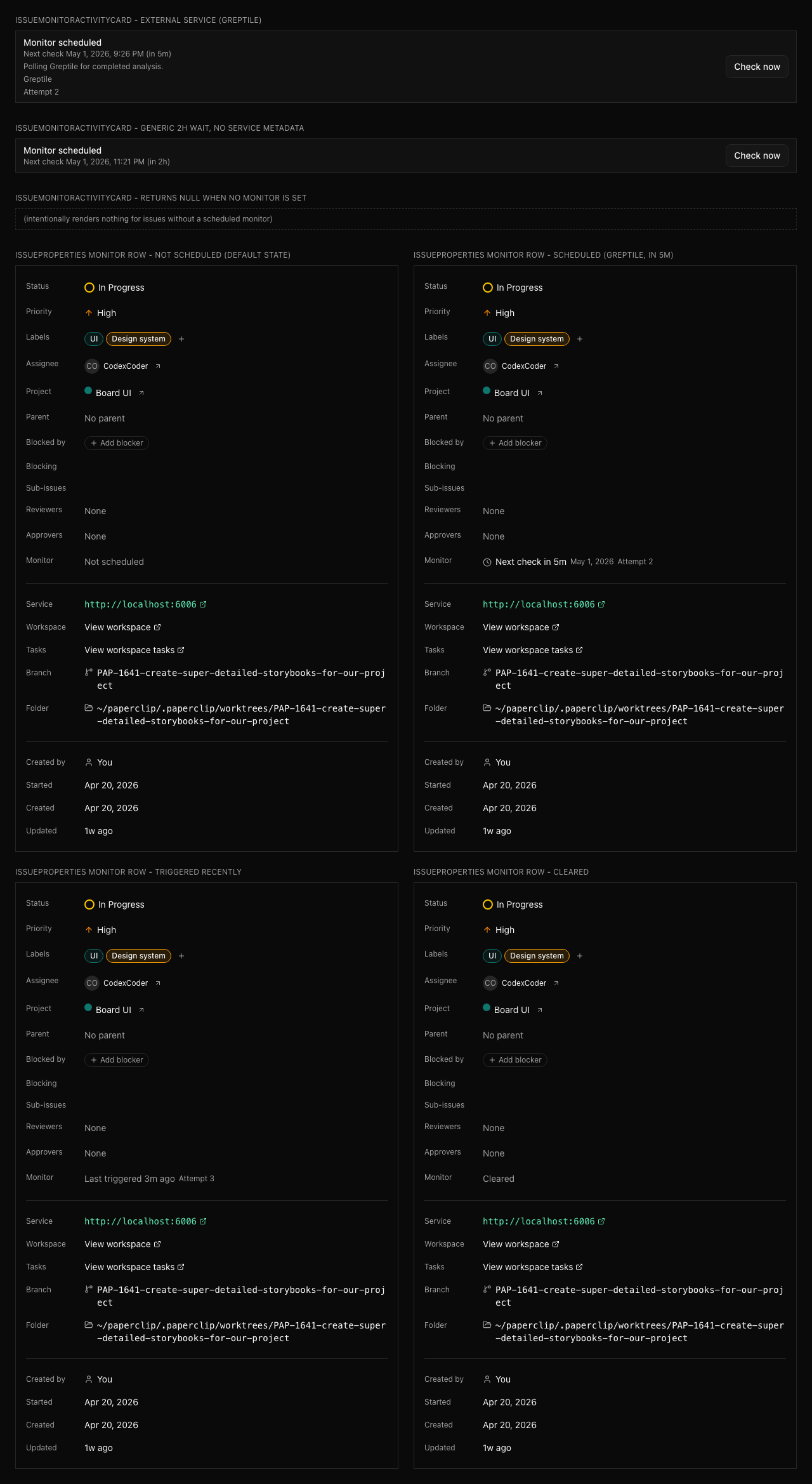
## Risks
- Medium: this changes heartbeat recovery behavior for scheduled
external-service waits, so regressions could affect wake timing or
recovery issue creation.
- Migration risk is reduced by using `IF NOT EXISTS` for the new issue
monitor columns and index.
- External monitor references are treated as secret-adjacent and are
intentionally omitted from visible activity/wake payloads.
> For core feature work, check [`ROADMAP.md`](ROADMAP.md) first and
discuss it in `#dev` before opening the PR. Feature PRs that overlap
with planned core work may need to be redirected — check the roadmap
first. See `CONTRIBUTING.md`.
## Model Used
- OpenAI Codex, GPT-5 coding agent with repository tool use and terminal
execution.
## Checklist
- [x] I have included a thinking path that traces from project context
to this change
- [x] I have specified the model used (with version and capability
details)
- [x] I have checked ROADMAP.md and confirmed this PR does not duplicate
planned core work
- [x] I have run tests locally and they pass
- [x] I have added or updated tests where applicable
- [x] If this change affects the UI, I have included before/after
screenshots or Storybook review surfaces
- [x] I have updated relevant documentation to reflect my changes
- [x] I have considered and documented any risks above
- [x] I will address all Greptile and reviewer comments before
requesting merge
---------
Co-authored-by: Paperclip <noreply@paperclip.ing>
## Thinking Path

> - Paperclip orchestrates AI agents for zero-human companies.
> - Heartbeat liveness recovery decides when stalled issue trees need
manager-visible follow-up.
> - Automatic recovery issue creation is useful, but operators need
instance-level controls for how aggressive it is.
> - Without controls, recovery behavior is harder to tune for local
development, production operations, and noisy edge cases.
> - This pull request adds configurable liveness auto-recovery settings
across shared contracts, API routes, services, and the instance
experimental settings UI.
> - The benefit is that operators can keep liveness findings advisory or
enable bounded recovery automation with explicit intervals and lookback
windows.

## What Changed

- Added shared types and validators for liveness auto-recovery settings.
- Extended instance settings routes and services to persist and validate
the new controls.
- Wired heartbeat/recovery services to honor enablement, minimum
interval, and lookback settings.
- Added UI controls for liveness recovery under instance experimental
settings.
- Covered the new server behavior with instance settings and liveness
escalation tests.

## Verification

- `pnpm exec vitest run --project @paperclipai/server
server/src/__tests__/heartbeat-issue-liveness-escalation.test.ts
server/src/__tests__/instance-settings-routes.test.ts --pool=forks
--poolOptions.forks.isolate=true`
- `pnpm --filter @paperclipai/shared typecheck`
- `pnpm --filter @paperclipai/server typecheck`
- `pnpm --filter @paperclipai/ui typecheck`

## Risks

- Moderate behavioral risk because recovery automation timing changes
when enabled; defaults keep existing advisory behavior unless the
setting is turned on.
- No database migration in this PR; settings are stored through the
existing instance settings path.

> For core feature work, check [`ROADMAP.md`](ROADMAP.md) first and
discuss it in `#dev` before opening the PR. Feature PRs that overlap
with planned core work may need to be redirected — check the roadmap
first. See `CONTRIBUTING.md`.

## Model Used

- OpenAI Codex, `gpt-5`, coding model with tool use and local command
execution; context window not exposed by the runtime.

## Checklist

- [x] I have included a thinking path that traces from project context
to this change
- [x] I have specified the model used (with version and capability
details)
- [x] I have checked ROADMAP.md and confirmed this PR does not duplicate
planned core work
- [x] I have run tests locally and they pass
- [x] I have added or updated tests where applicable
- [ ] If this change affects the UI, I have included before/after
screenshots
- [x] I have updated relevant documentation to reflect my changes
- [x] I have considered and documented any risks above
- [x] I will address all Greptile and reviewer comments before
requesting merge

---------

Co-authored-by: Paperclip <noreply@paperclip.ing>
## Thinking Path

> - Paperclip orchestrates AI agents through issue checkout, heartbeat
runs, routines, and auditable control-plane state
> - The runtime path has to recover from lost local processes, transient
adapter failures, blocked dependencies, and routine coalescing without
stranding work
> - The existing branch carried several reliability fixes across
heartbeat scheduling, issue runtime controls, routine dispatch, and
operator-facing run state
> - These changes belong together because they share backend contracts,
migrations, and runtime status semantics
> - This pull request groups the control-plane/runtime slice so it can
merge independently from board UI polish and adapter sandbox work
> - The benefit is safer heartbeat recovery, clearer runtime controls,
and more predictable recurring execution behavior

## What Changed

- Adds bounded heartbeat retry scheduling, scheduled retry state, and
Codex transient failure recovery handling.
- Tightens heartbeat process recovery, blocker wake behavior, issue
comment wake handling, routine dispatch coalescing, and
activity/dashboard bounds.
- Adds runtime-control MCP tools and Paperclip skill docs for issue
workspace runtime management.
- Adds migrations `0061_lively_thor_girl.sql` and
`0062_routine_run_dispatch_fingerprint.sql`.
- Surfaces retry state in run ledger/agent UI and keeps related shared
types synchronized.

## Verification

- `pnpm exec vitest run
server/src/__tests__/heartbeat-retry-scheduling.test.ts
server/src/__tests__/heartbeat-process-recovery.test.ts
server/src/__tests__/routines-service.test.ts`
- `pnpm exec vitest run src/tools.test.ts` from `packages/mcp-server`

## Risks

- Medium risk: this touches heartbeat recovery and routine dispatch,
which are central execution paths.
- Migration order matters if split branches land out of order: merge
this PR before branches that assume the new runtime/routine fields.
- Runtime retry behavior should be watched in CI and in local operator
smoke tests because it changes how transient failures are resumed.

> For core feature work, check [`ROADMAP.md`](ROADMAP.md) first and
discuss it in `#dev` before opening the PR. Feature PRs that overlap
with planned core work may need to be redirected — check the roadmap
first. See `CONTRIBUTING.md`.

## Model Used

- OpenAI Codex, GPT-5-based coding agent runtime, shell/git tool use
enabled. Exact hosted model build and context window are not exposed in
this Paperclip heartbeat environment.

## Checklist

- [x] I have included a thinking path that traces from project context
to this change
- [x] I have specified the model used (with version and capability
details)
- [x] I have checked ROADMAP.md and confirmed this PR does not duplicate
planned core work
- [x] I have run tests locally and they pass
- [x] I have added or updated tests where applicable
- [ ] If this change affects the UI, I have included before/after
screenshots
- [x] I have updated relevant documentation to reflect my changes
- [x] I have considered and documented any risks above
- [x] I will address all Greptile and reviewer comments before
requesting merge
## Thinking Path

> - Paperclip orchestrates AI agents for zero-human companies
> - Reliable execution depends on heartbeat routing, issue lifecycle
semantics, telemetry, and a fast enough local verification loop to keep
regressions visible
> - The remaining commits on this branch were mostly server/runtime
correctness fixes plus test and documentation follow-ups in that area
> - Those changes are logically separate from the UI-focused
issue-detail and workspace/navigation branches even when they touch
overlapping issue APIs
> - This pull request groups the execution reliability, heartbeat,
telemetry, and tooling changes into one standalone branch
> - The benefit is a focused review of the control-plane correctness
work, including the follow-up fix that restored the implicit
comment-reopen helpers after branch splitting

## What Changed

- Hardened issue/heartbeat execution behavior, including self-review
stage skipping, deferred mention wakes during active execution, stranded
execution recovery, active-run scoping, assignee resolution, and
blocked-to-todo wake resumption
- Reduced noisy polling/logging overhead by trimming issue run payloads,
compacting persisted run logs, silencing high-volume request logs, and
capping heartbeat-run queries in dashboard/inbox surfaces
- Expanded telemetry and status semantics with adapter/model fields on
task completion plus clearer status guidance in docs/onboarding material
- Updated test infrastructure and verification defaults with faster
route-test module isolation, cheaper default `pnpm test`, e2e isolation
from local state, and repo verification follow-ups
- Included docs/release housekeeping from the branch and added a small
follow-up commit restoring the implicit comment-reopen helpers that were
dropped during branch reconstruction

## Verification

- `pnpm vitest run
server/src/__tests__/issue-comment-reopen-routes.test.ts
server/src/__tests__/issue-telemetry-routes.test.ts`
- `pnpm vitest run server/src/__tests__/http-log-policy.test.ts
server/src/__tests__/heartbeat-run-log.test.ts
server/src/__tests__/health.test.ts`
- `server/src/__tests__/activity-service.test.ts`,
`server/src/__tests__/heartbeat-comment-wake-batching.test.ts`, and
`server/src/__tests__/heartbeat-process-recovery.test.ts` were attempted
on this host but the embedded Postgres harness reported
init-script/data-dir problems and skipped or failed to start, so they
are noted as environment-limited

## Risks

- Medium: this branch changes core issue/heartbeat routing and
reopen/wakeup behavior, so regressions would affect agent execution flow
rather than isolated UI polish
- Because it also updates verification infrastructure, reviewers should
pay attention to whether the new tests are asserting the right failure
modes and not just reshaping harness behavior

## Model Used

- OpenAI Codex coding agent (GPT-5-class runtime in Codex CLI; exact
deployed model ID is not exposed in this environment), reasoning
enabled, tool use and local code execution enabled

## Checklist

- [x] I have included a thinking path that traces from project context
to this change
- [x] I have specified the model used (with version and capability
details)
- [ ] I have run tests locally and they pass
- [x] I have added or updated tests where applicable
- [ ] If this change affects the UI, I have included before/after
screenshots
- [x] I have updated relevant documentation to reflect my changes
- [x] I have considered and documented any risks above
- [x] I will address all Greptile and reviewer comments before
requesting merge

---------

Co-authored-by: Paperclip <noreply@paperclip.ing>
 Dotta
Dotta
 Nicky Leach
 Devin Foley
 Nicolás Rodrigues
