## Thinking Path

> - Paperclip is the open source app people use to manage AI agents for
work.
> - The board UI is the main daily navigation surface for agents,
projects, and their related resources.
> - Operators need a lightweight way to keep frequently used agents and
projects close without changing company-wide ordering or ownership.
> - Resource memberships already model per-user relationships to
projects and agents, so they are the right place to store user-specific
starred state.
> - This pull request extends that membership contract with a starred
timestamp and exposes star controls in list/detail views.
> - The sidebar then uses those starred memberships to show compact,
user-specific shortcuts.
> - The benefit is faster navigation without introducing a separate
favorites system or leaking preferences across users.

## Linked Issues or Issue Description

No public GitHub issue exists.

Feature request:

## Problem or motivation

Users cannot pin frequently used agents or projects into the main
sidebar. Returning to important resources requires scanning full
project/agent lists or navigating through detail pages, which adds
friction to repeated daily workflows.

## Proposed solution

Store a per-user `starred_at` timestamp on agent and project
memberships, expose API actions to set or clear that state, add star
toggle controls to list/detail pages, and render starred projects and
agents as compact sidebar shortcuts.

## Alternatives considered

A separate favorites table would work, but it would duplicate membership
scoping and require another resource relationship model. Keeping starred
state on memberships preserves existing company/user boundaries and
avoids a second source of truth.

## Roadmap alignment

Checked `ROADMAP.md`; no overlapping planned core work for starred
resource/sidebar navigation was found.

## Additional context

The affected subsystems are `packages/db`, `packages/shared`, `server/`,
and `ui/`. The migration is idempotent with `IF NOT EXISTS` guards so
environments that saw an earlier local migration name can still apply
the final ordered migration safely.

## What Changed

- Added idempotent migration `0133_resource_membership_stars` for
`starred_at` columns and lookup indexes on agent/project memberships.
- Extended shared resource membership types and validators with starred
metadata and actions.
- Updated server resource membership services/routes to read and mutate
starred resource state.
- Added reusable star toggle UI and resource membership hook support for
starred state.
- Added starred projects and agents sidebar rendering, plus star
controls on list and detail pages.
- Added focused shared, server, and UI coverage for starred membership
behavior and sidebar rendering.

## Verification

- Rebased and force-with-lease pushed current PR head
`a086fc965391c9e50a51b5b83b5b44a797b2a6f4` onto current
`paperclipai/paperclip:master`; `gh pr view` reports `MERGEABLE` with no
merge conflicts. GitHub checks are green for this fresh head.
- `pnpm exec vitest run packages/shared/src/resource-memberships.test.ts
server/src/__tests__/resource-memberships-routes.test.ts
server/src/__tests__/workspace-runtime.test.ts
ui/src/components/Sidebar.test.tsx
ui/src/components/SidebarAgents.test.tsx
ui/src/components/SidebarStarredProjects.test.tsx
ui/src/components/StarToggle.test.tsx
ui/src/pages/InstanceExperimentalSettings.test.tsx` passed after the
rebase: 8 files, 143 tests.
- Greptile re-review is 5/5; the remaining screenshot thread was
resolved as non-blocking because this task explicitly requested no
screenshots/images in the PR.
- `pnpm exec vitest run
ui/src/components/SidebarStarredProjects.test.tsx` passed after the
mobile pending-spinner fix.
- `pnpm exec vitest run packages/shared/src/resource-memberships.test.ts
server/src/__tests__/resource-memberships-routes.test.ts
ui/src/components/Sidebar.test.tsx
ui/src/components/SidebarAgents.test.tsx
ui/src/components/SidebarStarredProjects.test.tsx
ui/src/components/StarToggle.test.tsx
ui/src/pages/InstanceExperimentalSettings.test.tsx` passed: 7 files, 68
tests.
- `pnpm --filter @paperclipai/db typecheck && pnpm --filter
@paperclipai/shared typecheck && pnpm --filter @paperclipai/server
typecheck && pnpm --filter @paperclipai/ui typecheck` passed
db/shared/server, then failed in pre-existing UI code outside this PR:
`src/pages/CompanyEnvironments.tsx` missing `@xterm/*` type declarations
and `previous` possibly null.
- Checked that the PR diff does not include `pnpm-lock.yaml` or
`.github/workflows` changes.
- Checked `ROADMAP.md` and found no overlapping planned core work for
starred resource/sidebar navigation.
- Searched existing GitHub PRs for duplicate starred-resource/sidebar
work and found none.

## Risks

- Migration touches membership tables. The SQL uses `IF NOT EXISTS` for
columns and indexes so environments that saw an earlier local migration
name can still apply this safely.
- Sidebar ordering and visibility changes could affect users who rely on
the previous flat sidebar layout.
- Starred state is per-user membership metadata; code paths must
continue preserving company/user scoping around memberships.

> For core feature work, check [`ROADMAP.md`](ROADMAP.md) first and
discuss it in `#dev` before opening the PR. Feature PRs that overlap
with planned core work may need to be redirected — check the roadmap
first. See `CONTRIBUTING.md`.

## Model Used

OpenAI GPT-5 Codex, tool-enabled coding agent with shell/GitHub access.
Context window not disclosed by the runtime.

## Checklist

- [x] I have included a thinking path that traces from project context
to this change
- [x] I have specified the model used (with version and capability
details)
- [x] I have checked ROADMAP.md and confirmed this PR does not duplicate
planned core work
- [x] I have searched GitHub for duplicate or related PRs and linked
them above
- [x] I have either (a) linked existing issues with `Fixes: #` / `Closes
#` / `Refs #` OR (b) described the issue in-PR following the relevant
issue template
- [x] I have not referenced internal/instance-local Paperclip issues or
links (only public GitHub `#NNN` / `github.com/paperclipai/paperclip`
URLs)
- [x] My branch name describes the change (e.g. `docs/...`, `fix/...`)
and contains no internal Paperclip ticket id or instance-derived details
- [x] I have run tests locally and they pass
- [x] I have added or updated tests where applicable
- [x] I have updated relevant documentation to reflect my changes
- [x] I have considered and documented any risks above
- [x] All Paperclip CI gates are green
- [x] Greptile is 5/5 with no open P2s, recommendations, or follow-ups
- [x] I will address all Greptile and reviewer comments before
requesting merge

---------

Co-authored-by: Paperclip <noreply@paperclip.ing>
## Thinking Path

> - Paperclip is the open source app people use to manage AI agents for
work
> - The browser UI depends on the Inter font family for its intended
visual baseline
> - The app previously referenced remote Google Fonts stylesheets at
runtime
> - That meant self-hosted, offline, or privacy-sensitive deployments
could lose the intended typography or depend on an external request
> - This pull request bundles the required Inter variable font files
with the UI and serves them from the app
> - A normal UI test now covers the static assets and CSS wiring without
adding a package script or build step
> - The benefit is a more reliable, self-contained UI that does not rely
on third-party webfont hosting

## Linked Issues or Issue Description

No public GitHub issue was found for this exact gap.

**Subsystem affected**
ui/ — React + Vite board UI

**Problem or motivation**
Paperclip's UI should ship the webfont assets it references so
production and self-hosted deployments render consistently without
reaching out to Google Fonts at runtime.

**Proposed solution**
Bundle the Inter variable font files under the UI public assets, load
them with local `@font-face` declarations, document the bundled assets,
and cover the source assets/CSS wiring with a normal UI Vitest test.

**Alternatives considered**
Keeping the remote stylesheet dependency is simpler, but leaves
deployments dependent on external font hosting. Using system fonts only
would avoid the asset footprint, but changes the intended UI typography.

**Roadmap alignment**
This is a focused UI reliability/polish fix, not a roadmap-level core
feature.

**Additional context**
Searched public GitHub issues and PRs for `webfonts
repo:paperclipai/paperclip`; no duplicates or closely related open items
were found.

## What Changed

- Added bundled Inter variable font assets and their notice under
`ui/public/fonts/`.
- Replaced remote Google Fonts imports with local `@font-face`
declarations using relative public-asset URLs that remain subpath-safe
from built CSS.
- Documented the local font asset expectation in development and UI spec
docs.
- Removed the follow-up font asset checker scripts and package/build
wiring after review feedback clarified they are not required for
building the UI.
- Added `ui/src/lib/ui-font-assets.test.ts` to verify the shipped WOFF2
files, notice text, and CSS font references through the normal UI test
suite.

## Verification

- `pnpm --filter @paperclipai/ui exec vitest run
src/lib/ui-font-assets.test.ts --config vitest.config.ts`
  - Passed.
- Confirms the bundled font files exist, are WOFF2 files, have notice
coverage, and are referenced by `ui/src/index.css`.
- `pnpm --filter @paperclipai/ui build`
  - Passed.
- Confirmed the UI still builds after removing the checker from
`ui/package.json`.
- Confirmed `ui/dist/fonts/` contains `InterVariable.woff2`,
`InterVariable-Italic.woff2`, and `NOTICE.md` after the build.
- The UI build emitted existing warnings about `::highlight(...)`, a
dynamic/static import overlap for `MarkdownEditor.tsx`, unresolved
relative public font URLs left for runtime resolution, and large chunks,
but completed successfully.

## Risks

Low risk. This adds static font assets and swaps the font source from a
remote stylesheet to same-origin files. The main tradeoff is a larger
repository/UI asset footprint from the bundled `.woff2` files.

> For core feature work, check [`ROADMAP.md`](ROADMAP.md) first and
discuss it in `#dev` before opening the PR. Feature PRs that overlap
with planned core work may need to be redirected — check the roadmap
first. See `CONTRIBUTING.md`.

## Model Used

OpenAI Codex, GPT-5-based coding agent, tool-enabled terminal/GitHub
workflow with reasoning support.

## Checklist

- [x] I have included a thinking path that traces from project context
to this change
- [x] I have specified the model used (with version and capability
details)
- [x] I have checked ROADMAP.md and confirmed this PR does not duplicate
planned core work
- [x] I have searched GitHub for duplicate or related PRs and linked
them above
- [x] I have either (a) linked existing issues with `Fixes: #` / `Closes
#` / `Refs #` OR (b) described the issue in-PR following the relevant
issue template
- [x] I have not referenced internal/instance-local Paperclip issues or
links (only public GitHub `#NNN` / `github.com/paperclipai/paperclip`
URLs)
- [x] My branch name describes the change (e.g. `docs/...`, `fix/...`)
and contains no internal Paperclip ticket id or instance-derived details
- [x] I have run tests locally and they pass
- [x] I have added or updated tests where applicable
- [x] I have updated relevant documentation to reflect my changes
- [x] I have considered and documented any risks above
- [x] All Paperclip CI gates are green
- [x] Greptile is 5/5 with no open P2s, recommendations, or follow-ups
- [x] I will address all Greptile and reviewer comments before
requesting merge

---------

Co-authored-by: Paperclip <noreply@paperclip.ing>
## Thinking Path

> - Paperclip is the open source app people use to manage AI agents for
work.
> - The board UI is where operators inspect company activity, agent
work, and issue progress.
> - Existing board views show individual issue and run details, but they
do not give operators a compact time-based picture of work across
agents.
> - A work timeline helps operators scan when agents worked, how
handoffs happened, and where overlapping work occurred.
> - This pull request adds a company-scoped Work Timeline page backed by
the existing API surface and renders the timeline as a custom SVG
Gantt-style view.
> - The benefit is faster operator understanding of multi-agent
execution without opening each issue thread individually.

## Linked Issues or Issue Description

No public GitHub issue exists for this change.

Subsystem affected:
- ui/ — React + Vite board UI

Problem or motivation:
- Operators can inspect individual issues and runs, but there is no
compact time-based view of company work across agents.
- This makes it harder to scan overlaps, handoffs, retries, and activity
windows without opening many issue threads.

Proposed solution:
- Add a company-scoped Work Timeline page in the board UI.
- Render agent and system run spans as a custom SVG Gantt-style chart
with packed overlap lanes.
- Show issue color identity, kickoff attribution, hover-revealed
delegation connectors, retry styling, zoom controls, a sticky actor
gutter, and a minimap brush.
- Keep human activity lightweight by showing human kickoff chips without
plotting standalone human event rows.

Alternatives considered:
- Add the same information to existing issue-list or run-list views.
That would preserve simpler UI, but it would not show temporal overlap
or handoff paths clearly.
- Build this as a plugin-only surface. That keeps core smaller, but the
board already has the company-scoped route, navigation, and API client
patterns needed for this operator workflow.

Roadmap alignment:
- `ROADMAP.md` does not list an existing duplicate work-timeline
milestone. This supports the broader operator visibility direction
around artifacts, enforced outcomes, and higher-autonomy execution.

Additional context:
- Storybook includes `Pages/Work Timeline` stories for hour/day zoom and
a human-activity sample so reviewers can inspect the component without a
live backend.

## What Changed

- Added the Work Timeline page, route, sidebar entry, API client, query
key, and company-prefixed route helper coverage.
- Added a pure timeline layout transform for row packing, issue colors,
kickoff attribution, connector calculation, tick selection, and duration
formatting.
- Added the custom SVG timeline chart with sticky actor gutter,
hover-revealed connectors, zoom controls, minimap brushing,
visible-range feedback, and issue navigation.
- Added Storybook coverage plus sample fixtures for the work timeline.
- Added and corrected focused UI tests covering layout, chart behavior,
routing, sidebar behavior, and collapsed-sidebar expectations.
- Addressed Greptile feedback for kickoff fallback ordering, minimap
range math, document drag listener cleanup, and stable default `now`
handling.

## Verification

- `pnpm --filter @paperclipai/ui exec vitest run
src/lib/timeline/layout.test.ts
src/components/timeline/WorkTimelineChart.test.tsx
src/pages/Timeline.test.tsx src/lib/company-routes.test.ts
src/components/Sidebar.test.tsx
src/components/RequestCollapsedSidebar.test.tsx`
- `pnpm --filter @paperclipai/ui typecheck`
- `git merge-tree $(git merge-base HEAD origin/master) HEAD
origin/master | rg -n "<<<<<<<|changed in both|CONFLICT"` returned no
conflicts.
- Attempted Storybook screenshot capture with Playwright; Storybook ran
locally, but Chromium could not launch in this container because native
browser libraries such as `libatk-1.0.so.0` are unavailable and `npx
playwright install-deps chromium` requires interactive sudo.

## Risks

- Medium UI risk: this adds a substantial visual surface with custom SVG
interaction logic, so browser-level review is still useful for
responsive behavior and usability.
- Low backend risk: this PR only adds a UI client/page around the
existing timeline API contract and does not change database schema or
server routes.

> For core feature work, check [`ROADMAP.md`](ROADMAP.md) first and
discuss it in `#dev` before opening the PR. Feature PRs that overlap
with planned core work may need to be redirected — check the roadmap
first. See `CONTRIBUTING.md`.

## Model Used

OpenAI GPT-5 via Codex coding agent, with repository file access, shell
command execution, GitHub connector access, and focused test execution.
Exact context-window details are not exposed in this runtime.

## Checklist

- [x] I have included a thinking path that traces from project context
to this change
- [x] I have specified the model used (with version and capability
details)
- [x] I have checked ROADMAP.md and confirmed this PR does not duplicate
planned core work
- [x] I have searched GitHub for duplicate or related PRs and linked
them above
- [x] I have either (a) linked existing issues with `Fixes: #` / `Closes
#` / `Refs #` OR (b) described the issue in-PR following the relevant
issue template
- [x] I have not referenced internal/instance-local Paperclip issues or
links (only public GitHub `#NNN` / `github.com/paperclipai/paperclip`
URLs)
- [x] My branch name describes the change (e.g. `docs/...`, `fix/...`)
and contains no internal Paperclip ticket id or instance-derived details
- [x] I have run tests locally and they pass
- [x] I have added or updated tests where applicable
- [x] I have updated relevant documentation to reflect my changes
- [x] I have considered and documented any risks above
- [x] All Paperclip CI gates are green
- [x] Greptile is 5/5 with no open P2s, recommendations, or follow-ups
- [x] I will address all Greptile and reviewer comments before
requesting merge

---------

Co-authored-by: Paperclip <noreply@paperclip.ing>
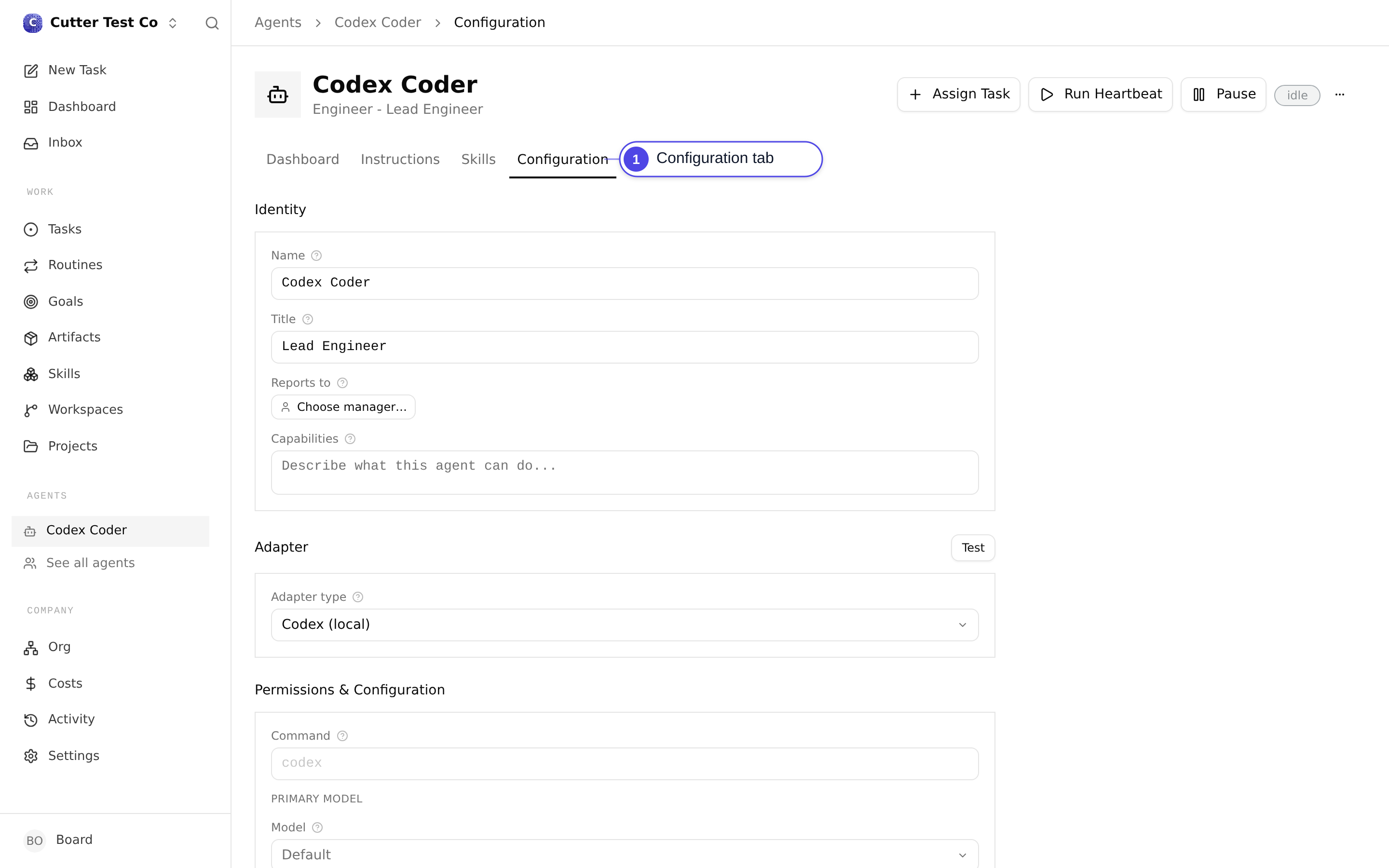
## Thinking Path

> - Paperclip is the open source app people use to manage AI agents for
work
> - When you swap an agent's adapter (e.g. from one LLM provider to
another), the server merges the incoming PATCH body with stored config —
keys listed in \`ADAPTER_AGNOSTIC_KEYS\` are preserved regardless of
which adapter is active
> - That constant was defined independently in two places:
\`server/src/agents.ts\` (used by the adapter-swap route) and
\`ui/src/lib/agent-config-patch.ts\` (used by the UI patch builder)
> - PR #8975 fixed the bug where \`paperclipSkillSync.desiredSkills\`
was dropped on adapter swap by adding it to the server-side constant,
but the UI-side copy was not updated in the same PR — creating ongoing
drift risk
> - This pull request hoists \`ADAPTER_AGNOSTIC_KEYS\` into
\`packages/shared\` so both consumers import the same constant
> - The benefit is a single source of truth: any future key addition is
made in one place and both the server route and the UI patch builder
pick it up automatically, with a drift guard to catch any accidental
re-duplication

## Linked Issues or Issue Description

Refs #8975 — follow-up deduplication: #8975 fixed the runtime bug but
left the constant duplicated across server and UI. This PR closes that
gap.

## What Changed

- Added \`ADAPTER_AGNOSTIC_KEYS\` constant and \`AdapterAgnosticKey\`
type to \`packages/shared/src/adapter-agnostic-keys.ts\`
- Updated \`server/src/agents.ts\` to import the shared constant,
removing the local copy
- Updated \`ui/src/lib/agent-config-patch.ts\` to import the shared
constant, removing the local copy
- Added \`packages/shared/src/adapter-agnostic-keys.test.ts\`: drift
guard asserting the expected key set and both consumer import sites

## Verification

\`\`\`bash
pnpm exec vitest run packages/shared/src/adapter-agnostic-keys.test.ts
ui/src/lib/agent-config-patch.test.ts
server/src/__tests__/agent-instructions-routes.test.ts
pnpm --filter @paperclipai/shared typecheck
pnpm --filter @paperclipai/server typecheck
pnpm --filter @paperclipai/ui typecheck
\`\`\`

All 15 tests pass across the three files; all three packages typecheck
clean.

## Risks

Low risk — behavior-preserving refactor. The key set is unchanged; only
the import source changes. The drift guard will fail loudly if someone
accidentally re-introduces a local copy or modifies one without updating
the other.

> For core feature work, check [\`ROADMAP.md\`](ROADMAP.md) first and
discuss it in \`#dev\` before opening the PR. Feature PRs that overlap
with planned core work may need to be redirected — check the roadmap
first. See \`CONTRIBUTING.md\`.

## Model Used

- Provider: Anthropic
- Model: Claude Sonnet 4.6 (\`claude-sonnet-4-6\`)
- Context: standard context window, tool use enabled
- Reasoning: standard mode (no extended thinking)

## Checklist

- [x] I have included a thinking path that traces from project context
to this change
- [x] I have specified the model used (with version and capability
details)
- [x] I have checked ROADMAP.md and confirmed this PR does not duplicate
planned core work
- [x] I have searched GitHub for duplicate or related PRs and linked
them above
- [x] I have either (a) linked existing issues with \`Fixes: #\` /
\`Closes #\` / \`Refs #\` OR (b) described the issue in-PR following the
relevant issue template
- [x] I have not referenced internal/instance-local Paperclip issues or
links (only public GitHub \`#NNN\` /
\`github.com/paperclipai/paperclip\` URLs)
- [ ] My branch name describes the change (e.g. \`docs/...\`,
\`fix/...\`) and contains no internal Paperclip ticket id or
instance-derived details
- [x] I have run tests locally and they pass
- [x] I have added or updated tests where applicable
- [ ] I have updated relevant documentation to reflect my changes
- [x] I have considered and documented any risks above
- [ ] All Paperclip CI gates are green
- [ ] Greptile is 5/5 with no open P2s, recommendations, or follow-ups
- [ ] I will address all Greptile and reviewer comments before
requesting merge

---------

Co-authored-by: Paperclip <noreply@paperclip.ing>
## Thinking Path

> - Paperclip is the open source app people use to manage AI agents for
work.
> - Agent runs often need provider credentials, API tokens, and other
environment-bound secrets.
> - Company-level secrets work for shared credentials, but they do not
model values that should differ by human operator.
> - Without a user-scoped model, a run can dispatch without knowing
whether the responsible human has supplied the needed value.
> - Paperclip also needs run attribution to make those user-scoped
runtime checks deterministic and auditable.
> - This pull request adds user-specific secret definitions, per-user
values, environment bindings, responsible-user attribution, and runtime
resolution gates.
> - The benefit is that teams can define the secret once, let each user
provide their own value, and block runs before dispatch when required
user secrets or active definitions are unavailable.

## Linked Issues or Issue Description

Refs #224
Refs #6057

This PR implements user-specific secret support as a core
secret-management capability rather than a one-off adapter setting. It
is related to existing public work on company secrets UI and runtime
secret refs, but is distinct because the value is owned by the
responsible user and resolved at run dispatch time.

Related PR search before opening found existing secrets work such as
#1550, #8256, #8614, #8634, and #8647; none of those add the full
user-secret definition/value/runtime gate covered here.

## What Changed

- Added user-secret definitions and per-user "My secrets" values,
keeping stored values out of access metadata.
- Added `user_secret_ref` environment bindings and UI affordances to
pick them alongside existing secret refs.
- Added responsible-user runtime resolution so user-secret refs resolve
against the human responsible for the run.
- Added pre-dispatch missing-secret gates so runs fail before adapter
dispatch when required user values are absent or definitions are
inactive.
- Added low-trust allowlist hardening for user-secret runtime access.
- Added issue, routine, run, and agent API key responsible-user
attribution and fail-closed dispatch behavior when attribution cannot be
resolved.
- Added denial-copy mapping so responsible-user authorization failures
surface as actionable run outcomes instead of opaque setup failures.
- Added OpenAPI documentation for the user-secret routes.
- Rebases cleanly on current `master`; migrations were renumbered
incrementally as `0128_user_specific_secrets`,
`0129_agent_api_key_responsible_user`, and
`0130_run_responsible_user_invariant` after upstream `0126`/`0127`
migrations.
- Removed previously committed local design screenshots so the PR
contains code/docs/tests only.

## Verification

- PASS: PR head `2527febd106bcf3ca264ca0da7fca491084192d6` is based on
`paperclipai/paperclip:master`.
- PASS: `git diff --check`
- PASS: `git diff --name-only public/master...HEAD | rg
'^(pnpm-lock\\.yaml|\\.github/workflows/|screenshots/)' || true`
produced no files.
- PASS: migration journal audit confirmed unique indexes through `130`
with tail entries `0126_issue_comment_derived_attribution`,
`0127_environment_custom_images_instance_scoped`,
`0128_user_specific_secrets`, `0129_agent_api_key_responsible_user`, and
`0130_run_responsible_user_invariant`.
- PASS: `pnpm --filter @paperclipai/ui typecheck`
- PASS: `pnpm --filter @paperclipai/server typecheck`
- PASS: `pnpm --filter @paperclipai/server exec vitest run
src/__tests__/heartbeat-responsible-user-invariant.test.ts`
- PASS: `pnpm --filter @paperclipai/server exec vitest run
src/__tests__/heartbeat-active-run-output-watchdog.test.ts
src/__tests__/heartbeat-stale-queue-invalidation.test.ts
src/__tests__/heartbeat-workspace-finalize-branch.test.ts
src/__tests__/issue-monitor-scheduler.test.ts`
- PASS: `pnpm --filter @paperclipai/server exec vitest run
src/__tests__/heartbeat-comment-wake-batching.test.ts
src/__tests__/heartbeat-retry-scheduling.test.ts
src/__tests__/heartbeat-accepted-plan-workspace-refresh.test.ts
src/__tests__/heartbeat-plugin-environment.test.ts`
- PASS: `pnpm --filter @paperclipai/server exec vitest run
src/__tests__/low-trust-red-team-routes.test.ts`
- PASS: `pnpm --filter @paperclipai/server exec vitest run
src/__tests__/secrets-service.test.ts` (55 tests)
- PASS: `pnpm vitest run server/src/__tests__/secrets-routes.test.ts
server/src/__tests__/secrets-service.test.ts` (89 tests after final
Greptile cleanup fixes)
- PASS: `pnpm --filter @paperclipai/server exec vitest run
src/__tests__/heartbeat-issue-liveness-escalation.test.ts` (17 tests
after the final rebase CI fix)
- PASS: focused server Vitest batches covering heartbeat recovery,
project env, plugin env, routines, low-trust, pipelines, monitors,
watchdog, and stale queue paths.
- PASS: GitHub checks are green on
`2527febd106bcf3ca264ca0da7fca491084192d6`, including Typecheck +
Release Registry, Build, General tests, serialized server suites, e2e,
Canary Dry Run, verify, security checks, and Greptile Review.
- PASS: Greptile Review completed successfully on
`2527febd106bcf3ca264ca0da7fca491084192d6` with Confidence Score 5/5,
and GraphQL review-thread audit returned zero unresolved non-outdated
threads.

## Risks

- Runtime behavior now depends on a run having a correct responsible
user; missing or incorrect responsibility assignment can block runs
before adapter dispatch.
- `user_secret_ref` bindings intentionally expose metadata without
values, but UI/API callers may need to handle the new binding kind
explicitly.
- External secret providers and IAM policies are not automatically
provisioned by this PR; operators still need to configure provider-side
access for non-local vaults.
- The PR is broad across db/shared/server/UI/runtime paths, so release
validation should include both API and UI secret workflows before merge.
- The migration renumbering is intentionally incremental after upstream
migrations; the branch migrations use guarded
column/table/index/constraint creation so users who tested the older
draft numbering should not hit duplicate DDL for the existing objects.

> For core feature work, check [`ROADMAP.md`](ROADMAP.md) first and
discuss it in `#dev` before opening the PR. Feature PRs that overlap
with planned core work may need to be redirected — check the roadmap
first. See `CONTRIBUTING.md`.

## Model Used

OpenAI Codex, GPT-5-based coding agent (`gpt-5`), Codex local adapter
with shell/tool use and code execution. Context window and internal
reasoning mode are not exposed by the runtime.

## Checklist

- [x] I have included a thinking path that traces from project context
to this change
- [x] I have specified the model used (with version and capability
details)
- [x] I have checked ROADMAP.md and confirmed this PR does not duplicate
planned core work
- [x] I have searched GitHub for duplicate or related PRs and linked
them above
- [x] I have either (a) linked existing issues with `Fixes: #` / `Closes
#` / `Refs #` OR (b) described the issue in-PR following the relevant
issue template
- [x] I have not referenced internal/instance-local Paperclip issues or
links (only public GitHub `#NNN` / `github.com/paperclipai/paperclip`
URLs)
- [x] My branch name describes the change (e.g. `docs/...`, `fix/...`)
and contains no internal Paperclip ticket id or instance-derived details
- [x] I have run tests locally and they pass
- [x] I have added or updated tests where applicable
- [x] I have updated relevant documentation to reflect my changes
- [x] I have considered and documented any risks above
- [x] All Paperclip CI gates are green
- [x] Greptile is 5/5 with no open P2s, recommendations, or follow-ups
- [x] I will address all Greptile and reviewer comments before
requesting merge

---------

Co-authored-by: Paperclip <noreply@paperclip.ing>
Co-authored-by: Claude Opus 4.8 <noreply@anthropic.com>
## Thinking Path
> - Paperclip is the open source app people use to manage AI agents for
work
> - Each agent runs on an adapter (`claude_local`, `codex_local`, …) and
can be assigned company skills that are synced into its runtime
> - An agent's desired-skill selection is persisted inside its single
`adapterConfig` JSON blob under `paperclipSkillSync`, even though the
selection is a company-level, adapter-agnostic choice
> - When a user changes an agent's adapter type, both the server PATCH
handler and the UI patch builder rebuild `adapterConfig` and carry over
only a hardcoded allow-list of adapter-agnostic keys (`env`, `cwd`,
instructions bundle, …)
> - `paperclipSkillSync` was missing from both allow-lists, so switching
adapters (e.g. claude_local → codex_local) silently wiped every assigned
skill
> - This pull request adds `paperclipSkillSync` to the adapter-agnostic
preservation list on both layers and covers it with regression tests
> - The benefit is that switching an agent's adapter no longer destroys
its skill configuration — skills are preserved exactly like
env/cwd/instructions already are
## Linked Issues or Issue Description
Fixes#8974
## What Changed
- **Server (authoritative fix)** — `server/src/routes/agents.ts`: added
`"paperclipSkillSync"` to the `ADAPTER_AGNOSTIC_KEYS` list in the
`changingAdapterType` branch of `PATCH /agents/:id`. On an adapter-type
change the handler now restores the skill-sync selection from the
existing persisted config when the incoming config omits it — the same
mechanism already used for `env`, `cwd`, and the instructions bundle.
This protects every API/CLI client, not just the UI.
- **UI (defense in depth)** — `ui/src/lib/agent-config-patch.ts`: added
`"paperclipSkillSync"` to the client-side `ADAPTER_AGNOSTIC_KEYS` in
`buildAgentUpdatePatch`, so the optimistic patch the client builds on an
adapter switch stops stripping the key before it reaches the server.
- **Tests** — added regression tests on both layers:
- `server/src/__tests__/agent-instructions-routes.test.ts`: `PATCH`ing
`adapterType` (claude_local → codex_local) with `replaceAdapterConfig:
true` keeps `adapterConfig.paperclipSkillSync`.
- `ui/src/lib/agent-config-patch.test.ts`: `buildAgentUpdatePatch`
preserves `paperclipSkillSync` when the overlay changes the adapter
type.
## Verification
```
# server (run from repo root)
cd server && ../node_modules/.bin/vitest run \
src/__tests__/agent-instructions-routes.test.ts \
src/__tests__/agent-skills-routes.test.ts \
src/__tests__/agent-adapter-validation-routes.test.ts \
src/__tests__/agent-permissions-routes.test.ts
# 83 passed
../node_modules/.bin/tsc --noEmit -p tsconfig.json # clean
# ui
cd ui && ./node_modules/.bin/vitest run src/lib/agent-config-patch.test.ts # 7 passed
pnpm --filter @paperclipai/ui typecheck # clean
```
Both new tests fail without the corresponding source change (verified
red → green).
Manual: create an agent on `claude_local`, assign skills, switch it to
`codex_local`, and confirm `GET /api/agents/:id/skills` still returns
the desired skills.
## Risks
Low risk.
- The change only *adds* one key to an existing preservation allow-list;
it does not alter how any other key is handled. Behavior for agents
without a `paperclipSkillSync` block is unchanged (the key is simply
absent and nothing is copied).
- `paperclipSkillSync` is adapter-agnostic (company skill keys, not
adapter-specific), so carrying it across an adapter switch is always
safe — a target adapter that does not support skill sync just ignores
it, and switching back restores the selection.
- Same-adapter config edits already merged and preserved the key; this
only closes the adapter-type-change gap, matching the existing
env/cwd/instructions behavior.
- Follow-up (not in this PR to keep it minimal): the server and client
`ADAPTER_AGNOSTIC_KEYS` lists are maintained separately and already
diverge (`instructionsFilePath` is client-only); a shared constant could
prevent future drift.
## Model Used
Claude Opus 4.8 (`claude-opus-4-8`, 1M-token context), extended thinking
enabled, with tool use (file edit, shell, GitHub CLI) via Claude Code. A
read-only sub-agent was used to trace the root cause across the server
and UI layers.
## Checklist
- [x] I have included a thinking path that traces from project context
to this change
- [x] I have specified the model used (with version and capability
details)
- [x] I have checked ROADMAP.md and confirmed this PR does not duplicate
planned core work (bug fix, not a feature)
- [x] I have searched GitHub for duplicate or related PRs and linked
them above (none found)
- [x] I have either (a) linked existing issues with `Fixes: #` / `Closes
#` / `Refs #` OR (b) described the issue in-PR following the relevant
issue template
- [x] I have not referenced internal/instance-local Paperclip issues or
links (only public GitHub `#NNN` / `github.com/paperclipai/paperclip`
URLs)
- [x] My branch name describes the change
(`fix/preserve-skills-on-adapter-type-switch`) and contains no internal
Paperclip ticket id or instance-derived details
- [x] I have run tests locally and they pass
- [x] I have added or updated tests where applicable
- [x] I have updated relevant documentation to reflect my changes (N/A —
internal config-preservation fix, no user-facing docs or API contract
change)
- [x] I have considered and documented any risks above
- [ ] All Paperclip CI gates are green (pending CI on this PR)
- [ ] Greptile is 5/5 with no open P2s, recommendations, or follow-ups
(pending review)
- [x] I will address all Greptile and reviewer comments before
requesting merge
## Thinking Path

> - Paperclip is the open source app people use to manage AI agents for
work.
> - The agent detail page is where operators inspect heartbeat runs and
watch live execution output.
> - Heartbeat runs can publish progress events while longer operations
are happening.
> - The live log viewer already appended streamed log and structured run
events, but it ignored progress events for the same run.
> - That made useful progress text invisible in the run log until
another event type arrived or the operator inspected other surfaces.
> - This pull request renders run progress events as system log lines in
the live agent run viewer.
> - The benefit is clearer live feedback during long-running heartbeat
operations without changing the backend event contract.

## Linked Issues or Issue Description

No public GitHub issue exists, so this PR describes the issue inline
following the bug report template.

### What happened

The agent detail run log subscribed to company live events and handled
`heartbeat.run.log` plus structured `heartbeat.run.event` payloads, but
it ignored `heartbeat.run.progress` events for the active run.

### Expected behavior

When a heartbeat run emits a progress message, the active run log should
show that message immediately as operator-visible system output.

### Steps to reproduce

1. Open an agent detail page for a live heartbeat run.
2. Trigger a run operation that emits `heartbeat.run.progress` events
with a `message` and optional `phase`.
3. Watch the live log viewer.

Before this change, the progress event was ignored by the log viewer.
After this change, it appears as a system log line, prefixed by
`[phase]` when a phase is present.

### Paperclip version / deployment mode

Current `master`; local development and normal board UI deployments.

### Related work search

Searched public GitHub issues and PRs in `paperclipai/paperclip` for
`heartbeat.run.progress AgentDetail` and `run progress log viewer`; no
duplicate issue or PR was found.

## What Changed

- Added live handling for `heartbeat.run.progress` events in
`AgentDetail`'s run `LogViewer`.
- Render progress messages as `system` log lines for the matching run.
- Include the optional progress phase in the displayed line as `[phase]
message`.
- Prefer the event's `updatedAt` timestamp when provided, falling back
to the live event timestamp.
- Added a replay key for progress log lines so WebSocket reconnect
replay does not duplicate the same rendered progress line.
- Added focused formatter/key tests covering phased progress, unphased
progress, empty messages, and replay-key output.

### Visual output example

The rendered log text is covered by the new formatter test:

```text
[workspace] Syncing issue history
Preparing workspace
```

No layout or styling changes are included; this PR only makes existing
log-line UI receive one more live event type.

## Verification

- `pnpm install --frozen-lockfile` — completed; emitted non-fatal
bin-link warnings for the unbuilt plugin SDK dev CLI.
- `pnpm --filter @paperclipai/ui typecheck` — passed.
- `pnpm --filter @paperclipai/ui exec vitest run
src/pages/AgentDetail.progress.test.ts
src/context/LiveUpdatesProvider.test.ts` — passed, 2 files / 26 tests.
- `git diff --check` — passed.
- Local sensitive-content scan over the PR diff using patterns for API
keys, tokens, secrets, passwords, auth headers, private keys,
localhost/private paths, internal ticket ids, agent links, and tailnet
markers — no findings.

## Risks

Low risk. This is a UI-only live-event handling change for an existing
event type. The replay guard is intentionally scoped to progress lines
and uses the rendered timestamp, stream, and chunk as the key, so
repeated progress events with distinct timestamps or messages still
appear.

> For core feature work, check [`ROADMAP.md`](ROADMAP.md) first and
discuss it in `#dev` before opening the PR. Feature PRs that overlap
with planned core work may need to be redirected — check the roadmap
first. See `CONTRIBUTING.md`.

## Model Used

OpenAI Codex, GPT-5 coding agent with repository tool use, shell
execution, GitHub CLI access, and local test execution. Context window
size was not exposed in this runtime.

## Checklist

- [x] I have included a thinking path that traces from project context
to this change
- [x] I have specified the model used (with version and capability
details)
- [x] I have checked ROADMAP.md and confirmed this PR does not duplicate
planned core work
- [x] I have searched GitHub for duplicate or related PRs and linked
them above
- [x] I have either (a) linked existing issues with `Fixes: #` / `Closes
#` / `Refs #` OR (b) described the issue in-PR following the relevant
issue template
- [x] I have not referenced internal/instance-local Paperclip issues or
links (only public GitHub `#NNN` / `github.com/paperclipai/paperclip`
URLs)
- [x] My branch name describes the change (e.g. `docs/...`, `fix/...`)
and contains no internal Paperclip ticket id or instance-derived details
- [x] I have run tests locally and they pass
- [x] I have added or updated tests where applicable
- [x] I have updated relevant documentation to reflect my changes
- [x] I have considered and documented any risks above
- [x] All Paperclip CI gates are green
- [x] Greptile is 5/5 with no open P2s, recommendations, or follow-ups
- [x] I will address all Greptile and reviewer comments before
requesting merge

---------

Co-authored-by: Paperclip <noreply@paperclip.ing>
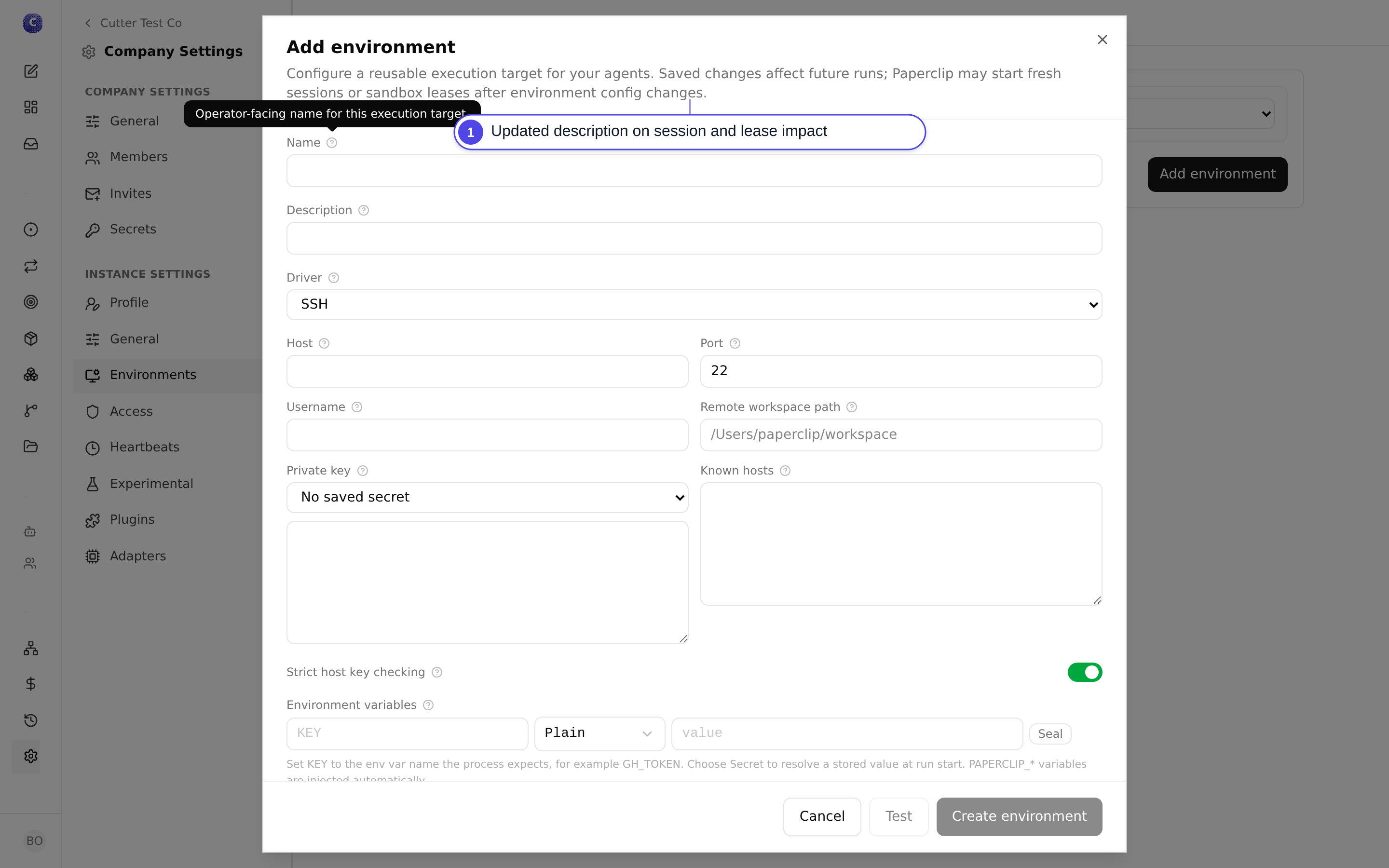
## Thinking Path

> - Paperclip is the open source app people use to manage AI agents for
work.
> - Environment sandboxes already support custom image creation and
refresh through a temporary SSH setup session.
> - The existing workflow makes operators copy an SSH command into an
external terminal before they can install packages or make image
changes.
> - That extra context switch is slower, easier to get wrong, and less
integrated with the setup session Paperclip already tracks.
> - This pull request adds an embedded browser SSH terminal for custom
image setup, so operators can start working in the target sandbox
directly from the environment configuration flow.
> - The implementation uses short-lived websocket attachment tokens,
session-lifetime SSH host-key pinning, and server-managed terminal
cleanup so the feature fits the existing setup-session boundary.
> - The benefit is a smoother custom image creation and refresh
experience without asking users to leave Paperclip for routine sandbox
setup work.

## Linked Issues or Issue Description

No public GitHub issue exists.

### Subsystem affected

Cross-cutting: `server/` custom image setup APIs and websocket handling,
`ui/` environment configuration UI, and shared custom image contracts.

### Problem or motivation

Custom image creation and refresh require an operator to open a separate
SSH client, paste the command shown by Paperclip, perform setup work,
then return to the browser to finish the image flow. This is functional
but awkward for a setup process that already starts and tracks a
temporary sandbox session.

### Proposed solution

Embed an SSH terminal in the custom image setup UI. When a setup session
exposes an SSH payload, Paperclip should open a browser terminal backed
by a server-side websocket session, let the operator run setup commands
in-place, and then close the terminal when setup is finished, cancelled,
expired, or disconnected.

### Alternatives considered

- Keep the existing copy/paste SSH command workflow. This remains a
fallback, but it does not streamline the common path.
- Put SSH credentials directly into websocket URLs. This was avoided so
terminal authentication can happen in an explicit first websocket auth
frame rather than in logged URLs.
- Trust the SSH host blindly for every reconnect. This PR instead pins
the observed host-key fingerprint for the setup-session lifetime.

### Roadmap alignment

This fits the roadmap theme of making agent workspaces usable in more
remote and sandboxed environments while preserving Paperclip's
control-plane model.

### Additional context

Public GitHub search did not find a duplicate issue or PR for `custom
image terminal ssh` in `paperclipai/paperclip`.

## What Changed

- Added server-side terminal session tracking for custom image setup
sessions, including connect-token issuance, websocket attachment,
expiry, resize, input, and shutdown handling.
- Added an embedded browser terminal to the custom image creation and
refresh flow when a setup session provides SSH connection details.
- Moved terminal token authentication out of the websocket URL and into
the first websocket JSON auth frame.
- Added SSH host-key SHA-256 pinning for each terminal session and
documented the provider convention for username-embedded SSH
credentials.
- Updated the custom image environment API and UI so the setup terminal
can open, reconnect, show status, authenticate, resize, and remain
active for the setup-session lifetime once attached.
- Kept custom image setup routes company-scoped and closed active
terminal sessions on setup finish/cancel.
- Added focused unit/integration/UI coverage for token expiry,
setup-session expiry, websocket close paths, host-key pinning, and
terminal session lifecycle behavior.
- Removed the generated lockfile delta from the PR; CI owns temporary
lockfile regeneration for manifest-changing PRs.

## Verification

- `pnpm exec vitest run
server/src/__tests__/server-startup-feedback-export.test.ts
server/src/__tests__/environment-custom-image-terminal-ws.test.ts
server/src/services/environment-custom-image-terminal-sessions.test.ts
server/src/__tests__/environment-custom-image-routes.test.ts
packages/shared/src/environment-custom-images.test.ts
ui/src/pages/CompanyEnvironments.test.tsx`
  - 6 test files passed
  - 58 tests passed
- `pnpm --filter @paperclipai/server typecheck`
- `pnpm --filter @paperclipai/ui typecheck`
- `pnpm --filter @paperclipai/server build`
- `pnpm --filter @paperclipai/ui build`
- `pnpm run typecheck:build-gaps`
- `git diff --check`
- Local sensitive-content scan over the PR diff using patterns for API
keys, private keys, private hostnames, local paths, token fields, and
credential-like strings.
- Findings were limited to removed URL-token code and synthetic test
placeholders such as `ssh-token-secret` and
`terminal-token-terminal-token-123456`.
- No real credentials, private hostnames, local filesystem paths, or
instance-local links were found.
- Remote PR checks were green after the implementation commit, including
Build, Typecheck + Release Registry, General tests, serialized server
suites, e2e, verify, Socket, Snyk, Superagent, and Greptile 5/5.
- Post-merge PR hardening on July 3, 2026: merged `origin/master` at
`47448721e` into the branch, resolved the `CompanyEnvironments.tsx`
import conflict, reran focused tests, server/UI typechecks, server/UI
builds, `pnpm run typecheck:build-gaps`, and `git diff --check`, scanned
the final diff for sensitive content, pushed `4b43558cc`, and confirmed
all remote checks plus Greptile 5/5 were green.
- PR metadata correction on July 3, 2026: changed the title/body framing
from bug-fix language to feature-request language. No source files
changed for this metadata-only update.

## Risks

- Moderate surface area because this adds websocket routing,
setup-session runtime state, package dependencies, and a new custom
image UI path.
- New websocket attachments still require valid short-lived tokens;
established terminal sessions remain bounded by setup-session expiry,
explicit finish/cancel, client close, or server shutdown.
- The terminal-session store is in-memory, so active terminal websocket
tokens and host-key pins do not survive server restarts.
- SSH host-key verification uses session-lifetime TOFU pinning because
the current provider payload does not expose a trusted host-key
fingerprint.
- The external SSH command remains important as a fallback if a browser,
proxy, or network environment cannot sustain the websocket terminal.

> For core feature work, check [`ROADMAP.md`](ROADMAP.md) first and
discuss it in `#dev` before opening the PR. Feature PRs that overlap
with planned core work may need to be redirected — check the roadmap
first. See `CONTRIBUTING.md`.

## Model Used

OpenAI Codex, GPT-5 coding agent with shell/tool execution. Context
window size was not exposed in this runtime.

## Checklist

- [x] I have included a thinking path that traces from project context
to this change
- [x] I have specified the model used (with version and capability
details)
- [x] I have checked ROADMAP.md and confirmed this PR does not duplicate
planned core work
- [x] I have searched GitHub for duplicate or related PRs and linked
them above
- [x] I have either (a) linked existing issues with `Fixes: #` / `Closes
#` / `Refs #` OR (b) described the issue in-PR following the relevant
issue template
- [x] I have not referenced internal/instance-local Paperclip issues or
links (only public GitHub `#NNN` / `github.com/paperclipai/paperclip`
URLs)
- [x] My branch name describes the change (e.g. `docs/...`, `fix/...`)
and contains no internal Paperclip ticket id or instance-derived details
- [x] I have run tests locally and they pass
- [x] I have added or updated tests where applicable
- [x] I have updated relevant documentation to reflect my changes
- [x] I have considered and documented any risks above
- [x] All Paperclip CI gates are green
- [x] Greptile is 5/5 with no open P2s, recommendations, or follow-ups
- [x] I will address all Greptile and reviewer comments before
requesting merge

---------

Co-authored-by: Paperclip <noreply@paperclip.ing>
## Thinking Path

> - Paperclip is the open source app people use to manage AI agents for
work.
> - The issue details sidebar is a high-traffic operator surface for
scanning task state, ownership, policy, relationships, and external
references.
> - The previous properties pane mixed too much behavior in one large
component and several rows could overflow or become hard to scan with
long labels and relation lists.
> - The UI needed a narrower, more reusable structure so compact
property rows, relation pills, external URL rows, and picker triggers
behave consistently.
> - This pull request splits the properties pane into focused helper
modules and tightens the pane's layout, truncation, popover, and
overflow behavior.
> - The benefit is a denser, more stable properties pane that stays
usable when issues have long titles, many relationships, external URLs,
or execution policy IDs.

## Linked Issues or Issue Description

No public issue exists for this work. I searched GitHub issues and PRs
for `IssueProperties properties pane`; there was no duplicate issue and
the matching PRs were unrelated test stabilization or other work.

### Problem or motivation

The board issue details properties pane is a frequent operator workflow
surface, but it was implemented as one large component and several rows
could become hard to scan with long labels, many relationships, external
URLs, or execution policy IDs.

### Proposed solution

Split the properties pane into focused modules, tighten compact row
layout and truncation behavior, add bounded previews with explicit
expansion controls for long relation and URL lists, and make execution
policy ID generation work on insecure origins as well as normal browser
origins.

### Alternatives considered

A smaller patch inside the existing monolithic component would fix
individual overflow symptoms, but it would keep related primitives,
picker behavior, relation controls, and external URL rendering tangled
in one file. The split keeps the behavior easier to test and review
without changing public APIs.

### Roadmap alignment

This is an incremental UI quality improvement to the existing board task
details surface. I checked `ROADMAP.md` and did not find overlapping
planned core feature work.

## What Changed

- Split the issue properties pane into focused modules for helpers,
primitives, relation controls, property pickers, and external object
rows.
- Cleaned up row spacing, truncation, picker trigger alignment, scroll
behavior, status color coverage, and long-value titles.
- Added bounded previews and expand/collapse controls for blocking,
sub-task, related-task, and external URL lists.
- Fixed execution policy ID generation so insecure origins fall back to
a stable base URL instead of throwing.
- Updated Storybook issue-management stories and expanded unit coverage
for the new properties pane behavior.

## Verification

- `git diff --check origin/master..HEAD`
- `pnpm --filter @paperclipai/ui exec vitest run
src/components/IssueProperties.test.tsx` — 38 tests passed

## Risks

Low to moderate risk. The changes are UI-only, but they touch a
frequently used task details surface. The main risk is a subtle layout
regression in an untested viewport or issue shape; the branch adds
targeted coverage for long relation and external URL lists.

> For core feature work, check [`ROADMAP.md`](ROADMAP.md) first and
discuss it in `#dev` before opening the PR. Feature PRs that overlap
with planned core work may need to be redirected — check the roadmap
first. See `CONTRIBUTING.md`.

## Model Used

OpenAI GPT-5 Codex coding agent with repository tool use, shell
execution, GitHub CLI access, and local test execution. Context window
size was not exposed in this runtime.

## Checklist

- [x] I have included a thinking path that traces from project context
to this change
- [x] I have specified the model used (with version and capability
details)
- [x] I have checked ROADMAP.md and confirmed this PR does not duplicate
planned core work
- [x] I have searched GitHub for duplicate or related PRs and linked
them above
- [x] I have either (a) linked existing issues with `Fixes: #` / `Closes
#` / `Refs #` OR (b) described the issue in-PR following the relevant
issue template
- [x] I have not referenced internal/instance-local Paperclip issues or
links (only public GitHub `#NNN` / `github.com/paperclipai/paperclip`
URLs)
- [x] My branch name describes the change (e.g. `docs/...`, `fix/...`)
and contains no internal Paperclip ticket id or instance-derived details
- [x] I have run tests locally and they pass
- [x] I have added or updated tests where applicable
- [x] I have updated relevant documentation to reflect my changes
- [x] I have considered and documented any risks above
- [x] All Paperclip CI gates are green
- [x] Greptile is 5/5 with no open P2s, recommendations, or follow-ups
- [x] I will address all Greptile and reviewer comments before
requesting merge

---------

Co-authored-by: Paperclip <noreply@paperclip.ing>
Co-authored-by: Claude Opus 4.8 <noreply@anthropic.com>
## Thinking Path

> - Paperclip is the open source control plane people use to manage AI
agents for work.
> - Environment variables and secrets sit in the configuration surfaces
that let agents, projects, routines, and company environments run with
the right runtime inputs.
> - The previous editor was a single legacy component with cramped row
behavior, weak secret conversion affordances, and duplicated handling
across several call sites.
> - Operators need a clearer editor that handles text values, secret
references, draft rows, and sensitive-value warnings consistently
wherever environment variables are configured.
> - This pull request replaces the legacy editor with a reusable
environment variables editor and migrates the existing configuration
surfaces to it.
> - The benefit is a more reliable editing workflow with targeted test
coverage around row state, dotenv parsing, secret selection, and
affected page integrations.

## Linked Issues or Issue Description

No public GitHub issue exists, so this PR describes the issue inline
following the feature request template.

### Subsystem affected

ui/ — React + Vite board UI

### Problem or motivation

Environment variables are edited in several Paperclip configuration
surfaces, including agent config, project properties, stage secrets,
routine sections, company environments, and company settings. The legacy
editor made common operator work difficult: rows could feel cramped,
secret conversion was inconsistent, draft rows and imported dotenv data
were easy to mishandle, and sensitive-value warnings did not have a
consistent place in the workflow.

### Proposed solution

Introduce a reusable environment variables editor component that
consistently supports text values, secret references, draft rows, dotenv
import parsing, sensitive-value hints, secret picking, secret creation,
and conversion to stored secrets. Migrate the existing
environment-variable call sites to the shared editor so behavior and
tests live in one component family.

### Alternatives considered

Keeping the existing `EnvVarEditor` and patching individual call sites
would preserve duplication and leave each surface responsible for its
own row and secret handling. This PR instead centralizes the behavior so
future fixes cover all migrated surfaces.

### Roadmap alignment

Checked `ROADMAP.md`; this does not duplicate a named roadmap item. It
supports the existing local-first and deployment-oriented product
direction by improving the UI where operators configure runtime
environment values.

### Additional context

The PR includes targeted tests for the editor model, dotenv parsing,
sensitive-value detection, component behavior, affected page
integrations, and Greptile review regressions around external saves and
bulk import immutability.

## What Changed

- Replaced the legacy `EnvVarEditor` with a reusable
`environment-variables-editor` component family.
- Added editor model helpers for draft rows, dotenv parsing,
sensitive-value detection, secret picking, secret creation, and
conversion to secret references.
- Migrated agent config, project properties, stage secrets, routine
editable sections, company environments, company settings, design guide
examples, and Storybook stories to the new editor.
- Added targeted tests for the editor model, parsing, sensitive-value
detection, component behavior, and affected company environment/settings
integrations.
- Fixed the company settings test harness to use the repo’s
`flushSync`-based React test helper pattern under the current React
build.
- Addressed Greptile feedback by flushing pending editor drafts before
enclosing form submits or external save-button clicks, cloning
bulk-import rows before mutation, and deferring the overflow
store-as-secret popover open path.

## Verification

- `pnpm exec vitest run
ui/src/components/environment-variables-editor/EnvironmentVariablesEditor.test.tsx
ui/src/pages/CompanyEnvironments.test.tsx
ui/src/components/AgentConfigForm.render.test.tsx` — passed, 3 files /
40 tests.
- Earlier focused Vitest coverage for model, dotenv parsing, sensitive
detection, company environments, and company settings passed, 6 files /
78 tests.
- `pnpm --filter @paperclipai/ui typecheck` — passed.
- GitHub PR checks on head `0aa49c6f8afed1f62d9e26da07fc466fbf299850` —
passed; CI checks green, security review neutral, Greptile check
success.
- Greptile review — 5/5 confidence on head
`0aa49c6f8afed1f62d9e26da07fc466fbf299850`; 0 unresolved review threads.

## Risks

- Medium UI risk: several environment-variable entry surfaces now share
the new editor, so regressions could affect multiple configuration
workflows at once.
- Secret conversion, draft-row behavior, external save flushing, and
bulk import behavior are covered by targeted tests, but reviewer
attention should still focus on manual editing flows, focus retention,
and save/cancel affordances.
- No database or API contract changes.

> For core feature work, check [`ROADMAP.md`](ROADMAP.md) first and
discuss it in `#dev` before opening the PR. Feature PRs that overlap
with planned core work may need to be redirected — check the roadmap
first. See `CONTRIBUTING.md`.

## Model Used

- OpenAI Codex, GPT-5-based coding agent with tool use and local command
execution; medium reasoning mode. Exact context-window metadata is not
exposed in this runtime.

## Checklist

- [x] I have included a thinking path that traces from project context
to this change
- [x] I have specified the model used (with version and capability
details)
- [x] I have checked ROADMAP.md and confirmed this PR does not duplicate
planned core work
- [x] I have searched GitHub for duplicate or related PRs and linked
them above
- [x] I have either (a) linked existing issues with `Fixes: #` / `Closes
#` / `Refs #` OR (b) described the issue in-PR following the relevant
issue template
- [x] I have not referenced internal/instance-local Paperclip issues or
links (only public GitHub `#NNN` / `github.com/paperclipai/paperclip`
URLs)
- [x] My branch name describes the change (e.g. `docs/...`, `fix/...`)
and contains no internal Paperclip ticket id or instance-derived details
- [x] I have run tests locally and they pass
- [x] I have added or updated tests where applicable
- [x] I have updated relevant documentation to reflect my changes
- [x] I have considered and documented any risks above
- [x] All Paperclip CI gates are green
- [x] Greptile is 5/5 with no open P2s, recommendations, or follow-ups
- [x] I will address all Greptile and reviewer comments before
requesting merge

---------

Co-authored-by: Claude Opus 4.8 <noreply@anthropic.com>
Co-authored-by: Paperclip <noreply@paperclip.ing>
## Thinking Path

> - Paperclip is the open source app people use to manage AI agents for
work
> - A core part of that experience is watching active agent runs without
dropping into raw logs first
> - Local and sandbox-backed adapters already record useful run output,
progress, and tool activity
> - But active issue threads could sit visually stale while the agent
was syncing workspaces, tailing sandbox output, or emitting incremental
tool-call updates
> - Operators need timely, human-readable progress while preserving the
raw transcript underneath
> - This pull request streams sandbox run-log progress into runtime
status, keeps visible issue threads refreshed, and folds repeated ACPX
tool updates into stable transcript cards
> - The benefit is that long-running agent work becomes easier to
supervise without changing the task/comment control-plane model

## Linked Issues or Issue Description

No public GitHub issue exists for this exact change.

Problem/motivation:

- During long-running sandboxed agent work, the issue UI can appear idle
even though the agent is actively syncing, running tools, or producing
incremental output.
- Operators need realtime feedback at the issue-thread layer, not only
after opening raw logs or waiting for the final heartbeat result.
- Related public context: #1808 previously added live-run status dots to
Projects; #4362 touches heartbeat wakeup behavior but is not a duplicate
of this runtime/UI feedback change.

## What Changed

- Added sandbox run-log streaming support and defaulted sandbox-capable
local adapters into the richer live-feedback path.
- Surfaced environment/sandbox sync progress through heartbeat runtime
status with bounded, redacted snippets.
- Added live issue-thread cache patching so visible active runs update
as progress events arrive.
- Folded repeated ACPX `tool_call` updates into one transcript card
instead of stacking duplicate cards.
- Updated adapter docs and added focused regression coverage for sandbox
log streaming, runtime status, ACPX parsing, live updates, transcript
rendering, and issue chat messages.

## Verification

- `pnpm install --frozen-lockfile`
- `pnpm exec vitest run ui/src/context/LiveUpdatesProvider.test.ts`
- `pnpm exec vitest run
server/src/services/heartbeat-run-runtime-status.test.ts
server/src/__tests__/heartbeat-runtime-state.test.ts
ui/src/context/LiveUpdatesProvider.test.ts`
- `pnpm exec vitest run
packages/adapter-utils/src/execution-target-sandbox.test.ts
packages/adapter-utils/src/sandbox-managed-runtime.test.ts
server/src/services/heartbeat-run-runtime-status.test.ts
server/src/__tests__/agent-live-run-routes.test.ts
server/src/__tests__/heartbeat-runtime-state.test.ts
packages/adapters/acpx-local/src/ui/parse-stdout.test.ts
ui/src/context/LiveUpdatesProvider.test.ts
ui/src/components/transcript/RunTranscriptView.test.tsx
ui/src/lib/issue-chat-messages.test.ts
ui/src/components/IssueChatThread.test.tsx`
- GitHub PR workflow on head `8397953e7b41ccd42e5d9457ee7e4dfb996e4ec5`:
`verify`, build, typecheck/release-registry, e2e, general shards,
serialized server shards, and canary dry run passed.
- Greptile Review on head `8397953e7b41ccd42e5d9457ee7e4dfb996e4ec5`:
Confidence Score 5/5, no unresolved review threads.

## Risks

- Live issue-thread cache patching could miss an edge case for a route
shape not covered by tests.
- Surfacing active-run snippets needs continued care around redaction;
this PR keeps snippets bounded and adds redaction-focused coverage.
- More frequent active-run UI refreshes could expose performance issues
on very large issue threads, though updates are scoped to visible
run/query caches.

## Model Used

OpenAI GPT-5 via Codex, operating as a tool-enabled coding agent with
shell, git, and repository-editing capabilities. Context window size is
not exposed in this runtime.

## Checklist

- [x] I have included a thinking path that traces from project context
to this change
- [x] I have specified the model used (with version and capability
details)
- [x] I have checked ROADMAP.md and confirmed this PR does not duplicate
planned core work
- [x] I have searched GitHub for duplicate or related PRs and linked
them above
- [x] I have either (a) linked existing issues with `Fixes: #` / `Closes
#` / `Refs #` OR (b) described the issue in-PR following the relevant
issue template
- [x] I have not referenced internal/instance-local Paperclip issues or
links (only public GitHub `#NNN` / `github.com/paperclipai/paperclip`
URLs)
- [x] My branch name describes the change (e.g. `docs/...`, `fix/...`)
and contains no internal Paperclip ticket id or instance-derived details
- [x] I have run tests locally and they pass
- [x] I have added or updated tests where applicable
- [x] I have updated relevant documentation to reflect my changes
- [x] I have considered and documented any risks above
- [x] All Paperclip CI gates are green
- [x] Greptile is 5/5 with no open P2s, recommendations, or follow-ups
- [x] I will address all Greptile and reviewer comments before
requesting merge

Co-authored-by: Paperclip <noreply@paperclip.ing>
## Thinking Path

> - Paperclip is the open source app people use to manage AI agents for
work.
> - Adapter names are part of the board-facing agent setup and
management experience.
> - The product now treats adapters as harnesses, while execution
environments are modeled separately.
> - Several built-in adapter labels still carried legacy local wording
from the older harness-by-environment model.
> - That wording makes the UI noisier and implies a distinction users no
longer need to reason about.
> - This pull request normalizes adapter display labels while keeping
persisted adapter type identifiers unchanged.
> - The benefit is clearer adapter selection and management copy without
a database migration.

## Linked Issues or Issue Description

No public GitHub issue was found for this exact cleanup.

Related public PRs:

- Supersedes #8910, an earlier branch for the same cleanup that did not
include the later docs/gateway/Cursor alignment.
- Refs #8819, which is related display-registry work for external
multi-segment adapter labels, but not a duplicate of this built-in label
cleanup.

Feature request details:

- Subsystem affected: Cross-cutting (`ui/`, `packages/adapters`, and
docs).
- Problem or motivation: user-facing adapter names include legacy local
qualifiers even though adapters map to harnesses and environments are
first-class elsewhere.
- Proposed solution: remove the legacy local wording from built-in
display labels, keep machine-readable adapter type ids unchanged, and
keep gateway disambiguation where it is useful.
- Alternatives considered: changing persisted adapter type ids was ruled
out because it would create migration and compatibility risk; one-off UI
replacements were ruled out because the display registry is already the
correct central label boundary.
- Roadmap alignment: this is small adapter UX polish, not a new
roadmap-level core feature.

## What Changed

- Updated the adapter display registry so known adapter labels are final
and no built-in local adapter renders a legacy local suffix.
- Preserved clean derived labels for unknown plugin local types while
keeping gateway disambiguation for unknown gateway types.
- Updated `AdapterManager` to prefer registry labels when the server
reports raw adapter type ids for built-ins.
- Removed legacy local wording from built-in adapter metadata labels in
UI and adapter packages.
- Aligned Cursor adapter metadata with the central display registry
label.
- Updated adapter docs and Storybook fixtures to match the new display
names.
- Added focused registry coverage for built-in labels and unknown plugin
suffix behavior.

## Verification

- `pnpm check:tokens`
- `git diff --check origin/master...fix/adapter-display-labels`
- Patch-addition scan for added secrets, private paths, and internal
links: no matches.
- GitHub duplicate search for open adapter-label/local-suffix issues and
PRs; #8910 was identified as the older superseded public PR.
- `pnpm exec vitest run
ui/src/adapters/adapter-display-registry.test.ts`
- `pnpm --filter @paperclipai/ui typecheck`
- Stale-label scan found no remaining user-facing display-label
suffixes; remaining local wording is operational/test terminology such
as adapter ids, docs about running locally, and test descriptions.

## Risks

Low risk. The change is display-label and documentation focused, and
adapter type ids remain unchanged. The main risk is ambiguous gateway
naming, mitigated by keeping explicit gateway labels where variants need
disambiguation.

## Model Used

OpenAI GPT-5 via Codex, tool-enabled coding agent in a local repository
workspace. Context window size is not exposed by this environment.

## Checklist

- [x] I have included a thinking path that traces from project context
to this change
- [x] I have specified the model used (with version and capability
details)
- [x] I have checked ROADMAP.md and confirmed this PR does not duplicate
planned core work
- [x] I have searched GitHub for duplicate or related PRs and linked
them above
- [x] I have either (a) linked existing issues with `Fixes: #` / `Closes
#` / `Refs #` OR (b) described the issue in-PR following the relevant
issue template
- [x] I have not referenced internal/instance-local Paperclip issues or
links (only public GitHub `#NNN` / `github.com/paperclipai/paperclip`
URLs)
- [x] My branch name describes the change (e.g. `docs/...`, `fix/...`)
and contains no internal Paperclip ticket id or instance-derived details
- [x] I have run tests locally and they pass
- [x] I have added or updated tests where applicable
- [x] I have updated relevant documentation to reflect my changes
- [x] I have considered and documented any risks above
- [x] All Paperclip CI gates are green
- [x] Greptile is 5/5 with no open P2s, recommendations, or follow-ups
- [x] I will address all Greptile and reviewer comments before
requesting merge

Co-authored-by: Paperclip <noreply@paperclip.ing>
## Thinking Path

> - Paperclip is the open source app people use to manage AI agents for
work
> - The app shell exposes user-visible product surfaces through routes
and the left navigation
> - The Work Timeline frontend landed on `master` in related PR #8880
before the product surface was ready for general users
> - The backend aggregation endpoint and shared DTOs can remain
available for continued iteration without exposing the page in the main
app
> - This pull request removes the visible `/timeline` route, sidebar
entry, page implementation, chart component, and Storybook fixtures
> - The benefit is that users no longer see an unfinished Work Timeline
page on `master`, while future work can continue from a preserved
branch/workspace

## Linked Issues or Issue Description

No public GitHub issue exists for this rollback request.

Bug-style description:

- **What happened:** A Work Timeline page was exposed in the app
navigation before the surface was ready for users.
- **Expected behavior:** Unready product work should not be visible from
the default app shell on `master`.
- **Steps to reproduce:** Open the app on current `master`; the sidebar
includes a `Timeline` item that routes to `/timeline`.
- **Paperclip version/commit:**
`60f7fb422394c94618b8eef27ae032702004f544`.
- **Deployment mode:** Local app / standard Paperclip app shell.
- **Related public PR:** #8880.

## What Changed

- Removed the `/timeline` route and `Timeline` page import from the app
route table.
- Removed the `Timeline` sidebar item and unused `GanttChartSquare` icon
import.
- Deleted the frontend Work Timeline API wrapper, chart component,
layout helper, page, Storybook story, and sample fixtures.
- Removed the now-unused `queryKeys.workTimeline` entry.
- Left the backend timeline endpoint and shared DTOs intact so the data
contract can continue to be developed off the preserved work.

## Verification

- `pnpm --filter @paperclipai/ui typecheck`
- Searched the frontend for stale `workTimeline`, `WorkTimeline`,
`/timeline` route/sidebar, and `GanttChartSquare` references after
deletion.

## Risks

- Low runtime risk: this removes an app route and navigation entry for
an unfinished surface.
- Deep links to `/timeline` will now fall through to the app's existing
not-found behavior.
- The backend endpoint remains available; if the intent was to remove
the API too, that should be handled in a separate, explicit PR.

## Model Used

OpenAI Codex coding agent, GPT-5-based model, with shell/tool use for
repository inspection, code editing, git, and GitHub CLI operations.

## Checklist

- [x] I have included a thinking path that traces from project context
to this change
- [x] I have specified the model used (with version and capability
details)
- [x] I have checked ROADMAP.md and confirmed this PR does not duplicate
planned core work
- [x] I have searched GitHub for duplicate or related PRs and linked
them above
- [x] I have either (a) linked existing issues with `Fixes: #` / `Closes
#` / `Refs #` OR (b) described the issue in-PR following the relevant
issue template
- [x] I have not referenced internal/instance-local Paperclip issues or
links (only public GitHub `#NNN` / `github.com/paperclipai/paperclip`
URLs)
- [x] My branch name describes the change (e.g. `docs/...`, `fix/...`)
and contains no internal Paperclip ticket id or instance-derived details
- [x] I have run tests locally and they pass
- [x] I have added or updated tests where applicable
- [x] I have updated relevant documentation to reflect my changes
- [x] I have considered and documented any risks above
- [ ] All Paperclip CI gates are green
- [ ] Greptile is 5/5 with no open P2s, recommendations, or follow-ups
- [ ] I will address all Greptile and reviewer comments before
requesting merge

Co-authored-by: Paperclip <noreply@paperclip.ing>
## Thinking Path

> - Paperclip is the open source app people use to manage AI agents for
work
> - Operators need to *see* how work actually flowed across their agents
over time — who was invoked, what they worked on, and how work was
delegated between them
> - The dashboard shows point-in-time state but nothing reconstructs the
temporal, cross-actor picture of heartbeat runs and delegations
> - A read-only company work-timeline endpoint was landed first (server
aggregation over runs/issues/activity); it had no frontend
> - This pull request adds the Gantt-style **Work Timeline** page that
renders that endpoint, plus the small additive server contract change it
needs (shared DTOs + a task title on each span)
> - The benefit is a single dense view — actor rows, concurrency lanes,
delegation connectors, zoom and a mini-map — that makes agent activity
legible without an N+1 fetch storm from the client

## Linked Issues or Issue Description

No public GitHub issue. Problem, in-PR:

- **Gap:** the company work-timeline aggregation endpoint has no UI.
There is no way to visually inspect how heartbeat runs unfolded over
time or how work was delegated between agents.
- **Solution:** a dashboard-adjacent Gantt-style page at
`/:companyPrefix/timeline`, linked from the sidebar's "Work" section,
rendering runs as bars on per-actor rows with delegation connectors,
kickoff chips, zoom, a lens filter, and a mini-map.
- Built with React + custom inline SVG (no chart dependency; consistent
with the existing Tailwind/Radix stack).

## What Changed

- **Frontend Gantt page** (`ui/src/pages/Timeline.tsx`,
`ui/src/components/timeline/WorkTimelineChart.tsx`): actor rows
(agents/system only — humans never get a row), overlapping runs packed
into concurrency sub-lanes, bars = heartbeat runs with a left colour tab
for issue identity, truncated task title + timing/status on hover,
click-through to the task.
- **Human activity markers & human rows** for kickoff/delegation
involving people, without giving humans their own run lane.
- **Kickoff avatar chips** at each bar's leading edge; straight
agent→agent delegation connectors (dashed for
retries/changes-requested); in-progress runs extend to a dashed "now"
line and fade out.
- **Zoom** (hour/day/week, auto-fit), full-window **mini-map** with a
draggable brush, **lens filter** (Everyone / per-user, server-side), and
colour **by task / by status**.
- **Pure layout/transform module** (`ui/src/lib/timeline/layout.ts`) —
packing, kickoff derivation, connector resolution, scales — unit-tested
in isolation.
- **Server contract (additive):** moved the `WorkTimeline*` DTOs into
`@paperclipai/shared` so the aggregation service and the UI consume one
contract; added `issueTitle` to each span so the tooltip shows the task
title with no N+1 client fetch.
- Sidebar link, query keys, API client (`ui/src/api/workTimeline.ts`),
and a Storybook story with fixtures.

## Verification

- `pnpm --filter @paperclipai/shared build` ✅
- `pnpm --filter @paperclipai/server typecheck` ✅ · `pnpm --filter
@paperclipai/ui typecheck` ✅
- `pnpm --filter @paperclipai/ui exec vitest run
src/lib/timeline/layout.test.ts
src/components/timeline/WorkTimelineChart.test.tsx` ✅ (15/15)
- `pnpm --filter @paperclipai/server exec vitest run
src/__tests__/work-timeline-service.test.ts` ✅ (5/5) — the DTO move +
`issueTitle` are additive; existing service tests use `objectContaining`
and still pass.
- Rendered `WorkTimelineChart` headless against a real slice of company
activity via a Storybook story; manual browser QA of the live page
passed on the feature branch.

## Risks

- **Low risk.** The change is UI-only plus an additive server DTO
refactor (types relocated to `@paperclipai/shared`, one new optional
field). No schema/migration changes, no change to endpoint behaviour
beyond the extra `issueTitle` field. The page is behind its own route
and does not alter existing views.

## Model Used

- Claude, Opus 4.8 (`claude-opus-4-8`), via Claude Code with extended
thinking and tool use.

## Checklist

- [x] I have included a thinking path that traces from project context
to this change
- [x] I have specified the model used (with version and capability
details)
- [x] I have checked ROADMAP.md and confirmed this PR does not duplicate
planned core work
- [x] I have searched GitHub for duplicate or related PRs and linked
them above (only the merged endpoint PR #8875 is related; no duplicates)
- [x] I have either (a) linked existing issues with `Fixes: #` / `Closes
#` / `Refs #` OR (b) described the issue in-PR following the relevant
issue template
- [x] I have not referenced internal/instance-local Paperclip issues or
links (only public GitHub `#NNN` / `github.com/paperclipai/paperclip`
URLs)
- [x] My branch name describes the change and contains no internal
ticket id
- [x] I have run tests locally and they pass
- [x] I have added or updated tests where applicable
- [x] I have updated relevant documentation to reflect my changes
- [x] I have considered and documented any risks above
- [ ] All Paperclip CI gates are green
- [ ] Greptile is 5/5 with no open P2s, recommendations, or follow-ups
- [x] I will address all Greptile and reviewer comments before
requesting merge

🤖 Generated with [Claude Code](https://claude.com/claude-code)

---------

Co-authored-by: Paperclip <noreply@paperclip.ing>
Co-authored-by: Claude Opus 4.8 <noreply@anthropic.com>
## Thinking Path

> - Paperclip is the open source app people use to manage AI agents for
work
> - The inbox is where operators quickly scan which issues are active,
blocked, or waiting for attention
> - A blocked parent can still have active descendant work, but the
inbox previously depended on only loaded rows to infer that state
> - That made collapsed or partially loaded issue trees look more stuck
than they really were
> - This pull request carries live descendant summary data through the
issue list API and inbox UI
> - The benefit is a more accurate blocked-inbox signal, so operators
can distinguish truly stalled work from blocked parents that still have
live child activity

## Linked Issues or Issue Description

No public GitHub issue was found for this exact inbox descendant-status
polish.

Feature request fields:

**Subsystem affected**
Cross-cutting: `server/`, `packages/shared`, plugin/MCP API surfaces,
and `ui/` inbox rendering.

**Problem or motivation**
Inbox rows need to show when blocked or collapsed parents still have
live descendant work, even when the live child row is not loaded in the
current client tree. Without a server-provided descendant summary, a
parent can look stalled even though active work continues below it.

**Proposed solution**
Expose an optional live descendant count on issue list results, request
it from inbox views, and use it to render covered blocked status and
live-below indicators. Keep the field opt-in so other issue list callers
keep their existing payload shape and query cost.

**Alternatives considered**
Relying only on client-loaded subtree state was ruled out because it
misses collapsed or unloaded descendants. Always returning the count was
also avoided because most list callers do not need this extra summary.

**Roadmap alignment**
This is scoped operator-visibility polish for the existing inbox. It
does not duplicate a named `ROADMAP.md` milestone.

**Additional context**
The recursive summary query is guarded against parent cycles, and the UI
still falls back to loaded subtree live counts when server summary data
is absent or stale.

## What Changed

- Added optional `includeLiveDescendantSummary` support to issue list
contracts, SDK surfaces, MCP tools, routes, services, and tests.
- Added `liveDescendantCount` to issue list results when requested.
- Updated inbox and blocked-inbox queries to request live descendant
summaries.
- Updated inbox row status rendering so blocked parents with live
descendants show covered blocker treatment without duplicating the
live-below chip.
- Hardened live descendant summary traversal against parent cycles and
preserved the loaded-subtree fallback path for blocked inbox rows.
- Added focused tests for the API parameter, service behavior, helper
logic, cycle handling, and inbox UI query/rendering behavior.

## Verification

- `pnpm exec vitest run
server/src/__tests__/issue-list-assignee-filter-routes.test.ts
ui/src/lib/inbox-live-descendants.test.ts
ui/src/components/IssueColumns.test.tsx
ui/src/components/BlockedInboxView.test.tsx ui/src/pages/Inbox.test.tsx`
- `pnpm --filter @paperclipai/ui typecheck`
- Rebased cleanly onto current upstream `master` before pushing.
- Confirmed the branch diff does not include `pnpm-lock.yaml` or
`.github/workflows/*` changes.

## Risks

Low to moderate risk. The new descendant count is opt-in on list
requests, but it adds query work when the inbox asks for it. The
recursive traversal now tracks visited ancestors to avoid cycle
failures. The UI uses the server count as a supplement to existing
loaded-tree state, so stale or absent counts fall back to the prior
behavior.

> For core feature work, check [`ROADMAP.md`](ROADMAP.md) first and
discuss it in `#dev` before opening the PR. Feature PRs that overlap
with planned core work may need to be redirected — check the roadmap
first. See `CONTRIBUTING.md`.

## Model Used

OpenAI Codex, GPT-5 coding agent, tool-enabled with local shell and git
access. Reasoning mode and context window are managed by the
Paperclip/Codex runtime.

## Checklist

- [x] I have included a thinking path that traces from project context
to this change
- [x] I have specified the model used (with version and capability
details)
- [x] I have checked ROADMAP.md and confirmed this PR does not duplicate
planned core work
- [x] I have searched GitHub for duplicate or related PRs and linked
them above
- [x] I have either (a) linked existing issues with `Fixes: #` / `Closes
#` / `Refs #` OR (b) described the issue in-PR following the relevant
issue template
- [x] I have not referenced internal/instance-local Paperclip issues or
links (only public GitHub `#NNN` / `github.com/paperclipai/paperclip`
URLs)
- [x] My branch name describes the change (e.g. `docs/...`, `fix/...`)
and contains no internal Paperclip ticket id or instance-derived details
- [x] I have run tests locally and they pass
- [x] I have added or updated tests where applicable
- [x] I have updated relevant documentation to reflect my changes
- [x] I have considered and documented any risks above
- [x] All Paperclip CI gates are green
- [x] Greptile is 5/5 with no open P2s, recommendations, or follow-ups
- [x] I will address all Greptile and reviewer comments before
requesting merge
## Thinking Path

> - Paperclip is the open source app people use to manage AI agents for
work
> - Environments are now managed as instance-level runtime resources
rather than per-company rows
> - The custom environment image setup tables were introduced with their
own `company_id` columns and route query parameters
> - That split made one saved environment image state depend on an extra
company context even though the environment itself is the durable owner
> - It also made saved-environment probes harder because applying the
active custom image template could require a company context when no
secret-backed config needed one
> - This pull request scopes custom image templates and setup sessions
directly to the saved environment
> - The benefit is that reusable environment images follow the same
instance-scoped model as environments while secret resolution still uses
company context only when secrets require it

## Linked Issues or Issue Description

No matching public GitHub issue was found.

Bug report:

### What happened?

saved environment custom-image routes and persistence required a
`companyId` even though environments are instance-scoped, and saved
sandbox probes did not opt into active custom-image template application
unless a company context was present.

### Expected behavior

custom-image templates and setup sessions should be owned by the saved
environment, and saved sandbox probes should apply the active template
while still requiring a company context only for secret-backed runtime
config.

### Steps to reproduce

1. Configure an instance-scoped sandbox environment with custom-image
setup support.
2. Start or inspect a custom-image session or template for that saved
environment.
3. Probe the saved environment without a custom-image-specific
`companyId` query parameter.

### Paperclip version or commit

current `master` after the environment custom-image template migration.

### Deployment mode

Local dev (pnpm dev) or authenticated local Paperclip instance.

### Installation method

Built from source (pnpm dev / pnpm build).

### Agent adapter(s) involved

Not adapter-specific (core bug).

### Database mode

Embedded PGlite/Postgres dev database.

### Access context

Board human operator.

### Privacy checklist

No logs, secrets, tokens, private URLs, or local machine paths are
included.

Duplicate search performed:

- `gh search prs "environment custom image companyId
repo:paperclipai/paperclip" --state open --limit 20`
- `gh search prs "custom image environment scoped
repo:paperclipai/paperclip" --state open --limit 20`
- `gh search issues "environment custom image
repo:paperclipai/paperclip" --state open --limit 20`

The returned results were unrelated adapter, Docker, auth, or
stale-workspace items.

## What Changed

- Removed redundant `company_id` columns from environment custom-image
templates and setup sessions.
- Added migration `0127_environment_custom_images_instance_scoped` to
collapse duplicate active rows per environment before dropping the old
company-scoped indexes/columns.
- Updated custom-image services, route handlers, shared validators, and
UI API/query keys to use environment-scoped custom-image state.
- Kept runtime secret resolution company-aware only when secret refs or
bindings require a company context.
- Made saved sandbox environment probes opt into active custom-image
template application.
- Updated DB, shared, server, and UI tests for the new
environment-scoped contract.

## Verification

- `pnpm --filter @paperclipai/db run check:migrations`
- `pnpm exec vitest run
packages/db/src/environment-custom-images-schema.test.ts
packages/shared/src/environment-custom-images.test.ts
server/src/__tests__/environment-custom-image-routes.test.ts
server/src/__tests__/environment-custom-images-service.test.ts
server/src/__tests__/environment-routes.test.ts
ui/src/pages/CompanyEnvironments.test.tsx`
- `pnpm -r typecheck`
- `pnpm test:run` before rebasing onto latest `master`; after the rebase
only the migration number changed, and the migration check plus focused
suite, typecheck, and build were rerun.
- `pnpm build`

## Risks

- Migration safety: the migration supersedes duplicate active templates
per environment and fails duplicate active setup sessions before adding
environment-only unique indexes. Operators with duplicate historical
active rows should review which active template is kept.
- Behavior shift: plugin custom-image setup calls now receive
`companyId: "instance"` when no secret binding determines a concrete
company context.
- Secret-backed configs still require an explicit or uniquely inferable
company context; environments with secret bindings spread across
multiple companies continue to fail fast.

> For core feature work, check [`ROADMAP.md`](ROADMAP.md) first and
discuss it in `#dev` before opening the PR. Feature PRs that overlap
with planned core work may need to be redirected — check the roadmap
first. See `CONTRIBUTING.md`.

## Model Used

OpenAI Codex via the `codex_local` adapter, GPT-5-based coding model
with tool-enabled repository inspection, editing, testing, git, and
GitHub CLI access. Exact context-window metadata was not exposed by the
runtime.

## Checklist

- [x] I have included a thinking path that traces from project context
to this change
- [x] I have specified the model used (with version and capability
details)
- [x] I have checked ROADMAP.md and confirmed this PR does not duplicate
planned core work
- [x] I have searched GitHub for duplicate or related PRs and linked
them above
- [x] I have either (a) linked existing issues with `Fixes: #` / `Closes
#` / `Refs #` OR (b) described the issue in-PR following the relevant
issue template
- [x] I have not referenced internal/instance-local Paperclip issues or
links (only public GitHub `#NNN` / `github.com/paperclipai/paperclip`
URLs)
- [x] My branch name describes the change (e.g. `docs/...`, `fix/...`)
and contains no internal Paperclip ticket id or instance-derived details
- [x] I have run tests locally and they pass
- [x] I have added or updated tests where applicable
- [x] I have updated relevant documentation to reflect my changes
- [x] I have considered and documented any risks above
- [ ] All Paperclip CI gates are green
- [ ] Greptile is 5/5 with no open P2s, recommendations, or follow-ups
- [x] I will address all Greptile and reviewer comments before
requesting merge

---------

Co-authored-by: Paperclip <noreply@paperclip.ing>
## Thinking Path

> - Paperclip is the open source app people use to manage AI agents for
work
> - Task/issue threads render each comment as a chat bubble; the author
determines whether it shows as a left-aligned agent bubble (name + icon)
or a right-aligned "Board" bubble
> - Comments posted by an agent from a local execution environment are
written with a non-human author id (`local-board`/system), so they were
mis-rendered as blue "Board" bubbles instead of being attributed to the
authoring agent
> - This misattribution is confusing (it looks like the human board said
something an agent actually said) and it can drive false
wake/reconciliation behavior on the affected threads
> - This pull request adds server-side attribution derivation (lossless
run-id join first, then an explicit run-log post marker), persists the
derived agent so the read path stops re-scanning run logs, and stops the
client from labeling agent-derived comments "Board"
> - The benefit is agent comments render as the correct agent, genuine
human board comments are never reattributed, and reads get cheaper after
a one-time persistence

## Linked Issues or Issue Description

<!-- No public GitHub issue — describing the problem in-PR (bug report
shape). -->

**What happened?**

In a task/issue comment thread, comments authored by an agent from a
local execution environment are stored with a non-human author id
(`local-board`/system). The UI renders these as right-aligned blue
"Board" bubbles, implying a human board member authored them. The
mislabeling is also a wake/reconciliation hazard: an agent comment that
reads as "Board" can look like human board input.

**Expected behavior**

Such comments should render as the authoring agent (left-aligned bubble
with agent name + icon). Genuine human/board comments must continue to
render as "Board" and must never be reattributed to an agent.

**Steps to reproduce**

1. Have an agent post a comment on an issue from a local execution
environment (author id `local-board`).
2. Open the issue comment thread in the UI.
3. Observe the agent's comment rendered as a right-aligned blue "Board"
bubble instead of the authoring agent.

**Root cause**

The read path did not resolve the authoring agent for these comments,
and the client fell back to a "Board" label for the `local-board`
author.

## What Changed

- **Server derivation (`server/src/services/issues.ts`):**
- Resolve the authoring agent from the comment's run id first
(`createdByRunId`/`derivedCreatedByRunId` → `heartbeatRuns.agentId`) —
lossless when present.
- Second tier `run_log_comment_post`: read the run log lazily (only for
still-unresolved comments) to match the explicit `comment id:` post
marker.
- **Guard:** never reattribute a comment whose author maps to a genuine
user profile. Only the non-human sentinel (`local-board`, which is
itself a `user` row) and authors absent from the `user` table are
eligible.
- Pure timing-overlap tiers are intentionally **not** used (Option A) —
an agent comment and a human board comment posted during the same run
are indistinguishable rows, so any timing guess risks mislabeling a real
human comment.
- **Persistence
(`packages/db/src/migrations/0126_issue_comment_derived_attribution.sql`,
`packages/db/src/schema/issue_comments.ts`):** add stored `derived_*`
attribution columns and write the resolved agent back with a single bulk
`UPDATE ... FROM (VALUES ...)`, so reads stop recomputing from run logs.
Migration is additive (new nullable columns) with a batched, idempotent
backfill of the lossless run-id tier over historical rows.
- **Types (`packages/shared/src/types/issue.ts`):** expose the persisted
attribution fields and the `IssueCommentDerivedAuthorSource` union.
- **Client (`ui/src/lib/issue-chat-messages.test.ts`):** the message
builder already prefers a resolved agent id (`authorAgentId ??
runAgentId ?? derivedAuthorAgentId`), so once the server persists the
derived agent the bubble renders as the agent automatically — no client
code change needed. Adds a regression guard confirming a genuine board
comment with no derived agent is still rendered as "Board".
- **Tests:** derivation + message-building tests, including assertions
that genuine board/user comments are **not** reattributed.

## Verification

- `cd server && npx vitest run issues-service` — 94 tests pass: run-id
resolution, no-attribution on timing overlap alone (Option A), multi-run
ambiguity, same-agent multi-run, and the genuine-user guard. Exercises
the real persistence path (bulk UPDATE) against the test DB.
- `cd ui && npx vitest run issue-chat-messages` — 27 tests pass; client
no longer labels agent-derived comments "Board", and a genuine board
comment with no derived agent is not re-labeled.
- `cd server && npm run typecheck` — passes (exit 0).
- Manual: on a thread containing old agent-authored comments, the blue
"Board" bubbles render as the authoring agent; a genuine board comment
on the same thread still renders as "Board".

## Risks

- **Mis-reattributing a genuine board comment made during an agent run**
→ mitigated by the human-profile guard (only `local-board`/system
authors are eligible) and by dropping pure timing tiers (Option A): only
the lossless run-id join and the explicit run-log post marker attribute
history.
- **Backfill volume / run-log reads** → the migration backfill is
batched (5000 rows/loop) and results are persisted so reads stop
recomputing; the read-path persistence is a single bulk UPDATE rather
than per-comment round-trips. Migration adds only nullable columns (no
destructive change).
- The persistence/backfill has **not** been run against any production
database as part of opening this PR.

## Model Used

Claude Opus 4.8 (`claude-opus-4-8`), extended thinking, via Claude Code
with tool use.

## Checklist

- [x] I have included a thinking path that traces from project context
to this change
- [x] I have specified the model used (with version and capability
details)
- [x] I have checked ROADMAP.md and confirmed this PR does not duplicate
planned core work
- [x] I have searched GitHub for duplicate or related PRs — related open
PRs (#6006 narrow attribution run scan, #4729 attribution roll-up, #7014
reaped-run attribution) address different attribution paths; none fix
the `local-board` "Board" bubble rendering this PR targets. Supersedes
#8832 (same change; branch renamed to drop an internal ticket id per
CONTRIBUTING → Branch Naming)
- [x] I have either (a) linked existing issues with `Fixes: #` / `Closes
#` / `Refs #` OR (b) described the issue in-PR following the relevant
issue template
- [x] I have not referenced internal/instance-local Paperclip issues or
links (only public GitHub `#NNN` / `github.com/paperclipai/paperclip`
URLs)
- [x] My branch name describes the change and contains no internal
Paperclip ticket id or instance-derived details
- [x] I have run tests locally and they pass
- [x] I have added or updated tests where applicable
- [x] I have updated relevant documentation to reflect my changes
- [x] I have considered and documented any risks above
- [x] All Paperclip CI gates are green
- [x] Greptile is 5/5 with no open P2s, recommendations, or follow-ups
- [x] I will address all Greptile and reviewer comments before
requesting merge

Co-authored-by: Claude Opus 4.8 <noreply@anthropic.com>
## Thinking Path

Two interactive UI controls were missing WAI-ARIA attributes, so
screen-reader users couldn't perceive their state. The IssuesList
view-mode toggle already had `title` tooltips but no
`aria-label`/`aria-pressed` and its container had no `role="group"`; the
GoalTree expand/collapse chevron announced only "button". Approach:
attributes only, no logic/render changes, reusing the pattern already
shipped on the Agents page toggle. Per review feedback, GoalTree uses a
**stable** `aria-label` (`` `${goal.title} subtree` ``) with
`aria-expanded` for state, rather than a dynamic label that
double-announces state.

## Issue

_No existing tracking issue — described inline per CONTRIBUTING.md →
"Link Issues or Describe Them In-PR"._

**What happened**
Two components expose buttons with no accessible name or state, making
them unusable via screen reader: (1) the `IssuesList` view-mode toggle
doesn't convey which view is active; (2) the `GoalTree` expand/collapse
chevrons have no name and no expanded/collapsed state.

**Expected behavior**
Both controls announce their purpose and current state to assistive
technology.

**Steps to reproduce**
Enable VoiceOver, open the Issues page and Tab to the view-mode toggle,
then open the Goals page with nested goals and Tab to a tree chevron —
each control announces only "button", with no name and no
pressed/expanded state.

## What Changed

**`ui/src/components/IssuesList.tsx`** — `role="group"` +
`aria-label="View mode"` on the container; `aria-label` ("List
view"/"Board view") and `aria-pressed` on each button.

**`ui/src/components/GoalTree.tsx`** — stable `aria-label` (``
`${goal.title} subtree` ``) and `aria-expanded` on the chevron button.

2 files, ARIA attributes only, no behavioral change.

## Verification

1. Issues page → toggle announces "List view, pressed" / "Board view,
not pressed", grouped as "View mode".
2. Goals page with nested goals → each chevron announces "<goal title>
subtree" with expanded/collapsed state.
3. Manual VoiceOver pass; no visual/behavioral change for sighted users.

## Risks

Minimal — additive HTML attributes with no impact on logic, rendering,
or state. Worst case is a suboptimal announcement string, trivially
adjusted.

## Model Used

Original change human-authored by @bluzername. Two follow-up commits
(stable `aria-label` refinement; removal of a stray tooling file)
applied via maintainer edit; the refinement was drafted with Claude Opus
4.8.

## Checklist

- [x] I searched the GitHub PR list (open + recently closed) for
similar/duplicate PRs before opening — none found.

---------

Co-authored-by: Andrew Aymeloglu <aaymeloglu@gmail.com>
## Thinking Path

> - Paperclip orchestrates ai-agents for zero-human companies
> - But humans want to watch the agents and oversee their work
> - Human users interact with the dashboard UI to monitor costs,
schedules, and agent behavior
> - The UI has toggle button groups where you click one option and other
become unselected (like date range presets, day-of-week selectors)
> - Visually the active button look different (filled vs outlined), but
screen reader users hear no difference - all buttons sound same
> - The `aria-pressed` attribute is what screen readers need to announce
which toggle is active and which is not
> - I searched entire UI codebase for `aria-pressed` and found zero
usage anywhere
> - This pull request adds `aria-pressed={isActive}` to two toggle
button groups: date range presets in Costs page and day-of-week selector
in ScheduleEditor
> - Now screen reader users can tell which button is currently selected
without relying on visual styling only

## Problem

The app has button groups that work like toggles - you click one button
to select it and the others become unselected. Visually this work fine
because the active button change to a different variant (filled vs
outlined). But for screen reader users, ALL buttons sound exactly the
same - just "button, 7 days", "button, 30 days", etc with no way to tell
which one is currently active.

I searched the entire UI codebase for `aria-pressed` and found zero
results. This attribute is what screen readers need to announce "7 days,
pressed" vs "30 days, not pressed" for toggle button groups.

## What I changed

Added `aria-pressed={isActive}` to two toggle button groups:

1. **Costs.tsx** - Date range preset buttons (7d, 30d, 90d, Custom).
Screen reader now announce which date range is selected.

2. **ScheduleEditor.tsx** - Day of week selector (Mon, Tue, Wed...).
Screen reader now announce which day is selected for weekly schedule.

## How to test

1. Go to Costs page, use VoiceOver (Cmd+F5 on Mac)
2. Tab through the date preset buttons
3. Active button should announce "pressed", others "not pressed"
4. Same for ScheduleEditor - create/edit trigger with weekly preset, tab
through day buttons

2 files, 2 lines added.
## Thinking Path

> - Paperclip is the open source app people use to manage AI agents for
work
> - Issue-thread interactions are how agents ask board users for typed
decisions and structured answers inside an issue thread
> - Confirmation interactions already become stale when a later
board/user comment supersedes the pending decision
> - Question interactions had the same workflow risk, because a
board/user could answer in a comment while the old question card stayed
pending
> - This pull request extends the supersede-by-comment lifecycle to
ask-user-question interactions and makes that status visible in the UI
> - The benefit is agents get a clear continuation signal and users do
not see stale question forms after the discussion has moved on

## Linked Issues or Issue Description

No exact public GitHub issue was found.

Bug report:

**Pre-submission checklist**

- [x] I have searched existing open and closed issues and this is not a
duplicate.
- [x] I am on the latest released version of Paperclip, or can reproduce
on `master`.
- [x] I have confirmed the error originates in Paperclip itself, not in
an agent adapter, API provider, or local configuration.

**What happened?**

Pending `ask_user_questions` interactions could remain open after a
later board/user comment changed or answered the request in-thread. That
left a stale form visible and kept the interaction in a pending state
even though the discussion had moved on.

**Expected behavior**

Question interactions should follow the same default
supersede-on-comment behavior as confirmation interactions, with an
explicit expired result that points to the superseding comment.

**Steps to reproduce**

1. Create an `ask_user_questions` interaction on an issue.
2. Add a board/user comment created at or after that interaction.
3. Observe that before this change, the question interaction stayed
pending instead of expiring as superseded by the comment.

**Paperclip version or commit**

Current `master` before this PR.

**Deployment mode**

Self-hosted server or local dev. The bug is in shared issue-thread
interaction lifecycle handling.

**Installation method**

Built from source.

**Agent adapter(s) involved**

Not adapter-specific. This is a core issue-thread interaction bug.

**Database mode**

Applies to the normal Paperclip database-backed interaction lifecycle.

**Access context**

Board user comments supersede agent-created questions.

**Relevant logs or output**

No crash output. The stale pending interaction was visible in the issue
thread state.

**Relevant config (if applicable)**

None.

**Additional context**

Confirmation-style interactions already supported this stale-by-comment
behavior. This PR brings question interactions into the same lifecycle
model.

**Privacy checklist**

- [x] I have reviewed all pasted output for PII and included no private
instance links, local ticket ids, secrets, logs, or screenshots.

## What Changed

- Added `supersedeOnUserComment` support to `ask_user_questions`
payloads, defaulting it to `true` during interaction creation.
- Expire pending question interactions when a later board/user comment
supersedes them, including a result with `expirationReason:
"superseded_by_comment"` and the superseding `commentId`.
- Updated interaction summaries and cards so expired question requests
show a clear amber state with a jump link to the comment and correct
singular/plural copy.
- Updated agent onboarding guidance to describe the new default and how
to opt out.
- Added shared, server, and UI test coverage for the new lifecycle
behavior.

## Verification

- `pnpm exec vitest run
packages/shared/src/issue-thread-interactions.test.ts
server/src/__tests__/issue-thread-interaction-routes.test.ts
server/src/__tests__/issue-thread-interactions-service.test.ts
ui/src/components/IssueThreadInteractionCard.test.tsx
ui/src/lib/issue-thread-interactions.test.ts --reporter=dot` passed: 5
files, 73 tests.
- `pnpm --filter @paperclipai/shared typecheck && pnpm --filter
@paperclipai/server typecheck && pnpm --filter @paperclipai/ui
typecheck` passed.
- `pnpm exec vitest run
server/src/__tests__/issue-thread-interactions-service.test.ts
--reporter=dot && pnpm --filter @paperclipai/server typecheck` passed
after the final type-safety cleanup.
- Confirmed the branch is rebased on current `origin/master`.
- Confirmed the diff does not touch `pnpm-lock.yaml`,
`.github/workflows`, or database migrations.

## Risks

- Low-to-medium risk: `ask_user_questions` now defaults to expiring
after later board/user comments. Existing callers that need questions to
stay open through discussion can set `supersedeOnUserComment: false`.
- Expired question interactions store an empty `answers` array, so
downstream consumers should treat the explicit `expirationReason` as the
meaningful outcome.

> For core feature work, check [`ROADMAP.md`](ROADMAP.md) first and
discuss it in `#dev` before opening the PR. Feature PRs that overlap
with planned core work may need to be redirected — check the roadmap
first. See `CONTRIBUTING.md`.

## Model Used

OpenAI Codex, GPT-5-based coding agent in Paperclip CodexCoder runtime,
with terminal and repository tool use. Exact context window is not
exposed in this runtime.

## Checklist

- [x] I have included a thinking path that traces from project context
to this change
- [x] I have specified the model used (with version and capability
details)
- [x] I have checked ROADMAP.md and confirmed this PR does not duplicate
planned core work
- [x] I have searched GitHub for duplicate or related PRs and linked
them above
- [x] I have either (a) linked existing issues with `Fixes: #` / `Closes
#` / `Refs #` OR (b) described the issue in-PR following the relevant
issue template
- [x] I have not referenced internal/instance-local Paperclip issues or
links (only public GitHub `#NNN` / `github.com/paperclipai/paperclip`
URLs)
- [x] My branch name describes the change (e.g. `docs/...`, `fix/...`)
and contains no internal Paperclip ticket id or instance-derived details
- [x] I have run tests locally and they pass
- [x] I have added or updated tests where applicable
- [x] I have updated relevant documentation to reflect my changes
- [x] I have considered and documented any risks above
- [x] All Paperclip CI gates are green
- [x] Greptile is 5/5 with no open P2s, recommendations, or follow-ups
- [x] I will address all Greptile and reviewer comments before
requesting merge

---------

Co-authored-by: Paperclip <noreply@paperclip.ing>
## Thinking Path

> - Paperclip is the open source app people use to manage AI agents for
work.
> - Agent runs are assembled by the heartbeat service from agent config,
project workspaces, environment config, secret bindings, skills, and
runtime session state.
> - The heartbeat service intentionally reuses adapter sessions,
execution workspaces, and sandbox leases when that preserves useful
state.
> - Reuse becomes incorrect when the effective next-run config changes
after a saved session, workspace, or lease was created.
> - Stale reuse can make a later run appear pinned to old agent,
environment, secret, instruction, or workspace settings.
> - This pull request records non-sensitive fingerprints for the
effective session, workspace, and lease config at run boundaries.
> - When those fingerprints drift, Paperclip refreshes persisted runtime
config or starts fresh execution instead of reusing stale state.
> - The benefit is predictable next-run config freshness without storing
raw secret values, full env maps, provider credentials, or private path
details.

## Linked Issues or Issue Description

- Refs #8058
- Related PRs checked during dedup search: #4968, #4155, #84, #8480.
These cover nearby workspace/session routing or model-config freshness
areas, but do not duplicate this effective run config fingerprinting
path.

## What Changed

- Added effective run config fingerprinting for session, workspace, and
lease reuse decisions, with canonicalization that ignores generated
runtime noise and redacts sensitive values.
- Updated heartbeat reuse logic to compare stored and next-run
fingerprints, reset stale saved sessions, refresh persisted workspace
config snapshots, replace stale reused workspaces when required, and
avoid stale sandbox lease reuse.
- Included plain environment value drift via value hashes, without
storing the raw env values.
- Root-bound instruction content hashing so legacy direct absolute
instruction paths are represented but not read for config fingerprints.
- Batched secret/version metadata lookups for environment lease
fingerprinting.
- Added workspace operation/run result freshness metadata so operators
can inspect non-sensitive decision categories.
- Surfaced config freshness labels and next-run copy in the UI and docs.
- Added focused coverage for fingerprint redaction, session reset
decisions, workspace refresh/replace behavior, environment lease drift,
and persisted workspace restoration.

## Verification

- `git diff --check`
- Sensitive-data scan before push:
- `git diff --unified=0 origin/master...HEAD | rg -n --pcre2
"(AWS_ACCESS_KEY_ID|AWS_SECRET_ACCESS_KEY|ghp_[A-Za-z0-9_]{20,}|github_pat_[A-Za-z0-9_]{20,}|sk-[A-Za-z0-9]{20,}|-----BEGIN
(RSA |OPENSSH |EC |DSA )?PRIVATE KEY-----|AKIA[0-9A-Z]{16})"`
- `git diff --unified=0 origin/master...HEAD | rg -n --pcre2
"[A-Za-z0-9._%+-]+@[A-Za-z0-9.-]+\\.[A-Za-z]{2,}"`
- `pnpm exec vitest run
server/src/__tests__/effective-run-config-fingerprints.test.ts
server/src/__tests__/heartbeat-workspace-session.test.ts
server/src/__tests__/environment-runtime.test.ts`
- `pnpm --filter @paperclipai/server typecheck`
- `pnpm -r typecheck`
- `pnpm --filter @paperclipai/db clean`
- `pnpm test:run`
- `pnpm build`
- UI screenshots from Cutter:
-
https://artifacts.cutter.sh/8797/run-2f4827c-2026-06-30T18-57-25/preview/change-01.png
-
https://artifacts.cutter.sh/8797/run-2f4827c-2026-06-30T18-57-25/preview/change-02.png
-
https://artifacts.cutter.sh/8797/run-2f4827c-2026-06-30T18-57-25/preview/change-03.png

## Risks

- Medium: overly broad fingerprints could start fresh sessions,
workspaces, or sandbox leases more often than necessary.
- Medium: missing a config category would allow stale reuse to persist
for that category.
- Medium: legacy direct absolute instruction paths are no longer
content-hashed unless they are paired with an absolute managed
instructions root.
- Low data risk: fingerprint metadata stores hashes and category names,
not raw secrets, raw env values, provider credentials, or private path
details.

> For core feature work, check [`ROADMAP.md`](ROADMAP.md) first and
discuss it in `#dev` before opening the PR. Feature PRs that overlap
with planned core work may need to be redirected — check the roadmap
first. See `CONTRIBUTING.md`.

## Model Used

OpenAI GPT-5 via Codex CLI / Codex coding agent, tool-enabled with
shell, Git, GitHub CLI, local test execution, and code editing. The
exact deployed model variant and context window are not exposed by this
environment.

## Checklist

- [x] I have included a thinking path that traces from project context
to this change
- [x] I have specified the model used (with version and capability
details)
- [x] I have checked ROADMAP.md and confirmed this PR does not duplicate
planned core work
- [x] I have searched GitHub for duplicate or related PRs and linked
them above
- [x] I have either (a) linked existing issues with `Fixes: #` / `Closes
#` / `Refs #` OR (b) described the issue in-PR following the relevant
issue template
- [x] I have not referenced internal/instance-local Paperclip issues or
links (only public GitHub `#NNN` / `github.com/paperclipai/paperclip`
URLs)
- [x] My branch name describes the change (e.g. `docs/...`, `fix/...`)
and contains no internal Paperclip ticket id or instance-derived details
- [x] I have run tests locally and they pass
- [x] I have added or updated tests where applicable
- [x] I have updated relevant documentation to reflect my changes
- [x] I have considered and documented any risks above
- [x] All Paperclip CI gates are green
- [x] Greptile is 5/5 with no open P2s, recommendations, or follow-ups
- [x] I will address all Greptile and reviewer comments before
requesting merge

---------

Co-authored-by: Paperclip <noreply@paperclip.ing>
Co-authored-by: Cody <cody@paperclip.ing>
## Thinking Path

> - Paperclip is the open source app people use to manage AI agents for
work.
> - A growing part of that work runs in sandboxed environments rather
than on the operator's local machine.
> - Today sandbox providers can start fresh workspaces and run probes,
but they do not have a shared contract for capturing and reusing
prepared sandbox state.
> - Operators need a way to set up tools, credentials, and project
dependencies once, then reuse that prepared image for later agent runs.
> - This pull request adds reusable sandbox custom images across the
provider contract, server runtime, and board UI.
> - It also keeps probes and sandbox copy flows aligned with
pre-authenticated/custom-image environments.
> - The benefit is faster, more reliable sandbox runs without repeatedly
rebuilding the same environment setup.

## Linked Issues or Issue Description

No public GitHub issue was found for this change. Inline feature request
follows.

### Problem or motivation

Sandboxed agents need reusable prepared runtime state so repeated runs
do not require manual setup every time. Operators often need system
packages, CLIs, SDKs, dependency caches, credentials, and project
tooling available before an agent can work productively.

### Proposed solution

Add a provider-level custom-image capability, server-side setup/capture
lifecycle, Daytona/fake provider support, and board UI controls for
creating, testing, selecting, and deleting custom images.

### Alternatives considered

Leaving this as provider-specific setup outside Paperclip would keep the
control plane blind to image state and would not give agents consistent
environment metadata. Re-running setup commands for every lease is
simpler, but slower and less reliable for interactive or credentialed
setup.

### Roadmap alignment

Checked `ROADMAP.md`; this aligns with the Cloud / Sandbox agents
roadmap area and does not duplicate any related public issue or PR found
by search.

Additional context:
- Subsystem affected: cross-cutting (`packages/db`, `packages/shared`,
`packages/plugins`, `server`, `ui`).
- Duplicate search: searched GitHub for `sandbox custom image` and
`sandbox template environment`; no related public issues or PRs were
found.

## What Changed

- Added custom-image shared types, validators, constants, API paths, and
database schema/migration.
- Added server services/routes for custom-image templates and setup
sessions, including runtime cleanup and provider metadata handling.
- Extended plugin/sandbox provider capabilities for interactive setup,
template capture, and template deletion.
- Implemented custom-image support in the fake sandbox provider and
Daytona provider.
- Updated environment runtime/config handling so active custom images
flow into leases, probes, and agent execution.
- Added board UI controls and API client support for custom-image setup,
capture, selection, status, and error states.
- Hardened sandbox copy/probe behavior for insecure clipboard contexts
and pre-authenticated sandbox images.
- Added targeted coverage across shared validators, DB schema, server
routes/services, provider plugins, adapter probes, and UI flows.

## Verification

- `pnpm install --frozen-lockfile --ignore-scripts`
- `pnpm vitest run
packages/adapters/claude-local/src/server/test.probe.test.ts
packages/adapters/claude-local/src/server/test.ts
packages/adapters/codex-local/src/server/test.remote.test.ts
packages/adapters/codex-local/src/server/test.ts`
- `pnpm --filter @paperclipai/adapter-claude-local typecheck`
- `pnpm --filter @paperclipai/adapter-codex-local typecheck`
- `pnpm vitest run
packages/db/src/environment-custom-images-schema.test.ts
packages/shared/src/environment-custom-images.test.ts
packages/shared/src/validators/plugin.test.ts
server/src/__tests__/environment-custom-images-service.test.ts
server/src/__tests__/workspace-runtime.test.ts
packages/plugins/sandbox-providers/daytona/src/plugin.test.ts
ui/src/pages/CompanyEnvironments.test.tsx
ui/src/pages/CompanySettings.test.tsx`
- `pnpm -r typecheck`
- `pnpm build`
- `rm -rf packages/db/dist && pnpm test:run`
- Public-safety scan of the final diff found no internal Paperclip issue
links, private instance URLs, or real secret patterns.

## Risks

- Adds a database migration and new environment runtime tables, so
migration ordering and rollback need care.
- Provider implementations may differ in how reliably they can
capture/delete images; unsupported providers surface capability-gated UI
states.
- Custom-image state can contain operator-prepared tooling and
credentials inside the provider image, so providers must enforce their
own access controls and cleanup semantics.
- Broad surface area across shared contracts, server runtime, plugins,
adapters, and UI means CI and Greptile review should be watched closely.

> For core feature work, check [`ROADMAP.md`](ROADMAP.md) first and
discuss it in `#dev` before opening the PR. Feature PRs that overlap
with planned core work may need to be redirected — check the roadmap
first. See `CONTRIBUTING.md`.

## Model Used

OpenAI GPT-5 (`gpt-5`) via Codex CLI with tool use and code execution.
Assisted with branch cleanup, conflict resolution, local verification,
and PR preparation. Earlier branch implementation work was assisted by
Paperclip-managed Claude/Codex agents.

## Checklist

- [x] I have included a thinking path that traces from project context
to this change
- [x] I have specified the model used (with version and capability
details)
- [x] I have checked ROADMAP.md and confirmed this PR does not duplicate
planned core work
- [x] I have searched GitHub for duplicate or related PRs and linked
them above
- [x] I have either (a) linked existing issues with `Fixes: #` / `Closes
#` / `Refs #` OR (b) described the issue in-PR following the relevant
issue template
- [x] I have not referenced internal/instance-local Paperclip issues or
links (only public GitHub `#NNN` / `github.com/paperclipai/paperclip`
URLs)
- [x] My branch name describes the change (e.g. `docs/...`, `fix/...`)
and contains no internal Paperclip ticket id or instance-derived details
- [x] I have run tests locally and they pass
- [x] I have added or updated tests where applicable
- [x] I have updated relevant documentation to reflect my changes
- [x] I have considered and documented any risks above
- [ ] All Paperclip CI gates are green
- [ ] Greptile is 5/5 with no open P2s, recommendations, or follow-ups
- [x] I will address all Greptile and reviewer comments before
requesting merge

---------

Co-authored-by: Paperclip <noreply@paperclip.ing>
## Thinking Path

> - Paperclip is the open source app people use to manage AI agents for
work
> - CI runs a set of required PR checks; the Canary Dry Run job is the
slowest (~4m)
> - Its dominant cost is `release.sh` Step 2 `pnpm build` (~133s), whose
critical path is the `ui` package
> - In `ui`, `tsc -b` runs ~46s *before* `vite build` (~20s), but
`ui/tsconfig.json` sets `noEmit: true`, so `tsc -b` is a pure type-check
that emits nothing — vite produces all artifacts
> - The PR workflow already runs a parallel Typecheck job
(`typecheck:build-gaps`) that auto-type-checks any workspace package
whose build script omits `tsc`
> - This pull request drops `tsc -b` from the `ui` build so the
type-check moves off the build/release critical path onto the slack-rich
Typecheck job
> - The benefit is ~46s shaved off the slowest PR check with no loss of
type coverage

## What Changed

- `ui/package.json`: `build` script changed from `tsc -b && vite build`
to `vite build`.
- Type coverage is preserved automatically:
`scripts/run-typecheck-build-gaps.mjs` already type-checks any workspace
whose `build` script omits `tsc` and defines a `typecheck` script. With
this change, `@paperclipai/ui` (whose `typecheck` is `tsc -b`) is now
picked up by the parallel Typecheck job. No script edit was required —
the gap-detection is generic.

## Verification

- `pnpm --filter @paperclipai/ui build` produces `ui/dist` via vite
alone (no `tsc` invocation).
- `pnpm typecheck:build-gaps` now type-checks `@paperclipai/ui` and
exits 0.
- A type error in `ui` still fails the parallel Typecheck job, so
type-error coverage is unchanged.

## Risks

- Low. The type-check is relocated, not removed. This is build-tooling
only — no migration, no runtime behavior change. If
`scripts/run-typecheck-build-gaps.mjs` ever stopped covering `ui`, a
type error could slip past the build job — but its gap-detection is
generic (any package with a tsc-less build plus a `typecheck` script),
and `ui` qualifies.

## Model Used

Claude (Anthropic), `claude-opus-4` family, extended-thinking mode with
tool use, operating as an automated CI-health agent.
## Thinking Path

> - Paperclip is the open source app people use to manage AI agents for
work.
> - The issue detail surface includes an Issue Properties pane that
shows live metadata for a selected issue.
> - Watchdog configuration can be changed from that pane, but cached
issue detail data also feeds the pane key and rerender behavior.
> - If the cache does not reflect watchdog changes immediately, the
properties pane can keep stale watchdog state until a later refetch
completes.
> - This pull request updates the watchdog save/delete paths to write
the returned watchdog state into cached issue detail data.
> - It also includes watchdog fields in the issue properties panel key
so watchdog configuration changes invalidate the memoized panel state.
> - The benefit is a properties pane that updates consistently after
operators set or remove a watchdog.

## Linked Issues or Issue Description

Refs #8789

This PR fixes stale watchdog state in the Issue Properties pane after
watchdog save/delete mutations.

## What Changed

- Write the saved watchdog summary into cached issue detail data after a
successful watchdog upsert using the exact
`queryKeys.issues.detail(issue.id)` key.
- Clear cached issue detail watchdog data after a successful watchdog
delete using the exact `queryKeys.issues.detail(issue.id)` key.
- Include stable watchdog fields in `buildIssuePropertiesPanelKey` so
watchdog configuration changes produce a new panel key.
- Add focused tests for watchdog cache updates and panel-key
invalidation, including save and delete cache assertions.

## Verification

- `pnpm --filter @paperclipai/ui exec vitest run
src/components/IssueProperties.test.tsx
src/lib/issue-properties-panel-key.test.ts`
- Result: 2 files passed, 40 tests passed.

## Risks

Low risk. The change is scoped to UI cache handling for issue detail
watchdog state and panel-key generation. The main risk is an unexpected
query-cache shape, covered by focused tests around the existing issue
detail query key.

> For core feature work, check [`ROADMAP.md`](ROADMAP.md) first and
discuss it in `#dev` before opening the PR. Feature PRs that overlap
with planned core work may need to be redirected — check the roadmap
first. See `CONTRIBUTING.md`.

## Model Used

OpenAI Codex coding agent running GPT-5-class model with repository tool
use and local command execution. The exact backend model identifier and
context window are not exposed in this runtime.

## Checklist

- [x] I have included a thinking path that traces from project context
to this change
- [x] I have specified the model used (with version and capability
details)
- [x] I have checked ROADMAP.md and confirmed this PR does not duplicate
planned core work
- [x] I have searched GitHub for duplicate or related PRs and linked
them above
- [x] I have either (a) linked existing issues with `Fixes: #` / `Closes
#` / `Refs #` OR (b) described the issue in-PR following the relevant
issue template
- [x] I have not referenced internal/instance-local Paperclip issues or
links (only public GitHub `#NNN` / `github.com/paperclipai/paperclip`
URLs)
- [x] My branch name describes the change (e.g. `docs/...`, `fix/...`)
and contains no internal Paperclip ticket id or instance-derived details
- [x] I have run tests locally and they pass
- [x] I have added or updated tests where applicable
- [x] I have updated relevant documentation to reflect my changes
- [x] I have considered and documented any risks above
- [ ] All Paperclip CI gates are green
- [x] Greptile is 5/5 with no open P2s, recommendations, or follow-ups
- [x] I will address all Greptile and reviewer comments before
requesting merge

---------

Co-authored-by: Paperclip <noreply@paperclip.ing>
## Thinking Path

> - Paperclip is the open source app people use to manage AI agents for
work
> - Issue detail pages and run output cards both render user-facing
attachment previews
> - Media attachments were handled through separate gallery entry
points, so attachments from issue comments and issue output did not
share one consistent viewing path
> - A shared gallery path makes image browsing more predictable across
the issue surface
> - This pull request unifies the issue media attachment gallery
behavior across attachments, output cards, and issue detail rendering
> - The benefit is a more consistent image preview experience with
focused regression coverage around the affected UI paths

## Linked Issues or Issue Description

Refs #8788

This PR fixes inconsistent issue media preview behavior across
attachment and output surfaces.

## What Changed

- Unified issue media attachment gallery behavior across issue
attachments, issue output, output primary cards, and issue detail
rendering.
- Added image gallery modal coverage and regression tests for
attachments, output image handling, keyboard navigation, and issue
detail interactions.
- Preserved the primary video output Open action while still allowing
gallery browsing when a gallery handler is available.
- Updated issue attachment and issue output helper logic to preserve
shared image gallery metadata.

## Verification

- `pnpm --filter @paperclipai/ui exec vitest run
src/components/ImageGalleryModal.test.tsx
src/components/issue-output/IssueOutputSection.test.tsx
src/components/IssueAttachmentsSection.test.tsx
src/pages/IssueDetail.test.tsx`
- Result: 4 files passed, 47 tests passed.

## Risks

Low to medium risk. The change is UI-scoped but touches shared issue
attachment/output rendering paths, so regressions would most likely
appear as image/video preview ordering, missing gallery entries, or
incorrect non-image attachment behavior.

> For core feature work, check [`ROADMAP.md`](ROADMAP.md) first and
discuss it in `#dev` before opening the PR. Feature PRs that overlap
with planned core work may need to be redirected — check the roadmap
first. See `CONTRIBUTING.md`.

## Model Used

OpenAI Codex, GPT-5 coding agent session with shell and git/GitHub CLI
tool use. Exact serving revision and context window were not exposed by
the runtime.

## Checklist

- [x] I have included a thinking path that traces from project context
to this change
- [x] I have specified the model used (with version and capability
details)
- [x] I have checked ROADMAP.md and confirmed this PR does not duplicate
planned core work
- [x] I have searched GitHub for duplicate or related PRs and linked
them above
- [x] I have either (a) linked existing issues with `Fixes: #` / `Closes
#` / `Refs #` OR (b) described the issue in-PR following the relevant
issue template
- [x] I have not referenced internal/instance-local Paperclip issues or
links (only public GitHub `#NNN` / `github.com/paperclipai/paperclip`
URLs)
- [x] My branch name describes the change (e.g. `docs/...`, `fix/...`)
and contains no internal Paperclip ticket id or instance-derived details
- [x] I have run tests locally and they pass
- [x] I have added or updated tests where applicable
- [x] I have updated relevant documentation to reflect my changes
- [x] I have considered and documented any risks above
- [ ] All Paperclip CI gates are green
- [ ] Greptile is 5/5 with no open P2s, recommendations, or follow-ups
- [x] I will address all Greptile and reviewer comments before
requesting merge
## Thinking Path

> - Paperclip is the open source app people use to manage AI agents for
work.
> - Pipeline automations let operators standardize repeated issue and
workflow actions.
> - Pipeline-created issues currently need a way to derive useful titles
from routine variables.
> - Without a configurable title template, automated pipeline output is
harder to scan and distinguish.
> - This pull request adds a title-template field through shared
contracts, server persistence, API routes, and the pipeline settings UI.
> - The benefit is clearer issue titles for pipeline-created work while
preserving the existing pipeline behavior when no template is
configured.

## Linked Issues or Issue Description

Refs #8790

This PR adds configurable generated-issue title templates for pipeline
automations.

## What Changed

- Added `issueTitleTemplate` to the shared pipeline automation contract
and field constants.
- Persisted and returned the title template through pipeline service and
route code.
- Applied title-template rendering when pipeline automations create
issue work.
- Added pipeline settings UI controls for editing the title template and
reusing routine variables.
- Moved title-token cursor restoration out of the React state updater
and into a layout effect.
- Added server and UI coverage for storing, returning, and rendering
pipeline title templates.

## Verification

- `NODE_ENV=test pnpm run preflight:workspace-links && NODE_ENV=test
pnpm exec vitest run server/src/__tests__/pipelines-service.test.ts
server/src/__tests__/pipelines-routes.test.ts
ui/src/pages/PipelineSettings.test.ts`
- Result before review follow-up: 3 files passed, 58 tests passed.
- `pnpm --filter @paperclipai/ui exec vitest run
src/pages/PipelineSettings.test.ts`
- Result after review follow-up: 1 file passed, 7 tests passed.
- Branch was merged with current `paperclipai:master` at `f019f54bb3`
before opening this PR.
- Searched existing PRs for the same head branch and for pipeline
title-template duplicates; no matching existing PR was found.
- Note: GitHub could not open a PR directly from `cryppadotta/paperclip`
because that repository is not a fork of `paperclipai/paperclip`. The
same updated branch SHA was pushed to `paperclipai/paperclip` so this PR
can compare normally against `master`.

## Risks

Low to moderate risk. The change touches pipeline automation persistence
and generated issue creation, so regressions would most likely appear as
missing or incorrectly rendered generated issue titles. Existing
behavior should remain unchanged when `issueTitleTemplate` is unset.

## Model Used

OpenAI Codex, GPT-5-based coding agent, tool-enabled execution in a
Paperclip heartbeat, with repository inspection, Git, GitHub CLI, and
local test execution.

## Checklist

- [x] I have included a thinking path that traces from project context
to this change
- [x] I have specified the model used (with version and capability
details)
- [x] I have checked ROADMAP.md and confirmed this PR does not duplicate
planned core work
- [x] I have searched GitHub for duplicate or related PRs and linked
them above
- [x] I have either (a) linked existing issues with `Fixes: #` / `Closes
#` / `Refs #` OR (b) described the issue in-PR following the relevant
issue template
- [x] I have not referenced internal/instance-local Paperclip issues or
links (only public GitHub `#NNN` / `github.com/paperclipai/paperclip`
URLs)
- [x] My branch name describes the change (e.g. `docs/...`, `fix/...`)
and contains no internal Paperclip ticket id or instance-derived details
- [x] I have run tests locally and they pass
- [x] I have added or updated tests where applicable
- [x] I have updated relevant documentation to reflect my changes
- [x] I have considered and documented any risks above
- [ ] All Paperclip CI gates are green
- [ ] Greptile is 5/5 with no open P2s, recommendations, or follow-ups
- [x] I will address all Greptile and reviewer comments before
requesting merge

---------

Co-authored-by: Paperclip <noreply@paperclip.ing>
## Thinking Path
> - Paperclip is the open source app people use to manage AI agents for
work
> - The ⌘K command palette is the primary fast-navigation surface across
tasks and projects
> - When searching, projects were ranked below tasks, so typing a
project name (e.g. "Paperclip") surfaced tasks first and buried matching
projects — often only one project was visible even when several matched
> - Users expect name-matching projects to appear at the top, like other
quick-switchers
> - This pull request promotes matching projects above tasks in the
palette (with a sensible cap) and ensures the project name is always
visible in the row
> - The benefit is faster, more predictable project navigation from ⌘K
## Linked Issues or Issue Description
No public GitHub issue exists for this, so the underlying problem is
described inline below following the [feature request
template](.github/ISSUE_TEMPLATE/feature_request.yml).
**Subsystem affected**
UI — the ⌘K command palette (`ui/src/components/CommandPalette.tsx`).
**Problem or motivation**
When typing in the ⌘K palette, projects were ranked *below* tasks. A
query matching several projects (e.g. "paperclip") surfaced mostly tasks
above the fold and pushed matching projects to the bottom of the list,
so often only one — or zero — matching projects were visible. Users
expect name-matching projects to appear at the top, the way other
quick-switchers behave.
**Proposed solution**
Compute matching projects from the typed query client-side (exact >
prefix > substring > description > fuzzy-subsequence ranking), promote
them into a dedicated "Projects" group above the Tasks group, and cap
both groups so neither crowds the other out. Keep the project name
always visible in each row.
**Alternatives considered**
A dedicated "Projects" search mode/scope toggle — rejected as heavier
and more UI for what is really a ranking problem. A backend
search-ranking change — unnecessary since the project list is already
loaded client-side.
**Roadmap alignment**
Small, self-contained UX improvement to an existing surface; not
roadmap-level core feature work.
## What Changed
- Added a `scoreProjectMatch` + `matchedProjects` memo in
`CommandPalette` that ranks already-loaded projects against the typed
query (exact > prefix > substring > description > fuzzy subsequence,
capped at 5).
- Promoted the matched "Projects" group above the Tasks group, and
reduced the task cap from 10 → 6 when projects are promoted so neither
group crowds the other out. Empty-query preview order is unchanged.
- Fixed the project-name span so the name stays visible in the typeahead
row (the name was being starved to 0px width by a flexible description
span).
## Verification
- `cd ui && npx vitest run CommandPalette` — added test seeds
react-query project data and asserts matching projects are promoted to
the top of the palette, non-matching projects are excluded, and
selecting a promoted project navigates correctly (6/6 passing).
- `pnpm --filter @paperclipai/ui typecheck` — passes.
- Manual (screenshots below): open ⌘K, type "paperclip"; matching
projects appear at the top with names visible.
**Before** — typing "paperclip" surfaces Tasks first; matching projects
are buried below the fold:

**After** — matching projects are promoted into a "Projects" group above
Tasks, names visible:

## Risks
Low risk. UI-only change scoped to the command palette; no backend or
data changes. Worst case is palette ordering for project-name queries.
Ranking is pure and unit-tested; the prefix-score length penalty is
clamped so the prefix > substring > description > fuzzy invariant holds
even for pathologically long project names.
## Model Used
Claude — claude-opus-4-8 (Opus 4.8), extended thinking, tool use (Claude
Code agent).
## Checklist
- [x] Thinking path included
- [x] Model used specified
- [x] Checked ROADMAP.md; small self-contained UX change
- [x] Searched GitHub for duplicate/related PRs
- [x] Described the issue in-PR (no public issue exists)
- [x] No internal/instance-local references
- [x] Branch name descriptive, no internal ticket id
- [x] Tests run locally and pass
- [x] Added/updated tests
- [x] Screenshots included for the visual change
- [ ] Docs updated (n/a — no user-facing docs for this)
- [x] Risks documented
- [ ] All CI gates green (verify after push)
- [ ] Greptile 5/5 (drive after push)
---------
Co-authored-by: Paperclip <noreply@paperclip.ing>
## Thinking Path
> - Paperclip is the open source app people use to manage AI agents for
work.
> - The issue/task chat subsystem renders board and agent comments as
markdown inside chat bubbles.
> - Human board comments use a saturated blue bubble so the message can
be distinguished from agent output.
> - The shared `.paperclip-markdown` rule forced `var(--foreground)` for
body text and related markdown elements.
> - On the blue bubble, that foreground color is too dark, so
paragraphs, lists, links, and emphasis lose contrast.
> - This pull request adds an explicit on-accent markdown treatment for
blue/current-user message bubbles.
> - The benefit is readable markdown without changing neutral markdown
surfaces elsewhere in the app.
## Linked Issues or Issue Description
Fixes#8688
## What Changed
- Added a `paperclip-markdown-on-accent` class for markdown rendered on
accent-colored message bubbles.
- Updated current-user issue chat messages to use the accent-safe
markdown class.
- Added CSS overrides for body text, list markers, headings, emphasis,
links, blockquotes, and inline code on accent backgrounds.
- Added a regression test proving current-user blue-bubble markdown
receives the accent-safe class.
## Before Screenshot:
<img width="816" height="618" alt="Screenshot 2026-06-27 at 14 22 59"
src="https://github.com/user-attachments/assets/2a982326-9ff3-40ce-9955-ceb081d8a2e0"
/>
## After Screenshot:
<img width="821" height="624" alt="Screenshot 2026-06-27 at 15 05 17"
src="https://github.com/user-attachments/assets/4722a0db-9f6a-4775-a7eb-47328c2f71e0"
/>
## Verification
- `CI=true corepack pnpm exec vitest run
ui/src/components/IssueChatThread.test.tsx`
- `CI=true corepack pnpm --filter @paperclipai/ui typecheck`
- GitHub Actions PR workflow passed on latest head
`f645cca3fc9675071c201471c0df938880c0c351`, including Build, Typecheck +
Release Registry, e2e, general test shards, serialized server shards,
Canary Dry Run, and aggregate verify.
- Greptile Review passed with Confidence Score 5/5 on latest head
`f645cca3fc9675071c201471c0df938880c0c351`.
## Risks
Low risk. The new color treatment is opt-in and only applied to
current-user issue chat markdown on accent bubbles. Neutral comment,
document, artifact, and skill markdown surfaces keep the existing
`.paperclip-markdown` colors.
> For core feature work, check [`ROADMAP.md`](ROADMAP.md) first and
discuss it in `#dev` before opening the PR. Feature PRs that overlap
with planned core work may need to be redirected — check the roadmap
first. See `CONTRIBUTING.md`.
## Model Used
OpenAI GPT-5 Codex in Codex desktop, with repository tool use and local
command execution.
## Checklist
- [x] I have included a thinking path that traces from project context
to this change
- [x] I have specified the model used (with version and capability
details)
- [x] I have checked ROADMAP.md and confirmed this PR does not duplicate
planned core work
- [x] I have searched GitHub for duplicate or related PRs and linked
them above
- [x] I have either (a) linked existing issues with `Fixes: #` / `Closes
#` / `Refs #` OR (b) described the issue in-PR following the relevant
issue template
- [x] I have not referenced internal/instance-local Paperclip issues or
links (only public GitHub `#NNN` / `github.com/paperclipai/paperclip`
URLs)
- [x] My branch name describes the change (e.g. `docs/...`, `fix/...`)
and contains no internal Paperclip ticket id or instance-derived details
- [x] I have run tests locally and they pass
- [x] I have added or updated tests where applicable
- [x] I have updated relevant documentation to reflect my changes
- [x] I have considered and documented any risks above
- [x] All Paperclip CI gates are green
- [x] Greptile is 5/5 with no open P2s, recommendations, or follow-ups
- [x] I will address all Greptile and reviewer comments before
requesting merge
## Thinking Path

> - Paperclip is the open source app people use to manage AI agents for
work
> - The experimental server info debug view helps local operators
inspect what code a running dev instance is actually serving
> - The view was moved into the account-menu drawer, which only mounts
while that drawer is open
> - That made stale health-query data easier to see after restarts, and
the server was also caching the running commit at process boot
> - A clean commit label alone is incomplete when the checkout has
uncommitted local changes
> - This pull request keeps the drawer health data fresh, refreshes git
metadata on demand, and adds a path-free checkout-state summary
> - The benefit is that the debug view reports restart time, running
commit, and dirty-checkout state without exposing local paths, secrets,
logs, or environment details

## Linked Issues or Issue Description

Fixes: #8752

## What Changed

- `SidebarServerInfo.tsx`: refetch the health query whenever the drawer
opens and poll every 2s while the dev server is active.
- `server-info.ts`: keep `processStartedAt` stable while refreshing git
HEAD through a short TTL cache instead of freezing commit metadata at
module boot.
- Shared health contract/OpenAPI: add `serverInfo.git.localChanges` with
only staged, unstaged, and untracked counts plus safe unavailable
fallbacks.
- `SidebarServerInfo.tsx`: add a `Checkout state` row that renders
clean/dirty/unavailable copy without file paths.
- Tests: cover stale drawer refresh, interval polling, TTL commit
refresh, health response shape, checkout-state count parsing, and
path-free UI rendering.

## Verification

- `npx vitest run server/src/__tests__/server-info.test.ts
server/src/__tests__/health.test.ts
ui/src/components/SidebarServerInfo.test.tsx` -> 3 files / 19 tests
passing.
- `pnpm install --frozen-lockfile --ignore-scripts` -> refreshed stale
workspace links without lockfile/source churn.
- `pnpm --filter @paperclipai/shared --filter @paperclipai/server
--filter @paperclipai/ui typecheck` -> passing.
- `pnpm --filter @paperclipai/ui typecheck` -> passing after the
Greptile test-coverage fix.
- `pnpm check:tokens` -> no forbidden tokens found.
- Local diff scans for obvious secrets, credentials, private URLs, local
paths, and PII patterns -> no matches.
- GitHub PR checks on head `56defd446` -> all green, including `verify`,
canary dry run, e2e, security scans, and Greptile Review.
- Greptile latest summary -> Confidence Score 5/5, 0 new comments; the
prior P2 polling-coverage thread is resolved.

## Risks

Low risk. The UI remains behind the experimental
`enableServerInfoDebugView` flag. The extra git status call is throttled
by the existing server-info TTL and reports only counts, not paths or
file names. If git status is unavailable, the commit row still works and
the checkout-state row shows clear fallback copy.

## Model Used

Claude Opus (claude-opus-4-8), extended thinking, with tool use / code
execution assisted the original stale-metadata fix. OpenAI GPT-5 via
Codex local, with tool use and code execution, added the checkout-state
follow-up, Greptile fix-up, and PR verification.

## Checklist

- [x] I have included a thinking path that traces from project context
to this change
- [x] I have specified the model used (with version and capability
details)
- [x] I have checked ROADMAP.md and confirmed this PR does not duplicate
planned core work
- [x] I have searched GitHub for duplicate or related PRs and linked
them above
- [x] I have either (a) linked existing issues with `Fixes: #` / `Closes
#` / `Refs #` OR (b) described the issue in-PR following the relevant
issue template
- [x] I have not referenced internal/instance-local Paperclip issues or
links (only public GitHub `#NNN` / `github.com/paperclipai/paperclip`
URLs)
- [x] My branch name describes the change (e.g. `docs/...`, `fix/...`)
and contains no internal Paperclip ticket id or instance-derived details
- [x] I have run tests locally and they pass
- [x] I have added or updated tests where applicable
- [x] I have updated relevant documentation to reflect my changes
- [x] I have considered and documented any risks above
- [x] All Paperclip CI gates are green
- [x] Greptile is 5/5 with no open P2s, recommendations, or follow-ups
- [x] I will address all Greptile and reviewer comments before
requesting merge

---------

Co-authored-by: Paperclip <noreply@paperclip.ing>
## Thinking Path

> - Paperclip is the open source app people use to manage AI agents for
work.
> - Paperclip runs agents through adapters, including built-in local and
gateway-style adapters.
> - Hermes gateway users need to connect Paperclip to an already-running
Hermes API server.
> - The gateway setup flow was missing clear non-local adapter
configuration fields and accepted fewer URL shapes than operators
naturally paste from Hermes.
> - It also surfaced sparse diagnostics when the gateway was unreachable
or when Paperclip generated onboarding prompts for gateway agents.
> - This pull request tightens Hermes gateway configuration, URL
normalization, diagnostics, and onboarding defaults.
> - The benefit is that Hermes gateway setup is easier to complete and
easier to debug without affecting unrelated adapters.

## Linked Issues or Issue Description

No public issue found for this exact follow-up. Related prior/in-flight
Hermes work:

- Refs #2363
- Refs #4359
- Refs #6473

Problem statement:

- **Type:** Adapter follow-up / setup reliability
- **Adapter:** `hermes_gateway`
- **Motivation:** Operators configure `hermes_gateway` against a running
Hermes API server, but the UI and onboarding flow did not expose enough
gateway-specific configuration or diagnostics.
- **Expected behavior:** Paperclip should render the gateway fields,
normalize common Hermes dashboard/API URL inputs, preserve sensible
gateway onboarding defaults, and report reachability failures with
actionable detail.
- **Deployment mode:** Built-in adapter package in the Paperclip
monorepo.

## What Changed

- Added UI config fields for non-local Hermes gateway settings,
including tests for rendering and field behavior.
- Accepted Hermes dashboard URLs by normalizing them to gateway API URLs
for execution.
- Improved gateway reachability and run URL diagnostics.
- Updated Hermes gateway onboarding text/default behavior so join
prompts preserve gateway configuration.
- Added focused server, UI, and adapter tests for the gateway
configuration and onboarding paths.

## Verification

- `pnpm install --frozen-lockfile --prefer-offline`
- `pnpm --filter @paperclipai/hermes-paperclip-adapter exec vitest run
src/gateway/server/execute.test.ts` — 20 passed
- `pnpm exec vitest run
server/src/__tests__/invite-accept-gateway-defaults.test.ts
server/src/__tests__/invite-onboarding-text.test.ts
ui/src/adapters/hermes-gateway/config-fields.test.tsx
ui/src/components/AgentConfigForm.render.test.tsx
ui/src/lib/agent-onboarding-prompt.test.ts` — 23 passed across 5 files
- Confirmed the PR diff excludes `pnpm-lock.yaml` and
`.github/workflows`.

## Risks

Low to moderate risk. The changes are scoped to Hermes gateway
configuration/onboarding and generic non-local adapter field rendering.
The main risk is rejecting an unusual Hermes URL shape that should be
accepted; the normalization tests cover dashboard and API URL variants
added here.

> For core feature work, check [`ROADMAP.md`](ROADMAP.md) first and
discuss it in `#dev` before opening the PR. Feature PRs that overlap
with planned core work may need to be redirected — check the roadmap
first. See `CONTRIBUTING.md`.

## Model Used

OpenAI Codex, GPT-5-based coding agent in a tool-enabled local CLI
environment, with shell/GitHub/Paperclip API access. Exact runtime model
identifier was not exposed in this session.

## Checklist

- [x] I have included a thinking path that traces from project context
to this change
- [x] I have specified the model used (with version and capability
details)
- [x] I have checked ROADMAP.md and confirmed this PR does not duplicate
planned core work
- [x] I have searched GitHub for duplicate or related PRs and linked
them above
- [x] I have either (a) linked existing issues with `Fixes: #` / `Closes
#` / `Refs #` OR (b) described the issue in-PR following the relevant
issue template
- [x] I have not referenced internal/instance-local Paperclip issues or
links (only public GitHub `#NNN` / `github.com/paperclipai/paperclip`
URLs)
- [x] My branch name describes the change (e.g. `docs/...`, `fix/...`)
and contains no internal Paperclip ticket id or instance-derived details
- [x] I have run tests locally and they pass
- [x] I have added or updated tests where applicable
- [x] I have updated relevant documentation to reflect my changes
- [x] I have considered and documented any risks above
- [x] All Paperclip CI gates are green
- [x] Greptile is 5/5 with no open P2s, recommendations, or follow-ups
- [x] I will address all Greptile and reviewer comments before
requesting merge

---------

Co-authored-by: Paperclip <noreply@paperclip.ing>
## Thinking Path

> - Paperclip is the open source app people use to manage AI agents for
work.
> - Operator secrets and provider vaults let a company connect external
secret stores without copying every value manually.
> - The existing AWS Secrets Manager import dialog already supports
importing remote secrets from any eligible vault.
> - From the Provider vaults tab, operators can see a specific vault
row, but there was no row-level import action that preserved that vault
context.
> - That meant importing from a specific vault required opening the
generic import dialog and reselecting the intended provider config.
> - This pull request adds a row-level refresh/import action that opens
the import dialog with the selected vault preselected.
> - The benefit is a tighter, less error-prone flow when a company has
multiple AWS provider vaults configured.

## Linked Issues or Issue Description

No public issue exists for this small UI follow-up.

Problem description:
- Users with multiple AWS Secrets Manager provider vaults need to
refresh/import secrets from the vault they are currently looking at.
- The existing import dialog defaulted to the configured default vault
or first eligible vault, even when the operator initiated the flow from
a specific provider-vault row.
- This creates extra selection work and makes it easier to import from
the wrong vault.

Related public PRs: Refs #5429, #8586.

## What Changed

- Added a Provider vaults row action for AWS Secrets Manager configs to
refresh/import existing remote secrets.
- Threaded an optional initial provider config id into
`ImportFromVaultDialog` so the selected vault is preselected when
eligible.
- Reset the initial vault selection when the dialog closes or routes to
vault management.
- Added render coverage proving the row action opens the import dialog
and previews against the selected vault id.

## Verification

- `pnpm exec vitest run ui/src/pages/Secrets.render.test.tsx` passed: 1
file, 9 tests.
- `pnpm --filter @paperclipai/ui typecheck` passed.

## Risks

Low risk. This is UI-only behavior scoped to AWS Secrets Manager
provider-vault rows and the existing import dialog. The main risk is
that future provider types may need their own row-level import labels or
eligibility rules instead of sharing this AWS-specific action.

> For core feature work, check [`ROADMAP.md`](ROADMAP.md) first and
discuss it in `#dev` before opening the PR. Feature PRs that overlap
with planned core work may need to be redirected — check the roadmap
first. See `CONTRIBUTING.md`.

## Model Used

OpenAI GPT-5 Codex via Paperclip/Codex local agent, with repository file
access, shell command execution, GitHub CLI, and TypeScript/Vitest
verification. Exact context-window metadata was not surfaced in this
runtime.

## Checklist

- [x] I have included a thinking path that traces from project context
to this change
- [x] I have specified the model used (with version and capability
details)
- [x] I have checked ROADMAP.md and confirmed this PR does not duplicate
planned core work
- [x] I have searched GitHub for duplicate or related PRs and linked
them above
- [x] I have either (a) linked existing issues with `Fixes: #` / `Closes
#` / `Refs #` OR (b) described the issue in-PR following the relevant
issue template
- [x] I have not referenced internal/instance-local Paperclip issues or
links (only public GitHub `#NNN` / `github.com/paperclipai/paperclip`
URLs)
- [x] My branch name describes the change (e.g. `docs/...`, `fix/...`)
and contains no internal Paperclip ticket id or instance-derived details
- [x] I have run tests locally and they pass
- [x] I have added or updated tests where applicable
- [x] I have updated relevant documentation to reflect my changes
- [x] I have considered and documented any risks above
- [x] All Paperclip CI gates are green
- [x] Greptile is 5/5 with no open P2s, recommendations, or follow-ups
- [x] I will address all Greptile and reviewer comments before
requesting merge

---------

Co-authored-by: Claude Opus 4.8 <noreply@anthropic.com>
## Thinking Path

> - Paperclip is the open source app people use to manage AI agents for
work.
> - The Agents page is where operators scan the current agent roster,
runtime status, model, adapter, and last heartbeat.
> - Environment selection now affects where agents execute, but the
roster did not expose each agent's effective execution environment.
> - Operators need that context when multiple environments are
configured, especially when sandbox-backed environments use different
providers.
> - This pull request adds environment/provider metadata to the Agents
page while keeping it hidden when the column would not add useful
information.
> - The benefit is better operational visibility without adding noise
for single-environment or environment-disabled instances.

## Linked Issues or Issue Description

No matching public GitHub issue was found after searching for related
Agents environment-column issues and PRs.

## Problem or motivation

Operators use the Agents page to scan active agents, but when multiple
execution environments are configured there was no row-level indication
of which environment each agent uses. That makes it harder to
distinguish host-local agents from sandbox-backed agents and to see the
sandbox provider at a glance.

## Proposed solution

Show each agent's effective environment in the Agents page metadata when
environments are enabled and multiple environments are configured.
Resolve the value from the agent override, instance default, or local
fallback, and include sandbox provider display names when available.

## Alternatives considered

Always showing the column would add noise for single-environment
instances. Adding filters and grouping was also considered, but this PR
keeps the scope to read-only metadata until the product has more usage
data.

## Roadmap alignment

This is a small UI visibility improvement related to the roadmap's
cloud/sandbox agents direction, without adding a new core workflow or
adapter capability.

## Additional context

The column is hidden when the experimental environments setting is
disabled or when only one environment is configured.

## What Changed

- Added environment metadata loading to the Agents page, including
environment list, capabilities, and instance settings.
- Resolved each agent's effective environment from the agent override,
instance default, or local fallback.
- Rendered environment name and sandbox provider detail in list and org
views when environments are enabled and multiple environments are
configured.
- Hid the environment column when environments are disabled or only one
environment is configured.
- Added focused UI tests for display, fallback, loading, hidden-column,
disabled-feature, and no filter/grouping behavior.
- Addressed Greptile review feedback by preserving custom local
environment names, reserving the column while environment data loads,
and separating the capabilities query key.

## Verification

- `pnpm install --frozen-lockfile`
- `pnpm --filter @paperclipai/ui exec vitest run
src/pages/Agents.test.tsx` — 11 tests passed
- `pnpm --filter @paperclipai/ui build`
- Local PR-diff scan for secrets/private references before push
- GitHub PR workflow passed on head `bb770acc3`
- Commitperclip review check passed
- Greptile Review passed with confidence score 5/5 and no inline review
comments

## Risks

Low risk. The change is limited to the Agents page, query keys, and
tests. The main behavioral risk is extra metadata query traffic on the
Agents page when environments are enabled; those queries are skipped
when the experimental environments flag is disabled.

## Model Used

OpenAI Codex, GPT-5 coding agent with shell/tool use and code execution
in the local repository.

## Checklist

- [x] I have included a thinking path that traces from project context
to this change
- [x] I have specified the model used (with version and capability
details)
- [x] I have checked ROADMAP.md and confirmed this PR does not duplicate
planned core work
- [x] I have searched GitHub for duplicate or related PRs and linked
them above
- [x] I have either (a) linked existing issues with `Fixes: #` / `Closes
#` / `Refs #` OR (b) described the issue in-PR following the relevant
issue template
- [x] I have not referenced internal/instance-local Paperclip issues or
links (only public GitHub `#NNN` / `github.com/paperclipai/paperclip`
URLs)
- [x] My branch name describes the change (e.g. `docs/...`, `fix/...`)
and contains no internal Paperclip ticket id or instance-derived details
- [x] I have run tests locally and they pass
- [x] I have added or updated tests where applicable
- [x] I have updated relevant documentation to reflect my changes
- [x] I have considered and documented any risks above
- [x] All Paperclip CI gates are green
- [x] Greptile is 5/5 with no open P2s, recommendations, or follow-ups
- [x] I will address all Greptile and reviewer comments before
requesting merge

---------

Co-authored-by: Paperclip <noreply@paperclip.ing>
## Thinking Path

> - Paperclip is the open source app people use to manage AI agents for
work
> - The dev/server UI exposes a `/api/health` endpoint and a lower-left
account drawer, but nothing surfaces *which* build the running instance
is on or when it last restarted
> - When iterating on a local dev instance it is hard to tell whether
the server you're looking at has actually restarted onto your latest
commit, or how stale the running process is
> - Developers need a lightweight, opt-in way to confirm the running
instance's identity without digging through logs or shelling into the
host
> - This pull request adds an experimental "Server Info Debug View"
setting that surfaces the running instance's last-restart time and
current commit as read-only rows in the account drawer
> - The benefit is a quick, in-UI sanity check of what the live server
is actually running, behind an experimental flag so it ships zero cost
to users who don't opt in

## Linked Issues or Issue Description

No public GitHub issue exists. Describing the underlying request inline
following the feature request template:

**Problem or motivation:**

When working against a local Paperclip dev instance there is no in-UI
way to confirm what the running server is — its current commit or when
it last restarted. You have to check logs or the host shell to know
whether the process picked up your latest build.

**Proposed solution:**

An opt-in experimental setting ("Server Info Debug View") that, once
enabled, renders a small read-only "Server" section at the bottom of the
lower-left account drawer showing **Last restarted** (the server process
start time) and **Running commit** (the current git HEAD short SHA +
subject).

**Alternatives considered:**

A separate top-right pill/overlay (like the work-life-balance plugin).
The account drawer was chosen to reuse existing menu-row styling and
avoid adding new always-present chrome.

**Roadmap alignment:**

Small, self-contained developer-experience aid gated behind an
experimental flag; does not overlap planned core roadmap work.

## What Changed

- Added `server/src/server-info.ts`: captures a `serverInfo` snapshot
once at boot — process start time and current git commit (SHA +
subject). Git is read via `execFileSync` with SHA validation and a
timeout.
- `/api/health` exposes the `serverInfo` snapshot, but only on
full-details health responses (board/agent in authenticated mode, or
local-trusted dev).
- Gated the UI surface behind a new `enableServerInfoDebugView`
experimental setting, wired through the shared instance type, validator,
settings normalizer, and OpenAPI schema.
- UI: added `SidebarServerInfo` rendering the read-only rows in the
account drawer (`BreadcrumbBar` / `SidebarAccountMenu`), plus the
experimental settings toggle and a typed `health` API client.
- Moved `ServerGitInfo` / `ServerInfoSnapshot` into
`@paperclipai/shared` so the server and UI share one definition instead
of duplicating it.
- Added unit tests for the server-info snapshot, health route exposure,
validator/normalizer, settings routes, the experimental settings page,
and the sidebar component.

## Verification

- `pnpm --filter @paperclipai/server exec vitest run
src/__tests__/health.test.ts src/__tests__/server-info.test.ts
src/__tests__/instance-settings-service.test.ts
src/__tests__/instance-settings-routes.test.ts` — 32 passed
- `pnpm --filter @paperclipai/ui exec vitest run
src/components/SidebarServerInfo.test.tsx
src/pages/InstanceExperimentalSettings.test.tsx` — 9 passed
- `tsc --noEmit` on both `@paperclipai/server` and `@paperclipai/ui` —
clean
- Manual: enable **Settings → Experimental → Server Info Debug View**,
refresh the UI, open the lower-left account drawer — a "Server" section
shows Last restarted and Running commit.

## Risks

- Low risk. The UI surface is fully opt-in via an experimental flag and
defaults off.
- The `serverInfo` field on `/api/health` is access-controlled to
full-details responses only (board/agent in authenticated mode, or
local-trusted dev) — never anonymous authenticated callers — so the git
SHA is not broadly exposed.
- The only new server work is a one-time git read at boot, guarded with
SHA validation and a timeout; failures degrade gracefully (the git block
reports `available: false` rather than throwing).

## Model Used

Claude — `claude-opus-4` (Anthropic), extended thinking with tool use,
via Claude Code.

## Checklist

- [x] I have included a thinking path that traces from project context
to this change
- [x] I have specified the model used (with version and capability
details)
- [x] I have checked ROADMAP.md and confirmed this PR does not duplicate
planned core work
- [x] I have searched GitHub for duplicate or related PRs and linked
them above
- [x] I have either (a) linked existing issues with `Fixes: #` / `Closes
#` / `Refs #` OR (b) described the issue in-PR following the relevant
issue template
- [x] I have not referenced internal/instance-local Paperclip issues or
links (only public GitHub `#NNN` / `github.com/paperclipai/paperclip`
URLs)
- [x] My branch name describes the change and contains no
instance-derived details
- [x] I have run tests locally and they pass
- [x] I have added or updated tests where applicable
- [x] I have updated relevant documentation to reflect my changes
- [x] I have considered and documented any risks above
- [x] All Paperclip CI gates are green
- [x] Greptile is 5/5 with no open P2s, recommendations, or follow-ups
- [x] I will address all Greptile and reviewer comments before
requesting merge
## Thinking Path

> - Paperclip is the open source app people use to manage AI agents for
work.
> - Agent adapters are the boundary between the control plane and the
runtimes that actually do work.
> - Hermes support needs to be available as first-class local and
gateway adapters while still preserving the adapter-manager override
path for external packages.
> - The adapter work touches runtime execution, UI adapter metadata,
onboarding prompts, scoped credentials, release packaging, and smoke
coverage, so the handoff needs concrete verification rather than only
unit tests.
> - This pull request adds built-in Hermes local and Hermes gateway
support, keeps external adapter overrides compatible, and
documents/tests the gateway flow end to end.
> - The benefit is that operators can hire Hermes-backed agents without
a manual plugin install, while self-hosted installs can still
override/shadow the built-ins through Adapter manager packages.

## Linked Issues or Issue Description

No public GitHub issue exists for this exact Hermes built-in adapter,
gateway onboarding, and release-source work.

Problem description:
- Hermes local and gateway adapters need a public, reviewable source
path in the monorepo so package artifacts and built-in adapter behavior
match the application source.
- Operators need built-in `hermes_local` and `hermes_gateway` adapter
choices without losing the ability to install external Hermes packages
as overrides.
- Gateway onboarding needs secure defaults for API server URLs, API
keys, and generated agent setup text.
- Hermes-originated task bridge credentials need narrower API-key scope
configuration.
- Related public PRs found during duplicate search include #3027, #2363,
#7544, #7950, #8095, and #8543.

## What Changed

- Added the unified Hermes adapter package with local and gateway
server/UI/CLI exports, config schemas, transcript parsing, model
detection, and package metadata.
- Registered `hermes_local` and `hermes_gateway` as built-in adapters
across shared constants, server registries, CLI packaging, and UI
adapter registries.
- Kept the external adapter override path compatible so installed Hermes
packages can shadow built-ins and restore the built-in parser when
disabled.
- Added Hermes gateway onboarding docs, board-operator docs, Docker
smoke assets, and shell smoke harnesses for join/e2e validation.
- Added scoped task-bridge API-key support, authorization checks,
issue-origin handling, and tests for Hermes-created Paperclip tasks.
- Hardened gateway transport and redaction behavior for API keys,
headers, session data, and smoke diagnostics.
- Updated release packaging/bootstrap checks for the Hermes packages
while leaving `pnpm-lock.yaml` out of the PR per repository policy.

## Verification

Targeted local verification recorded before PR handoff:
- `pnpm --filter @paperclipai/hermes-paperclip-adapter exec vitest run
src/gateway/server/execute.test.ts` — 14/14 passed.
- `pnpm test:hermes-gateway-smoke` — 6/6 passed.
- Hermes package typecheck/build checks passed.
- Focused server/UI adapter tests passed — 31/31.
- Release helper Node tests passed — 18/18.
- `git diff --check origin/master..HEAD` passed.

Fresh Docker E2E smoke evidence:
- Ran `pnpm smoke:hermes-gateway-e2e` on 2026-06-26 with a fresh state
directory and fresh Docker container against a live Paperclip dev
server.
- Hermes direct execution reached `completed`.
- Hermes stop/cancel path reached `cancelled`.
- Hermes gateway created a Paperclip task, Paperclip ran the Hermes
agent, and the task reached `done` with the expected marker response.
- Temporary board auth keys, token files, smoke state, and Docker
containers were cleaned up after the run.

PR checks on head `b5eae40ce`:
- GitHub Actions passed: `policy`, `review`, `Typecheck + Release
Registry`, all general test shards, all serialized server shards,
`Build`, `Canary Dry Run`, `e2e`, and aggregate `verify`.
- External checks passed: Snyk and Socket Project Report.
- External Socket Pull Request Alerts remained pending after the
first-party CI matrix completed.

## Risks

- Medium risk: this spans adapter registration, package publishing,
gateway execution, onboarding docs, API-key scoping, and UI adapter
metadata.
- Migration risk is low: the scope-config migration adds a nullable
column and does not rewrite existing keys.
- Gateway execution depends on operator-provided Hermes API
configuration; the smoke covers the Docker gateway path but real
deployments may differ by network/auth setup.
- Direct Greptile review on the latest expanded diff is file-count
limited, although the commitperclip review gate passed.

> For core feature work, check [`ROADMAP.md`](ROADMAP.md) first and
discuss it in `#dev` before opening the PR. Feature PRs that overlap
with planned core work may need to be redirected — check the roadmap
first. See `CONTRIBUTING.md`.

## Model Used

OpenAI Codex, GPT-5 coding agent, tool use enabled in a local repository
workspace. Context window size is not exposed in this environment.

## Checklist

- [x] I have included a thinking path that traces from project context
to this change
- [x] I have specified the model used (with version and capability
details)
- [x] I have checked ROADMAP.md and confirmed this PR does not duplicate
planned core work
- [x] I have searched GitHub for duplicate or related PRs and linked
them above
- [x] I have either (a) linked existing issues with `Fixes: #` / `Closes
#` / `Refs #` OR (b) described the issue in-PR following the relevant
issue template
- [x] I have not referenced internal/instance-local Paperclip issues or
links (only public GitHub `#NNN` / `github.com/paperclipai/paperclip`
URLs)
- [x] My branch name describes the change (e.g. `docs/...`, `fix/...`)
and contains no internal Paperclip ticket id or instance-derived details
- [x] I have run tests locally and they pass
- [x] I have added or updated tests where applicable
- [x] I have updated relevant documentation to reflect my changes
- [x] I have considered and documented any risks above
- [x] All Paperclip CI gates are green
- [x] Commitperclip review gate is green; direct Greptile review is
file-count limited on the latest expanded diff
- [x] I will address all Greptile and reviewer comments before
requesting merge

---------

Co-authored-by: Paperclip <noreply@paperclip.ing>
## Thinking Path

> - Paperclip is the open source app people use to manage AI agents for
work
> - Agent runs stream their transcripts through per-adapter stdout
parsers into the chat/run transcript UI
(`ui/src/adapters/transcript.ts`)
> - The Cursor CLI (local) streams assistant text as many small `text`
events (often a token or word each), and the parser emitted one
assistant entry per event and trimmed each
> - As a result the chat rendered one bubble per token ("every line a
new token") and dropped inter-token whitespace, making Cursor runs hard
to read
> - The render layer already coalesces consecutive `delta` entries
(`appendTranscriptEntry`), but the Cursor parser never tagged streamed
text as a delta
> - This pull request tags streamed `text` as a delta (without trimming)
so the existing render-time coalescer merges them into one assistant
block, while a `tool_call`/`tool_result` between deltas still breaks the
run
> - The benefit is readable Cursor transcripts with correct spacing and
preserved tool boundaries, with no change to the canonical event stream
(raw view unaffected)

## Linked Issues or Issue Description

No existing public issue — describing the bug inline (per
`.github/ISSUE_TEMPLATE/bug_report.yml`):

**What happened**

In the chat/run transcript, Cursor (local) assistant messages render as
one bubble per token/word, and inter-token spaces are dropped, making
the transcript unreadable. Root cause:
`packages/adapters/cursor-local/src/ui/parse-stdout.ts` (`type: "text"`
branch) emitted `{ kind: "assistant" }` per streamed `text` event
without `delta: true` and trimmed each, so the render-time coalescer
(`ui/src/adapters/transcript.ts`) never merged them and whitespace was
lost.

**Expected behavior**

Streamed assistant text should render as a single contiguous prose
block, with tool calls preserved as boundaries between blocks.

**Steps to reproduce**

1. Run a Cursor (local) agent that streams a multi-word assistant
message.
2. Open the run transcript in the chat UI.
3. Observe each streamed token/word rendered as its own bubble, with
inter-token spaces missing.

**Paperclip version**

Reproduced on current `master` (cutover base `e68188c43`).

**Deployment mode**

Self-hosted, `cursor_local` adapter.

## What Changed

- `packages/adapters/cursor-local/src/ui/parse-stdout.ts`: tag streamed
`text` events as `{ kind: "assistant", delta: true }` and stop trimming,
so the existing `appendTranscriptEntry` coalescer merges consecutive
deltas into one block.
- `ui/src/adapters/cursor-coalescing.test.ts` (new): dual-shape golden
fixtures (Cursor local + cloud) exercising the full render-time
projection via `buildTranscript`.

## Verification

- `pnpm --filter @paperclipai/ui exec vitest run
src/adapters/cursor-coalescing.test.ts src/adapters/transcript.test.ts`
→ **10/10 pass**.
- `pnpm --filter @paperclipai/ui --filter
@paperclipai/adapter-cursor-local typecheck` → **green**.
- The golden fixtures assert the run `text → tool_call → tool_result →
text → consolidated final` renders as exactly **two prose blocks with
the tool between them**, **no duplication** of the consolidated final,
and **inter-token whitespace preserved** across coalesced deltas.

## Risks

- **Low risk.** Pure classification at parse time; the canonical event
stream and the raw view are unchanged — only the "nice" render-time
projection changes. The coalescing logic (`appendTranscriptEntry`) is
pre-existing and already covered by tests. No schema, migration, or
behavioral change outside transcript rendering.

## Model Used

- **Claude Opus 4.8** (Anthropic), extended/high reasoning mode, driven
via the Cursor agent with tool use + code execution. Diagnosis and
fixtures grounded in the repo's actual parser/render code.

## Checklist

- [x] I have included a thinking path that traces from project context
to this change
- [x] I have specified the model used (with version and capability
details)
- [x] I have checked ROADMAP.md and confirmed this PR does not duplicate
planned core work
- [x] I have searched GitHub for duplicate or related PRs and linked
them above (none found)
- [x] I have either (a) linked existing issues with `Fixes: #` / `Closes
#` / `Refs #` OR (b) described the issue in-PR following the relevant
issue template
- [x] I have not referenced internal/instance-local Paperclip issues or
links (only public GitHub references)
- [x] My branch name describes the change
(`fix/cursor-transcript-coalescing`) and contains no internal Paperclip
ticket id or instance-derived details
- [x] I have run tests locally and they pass
- [x] I have added or updated tests where applicable
- [ ] I have updated relevant documentation to reflect my changes (N/A —
no documented behavior changes)
- [x] I have considered and documented any risks above
- [ ] All Paperclip CI gates are green (pending CI run)
- [ ] Greptile is 5/5 with no open P2s, recommendations, or follow-ups
(pending review)
- [x] I will address all Greptile and reviewer comments before
requesting merge

Co-authored-by: Sebastian Heyneman <sebastian@joinnova.com>
Co-authored-by: Cursor <cursoragent@cursor.com>
Reviewed by CTO for PAP-12039. Client-side ordering change only, with focused helper coverage; CI, security scans, and Greptile are green.

Co-Authored-By: Paperclip <noreply@paperclip.ing>
Reviewed by CTO for PAP-12039. Scope is limited to external object URL/link label fallback and focused UI regression coverage; CI and Greptile are green.

Co-Authored-By: Paperclip <noreply@paperclip.ing>
## Thinking Path

> - Paperclip is the open source app people use to manage AI agents for
work.
> - The pipeline subsystem models repeatable work as items moving
through stages, with agent automation, review gates, blockers, drift
notices, and linked work.
> - Operators need this to be usable as one coherent workflow surface,
not just as backend primitives or disconnected route experiments.
> - The branch now carries the pipeline data model, service/routes,
CLI/tutorial path, aggregation feeds, operator UI, stage automation
controls, liveness/retry handling, and follow-up polish that make the
primitive reviewable end to end.
> - This pull request is the single review target for that pipeline
workflow primitive stack.
> - The benefit is that reviewers can evaluate the full operator
experience and server contract together against `master`.

## Linked Issues or Issue Description

No public GitHub issue exists for this work. The underlying feature
request is described inline.

### Problem or motivation

Paperclip needs a first-class way to model multi-stage agent/company
workflows where upstream items can spawn downstream work, request
review, carry fields across pipelines, surface drift, retry automation,
and show operators where work is blocked or active. Without a unified
pipeline primitive, these workflows spread across ad hoc issues,
routines, and comments, making the state hard to inspect or operate.

### Proposed solution

Add the pipeline workflow primitive stack: database schema and
migrations, shared validators/types, server services and REST routes,
aggregation and liveness helpers, CLI/tutorial smoke support, and the
React operator UI for pipeline lists, boards, item detail,
review/learnings views, settings, stage automation, secrets, carry-over
fields, and retry/recovery flows.

### Alternatives considered

- Keep workflows as loosely linked issues and routines: rejected because
operators need a single board/detail/settings surface for repeated
workflow patterns.
- Ship backend primitives first and defer UI: rejected for this branch
because the operator experience is the main way to validate the
primitive.
- Add a narrower one-off content workflow: rejected because the same
primitives are useful across future company processes.

## What Changed

- Added and evolved pipeline schema, migrations, shared contracts,
server services, REST routes, route tests, and CLI/tutorial smoke
support.
- Added pipeline aggregation, health/liveness, drift acknowledgment,
blocker/carry-over, automation retry, stage automation environment, and
permission recovery behavior.
- Added the operator UI for pipeline index/board/item
detail/settings/review/learnings flows, including stage secrets,
automation controls, markdown/item descriptions, linked issue assets,
liveness banners, and source automation metadata.
- Refactored issue document frame rendering through the shared
`DocumentFrameHeader` component to keep document controls consistent
with the pipeline document surfaces.
- Kept this PR as the single base-branch review target for the current
pipeline branch.

## Verification

Current branch refresh:

- `pnpm vitest run server/src/__tests__/pipelines-service.test.ts` — 31
passed
- `pnpm vitest run server/src/__tests__/pipelines-routes.test.ts` — 19
passed
- `pnpm --filter ./server typecheck` — passed
- `pnpm --filter ./ui typecheck` — passed
- Verified Pipelines remains gated by `enablePipelines === true`:
sidebar item is hidden unless the flag is enabled, direct pipeline
routes redirect to `/dashboard` when disabled, and the Experimental
settings UI still has no Pipelines toggle.
- GitHub status checks on `df071c710646de625131064c3fb6588b5e97964a` —
all complete with no failing conclusions, including Actions, Socket,
Superagent/Security, and Greptile Review
- Greptile summary on `df071c710646de625131064c3fb6588b5e97964a` —
Confidence Score 5/5
- GitHub review-thread sweep — 0 unresolved Greptile threads

Previously recorded during branch development:

- Server pipeline service/route and aggregation tests
- Shared validator tests
- UI pipeline page/settings/item-detail/learnings/liveness tests
- Pipeline tutorial smoke path

## Risks

- High review surface: this is a large feature branch spanning database,
shared contracts, server behavior, CLI/docs, and UI.
- Migration ordering and schema compatibility need reviewer attention
because this branch has been kept current across multiple `master`
syncs.
- GitHub still reports merge state `BLOCKED` because the PR is awaiting
normal human review/branch-protection completion; all current status
checks are green.
- Branch-name checklist exception: this PR uses the pre-existing
requested branch name, which predates the current public-branch naming
rule. The PR title/body avoid internal issue references.

> For core feature work, check [`ROADMAP.md`](ROADMAP.md) first and
discuss it in `#dev` before opening the PR. Feature PRs that overlap
with planned core work may need to be redirected — check the roadmap
first. See `CONTRIBUTING.md`.

## Model Used

OpenAI Codex coding agent based on GPT-5, with repository tool use,
shell execution, git/GitHub CLI operations, and local verification
commands. Earlier commits in this branch were assisted by Paperclip
agents and other AI coding agents as recorded in commit authorship.

## Checklist

- [x] I have included a thinking path that traces from project context
to this change
- [x] I have specified the model used (with version and capability
details)
- [x] I have checked ROADMAP.md and confirmed this PR does not duplicate
planned core work
- [x] I have searched GitHub for duplicate or related PRs and linked
them above
- [x] I have either (a) linked existing issues with `Fixes: #` / `Closes
#` / `Refs #` OR (b) described the issue in-PR following the relevant
issue template
- [x] I have not referenced internal/instance-local Paperclip issues or
links (only public GitHub `#NNN` / `github.com/paperclipai/paperclip`
URLs)
- [ ] My branch name describes the change (e.g. `docs/...`, `fix/...`)
and contains no internal Paperclip ticket id or instance-derived details
- [x] I have run tests locally and they pass
- [x] I have added or updated tests where applicable
- [x] I have updated relevant documentation to reflect my changes
- [x] I have considered and documented any risks above
- [x] All Paperclip CI gates are green
- [x] Greptile is 5/5 with no open P2s, recommendations, or follow-ups
- [x] I will address all Greptile and reviewer comments before
requesting merge

---------

Co-authored-by: Paperclip <noreply@paperclip.ing>
## Thinking Path

> - Paperclip is the open source app people use to manage AI agents for
work
> - The onboarding and company switcher UI are the first places users
create or select an organization
> - Some of that surface still used older team/workspace wording even
though the product model is company-centric
> - Mixed wording makes the setup path feel inconsistent and can make
users wonder whether they are creating a team, workspace, or company
> - This pull request updates the affected UI copy to consistently say
company
> - The benefit is a clearer first-run and navigation experience without
changing behavior

## Linked Issues or Issue Description

No public issue exists for this small UI polish change.

### Problem or motivation

The company creation and switcher surfaces used mixed
team/workspace/company wording for the same concept, which makes the
setup path feel inconsistent.

### Proposed solution

Update the visible copy, accessibility label, inline comment, e2e
expectations, and matching test expectations to use company-centric
language consistently.

### Alternatives considered

Leave the existing wording alone, but that preserves inconsistent
terminology in a high-traffic setup path.

### Roadmap alignment

This is focused UI polish and does not overlap with a roadmap-level core
feature.

### Additional context

The create action keeps its trailing ellipsis because it opens the
onboarding wizard rather than completing immediately.

## What Changed

- Updated front door and onboarding wizard labels from team-oriented
copy to company-oriented copy.
- Updated the sidebar company menu from workspace/team wording to
company wording, including the trigger accessibility label and empty
fallback text.
- Kept the sidebar create action ellipsis for the dialog/wizard
affordance.
- Updated component and Playwright test expectations for the new copy.

## Verification

- `pnpm exec vitest run ui/src/components/SidebarCompanyMenu.test.tsx`
- Attempted `npx playwright test --config tests/e2e/playwright.config.ts
tests/e2e/onboarding.spec.ts tests/e2e/nux-phase4-screenshots.spec.ts
tests/e2e/planning-mode-visual-verification.spec.ts
tests/e2e/conference-room-typing-intro.spec.ts`; local browser launch is
blocked by missing host Chromium dependencies (`libatk1.0-0t64`,
`libatspi2.0-0t64`, `libxcomposite1`, `libxdamage1`, `libxfixes3`,
`libxrandr2`, `libgbm1`, `libasound2t64`).
- Screenshots intentionally omitted because this is a copy-only change
and no design screenshots are needed for review.

## Risks

Low risk. This is copy-only UI polish plus matching test updates; no
data model, API, migration, workflow, lockfile, or behavior changes are
included.

## Model Used

OpenAI GPT-5 Codex (`gpt-5`) via the Paperclip Codex agent, with
tool-assisted repository inspection, GitHub CLI usage, and local command
execution.

## Checklist

- [x] I have included a thinking path that traces from project context
to this change
- [x] I have specified the model used (with version and capability
details)
- [x] I have checked ROADMAP.md and confirmed this PR does not duplicate
planned core work
- [x] I have searched GitHub for duplicate or related PRs and linked
them above
- [x] I have either (a) linked existing issues with `Fixes: #` / `Closes
#` / `Refs #` OR (b) described the issue in-PR following the relevant
issue template
- [x] I have not referenced internal/instance-local Paperclip issues or
links (only public GitHub `#NNN` / `github.com/paperclipai/paperclip`
URLs)
- [x] My branch name describes the change (e.g. `docs/...`, `fix/...`)
and contains no internal Paperclip ticket id or instance-derived details
- [x] I have run tests locally and they pass
- [x] I have added or updated tests where applicable
- [x] I have updated relevant documentation to reflect my changes
- [x] I have considered and documented any risks above
- [x] All Paperclip CI gates are green
- [x] Greptile is 5/5 with no open P2s, recommendations, or follow-ups
- [x] I will address all Greptile and reviewer comments before
requesting merge

---------

Co-authored-by: Paperclip <noreply@paperclip.ing>
## Thinking Path

> - Paperclip is the open source app people use to manage AI agents for
work.
> - Scheduled routines can prompt agents with variables that are filled
in at dispatch time.
> - Existing routine variable handling supported plain text-like values,
but date inputs need a structured contract so routines can pass
consistent date values.
> - Operators also need date variables to be easy to configure and
override from the routine UI.
> - This pull request adds a date variable type across shared
validation, server dispatch, and UI editing/run dialogs.
> - The benefit is that routine authors can define date inputs once and
agents receive validated ISO-style date values when routines run.

## Linked Issues or Issue Description

Refs #219

Feature request:

- Problem/motivation: Scheduled routines need first-class, typed date
variables so operators can configure dates without relying on free-form
text conventions.
- Proposed solution: Add an `x-date` routine variable type with shared
parsing/validation, server dispatch support, and UI date-picker controls
in routine variable editors and run dialogs.
- Alternatives considered: Continue treating dates as plain text, but
that leaves validation and formatting to individual operators and
agents.
- Roadmap alignment: This is a focused improvement to the completed
Scheduled Routines milestone and does not duplicate an active roadmap
item.

Related PR search:

- Searched existing PRs/issues for `routine date picker`, `date
variables`, and `scheduled routine date variable`; no direct duplicate
PR was found.

## What Changed

- Added the shared `x-date` routine variable contract, parsing,
defaults, and validation coverage.
- Extended routine dispatch to validate and pass date variable values.
- Added date input controls to the routine variable editor and routine
run variables dialog.
- Added focused tests for shared validation, server dispatch, and the UI
date controls.

## Verification

- `git diff --check public/master...HEAD`
- `pnpm run preflight:workspace-links && pnpm exec vitest run
packages/shared/src/routine-variables.test.ts
packages/shared/src/validators/routine.test.ts
server/src/__tests__/routines-service.test.ts
ui/src/components/RoutineRunVariablesDialog.test.tsx
ui/src/components/RoutineVariablesEditor.test.tsx`
  - 5 test files passed
  - 68 tests passed

## Risks

Low to medium risk. This adds a new routine variable type across
shared/server/UI paths, so the main risk is compatibility with existing
routine variable payloads. The change keeps existing variable types
intact and adds targeted validation tests for the new date behavior.

> For core feature work, check [`ROADMAP.md`](ROADMAP.md) first and
discuss it in `#dev` before opening the PR. Feature PRs that overlap
with planned core work may need to be redirected — check the roadmap
first. See `CONTRIBUTING.md`.

## Model Used

OpenAI Codex coding agent based on GPT-5, with terminal, git, GitHub
CLI, and local test execution capabilities.

## Checklist

- [x] I have included a thinking path that traces from project context
to this change
- [x] I have specified the model used (with version and capability
details)
- [x] I have checked ROADMAP.md and confirmed this PR does not duplicate
planned core work
- [x] I have searched GitHub for duplicate or related PRs and linked
them above
- [x] I have either (a) linked existing issues with `Fixes: #` / `Closes
#` / `Refs #` OR (b) described the issue in-PR following the relevant
issue template
- [x] I have not referenced internal/instance-local Paperclip issues or
links (only public GitHub `#NNN` / `github.com/paperclipai/paperclip`
URLs)
- [x] My branch name describes the change (e.g. `docs/...`, `fix/...`)
and contains no internal Paperclip ticket id or instance-derived details
- [x] I have run tests locally and they pass
- [x] I have added or updated tests where applicable
- [x] I have updated relevant documentation to reflect my changes
- [x] I have considered and documented any risks above
- [x] All Paperclip CI gates are green
- [x] Greptile is 5/5 with no open P2s, recommendations, or follow-ups
- [x] I will address all Greptile and reviewer comments before
requesting merge

---------

Co-authored-by: Paperclip <noreply@paperclip.ing>
## Thinking Path

> - Paperclip is the open source app people use to manage AI agents for
work
> - The web UI (`ui/`) renders inside a single persistent shell
(`Layout`) whose `#main-content` element is the scroll container for
every route
> - Because that scroll container survives route changes, browser
back/forward (a history `POP`) lands on the previous page with the
scroll offset of the page you just left
> - Concretely: scroll deep into an issue detail, hit browser back, and
the inbox renders scrolled to the issue-detail offset instead of where
you left off — making it hard to find your place
> - The app already reset scroll for forward (`PUSH`) navigation but
deliberately did nothing on `POP`, so nothing restored the prior
position
> - This pull request records each history entry's scroll offset as the
user scrolls and restores it on `POP`, while keeping the existing
reset-to-top behavior for `PUSH`/`REPLACE`
> - The benefit is that back/forward returns you to the exact place you
were, so the inbox (and any scrolled page) keeps your reading position

## Linked Issues or Issue Description

No public GitHub issue — describing the bug inline following the bug
report template.

**What happened**

From the inbox, open an issue, scroll down within the issue detail, then
press the browser Back button. The inbox is restored at the wrong scroll
position — it shows the Y offset from the issue-detail page rather than
the position you had in the inbox.

**Expected behavior**

Browser back/forward returns the page to the scroll position it had when
you left it.

**Steps to reproduce**

1. Open the inbox and scroll to a known position partway down the list.
2. Click into an issue.
3. Scroll down within the issue detail.
4. Press the browser Back button to return to the inbox.
5. Observe the inbox is scrolled to the issue-detail offset instead of
where you left off.

**Deployment mode**

Web UI (`ui/`), any deployment — client-side scroll behavior only.

Root cause: `#main-content` is a single scroll container that stays
mounted across route changes. Scroll was only reset on forward (`PUSH`)
navigation and left untouched on `POP`, so the stale offset from the
outgoing page persisted onto the page being returned to.

## What Changed

- Added `NavigationScrollMemory` (`ui/src/lib/navigation-scroll.ts`): a
per-history-key map of `#main-content` scroll offsets, clamped to `>=
0`.
- Added `applyMainContentScrollTop` helper to restore a saved offset
onto the main content element (null-safe).
- In `Layout` (`ui/src/components/Layout.tsx`): continuously record the
active history entry's scroll offset on scroll, and on `POP` navigation
restore the remembered offset (re-applying on the next animation frame
so a late-laying-out cached page doesn't clamp the offset to a shorter
interim height). Forward `PUSH`/`REPLACE` keeps the existing
reset-to-top behavior.
- Added unit tests covering the remember/recall logic and the restore
helper.

## Verification

- `ui` unit tests pass, including the new `navigation-scroll` cases
(remember/recall per key, clamping, and DOM restore).
- TypeScript clean on the changed files.
- Manual: inbox → open issue → scroll down → browser Back returns the
inbox to its previous scroll position; forward navigation still resets
to top.

## Risks

Low risk. Scoped to client-side scroll restoration in the web UI; no
API, schema, or migration changes. The only behavioral change is that
`POP` navigation now restores a saved offset instead of leaving the
container untouched; `PUSH`/`REPLACE` behavior is unchanged. Memory is
per-session and bounded by visited history keys.

## Model Used

Claude (Anthropic), Opus-class model via Paperclip's `claude_local`
adapter, with extended thinking and tool use.

## Checklist

- [x] I have included a thinking path that traces from project context
to this change
- [x] I have specified the model used (with version and capability
details)
- [x] I have checked ROADMAP.md and confirmed this PR does not duplicate
planned core work
- [x] I have searched GitHub for duplicate or related PRs and linked
them above
- [x] I have either (a) linked existing issues with `Fixes: #` / `Closes
#` / `Refs #` OR (b) described the issue in-PR following the relevant
issue template
- [x] I have not referenced internal/instance-local Paperclip issues or
links (only public GitHub `#NNN` / `github.com/paperclipai/paperclip`
URLs)
- [x] My branch name describes the change (e.g. `docs/...`, `fix/...`)
and contains no internal Paperclip ticket id or instance-derived details
- [x] I have run tests locally and they pass
- [x] I have added or updated tests where applicable
- [ ] I have updated relevant documentation to reflect my changes
- [x] I have considered and documented any risks above
- [ ] All Paperclip CI gates are green
- [ ] Greptile is 5/5 with no open P2s, recommendations, or follow-ups
- [x] I will address all Greptile and reviewer comments before
requesting merge
## Thinking Path

> - Paperclip is the open source app people use to manage AI agents for
work.
> - The board UI needs to render issue details, comments, properties,
and rich external object labels clearly during normal operator
workflows.
> - Three small UI regressions made those workflows harder to scan: rich
object URLs could show weak labels, interrupting comments could briefly
flash in the wrong state, and watchdog labels could overflow the
properties panel.
> - These are related quality fixes in the same UI surface, with focused
regression coverage for each behavior.
> - This pull request groups the fixes so they go through normal review
instead of bypassing CI.
> - The benefit is a quieter, more predictable issue detail experience
for board operators.

## Linked Issues or Issue Description

No public GitHub issue was found for these regressions after searching
related PRs and issues.

### Pre-submission checklist

- Existing open and closed GitHub issues and PRs were searched for
duplicates.
- The fixes are based on current `master` behavior.
- The regressions originate in Paperclip board UI code, not an adapter,
API provider, or local configuration.

### What happened?

In the board UI, three issue-detail regressions made normal review
workflows harder to scan:

- URL-rich external objects could fall back to a weak generic label
instead of showing a useful URL label.
- An interrupting issue comment could briefly flash through the wrong
state while issue run data refreshed.
- Long watchdog property instructions could truncate or overflow instead
of wrapping inside the properties panel.

### Expected behavior

- URL-rich external objects should surface a clear URL label.
- Interrupting comments should stay visually stable while live run state
refreshes.
- Long watchdog property values should wrap within the available
properties panel width.

### Steps to reproduce

1. Open an issue detail view that includes URL-rich external object
metadata, an interrupting run/comment state, or long watchdog
instructions.
2. Observe the rendered issue detail thread and properties panel.
3. Compare the rendered label, comment state, and watchdog row wrapping
against the expected stable/readable behavior above.

### Paperclip version or commit

Current `master`, fixed by this PR branch at
`1c763001c9a16fa6cf3faad6f58a83c4b202c928`.

### Deployment mode

Local dev (`pnpm dev`) / board UI.

### Installation method

Built from source (`pnpm dev` / `pnpm build`).

### Agent adapter(s) involved

Not adapter-specific (core board UI bug).

### Database mode

Not database-related.

### Access context

Board operator UI.

### Relevant logs or output

Not applicable.

### Relevant config

Not applicable.

### Additional context

The PR includes focused regression tests for all three behaviors.
Browser-visible before/after evidence for the watchdog wrapping change
was posted in
https://github.com/paperclipai/paperclip/pull/8613#issuecomment-4794863305.

### Privacy checklist

- All pasted output was reviewed for sensitive data; this PR body
contains no private config, logs, or internal instance links.

## What Changed

- Prefer direct URLs as rich object labels when rendering external
object metadata.
- Keep interrupting issue comments from flashing through the wrong
thread state while issue chat data is refreshing.
- Allow watchdog property labels to wrap cleanly inside the issue
properties panel.
- Added focused regression coverage for the external object helper,
issue detail interrupt behavior, and watchdog property wrapping.

## Verification

- `pnpm exec vitest run ui/src/lib/external-objects.test.ts
ui/src/lib/issue-chat-messages.test.ts
ui/src/components/IssueProperties.test.tsx
ui/src/pages/IssueDetail.test.tsx`

## Risks

Low risk. The changes are scoped to UI rendering/state handling and add
regression coverage for the touched behavior. No database, API,
workflow, lockfile, or migration changes are included.

> For core feature work, check [`ROADMAP.md`](ROADMAP.md) first and
discuss it in `#dev` before opening the PR. Feature PRs that overlap
with planned core work may need to be redirected — check the roadmap
first. See `CONTRIBUTING.md`.

## Model Used

OpenAI Codex using GPT-5 (`gpt-5`) with repository shell/tool access.
The changes were prepared by an AI coding agent with local command
execution for git inspection and focused Vitest verification.

## Checklist

- [x] I have included a thinking path that traces from project context
to this change
- [x] I have specified the model used (with version and capability
details)
- [x] I have checked ROADMAP.md and confirmed this PR does not duplicate
planned core work
- [x] I have searched GitHub for duplicate or related PRs and linked
them above
- [x] I have either (a) linked existing issues with `Fixes: #` / `Closes
#` / `Refs #` OR (b) described the issue in-PR following the relevant
issue template
- [x] I have not referenced internal/instance-local Paperclip issues or
links (only public GitHub `#NNN` / `github.com/paperclipai/paperclip`
URLs)
- [x] My branch name describes the change (e.g. `docs/...`, `fix/...`)
and contains no internal Paperclip ticket id or instance-derived details
- [x] I have run tests locally and they pass
- [x] I have added or updated tests where applicable
- [x] I have updated relevant documentation to reflect my changes
- [x] I have considered and documented any risks above
- [x] All Paperclip CI gates are green
- [x] Greptile is 5/5 with no open P2s, recommendations, or follow-ups
- [x] I will address all Greptile and reviewer comments before
requesting merge

---------

Co-authored-by: Paperclip <noreply@paperclip.ing>
## Thinking Path

> - Paperclip is the open source app people use to manage AI agents for
work.
> - The execution workspace subsystem powers project and workspace views
by listing runtime state, branch metadata, issue links, and status
summaries.
> - The existing workspace views relied on broad list data that can grow
expensive as a company accumulates many workspaces and linked issues.
> - That makes the Workspaces page and project workspace cards slower
than necessary because the UI does not always need the full workspace
detail payload up front.
> - This pull request adds a bounded overview contract for workspace
listings and moves the relevant UI surfaces to that cheaper path.
> - The benefit is faster workspace loading while preserving detail
fetches for pages that actually need full workspace data.

## Linked Issues or Issue Description

No public GitHub issue exists for this change. Inline bug report follows
the repository bug template.

### What happened?

Workspace index-style screens can load too much execution workspace
detail before the user asks for it. Several UI surfaces used fuller
workspace data paths for summary displays, which can make workspace
loading slower as workspace history grows.

### Expected behavior

Overview screens should request a bounded summary payload, while detail
screens should keep using the full workspace detail endpoint.

### Steps to reproduce

1. Run Paperclip from source with enough execution workspace history to
make workspace lists non-trivial.
2. Open the Workspaces page or a project workspace summary card.
3. Observe that summary UI needs only bounded workspace metadata but can
depend on broader workspace payloads.

### Paperclip version or commit

`master` at the time this branch was prepared.

### Deployment mode

Local dev (`pnpm dev`)

## What Changed

- Added shared types, validators, and path constants for bounded
execution workspace overviews.
- Added server service and route support for overview queries with
bounded linked issue/runtime metadata.
- Updated workspace overview UI API calls, query keys, breadcrumbs,
quicklooks, close dialogs, project summaries, and detail links to
consume the cheaper overview shape where appropriate.
- Added regression coverage for the new server route/service behavior
and the UI overview consumers.
- Registered the new workspace overview route in the generated OpenAPI
spec.
- Kept overview totals aligned with the project join and preserved
project slug links in workspace headers.

## Verification

- `pnpm exec vitest run
server/src/__tests__/execution-workspaces-service.test.ts
server/src/__tests__/execution-workspaces-routes.test.ts
ui/src/api/execution-workspaces.test.ts
ui/src/components/ProjectWorkspaceSummaryCard.test.tsx
ui/src/pages/Workspaces.test.tsx`
- `pnpm --filter @paperclipai/shared typecheck && pnpm --filter
@paperclipai/server typecheck && pnpm --filter @paperclipai/ui
typecheck`
- `pnpm exec vitest run server/src/__tests__/openapi-routes.test.ts
server/src/__tests__/execution-workspaces-routes.test.ts
server/src/__tests__/execution-workspaces-service.test.ts`
- `pnpm test:run:serialized -- --shard-index 1 --shard-count 4`

## Risks

Low to medium risk. The change introduces a new overview contract across
shared/server/ui layers, so the main risk is a mismatch between summary
and detail payload expectations. The added route/service/UI tests cover
the intended split, and full detail pages continue using the detail
path.

> For core feature work, check [`ROADMAP.md`](ROADMAP.md) first and
discuss it in `#dev` before opening the PR. Feature PRs that overlap
with planned core work may need to be redirected — check the roadmap
first. See `CONTRIBUTING.md`.

## Model Used

OpenAI Codex, GPT-5-based coding agent with repository tool use and
local command execution. Exact served model identifier and context
window were not exposed in this session.

## Checklist

- [x] I have included a thinking path that traces from project context
to this change
- [x] I have specified the model used (with version and capability
details)
- [x] I have checked ROADMAP.md and confirmed this PR does not duplicate
planned core work
- [x] I have searched GitHub for duplicate or related PRs and linked
them above
- [x] I have either (a) linked existing issues with `Fixes: #` / `Closes
#` / `Refs #` OR (b) described the issue in-PR following the relevant
issue template
- [x] I have not referenced internal/instance-local Paperclip issues or
links (only public GitHub `#NNN` / `github.com/paperclipai/paperclip`
URLs)
- [x] My branch name describes the change (e.g. `docs/...`, `fix/...`)
and contains no internal Paperclip ticket id or instance-derived details
- [x] I have run tests locally and they pass
- [x] I have added or updated tests where applicable
- [x] I have updated relevant documentation to reflect my changes
- [x] I have considered and documented any risks above
- [x] All Paperclip CI gates are green
- [x] Greptile is 5/5 with no open P2s, recommendations, or follow-ups
- [x] I will address all Greptile and reviewer comments before
requesting merge

---------

Co-authored-by: Paperclip <noreply@paperclip.ing>
## Thinking Path

> - Paperclip is the open source app people use to manage AI agents for
work.
> - Agent configuration includes adapter model settings and optional
cheap model profiles used by runtime lanes.
> - The agent configuration screen already exposes a Test action for
adapter environment checks.
> - When a cheap model profile is configured, that Test action only
exercised the primary model configuration.
> - That left users able to save a cheap model profile that had not been
validated by the same configuration test flow.
> - This pull request makes the Test action probe both the primary model
and the configured cheap model.
> - The benefit is earlier feedback when the cheap model is unavailable
or misconfigured.

## Linked Issues or Issue Description

No exact public issue found.

Problem description:
- What happened: the agent configuration Test action validated the
primary adapter model but did not validate an enabled cheap model
profile.
- Expected behavior: when a cheap model is configured and enabled, the
Test action should also test that cheap model using the same environment
selection.
- Steps to reproduce: configure an agent with a primary model and
enabled cheap model profile, then click Test in the agent configuration
UI.
- Paperclip version/commit: current `master` at PR creation.
- Deployment mode: local development UI behavior.

Related public context found during GitHub search:
- #4881 added cheap model profiles for local adapters.
- #6534 is related cheap-primary-model preservation work.
- #6956 tracks broader agent configuration settings exposure.

GitHub searches performed:
- `cheap model config test`
- `AgentConfigForm cheap model`
- `modelProfiles cheap`
- `adapter environment cheap model`

## What Changed

- Updated `AgentConfigForm` so the adapter environment Test action runs
the primary model check first.
- Added a second cheap model check when the cheap profile is enabled and
resolves to a model.
- Built the cheap test payload from the resolved cheap profile config
instead of a model-only override, preserving adapter-default and saved
cheap-profile fields.
- Merged the individual results into a single labeled result so the UI
can show both outcomes together.
- Preserved request/API failures so they still surface through the
existing error UI instead of becoming synthetic adapter checks.
- Added render coverage asserting both primary and cheap test calls,
non-model cheap-profile fields, and request failure handling.

## Verification

- `git diff origin/master...HEAD | rg -n
"(API[_-]?KEY|SECRET|TOKEN|PASSWORD|PRIVATE[_-]?KEY|BEGIN RSA|BEGIN
OPENSSH|Bearer
[A-Za-z0-9._-]+|ghp_[A-Za-z0-9_]+|sk-[A-Za-z0-9]+|AIza[0-9A-Za-z_-]+|OPENAI_API_KEY|ANTHROPIC_API_KEY)"
|| true` produced no matches.
- `git diff --check origin/master...HEAD`
- `pnpm --filter @paperclipai/ui exec vitest run
src/components/AgentConfigForm.render.test.tsx --reporter=dot`
- `pnpm --filter @paperclipai/ui typecheck`
- GitHub PR checks on head `3d9ba15d2` are green, including Build,
Typecheck + Release Registry, General tests, serialized server suites,
e2e, Canary Dry Run, security scans, and policy/review checks.
- Greptile Review passed on head `3d9ba15d2`; all review threads are
resolved.

## Risks

Low risk. The change is limited to the agent configuration UI test
action and its render test. The cheap-model probe now preserves
adapter-default and saved cheap-profile fields, matching the runtime
merge order more closely. The main residual risk is adapter-specific UI
coverage for cheap-profile fields that are stored but not directly
editable in this form.

## Model Used

OpenAI GPT-5 Codex via the Codex local agent environment, with
terminal/tool use for repository inspection, implementation, GitHub CLI
operations, and local verification. Exact context window was not exposed
by the runtime.

## Checklist

- [x] I have included a thinking path that traces from project context
to this change
- [x] I have specified the model used (with version and capability
details)
- [x] I have checked ROADMAP.md and confirmed this PR does not duplicate
planned core work
- [x] I have searched GitHub for duplicate or related PRs and linked
them above
- [x] I have either (a) linked existing issues with `Fixes: #` / `Closes
#` / `Refs #` OR (b) described the issue in-PR following the relevant
issue template
- [x] I have not referenced internal/instance-local Paperclip issues or
links (only public GitHub `#NNN` / `github.com/paperclipai/paperclip`
URLs)
- [x] My branch name describes the change (e.g. `docs/...`, `fix/...`)
and contains no internal Paperclip ticket id or instance-derived details
- [x] I have run tests locally and they pass
- [x] I have added or updated tests where applicable
- [x] I have updated relevant documentation to reflect my changes
- [x] I have considered and documented any risks above
- [x] All Paperclip CI gates are green
- [x] Greptile is 5/5 with no open P2s, recommendations, or follow-ups
- [x] I will address all Greptile and reviewer comments before
requesting merge

---------

Co-authored-by: Paperclip <noreply@paperclip.ing>
## Thinking Path

> - Paperclip is the open source app people use to manage AI agents for
work
> - The board UI has been graduating experimental conference-room task
experiences into the default issue and onboarding flows
> - Several task UI improvements were still coupled to the Conference
Room Chat experimental flag even though they are useful outside chat
itself
> - That coupling meant disabling chat also reverted unrelated defaults
such as work-mode labels, task status colors, team creation copy, and
the graduated issue thread
> - This pull request keeps chat-specific gating scoped to chat while
making the graduated task UI the default experience
> - The benefit is that operators can use the newer task workflows
without needing to enable the separate chat experiment

## Linked Issues or Issue Description

No public GitHub issue exists for this exact change.

### Problem or motivation

The Conference Room Chat experimental flag was controlling unrelated
task UI defaults, which made non-chat workflows regress when chat was
disabled.

### Proposed solution

Remove that flag from task-thread, work-mode, onboarding, status, and
team-creation presentation paths while leaving chat-specific behavior
separately gated.

### Alternatives considered

Keeping the flag as a broad umbrella until chat graduates would avoid a
behavior change, but it keeps unrelated UI improvements hidden behind
the wrong capability switch.

### Roadmap alignment

Checked `ROADMAP.md`; this is focused graduation/polish for existing UI
surfaces rather than a new roadmap-level core feature.

Related search:

- Searched open PRs and issues for `conference room chat experimental
flag`: no matches.
- Searched open PRs and issues for `graduated issue thread`: no matches.

## What Changed

- Removes Conference Room Chat flag branching from task-thread
rendering, work-mode labels, task status colors, and team creation copy.
- Makes the onboarding completion path create/reuse an onboarding
project, create the first assigned task, and send the user to the
dashboard instead of chat.
- Deletes the legacy onboarding wizard and classic task-thread files now
that the graduated flow is the default.
- Updates focused UI tests and affected E2E specs for the default task
experience.
- Adds a user-visible onboarding error if restored state is missing the
company or agent required for launch.

## Verification

- `pnpm run preflight:workspace-links && pnpm exec vitest run
ui/src/components/NewIssueDialog.test.tsx
ui/src/components/OnboardingWizardVariant.test.tsx
ui/src/components/RunChatSurface.test.tsx
ui/src/components/SidebarCompanyMenu.test.tsx
ui/src/components/StatusBadge.test.tsx ui/src/lib/agent-order.test.ts
ui/src/lib/onboarding-launch.test.ts ui/src/lib/work-mode-meta.test.ts
ui/src/pages/IssueDetail.test.tsx`
- `pnpm --filter @paperclipai/ui typecheck`
- `npx playwright test --config tests/e2e/playwright.config.ts --list
tests/e2e/conference-room-typing-intro.spec.ts
tests/e2e/planning-mode-visual-verification.spec.ts`
- Attempted targeted Playwright execution locally, but this host is
missing Chromium system libraries (`libatk1.0-0t64`, `libatspi2.0-0t64`,
`libxcomposite1`, `libxdamage1`, `libxfixes3`, `libxrandr2`, `libgbm1`,
`libasound2t64`). CI runs the specs in the proper Actions environment.

## Risks

- Medium UI behavior risk: this intentionally changes the default
experience for users who have not enabled Conference Room Chat.
- Medium onboarding risk: completion now creates/reuses a project and
creates the first task instead of only navigating.
- Low migration risk: no database schema or migration changes are
included.
- The PR avoids `pnpm-lock.yaml` and `.github/workflows` changes.

## Model Used

OpenAI Codex, GPT-5-class coding model, tool-enabled local repository
workflow with shell, git, and test execution.

## Checklist

- [x] I have included a thinking path that traces from project context
to this change
- [x] I have specified the model used (with version and capability
details)
- [x] I have checked ROADMAP.md and confirmed this PR does not duplicate
planned core work
- [x] I have searched GitHub for duplicate or related PRs and linked
them above
- [x] I have either (a) linked existing issues with `Fixes: #` / `Closes
#` / `Refs #` OR (b) described the issue in-PR following the relevant
issue template
- [x] I have not referenced internal/instance-local Paperclip issues or
links (only public GitHub `#NNN` / `github.com/paperclipai/paperclip`
URLs)
- [x] My branch name describes the change (e.g. `docs/...`, `fix/...`)
and contains no internal Paperclip ticket id or instance-derived details
- [x] I have run tests locally and they pass
- [x] I have added or updated tests where applicable
- [x] I have updated relevant documentation to reflect my changes
- [x] I have considered and documented any risks above
- [x] All Paperclip CI gates are green
- [x] Greptile is 5/5 with no open P2s, recommendations, or follow-ups
- [x] I will address all Greptile and reviewer comments before
requesting merge

---------

Co-authored-by: Paperclip <noreply@paperclip.ing>
## Thinking Path

> - Paperclip is the open source app people use to manage AI agents for
work
> - Skills can be installed, inspected, filtered, and grouped inside
company settings
> - Skill category metadata already exists in the data model and list
filters, but users could not edit categories after a skill was created
or imported
> - That made category filters and counts drift from the way operators
actually want to organize their skills
> - This pull request adds category editing to the existing skill
settings dialog and sends those edits through the existing
company-scoped skill update API
> - The server mutation now includes category information in the
activity log so settings changes are auditable
> - The benefit is that operators can keep installed skills organized
without reinstalling or recreating them

## Linked Issues or Issue Description

No duplicate or closely related public GitHub issues or PRs were found
for `skill categories settings`.

Feature request fields:

**Subsystem affected**

Cross-cutting: `server/` REST API routes/services and `ui/` React board
settings.

**Problem or motivation**

Company operators can create or import skills with categories, and
Paperclip already exposes category filters and category counts. After
installation, though, operators could not edit a skill's categories from
the skill detail settings screen. That made it difficult to keep skills
grouped correctly as workflows evolved.

**Proposed solution**

Add category editing to the existing skill settings dialog. The category
field accepts comma-separated values, normalizes them into slugs,
deduplicates repeated categories, allows clearing all categories, and
saves categories together with the existing sharing setting through the
company-scoped skill update API.

**Alternatives considered**

One alternative was to keep categories editable only during
create/import flows, but that forces users to recreate or reinstall
skills just to adjust grouping metadata. Another was a separate
categories-only action, but batching settings into one explicit Save
action keeps the dialog predictable.

**Roadmap alignment**

This supports the completed Skills Manager roadmap area by making
installed skills easier to organize and maintain inside company
settings.

**Additional context**

The server already persisted skill categories and supported category
list filters/counts. This PR wires the existing metadata into the
settings editing path and adds focused route, service, and UI tests.

## What Changed

- Added category editing to the skill detail settings dialog, including
comma-separated input, normalized deduplication, reset, dirty-state
handling, and save feedback.
- Updated the skill settings mutation path to save categories and
sharing scope together, then refresh detail/list cache entries.
- Included updated categories in `company.skill_updated` activity
details.
- Added server route/service coverage for category updates,
normalization, filtering, counts, clearing, and activity logging.
- Added UI coverage for saving category edits, clearing categories,
reordered no-op category sets, saving sharing changes together, and
preserving draft input after a failed save.
- Updated the Storybook skill detail harness for the renamed settings
callback props.

## Verification

- `pnpm run preflight:workspace-links && pnpm exec vitest run
server/src/__tests__/company-skills-routes.test.ts
server/src/__tests__/company-skills-service.test.ts
ui/src/pages/CompanySkills.test.tsx`
- Latest-head GitHub checks are green for typecheck, build, e2e, general
tests, serialized server suites, policy, commitperclip review, Socket
Security, Snyk status, and Canary Dry Run.
- Greptile Review succeeded on the latest head with zero unresolved
review threads.

## Risks

Low risk. The change uses the existing company skill update API and
category normalization path. The main behavioral change is that the
settings dialog now batches sharing and category edits behind an
explicit Save button instead of saving sharing immediately on select
change.

> For core feature work, check [`ROADMAP.md`](ROADMAP.md) first and
discuss it in `#dev` before opening the PR. Feature PRs that overlap
with planned core work may need to be redirected — check the roadmap
first. See `CONTRIBUTING.md`.

## Model Used

OpenAI Codex coding agent based on GPT-5, with tool-enabled repository
inspection, shell execution, git, and GitHub CLI access.

## Checklist

- [x] I have included a thinking path that traces from project context
to this change
- [x] I have specified the model used (with version and capability
details)
- [x] I have checked ROADMAP.md and confirmed this PR does not duplicate
planned core work
- [x] I have searched GitHub for duplicate or related PRs and linked
them above
- [x] I have either (a) linked existing issues with `Fixes: #` / `Closes
#` / `Refs #` OR (b) described the issue in-PR following the relevant
issue template
- [x] I have not referenced internal/instance-local Paperclip issues or
links (only public GitHub `#NNN` / `github.com/paperclipai/paperclip`
URLs)
- [x] My branch name describes the change (e.g. `docs/...`, `fix/...`)
and contains no internal Paperclip ticket id or instance-derived details
- [x] I have run tests locally and they pass
- [x] I have added or updated tests where applicable
- [x] I have updated relevant documentation to reflect my changes
- [x] I have considered and documented any risks above
- [x] All Paperclip CI gates are green
- [x] Greptile is 5/5 with no open P2s, recommendations, or follow-ups
- [x] I will address all Greptile and reviewer comments before
requesting merge

---------

Co-authored-by: Paperclip <noreply@paperclip.ing>
 Dotta
Dotta
 Nicky Leach
 fengqing
 Devin Foley
 scotttong
 Evyatar Bluzer
 dependabot[bot]
 Aron Prins
 seb-veto