## Thinking Path

> - Paperclip is the open source control plane people use to manage
AI-agent companies
> - Operators need a predictable installation path that survives beyond
an ephemeral `npx` process
> - A durable installation needs an owned per-user payload store, stable
command shim, safe shell integration, and supported service lifecycle
> - Updates must preserve recoverability by backing up data, installing
side-by-side, verifying the new payload, and retaining rollback state
> - Bootstrap scripts and privileged service operations must fail closed
across download, filesystem, ownership, and consent boundaries
> - This pull request integrates managed install, update, rollback,
service, uninstall, doctor, bootstrap-installer, and runtime-serving
support into one workflow
> - The benefit is a recoverable, inspectable, and documented
installation lifecycle with explicit safety boundaries across Linux,
macOS, containers, WSL, npm, npx, and source checkouts

## Linked Issues or Issue Description

### Problem

Paperclip lacks a first-class durable installation and lifecycle
workflow. Operators currently have to assemble npm/npx installation,
PATH setup, background-service management, updates, rollback,
diagnostics, and uninstall behavior themselves. That makes upgrades
harder to recover, creates inconsistent behavior across platforms, and
leaves shell/download/service trust boundaries without one documented
implementation.

### Proposed Solution

Add a managed per-user install store and stable shim, a verified shell
bootstrap installer, service lifecycle commands, install-mode-aware
update/rollback behavior, doctor checks, and documentation. Managed
updates back up the database, install and smoke-test a side-by-side
payload, atomically switch `current`, and retain prior payloads. The
shell installer pins registry/download trust boundaries and requires
explicit consent for non-interactive privileged actions.

### Alternatives Considered

- Keep recommending `npx`: simple for evaluation, but ephemeral and
unsuitable for stable services, atomic updates, or rollback.
- Require global npm installation only: familiar, but cannot provide the
owned side-by-side payload store and retained rollback semantics.
- Split the capability across multiple PRs: rejected because install,
update, service, uninstall, bootstrap, and serving behavior share
contracts and security boundaries that need review together.

### Related Pull Requests

- Supersedes #10042 and #10044 with one integrated final diff.
- Incorporates and replaces the closed preparatory work in #10032 and
#10034.

## What Changed

- Added `paperclipai install`, `update`/`upgrade`, rollback, uninstall,
service lifecycle, onboarding integration, and managed-install doctor
checks.
- Added a private managed payload store, verified manifest/marker
ownership, exclusive mutation locks, atomic manifest/current/shim
writes, retained previous payloads, and provenance validation.
- Added npm and GitHub-ref install sources with exact target resolution,
registry isolation, database backup, side-by-side verification, atomic
activation, service restart coordination, and failure rollback.
- Made managed-update backups report actionable service-start and
`--no-backup` recovery guidance for unreachable databases, while clean
never-onboarded instances skip an empty backup.
- Added systemd user and launchd service definitions, status/health/log
commands, single-instance coordination, stale-port recovery, and
explicit sudo/lingering consent handling.
- Added the `scripts/install.sh` bootstrap path with checked two-stage
downloads, pinned public npm registry usage, platform checks,
dry-run/non-interactive controls, and Docker fixtures.
- Added embedded Postgres/native bootstrap integration,
hot-restart/systemd-notify serving support, passive update notices,
configuration contracts, README/CLI/install documentation, and focused
regression tests.
- Security re-review should explicitly re-verify: (1)
`addManagedPathBlock`/`removeManagedPathBlock` reject symlinked or
non-regular rc files, assert current-user ownership, preserve
restrictive modes, and replace atomically; (2) managed shim replacement
rejects unsafe parents, foreign-owned or multiply linked files, and uses
checked atomic replacement; (3) the shell installer and sudo path
preserve explicit consent and checked downloads; and (4) installed
service/runtime serving remains bound to the validated managed shim and
instance configuration.

## Verification

- `bash -n scripts/install.sh scripts/clean-install-git.sh
scripts/clean-install-npm.sh scripts/test-install-sh-docker.sh`
- `pnpm exec vitest run cli/src/__tests__/install-store.test.ts
cli/src/__tests__/install-command.test.ts
cli/src/__tests__/managed-install-check.test.ts
cli/src/__tests__/onboard-service.test.ts
cli/src/__tests__/service-health-check.test.ts
cli/src/__tests__/service-manager.test.ts
cli/src/__tests__/update-command.test.ts
cli/src/__tests__/update-notice.test.ts
packages/db/src/embedded-postgres-native.test.ts` — 9 files, 66 tests
passed
- `pnpm --dir cli typecheck`
- `pnpm --dir cli build`
- Follow-up verification: `pnpm exec vitest run
cli/src/__tests__/update-command.test.ts` (14/14), `pnpm --dir cli
typecheck`, `pnpm --dir cli build`, and `pnpm --filter
@paperclipai/server typecheck`.
- `pnpm -r typecheck`
- `pnpm build`
- Full `pnpm test:run` exercised all suites; an injected static AWS
credential changed one unrelated doctor expectation, which passed when
those credentials were removed. A second run cleared that case and
exposed stale pre-existing adapter-utils `dist` output; rebuilding
`@paperclipai/adapter-utils` made the isolated test pass. The updated PR
CI is the authoritative clean-workspace full-suite run.

## Risks

- Installer/update code writes executable shims, symlinks, shell rc
blocks, service definitions, and managed payloads; ownership,
regular-file, symlink, hard-link, marker, and path-containment checks
fail closed before destructive changes.
- The bootstrap installer executes downloaded tooling; downloads are
staged and checked before execution, npm traffic is pinned to the public
registry, and non-interactive privileged behavior requires explicit
consent.
- Linux lingering may invoke `sudo`; the command is surfaced and
confirmed before execution, and unsupported service managers fall back
to foreground-run guidance.
- Database migrations remain forward-only; payload rollback does not
reverse migrations, so managed updates create a backup before activation
unless explicitly disabled.
- Service restart and runtime serving touch process/port ownership;
lifecycle locks, health/version checks, and stable-shim service
definitions reduce split-brain and stale-process risk.

> For core feature work, check [`ROADMAP.md`](ROADMAP.md) first and
discuss it in `#dev` before opening the PR. Feature PRs that overlap
with planned core work may need to be redirected — check the roadmap
first. See `CONTRIBUTING.md`.

## Model Used

- OpenAI Codex coding agents using GPT-5.5 and GPT-5.6-sol, with
reasoning, repository/API access, shell execution, and test tooling. The
runtime did not expose a reliable context-window size.

## Checklist

- [x] I have included a thinking path that traces from project context
to this change
- [x] I have specified the model used (with version and capability
details)
- [x] I have checked ROADMAP.md and confirmed this PR does not duplicate
planned core work
- [x] I have searched GitHub for duplicate or related PRs and linked
them above
- [x] I have either (a) linked existing issues with `Fixes: #` / `Closes
#` / `Refs #` OR (b) described the issue in-PR following the relevant
issue template
- [x] I have not referenced internal/instance-local Paperclip issues or
links (only public GitHub `#NNN` / `github.com/paperclipai/paperclip`
URLs)
- [x] My branch name describes the change (e.g. `docs/...`, `fix/...`)
and contains no internal Paperclip ticket id or instance-derived details
- [x] I have run tests locally and they pass
- [x] I have added or updated tests where applicable
- [x] I have updated relevant documentation to reflect my changes
- [x] I have considered and documented any risks above
- [x] All Paperclip CI gates are green
- [x] Greptile is 5/5 with no open P2s, recommendations, or follow-ups
- [x] I will address all Greptile and reviewer comments before
requesting merge

---------

Co-authored-by: Paperclip <noreply@paperclip.ing>
Co-authored-by: Claude Fable 5 <noreply@anthropic.com>
The Decisions queue ran five parallel colour/icon vocabularies chosen by
source kind, plus a separate severity badge, so two rows needing the same
response could look unrelated and none of it matched the task list.

Every row now resolves to one of two kinds, each borrowing the task status
it corresponds to: blocking renders as `blocked`, review as `in_review`,
both through StatusGlyph and the existing --status-task-icon-* tokens.
Source kinds keep their own wording; only colour and icon merge.

Card anatomy follows the design mock: no left accent rail, rounded cards
16px apart, a "/"-separated meta breadcrumb, a named See more / See less
control, and no separately tinted drawer when expanded. Verb order is
fixed across both states. Severity moves from chrome to a toolbar filter.

Four defects fixed along the way:
- blocked rows reported themselves as their own blocker (server-side)
- the task key was missing wherever the row's subject IS the task
- the task quicklook stuck open, because closing handed focus back to a
  trigger that opens on focus
- the card ring appeared on click, and only on cards with a toggle

Also: the standard task preview is aligned to its trigger's text and
scales out of it, the task eyebrow renders its project as a tile, and the
first motion tokens land alongside the disclosure and crossfade.

Supersedes #9574 and #9575.

Co-Authored-By: Claude Opus 5 <noreply@anthropic.com>
## Thinking Path

> - Paperclip is the open source control plane people use to manage AI
agents for work.
> - Local agent heartbeats need durable process identity so the server
can supervise them.
> - The ACPX runtime owns the child process used by `codex_local`
sessions.
> - ACPX did not expose the child PID and start time to the Paperclip
adapter.
> - Warm ACPX runtimes can also serve a later heartbeat without a new
spawn event.
> - A hot restart could therefore classify a live Codex run as lost
because its heartbeat row had no process identity.
> - This pull request forwards ACPX spawn identity, reuses it for
compatible warm heartbeats, and fails closed when identity cannot be
persisted.
> - The benefit is reliable hot-restart adoption for eligible local
Codex runs.

## Linked Issues or Issue Description

No matching public GitHub issue was found.

**What happened?**

A `codex_local` heartbeat could run through ACPX without a persisted
`processPid` or `processStartedAt`. A Paperclip hot restart then had no
durable identity for the live ACP child. Recovery could classify the run
as `process_lost` even while the child was still alive.

**Expected behavior**

ACPX reports the real child PID and start time before the first prompt.
A compatible warm runtime reports the same known identity to each later
heartbeat that reuses the child. ACPX stops the child if the identity is
invalid or persistence fails. Hot-restart recovery can then adopt the
live run.

**Steps to reproduce**

1. Start a `codex_local` heartbeat through the ACPX execution lane.
2. Keep the run active during a Paperclip hot restart.
3. Inspect the heartbeat row before this change.
4. Observe that the process identity can be null and recovery cannot
adopt the live child.

**Reproduced on**

- Paperclip `master` before this change.
- Linux source deployment.
- `codex_local` with ACPX `0.12.0`.

## What Changed

- Add an awaited `onAgentSpawn` lifecycle hook to the patched ACPX
runtime.
- Forward the ACP child PID and start time through the adapter `onSpawn`
callback.
- Keep a mutable callback sink for cached runtimes so a later respawn
updates the current heartbeat.
- Reuse the last known process identity when a compatible warm heartbeat
reuses the existing child.
- Kill the ACP child and fail session startup when the PID is invalid or
identity persistence rejects.
- Add ACPX and heartbeat recovery tests for callback ordering, warm
reuse, failure cleanup, durable row identity, and hot-restart adoption.
- Document the one-time drain required when an installed pre-fix run
already lacks process metadata.

## Verification

-
`PAPERCLIP_HOME="$PAPERCLIP_RUN_SCRATCH_DIR/test-home-execute-escalated"
pnpm exec vitest run
packages/adapter-utils/src/acpx-engine/execute.test.ts` — 89 passed.
-
`PAPERCLIP_HOME="$PAPERCLIP_RUN_SCRATCH_DIR/test-home-recovery-escalated"
pnpm exec vitest run
server/src/__tests__/heartbeat-process-recovery.test.ts` — 92 passed.
-
`PAPERCLIP_HOME="$PAPERCLIP_RUN_SCRATCH_DIR/test-home-remote-smoke-escalated"
pnpm exec vitest run
packages/adapter-utils/src/acpx-engine/remote-spawn-smoke.test.ts` — 3
passed.
-
`PAPERCLIP_HOME="$PAPERCLIP_RUN_SCRATCH_DIR/test-home-ci-repro-escalated"
pnpm exec vitest run
server/src/__tests__/heartbeat-dependency-scheduling.test.ts` — 6
passed.
- `pnpm --filter @paperclipai/adapter-utils typecheck` — passed.
- Reverse and forward dry-run application of `patches/acpx@0.12.0.patch`
— passed.
- `git diff --check` — passed.
- `git diff --exit-code origin/master...HEAD -- pnpm-lock.yaml` —
passed.
- `git diff --exit-code origin/master...HEAD -- .github/workflows` —
passed.

## Risks

- Runtime risk is low to moderate. ACPX now awaits process-identity
persistence during child startup.
- ACPX kills the child when persistence fails. This prevents an
unsupervised process, but it makes that heartbeat fail visibly.
- A compatible warm heartbeat reuses the identity of the existing ACP
child. Regression tests verify that identity is persisted before the
next prompt.
- The change updates the vendored ACPX patch. Package installation must
apply that patch.
- There are no schema, migration, public API, UI, workflow, or lockfile
changes.

> For core feature work, check [`ROADMAP.md`](ROADMAP.md) first and
discuss it in `#dev` before opening the PR. Feature PRs that overlap
with planned core work may need to be redirected — check the roadmap
first. See `CONTRIBUTING.md`.

## Model Used

- OpenAI Codex used GPT-5.3-Codex for the earlier implementation.
- OpenAI Codex used GPT-5 for the lifecycle-hook revision and the
current fail-closed review fix. The runtime did not expose a more
specific snapshot ID or context-window size. Both runs used reasoning,
repository tools, and code execution.

## Checklist

- [x] I have included a thinking path that traces from project context
to this change
- [x] I have specified the model used (with version and capability
details)
- [x] I have checked ROADMAP.md and confirmed this PR does not duplicate
planned core work
- [x] I have searched GitHub for duplicate or related PRs and linked
them above
- [x] I have either (a) linked existing issues with `Fixes: #` / `Closes
#` / `Refs #` OR (b) described the issue in-PR following the relevant
issue template
- [x] I have not referenced internal/instance-local Paperclip issues or
links (only public GitHub `#NNN` / `github.com/paperclipai/paperclip`
URLs)
- [x] My branch name describes the change (e.g. `docs/...`, `fix/...`)
and contains no internal Paperclip ticket id or instance-derived details
- [x] I have run tests locally and they pass
- [x] I have added or updated tests where applicable
- [x] I have updated relevant documentation to reflect my changes
- [x] I have considered and documented any risks above
- [x] All Paperclip CI gates are green
- [x] Greptile is 5/5 with no open P2s, recommendations, or follow-ups
- [x] I will address all Greptile and reviewer comments before
requesting merge

---------

Co-authored-by: Paperclip <noreply@paperclip.ing>
## Thinking Path

> - Paperclip is the open source app people use to manage AI agents for
work.
> - The heartbeat service delivers issue work to assigned agents.
> - Recovery can hand an issue back to its agent while the recovery run
is still active.
> - The hand-back wake can merge into that active run and disappear when
the run exits.
> - The stranded-work scan also treats the successful recovery run as
proof that the handed-back issue is live.
> - This pull request keeps the hand-back wake for follow-up delivery
and lets the scan repair a lost wake.
> - The benefit is that an assigned issue continues after recovery
without manual operator action.

## Linked Issues or Issue Description

No public issue exists. This is related to the wake reconciliation work
in #8943.

**What happened?**

A recovery action could hand an assigned issue back from `blocked` to
`todo`. The `issue_recovery_action_restored` wake then merged into the
recovery run that made the change. The wake disappeared when that run
exited. The stranded-work scan did not repair the issue because it
treated the successful recovery run as current liveness.

**Expected behavior**

Paperclip must dispatch the hand-back wake after the recovery run exits.
If that delivery is lost, the stranded-work scan must enqueue the
assigned `todo` issue again.

**Steps to reproduce**

1. Start a recovery run for an assigned blocked issue.
2. Resolve a recovery action with the `handed_back` outcome.
3. Move the issue to `todo` while the recovery run is still active.
4. Observe that the wake merges into the active run and no new run
starts after it exits.
5. Run the stranded-work scan and observe that the successful latest run
prevents repair.

**Paperclip version or commit**

`131d476a7e`

**Deployment mode**

Local dev (`pnpm dev`). The defect is in the core server and is not
deployment-specific.

**Agent adapter(s) involved**

Not adapter-specific. This is a core heartbeat and recovery defect.

## What Changed

- Added `issue_recovery_action_restored` to the wake reasons that
require follow-up delivery when an issue run is active.
- Made the stranded-work scan detect a resolved hand-back that occurred
during or after the latest successful run.
- Added focused regression tests for the heartbeat coalescing seam and
the stranded-work repair shape.
- Documented the hand-back liveness guarantee in execution semantics
section 9.1.

## Verification

- `pnpm exec vitest run
server/src/__tests__/heartbeat-comment-wake-batching.test.ts
server/src/__tests__/heartbeat-process-recovery.test.ts` passed: 104
tests.
- `pnpm --filter @paperclipai/server typecheck` passed.
- `pnpm -r typecheck` passed.
- `pnpm build` passed.
- `pnpm test:run` passed the server shard (3,095 passed, 2 skipped) and
UI shard (3,182 passed). One unrelated CLI test failed because the agent
environment exports static AWS credentials. `env -u AWS_ACCESS_KEY_ID -u
AWS_SECRET_ACCESS_KEY -u AWS_SESSION_TOKEN pnpm exec vitest run
cli/src/__tests__/secrets.test.ts` passed all 8 tests.
- `git diff --check` passed.
- All GitHub checks passed on commit `8b380e67e6`.
- Greptile gave 5/5 confidence with no comments or unresolved threads.

## Risks

- Low risk. The follow-up rule affects only a recovery hand-back wake
that arrives while the same issue already has an active run.
- The backstop adds one indexed recovery-action lookup for an assigned
`todo` issue whose latest run succeeded.
- The timestamp check uses the latest run start time. This includes
hand-backs made by that run and later hand-backs, but excludes older
resolved actions.

## Model Used

- OpenAI Codex with GPT-5 (`gpt-5`), agentic reasoning, tool use, and
code execution. The serving context-window size is not exposed to the
agent.

## Checklist

- [x] I have included a thinking path that traces from project context
to this change
- [x] I have specified the model used (with version and capability
details)
- [x] I have checked ROADMAP.md and confirmed this PR does not duplicate
planned core work
- [x] I have searched GitHub for duplicate or related PRs and linked
them above
- [x] I have either (a) linked existing issues with `Fixes: #` / `Closes
#` / `Refs #` OR (b) described the issue in-PR following the relevant
issue template
- [x] I have not referenced internal/instance-local Paperclip issues or
links (only public GitHub `#NNN` / `github.com/paperclipai/paperclip`
URLs)
- [x] My branch name describes the change (e.g. `docs/...`, `fix/...`)
and contains no internal Paperclip ticket id or instance-derived details
- [x] I have run tests locally and they pass
- [x] I have added or updated tests where applicable
- [x] I have updated relevant documentation to reflect my changes
- [x] I have considered and documented any risks above
- [x] All Paperclip CI gates are green
- [x] Greptile is 5/5 with no open P2s, recommendations, or follow-ups
- [x] I will address all Greptile and reviewer comments before
requesting merge

Co-authored-by: Paperclip <noreply@paperclip.ing>
## Thinking Path

> - Paperclip is the open source app people use to manage AI agents for
work
> - Paperclip creates isolated instances for linked git worktrees so
development does not affect the primary instance
> - Those instances inherited the source instance's automatic
database-backup setting and also repaired older configs without
overriding it
> - As worktrees accumulated, each isolated instance could schedule its
own backup stream, producing redundant backup churn for disposable
database clones
> - This pull request makes backup disablement an invariant of worktree
config creation and repair
> - The benefit is that automatic backups remain focused on the durable
primary instance while isolated development instances stop accumulating
redundant backup files

## Linked Issues or Issue Description

No public GitHub issue exists for this bug, so the report is included
here. The closest related open change is Refs #10266, which hardens
where worktree config repair may write; this PR changes the backup
policy applied by that repair and by worktree initialization.

### What happened?

Isolated worktree instances copied `database.backup.enabled` from their
source config. When the source instance enabled automatic backups (the
normal default), every linked worktree also enabled a scheduled backup
stream. Existing worktree configs kept that state during startup repair,
so the redundant backups continued after the policy changed.

### Expected behavior

Automatic database backups are disabled for isolated worktree instances
created by `paperclipai worktree init` or `paperclipai worktree:make`,
and legacy worktree configs are migrated to that policy during normal
startup repair. The durable primary/default instance keeps its existing
backup behavior.

### Steps to reproduce

1. Start from a Paperclip instance whose database backup setting is
enabled.
2. Create or initialize a linked worktree with `paperclipai worktree
init`.
3. Inspect the generated worktree config and environment.
4. Before this change, the config retained `database.backup.enabled:
true` and the environment had no disabling override; after this change,
the config is false and `PAPERCLIP_DB_BACKUP_ENABLED=false` is
persisted.

### Paperclip version, deployment mode, and environment

- Reproduced against `master` before commit `ea5e0a0269`.
- Deployment mode: local trusted development with linked git worktrees
and embedded PostgreSQL.
- Environment: Node.js 22, pnpm workspace install.

## What Changed

- Always generate isolated worktree configs with automatic backups
disabled.
- Persist `PAPERCLIP_DB_BACKUP_ENABLED=false` in generated worktree
environments.
- Repair existing isolated worktree configs and environments that still
enable backups.
- Add CLI and server regression coverage for creation and legacy repair
paths.
- Document the worktree-specific backup policy and primary-instance
exception.

## Verification

- `pnpm exec vitest run cli/src/__tests__/worktree.test.ts
server/src/__tests__/worktree-config.test.ts` — 52 tests passed.
- `pnpm -r typecheck` — passed.
- `pnpm build` — passed.
- All repository commands above were run with inherited worktree runtime
identity variables removed.

## Risks

- Low operational risk: the change is limited to explicitly isolated
worktree instances.
- Operators who intentionally relied on automatic backups of disposable
worktree databases will now need to run a manual backup or explicitly
manage those files outside the scheduled worktree runtime.
- No schema, migration, API, UI, lockfile, or workflow changes.

> For core feature work, check [`ROADMAP.md`](ROADMAP.md) first and
discuss it in `#dev` before opening the PR. Feature PRs that overlap
with planned core work may need to be redirected — check the roadmap
first. See `CONTRIBUTING.md`.

## Model Used

- OpenAI Codex based on GPT-5 (the runtime does not expose a more
specific snapshot ID or context-window value), using reasoning, tool
use, local code execution, and GitHub CLI integration.

## Checklist

- [x] I have included a thinking path that traces from project context
to this change
- [x] I have specified the model used (with version and capability
details)
- [x] I have checked ROADMAP.md and confirmed this PR does not duplicate
planned core work
- [x] I have searched GitHub for duplicate or related PRs and linked
them above
- [x] I have either (a) linked existing issues with `Fixes: #` / `Closes
#` / `Refs #` OR (b) described the issue in-PR following the relevant
issue template
- [x] I have not referenced internal/instance-local Paperclip issues or
links (only public GitHub `#NNN` / `github.com/paperclipai/paperclip`
URLs)
- [x] My branch name describes the change (e.g. `docs/...`, `fix/...`)
and contains no internal Paperclip ticket id or instance-derived details
- [x] I have run tests locally and they pass
- [x] I have added or updated tests where applicable
- [x] I have updated relevant documentation to reflect my changes
- [x] I have considered and documented any risks above
- [x] All Paperclip CI gates are green
- [x] Greptile is 5/5 with no open P2s, recommendations, or follow-ups
- [x] I will address all Greptile and reviewer comments before
requesting merge

---------

Co-authored-by: Paperclip <noreply@paperclip.ing>
## Thinking Path

> - Paperclip is the open source app people use to manage AI agents for
work
> - Integrations are governed through the Apps v2 "connections"
substrate documented in `doc/connections/`
> - Contributors adding connectors had no written boundary between
*signing a user in* (identity) and *connecting an external resource* (a
connection), so app-store work could drift into merging the two
> - Unwritten, that boundary risks a design where a sign-in provider's
token gets reused as a resource token, or the identity service grows a
connections hub — exactly the failure the separation exists to prevent
> - This pull request adds an "Identity vs. connections" section to the
public connections docs that names the three planes, states the standing
rule verbatim, and aligns naming across surfaces
> - The benefit is that connector implementers inherit the
identity/connection boundary from accessible repository documentation
instead of re-deriving it

## Linked Issues or Issue Description

Docs-only change. No public GitHub issue.

**Problem:** The `doc/connections/` docs describe how to add a connector
(the First-30 matrix and connector playbook) but never state where
identity ends and connections begin. Without an accessible statement of
that boundary, connector work can accidentally blur sign-in tokens and
resource tokens.

**Change:** Adds a public reference section fixing the boundary and
makes it self-contained for contributors without access to private
identity-service implementation documentation.

## What Changed

- `doc/connections/README.md`: adds an **Identity vs. connections**
section with the P1/P2/P3 model, D7 standing rule, rationale, naming
alignment, and canonical-doc cross-reference.
- `doc/connections/FIRST-30-MATRIX.md`: notes that every listed provider
is a plane-P2 connection and links the new section.
- `doc/connections/CONNECTOR-PLAYBOOK.md`: points connector authors to
the boundary and standing rule before implementation.
- Removes inaccessible private-repository documentation links so every
reference in the new public guidance is usable by contributors.

## Verification

- `git diff --check origin/master...HEAD`
- Verified Markdown table column consistency across the three changed
files.
- Verified no private `paperclip-id` URLs or new internal Paperclip
issue references remain in the diff.
- Current-head CI is fully green, including typecheck, build,
server/workspace tests, serialized suites, canary, and both e2e shards.
- Greptile reviewed commit `d964abab50b39a79fef394c0b1855dd1f2e4b92b` at
5/5 with no unresolved findings; its connections-doc validation returned
`RESULT: PASS`.

## Risks

Low risk — documentation only. No code, schema, migration, or runtime
behavior changes.

> For core feature work, check [`ROADMAP.md`](ROADMAP.md) first and
discuss it in `#dev` before opening the PR. Feature PRs that overlap
with planned core work may need to be redirected — check the roadmap
first. See `CONTRIBUTING.md`.

## Model Used

- Anthropic Claude Opus 4.8 (`claude-opus-4-8`), 1M context, extended
thinking with tool use, authored the initial documentation change.
- OpenAI Codex CLI (runtime model identifier not exposed to this
session), agentic reasoning with shell and GitHub tooling, performed PR
preparation, rebase, review-loop diagnosis, and the public-link
correction.

## Checklist

- [x] I have included a thinking path that traces from project context
to this change
- [x] I have specified the model used (with version and capability
details)
- [x] I have checked ROADMAP.md and confirmed this PR does not duplicate
planned core work
- [x] I have searched GitHub for duplicate or related PRs and linked
them above
- [x] I have either (a) linked existing issues with `Fixes: #` / `Closes
#` / `Refs #` OR (b) described the issue in-PR following the relevant
issue template
- [x] I have not referenced internal/instance-local Paperclip issues or
links (only public GitHub `#NNN` / `github.com/paperclipai/paperclip`
URLs)
- [x] My branch name describes the change (e.g. `docs/...`, `fix/...`)
and contains no internal Paperclip ticket id or instance-derived details
- [x] I have run tests locally and they pass
- [x] I have added or updated tests where applicable
- [x] I have updated relevant documentation to reflect my changes
- [x] I have considered and documented any risks above
- [x] All Paperclip CI gates are green
- [x] Greptile is 5/5 with no open P2s, recommendations, or follow-ups
- [x] I will address all Greptile and reviewer comments before
requesting merge

---------

Co-authored-by: Paperclip <noreply@paperclip.ing>
## Thinking Path

> - Paperclip is the open source control plane people use to manage
AI-agent companies.
> - Execution semantics define when work may stop, how child work
reports upward, and how watchdog recovery proves liveness was restored.
> - The existing docs did not require a routable waiting path before
entering `blocked`, leaving permission-denial and review workflows
vulnerable to dead ends.
> - Child-to-parent reporting and low-trust review delegation also
needed explicit channels and ownership boundaries.
> - Watchdog recovery needed bounded restoration verification rather
than treating a recovery write as proof of restored progress.
> - The security-sensitive defaults were reviewed and approved before
publication.
> - This pull request documents those contracts and synchronizes the
bundled Paperclip skills that operationalize them.
> - The benefit is clearer stop conditions, safer reporting defaults,
and bounded watchdog recovery without sacrificing liveness.

## Linked Issues or Issue Description

- No public GitHub issue exists for this execution-semantics
documentation phase, so the problem and solution are described here in
full.
- Problem: `blocked` could be entered without a routable owner/action
path, review findings could be reported on the wrong issue or treated as
blockers, and watchdog recovery lacked bounded verification of restored
liveness.

## What Changed

- Require a routable waiting path for `blocked` and clarify that
permission denial alone is not a blocker.
- Define canonical child-to-parent completion/report channels,
review-delegation ownership, and the sanctioned courier pattern.
- Specify atomic watchdog recovery batches, fingerprint validation,
bounded restoration attempts, and human escalation.
- Document the low-trust preset default for report comments and align
both bundled Paperclip skills.

## Scope and Sequencing

- This is the contract-first P1 documentation PR. Runtime enforcement is
intentionally excluded and follows in the separately owned
implementation phases; these docs define the acceptance contract those
phases must satisfy.
- The five-file patch is approved and frozen for this PR, so review
findings about absent runtime support are tracked as
implementation-phase requirements rather than edits to this docs-only
change.

## Verification

- `git diff --check origin/master...HEAD`
- Confirmed the PR diff is exactly 5 approved docs/skill files with 91
insertions and 1 deletion.
- Confirmed the patch preserves the approved execution-semantics
contract after replay on latest `origin/master`.

## Risks

- Low implementation risk: documentation and skill guidance only; no
runtime code, schema, migration, dependency, lockfile, or workflow
changes.
- Semantic risk is limited to readers or agents applying the clarified
contracts; the security-sensitive R1a default was approved before
publication.

> For core feature work, check [`ROADMAP.md`](ROADMAP.md) first and
discuss it in `#dev` before opening the PR. Feature PRs that overlap
with planned core work may need to be redirected — check the roadmap
first. See `CONTRIBUTING.md`.

## Model Used

- OpenAI Codex coding agent (exact underlying model ID and
context-window size are not exposed by this runtime), with reasoning,
terminal tool use, Git/GitHub operations, and code execution.

## Checklist

- [x] I have included a thinking path that traces from project context
to this change
- [x] I have specified the model used (with version and capability
details)
- [x] I have checked ROADMAP.md and confirmed this PR does not duplicate
planned core work
- [x] I have searched GitHub for duplicate or related PRs and linked
them above
- [x] I have either (a) linked existing issues with `Fixes: #` / `Closes
#` / `Refs #` OR (b) described the issue in-PR following the relevant
issue template
- [x] I have not referenced private URLs or internal issue identifiers
- [x] My branch name describes the change and contains no internal
Paperclip ticket id
- [x] I have run the applicable docs-only checks locally and they pass
- [x] Tests are not applicable because this is a
docs/skill-guidance-only change
- [x] I have updated relevant documentation to reflect my changes
- [x] I have considered and documented any risks above
- [x] All Paperclip CI gates are green
- [x] Greptile is 5/5 with no open P2s, recommendations, or follow-ups
- [x] I will address all Greptile and reviewer comments before
requesting merge

Co-authored-by: Paperclip <noreply@paperclip.ing>
## Thinking Path

> - Paperclip is an open-source AI-agent management platform; agents run
tasks inside sandboxed environments (Daytona, Kubernetes, E2B, etc.)
> - The control-plane ↔ sandbox file-transfer path flows through the
`environmentExecute` seam in `protocol.ts` — the only verb available to
plugins — which forces a base64-over-exec chunked loop for every file
move: workspace files, assets, Codex home sync
> - This transport is correct and safe, but it bypasses provider-native
bulk/streaming APIs (Daytona `uploadFiles`, K8s `FastUploadInterceptor`
/ volume mounts), leaving significant throughput on the table for large
workspaces
> - The right fix is an opt-in seam extension: providers with faster
native transfer declare two optional verbs; providers that do not opt in
stay on the existing fallback with zero code or behavior change required
> - This PR adds the first layer of that extension — two optional verbs
(`environmentSyncIn` / `environmentSyncOut`) in the plugin SDK, the
runtime plumbing to prefer the native path for the two clean
destroy-then-replace cases, and a doc for the contract
> - The core correctness invariant is byte-identical fallback: if no
provider opts in, execution is exactly what ships today;
`assertSyncOperationsConfined` enforces host-side path confinement for
providers that do opt in
> - No provider advertises the verbs yet → zero production behavior
change; future PRs wire up Daytona and K8s providers against this
contract

## Linked Issues or Issue Description

No public GitHub issue exists for this feature. Description follows the
`feature_request` issue template:

**Subsystem affected:**
packages/plugins — plugin system; packages/adapter-utils — adapter
runtime; server/ — EnvironmentRuntimeService

**Problem or motivation:**
Sandbox file transfers currently always use a base64-over-exec chunked
loop regardless of what the underlying provider supports. For workspaces
larger than a few MB this becomes the dominant wall-clock cost of every
sandbox run, and it bypasses bulk/stream APIs that providers like
Daytona already expose natively.

**Proposed solution:**
Add two optional, opt-in plugin hooks — `onEnvironmentSyncIn` /
`onEnvironmentSyncOut` — to the plugin SDK. When a provider defines both
hooks and both are advertised via the existing `supportedMethods`
negotiation, the runtime prefers the native path for the two clean
destroy-then-replace transfer cases; all other cases fall back to the
existing byte-identical base64 transport.

**Alternatives considered:**
An unconditional verb would require every provider to implement or stub
the verb. The opt-in / `METHOD_NOT_IMPLEMENTED` pattern (already used by
`environmentExecute`) preserves backward compatibility with zero
provider changes required.

**Roadmap alignment:**
Consistent with the ✅ "Cloud / Sandbox agents" and ✅ "Plugin system"
milestones; extends the plugin seam rather than adding
control-plane-level logic.

**Additional context:**
Searched open pull requests and issues for duplicate sandbox file-sync /
native-transfer work; none found.

## What Changed

- **`packages/plugins/sdk`**
- `protocol.ts`: two new optional `HostToWorkerMethods` —
`environmentSyncIn` / `environmentSyncOut` — plus generic
`SyncOperation`, `SyncFileMapping`, and `SyncOutcome` types
- `define-plugin.ts`: optional `onEnvironmentSyncIn` /
`onEnvironmentSyncOut` fields on `PluginDefinition`; worker advertises
each verb only when its hook is defined (else `METHOD_NOT_IMPLEMENTED`,
mirroring `environmentExecute`)
  - `worker-rpc-host.ts`: route new verbs to plugin hooks
  - `index.ts`: re-export new public types
- **`packages/adapter-utils`**
- `command-managed-runtime.ts`: expose optional `syncIn` / `syncOut` on
`CommandManagedRuntimeRunner` (available only when both verbs are
advertised); add `assertSyncOperationsConfined` host-side
path-confinement guard
- `sandbox-managed-runtime.ts`: `SandboxManagedRuntimeClient` gains
optional `syncIn` / `syncOut`; orchestrator prefers native path for
default-provision asset inbound and workspace-download-into-fresh-dir
outbound; all other paths keep the existing base64 fallback
- `sandbox-file-sync.test.ts` (new): 234-line characterization suite —
native-opt-in branch, fallback branch, `assertSyncOperationsConfined`
escape-path rejection, `followSymlinks` → tar `-h`
- `command-managed-runtime.test.ts`: negotiation + native-sync +
confinement tests
- **`server/src/services/environment-runtime.ts`**:
`EnvironmentRuntimeService` delegates to `syncIn` / `syncOut`, gated on
advertised support
- **`server/src/services/environment-execution-target.ts`**: minor
typing fix alongside the new verbs
- **`doc/plugins/SANDBOX_FILE_SYNC_HOOKS.md`** (new): documents the full
contract — opt-in / no-op guarantee, operation ordering,
provider-may-tar, atomicity, `followSymlinks`, secret modes (0600, no
window), path confinement, `operationId` opacity, resource bounds,
shell-quoting

## Verification

```bash
# SDK suite
pnpm --filter packages/plugins/sdk test

# Adapter-utils suite (includes new sandbox-file-sync characterization tests)
pnpm --filter packages/adapter-utils test
# Expected: 255 pass / 4 skip

# Type-check across affected packages
pnpm --filter packages/plugins/sdk typecheck
pnpm --filter packages/adapter-utils typecheck
# Server changed-file spot check:
cd server && npx tsc --noEmit --skipLibCheck 2>&1 | grep -E "environment-(runtime|execution-target)" | head -20
```

Key behavioral invariant to spot-check: with no provider opting in (the
current state), run any sandbox task and confirm file-transfer behavior
is byte-for-byte identical to what the pre-PR code produces. The
characterization tests assert this at the unit level.

## Risks

- **Zero production risk today**: no provider advertises
`environmentSyncIn` / `environmentSyncOut`, so the new code paths are
unreachable in production; all real traffic stays on the existing base64
fallback
- **Path confinement**: `assertSyncOperationsConfined` rejects any
`targetPath` that escapes the declared root — this is the primary
security boundary for future providers. The test suite covers
escape-path rejection
- **Atomicity**: the contract delegates atomicity to providers; the doc
explicitly calls out that directory-level ops are not guaranteed atomic
- **Secret transport**: credential assets (e.g., Codex `auth.json`,
directory mappings) continue to use the existing tar path — they do not
go through the new verbs in any current provider

> For core feature work, check [`ROADMAP.md`](ROADMAP.md) first and
discuss it in `#dev` before opening the PR. Feature PRs that overlap
with planned core work may need to be redirected — check the roadmap
first. See `CONTRIBUTING.md`.

## Model Used

Provider: Anthropic
Model: `claude-sonnet-4-6` (Claude Sonnet 4.6)
Context window: 200 K tokens
Capabilities: extended tool use, multi-file code generation, agentic
reasoning via the Paperclip agent framework

## Checklist

- [x] I have included a thinking path that traces from project context
to this change
- [x] I have specified the model used (with version and capability
details)
- [x] I have checked ROADMAP.md and confirmed this PR does not duplicate
planned core work
- [x] I have searched GitHub for duplicate or related PRs and linked
them above
- [x] I have either (a) linked existing issues with `Fixes: #` /
`Closes: #` / `Refs: #` OR (b) described the issue in-PR following the
relevant issue template
- [x] I have not referenced internal/instance-local Paperclip issues or
links (only public GitHub `#NNN` / `github.com/paperclipai/paperclip`
URLs)
- [x] My branch name describes the change (e.g. `docs/...`, `fix/...`)
and contains no internal Paperclip ticket id or instance-derived details
- [x] I have run tests locally and they pass
- [x] I have added or updated tests where applicable
- [x] I have updated relevant documentation to reflect my changes
- [x] I have considered and documented any risks above
- [x] All Paperclip CI gates are green
- [x] Greptile is 5/5 with no open P2s, recommendations, or follow-ups
- [x] I will address all Greptile and reviewer comments before
requesting merge

---------

Co-authored-by: Harold Kim <harold@paperclip.ing>
Co-authored-by: Paperclip <noreply@paperclip.ing>
## Thinking Path

> - Paperclip is the open source app people use to manage AI agents for
work
> - Connections is the subsystem that defines which external apps and
MCP-style integrations operators can browse, configure, and run
> - The v3 schema core in #9958 added stable connection identities, auth
metadata, and grant-aware contracts, but the app catalog still used the
older gallery shape
> - The product needs a richer, typed AppDefinition catalog so browsing
and setup can render provider-specific auth and configuration
requirements consistently
> - This pull request moves the Wave 1 app catalog onto generated
AppDefinition data and carries that shape through shared types, server
lookup paths, and app connection UI
> - The benefit is that follow-up runtime and wizard work can build
against one catalog contract instead of local-only mock/gallery data

## Linked Issues or Issue Description

Refs #9958.

No public GitHub issue exists for this branch. This is the catalog layer
for the Connections v3 stack after the schema-core foundation in #9958.

## What Changed

- Adds generated AppDefinition data for the Wave 1 catalog and ingestion
reporting.
- Replaces the legacy tool app gallery exports with
AppDefinition-centered shared contracts, validators, and tests.
- Updates server tool-access lookup behavior to use the AppDefinition
catalog.
- Updates app connection UI surfaces and tests to consume
AppDefinition-backed catalog data.
- Documents the catalog ingestion workflow in the connector playbook.

## Verification

- `pnpm run preflight:workspace-links`
- `pnpm exec vitest run packages/shared/src/app-definitions.test.ts
packages/shared/src/app-definitions-url.test.ts
ui/src/pages/apps/AppsConnect.test.tsx
server/src/__tests__/tool-access-service.test.ts`

## Risks

- Medium: this changes the catalog contract used by shared, server, and
UI app connection surfaces.
- Catalog data quality matters because generated definitions now drive
browse/setup display.
- Follow-up runtime and wizard PRs must rebase on this branch or on
master after this lands.

> For core feature work, check [`ROADMAP.md`](ROADMAP.md) first and
discuss it in `#dev` before opening the PR. Feature PRs that overlap
with planned core work may need to be redirected — check the roadmap
first. See `CONTRIBUTING.md`.

## Model Used

OpenAI GPT-5 Codex coding agent with repository tool use.

## Checklist

- [x] I have included a thinking path that traces from project context
to this change
- [x] I have specified the model used (with version and capability
details)
- [x] I have checked ROADMAP.md and confirmed this PR does not duplicate
planned core work
- [x] I have searched GitHub for duplicate or related PRs and linked
them above
- [x] I have either (a) linked existing issues with `Fixes: #` / `Closes
#` / `Refs #` OR (b) described the issue in-PR following the relevant
issue template
- [x] I have not referenced internal/instance-local Paperclip issues or
links (only public GitHub `#NNN` / `github.com/paperclipai/paperclip`
URLs)
- [x] My branch name describes the change (e.g. `docs/...`, `fix/...`)
and contains no internal Paperclip ticket id or instance-derived details
- [x] I have run tests locally and they pass
- [x] I have added or updated tests where applicable
- [x] I have updated relevant documentation to reflect my changes
- [x] I have considered and documented any risks above
- [x] All Paperclip CI gates are green
- [x] Greptile is 5/5 with no open P2s, recommendations, or follow-ups
- [x] I will address all Greptile and reviewer comments before
requesting merge

---------

Co-authored-by: Paperclip <noreply@paperclip.ing>
## Thinking Path

> - Paperclip is the open source control plane people use to manage
AI-agent companies and their governed access to external systems.
> - Connected Apps build on the existing Apps and MCP gateway substrate
so companies can configure reusable, auditable integrations.
> - The current connection record does not yet have a stable public
address, explicit ownership/auth method fields, or subject-specific
credential grants.
> - Without that schema core, later OAuth, per-user authorization, token
brokering, triggers, and connector-service phases cannot enforce tenant
and subject boundaries consistently.
> - This pull request adds the forward-compatible Connections v3 schema
core while preserving the existing connection lifecycle and directly
migrating the remote MCP transport name.
> - The benefit is a company-scoped, least-privilege foundation for
one-click integrations without bypassing Paperclip secrets, profiles,
rules, or audit controls.

## Linked Issues or Issue Description

No matching public issue was found.

**Problem**

Paperclip's current app connections need a durable identity and
authorization substrate before Connected Apps can safely support
multiple setup methods, per-user credentials, provider tenants, and
managed connector services. The existing schema only models a single
connection-level credential set and uses legacy transport terminology.

**Proposed solution**

Add a stable company-scoped connection UID, explicit
ownership/auth/transport fields, a subject-aware `connection_grants`
table, and multi-key credential annotations. Backfill existing
connections and workspace grants in a reversible migration, then update
shared/server/UI contracts to the new `mcp_remote` transport name.

**Related work**

- Related foundation: #9534
- Roadmap: Connected Apps (one-click integrations)

## What Changed

- Added company-scoped connection `uid`, `ownership`, `authKind`, and
canonical transport fields across database, shared contracts,
validators, services, and UI fixtures.
- Added `connection_grants` with workspace/user subject rules, provider
tenant metadata, credential secret refs, revocation state, company
scoping, and uniqueness constraints.
- Added migration `0182_connections_v3_schema_core` to backfill stable
UIDs, rename `remote_http` to `mcp_remote`, infer auth kinds, create
default workspace grants, and support rollback coverage.
- Added multi-key credential annotations and updated gateway/access
services without changing the existing lifecycle behavior.
- Updated the connection glossary, connector playbook, and security
threat model for the new identity, grant, and relay boundaries.
- Added explicit test UIDs to direct database fixtures so the new
non-null invariant is exercised across affected server suites.

## Verification

- `pnpm --filter @paperclipai/shared typecheck`
- `pnpm --filter @paperclipai/db typecheck`
- `pnpm --filter @paperclipai/server typecheck`
- `pnpm --filter @paperclipai/ui typecheck`
- `pnpm exec vitest run server/src/__tests__/tool-access-service.test.ts
server/src/__tests__/tool-gateway-service.test.ts
server/src/__tests__/tool-gateway.test.ts
server/src/__tests__/heartbeat-runtime-skills.test.ts
server/src/__tests__/tool-oauth-legacy-backfill.test.ts
server/src/__tests__/tool-access-policy-service.test.ts
server/src/__tests__/heartbeat-runtime-mcp-servers.test.ts
packages/db/src/connections-v3-schema-core-migration.test.ts
packages/shared/src/validators/tool-access.test.ts --config
vitest.config.ts` — 9 files, 218 tests passed.
- Latest-head GitHub Actions: build, typecheck, general/serialized
suites, backup/worktree restore coverage, both e2e shards, canary,
policy, and security scans pass.
- Greptile: 5/5 with zero unresolved threads.
- `pnpm check:token-gates` remains red only on five pre-existing `#9627`
color literals outside this change.

## Risks

- **Migration risk:** UID backfill and default-grant creation touch
every existing connection. The migration uses company-scoped uniqueness,
deterministic legacy UIDs with ID suffixes, and seeded up/rollback
coverage.
- **Authorization risk:** Grant rows carry credential references.
Constraints enforce workspace-vs-user subject shape, company/connection
lookup indexes, one default grant per connection, and one user grant per
connection/subject. Security review is requested specifically for this
design.
- **Compatibility risk:** `remote_http` is renamed directly to
`mcp_remote`; all repository call sites and fixtures are updated in the
same change.
- **Future-phase risk:** Subject-bound token issuance, triggers, and
connector-service relay verification remain fail-closed requirements
documented for later phases; this PR does not expose those capabilities.

> For core feature work, check [`ROADMAP.md`](ROADMAP.md) first and
discuss it in `#dev` before opening the PR. Feature PRs that overlap
with planned core work may need to be redirected — check the roadmap
first. See `CONTRIBUTING.md`.

## Model Used

OpenAI Codex CLI coding agent. The runtime did not expose an exact
underlying model ID or context-window size; capabilities used include
repository inspection, code editing, shell execution, test execution,
Git/GitHub CLI operations, and structured reasoning.

## Checklist

- [x] I have included a thinking path that traces from project context
to this change
- [x] I have specified the model used (with version and capability
details)
- [x] I have checked ROADMAP.md and confirmed this PR does not duplicate
planned core work
- [x] I have searched GitHub for duplicate or related PRs and linked
them above
- [x] I have either (a) linked existing issues with `Fixes: #` / `Closes
#` / `Refs #` OR (b) described the issue in-PR following the relevant
issue template
- [x] I have not referenced internal/instance-local Paperclip issues or
links (only public GitHub `#NNN` / `github.com/paperclipai/paperclip`
URLs)
- [x] My branch name describes the change (e.g. `docs/...`, `fix/...`)
and contains no internal Paperclip ticket id or instance-derived details
- [x] I have run tests locally and they pass
- [x] I have added or updated tests where applicable
- [x] I have updated relevant documentation to reflect my changes
- [x] I have considered and documented any risks above
- [x] All Paperclip CI gates are green
- [x] Greptile is 5/5 with no open P2s, recommendations, or follow-ups
- [x] I will address all Greptile and reviewer comments before
requesting merge

---------

Co-authored-by: Paperclip <noreply@paperclip.ing>
## Thinking Path
> - Paperclip is the open source control plane people use to organize
and govern companies of AI agents
> - The README is the project’s front door, while `ROADMAP.md` is the
detailed statement of shipped and planned product direction
> - The existing README roadmap had fallen behind capabilities that are
already available and did not explain the product’s organizing model
> - That drift made current features look unfinished and left the
relationship between tasks, organization, training, and infrastructure
implicit
> - This pull request synchronizes the roadmap preview with the detailed
roadmap and introduces the four-pillar product framing
> - The benefit is a more accurate, coherent first impression for users
and contributors, with theme-aware visuals that render correctly on
GitHub
## Linked Issues or Issue Description
- **Subsystem affected:** Documentation (`README.md`, `ROADMAP.md`, and
documentation assets); no runtime subsystem changes.
- **Problem or motivation:** The README roadmap understated shipped
capabilities, the detailed roadmap had corresponding stale statuses, and
the README did not clearly explain the four product pillars that connect
Paperclip’s task, organization, training, and infrastructure surfaces.
- **Proposed solution:** Refresh both roadmap views from one ordered
list, add the four-pillars section and light/dark graphic, and keep
future capabilities explicitly marked as planned or partial.
- **Alternatives considered:** Updating only `ROADMAP.md` would leave
the project’s front page stale; updating only the README would create a
second source of truth; a single non-theme-aware image would be less
legible for half of GitHub’s color schemes.
- **Roadmap alignment:** This change directly updates `ROADMAP.md` and
its README preview rather than introducing an unplanned runtime feature.
- **Additional context:** Searched open pull requests for related README
roadmap/four-pillars work and found no duplicate.
## What Changed
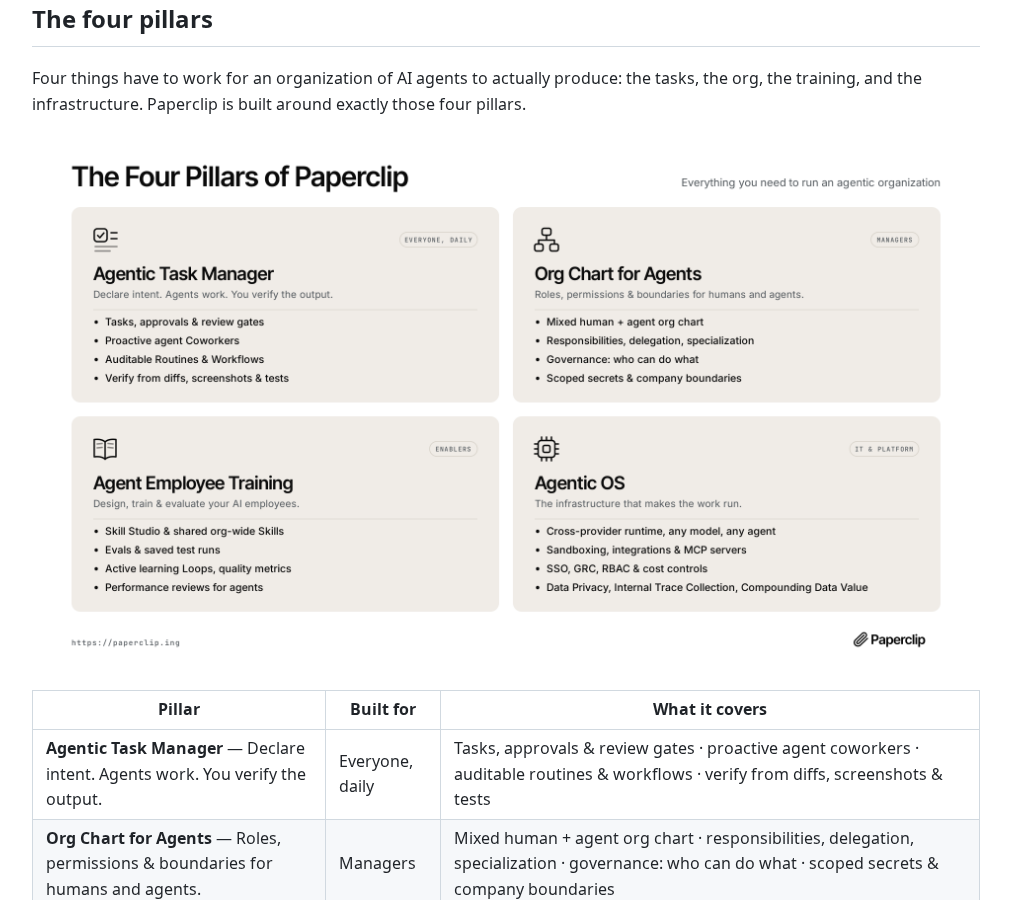
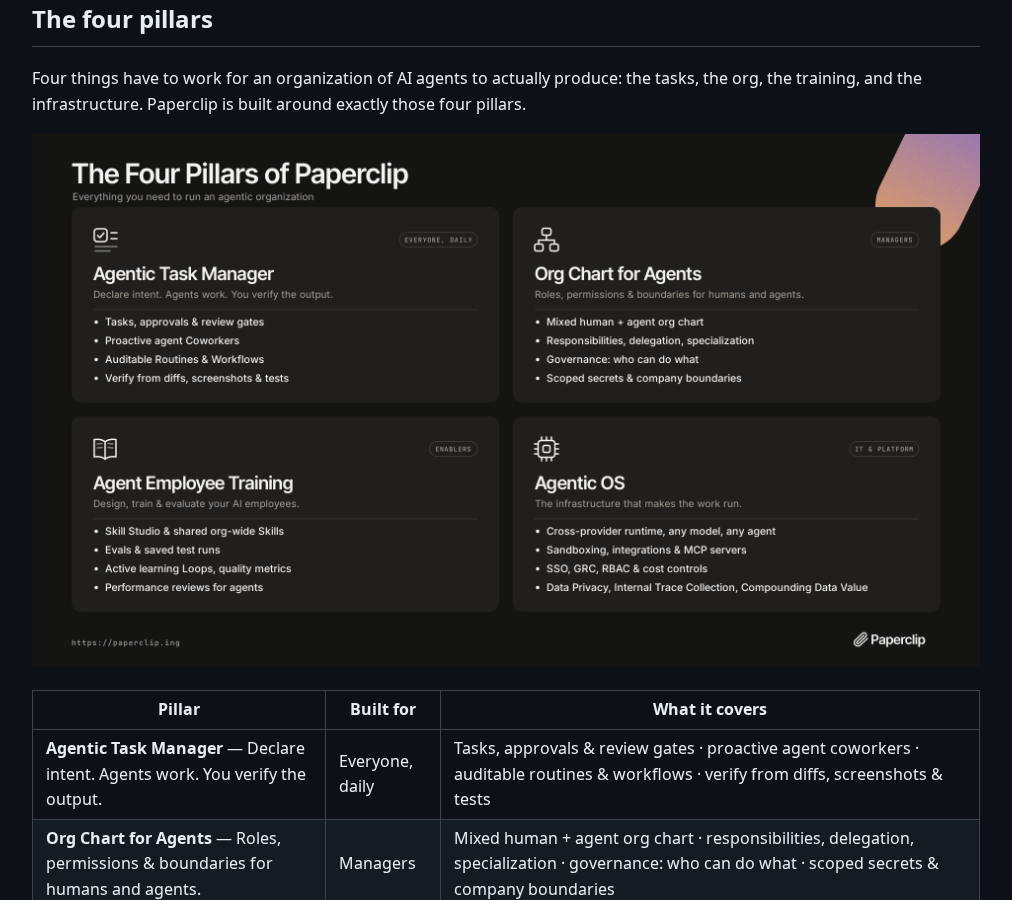
- Added a **The four pillars** section covering Agentic Task Manager,
Org Chart for Agents, Agent Employee Training, and Agentic OS, with a
theme-aware `<picture>` graphic.
- Flipped four roadmap entries from ⚪ to ✅: Cloud / Sandbox agents,
Artifacts & Work Products, Deep Planning, and Enforced Outcomes.
- Added shipped ✅ entries for MCP Tool Gateway & Apps, per-agent Secrets
Manager access, activity logging and action attribution, self-healing
recovery, and agent evals/feedback; expanded the skills entry to include
Skill Studio and Skills Store.
- Added planned ⚪ entries for Bring-your-own-ticket-system and Connected
Apps, resolving the README FAQ inconsistency around external ticket
systems.
- Moved Cloud deployments to 🟡 and documented the shipped multi-tenant
isolation, local-to-cloud sync, and cloud-managed bootstrap scope.
- Synchronized the README preview and `ROADMAP.md` ordering/statuses: 18
✅, 9 ⚪, and 1 🟡 entry.
## Verification
- `git diff --check origin/master...HEAD`
- Focused Node consistency check confirms README and `ROADMAP.md` have
the same 28 ordered entries/statuses and expected 18 ✅ / 9 ⚪ / 1 🟡
counts.
- `file doc/assets/four-pillars-light.png
doc/assets/four-pillars-dark.png` confirms both assets are valid
3840×2160 RGB PNGs.
- Visual QA rendered the README through GitHub’s GFM API in Chromium at
GitHub content width under both light and dark `prefers-color-scheme`
modes; the correct graphic swapped per theme, all links resolved, the
section placement/table were correct, and `ROADMAP.md` matched the
README preview.
### Visual Evidence
**Light theme**
**Dark theme**
- Prettier was not run because this repository does not expose a
configured `prettier` binary; markdown whitespace was checked with `git
diff --check` and the rendered QA above.
## Risks
- Low risk: documentation and image assets only; no application code,
API contract, schema, dependencies, lockfile, or workflow changes.
- Roadmap status wording can become stale as product work evolves, so
future shipped capabilities should update both the README preview and
`ROADMAP.md` together.
> For core feature work, check [`ROADMAP.md`](ROADMAP.md) first and
discuss it in `#dev` before opening the PR. Feature PRs that overlap
with planned core work may need to be redirected — check the roadmap
first. See `CONTRIBUTING.md`.
## Model Used
- OpenAI Codex, exact model ID `gpt-5.6-sol`, with reasoning,
terminal/tool use, GitHub API access, and Paperclip control-plane
integration. The model context-window size was not exposed by this
execution environment.
## Checklist
- [x] I have included a thinking path that traces from project context
to this change
- [x] I have specified the model used (with version and capability
details)
- [x] I have checked ROADMAP.md and confirmed this PR does not duplicate
planned core work
- [x] I have searched GitHub for duplicate or related PRs and linked
them above
- [x] I have either (a) linked existing issues with `Fixes: #` / `Closes
#` / `Refs #` OR (b) described the issue in-PR following the relevant
issue template
- [x] I have not referenced internal/instance-local Paperclip issues or
links (only public GitHub `#NNN` / `github.com/paperclipai/paperclip`
URLs)
- [x] My branch name describes the change (e.g. `docs/...`, `fix/...`)
and contains no internal Paperclip ticket id or instance-derived details
- [x] I have run tests locally and they pass
- [x] I have added or updated tests where applicable
- [x] I have updated relevant documentation to reflect my changes
- [x] I have considered and documented any risks above
- [x] All Paperclip CI gates are green
- [x] Greptile is 5/5 with no open P2s, recommendations, or follow-ups
- [x] I will address all Greptile and reviewer comments before
requesting merge
---------
Co-authored-by: Paperclip <noreply@paperclip.ing>
## Thinking Path

> - Paperclip is the open source control plane people use to manage
AI-agent companies and their work
> - Human approvals, issue interactions, and execution decisions already
capture high-value decision moments
> - Those moments are currently transient and cannot be reused as stable
evaluation or training examples
> - Reusable examples need a server-owned, immutable snapshot so later
comments or runs cannot leak into the recorded state
> - Human notes need to remain editable and auditable without changing
the captured state
> - This pull request adds the database model, snapshot capture service,
API, export format, and attention-feed enrichment for decision training
> - The benefit is a durable, inspectable foundation for evaluating
whether agents can reproduce good human decisions from only the context
available at decision time

## Linked Issues or Issue Description

### Subsystem affected

Cross-cutting (`server/`, `packages/db`, and `packages/shared`).

### Problem or motivation

Paperclip has no durable dataset for converting human decisions into
evaluation-ready examples. Teams need to capture pending or resolved
decisions with the exact issue context, comments, runs, and repository
evidence available at a cutoff, while preventing future context from
leaking into the example.

### Proposed solution

Store immutable, schema-versioned snapshots anchored to durable
interaction, approval, or execution-decision records; keep notes
separately editable with history; expose human-only CRUD, list, and
JSONL export APIs.

### Alternatives considered

Client-generated snapshots were rejected because they duplicate cutoff
logic and cannot reliably enforce no-leakage boundaries. Automatic
outcome backfill was deferred so captured examples remain faithful to
what was known at capture time.

### Roadmap alignment

Supports the roadmap direction of turning completed work and decision
patterns into reusable organizational knowledge.

### Additional context

The implementation records explicit commit-resolution confidence
(`exact`, `nearest_run`, `workspace`, or `none`) so downstream
evaluation can distinguish evidence quality.

## What Changed

- Added the `decision_training_examples` schema and idempotent migration
with company, issue, and source/author indexes.
- Added shared types for decision-training records, notes history, and
versioned snapshots.
- Added a single server-side snapshot capture path with inclusive
comment cutoffs, pre-cutoff run capture, durable decision payloads, and
explicit commit-resolution confidence.
- Added create, list, detail, notes-only update, delete, and JSONL
export routes with human-only write authorization and activity logging
that skips no-op note submissions.
- Added per-user `trainingExampleId` enrichment to attention items.
- Added focused embedded-Postgres tests for cutoff boundaries,
post-cutoff leakage, immutable snapshots, human-only writes, duplicate
prevention, notes history, attention enrichment, and export shape.
- Updated UI test and Storybook attention-item factories for the new
required `trainingExampleId` contract.

## Verification

- `pnpm exec vitest run server/src/__tests__/decision-training.test.ts`
— 10 tests passed.
- `pnpm --filter @paperclipai/db typecheck` — passed, including
migration numbering and safety checks.
- `pnpm --filter @paperclipai/shared typecheck` — passed.
- `pnpm --filter @paperclipai/server typecheck` — passed.
- `pnpm --filter @paperclipai/ui typecheck` — passed.

## Risks

- The migration adds a new table and indexes only; it does not rewrite
existing rows or install resolve-time hooks.
- Snapshot JSON can grow with long comment threads and run histories; v1
intentionally favors complete, inspectable examples over aggressive
truncation.
- Commit SHA resolution is evidence-based and records `exact`,
`nearest_run`, or `none` so downstream consumers can account for
confidence.
- The API is additive, but future UI work must continue to treat the
snapshot as immutable and use notes-only updates.

> For core feature work, check [`ROADMAP.md`](ROADMAP.md) first and
discuss it in `#dev` before opening the PR. Feature PRs that overlap
with planned core work may need to be redirected — check the roadmap
first. See `CONTRIBUTING.md`.

## Model Used

- OpenAI Codex using `gpt-5.3-codex`, with repository tool use, terminal
execution, and code-editing capabilities; context-window size is not
exposed by the runtime.

## Checklist

- [x] I have included a thinking path that traces from project context
to this change
- [x] I have specified the model used (with version and capability
details)
- [x] I have checked ROADMAP.md and confirmed this PR does not duplicate
planned core work
- [x] I have searched GitHub for duplicate or related PRs and linked
them above
- [x] I have either (a) linked existing issues with `Fixes: #` / `Closes
#` / `Refs #` OR (b) described the issue in-PR following the relevant
issue template
- [x] I have not referenced internal/instance-local Paperclip issues or
links (only public GitHub `#NNN` / `github.com/paperclipai/paperclip`
URLs)
- [x] My branch name describes the change (e.g. `docs/...`, `fix/...`)
and contains no internal Paperclip ticket id or instance-derived details
- [x] I have run tests locally and they pass
- [x] I have added or updated tests where applicable
- [x] I have updated relevant documentation to reflect my changes
- [x] I have considered and documented any risks above
- [ ] All Paperclip CI gates are green
- [ ] Greptile is 5/5 with no open P2s, recommendations, or follow-ups
- [x] I will address all Greptile and reviewer comments before
requesting merge

---------

Co-authored-by: Paperclip <noreply@paperclip.ing>
## Thinking Path

> - Paperclip is the open source control plane people use to manage
AI-agent companies and their work
> - The inbox is a per-user attention view, so archiving an item must
not alter the underlying issue, assignment, or status
> - Agents can help responsible users tidy resolved work only when the
action is company-scoped, reversible, policy-controlled, and fully
attributable
> - The database and authorization foundations landed in #9654 and
#9658, but the end-to-end archive routes, audit details, agent workflow
guidance, and operator UI still need to ship together
> - Separate stacked PRs #9659 and #9661 made the complete behavior
harder to review and land as one coherent capability
> - This pull request consolidates the remaining server,
shared-contract, documentation, skill, and UI work on top of current
master
> - The benefit is a single reviewable change that lets agents safely
archive responsible-user inbox items and lets users control or undo that
behavior

## Linked Issues or Issue Description

### Subsystem affected

Cross-cutting inbox management across shared contracts, server
authorization/routes/services, shipped agent skills, and the board UI.

### Problem or motivation

Agents may complete work whose issue remains in the responsible user's
Mine inbox. Existing board-user archive behavior does not provide the
agent-facing policy endpoints, target resolution, heartbeat-run
attribution, typed denials, conservative workflow guidance, or UI needed
for safe agent-managed cleanup.

### Proposed solution

Allow authorized agents to archive or unarchive responsible-user inbox
items under the user's open, allowlist, or disabled policy; preserve
actor/agent/run attribution in issue detail and activity records; expose
policy controls and agent archive attribution in the UI; and document
conservative cleanup rules for agents and PR gardening.

### Alternatives considered

- Reuse generic issue mutation permissions: rejected because inbox state
belongs to a target user and requires user-scoped authorization.
- Automatically archive every completed or closed item: rejected because
completion signals can still require human review or a decision.
- Keep the backend and UI as separate stacked PRs: superseded by this
consolidated PR so the complete user-visible behavior can be reviewed
and verified together.

### Related work

- Builds on merged foundations #9654 and #9658.
- Supersedes the remaining stacked changes in #9659 and #9661.
- `ROADMAP.md` has no overlapping inbox archive or inbox authorization
initiative.

## What Changed

- Added shared inbox-agent policy types and validators plus
company-scoped self-service policy routes and OpenAPI coverage.
- Enabled agent archive/unarchive mutations with responsible-user
targeting, policy enforcement, typed failures, attribution, idempotency,
and detailed activity auditing.
- Returned agent archive attribution in issue detail and documented
reversible inbox cleanup semantics in the implementation spec and
Paperclip skill.
- Added conservative PR-gardening inbox tidy guidance that keeps GitHub
access read-only and avoids archiving work that still needs human
action.
- Added the Profile settings policy control and Issue Properties
attribution/unarchive UI with focused component coverage and narrow-pane
handling.

## Verification

- `pnpm exec vitest run
server/src/__tests__/inbox-archive-routes.test.ts
server/src/__tests__/inbox-agent-policy-routes.test.ts
server/src/__tests__/authorization-service.test.ts
server/src/__tests__/openapi-routes.test.ts
ui/src/components/InboxAgentPolicyControl.test.tsx
ui/src/components/IssueProperties.test.tsx` — 110 passed.
- `pnpm --filter @paperclipai/db exec vitest run
src/inbox-archive-agent-policies-migration.test.ts` — 1 passed.
- `node --test
.agents/skills/pr-gardening/scripts/pr-gardening.test.mjs` — 9 passed.
- `pnpm --filter @paperclipai/server typecheck` — passed.
- `pnpm --filter @paperclipai/ui typecheck` — passed.
- `pnpm check:token-gates` — changed files are clean; the
repository-wide command currently reports nine unrelated pre-existing
`#9627` literals outside this PR's diff.

## Risks

- Agent inbox mutations broaden an existing endpoint path, so
authorization and target resolution must remain fail-closed; focused
route and authorization tests cover allowed and denied paths.
- Archive state affects only the responsible user's inbox presentation
and remains reversible; it does not mutate issue status, assignment, or
visibility.
- The UI policy defaults to the existing open behavior, while allowlist
and disabled modes can reduce agent access.
- This PR intentionally builds on #9654 and #9658 and contains no new
migration number or modification to an already-applied migration.

> For core feature work, check [`ROADMAP.md`](ROADMAP.md) first and
discuss it in `#dev` before opening the PR. Feature PRs that overlap
with planned core work may need to be redirected — check the roadmap
first. See `CONTRIBUTING.md`.

## Model Used

- OpenAI Codex using GPT-5.4, medium reasoning, repository tool use,
shell execution, code review, and test execution.

## Checklist

- [x] I have included a thinking path that traces from project context
to this change
- [x] I have specified the model used (with version and capability
details)
- [x] I have checked ROADMAP.md and confirmed this PR does not duplicate
planned core work
- [x] I have searched GitHub for duplicate or related PRs and linked
them above
- [x] I have either (a) linked existing issues with `Fixes: #` / `Closes
#` / `Refs #` OR (b) described the issue in-PR following the relevant
issue template
- [x] I have not referenced internal/instance-local Paperclip issues or
links (only public GitHub `#NNN` / `github.com/paperclipai/paperclip`
URLs)
- [x] My branch name describes the change
(`feat/inbox-agent-archive-complete`) and contains no internal Paperclip
ticket id or instance-derived details
- [x] I have run tests locally and they pass
- [x] I have added or updated tests where applicable
- [x] I have updated relevant documentation to reflect my changes
- [x] I have considered and documented any risks above
- [x] All Paperclip CI gates are green
- [x] Greptile is 5/5 with no open P2s, recommendations, or follow-ups
- [x] I will address all Greptile and reviewer comments before
requesting merge

---------

Co-authored-by: Paperclip <noreply@paperclip.ing>
Co-authored-by: Claude Opus 4.8 <noreply@anthropic.com>
## Thinking Path

> - Paperclip is the open source app people use to manage AI agents for
work.
> - The local heartbeat/runtime subsystem starts long-running local
agent processes and records their run state.
> - Operators sometimes need to rebuild and restart the Paperclip server
while local agent processes are still alive.
> - A normal restart should remain conservative, but a guarded
production hot restart needs an explicit marker, startup reconciliation,
and an inspectable report.
> - The broader hot-restart PR is currently merge-conflicted, so this
pull request lands the minimal server-side recovery path on current
`master`.
> - The benefit is that deploy operators can restart from a current
branch without reverting production changes and without marking adopted
live runs as `process_lost`.

## Linked Issues or Issue Description

No public GitHub issue exists for this deploy-safety fix.

Bug fix:

- What happened: the current deployable `master` branch did not include
the hot-restart marker CLI, startup adoption report path, or health
version proof needed by guarded service restarts.
- Expected behavior: a deploy operator can write a one-shot marker
before restarting, the old server snapshots eligible running child
processes, the new server reports adopted/finalized/lost runs, and
adopted live runs are not reaped as `process_lost`.
- Steps to reproduce: restart a server with running local child-process
heartbeat runs without the marker/adoption path; startup orphan reaping
has no adoption metadata and treats live detached children as lost.
- Paperclip version/commit: fixed on top of `master` at `b606869a6`.
- Deployment mode: production/local-service style deployments that
rebuild and restart the primary `paperclip.service`.
- Related PR: Refs #9628. This PR intentionally lands a smaller
deploy-safe subset because #9628 is currently merge-conflicted.
- Duplicate search: searched public PRs/issues for `hot restart` and
`process_lost adoption`; #9628 is the directly related prior
implementation.

## What Changed

- Added `scripts/request-hot-restart.ts` to write a one-shot hot-restart
intent marker under `PAPERCLIP_HOME`.
- Added `server/src/services/hot-restart.ts` for intent/report path
resolution, parsing, atomic writes, shutdown snapshots, and marker
cleanup.
- Wired server shutdown/startup so explicit hot restarts snapshot active
runs, skip the normal heartbeat drain, reconcile live child processes on
boot, and write `hot-restart-report.json`.
- Preserved adopted run metadata so normal orphan reaping does not
regress adopted live runs to `process_lost`.
- Added `serverVersion` health proof alongside existing `version`, plus
docs and regression coverage.

## Verification

- `pnpm vitest run server/src/__tests__/health.test.ts
server/src/__tests__/heartbeat-process-recovery.test.ts` — 2 files
passed, 100 tests passed.
- `pnpm --filter @paperclipai/server typecheck`
- `env PAPERCLIP_HOME="$PAPERCLIP_RUN_SCRATCH_DIR/hot-restart-cli-smoke"
pnpm --filter @paperclipai/server exec tsx
../scripts/request-hot-restart.ts --server-pid 12345`
- Branch ancestry checked after `git fetch origin master`:
`origin/master` was `b606869a6`, and `HEAD..origin/master` was empty.

## Risks

- Medium risk: process adoption depends on PID/PGID metadata and the
service manager leaving child processes alive for the guarded restart.
- Normal restarts remain conservative, but an incorrect marker PID
intentionally falls back to graceful drain instead of adoption.
- The PR is server-only and does not include the broader
UI/experimental-setting work from #9628.

> For core feature work, check [`ROADMAP.md`](ROADMAP.md) first and
discuss it in `#dev` before opening the PR. Feature PRs that overlap
with planned core work may need to be redirected — check the roadmap
first. See `CONTRIBUTING.md`.

## Model Used

- OpenAI GPT-5 via Codex coding agent in a Paperclip execution
workspace; tool use and shell/code execution enabled; context window not
surfaced by this runtime.

## Checklist

- [x] I have included a thinking path that traces from project context
to this change
- [x] I have specified the model used (with version and capability
details)
- [x] I have checked ROADMAP.md and confirmed this PR does not duplicate
planned core work
- [x] I have searched GitHub for duplicate or related PRs and linked
them above
- [x] I have either (a) linked existing issues with `Fixes: #` / `Closes
#` / `Refs #` OR (b) described the issue in-PR following the relevant
issue template
- [x] I have not referenced internal/instance-local Paperclip issues or
links (only public GitHub `#NNN` / `github.com/paperclipai/paperclip`
URLs)
- [x] My branch name describes the change (e.g. `docs/...`, `fix/...`)
and contains no internal Paperclip ticket id or instance-derived details
- [x] I have run tests locally and they pass
- [x] I have added or updated tests where applicable
- [x] I have updated relevant documentation to reflect my changes
- [x] I have considered and documented any risks above
- [x] All Paperclip CI gates are green
- [x] Greptile is 5/5 with no open P2s, recommendations, or follow-ups
- [x] I will address all Greptile and reviewer comments before
requesting merge

---------

Co-authored-by: Paperclip <noreply@paperclip.ing>
## Thinking Path

> - Paperclip is the open source app people use to manage AI agents for
work
> - Heartbeat recovery keeps assigned issues moving when a run or
continuation path disappears
> - Accepted issue-thread interactions can create a continuation wake
after an agent previously parked for review
> - The recovery sweep could requeue that accepted-interaction wake
while the queued-run gate cancelled it using the older pre-acceptance
park summary
> - That cancellation path had no bound, so recovery could repeat the
same wake and cancellation indefinitely
> - This pull request makes accepted-interaction evidence supersede the
older park and caps repeated recovery cancellations at three attempts
> - The benefit is that accepted work resumes normally, while genuine
repeated failures become a visible dependency wait or escalation instead
of a cancel loop

## Linked Issues or Issue Description

Refs #9331

The accepted-interaction continuation recovery added by #9331 can
encounter a stale continuation summary written before approval. The
sweep requeues a continuation carrying the accepted interaction
timestamp, but queued-run invalidation cancels it because the older
summary says to wait for review. Recovery then sees the accepted
interaction without a successful run and requeues again. This PR
prevents that stale-summary cancellation and adds a bounded fallback if
three equivalent cancellations have already occurred.

## What Changed

- Let queued continuation wakes with a parseable `interactionResolvedAt`
bypass a pre-acceptance waiting-for-review park summary.
- Count consecutive unsuccessful continuation runs for the same issue
and agent since interaction acceptance; after three review-park
cancellations, convert a real dependency wait or use the existing
visible escalation path.
- Add focused regression coverage for the park bypass, unchanged
non-interaction park behavior, below-cap requeue, cap escalation, and
successful-run skip.
- Document the accepted-interaction precedence and bounded requeue
contract in execution semantics §9.2.

## Verification

- `pnpm vitest run
server/src/__tests__/heartbeat-process-recovery.test.ts -t "accepted
interaction continuation recovery|accepted interaction recovery after
its continuation succeeds|requeues accepted interaction continuations
stranded"`
- `pnpm vitest run
server/src/__tests__/heartbeat-stale-queue-invalidation.test.ts -t
"pre-acceptance review park|continuation summary parks executor work"`
- `pnpm --filter @paperclipai/server typecheck`

## Risks

- Low risk: the park bypass only applies when the queued context
contains a parseable interaction resolution timestamp.
- The retry bound is scoped to unsuccessful `issue_continuation_needed`
runs for the same company, issue, agent, error code, and post-acceptance
time window.
- No schema, migration, API, or UI changes.

> For core feature work, check [`ROADMAP.md`](ROADMAP.md) first and
discuss it in `#dev` before opening the PR. Feature PRs that overlap
with planned core work may need to be redirected — check the roadmap
first. See `CONTRIBUTING.md`.

## Model Used

- OpenAI Codex, exact model ID `gpt-5.5`, high-reasoning coding mode
with repository tool use and command execution; context-window size was
not exposed by the runtime.

## Checklist

- [x] I have included a thinking path that traces from project context
to this change
- [x] I have specified the model used (with version and capability
details)
- [x] I have checked ROADMAP.md and confirmed this PR does not duplicate
planned core work
- [x] I have searched GitHub for duplicate or related PRs and linked
them above
- [x] I have either (a) linked existing issues with `Fixes: #` / `Closes
#` / `Refs #` OR (b) described the issue in-PR following the relevant
issue template
- [x] I have not referenced internal/instance-local Paperclip issues or
links (only public GitHub `#NNN` / `github.com/paperclipai/paperclip`
URLs)
- [x] My branch name describes the change (e.g. `docs/...`, `fix/...`)
and contains no internal Paperclip ticket id or instance-derived details
- [x] I have run tests locally and they pass
- [x] I have added or updated tests where applicable
- [x] I have updated relevant documentation to reflect my changes
- [x] I have considered and documented any risks above
- [x] All Paperclip CI gates are green
- [x] Greptile is 5/5 with no open P2s, recommendations, or follow-ups
- [x] I will address all Greptile and reviewer comments before
requesting merge

---------

Co-authored-by: Paperclip <noreply@paperclip.ing>
## Thinking Path

> - Paperclip is the open source app people use to manage AI agents for
work
> - The `/pr-gardening` skill drives a bundled agent that scans a
company's issues for those linked to open GitHub PRs, then reports on
their state; it relies on the server's company-search **extract**
endpoint to pull PR references out of issue bodies
> - Two gaps surfaced during end-to-end QA of the gardening workflow:
the extract service silently ignored a per-issue match cap, so callers
could not bound how many matches came back per issue, and the skill's
candidate-discovery scripts fell over on large repos and on issues that
referenced deleted PRs
> - Left unaddressed, the gardener either truncated its scan
unpredictably or aborted outright, so it could not reliably enumerate PR
candidates
> - This pull request honors an explicit `matchesPerIssue` limit in the
extract search API and hardens the skill's candidate discovery against
missing/unavailable PRs and oversized `gh` output
> - The benefit is a PR-gardening workflow that scans deterministically
and finishes cleanly on real-world companies

## Linked Issues or Issue Description

No pre-existing public GitHub issue — describing the bug in-PR following
the bug report template (`.github/ISSUE_TEMPLATE/bug_report.yml`).

### What happened?

The company-search extract endpoint accepted a per-issue match limit but
did not apply it, returning matches capped only by the old hardcoded
constant regardless of the caller's request. Separately, the
`/pr-gardening` skill's candidate-discovery scripts crashed when a
scanned issue referenced a deleted PR (GitHub `Not Found (HTTP 404)` /
GraphQL `Could not resolve to a PullRequest`) and could exceed the
default `gh` output buffer on large result sets, aborting the whole
scan.

### Expected behavior

The extract API bounds matches per issue when a caller passes
`matchesPerIssue` (default 20, max 200), and omitting it preserves the
previous default. The gardening scripts skip PRs that are
deleted/unavailable and tolerate large `gh` responses without aborting
the scan.

### Steps to reproduce

1. Call the company-search extract endpoint with a `matchesPerIssue`
value against an issue containing many PR references — previously the
value was ignored.
2. Run the pr-gardening candidate scan against a company whose issues
reference a since-deleted PR — previously the scan threw instead of
skipping that PR.

### Paperclip version or commit

`master` at the base of this PR (branch cut from current
`origin/master`).

### Deployment mode

Local Paperclip instance / self-hosted.

## What Changed

- **Extract search honors `matchesPerIssue`**: added the
`matchesPerIssue` field to the shared search validator/types and applied
the cap in `company-search-extract` so results are bounded per issue
(`packages/shared`, `server/src/services/company-search-extract.ts`,
`doc/SPEC-implementation.md`).
- **Hardened pr-gardening candidate discovery**: `find-candidates.mjs` /
`lib.mjs` now request `matchesPerIssue=200`, treat missing/unavailable
PRs (deleted PR → `isMissingPullRequestError` / `unavailable`) as skips
instead of fatal errors, and raise the `gh` `maxBuffer` to 50 MB for
large repos.
- **Tests**: expanded `company-search-extract-{routes,service}.test.ts`
for the new limit and added coverage in `pr-gardening.test.mjs`.

## Verification

Re-run on a fresh worktree cherry-picked onto current `master`:

- `node --test
.agents/skills/pr-gardening/scripts/pr-gardening.test.mjs` → 8/8 pass
- `pnpm vitest run
server/src/__tests__/company-search-extract-routes.test.ts
server/src/__tests__/company-search-extract-service.test.ts` → 10/10
pass

## Risks

Low risk. `matchesPerIssue` is optional and backward-compatible
(omitting it preserves prior behavior). The skill changes only add
skip/tolerance paths and a larger buffer; no schema or migration
changes.

## Model Used

Claude — Opus 4.8 (`claude-opus-4-8`), extended thinking, tool use /
code execution via the Claude Agent SDK.

## Checklist

- [x] I have included a thinking path that traces from project context
to this change
- [x] I have specified the model used (with version and capability
details)
- [x] I have checked ROADMAP.md and confirmed this PR does not duplicate
planned core work
- [x] I have searched GitHub for duplicate or related PRs and linked
them above
- [x] I have either (a) linked existing issues with `Fixes: #` / `Closes
#` / `Refs #` OR (b) described the issue in-PR following the relevant
issue template
- [x] I have not referenced internal/instance-local Paperclip issues or
links (only public GitHub `#NNN` / `github.com/paperclipai/paperclip`
URLs)
- [x] My branch name describes the change (e.g. `docs/...`, `fix/...`)
and contains no internal Paperclip ticket id or instance-derived details
- [x] I have run tests locally and they pass
- [x] I have added or updated tests where applicable
- [x] I have updated relevant documentation to reflect my changes
- [x] I have considered and documented any risks above
- [ ] All Paperclip CI gates are green
- [ ] Greptile is 5/5 with no open P2s, recommendations, or follow-ups
- [x] I will address all Greptile and reviewer comments before
requesting merge

---------

Co-authored-by: Paperclip <noreply@paperclip.ing>
## Thinking Path

> - Paperclip is the open source control plane people use to coordinate
AI-agent companies and their work.
> - Its recovery subsystem detects stranded issue execution and decides
whether to retry, escalate, or request operator intervention.
> - The existing recovery path used a mostly generic owner ladder and
generic execution contract, so transient failures could wake a manager
who then performed the deliverable instead of repairing and returning
the task.
> - Provider quota failures also entered the same takeover path even
when the correct action was to wait for capacity and retry the original
assignee.
> - Recovery actions already retain the source owner and evidence needed
to choose a cause-specific route, render a scoped contract, and measure
whether work was handed back.
> - This pull request adds a cause-keyed recovery playbook, propagates
its contract through every built-in adapter, and makes resolved recovery
actions return work to the original owner by default.
> - The benefit is bounded self-recovery that preserves task ownership,
avoids needless management takeover, and makes recovery outcomes
observable.

## Linked Issues or Issue Description

No matching public GitHub issue was found.

Related recovery work was reviewed but is not duplicated here: #9630
restores bounded recovery continuations, #8807 changes one
assignee-ranking case, and #9404 records runtime-failure transition
evidence. This change instead introduces cause-specific routing and
recovery contracts across the recovery lifecycle.

### What happened?

When an issue became stranded, recovery generally selected an owner
through the same fallback ladder and rendered the normal execution
contract. That made the recovery wake look like ordinary deliverable
work, even when the correct action was to retry the original agent,
repair its runtime, or wait for a provider quota reset.

### Expected behavior

Recovery should select a response by failure cause, tell the recipient
to recover rather than complete the deliverable, suppress takeover wakes
for provider quota waits, and return repaired work to its original
assignee unless the recovery owner explicitly completes it.

### Actual behavior

Recovery could escalate transient failures to management, omit the
cause-specific next action from the wake, and leave the recovery owner
assigned after the runtime problem was resolved.

### Impact

The generic path creates avoidable management work, ownership churn, and
budget consumption while obscuring whether recovery successfully
returned work to the responsible agent.

## What Changed

- Added cause-keyed routing for process loss, missing disposition,
provider quota limits, Codex output inactivity, workspace validation
failures, and fallback recovery causes.
- Added recovery-scoped wake rendering that replaces the generic
execution contract with the failure summary, original assignee, attempt
count, next action, and cause-specific playbook instruction.
- Propagated the structured recovery contract through all built-in
adapter execution paths, including Hermes local and gateway adapters.
- Added provider-quota wait monitoring so capacity failures schedule the
original assignee instead of enqueueing a takeover wake.
- Added hand-back behavior and `handed_back` / `owner_completed` outcome
accounting when recovery actions are resolved.
- Added focused routing, renderer, quota-monitor, and hand-back
regression coverage plus implementation-spec documentation.

## Verification

- `pnpm exec vitest run packages/adapter-utils/src/server-utils.test.ts
server/src/__tests__/heartbeat-process-recovery.test.ts
server/src/__tests__/heartbeat-workspace-branch-containment.test.ts
server/src/__tests__/issue-recovery-actions.test.ts`
  - 4 test files passed; 194 tests passed.
- Targeted `pnpm --filter ... typecheck` across
`@paperclipai/adapter-utils`, `@paperclipai/shared`,
`@paperclipai/server`, `@paperclipai/ui`, and all nine changed adapter
packages.
  - 13 affected workspace packages passed typecheck.
- `pnpm check:token-gates`
  - All UI token gates passed.

## Risks

- Recovery routing behavior changes for stranded work, so an incorrectly
classified cause could select a different recipient than before;
fallback causes retain the existing management ladder.
- Provider quota detection depends on structured failure evidence and
conservative text matching; unmatched failures continue through fallback
recovery.
- Adapter prompt plumbing changes across built-ins, covered by shared
renderer tests and compile-time call signatures.

> For core feature work, check [`ROADMAP.md`](ROADMAP.md) first and
discuss it in `#dev` before opening the PR. Feature PRs that overlap
with planned core work may need to be redirected — check the roadmap
first. See `CONTRIBUTING.md`.

## Model Used

- OpenAI Codex with exact model ID `gpt-5.6-sol`, using reasoning, tool
use, and code execution. The runtime does not expose its configured
context-window size.

## Checklist

- [x] I have included a thinking path that traces from project context
to this change
- [x] I have specified the model used (with version and capability
details)
- [x] I have checked ROADMAP.md and confirmed this PR does not duplicate
planned core work
- [x] I have searched GitHub for duplicate or related PRs and linked
them above
- [x] I have either (a) linked existing issues with `Fixes: #` / `Closes
#` / `Refs #` OR (b) described the issue in-PR following the relevant
issue template
- [x] I have not referenced internal/instance-local Paperclip issues or
links (only public GitHub `#NNN` / `github.com/paperclipai/paperclip`
URLs)
- [x] My branch name describes the change (e.g. `docs/...`, `fix/...`)
and contains no internal Paperclip ticket id or instance-derived details
- [x] I have run tests locally and they pass
- [x] I have added or updated tests where applicable
- [x] I have updated relevant documentation to reflect my changes
- [x] I have considered and documented any risks above
- [x] All Paperclip CI gates are green
- [x] Greptile is 5/5 with no open P2s, recommendations, or follow-ups
- [x] I will address all Greptile and reviewer comments before
requesting merge

---------

Co-authored-by: Paperclip <noreply@paperclip.ing>
## Thinking Path

> - Paperclip is the open source control plane people use to coordinate
AI-agent companies
> - Agents and operators need company-scoped search to discover relevant
issue history safely
> - The interactive search endpoint intentionally returns compact
excerpts and low pagination caps for UI use
> - Automation that inventories repeated references, such as
pull-request URLs, needs exhaustive distinct matches without loading
full issue objects into an LLM context
> - Client-provided regular expressions would create an unsafe and
expensive query surface, so extraction must remain literal with
server-owned expansion modes
> - This pull request adds a bounded agent-oriented extraction endpoint
with explicit truncation
> - The benefit is deterministic, compact bulk discovery across issues,
comments, and documents while preserving company authorization and rate
limits

## Linked Issues or Issue Description

### Subsystem affected

`server/` REST API and `packages/shared/` contracts.

### Problem or motivation

The existing interactive company search caps issue pagination and
snippets, so automation cannot reliably enumerate every distinct literal
or pull-request URL across issue descriptions, comments, and linked
documents without fetching large full issue payloads.

### Proposed solution

Add `GET /api/companies/:companyId/search/extract` with escaped literal
matching, optional server-owned URL token expansion,
issue/comment/document scopes, status/date filters, higher issue-level
pagination caps, compact source references, and explicit
pagination/match truncation flags.

### Alternatives considered

Reusing `GET /issues?q=` would return unnecessarily large issue objects;
increasing interactive-search snippet limits would make the UI API
heavier; accepting arbitrary client regex would expose avoidable
database cost and ReDoS risk.

### Roadmap alignment

`ROADMAP.md` does not currently list a conflicting company-search or
bulk-extraction initiative. GitHub searches found no directly
duplicative open issue or pull request.

## What Changed

- Added shared query validation and response contracts for literal and
URL extraction.
- Added a company-scoped extraction service that pages issues, gathers
matching issue/comment/document sources, expands URL tokens,
deduplicates values, and reports truncation explicitly.
- Added the authenticated route using the existing company-search
authorization decision and rate limiter.
- Added targeted Vitest coverage for URL extraction, multi-source
dedupe, date/status filters, match caps, cross-company denial, and rate
limiting.
- Documented the extraction surface in the implementation specification.

## Verification

- `pnpm exec vitest run
server/src/__tests__/company-search-extract-service.test.ts
server/src/__tests__/company-search-extract-routes.test.ts
server/src/__tests__/company-search-rate-limit-routes.test.ts
server/src/__tests__/company-search-service.test.ts` — 30 tests passed.
- `pnpm --filter @paperclipai/shared typecheck` — passed.
- `pnpm --filter @paperclipai/server typecheck` — passed.
- `git diff --check` — passed.

## Risks

- Bulk substring search can scan large text columns. The endpoint
mitigates this with a minimum literal length, bounded issue pagination,
a 20-distinct-match cap per issue, explicit truncation, existing
company-search rate limiting, and no client-provided regex.
- URL expansion uses a fixed server-owned pattern plus an escaped
literal. A security review is requested as part of PR review to confirm
the pattern and abuse controls.
- No database migration or existing API response shape changes are
included.

> For core feature work, check [`ROADMAP.md`](ROADMAP.md) first and
discuss it in `#dev` before opening the PR. Feature PRs that overlap
with planned core work may need to be redirected — check the roadmap
first. See `CONTRIBUTING.md`.

## Model Used

- OpenAI Codex CLI coding agent; exact runtime model ID and
context-window size were not exposed to the session. Tool-enabled code
execution and repository editing were used with medium reasoning effort.

## Checklist

- [x] I have included a thinking path that traces from project context
to this change
- [x] I have specified the model used (with version and capability
details)
- [x] I have checked ROADMAP.md and confirmed this PR does not duplicate
planned core work
- [x] I have searched GitHub for duplicate or related PRs and linked
them above
- [x] I have either (a) linked existing issues with `Fixes: #` / `Closes
#` / `Refs #` OR (b) described the issue in-PR following the relevant
issue template
- [x] I have not referenced internal/instance-local Paperclip issues or
links (only public GitHub `#NNN` / `github.com/paperclipai/paperclip`
URLs)
- [x] My branch name describes the change (e.g. `docs/...`, `fix/...`)
and contains no internal Paperclip ticket id or instance-derived details
- [x] I have run tests locally and they pass
- [x] I have added or updated tests where applicable
- [x] I have updated relevant documentation to reflect my changes
- [x] I have considered and documented any risks above
- [x] All Paperclip CI gates are green
- [x] Greptile is 5/5 with no open P2s, recommendations, or follow-ups
- [x] I will address all Greptile and reviewer comments before
requesting merge

---------

Co-authored-by: Paperclip <noreply@paperclip.ing>
## Thinking Path

> - Paperclip is the open source control plane people use to coordinate
AI agents and their work.
> - Its server recovery layer classifies blocked issue graphs and
restores interrupted heartbeat execution.
> - A dependent issue could remain dispatch-suppressed by a cancelled
blocker without producing operator-visible attention when the dependent
still displayed as todo or backlog.
> - Separately, a monitor-triggered run that lost its process before
disposition could consume the monitor's one-shot wake without scheduling
the existing bounded continuation.
> - Both gaps strand useful work even though Paperclip already has the
relevant blocker-attention and process-loss recovery mechanisms.
> - This pull request widens the existing classification path and reuses
the single process-loss retry for monitor dispatches with no future
wake.
> - The benefit is visible, routable recovery without weakening
dependency checkout rules or introducing an unbounded retry loop.

## Linked Issues or Issue Description

No matching public GitHub issue or pull request was found.

### What happened?

Two server recovery cases could leave work stranded:

1. A non-terminal, agent-assigned issue with an unresolved cancelled
blocker remained ineligible for checkout, but blocked-chain liveness
classification only inspected issues already displaying `blocked` or
`in_review`, so the existing `blocked_by_cancelled_issue` attention was
not surfaced.
2. A one-shot issue monitor cleared its next check when dispatched. If
that monitor-triggered run ended as `process_lost` without a tracked
local child, the existing bounded retry gate rejected it and no future
monitor wake remained.

### Expected behavior

- Cancelled blockers continue to be unresolved dependencies, and their
dependents receive blocker attention regardless of whether the dependent
currently displays as backlog, todo, blocked, or in review.
- A monitor-triggered run lost before disposition receives exactly one
bounded continuation when no future monitor check exists; a second loss
follows the normal recovery-action escalation path.

### Steps to reproduce

1. Create an agent-assigned todo issue blocked by a cancelled issue and
run issue-graph liveness classification.
2. Observe that no cancelled-blocker finding appears before this change.
3. Dispatch a due issue monitor, clear its one-shot
`monitorNextCheckAt`, and mark the resulting untracked run
`process_lost`.
4. Observe that no retry is queued before this change.

### Environment

- Paperclip commit: `3e348b96b`
- Deployment: built from source / local test environment
- Adapter: not adapter-specific; core server recovery
- Database: embedded test database

## What Changed

- Inspect non-terminal, agent-assigned issues with unresolved blocker
edges during blocked-chain liveness classification.
- Include cancelled dependents in the existing blocked-inbox attention
query while preserving company-scoped relation checks.
- Allow monitor-triggered `process_lost` runs with no future monitor
wake to use the existing single bounded retry.
- Mark monitor recovery retries as continuation-needed context and
retain the existing second-loss escalation behavior.
- Document cancelled-blocker and monitor-dispatch recovery semantics.
- Add focused regressions for liveness findings, attention propagation,
one retry, and second-loss escalation.

## Verification

- `pnpm exec vitest run
server/src/__tests__/heartbeat-process-recovery.test.ts
server/src/__tests__/issue-blocker-attention.test.ts
server/src/__tests__/issue-liveness.test.ts` — 3 files, 126 tests
passed.
- `pnpm --filter @paperclipai/server typecheck` — passed.

## Risks

- Low risk and server-only. The liveness scan inspects more unresolved
dependency shapes, which can produce additional existing attention
entries for previously invisible cancelled blockers.
- Monitor recovery remains bounded by `processLossRetryCount < 1`, and
the extra path only applies when the dispatch was monitor-triggered and
no future monitor check exists.
- No schema, migration, authorization, API-contract, or UI changes.

> For core feature work, check [`ROADMAP.md`](ROADMAP.md) first and
discuss it in `#dev` before opening the PR. Feature PRs that overlap
with planned core work may need to be redirected — check the roadmap
first. See `CONTRIBUTING.md`.

## Model Used

- OpenAI `gpt-5.4` through Codex CLI, with reasoning, repository tool
use, command execution, and test execution capabilities.

## Checklist

- [x] I have included a thinking path that traces from project context
to this change
- [x] I have specified the model used (with version and capability
details)
- [x] I have checked ROADMAP.md and confirmed this PR does not duplicate
planned core work
- [x] I have searched GitHub for duplicate or related PRs and linked
them above
- [x] I have either (a) linked existing issues with `Fixes: #` / `Closes
#` / `Refs #` OR (b) described the issue in-PR following the relevant
issue template
- [x] I have not referenced internal/instance-local Paperclip issues or
links (only public GitHub `#NNN` / `github.com/paperclipai/paperclip`
URLs)
- [x] My branch name describes the change (e.g. `docs/...`, `fix/...`)
and contains no internal Paperclip ticket id or instance-derived details
- [x] I have run tests locally and they pass
- [x] I have added or updated tests where applicable
- [x] I have updated relevant documentation to reflect my changes
- [x] I have considered and documented any risks above
- [x] All Paperclip CI gates are green
- [x] Greptile is 5/5 with no open P2s, recommendations, or follow-ups
- [x] I will address all Greptile and reviewer comments before
requesting merge

---------

Co-authored-by: Paperclip <noreply@paperclip.ing>
## Thinking Path

> - Paperclip uses company skills to make agent capabilities reusable
across an organization.
> - Skill operations currently mix capability availability with
permission checks, which creates avoidable setup friction and
inconsistent denial handling.
> - The policy contract needs to remain open by default while allowing
company-scoped restrictions for governed deployments.
> - Core owns the canonical policy actions, persistence, evaluation, API
behavior, safe import boundaries, and generic denial/read-only UI.
> - Enterprise policy-editor implementation belongs in the separate
`paperclip-ee` repository and is intentionally excluded from this PR.

### Problem or motivation

Company skill operations can encounter permission dead ends even when no
explicit restriction has been configured, and import-source
classification can drift between policy evaluation and execution.

### Proposed solution

Define eight canonical skill policy actions, default all actions to
allowed, persist company-scoped restrictions, expose policy evaluation
APIs, normalize import sources at the boundary, and update Skill Studio
to present actionable restriction states without embedding Enterprise
Edition implementation in the core repository.

### Alternatives considered

Keeping capability checks distributed across routes and UI surfaces was
rejected because it duplicates policy logic and makes denial behavior
inconsistent. Shipping the Enterprise policy editor in this repository
was rejected because `paperclip-ee` is a separate repository and must
receive its own PR.

### Roadmap alignment

Extends the completed **Skills Manager** roadmap area by adding coherent
governance and removing workflow dead ends.

### Additional context

The core API contract remains suitable for a separate Enterprise Edition
editor, but this PR contains no `paperclip-ee` package or EE-specific UI
integration code.

## What Changed

- Added the company skill policy contract to product and implementation
documentation, including the open-by-default rule, eight canonical
actions, decision shape, and core/EE ownership boundary.
- Added the company-scoped policy schema, migration `0170`, shared
validators, policy service, REST routes, OpenAPI coverage, and focused
server tests.
- Hardened import policy enforcement by normalizing import sources and
keeping source classification consistent between policy evaluation and
execution.
- Updated core Skill Studio behavior to remove generic permission dead
ends and show actionable policy/platform denial states only when an
operation is actually denied.
- Removed the `plugin-paperclip-ee` package, Docker wiring, EE
discovery/deep-link helpers, and EE-specific UI tests/stories from this
PR so that implementation can be submitted separately to the EE
repository.
- Preserved open-by-default behavior when no explicit company
restriction exists.

## Verification

- `pnpm --filter @paperclipai/ui exec vitest run
src/components/skill-studio/SkillPolicySurfaces.test.tsx
src/lib/skill-policy-denial.test.ts` — 20/20 passed.
- `pnpm --filter @paperclipai/ui exec tsc --noEmit` — passed.
- `pnpm --filter @paperclipai/server exec vitest run
src/__tests__/worktree-config.test.ts` — 12/12 passed.
- `pnpm check:token-gates` — passed with all gates clean.
- `git diff --check` — passed.
- `git diff --name-only origin/master | rg
'paperclip-ee|ee-skill-policy'` — no matches.

## Risks

- Migration `0170` introduces company policy persistence; rollout
depends on the migration applying before policy routes are exercised.
- Open-by-default is an intentional behavioral policy: deployments
expecting implicit denials must configure explicit restrictions.
- Import normalization is security-sensitive and should retain focused
review.
- The separate EE editor must stay contract-compatible with the core
policy API as policy actions evolve.

## Model Used

- OpenAI Codex CLI, runtime model identifier and context-window size not
exposed by this execution environment; reasoning, repository tool use,
shell execution, and code review capabilities enabled.

## Checklist

- [x] I have included a thinking path that traces from project context
to this change
- [x] I have specified the model used (with version and capability
details available to this runtime)
- [x] I have checked ROADMAP.md and confirmed this PR does not duplicate
planned core work
- [x] I have searched GitHub for duplicate or related PRs and linked or
described the result above
- [x] I have either (a) linked existing issues with `Fixes: #` / `Closes
#` / `Refs #` OR (b) described the issue in-PR following the relevant
issue template
- [x] I have not referenced internal/instance-local Paperclip issues or
links (only public GitHub `#NNN` / `github.com/paperclipai/paperclip`
URLs)
- [x] My branch name describes the change and contains no internal
Paperclip ticket id or instance-derived details
- [x] I have run focused tests locally and they pass
- [x] I have added or updated tests where applicable
- [x] I have updated relevant documentation to reflect my changes
- [x] I have considered and documented any risks above
- [x] All Paperclip CI gates are green on the latest head
- [x] Greptile is 5/5 with no open P2s, recommendations, or follow-ups
- [x] I will address all Greptile and reviewer comments before
requesting merge

---------

Co-authored-by: Paperclip <noreply@paperclip.ing>
Co-authored-by: Claude Fable 5 <noreply@anthropic.com>
Co-authored-by: Evyatar Bluzer <bluzername@users.noreply.github.com>
## Thinking Path

> - Paperclip is the open source app people use to manage AI agents for
work
> - Governed MCP access spans contracts, runtime enforcement, adapters,
UI surfaces, and operator verification
> - The parity reference PR #9534 is too large for effective automated
or human review
> - The feature therefore needs a linear stack whose individual diffs
stay below the 100-file review limit
> - This pull request is split 8/8 and focuses on end-to-end coverage,
operator docs, evals, and release notes
> - The benefit is a standalone, testable review boundary while
preserving byte-for-byte parity at the top of the stack

## Linked Issues or Issue Description

- Related parity reference: #9534
- Problem: The complete stack needs discoverable browser scenarios,
operator guidance, threat modeling, eval coverage, and a parity proof
before merge.
- Proposed solution: Adds MCP user-story and Smoke Lab e2e suites,
docs/evals/release notes, the skill update, and the root e2e driver
script registration.
- Alternatives considered: keeping #9534 as one 403-file review, or
rewriting the feature to manufacture seams; both were rejected in favor
of path extraction plus compile-driven boundary moves.
- Roadmap alignment: this advances the existing governed MCP/tool-access
work already represented by #9534; it does not introduce a separate
roadmap initiative.
- Stack position: base branch is `pap10341-split/07-ui-apps-activation`.
- Merge policy: merge bottom-up, in order, only after the complete
eight-PR stack has been reviewed and the top-of-stack parity gate
remains empty.
- Requested review: QA for flag audit and e2e/browser acceptance;
Greptile on every PR.

## What Changed

- Adds MCP user-story and Smoke Lab e2e suites, docs/evals/release
notes, the skill update, and the root e2e driver script registration.
- Keeps this PR below 100 changed files and independently typecheckable.
- Preserves the final tree from #9534 when combined with the other seven
stack levels.

## Verification

- `pnpm typecheck`
- `node --check scripts/e2e-mcp-user-stories.mjs`
- `pnpm exec playwright test --config tests/e2e/playwright.config.ts
--list` — 43 tests discovered
- `git diff pap10341-split/08-e2e-docs
6b40e3876d9297105d4ec306e47e46d351c86172` — empty (0 bytes)

## Risks

- Browser suites depend on runtime services and environment setup; this
PR validates discovery locally while QA owns full flag-on/flag-off
execution.
- Stack risk: merging out of order can expose incomplete layers;
mitigate by following the documented bottom-up merge policy.
- Parity risk: later edits to an intermediate branch can drift from
#9534; mitigate by re-running the empty top-of-stack diff before merge.

> For core feature work, check [`ROADMAP.md`](ROADMAP.md) first and
discuss it in `#dev` before opening the PR. Feature PRs that overlap
with planned core work may need to be redirected — check the roadmap
first. See `CONTRIBUTING.md`.

## Model Used

- OpenAI Codex, exact model ID `gpt-5.4`; runtime-managed context
window; medium reasoning with repository, shell, Git, GitHub CLI, and
code-execution tools enabled.

## Checklist

- [x] I have included a thinking path that traces from project context
to this change
- [x] I have specified the model used (with version and capability
details)
- [x] I have checked ROADMAP.md and confirmed this PR does not duplicate
planned core work
- [x] I have searched GitHub for duplicate or related PRs and linked
them above
- [x] I have either (a) linked existing issues with `Fixes: #` / `Closes
#` / `Refs #` OR (b) described the issue in-PR following the relevant
issue template
- [x] Internal references are omitted except the execution-plan link
explicitly required for this coordinated split stack
- [x] My branch name describes the change and contains no internal
Paperclip ticket id or instance-derived details
- [x] I have run tests locally and they pass
- [x] I have added or updated tests where applicable
- [x] I have updated relevant documentation to reflect my changes
- [x] I have considered and documented any risks above
- [ ] All Paperclip CI gates are green
- [ ] Greptile is 5/5 with no open P2s, recommendations, or follow-ups
- [x] I will address all Greptile and reviewer comments before
requesting merge


## Stack Coordination

- Internal execution plan:
[PAP-13874](/PAP/issues/PAP-13874#document-plan)
- Parity reference: #9534
- Stack: #9556 → #9557 → #9558 → #9559 → #9560 → #9561 → #9562 → #9563
- Merge bottom-up only after full-stack review and an empty parity diff
at #9563.

---------

Co-authored-by: Paperclip <noreply@paperclip.ing>
## Thinking Path
> - Paperclip is the open source app people use to manage AI agents for
work
> - Governed MCP access spans contracts, runtime enforcement, adapters,
UI surfaces, and operator verification
> - The parity reference PR #9534 is too large for effective automated
or human review
> - The feature therefore needs a linear stack whose individual diffs
stay below the 100-file review limit
> - This pull request is split 7/8 and focuses on Apps/Gateways UI and
feature-flagged activation
> - The benefit is a standalone, testable review boundary while
preserving byte-for-byte parity at the top of the stack
## Linked Issues or Issue Description
- Related parity reference: #9534
- Problem: The standalone UI foundation needs feature-flagged routes,
navigation, app detail flows, gateways, Storybook scenarios, and QA
configuration.
- Proposed solution: Adds Apps/Gateways pages and components,
navigation/route activation, remaining page integrations, Storybook
stories, and QA Vite configuration.
- Alternatives considered: keeping #9534 as one 403-file review, or
rewriting the feature to manufacture seams; both were rejected in favor
of path extraction plus compile-driven boundary moves.
- Roadmap alignment: this advances the existing governed MCP/tool-access
work already represented by #9534; it does not introduce a separate
roadmap initiative.
- Stack position: base branch is
`pap10341-split/06-ui-tools-foundation`.
- Merge policy: merge bottom-up, in order, only after the complete
eight-PR stack has been reviewed and the top-of-stack parity gate
remains empty.
- Requested review: UXDesigner sanity pass on Apps/Gateways flows and
flag-off behavior; Greptile on every PR.
## What Changed
- Adds Apps/Gateways pages and components, navigation/route activation,
remaining page integrations, Storybook stories, and QA Vite
configuration.
- Keeps this PR below 100 changed files and independently typecheckable.
- Preserves the final tree from #9534 when combined with the other seven
stack levels.
## Verification
- `pnpm typecheck`
- `pnpm check:token-gates` — all gates clean
- Focused UI Vitest run with `NODE_ENV=test` — 17 files, 147 tests
passed
## Risks
- Navigation or flag regressions could expose incomplete experiences;
activation remains controlled by existing experimental settings.
- Stack risk: merging out of order can expose incomplete layers;
mitigate by following the documented bottom-up merge policy.
- Parity risk: later edits to an intermediate branch can drift from
#9534; mitigate by re-running the empty top-of-stack diff before merge.
> For core feature work, check [`ROADMAP.md`](ROADMAP.md) first and
discuss it in `#dev` before opening the PR. Feature PRs that overlap
with planned core work may need to be redirected — check the roadmap
first. See `CONTRIBUTING.md`.
## Model Used
- OpenAI Codex, exact model ID `gpt-5.4`; runtime-managed context
window; medium reasoning with repository, shell, Git, GitHub CLI, and
code-execution tools enabled.
## Checklist
- [x] I have included a thinking path that traces from project context
to this change
- [x] I have specified the model used (with version and capability
details)
- [x] I have checked ROADMAP.md and confirmed this PR does not duplicate
planned core work
- [x] I have searched GitHub for duplicate or related PRs and linked
them above
- [x] I have either (a) linked existing issues with `Fixes: #` / `Closes
#` / `Refs #` OR (b) described the issue in-PR following the relevant
issue template
- [x] Internal references are omitted except the execution-plan link
explicitly required for this coordinated split stack
- [x] My branch name describes the change and contains no internal
Paperclip ticket id or instance-derived details
- [x] I have run tests locally and they pass
- [x] I have added or updated tests where applicable
- [x] I have updated relevant documentation to reflect my changes
- [x] I have considered and documented any risks above
- [ ] All Paperclip CI gates are green
- [ ] Greptile is 5/5 with no open P2s, recommendations, or follow-ups
- [x] I will address all Greptile and reviewer comments before
requesting merge
## Stack Coordination
- Internal execution plan:
[PAP-13874](/PAP/issues/PAP-13874#document-plan)
- Parity reference: #9534
- Stack: #9556 → #9557 → #9558 → #9559 → #9560 → #9561 → #9562 → #9563
- Merge bottom-up only after full-stack review and an empty parity diff
at #9563.
## UI Evidence
QA captured these from the live Garden MCP split stack at 1440px and
verified clean rendering:
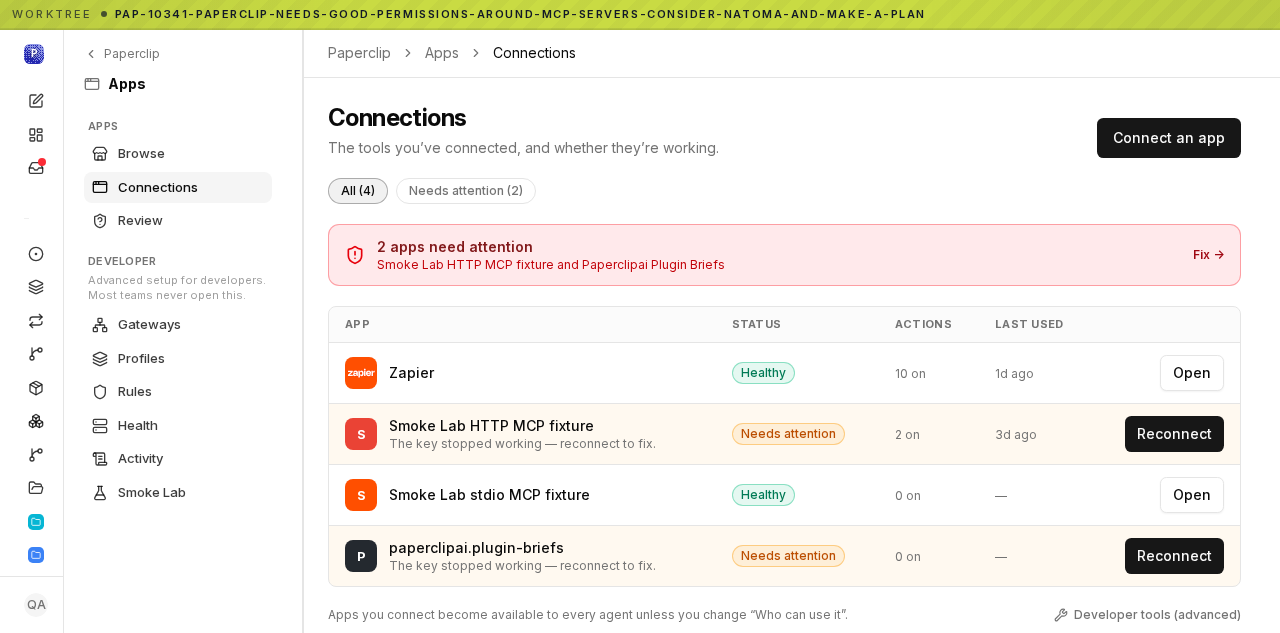
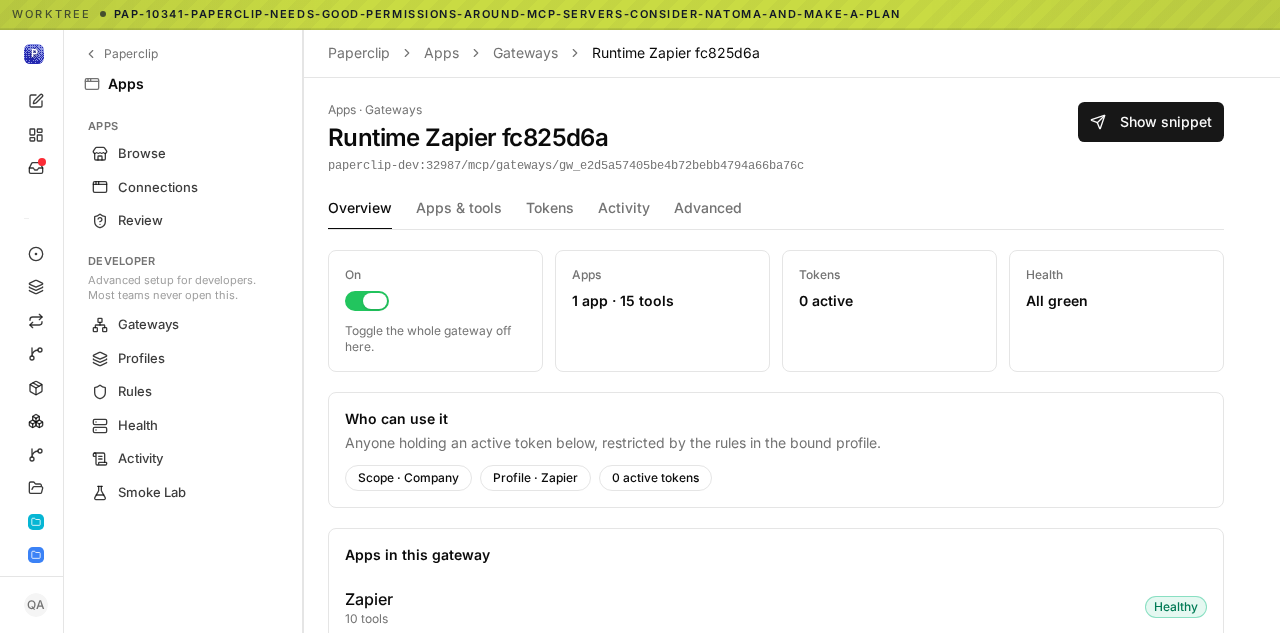
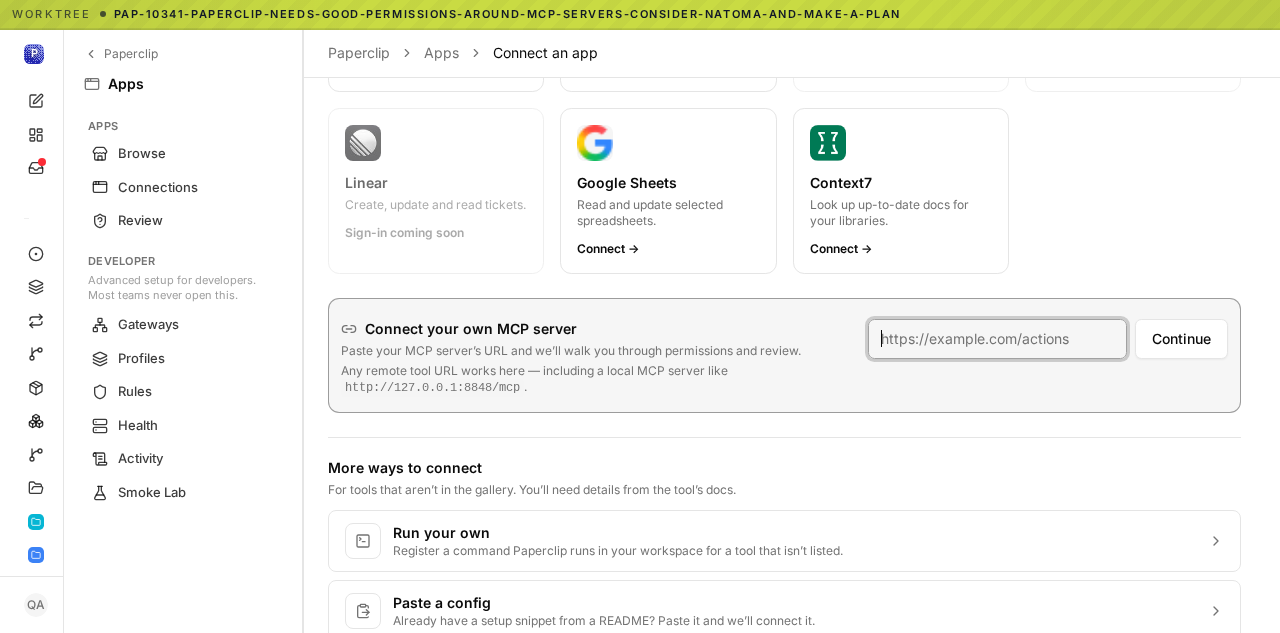
---------
Co-authored-by: Paperclip <noreply@paperclip.ing>
## Thinking Path
> - Paperclip is the open source app people use to manage AI agents for
work
> - Governed MCP access spans contracts, runtime enforcement, adapters,
UI surfaces, and operator verification
> - The parity reference PR #9534 is too large for effective automated
or human review
> - The feature therefore needs a linear stack whose individual diffs
stay below the 100-file review limit
> - This pull request is split 6/8 and focuses on UI API, shared
components, and Tools/Profile surfaces
> - The benefit is a standalone, testable review boundary while
preserving byte-for-byte parity at the top of the stack
## Linked Issues or Issue Description
- Related parity reference: #9534
- Problem: Operators need typed clients and administration surfaces that
compile independently before navigation exposes them.
- Proposed solution: Adds UI APIs, hooks, libraries, shared components,
Tools/Profiles pages, and the plugin settings consumer required by the
new company-scoped API.
- Alternatives considered: keeping #9534 as one 403-file review, or
rewriting the feature to manufacture seams; both were rejected in favor
of path extraction plus compile-driven boundary moves.
- Roadmap alignment: this advances the existing governed MCP/tool-access
work already represented by #9534; it does not introduce a separate
roadmap initiative.
- Stack position: base branch is
`pap10341-split/05-runtime-integration`.
- Merge policy: merge bottom-up, in order, only after the complete
eight-PR stack has been reviewed and the top-of-stack parity gate
remains empty.
- Requested review: UXDesigner sanity pass on Tools/Profile surfaces;
Greptile on every PR.
## What Changed
- Adds UI APIs, hooks, libraries, shared components, Tools/Profiles
pages, and the plugin settings consumer required by the new
company-scoped API.
- Keeps this PR below 100 changed files and independently typecheckable.
- Preserves the final tree from #9534 when combined with the other seven
stack levels.
## Verification
- `pnpm typecheck`
- `pnpm check:token-gates` — all gates clean
- Focused UI Vitest run with `NODE_ENV=test` — 28 files, 183 tests
passed
## Risks
- Large dead-code UI additions can drift from activation routes; PR 7
supplies the registration layer and top-level parity catches omissions.
- Stack risk: merging out of order can expose incomplete layers;
mitigate by following the documented bottom-up merge policy.
- Parity risk: later edits to an intermediate branch can drift from
#9534; mitigate by re-running the empty top-of-stack diff before merge.
> For core feature work, check [`ROADMAP.md`](ROADMAP.md) first and
discuss it in `#dev` before opening the PR. Feature PRs that overlap
with planned core work may need to be redirected — check the roadmap
first. See `CONTRIBUTING.md`.
## Model Used
- OpenAI Codex, exact model ID `gpt-5.4`; runtime-managed context
window; medium reasoning with repository, shell, Git, GitHub CLI, and
code-execution tools enabled.
## Checklist
- [x] I have included a thinking path that traces from project context
to this change
- [x] I have specified the model used (with version and capability
details)
- [x] I have checked ROADMAP.md and confirmed this PR does not duplicate
planned core work
- [x] I have searched GitHub for duplicate or related PRs and linked
them above
- [x] I have either (a) linked existing issues with `Fixes: #` / `Closes
#` / `Refs #` OR (b) described the issue in-PR following the relevant
issue template
- [x] Internal references are omitted except the execution-plan link
explicitly required for this coordinated split stack
- [x] My branch name describes the change and contains no internal
Paperclip ticket id or instance-derived details
- [x] I have run tests locally and they pass
- [x] I have added or updated tests where applicable
- [x] I have updated relevant documentation to reflect my changes
- [x] I have considered and documented any risks above
- [ ] All Paperclip CI gates are green
- [ ] Greptile is 5/5 with no open P2s, recommendations, or follow-ups
- [x] I will address all Greptile and reviewer comments before
requesting merge
## Stack Coordination
- Internal execution plan:
[PAP-13874](/PAP/issues/PAP-13874#document-plan)
- Parity reference: #9534
- Stack: #9556 → #9557 → #9558 → #9559 → #9560 → #9561 → #9562 → #9563
- Merge bottom-up only after full-stack review and an empty parity diff
at #9563.
## UI Evidence
QA captured these from the live Garden MCP split stack at 1440px and
verified clean rendering:
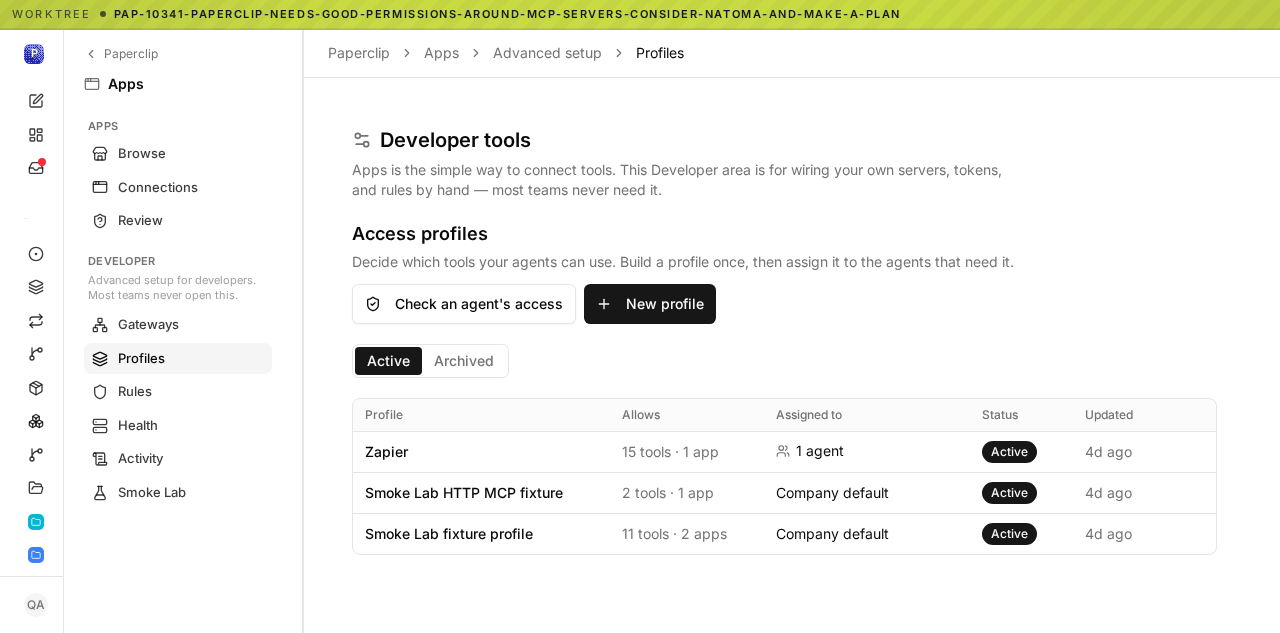
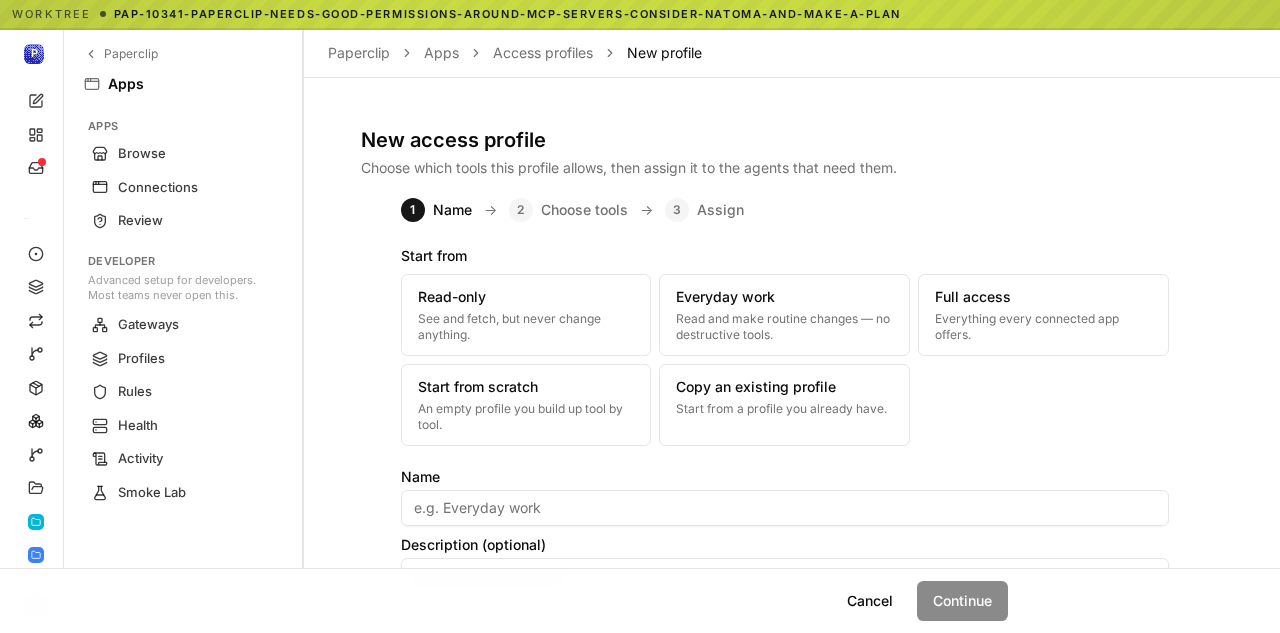
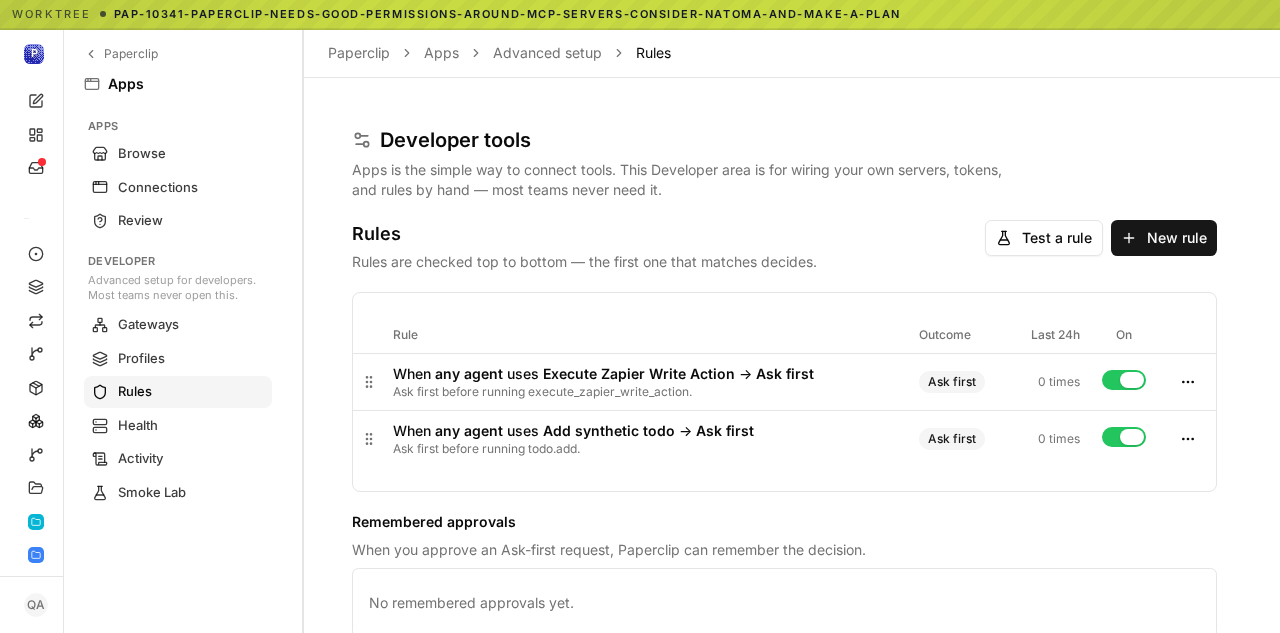
---------
Co-authored-by: Paperclip <noreply@paperclip.ing>
## Thinking Path

> - Paperclip is the open source control plane people use to manage AI
agents for work.
> - Local coding adapters currently spawn their CLI processes directly
on the Paperclip host.
> - CLI-native approval and sandbox flags do not provide a reliable host
filesystem or network boundary.
> - An agent can therefore inspect unrelated host files or fetch
external material when an operator needs stronger isolation.
> - The confinement must stay opt-in so existing local adapter behavior
does not change unexpectedly.
> - This pull request adds a shared Linux Bubblewrap spawn layer for
workspace filesystem and deny/allowlist network scopes.
> - The benefit is enforceable defense in depth around Codex and Claude
local runs while preserving explicit provider connectivity.

## Linked Issues or Issue Description

### What happened?

`codex_local` and `claude_local` processes could read arbitrary host
paths and make unrestricted outbound network requests because Paperclip
did not impose a spawn-level boundary.

### Expected behavior

Operators can opt into a workspace-only filesystem view and either deny
network egress or allow exact provider/API hosts, independently of CLI
approval flags.

### Steps to reproduce

1. Run current `master` on Linux and configure a Codex or Claude local
adapter.
2. Ask the agent to read a canary file outside its active workspace.
3. Ask the agent to `curl` a public host.
4. Observe that both operations succeed without a Paperclip-level
confinement option.

### Environment

- Paperclip commit: `c36f1a4af` / current `master` base.
- Deployment mode: Linux local dev or self-hosted server.
- Installation: built from source.
- Adapters: Codex and Claude Code.
- Database: not related.

## What Changed

- Added a shared Bubblewrap process wrapper with opt-in
`filesystemScope: "workspace"`, managed/extra path mounts, private
`/tmp`, and Linux-only validation.
- Added `networkScope: "deny" | "allowlist"`; both use a private network
namespace, while allowlist mode exposes an exact-host HTTP(S) proxy over
a Unix-socket bridge.
- Wired Codex and Claude local CLI execution through the wrapper and
forced scoped auto runs onto the CLI lane because ACP processes are not
covered.
- Added unit and gated Bubblewrap canaries for outside-file denial,
workspace writes, direct network denial, allowlisted forwarding, and
rejected destinations.
- Documented both scopes, provider allowlist examples, Bubblewrap
requirements, and default-off behavior.

## Verification

- `pnpm exec vitest run
packages/adapter-utils/src/local-process-sandbox.test.ts
packages/adapters/codex-local/src/server/acp.test.ts
packages/adapters/claude-local/src/server/acp.test.ts` — 34 passed, 4
gated Bubblewrap tests skipped by default.
- `pnpm --filter @paperclipai/adapter-utils typecheck`
- `pnpm --filter @paperclipai/adapter-codex-local typecheck`
- `pnpm --filter @paperclipai/adapter-claude-local typecheck`
- `pnpm --filter @paperclipai/adapter-utils build`
- `pnpm --filter @paperclipai/adapter-codex-local build`
- `pnpm --filter @paperclipai/adapter-claude-local build`
- Attempted the gated tests with a vendored Bubblewrap binary; this
container blocks unprivileged namespace setup (`setting up uid map:
Permission denied` / loopback `RTM_NEWADDR: Operation not permitted`),
so kernel-level execution remains for CI or a namespace-enabled Linux
host.

## Risks

- Bubblewrap must be installed and unprivileged user/mount/network
namespaces must be enabled on the host; scoped runs fail clearly if the
prerequisite is missing.
- Allowlist mode depends on the coding CLI honoring standard
`HTTP_PROXY` / `HTTPS_PROXY` variables; custom providers must list every
required exact hostname and port.
- Exact-host allowlists intentionally reject wildcards, which is safer
but may require operators to enumerate multi-host provider setups.
- No behavior changes unless an operator enables `filesystemScope` or
`networkScope`.

> This aligns with the ROADMAP direction toward safer remote and
sandboxed agent environments and does not duplicate an open PR or issue
found in the repository search.

## Model Used

- OpenAI GPT-5.5 (`gpt-5.5`) via Codex CLI, with reasoning, repository
tool use, shell execution, code editing, and test execution. The serving
context-window size is not exposed to the agent.

## Checklist

- [x] I have included a thinking path that traces from project context
to this change
- [x] I have specified the model used (with version and capability
details)
- [x] I have checked ROADMAP.md and confirmed this PR does not duplicate
planned core work
- [x] I have searched GitHub for duplicate or related PRs and linked
them above
- [x] I have either (a) linked existing issues with `Fixes: #` / `Closes
#` / `Refs #` OR (b) described the issue in-PR following the relevant
issue template
- [x] I have not referenced internal/instance-local Paperclip issues or
links (only public GitHub `#NNN` / `github.com/paperclipai/paperclip`
URLs)
- [x] My branch name describes the change (e.g. `docs/...`, `fix/...`)
and contains no internal Paperclip ticket id or instance-derived details
- [x] I have run tests locally and they pass
- [x] I have added or updated tests where applicable
- [x] I have updated relevant documentation to reflect my changes
- [x] I have considered and documented any risks above
- [ ] All Paperclip CI gates are green
- [ ] Greptile is 5/5 with no open P2s, recommendations, or follow-ups
- [x] I will address all Greptile and reviewer comments before
requesting merge

---------

Co-authored-by: Paperclip <noreply@paperclip.ing>
## Thinking Path

> - Paperclip is the open source app people use to manage AI agents for
work
> - It emits telemetry events to understand product usage — registered
event names are gated by a generated `PAPERCLIP_EVENTS` registry so the
client only enqueues known, schema-approved events
> - When product teams want to instrument a new behaviour, they must
first register the event name — but schema registration is a
commit-and-release cycle, which creates friction in fast-moving product
iterations
> - A proposal lane is needed: let developers mark a `track()` call with
a typed `@ts-expect-error` proposal marker so the event name can be
reviewed and tracked in CI before the schema is formally registered
> - The existing client had no guard against unregistered event names,
so any call with an out-of-registry name (or a prototype-inherited key)
would silently enter the queue, state, and network flush path
> - This PR adds an `Object.hasOwn(PAPERCLIP_EVENTS, eventName)` guard
at the entry point of `track()` to swallow unregistered calls before any
side effects, adds `scripts/extract-proposed-events.mjs` to scan source
for proposal markers and emit a v2 JSON manifest with provenance and
rationale, and documents the complete proposal workflow
> - The benefit is that new instrumentation can be proposed and reviewed
in code without touching the registered schema, and tooling can surface
missing rationale before events graduate to stable

## Linked Issues or Issue Description

No existing GitHub issue covers this change. This PR introduces a new
feature.

**Feature motivation:** Paperclip's telemetry schema is intentionally
stable — registered event names are code-generated and gated. Product
engineers who want to instrument a new behaviour today must land a
schema change first, creating a two-step process that slows iteration. A
proposal lane lets developers write the instrumentation call ahead of
schema registration, protected by a compile-time `@ts-expect-error`
marker that an extractor script can surface for review. This PR
implements both the client-side safety gate and the extraction tooling.

Refs: #9518 (closed predecessor — docs-only; this PR supersedes it with
the full implementation)

## What Changed

- Added `Object.hasOwn(PAPERCLIP_EVENTS, eventName)` guard at the top of
`TelemetryClient.track()`: unregistered event names (including
prototype-inherited keys) are now swallowed before any state, queue, or
network operation
- Added `scripts/extract-proposed-events.mjs`: scans TypeScript source
for `@ts-expect-error -- proposed-telemetry(<issue>): <rationale>`
markers; emits a v2 JSON manifest per proposed event including name,
rationale, provenance (repo-relative file + line), and a
`rationale_missing` flag for CI enforcement
- Added `scripts/extract-proposed-events.test.mjs`: test suite covering
marker parsing, multi-line markers, path validation, out-of-repo
rejection, and the v2 schema output contract
- Added `doc/TELEMETRY_WORKFLOW.md`: documents the proposal workflow,
the canonical multi-line marker example, rationale requirements, and how
to graduate a proposed event to stable schema
- Updated `packages/shared/src/telemetry/README.md`: added "Proposed
Events" section to the Telemetry Data Contract per the contributing
guide requirement for telemetry changes

## Verification

Run all of the following from the repo root:

```sh
# Extractor unit tests
node --test scripts/extract-proposed-events.test.mjs

# Telemetry client + types tests
pnpm exec vitest run --config vitest.config.ts \
  src/telemetry/client.test.ts src/telemetry/client-types.test.ts \
  --reporter=verbose
# (run from packages/shared)

# Type-check
pnpm --filter @paperclipai/shared typecheck

# Smoke-run the extractor in local-test mode
node scripts/extract-proposed-events.mjs --ref local-test
```

All four commands pass locally.

## Risks

- **Silent drop on unregistered events:** The `Object.hasOwn` guard
fails closed — any event name not in `PAPERCLIP_EVENTS` is silently
dropped. If the generated registry is missing an event that was
previously tracked, those calls will be silently lost. Mitigation: the
extractor script surfaces proposed events that need registration; the
TypeScript type system already enforces `TelemetryEventName ⊆
PAPERCLIP_EVENTS` at compile time.
- **Extractor is read-only:** `extract-proposed-events.mjs` reads source
and emits JSON; it does not modify any files. No runtime or schema risk.
- Overall risk: **low**. The guard is additive and defensive; the
extractor and docs are additive only.

## Model Used

- Provider: Anthropic
- Model ID: `claude-sonnet-4-6`
- Context window: 200 K tokens
- Capabilities: tool use, extended context, code generation

## Checklist

- [x] I have included a thinking path that traces from project context
to this change
- [x] I have specified the model used (with version and capability
details)
- [x] I have checked ROADMAP.md and confirmed this PR does not duplicate
planned core work
- [x] I have searched GitHub for duplicate or related PRs and linked
them above
- [x] I have either (a) linked existing issues with `Fixes: #` / `Closes
#` / `Refs #` OR (b) described the issue in-PR following the relevant
issue template
- [x] I have not referenced internal/instance-local Paperclip issues or
links (only public GitHub `#NNN` / `github.com/paperclipai/paperclip`
URLs)
- [x] My branch name describes the change (e.g. `docs/...`, `fix/...`)
and contains no internal Paperclip ticket id or instance-derived details
- [x] I have run tests locally and they pass
- [x] I have added or updated tests where applicable
- [x] I have updated relevant documentation to reflect my changes
- [x] I have considered and documented any risks above
- [ ] All Paperclip CI gates are green
- [ ] Greptile is 5/5 with no open P2s, recommendations, or follow-ups
- [x] I will address all Greptile and reviewer comments before
requesting merge

---------

Co-authored-by: Paperclip <noreply@paperclip.ing>
## Thinking Path

> - Paperclip is the open source control plane people use to manage
AI-agent companies
> - Budgets and spend telemetry are control-plane safety features, not
just reporting
> - Local Codex and Claude adapters can execute through either ACP or
their native CLI engines
> - The ACP lane records usage and reported cost, but CLI JSON output
often reports tokens without a price
> - The CLI lane was either losing per-run usage semantics or coercing
missing cost to zero, making real usage indistinguishable from a
genuinely free run
> - This pull request preserves CLI usage as per-run totals and records
token-bearing runs without a reported price as explicitly unpriced
ledger events
> - The benefit is accurate usage accounting and a visible pricing gap
instead of silently misleading zero-cost telemetry

## Linked Issues or Issue Description

Refs #9471
Refs #9230

**Bug description**

A `codex_local` run using the CLI engine can emit a final
`turn.completed` event with millions of input tokens and tens of
thousands of output tokens while the agent's spend ledger remains
indistinguishable from a true zero-usage, zero-cost run. Claude CLI
output has the same missing-price edge case.

**Expected behavior**

Token-bearing CLI runs should persist their usage. If the adapter
reports a price, the ledger should record it as reported; if the CLI
reports usage but no price, the ledger should explicitly mark the event
as unpriced rather than silently treating missing price data as a
reported `$0` cost.

**Reproduction shape**

1. Configure `codex_local` with `engine: cli`.
2. Run a task that produces a `turn.completed` usage payload.
3. Observe token usage in the run stream.
4. Before this change, missing price data is represented as ordinary
zero-cost spend and the CLI usage basis is not consistently propagated.

## What Changed

- Mark Codex and Claude native CLI usage totals as `per_run` and
propagate that basis through success and failure results.
- Stop coercing missing Claude CLI cost to `0`.
- Add `cost_status` to cost events with `reported` and `unpriced`
values, including an idempotent migration and shared validation/types.
- Persist token-bearing runs without a reported price as `unpriced`
ledger events while retaining zero cents until an authoritative price
exists.
- Add parser, execute-path, heartbeat-accounting, and cost-service
regression coverage for both local CLI adapters.
- Document the cost-status invariant and CLI accounting behavior.

## Verification

- `pnpm exec vitest run
packages/adapters/codex-local/src/server/parse.test.ts
packages/adapters/claude-local/src/server/parse.test.ts
server/src/__tests__/codex-local-execute.test.ts
server/src/__tests__/claude-local-execute.test.ts
server/src/__tests__/heartbeat-cost-accounting.test.ts
server/src/__tests__/costs-service.test.ts` — 6 files / 102 tests
passed.
- `pnpm --filter @paperclipai/shared typecheck`
- `pnpm --filter @paperclipai/db typecheck` — includes migration
numbering and safety checks.
- `pnpm --filter @paperclipai/adapter-codex-local typecheck`
- `pnpm --filter @paperclipai/adapter-claude-local typecheck`
- `pnpm --filter @paperclipai/server typecheck`

## Risks

- Existing cost rows default to `reported`, preserving current
interpretation; only new token-bearing events with absent cost are
marked `unpriced`.
- This change does not invent model pricing. Budget hard stops still
cannot charge an unknown amount, but operators and evals can now
distinguish missing pricing from a genuinely reported zero cost.
- Consumers that enumerate cost-event fields should tolerate the
additive `costStatus` field.

> For core feature work, check [`ROADMAP.md`](ROADMAP.md) first and
discuss it in `#dev` before opening the PR. Feature PRs that overlap
with planned core work may need to be redirected — check the roadmap
first. See `CONTRIBUTING.md`.

## Model Used

- OpenAI Codex, exact model `gpt-5.3-codex`, with repository tool use
and code execution; default reasoning mode.

## Checklist

- [x] I have included a thinking path that traces from project context
to this change
- [x] I have specified the model used (with version and capability
details)
- [x] I have checked ROADMAP.md and confirmed this PR does not duplicate
planned core work
- [x] I have searched GitHub for duplicate or related PRs and linked
them above
- [x] I have either (a) linked existing issues with `Fixes: #` / `Closes
#` / `Refs #` OR (b) described the issue in-PR following the relevant
issue template
- [x] I have not referenced internal/instance-local Paperclip issues or
links (only public GitHub `#NNN` / `github.com/paperclipai/paperclip`
URLs)
- [x] My branch name describes the change (e.g. `docs/...`, `fix/...`)
and contains no internal Paperclip ticket id or instance-derived details
- [x] I have run tests locally and they pass
- [x] I have added or updated tests where applicable
- [x] I have updated relevant documentation to reflect my changes
- [x] I have considered and documented any risks above
- [x] All Paperclip CI gates are green
- [x] Greptile is 5/5 with no open P2s, recommendations, or follow-ups
- [x] I will address all Greptile and reviewer comments before
requesting merge

Co-authored-by: Paperclip <noreply@paperclip.ing>
## Thinking Path

> - Paperclip is the open source app people use to manage AI agents for
work.
> - The heartbeat/recovery subsystem decides whether an agent run has a
durable continuation path after the process stops.
> - External waits need stricter semantics than local background
watchers: a killed local process is not durable, while a first-class
blocker/monitor/scheduled wake is.
> - Without that distinction, recovery can repeatedly treat
adapter-failed continuations as live work and obscure the real reason a
task stopped.
> - This pull request adds explicit durable external-wait liveness
handling and documents the expected execution semantics.
> - It also improves operator-visible recovery evidence so invalid
external-wait paths explain why they were rejected.
> - The benefit is clearer recovery behavior, fewer duplicate
continuation recoveries, and a safer contract for monitor-backed
external waits.

## Linked Issues or Issue Description

- Refs #5978
- Related PRs: #4988, #7495, #8502

## What Changed

- Added durable external-wait liveness classification so
local/background watchers are not accepted as durable live paths after
the owning process exits.
- Preserved first-class blocker/monitor/scheduled wake paths as valid
external-wait continuations.
- Added backend regression coverage for killed watcher failure,
monitor-backed durable wait resumption, normal completion, blocker
behavior, and no duplicate recovery.
- Added adapter utility coverage for terminal cleanup behavior used by
local process adapters.
- Surfaced invalid external-wait recovery evidence in the recovery
action card and run ledger.
- Updated execution semantics documentation and the V1 implementation
contract.

## Verification

- `pnpm check:token-gates` passed.
- `pnpm -r typecheck` passed.
- `node scripts/run-vitest-stable.mjs --mode general --group
general-server` equivalent lane passed in CI-clean env: 238 files, 2164
tests passed, 1 skipped.
- `node scripts/run-vitest-stable.mjs --mode general --group
general-workspaces-a` passed in fully Paperclip-env-clean env: UI 305
files / 2430 tests; CLI 43 files / 230 tests.
- `node scripts/run-vitest-stable.mjs --mode general --group
general-workspaces-b` passed in fully Paperclip-env-clean env:
shared/db/adapters/plugin packages all green.
- `node scripts/run-vitest-stable.mjs --mode serialized` passed in fully
Paperclip-env-clean env: 107 serialized server suites green, including
84/84 heartbeat-process-recovery tests.
- `pnpm build` passed in fully Paperclip-env-clean env.

Notes: running `pnpm test:run` directly inside the Paperclip heartbeat
environment exposed local harness env contamination in existing tests
(`PAPERCLIP_CONFIG`, `PAPERCLIP_DB_BACKUP_DIR`, and
`PAPERCLIP_WORKTREE_START_POINT`). Re-running the same lanes with
inherited `PAPERCLIP_*` and port env removed produced the CI-equivalent
green results above.

## Risks

- Medium behavioral risk: this changes recovery classification for
stopped local external-wait processes, so adapters relying on unmanaged
background watchers must use blockers, monitors, scheduled wakes, or
explicit durable handoff instead.
- Low UI risk: recovery-card copy changes are covered by component tests
and Storybook screenshot QA.
- No database migration is included.

> For core feature work, check [`ROADMAP.md`](ROADMAP.md) first and
discuss it in `#dev` before opening the PR. Feature PRs that overlap
with planned core work may need to be redirected — check the roadmap
first. See `CONTRIBUTING.md`.

## Model Used

- OpenAI Codex, GPT-5-based coding agent, tool-enabled terminal/code
execution. Exact context-window metadata was not exposed in the runtime.

## Checklist

- [x] I have included a thinking path that traces from project context
to this change
- [x] I have specified the model used (with version and capability
details)
- [x] I have checked ROADMAP.md and confirmed this PR does not duplicate
planned core work
- [x] I have searched GitHub for duplicate or related PRs and linked
them above
- [x] I have either (a) linked existing issues with `Fixes: #` / `Closes
#` / `Refs #` OR (b) described the issue in-PR following the relevant
issue template
- [x] I have not referenced internal/instance-local Paperclip issues or
links (only public GitHub `#NNN` / `github.com/paperclipai/paperclip`
URLs)
- [x] My branch name describes the change (e.g. `docs/...`, `fix/...`)
and contains no internal Paperclip ticket id or instance-derived details
- [x] I have run tests locally and they pass
- [x] I have added or updated tests where applicable
- [x] I have updated relevant documentation to reflect my changes
- [x] I have considered and documented any risks above
- [ ] All Paperclip CI gates are green
- [ ] Greptile is 5/5 with no open P2s, recommendations, or follow-ups
- [x] I will address all Greptile and reviewer comments before
requesting merge

---------

Co-authored-by: Paperclip <noreply@paperclip.ing>
Co-authored-by: Claude Opus 4.8 <noreply@anthropic.com>
## Thinking Path

> - Paperclip is the open source app people use to manage AI agents for
work.
> - Operators need first-party agent capabilities for repeatable company
work, not just manually created one-off agents.
> - Built-in agents need to behave like normal company-scoped agents
while preserving approval gates, permissions, budgets, and audit trails.
> - Reflection and coaching work also needs bundled instructions, skill
content, and a routine so the feature can be installed and reset
predictably.
> - The API, database, UI, portability, and tests all need to agree on
the built-in lifecycle from not provisioned through setup, approval,
ready, paused, and reset.
> - This pull request adds built-in agent provisioning and the
Reflection Coach bundle end-to-end.
> - The benefit is a safer first-party path for Paperclip-managed agents
without bypassing the same governance model used for operator-created
agents.

## Linked Issues or Issue Description

No public GitHub issue was found for this exact built-in agent and
Reflection Coach bundle work.

Problem/motivation:
- Paperclip did not have a first-party built-in agent lifecycle for
product-owned agents.
- Bundled agent resources such as default instructions, skills, and
routines needed managed ownership and reset semantics.
- Approval-gated companies needed built-in setup to preserve requested
adapter, budget, manager, and permission state through board approval.
- The board UI needed clear built-in badges, setup affordances,
readiness state, and bundle status without exposing secrets.

Proposed solution:
- Add a company-scoped built-in agent registry,
provisioning/reset/reconcile/status APIs, and Reflection Coach bundled
resources.
- Track bundled managed resources in the database with idempotent
migration behavior.
- Reuse existing agent approval, authorization, budget, and activity-log
paths instead of creating a bypass.
- Add UI setup, badges, gates, bundle panels, and route coverage for
built-in agents.

Duplicate search:
- Searched GitHub PRs for `built-in agents Reflection Coach
repo:paperclipai/paperclip`; only this PR was returned.
- Searched GitHub issues for the same query; no public issues were
returned.

## What Changed

- Added built-in agent definitions, lifecycle state derivation,
provisioning, reset, reconcile, status, and routine-control routes.
- Added the `built_in_managed_resources` migration and schema exports
for bundled instructions, skill, and routine ownership.
- Added the Reflection Coach built-in bundle with default instructions,
skill catalog content, routine template, default permissions, and
managed-resource drift handling.
- Added approval-aware provisioning behavior that preserves requested
adapter config, budgets, manager assignment, and built-in permissions
through hire approval.
- Added authorization and mutation gates for built-in agent and skill
changes, including consented Reflection Coach change paths.
- Added UI surfaces for built-in agent setup, roster/detail badges,
readiness gates, bundle status, routine controls, and route filtering.
- Added company import/export and validator coverage for built-in
managed resources and low-trust/red-team presets.
- Addressed Greptile follow-ups for pending approval reconciliation,
consent-gate error propagation, config-read authorization fallback,
approval-path manager preservation, and non-model adapter provisioning.

## Verification

Local verification:
- `git diff --check public/master..HEAD` passed.
- `pnpm check:token-gates` passed with all gates clean.
- `pnpm exec vitest run
ui/src/components/ConfigureBuiltInAgentModal.test.tsx` passed: 1 file, 4
tests.
- `pnpm exec vitest run ui/src/components/EntityRow.test.tsx
ui/src/pages/Agents.test.tsx ui/src/components/BuiltInAgentGate.test.tsx
ui/src/components/ConfigureBuiltInAgentModal.test.tsx
ui/src/components/BuiltInBundlePanel.test.tsx
ui/src/pages/InstanceExperimentalSettings.test.tsx
ui/src/pages/Routines.test.tsx` passed: 7 files, 64 tests.
- `pnpm --filter @paperclipai/server exec vitest run
src/__tests__/built-in-agents.test.ts
src/__tests__/authorization-service.test.ts
src/__tests__/company-skills-routes.test.ts` passed: 3 files, 91 tests.
- `pnpm --filter @paperclipai/db check:migrations` passed.
- `pnpm -r typecheck` passed after the rebase; `pnpm --filter ui
typecheck` passed after the final UI review fix.

Remote verification on latest head
`1c61f693a4ec881d739022b0e75a8ca8bf8c2cd8`:
- Merge state: `CLEAN`.
- Greptile: `5/5`, zero unresolved Greptile threads.
- PR check rollup: all checks successful, neutral, or skipped as
expected.
- Passing gates include Build, Typecheck + Release Registry, all server
shards, all workspace shards, all serialized server suites, e2e, Canary
Dry Run, policy, review, verify, Socket, Superagent, and Snyk.

## Risks

- This adds a new managed-resource table and migration; the migration
uses idempotent create/add/index guards and passed migration safety
checks.
- Built-in agent provisioning touches approval and authorization paths;
tests cover pending approval preservation, stale retry rejection,
consent gates, and config-read fallback behavior.
- Reflection Coach creates managed instructions, skill, and routine
resources; drift/reset behavior is covered by service tests and redacted
API responses.
- Non-model adapter setup now provisions a `needs_setup` built-in row
before command/endpoint fields are complete; this matches the server
lifecycle and is covered by the setup modal regression test.

## Model Used

OpenAI Codex coding agent based on GPT-5. Exact hosted model ID,
context-window size, and reasoning-mode labels are not exposed in this
runtime; tool use, shell execution, GitHub CLI/API access, and local
code editing were enabled.

## Checklist

- [x] I have included a thinking path that traces from project context
to this change
- [x] I have specified the model used (with version and capability
details)
- [x] I have checked ROADMAP.md and confirmed this PR does not duplicate
planned core work
- [x] I have searched GitHub for duplicate or related PRs and linked
them above
- [x] I have either (a) linked existing issues with `Fixes: #` / `Closes
#` / `Refs #` OR (b) described the issue in-PR following the relevant
issue template
- [x] I have not referenced internal/instance-local Paperclip issues or
links (only public GitHub `#NNN` / `github.com/paperclipai/paperclip`
URLs)
- [x] My branch name describes the change (e.g. `docs/...`, `fix/...`)
and contains no internal Paperclip ticket id or instance-derived details
- [x] I have run tests locally and they pass
- [x] I have added or updated tests where applicable
- [x] I have updated relevant documentation to reflect my changes
- [x] I have considered and documented any risks above
- [x] All Paperclip CI gates are green
- [x] Greptile is 5/5 with no open P2s, recommendations, or follow-ups
- [x] I will address all Greptile and reviewer comments before
requesting merge

---------

Co-authored-by: Paperclip <noreply@paperclip.ing>
## Thinking Path

> - Paperclip's UI is governed by the design system merged in #9134 and
the component convergence in #9240 — one Card, one Badge, one nav row,
one `IssueRow`, a single multiplicative radius ladder.
> - With those primitives in place, the remaining rough edges were
interaction and alignment details on the surfaces people use every day:
the inbox, the task list, the sidebar, and the routine/task detail
pages.
> - Each item here was reported from live use and fixed against a
running instance, then verified by measurement (pixel alignment, frame
timing) rather than by eye alone.
> - The result is that the inbox and task lists now behave as one system
(same hover, keyboard nav, tree-guide, and archive language), list
nesting reads correctly, list hover is smooth, and the routine detail
page scrolls and aligns like the rest of the app.

## Linked Issues or Issue Description

No public GitHub issue exists for this work; describing per the feature
template.

- **Problem**: after the design-system foundation (#9134) and component
convergence (#9240), the inbox/task lists still had interaction and
alignment gaps — hover lag on long lists, keyboard navigation that only
partly matched between the two lists, workspace/parent nesting whose
guides and chevrons didn't line up, an inbox that sat offset from the
task list, and a routine detail page with an odd double-scroll and a
bespoke sub-nav.
- **Proposed behavior**: the inbox and task lists share one interaction
contract (hover, keyboard nav, collapse, archive), list nesting aligns
to the status column with clean chevrons, list hover is CSS-only (no
per-hover re-render), and the routine detail page uses a fixed
header/sub-nav with a single scrolling content region and a sub-nav that
matches the primary nav.

## What Changed

- **List hover performance**: hover is now painted purely by CSS
`:hover` and records the hovered row in a ref, instead of writing
list-selection state on every `mouseenter` (which re-rendered 100–300
non-memoized rows per hover). Keyboard nav reads the ref so it still
continues from the hovered row; the keyboard band clears on the first
real mouse move so hover and keyboard selection never show two bands at
once. The row's `transition-colors` fade was removed so the highlight
snaps (no comet-tail). Measured on a 100-row scrub: worst frame **333 ms
→ 33 ms**, long frames (>50 ms) **12 → 0**, avg **41 → 60 fps**.
- **Inbox ↔ task-list parity**: keyboard navigation works on every inbox
tab (archive/read keys stay scoped to the archivable tab); group headers
and parent tasks collapse/expand with the arrow keys in both lists; the
task list gains the same j/k / arrows / Enter selection model as the
inbox; hover selection bands match; the `g` then `i` go-to-inbox chord
works app-wide.
- **List nesting & alignment**: the workspace group-header chevron lines
up exactly with the task chevrons below it (both lists); the
parent→child connector line drops from under the parent's **status
icon** rather than its chevron and breaks with a 14px gap around a
nested row's own chevron; and inbox rows line up with the task list
(read rows no longer reserve a mark-read column).
- **Inbox archive affordance**: moved from a bare `x` left of the status
icon to an `Archive` icon + label button on the right (before the
timestamp), revealed on row hover; the left slot now carries only the
unread dot; swipe-to-archive is unchanged.
- **Sidebar**: when no agent has a live run, the AGENTS section shows 3
recent agents (was 5) plus "See all agents"; the working-agents view is
unchanged.
- **Routine detail page**: the layout is bounded to the main scroll area
so the header (Run now + automation toggle) and the sub-nav stay fixed
and only the section content scrolls (was a page-level scroll competing
with a `sticky` sub-nav). The sub-nav items adopt the primary nav's
rhythm — row padding/height, inset rounded pill, type scale, and 16px
icons — and its background matches the main nav.
- **Task detail**: dropped the redundant `🔵` prefix the breadcrumb added
for live/in-progress tasks; the status glyph already conveys that state.

## Verification

- `pnpm check:token-gates` → 3/3 CLEAN
- `pnpm typecheck` → green (all packages)
- `cd ui && npx vitest run` → 2255/2255 (assertions updated in lockstep
where behavior changed)
- `pnpm --filter @paperclipai/ui build` → exit 0
- Storybook visual regression: run locally throughout (the
baseline-manifest archive is still unpublished, so CI cannot run this
suite — pre-existing condition from #9134). Every visible delta was
reviewed against a live instance and, where it was intentional (nesting
alignment, routine sub-nav restyle, unread-row shift), the affected
snapshots were re-baselined locally.
- Manual/measured: inbox + task lists (grouped and nested, light +
dark), hover-scrub frame timing, keyboard navigation, and the routine
detail scroll/alignment were exercised on a running instance.

## Risks

- Behavior-and-alignment changes concentrated in `IssueRow` /
`IssuesList` / `Inbox` (the shared task-row surfaces). The riskiest area
— the hover/keyboard-selection model — is covered by unit tests (updated
in lockstep) and was measured and driven live.
- The routine detail scroll change restructures that page's layout
container; verified the page's own scroll stays fixed while only the
section content scrolls.
- The visual suite cannot yet run in CI (unpublished baseline archive —
pre-existing); snapshot coverage is local-only until that lands.

## Model Used

- Claude Fable 5 (`claude-fable-5`, Anthropic) via Claude Code — agentic
coding with tool use (file editing, test execution, Playwright
measurement/screenshot verification); extended thinking enabled.

## Checklist

- [x] I have included a thinking path that traces from project context
to this change
- [x] I have specified the model used (with version and capability
details)
- [x] I have checked ROADMAP.md and confirmed this PR does not duplicate
planned core work
- [x] I have searched GitHub for duplicate or related PRs and linked
them above
- [x] I have either (a) linked existing issues with `Fixes: #` / `Closes
#` / `Refs #` OR (b) described the issue in-PR following the relevant
issue template
- [x] I have not referenced internal/instance-local Paperclip issues or
links (only public GitHub `#NNN` / `github.com/paperclipai/paperclip`
URLs)
- [x] My branch name describes the change (e.g. `docs/...`, `fix/...`)
and contains no internal Paperclip ticket id or instance-derived details
- [x] I have run tests locally and they pass
- [x] I have added or updated tests where applicable

---------

Co-authored-by: Claude Fable 5 <noreply@anthropic.com>
## Thinking Path
> - Paperclip is the open source app people use to manage AI agents for
work.
> - Adapter packages are the bridge between the control plane and local
agent harnesses such as Claude Code, Codex, and Gemini CLI.
> - ACP support was concentrated in a separate `acpx_local` adapter,
which made ACP feel like a separate agent choice instead of an execution
capability of the harness adapters.
> - Claude, Codex, and Gemini now have ACP-capable harnesses, so the
native adapter should own ACP selection, fallback, config, transcript
parsing, and environment diagnostics.
> - The standalone ACPX adapter still needs a compatibility path for
existing rows, but it should not be offered as an active adapter for new
agents.
> - This pull request moves the shared ACP runtime into
`@paperclipai/acpx-engine`, wires Claude/Codex/Gemini local adapters to
prefer ACP when prerequisites are available, and retires `acpx_local` to
a tombstone.
> - The benefit is one adapter per harness, richer ACP transcripts by
default where possible, and a migration path for existing Claude/Codex
ACPX agents.
## Linked Issues or Issue Description
Closes#5932 — the broken default `acpx_local` Claude path is replaced
by native `claude_local` ACP support, existing Claude/Codex ACPX rows
migrate to native adapters, and new agents no longer choose the
standalone ACPX adapter.
Refs #4893 — original merged ACPX local adapter runtime that this PR
replaces with native per-harness ACP engines.
Refs #6590 — prior ACPX-Claude seamlessness work folded into the new
native Claude ACP path.
Refs #197 — related open generic ACP/Kiro adapter work; this PR does not
close it because Kiro/custom generic ACP remains a separate adapter
decision.
Refs #7018 — related Kimi-specific `acpx_local` shell failure; this PR
retires the built-in standalone adapter but does not add a native Kimi
adapter.
Refs #8864 — related ACPX prompt/API guidance PR; this PR moves runtime
guidance into the shared/native ACP engine path instead of the old
standalone adapter.
Refs #8881 — related `acpx_local` POSIX shell failure from the old
`acpx` pin; this PR updates ACP dependencies but does not claim
custom/OMP ACP support as a first-class native adapter.
Refs #8964 — related open `acpx_local` stderr cleanup PR; this PR makes
the old runtime path obsolete for new agents but keeps it as a
non-closing reference.
Problem description:
- The standalone `acpx_local` adapter duplicates Claude/Codex agent
choices that already have first-class local adapters.
- ACP should be an execution engine capability of each harness adapter
when the underlying harness supports ACP.
- Existing `acpx_local` agents should either migrate to native harness
adapters or fail with an explicit retirement message instead of silently
falling back to the process adapter.
## What Changed
- Added `@paperclipai/acpx-engine` as the shared ACP execution,
session-codec, CLI formatter, and UI parser package.
- Wired `claude_local`, `codex_local`, and `gemini_local` to auto-select
ACP by default when prerequisites pass, with `engine=cli` opt-out and
`engine=acp` strict mode.
- Added ACP config schema/UI fields, environment checks, session-codec
preservation, transcript parsing, and adapter capability metadata for
the native adapters.
- Retired `acpx_local` to a server tombstone, removed its
UI/package/runtime image surface, and added a migration for existing
Claude/Codex ACPX agents.
- Updated package manifests, lockfile, release tooling, docs, Kubernetes
sandbox defaults, and tests.
## Verification
- `corepack pnpm --filter @paperclipai/acpx-engine typecheck`
- `corepack pnpm --filter @paperclipai/adapter-claude-local typecheck`
- `corepack pnpm --filter @paperclipai/adapter-codex-local typecheck`
- `corepack pnpm --filter @paperclipai/adapter-gemini-local typecheck`
- `corepack pnpm --filter @paperclipai/acpx-engine exec vitest run`
- `corepack pnpm --filter @paperclipai/adapter-claude-local exec vitest
run src/server/acp.test.ts src/server/execute.acp-fallback.test.ts
src/ui/build-config.test.ts`
- `corepack pnpm --filter @paperclipai/adapter-codex-local exec vitest
run src/server/acp.test.ts src/ui/build-config.test.ts`
- `corepack pnpm --filter @paperclipai/adapter-gemini-local exec vitest
run src/server/acp.test.ts src/ui/build-config.test.ts
src/ui/parse-stdout.test.ts`
- `corepack pnpm --filter @paperclipai/plugin-sdk ensure-build-deps &&
corepack pnpm --filter @paperclipai/server exec tsc --noEmit`
- `corepack pnpm --filter @paperclipai/server exec vitest run
src/__tests__/adapter-routes.test.ts
src/__tests__/adapter-session-codecs.test.ts
src/__tests__/adapter-models.test.ts`
- `corepack pnpm --filter @paperclipai/ui typecheck`
- `corepack pnpm --filter @paperclipai/ui exec vitest run
src/adapters/metadata.test.ts
src/adapters/adapter-display-registry.test.ts
src/components/AgentConfigForm.test.ts
src/components/AgentConfigForm.render.test.tsx
src/components/transcript/RunTranscriptView.test.tsx`
- `node --test scripts/bootstrap-npm-package.test.mjs
scripts/release-package-map.test.mjs
scripts/verify-release-registry-state.test.mjs`
Note: the server typecheck script calls `pnpm` internally; this dev
shell exposes pnpm through Corepack only, so I ran the two script steps
manually with `corepack pnpm`.
## Risks
- Migration changes existing `acpx_local` Claude/Codex agents to native
adapter types and clears old ACPX task sessions/runtime state.
- Custom ACP commands remain on the retired tombstone and will need a
separate future adapter/plugin path.
- ACP auto-selection depends on local Node and ACP server command
prerequisites; remote and unsupported environments fall back to CLI
unless `engine=acp` is explicit.
- `@paperclipai/acpx-engine` is a new public package and needs npm
trusted-publishing bootstrap before release automation can publish it.
> For core feature work, check [`ROADMAP.md`](ROADMAP.md) first and
discuss it in `#dev` before opening the PR. Feature PRs that overlap
with planned core work may need to be redirected — check the roadmap
first. See `CONTRIBUTING.md`.
## Model Used
OpenAI GPT-5 via Codex coding agent. Exact hosted model build and
context-window size are not exposed in this runtime. Tool use included
shell execution, repository editing, GitHub CLI operations, and local
test/typecheck execution.
## Checklist
- [x] I have included a thinking path that traces from project context
to this change
- [x] I have specified the model used (with version and capability
details)
- [x] I have checked ROADMAP.md and confirmed this PR does not duplicate
planned core work
- [x] I have searched GitHub for duplicate or related PRs and linked
them above
- [x] I have either (a) linked existing issues with `Fixes: #` / `Closes
#` / `Refs #` OR (b) described the issue in-PR following the relevant
issue template
- [x] I have not referenced internal/instance-local Paperclip issues or
links (only public GitHub `#NNN` / `github.com/paperclipai/paperclip`
URLs)
- [x] My branch name describes the change (e.g. `docs/...`, `fix/...`)
and contains no internal Paperclip ticket id or instance-derived details
- [x] I have run tests locally and they pass
- [x] I have added or updated tests where applicable
- [x] I have updated relevant documentation to reflect my changes
- [x] I have considered and documented any risks above
- [x] All Paperclip CI gates are green
- [x] Greptile is 5/5 with no open P2s, recommendations, or follow-ups
- [x] I will address all Greptile and reviewer comments before
requesting merge
---------
Co-authored-by: Paperclip <noreply@paperclip.ing>
## Thinking Path

> - Paperclip is the open source app people use to manage AI agents for
work
> - Its UI is governed by a design system (`DESIGN.md` + the token layer
in `ui/src/index.css`, merged in #9134) whose first principle is "one
way to say each thing" — one Card, one Badge, one nav row
> - After the token extraction landed, ~35 files still hand-rolled card
containers, ~45 files hand-rolled pill spans, the sidebar agents section
duplicated the nav-row chrome, and the inbox and tasks lists rendered
the same task rows two subtly different ways
> - Each divergence is a place where a future design change (radius,
hover language, status vocabulary) silently misses surfaces, defeating
the "edit tokens + run checks" model the design system exists for
> - This pull request converges those surfaces onto the shared
primitives, codifies the radius scale as the modern multiplicative
shadcn ladder, and unifies the row/hover/tree-guide language across the
inbox and tasks lists — every visible delta was human-reviewed
screen-by-screen against a live instance across nine feedback rounds
> - The benefit is that the app's look is now steerable from single
knobs (one `--radius` anchor, one Card, one Badge, one row component),
and the visual regression suite covers the result (514 snapshots
including a new AgentDetail page story)

## Linked Issues or Issue Description

No public GitHub issue exists for this work; describing per the feature
template:

- **Problem**: after the design-token foundation (#9134),
component-level drift remained — hand-rolled cards/pills, duplicated
sidebar row chrome, and two different renderings of task rows (inbox vs
tasks list) meant design changes had to be applied per-surface and
frequently missed spots (e.g. status glyphs rendered 16px in the inbox
but 20px in the tasks list because a slot override silently beat the
component default).
- **Proposed behavior**: all card-shaped containers render via `Card`,
all label pills via `Badge`, sidebar rows via `SidebarNavItem`, and both
task-list surfaces via one `IssueRow` configuration; the radius scale is
a single multiplicative ladder anchored at `--radius: 0.5rem`.
- **Alternatives considered**: converting interactive
`<button>`/`<Link>` cards to `Card` divs (rejected — breaks semantics;
documented inline with `design-allow` comments instead); keeping the
legacy additive radius ladder (rejected in favor of the standard shadcn
multiplicative mapping).

## What Changed

- `Card` adoption across ~35 files (settings pages, auth/board flows,
dashboards, list containers, KPI tiles); non-adoptable sites
(interactive cards, `<li>` rows, class-string props, chart tooltip)
carry documented `design-allow(card-pattern)` comments
- `Card` gains an `interactive` prop — one quiet hover affordance for
clickable cards (cursor, border darken, shadow lift, focus ring),
applied to skills tiles, artifact cards, and the company selector; cards
carry no resting shadow
- `Badge` adoption for 113 hand-rolled pill spans across ~45 files;
`PropertyChip` wraps `Badge` internally; `StatusBadge`, external-object
chips, and match chips stay bespoke by documented decision (WCAG-tuned
status mechanics)
- Radius ladder becomes the multiplicative shadcn mapping
(`sm/md/lg/xl/2xl/3xl/4xl = 0.6/0.8/1.0/1.4/1.8/2.2/2.6 × --radius`,
anchor `0.5rem`); every card surface unifies on `rounded-lg`; the
orphaned 8px literal token is deleted
- Sidebar: agent rows render via `SidebarNavItem` (new additive props:
`iconNode`, `active`, `trailing`, `liveAccessory`); live dots use
`--status-agent-running`; one row rhythm and inset rounded pill
highlight; right-aligned trailing badges; every labeled section is
collapsible
- Inbox + tasks lists unified: md status glyphs, `accent/50` rounded row
hovers, vertical tree guides under parent rows (opaque underlay so
dark-mode translucent borders don't stack), no horizontal dividers under
expanded parents; the swipe-to-archive reveal layer shows only
mid-swipe; board toggle uses the `SquareKanban` glyph
- Kanban: every column carries a status-hued tint; lanes default
expanded (including empty); compact mode collapses empty lanes to
labeled rails (fixes a clipped, label-less empty-column state)
- Storybook: new AgentDetail page story (realistic fixtures, light+dark)
joins the visual suite; suite captures with `reducedMotion: 'reduce'`
and the ux-lab reasoning ticker honors `prefers-reduced-motion`; a stale
lexical alias in `storybook/main.ts` is fixed (build was broken since
the lexical 0.46 bump)
- Keyboard navigation, from live review of the unified lists: inbox
navigation keys work on every tab (archive keys stay scoped to the
archivable tab); keyboard-driven scrolling no longer hands the selection
to whatever row lands under the stationary cursor (hover selects only
after real pointer movement); the tasks list view gains the same j/k /
arrows / Enter selection model as the inbox; and the `g` then `i`
go-to-inbox chord works app-wide instead of only on the issue detail
page
- Token gates restored to 3/3 CLEAN (tokenized a post-#9134 regression
in the recovery card); decisions recorded in
`doc/design/DECISION-SHEET.md` and `doc/design/COMPONENT-INVENTORY.md`
(investigation verdicts: FileTree vs WorkspaceFileBrowser and the four
entity pickers stay separate — evidence included)

## Verification

- `pnpm check:token-gates` → 3/3 CLEAN
- `pnpm typecheck` → green (all packages)
- `cd ui && npx vitest run` → 2106/2106 (assertions updated in lockstep
where they documented superseded decisions; new tests for the global
go-to-inbox chord)
- `pnpm --filter @paperclipai/ui build` → exit 0
- `pnpm build-storybook` → succeeds (also fixes the lexical-alias break
on master)
- Visual regression: 514-snapshot Playwright suite green against the
updated baseline (zero diffs from the keyboard-navigation round — those
changes are purely behavioral). Note: baselines live outside git per the
suite design and the baseline-manifest archive is not yet published, so
CI cannot run this suite — it was run locally throughout; every visible
delta was reviewed screen-by-screen in a live instance across nine
review rounds. Review evidence (before/after triplets) intentionally
kept out of the repo for size; available on request.
- Manual: exercised dashboard, tasks (list + board), inbox, agents,
skills, costs, settings, and artifact surfaces in light and dark themes

## Risks

- Wide but shallow visual surface: most changes are class-string
substitutions with behavior preserved (props, handlers, roles, test
ids). The riskiest areas — dnd-kit card refs (React 19 ref-as-prop),
inbox swipe-to-archive, and sidebar overlays — are covered by existing
unit tests (all green) and were manually exercised.
- Intentional visual deltas (rounded cards, tinted kanban columns, md
status glyphs, unified hovers) are design decisions recorded in
`doc/design/DECISION-SHEET.md`; each maps to a re-baselined snapshot set
locally.
- The visual suite cannot yet run in CI (unpublished baseline archive —
pre-existing condition from #9134); until that lands, snapshot coverage
is local-only.

## Model Used

- Claude Fable 5 (`claude-fable-5`, Anthropic) via Claude Code — agentic
coding with tool use (file editing, test execution, Playwright
screenshot verification); extended thinking enabled.

## Checklist

- [x] I have included a thinking path that traces from project context
to this change
- [x] I have specified the model used (with version and capability
details)
- [x] I have checked ROADMAP.md and confirmed this PR does not duplicate
planned core work
- [x] I have searched GitHub for duplicate or related PRs and linked
them above
- [x] I have either (a) linked existing issues with `Fixes: #` / `Closes
#` / `Refs #` OR (b) described the issue in-PR following the relevant
issue template
- [x] I have not referenced internal/instance-local Paperclip issues or
links (only public GitHub `#NNN` / `github.com/paperclipai/paperclip`
URLs)
- [x] My branch name describes the change (e.g. `docs/...`, `fix/...`)
and contains no internal Paperclip ticket id or instance-derived details
- [x] I have run tests locally and they pass
- [x] I have added or updated tests where applicable
- [x] I have updated relevant documentation to reflect my changes
- [x] I have considered and documented any risks above
- [ ] All Paperclip CI gates are green (will confirm once CI runs)
- [ ] Greptile is 5/5 with no open P2s, recommendations, or follow-ups
(pending first review)
- [x] I will address all Greptile and reviewer comments before
requesting merge

🤖 Generated with [Claude Code](https://claude.com/claude-code)

---------

Co-authored-by: Claude Fable 5 <noreply@anthropic.com>
## Thinking Path

> - Paperclip is the open source app people use to manage AI agents for
work.
> - Storybook visual baselines protect UI surfaces from unintended
visual drift.
> - Pixel-perfect screenshot baselines are sensitive to OS, font
rasterization, and browser environment.
> - The suite already stores external baseline artifacts and has an
opt-in CI path.
> - Local runs on non-matching platforms can report false-positive diffs
unless the platform lock is explicit.
> - This pull request documents the Linux/Ubuntu baseline constraint and
makes the local static server port explicit.
> - The benefit is clearer visual-review guidance and more predictable
Playwright web server startup.

## Linked Issues or Issue Description

No public GitHub issue exists.

### What happened?

The Storybook visual baseline suite requires a matching Linux capture
environment for pixel-exact comparisons, but the docs did not clearly
warn local users that non-Linux environments can produce false-positive
diffs. The Playwright web server command also relied on the static
server's default port instead of passing the configured port explicitly.

### Expected behavior

Developers should see clear Linux/Ubuntu baseline guidance before
running the visual suite locally, and Playwright should start the
Storybook static server on the same explicit port that the test config
expects.

### Steps to reproduce

1. Review the Storybook visual docs before this PR.
2. Run or inspect the Storybook visual Playwright config.
3. Notice the missing platform guidance and implicit static server port
coupling.

### Paperclip version or commit

Reproducible on `master` before this branch.

### Deployment mode

Local dev (pnpm dev) / built from source.

## What Changed

- Documents the Linux/Ubuntu-only baseline limitation in the developer
docs and visual-suite README.
- Adds `--port` parsing and validation to the Storybook static server
helper.
- Adds regression coverage for `--port` followed by another flag.
- Passes the Playwright web server port explicitly from the Storybook
visual config.

## Verification

- Passed: `node --check scripts/serve-storybook-static.mjs`
- Passed: `node --test
scripts/__tests__/serve-storybook-static.test.mjs`
- Passed: `node --test
scripts/__tests__/storybook-visual-baseline.test.mjs`
- Greptile: 5/5 with no unresolved review threads after commit
`94a649755a2ae7c4a34a3e8a1f16ec4d26d738fd`.
- Not run: full `pnpm test:storybook-visual`, because it builds
Storybook and runs the browser visual suite; this PR only changes docs
plus server port plumbing.

## Risks

Low risk. The server still defaults to port 6106 when no explicit port
is provided, and invalid port values now fail fast with a clear error
before the Playwright server waits for an unreachable URL.

## Model Used

OpenAI GPT-5 Codex coding agent with local command execution and
repository editing tools.

## Checklist

- [x] I have included a thinking path that traces from project context
to this change
- [x] I have specified the model used (with version and capability
details)
- [x] I have checked ROADMAP.md and confirmed this PR does not duplicate
planned core work
- [x] I have searched GitHub for duplicate or related PRs and linked
them above
- [x] I have either (a) linked existing issues with `Fixes: #` / `Closes
#` / `Refs #` OR (b) described the issue in-PR following the relevant
issue template
- [x] I have not referenced internal/instance-local Paperclip issues or
links (only public GitHub `#NNN` / `github.com/paperclipai/paperclip`
URLs)
- [x] My branch name describes the change (e.g. `docs/...`, `fix/...`)
and contains no internal Paperclip ticket id or instance-derived details
- [x] I have run tests locally and they pass
- [x] I have added or updated tests where applicable
- [x] I have updated relevant documentation to reflect my changes
- [x] I have considered and documented any risks above
- [x] All Paperclip CI gates are green
- [x] Greptile is 5/5 with no open P2s, recommendations, or follow-ups
- [x] I will address all Greptile and reviewer comments before
requesting merge

---------

Co-authored-by: Paperclip <noreply@paperclip.ing>
## Thinking Path

> - Paperclip is the open source app people use to manage AI agents for
work
> - Its UI is the operator's daily surface: task lists, boards, budgets,
agent status — all built on shadcn components and Tailwind
> - Visual values (colors, spacing, type sizes, radii) were hardcoded at
~1,600 call sites: the same "small gray label" was 9/10/11px depending
on the file, charts disagreed with chips about status colors, two
toggle-switch implementations coexisted in two greens, and there was no
visual regression coverage
> - This made the UI drift-prone and made any restyle a
hundreds-of-files project, which discourages design iteration
> - This pull request extracts visual values into a single token layer
in `ui/src/index.css`, adds a Storybook visual regression suite backed
by external immutable baseline archives, and then applies a deliberate
retune reviewed change-by-change on screenshot diffs
> - The benefit is that Paperclip's look becomes a config surface:
retheming is a token edit reviewed as a snapshot diff, drift is blocked
by a token gate, and future UI PRs can prove exactly what changed
visually without committing hundreds of PNGs

## Linked Issues or Issue Description

No existing public issue covers this work (searched "design tokens",
"visual regression", "design system" across issues and PRs). Related in
spirit: Refs #8982 (theming a hardcoded panel — a one-off instance of
the same problem class this PR addresses systematically).

**Problem (feature-request form):** UI visual values are hardcoded per
call site with no source of truth and no regression coverage;
consistency depends on reviewer memory, and restyling requires mass file
edits.
**Proposed solution (this PR):** a single token layer + enforcement gate
+ externally stored visual snapshot suite, then an intentional restyle
on top of that foundation.

## What Changed

- **Token extraction (zero visual change, machine-verified during
development):** committed codemods (`scripts/codemod-*.mjs`) moved
~1,600 hardcoded color/type/spacing/radius/shadow/misc values into named
tokens in a non-inline `:root` block of `ui/src/index.css`.
- **Visual regression suite:** `pnpm test:storybook-visual` covers 255
stories × light/dark = 510 Playwright screenshots at `maxDiffPixels: 0`,
plus new primitive-coverage stories and deterministic-render fixes.
- **External visual baselines:** committed PNG snapshots were removed.
`tests/storybook-visual/baseline-manifest.json` pins an immutable
archive URL/hash/size/count, and `scripts/storybook-visual-baseline.mjs`
handles `download`, `verify`, `pack`, and trusted maintainer `upload`
flows.
- **Opt-in visual CI artifacts:** added a `Storybook Visual` workflow
that runs on manual dispatch or PRs labeled `storybook-visual`,
downloads/verifies the baseline, runs Playwright, and uploads Playwright
report/test-result artifacts for review. Normal PR runs do not mutate
baseline objects.
- **Token gate:** `pnpm check:token-gates` — zero hex literals, zero
arbitrary bracket values, zero raw font-sizes in `ui/src/components/**`
and `ui/src/pages/**`, with a documented inline allowlist for legitimate
opt-outs.
- **Theme retune (intentional, snapshot-reviewed):** new base theme
values; radius ladder derived from a single `--radius` knob; micro-type
cluster collapsed to a named ladder (`--text-nano/micro/compact` +
Tailwind `text-xs`/`text-sm`); letter-spacing collapsed to named steps.
- **One status-color vocabulary:** charts, quota/budget bar fills,
RUNNING/live chips, and liveness indicators all use the canonical
`--status-*` hues. Light-mode legibility fixes for red alert surfaces
that used dark-tuned text classes.
- **One switch:** `ToggleSwitch` restyled to the registry capsule form,
second hand-rolled implementation removed, and all call sites unified.
- **Docs:** `DESIGN.md` is the design contract; `doc/design/` holds
audit reports, decision logs, and updated guidance for external baseline
review/update workflows.
- Dead code removed (`agentStatusBadge` duplicate map), byte-identical
contrast constants consolidated, semantic renames
(`--project-seed`/`--project-none`, `--liveness-blue`).

## Verification

- `pnpm check:token-gates` — 3/3 gates CLEAN during the design-system
run
- `pnpm typecheck` && `pnpm --filter @paperclipai/ui build` — green
during the design-system run
- `node --test scripts/__tests__/storybook-visual-baseline.test.mjs` —
pass after external-baseline rework
- `pnpm exec tsc --noEmit --pretty false --module NodeNext
--moduleResolution NodeNext --target ES2022 --types
node,@playwright/test tests/storybook-visual/playwright.config.ts
tests/storybook-visual/storybook-visual.spec.ts` — pass after
external-baseline rework
- `git diff --check origin/pr/9134..HEAD` — pass after external-baseline
rework
- `find tests/storybook-visual -type f -name '*.png' -print | wc -l` —
`0`
- `node scripts/storybook-visual-baseline.mjs verify` — intentionally
fails closed until the first trusted maintainer publishes the baseline
archive and updates `baseline-manifest.json`

## Risks

- **Large but shallow:** the PR still touches many UI files due to
mechanical token extraction and retune work, but committed PNG snapshot
churn has been removed from the branch.
- **Baseline publication required before the visual suite can pass in
clean clones:** the manifest currently has placeholder archive metadata.
A trusted maintainer must publish the first immutable archive, then
update `baseline-manifest.json`.
- **Rendering platform variance:** the external baseline should be
captured in the documented Linux/Chromium environment. Future CI runs
verify against the pinned archive and fail closed on checksum/count
mismatch.
- **Visual CI is opt-in while stabilizing:** add the `storybook-visual`
label or dispatch the workflow manually to produce downloadable
Playwright report/test-result artifacts.
- **Scheduled follow-ups, deliberately out of scope:** Tailwind palette
classes map to semantic tokens in a dedicated pass; card/pill component
consolidation; ESLint ratchet. Tracked in
`doc/design/DECISION-SHEET.md`.

## Model Used

Claude Fable 5 (Anthropic, `claude-fable-5`, Mythos-class tier) with
extended thinking, running in Claude Code with tool use; mechanical
phases delegated to Claude Sonnet subagents. Follow-up external-baseline
rework assisted by OpenAI Codex (`gpt-5` coding agent with repository,
terminal, and GitHub tool use). All bulk rewrites executed via
deterministic, idempotent scripts committed in `scripts/`; intentional
visual changes were human-reviewed on screenshot contact sheets.

## Checklist

- [x] I have included a thinking path that traces from project context
to this change
- [x] I have specified the model used (with version and capability
details)
- [x] I have checked ROADMAP.md and confirmed this PR does not duplicate
planned core work
- [x] I have searched GitHub for duplicate or related PRs and linked
them above
- [x] I have either (a) linked existing issues with `Fixes: #` / `Closes
#` / `Refs #` OR (b) described the issue in-PR following the relevant
issue template
- [x] I have not referenced internal/instance-local Paperclip issues or
links (only public GitHub `#NNN` / `github.com/paperclipai/paperclip`
URLs)
- [x] My branch name describes the change (e.g. `docs/...`, `fix/...`)
and contains no internal Paperclip ticket id or instance-derived details
- [x] I have run targeted local verification and documented the
intentional baseline-publication failure above
- [x] I have added or updated tests where applicable
- [x] I have updated relevant documentation to reflect my changes
- [x] I have considered and documented any risks above
- [ ] All Paperclip CI gates are green *(pending new CI run after this
rework)*
- [ ] Greptile is 5/5 with no open P2s, recommendations, or follow-ups
*(pending review)*
- [x] I will address all Greptile and reviewer comments before
requesting merge

🤖 Generated with [Claude Code](https://claude.com/claude-code) and
OpenAI Codex

---------

Co-authored-by: Claude Fable 5 <noreply@anthropic.com>
Co-authored-by: Dotta <bippadotta@protonmail.com>
Co-authored-by: Paperclip <noreply@paperclip.ing>
## Thinking Path

> - Paperclip is the open source app people use to manage AI agents for
work.
> - Operators depend on `/api/health` and OpenAPI status surfaces to
know whether the local control plane is healthy.
> - Database backups are a safety-critical background process, but
backup failures were not represented in health responses.
> - That gap means an instance can look healthy while backup state is
stale, failing, or unavailable.
> - This pull request adds backup-health evaluation and exposes it
through the health route, server startup wiring, and OpenAPI contract.
> - The benefit is earlier operator visibility when automatic backups
stop protecting instance data.

## Linked Issues or Issue Description

No public GitHub issue exists. Inline bug report:

**Pre-submission checklist**

- [x] I have searched existing open and closed issues and this is not a
duplicate.
- [x] I am on the latest released version of Paperclip (or can reproduce
on `master`).
- [x] I have confirmed the error originates in Paperclip itself — not in
my agent adapter, API provider, or local configuration.

**What happened?**

Automatic database backup health was not included in the app health
response, so backup failures or stale backups could be missed while
`/api/health` still looked otherwise usable.

**Expected behavior**

The health endpoint should include backup-health details that let
operators identify disabled, stale, failing, or healthy backup states.

**Steps to reproduce**

1. Configure a Paperclip instance with automatic database backups.
2. Force backup status into a stale or failing state.
3. Call `/api/health` and inspect whether backup state is represented.

**Paperclip version or commit**

`master` at the PR base.

**Deployment mode**

Local dev (`pnpm dev`) and self-hosted server deployments.

**Installation method**

Built from source (`pnpm dev` / `pnpm build`).

**Agent adapter(s) involved**

- [x] Not adapter-specific (core bug)

**Database mode**

Embedded development Postgres and external Postgres backup paths.

**Access context**

Board/operator health checks.

**Relevant logs or output**

Covered by the added `server/src/__tests__/health.test.ts` cases.

**Relevant config (if applicable)**

Not applicable.

**Additional context**

This surfaces backup status only; it does not change backup execution
scheduling.

**Privacy checklist**

- [x] I have reviewed all pasted output for PII (usernames, file paths,
API keys, tokens, company names) and redacted where necessary.

## What Changed

- Added a database backup health service that classifies backup recency,
status, and failure conditions.
- Wired backup health into app/server startup and the health route
response.
- Documented the backup-health behavior in development docs and OpenAPI
output.
- Added focused health route tests for healthy, stale, disabled, and
failing backup states.

## Verification

- `/srv/paperclip/home/paperclipai/paperclip/node_modules/.bin/vitest
run server/src/__tests__/health.test.ts`

## Risks

Low-to-medium risk. This changes health response content and may affect
external health consumers that parse fields strictly. It should not
alter backup execution itself.

> For core feature work, check [`ROADMAP.md`](ROADMAP.md) first and
discuss it in `#dev` before opening the PR. Feature PRs that overlap
with planned core work may need to be redirected — check the roadmap
first. See `CONTRIBUTING.md`.

## Model Used

OpenAI Codex, GPT-5.5 coding agent with repository tool use and local
shell execution. Context window was not surfaced by the runtime.

## Checklist

- [x] I have included a thinking path that traces from project context
to this change
- [x] I have specified the model used (with version and capability
details)
- [x] I have checked ROADMAP.md and confirmed this PR does not duplicate
planned core work
- [x] I have searched GitHub for duplicate or related PRs and linked
them above
- [x] I have either (a) linked existing issues with `Fixes: #` / `Closes
#` / `Refs #` OR (b) described the issue in-PR following the relevant
issue template
- [x] I have not referenced internal/instance-local Paperclip issues or
links (only public GitHub `#NNN` / `github.com/paperclipai/paperclip`
URLs)
- [x] My branch name describes the change (e.g. `docs/...`, `fix/...`)
and contains no internal Paperclip ticket id or instance-derived details
- [x] I have run tests locally and they pass
- [x] I have added or updated tests where applicable
- [x] I have updated relevant documentation to reflect my changes
- [x] I have considered and documented any risks above
- [ ] All Paperclip CI gates are green
- [ ] Greptile is 5/5 with no open P2s, recommendations, or follow-ups
- [ ] I will address all Greptile and reviewer comments before
requesting merge

---------

Co-authored-by: Paperclip <noreply@paperclip.ing>
## Thinking Path

> - Paperclip is the open source app people use to manage AI agents for
work
> - Paperclip stores agent work in a PostgreSQL database that evolves
via numbered sequential migrations
> - Migrations that run large unbounded table scans can block the
server's `listen()` call during upgrades, causing multi-minute startup
stalls on large databases
> - Migration 0126 ran a full sequential scan backfill over
`issue_comments` for derived attribution columns — O(n²) due to
unindexed `LIMIT`/`OFFSET` batching, pegging CPU for ~5 minutes on a 3–4
M row table
> - The safe fix (landed in #9108) replaced 0126 with a new forward-only
migration using a partial index + keyset pagination backfill
> - But the root cause is the absence of author-time guidance:
contributors have no documented rules for writing bounded, indexed
migration backfills before they land
> - This PR adds a migration authoring checklist to `doc/DATABASE.md` so
future contributors have those rules at hand before opening a PR
> - The benefit is a durable, discoverable guide that prevents the same
class of startup-blocking slowness before it reaches production

## Linked Issues or Issue Description

This PR is a documentation follow-on to #9108, which landed the fast
0132 migration fix. It adds author-time guidance that captures the
root-cause lesson from that incident.

No separate public issue exists for the doc addition; the motivation is
described above.

Refs #9108

## What Changed

- `doc/DATABASE.md`: Added a **Migration authoring checklist** section
with rules for indexed, bounded backfill batches — keyset pagination
over `LIMIT`/`OFFSET`, mandatory partial index, idempotent guards, and
split-phase schema-vs-data changes. The `check:migrations` CI gate is
referenced as the enforcement backstop.

## Verification

- `git diff --check -- doc/DATABASE.md` passes (no whitespace errors).
- No executable code changed; the checklist is an additive documentation
section.

## Risks

Low. The change is additive text in `doc/DATABASE.md`. No schema,
migration, or code changes. No behavioral diff.

## Model Used

Claude claude-sonnet-4-6 (Anthropic, 200 K context, tool use) — used to
author the migration authoring checklist and coordinate the PR workflow.

## Checklist

- [x] I have included a thinking path that traces from project context
to this change
- [x] I have specified the model used (with version and capability
details)
- [x] I have checked ROADMAP.md and confirmed this PR does not duplicate
planned core work
- [x] I have searched GitHub for duplicate or related PRs and linked
them above
- [x] I have either (a) linked existing issues with \`Fixes: #\` /
\`Closes #\` / \`Refs #\` OR (b) described the issue in-PR following the
relevant issue template
- [x] I have not referenced internal/instance-local Paperclip issues or
links (only public GitHub \`#NNN\` /
\`github.com/paperclipai/paperclip\` URLs)
- [x] My branch name describes the change (e.g. \`docs/...\`,
\`fix/...\`) and contains no internal Paperclip ticket id or
instance-derived details
- [x] I have run tests locally and they pass
- [x] I have added or updated tests where applicable
- [x] I have updated relevant documentation to reflect my changes
- [x] I have considered and documented any risks above
- [x] All Paperclip CI gates are green
- [x] Greptile is 5/5 with no open P2s, recommendations, or follow-ups
- [x] I will address all Greptile and reviewer comments before
requesting merge

Co-authored-by: Paperclip <noreply@paperclip.ing>
## Thinking Path

> - `doc/SPEC-implementation.md` §5.2 (Out of Scope V1) conflates two
distinct concerns into a single bullet: _"Multi-board governance or
role-based human permission granularity"_.
> - Role-based human permission granularity has been V1 for a while —
the `humans-and-permissions` plan and the `principal_permission_grants`
table shipped, the `PERMISSION_KEYS` set covers `users:invite`,
`users:manage_permissions`, `tasks:assign`, `tasks:assign_scope`,
`tasks:manage_active_checkouts`, `tasks:view_all`, `agents:view_all`,
`joins:approve`, `agents:create`, `environments:manage`.
> - The remaining OOS item from that bullet is _multi-board governance_
— running multiple board UIs against one company. That's a
deployment-topology concern, separate from permission granularity, and
stays V1 OOS.
> - This PR splits the bullet so the OOS list reflects reality and
contributors don't read the SPEC and conclude that per-user permission
scoping is unplanned.

## What Changed

Single-file docs edit in `doc/SPEC-implementation.md` §5.2:

- Drop the conflated "Multi-board governance or role-based human
permission granularity" bullet.
- Keep "Multi-board governance (multiple board UIs for a single
company)" as OOS — that part is still out of scope.
- Add a short paragraph below the OOS list pointing readers to the
`humans-and-permissions` plan, `principal_permission_grants`, and the
existing `tasks:view_all` + `agents:view_all` opt-out scoping primitives
so anyone reading §5.2 finds the V1 surface immediately.

## Verification

- N/A — docs-only change, no code/schema/test impact.

## Risks

- None. Single bullet rewording.

## Model Used

Claude (Anthropic). Model ID: `claude-opus-4-7`.

## Checklist

- [x] I have included a thinking path that traces from project context
to this change
- [x] I have specified the model used
- [x] I have checked ROADMAP.md and confirmed this PR does not duplicate
planned core work — it documents already-shipped V1 work that the SPEC
was lagging on
- [x] I have run tests locally and they pass — N/A docs-only
- [x] I have added or updated tests where applicable — N/A
- [x] If this change affects the UI, I have included before/after
screenshots — N/A docs-only
- [x] I have updated relevant documentation to reflect my changes — this
PR IS the doc update
- [x] I have considered and documented any risks above
- [x] I will address all Greptile and reviewer comments before
requesting merge

---------

Co-authored-by: Mike <ms@moar.tools>
Co-authored-by: Andrew Aymeloglu <aaymeloglu@gmail.com>
## Thinking Path

> - Paperclip is the open source app people use to manage AI agents for
work
> - The browser UI depends on the Inter font family for its intended
visual baseline
> - The app previously referenced remote Google Fonts stylesheets at
runtime
> - That meant self-hosted, offline, or privacy-sensitive deployments
could lose the intended typography or depend on an external request
> - This pull request bundles the required Inter variable font files
with the UI and serves them from the app
> - A normal UI test now covers the static assets and CSS wiring without
adding a package script or build step
> - The benefit is a more reliable, self-contained UI that does not rely
on third-party webfont hosting

## Linked Issues or Issue Description

No public GitHub issue was found for this exact gap.

**Subsystem affected**
ui/ — React + Vite board UI

**Problem or motivation**
Paperclip's UI should ship the webfont assets it references so
production and self-hosted deployments render consistently without
reaching out to Google Fonts at runtime.

**Proposed solution**
Bundle the Inter variable font files under the UI public assets, load
them with local `@font-face` declarations, document the bundled assets,
and cover the source assets/CSS wiring with a normal UI Vitest test.

**Alternatives considered**
Keeping the remote stylesheet dependency is simpler, but leaves
deployments dependent on external font hosting. Using system fonts only
would avoid the asset footprint, but changes the intended UI typography.

**Roadmap alignment**
This is a focused UI reliability/polish fix, not a roadmap-level core
feature.

**Additional context**
Searched public GitHub issues and PRs for `webfonts
repo:paperclipai/paperclip`; no duplicates or closely related open items
were found.

## What Changed

- Added bundled Inter variable font assets and their notice under
`ui/public/fonts/`.
- Replaced remote Google Fonts imports with local `@font-face`
declarations using relative public-asset URLs that remain subpath-safe
from built CSS.
- Documented the local font asset expectation in development and UI spec
docs.
- Removed the follow-up font asset checker scripts and package/build
wiring after review feedback clarified they are not required for
building the UI.
- Added `ui/src/lib/ui-font-assets.test.ts` to verify the shipped WOFF2
files, notice text, and CSS font references through the normal UI test
suite.

## Verification

- `pnpm --filter @paperclipai/ui exec vitest run
src/lib/ui-font-assets.test.ts --config vitest.config.ts`
  - Passed.
- Confirms the bundled font files exist, are WOFF2 files, have notice
coverage, and are referenced by `ui/src/index.css`.
- `pnpm --filter @paperclipai/ui build`
  - Passed.
- Confirmed the UI still builds after removing the checker from
`ui/package.json`.
- Confirmed `ui/dist/fonts/` contains `InterVariable.woff2`,
`InterVariable-Italic.woff2`, and `NOTICE.md` after the build.
- The UI build emitted existing warnings about `::highlight(...)`, a
dynamic/static import overlap for `MarkdownEditor.tsx`, unresolved
relative public font URLs left for runtime resolution, and large chunks,
but completed successfully.

## Risks

Low risk. This adds static font assets and swaps the font source from a
remote stylesheet to same-origin files. The main tradeoff is a larger
repository/UI asset footprint from the bundled `.woff2` files.

> For core feature work, check [`ROADMAP.md`](ROADMAP.md) first and
discuss it in `#dev` before opening the PR. Feature PRs that overlap
with planned core work may need to be redirected — check the roadmap
first. See `CONTRIBUTING.md`.

## Model Used

OpenAI Codex, GPT-5-based coding agent, tool-enabled terminal/GitHub
workflow with reasoning support.

## Checklist

- [x] I have included a thinking path that traces from project context
to this change
- [x] I have specified the model used (with version and capability
details)
- [x] I have checked ROADMAP.md and confirmed this PR does not duplicate
planned core work
- [x] I have searched GitHub for duplicate or related PRs and linked
them above
- [x] I have either (a) linked existing issues with `Fixes: #` / `Closes
#` / `Refs #` OR (b) described the issue in-PR following the relevant
issue template
- [x] I have not referenced internal/instance-local Paperclip issues or
links (only public GitHub `#NNN` / `github.com/paperclipai/paperclip`
URLs)
- [x] My branch name describes the change (e.g. `docs/...`, `fix/...`)
and contains no internal Paperclip ticket id or instance-derived details
- [x] I have run tests locally and they pass
- [x] I have added or updated tests where applicable
- [x] I have updated relevant documentation to reflect my changes
- [x] I have considered and documented any risks above
- [x] All Paperclip CI gates are green
- [x] Greptile is 5/5 with no open P2s, recommendations, or follow-ups
- [x] I will address all Greptile and reviewer comments before
requesting merge

---------

Co-authored-by: Paperclip <noreply@paperclip.ing>
## Thinking Path

> - Paperclip is the open source app people use to manage AI agents for
work.
> - Agent runs often need provider credentials, API tokens, and other
environment-bound secrets.
> - Company-level secrets work for shared credentials, but they do not
model values that should differ by human operator.
> - Without a user-scoped model, a run can dispatch without knowing
whether the responsible human has supplied the needed value.
> - Paperclip also needs run attribution to make those user-scoped
runtime checks deterministic and auditable.
> - This pull request adds user-specific secret definitions, per-user
values, environment bindings, responsible-user attribution, and runtime
resolution gates.
> - The benefit is that teams can define the secret once, let each user
provide their own value, and block runs before dispatch when required
user secrets or active definitions are unavailable.

## Linked Issues or Issue Description

Refs #224
Refs #6057

This PR implements user-specific secret support as a core
secret-management capability rather than a one-off adapter setting. It
is related to existing public work on company secrets UI and runtime
secret refs, but is distinct because the value is owned by the
responsible user and resolved at run dispatch time.

Related PR search before opening found existing secrets work such as
#1550, #8256, #8614, #8634, and #8647; none of those add the full
user-secret definition/value/runtime gate covered here.

## What Changed

- Added user-secret definitions and per-user "My secrets" values,
keeping stored values out of access metadata.
- Added `user_secret_ref` environment bindings and UI affordances to
pick them alongside existing secret refs.
- Added responsible-user runtime resolution so user-secret refs resolve
against the human responsible for the run.
- Added pre-dispatch missing-secret gates so runs fail before adapter
dispatch when required user values are absent or definitions are
inactive.
- Added low-trust allowlist hardening for user-secret runtime access.
- Added issue, routine, run, and agent API key responsible-user
attribution and fail-closed dispatch behavior when attribution cannot be
resolved.
- Added denial-copy mapping so responsible-user authorization failures
surface as actionable run outcomes instead of opaque setup failures.
- Added OpenAPI documentation for the user-secret routes.
- Rebases cleanly on current `master`; migrations were renumbered
incrementally as `0128_user_specific_secrets`,
`0129_agent_api_key_responsible_user`, and
`0130_run_responsible_user_invariant` after upstream `0126`/`0127`
migrations.
- Removed previously committed local design screenshots so the PR
contains code/docs/tests only.

## Verification

- PASS: PR head `2527febd106bcf3ca264ca0da7fca491084192d6` is based on
`paperclipai/paperclip:master`.
- PASS: `git diff --check`
- PASS: `git diff --name-only public/master...HEAD | rg
'^(pnpm-lock\\.yaml|\\.github/workflows/|screenshots/)' || true`
produced no files.
- PASS: migration journal audit confirmed unique indexes through `130`
with tail entries `0126_issue_comment_derived_attribution`,
`0127_environment_custom_images_instance_scoped`,
`0128_user_specific_secrets`, `0129_agent_api_key_responsible_user`, and
`0130_run_responsible_user_invariant`.
- PASS: `pnpm --filter @paperclipai/ui typecheck`
- PASS: `pnpm --filter @paperclipai/server typecheck`
- PASS: `pnpm --filter @paperclipai/server exec vitest run
src/__tests__/heartbeat-responsible-user-invariant.test.ts`
- PASS: `pnpm --filter @paperclipai/server exec vitest run
src/__tests__/heartbeat-active-run-output-watchdog.test.ts
src/__tests__/heartbeat-stale-queue-invalidation.test.ts
src/__tests__/heartbeat-workspace-finalize-branch.test.ts
src/__tests__/issue-monitor-scheduler.test.ts`
- PASS: `pnpm --filter @paperclipai/server exec vitest run
src/__tests__/heartbeat-comment-wake-batching.test.ts
src/__tests__/heartbeat-retry-scheduling.test.ts
src/__tests__/heartbeat-accepted-plan-workspace-refresh.test.ts
src/__tests__/heartbeat-plugin-environment.test.ts`
- PASS: `pnpm --filter @paperclipai/server exec vitest run
src/__tests__/low-trust-red-team-routes.test.ts`
- PASS: `pnpm --filter @paperclipai/server exec vitest run
src/__tests__/secrets-service.test.ts` (55 tests)
- PASS: `pnpm vitest run server/src/__tests__/secrets-routes.test.ts
server/src/__tests__/secrets-service.test.ts` (89 tests after final
Greptile cleanup fixes)
- PASS: `pnpm --filter @paperclipai/server exec vitest run
src/__tests__/heartbeat-issue-liveness-escalation.test.ts` (17 tests
after the final rebase CI fix)
- PASS: focused server Vitest batches covering heartbeat recovery,
project env, plugin env, routines, low-trust, pipelines, monitors,
watchdog, and stale queue paths.
- PASS: GitHub checks are green on
`2527febd106bcf3ca264ca0da7fca491084192d6`, including Typecheck +
Release Registry, Build, General tests, serialized server suites, e2e,
Canary Dry Run, verify, security checks, and Greptile Review.
- PASS: Greptile Review completed successfully on
`2527febd106bcf3ca264ca0da7fca491084192d6` with Confidence Score 5/5,
and GraphQL review-thread audit returned zero unresolved non-outdated
threads.

## Risks

- Runtime behavior now depends on a run having a correct responsible
user; missing or incorrect responsibility assignment can block runs
before adapter dispatch.
- `user_secret_ref` bindings intentionally expose metadata without
values, but UI/API callers may need to handle the new binding kind
explicitly.
- External secret providers and IAM policies are not automatically
provisioned by this PR; operators still need to configure provider-side
access for non-local vaults.
- The PR is broad across db/shared/server/UI/runtime paths, so release
validation should include both API and UI secret workflows before merge.
- The migration renumbering is intentionally incremental after upstream
migrations; the branch migrations use guarded
column/table/index/constraint creation so users who tested the older
draft numbering should not hit duplicate DDL for the existing objects.

> For core feature work, check [`ROADMAP.md`](ROADMAP.md) first and
discuss it in `#dev` before opening the PR. Feature PRs that overlap
with planned core work may need to be redirected — check the roadmap
first. See `CONTRIBUTING.md`.

## Model Used

OpenAI Codex, GPT-5-based coding agent (`gpt-5`), Codex local adapter
with shell/tool use and code execution. Context window and internal
reasoning mode are not exposed by the runtime.

## Checklist

- [x] I have included a thinking path that traces from project context
to this change
- [x] I have specified the model used (with version and capability
details)
- [x] I have checked ROADMAP.md and confirmed this PR does not duplicate
planned core work
- [x] I have searched GitHub for duplicate or related PRs and linked
them above
- [x] I have either (a) linked existing issues with `Fixes: #` / `Closes
#` / `Refs #` OR (b) described the issue in-PR following the relevant
issue template
- [x] I have not referenced internal/instance-local Paperclip issues or
links (only public GitHub `#NNN` / `github.com/paperclipai/paperclip`
URLs)
- [x] My branch name describes the change (e.g. `docs/...`, `fix/...`)
and contains no internal Paperclip ticket id or instance-derived details
- [x] I have run tests locally and they pass
- [x] I have added or updated tests where applicable
- [x] I have updated relevant documentation to reflect my changes
- [x] I have considered and documented any risks above
- [x] All Paperclip CI gates are green
- [x] Greptile is 5/5 with no open P2s, recommendations, or follow-ups
- [x] I will address all Greptile and reviewer comments before
requesting merge

---------

Co-authored-by: Paperclip <noreply@paperclip.ing>
Co-authored-by: Claude Opus 4.8 <noreply@anthropic.com>
## Thinking Path

> - Paperclip is the open source app people use to manage AI agents for
work.
> - Agent runs can execute inside reusable, runtime-created git worktree
execution workspaces.
> - Those managed worktrees record the expected branch so later
dispatches do not accidentally run an agent in the wrong checkout.
> - Successful run finalization already checked branch coherence, but it
treated every unrecorded branch switch as fatal.
> - A common publishing flow can briefly switch a clean worktree to a
PR/publish branch that points at the same commit as the recorded issue
branch, leaving no divergent work to protect.
> - This pull request keeps the strict finalization guard for unsafe
drift, but lets finalization restore the recorded branch when
same-commit repair is provably safe.
> - The benefit is fewer false failed runs after harmless branch
switches while preserving hard failures for divergent or dirty
worktrees.

## Linked Issues or Issue Description

No public issue exists for this exact finalization failure. Related
public worktree-recovery context: #3087 and #3056, but those address
different worktree realization/reuse recovery paths rather than
successful-run finalization branch repair.

Bug report details:

**What happened?**

When an adapter run succeeded after switching a managed git worktree
from its recorded issue branch to a publish/PR branch, finalization
failed with a managed worktree branch mismatch even when the publish
branch and recorded branch pointed at the same commit and the worktree
was clean.

**Expected behavior**

Finalization should restore the recorded branch only when it can prove
the worktree is clean, registered, and the recorded branch points at the
current `HEAD`. If the actual branch has different commits or unsafe
state, finalization should continue to fail with bounded validation
evidence.

**Steps to reproduce**

1. Create a runtime-managed `git_worktree` execution workspace for an
issue run.
2. During the adapter run, create and check out a new publish branch
without committing new changes.
3. Return adapter success and let heartbeat finalization run.
4. Before this change, finalization records a failed branch check and
fails the run even though the branches point at the same commit.
5. With this change, finalization records the repair operation, restores
the recorded branch, and records a successful finalize row.
6. Repeat with a commit on the publish branch; finalization still fails
because the branch heads differ.

**Paperclip version or commit**

Reproduced against `master` at `bac7307ec`; fixed by this PR at
`64ec605cf`.

**Deployment mode**

Local dev / built from source.

**Agent adapter(s) involved**

Not adapter-specific. This is core heartbeat/workspace finalization
behavior.

**Database mode**

Embedded test Postgres in the focused server test.

**Access context**

Agent run finalization.

**Node.js version**

`v25.6.1`

**Operating system**

`Darwin 24.6.0 arm64`

**Relevant logs or output**

The new focused test intentionally exercises both outcomes:

```text
Test Files  1 passed (1)
Tests       3 passed (3)
```

**Relevant config**

Runtime-created `git_worktree` execution workspace.

**Additional context**

The unsafe divergent branch case still fails with
`workspace_validation_failed` and `git_worktree_branch_incoherence`
evidence.

**Privacy checklist**

Reviewed; this description avoids internal task links, local workspace
paths, credentials, and instance-specific URLs.

## What Changed

- Reused the existing guarded branch-coherence repair helper during
heartbeat finalization when the final branch inspection finds clean
same-commit branch drift.
- Recorded repair metadata in the `workspace_finalize` operation so
reviewers/operators can audit whether finalization repaired branch
drift.
- Preserved failure behavior for divergent branch heads and surfaced the
bounded workspace validation evidence from the repair helper.
- Added focused server coverage for safe finalization repair and unsafe
divergent branch failure.
- Updated execution semantics docs to describe the narrower finalization
rule.

## Verification

- `pnpm exec vitest run
server/src/__tests__/heartbeat-workspace-finalize-branch.test.ts`
- `pnpm --filter @paperclipai/server typecheck`
- `git diff --check`

## Risks

Low to medium risk. The change affects successful-run finalization for
runtime-created git worktree execution workspaces. The repair path is
constrained to clean, registered, same-commit branch drift, and the
focused test confirms divergent branch heads still fail instead of being
restored silently.

## Model Used

OpenAI Codex, GPT-5-based coding agent. Exact hosted model ID was not
exposed in the runtime; tool use and local shell execution were enabled.

## Checklist

- [x] I have included a thinking path that traces from project context
to this change
- [x] I have specified the model used (with version and capability
details)
- [x] I have checked ROADMAP.md and confirmed this PR does not duplicate
planned core work
- [x] I have searched GitHub for duplicate or related PRs and linked
them above
- [x] I have either (a) linked existing issues with `Fixes: #` / `Closes
#` / `Refs #` OR (b) described the issue in-PR following the relevant
issue template
- [x] I have not referenced internal/instance-local Paperclip issues or
links (only public GitHub `#NNN` / `github.com/paperclipai/paperclip`
URLs)
- [x] My branch name describes the change (e.g. `docs/...`, `fix/...`)
and contains no internal Paperclip ticket id or instance-derived details
- [x] I have run tests locally and they pass
- [x] I have added or updated tests where applicable
- [x] I have updated relevant documentation to reflect my changes
- [x] I have considered and documented any risks above
- [x] All Paperclip CI gates are green
- [x] Greptile is 5/5 with no open P2s, recommendations, or follow-ups
- [x] I will address all Greptile and reviewer comments before
requesting merge

---------

Co-authored-by: Paperclip <noreply@paperclip.ing>
## Thinking Path

> - Paperclip is the open source app people use to manage AI agents for
work.
> - The local adapter and heartbeat recovery systems decide whether an
agent has a real control-plane mutation path.
> - Sandboxed local adapters split execution between the trusted host
process and the sandbox shell/tool surface.
> - A host-side adapter can still reach Paperclip while the sandbox
shell surface cannot, which leaves agents thinking no endpoint or
credentials are configured even though the host can still post comments.
> - Execution-policy review stages can also remain pending after a
reviewer run finishes without recording a decision.
> - This pull request makes the sandbox bridge available to the actual
shell mutation surface and adds bounded recovery for
terminal-but-still-pending review participants.
> - The benefit is that agents get a real reachable Paperclip API path
where they need it, and stalled review stages become visible recovery
work instead of silently drifting.

## Linked Issues or Issue Description

No exact public GitHub issue matched this combined failure. I searched
for exact and related terms including `cannot reach the Paperclip
control plane`, `execution_review_participant_recovery`, `sandbox
callback bridge`, `review participant in_review`, and `control plane
sandbox`.

Related public issues:

- Refs #8482 for `in_review` liveness invariant recovery.
- Refs #863 for prior agent API-key reachability confusion.
- Refs #248 for the broader sandboxed agent execution model.

Bug summary:

- What happened: a sandboxed local-adapter run could have host-side
Paperclip access while the sandbox Bash/tool surface lacked a reachable
API endpoint or usable run credentials. Separately, a reviewer run could
finish while its execution-review stage remained pending, leaving the
source issue in `in_review` with no decision and no live participant
run.
- Expected behavior: the mutation surface that agents actually use
should receive a run-scoped Paperclip bridge, and pending review
participants should get one bounded normal-model recovery wake before
moving to explicit blocked/source-scoped recovery.
- Steps to reproduce: run a sandbox-backed local adapter that needs
Bash/curl/tooling to call Paperclip from inside the sandbox, or finish
an execution-policy reviewer run without submitting the pending review
decision.
- Deployment mode: local/authenticated private development instance with
sandbox-backed local adapters.

## What Changed

- Changed sandbox callback bridge startup so bridge credentials are
passed through the sandbox runner environment instead of embedded in the
visible `nohup env ...` command string.
- Added adapter-utils coverage proving the sandbox shell can call
Paperclip through the bridge, forwards the host run JWT with
`X-Paperclip-Run-Id`, and does not leak host or bridge tokens into
stdout/stderr, runner command text, or runtime files.
- Added one bounded execution-review participant recovery path for
terminal reviewer runs whose `executionState` remains pending.
- Escalated exhausted or non-invokable review participant recovery to
blocked/source-scoped recovery with dedicated evidence, activity, and
next-action text.
- Documented the mutation-surface reachability contract in
`doc/execution-semantics.md` and updated the Paperclip skill
authentication guidance for sandbox bridge env vars.

## Verification

- `pnpm exec vitest run
packages/adapter-utils/src/execution-target-sandbox.test.ts`
- `pnpm exec vitest run
server/src/__tests__/heartbeat-process-recovery.test.ts
--no-file-parallelism --maxWorkers=1`
- `pnpm --filter @paperclipai/adapter-utils typecheck`
- `pnpm --filter @paperclipai/server typecheck`
- `git diff --check`
- `curl -fsS $PAPERCLIP_API_URL/api/health` returned `status: ok` on the
local instance.

## Risks

- Medium behavioral risk: more `in_review` issues with
terminal-but-pending reviewer runs will now be retried once and then
blocked explicitly instead of remaining quiet.
- Low sandbox bridge risk: credential delivery moved from command text
to the runner environment, which is less leaky but depends on sandbox
providers honoring the env payload for startup commands.
- No database migration is included.
- Full repo build and CI were not run locally before opening the PR;
targeted server/adapter tests and typechecks passed.

## Model Used

OpenAI GPT-5 via the Codex local agent, with repository tool use and
shell-based code execution. The runtime did not expose a precise
context-window value to the agent.

## Checklist

- [x] I have included a thinking path that traces from project context
to this change
- [x] I have specified the model used (with version and capability
details)
- [x] I have checked ROADMAP.md and confirmed this PR does not duplicate
planned core work
- [x] I have searched GitHub for duplicate or related PRs and linked
them above
- [x] I have either (a) linked existing issues with `Fixes: #` / `Closes
#` / `Refs #` OR (b) described the issue in-PR following the relevant
issue template
- [x] I have not referenced internal/instance-local Paperclip issues or
links (only public GitHub `#NNN` / `github.com/paperclipai/paperclip`
URLs)
- [x] My branch name describes the change (e.g. `docs/...`, `fix/...`)
and contains no internal Paperclip ticket id or instance-derived details
- [x] I have run tests locally and they pass
- [x] I have added or updated tests where applicable
- [x] I have updated relevant documentation to reflect my changes
- [x] I have considered and documented any risks above
- [ ] All Paperclip CI gates are green
- [ ] Greptile is 5/5 with no open P2s, recommendations, or follow-ups
- [x] I will address all Greptile and reviewer comments before
requesting merge

---------

Co-authored-by: Paperclip <noreply@paperclip.ing>
## Thinking Path

> - Paperclip is the open source app people use to manage AI agents for
work.
> - Managed issue workspaces are part of the control-plane runtime
boundary: the server records which git worktree and branch an agent run
is allowed to use.
> - Existing reuse checks validated the worktree path and cleanliness,
but did not fully validate that the actual checked-out branch still
matched the recorded execution workspace branch.
> - That gap let an agent run switch a managed worktree onto a
publishing branch without updating the execution workspace record, then
later reuse or finalize the workspace as though it were coherent.
> - The runtime needs a bounded repair path for provably safe mismatches
and a hard validation failure for dirty, divergent, or unrecorded branch
transitions.
> - This pull request adds branch coherence to managed git worktree
validation, records explicit recovery evidence, and prevents finalize
success when a run silently changes branches.
> - The benefit is that branch drift becomes either safely repaired or
visibly recoverable instead of silently corrupting managed workspace
state.

## Linked Issues or Issue Description

No public GitHub issue exists for this bug.

Bug report:

- What happened: a managed agent workspace could be recorded for one
branch while the underlying git worktree was actually checked out on
another branch. Reuse and finalization could still treat the workspace
as healthy.
- Expected behavior: managed git worktrees should verify the actual
branch against the recorded execution workspace branch. Safe same-HEAD
clean mismatches may be repaired, while dirty, divergent, or unrecorded
branch transitions should fail into explicit workspace validation
recovery.
- Reproduction outline: create a runtime-managed issue worktree, switch
its checkout to another branch without updating the execution workspace
record, then attempt reuse or run finalization.
- Deployment mode: local/self-hosted Paperclip server using managed git
workspaces.
- Related public work: Refs #7644 and #7579. Related but not duplicate:
#8275 and #5851.

## What Changed

- Added managed git worktree branch inspection, formatted validation
evidence, and safe same-HEAD repair logic to the workspace runtime
service.
- Validated recorded managed workspace branch state before reuse and
during heartbeat setup.
- Added finalization-time branch guards so runs that silently switch
branches fail with `workspace_validation_failed` instead of recording a
successful finalize.
- Added recovery fingerprints and evidence for
`git_worktree_branch_incoherence`, including manual-repair next actions
for unsafe branch drift.
- Documented branch coherence as part of runtime-created git worktree
workspace coherence.
- Added focused tests for safe branch repair, dirty/divergent recovery
evidence, heartbeat setup validation, and finalize failure/success
paths.

## Verification

- `pnpm install --frozen-lockfile`
- `git diff --check origin/master...HEAD`
- `pnpm exec vitest run server/src/__tests__/workspace-runtime.test.ts
server/src/__tests__/heartbeat-workspace-session.test.ts
server/src/__tests__/issue-recovery-actions.test.ts
server/src/__tests__/heartbeat-workspace-finalize-branch.test.ts`
- `pnpm -r typecheck`
- `pnpm test:run`
- `pnpm build`

Notes:

- An initial full `pnpm test:run` attempt hit a transient `socket hang
up` in one `plugin-routes-authz` case. The exact case passed when rerun
directly, the full `plugin-routes-authz` file passed, and the subsequent
full `pnpm test:run` passed.
- `pnpm build` still emits existing Vite CSS pseudo-element and
chunk-size warnings unrelated to this change.

## Risks

- This intentionally changes behavior for managed runs that switch
branches without recording the transition: they now fail during
workspace validation/finalization instead of silently proceeding.
- The automatic repair path is intentionally narrow. It only repairs
clean branch mismatches when both branches point at the same commit;
dirty or divergent worktrees require manual recovery.
- Recovery fingerprints now include workspace-validation evidence, so
duplicate recovery-action grouping is more precise for
branch-incoherence failures.

> For core feature work, check [`ROADMAP.md`](ROADMAP.md) first and
discuss it in `#dev` before opening the PR. Feature PRs that overlap
with planned core work may need to be redirected — check the roadmap
first. See `CONTRIBUTING.md`.

## Model Used

OpenAI Codex, GPT-5 Codex CLI/API coding agent, with shell/git/test
execution and reasoning mode enabled.

## Checklist

- [x] I have included a thinking path that traces from project context
to this change
- [x] I have specified the model used (with version and capability
details)
- [x] I have checked ROADMAP.md and confirmed this PR does not duplicate
planned core work
- [x] I have searched GitHub for duplicate or related PRs and linked
them above
- [x] I have either (a) linked existing issues with `Fixes: #` / `Closes
#` / `Refs #` OR (b) described the issue in-PR following the relevant
issue template
- [x] I have not referenced internal/instance-local Paperclip issues or
links (only public GitHub `#NNN` / `github.com/paperclipai/paperclip`
URLs)
- [x] My branch name describes the change (e.g. `docs/...`, `fix/...`)
and contains no internal Paperclip ticket id or instance-derived details
- [x] I have run tests locally and they pass
- [x] I have added or updated tests where applicable
- [x] I have updated relevant documentation to reflect my changes
- [x] I have considered and documented any risks above
- [ ] All Paperclip CI gates are green
- [ ] Greptile is 5/5 with no open P2s, recommendations, or follow-ups
- [x] I will address all Greptile and reviewer comments before
requesting merge

---------

Co-authored-by: Cody <noreply@paperclip.ing>
Co-authored-by: Cody <cody@paperclip.ing>
## Thinking Path

> - Paperclip is the open source app people use to manage AI agents for
work.
> - Agent runs are assembled by the heartbeat service from agent config,
project workspaces, environment config, secret bindings, skills, and
runtime session state.
> - The heartbeat service intentionally reuses adapter sessions,
execution workspaces, and sandbox leases when that preserves useful
state.
> - Reuse becomes incorrect when the effective next-run config changes
after a saved session, workspace, or lease was created.
> - Stale reuse can make a later run appear pinned to old agent,
environment, secret, instruction, or workspace settings.
> - This pull request records non-sensitive fingerprints for the
effective session, workspace, and lease config at run boundaries.
> - When those fingerprints drift, Paperclip refreshes persisted runtime
config or starts fresh execution instead of reusing stale state.
> - The benefit is predictable next-run config freshness without storing
raw secret values, full env maps, provider credentials, or private path
details.

## Linked Issues or Issue Description

- Refs #8058
- Related PRs checked during dedup search: #4968, #4155, #84, #8480.
These cover nearby workspace/session routing or model-config freshness
areas, but do not duplicate this effective run config fingerprinting
path.

## What Changed

- Added effective run config fingerprinting for session, workspace, and
lease reuse decisions, with canonicalization that ignores generated
runtime noise and redacts sensitive values.
- Updated heartbeat reuse logic to compare stored and next-run
fingerprints, reset stale saved sessions, refresh persisted workspace
config snapshots, replace stale reused workspaces when required, and
avoid stale sandbox lease reuse.
- Included plain environment value drift via value hashes, without
storing the raw env values.
- Root-bound instruction content hashing so legacy direct absolute
instruction paths are represented but not read for config fingerprints.
- Batched secret/version metadata lookups for environment lease
fingerprinting.
- Added workspace operation/run result freshness metadata so operators
can inspect non-sensitive decision categories.
- Surfaced config freshness labels and next-run copy in the UI and docs.
- Added focused coverage for fingerprint redaction, session reset
decisions, workspace refresh/replace behavior, environment lease drift,
and persisted workspace restoration.

## Verification

- `git diff --check`
- Sensitive-data scan before push:
- `git diff --unified=0 origin/master...HEAD | rg -n --pcre2
"(AWS_ACCESS_KEY_ID|AWS_SECRET_ACCESS_KEY|ghp_[A-Za-z0-9_]{20,}|github_pat_[A-Za-z0-9_]{20,}|sk-[A-Za-z0-9]{20,}|-----BEGIN
(RSA |OPENSSH |EC |DSA )?PRIVATE KEY-----|AKIA[0-9A-Z]{16})"`
- `git diff --unified=0 origin/master...HEAD | rg -n --pcre2
"[A-Za-z0-9._%+-]+@[A-Za-z0-9.-]+\\.[A-Za-z]{2,}"`
- `pnpm exec vitest run
server/src/__tests__/effective-run-config-fingerprints.test.ts
server/src/__tests__/heartbeat-workspace-session.test.ts
server/src/__tests__/environment-runtime.test.ts`
- `pnpm --filter @paperclipai/server typecheck`
- `pnpm -r typecheck`
- `pnpm --filter @paperclipai/db clean`
- `pnpm test:run`
- `pnpm build`
- UI screenshots from Cutter:
-
https://artifacts.cutter.sh/8797/run-2f4827c-2026-06-30T18-57-25/preview/change-01.png
-
https://artifacts.cutter.sh/8797/run-2f4827c-2026-06-30T18-57-25/preview/change-02.png
-
https://artifacts.cutter.sh/8797/run-2f4827c-2026-06-30T18-57-25/preview/change-03.png

## Risks

- Medium: overly broad fingerprints could start fresh sessions,
workspaces, or sandbox leases more often than necessary.
- Medium: missing a config category would allow stale reuse to persist
for that category.
- Medium: legacy direct absolute instruction paths are no longer
content-hashed unless they are paired with an absolute managed
instructions root.
- Low data risk: fingerprint metadata stores hashes and category names,
not raw secrets, raw env values, provider credentials, or private path
details.

> For core feature work, check [`ROADMAP.md`](ROADMAP.md) first and
discuss it in `#dev` before opening the PR. Feature PRs that overlap
with planned core work may need to be redirected — check the roadmap
first. See `CONTRIBUTING.md`.

## Model Used

OpenAI GPT-5 via Codex CLI / Codex coding agent, tool-enabled with
shell, Git, GitHub CLI, local test execution, and code editing. The
exact deployed model variant and context window are not exposed by this
environment.

## Checklist

- [x] I have included a thinking path that traces from project context
to this change
- [x] I have specified the model used (with version and capability
details)
- [x] I have checked ROADMAP.md and confirmed this PR does not duplicate
planned core work
- [x] I have searched GitHub for duplicate or related PRs and linked
them above
- [x] I have either (a) linked existing issues with `Fixes: #` / `Closes
#` / `Refs #` OR (b) described the issue in-PR following the relevant
issue template
- [x] I have not referenced internal/instance-local Paperclip issues or
links (only public GitHub `#NNN` / `github.com/paperclipai/paperclip`
URLs)
- [x] My branch name describes the change (e.g. `docs/...`, `fix/...`)
and contains no internal Paperclip ticket id or instance-derived details
- [x] I have run tests locally and they pass
- [x] I have added or updated tests where applicable
- [x] I have updated relevant documentation to reflect my changes
- [x] I have considered and documented any risks above
- [x] All Paperclip CI gates are green
- [x] Greptile is 5/5 with no open P2s, recommendations, or follow-ups
- [x] I will address all Greptile and reviewer comments before
requesting merge

---------

Co-authored-by: Paperclip <noreply@paperclip.ing>
Co-authored-by: Cody <cody@paperclip.ing>
## Thinking Path

> - Paperclip is the open source app people use to manage AI agents for
work.
> - Agent adapters are the boundary between the control plane and the
runtimes that actually do work.
> - Hermes support needs to be available as first-class local and
gateway adapters while still preserving the adapter-manager override
path for external packages.
> - The adapter work touches runtime execution, UI adapter metadata,
onboarding prompts, scoped credentials, release packaging, and smoke
coverage, so the handoff needs concrete verification rather than only
unit tests.
> - This pull request adds built-in Hermes local and Hermes gateway
support, keeps external adapter overrides compatible, and
documents/tests the gateway flow end to end.
> - The benefit is that operators can hire Hermes-backed agents without
a manual plugin install, while self-hosted installs can still
override/shadow the built-ins through Adapter manager packages.

## Linked Issues or Issue Description

No public GitHub issue exists for this exact Hermes built-in adapter,
gateway onboarding, and release-source work.

Problem description:
- Hermes local and gateway adapters need a public, reviewable source
path in the monorepo so package artifacts and built-in adapter behavior
match the application source.
- Operators need built-in `hermes_local` and `hermes_gateway` adapter
choices without losing the ability to install external Hermes packages
as overrides.
- Gateway onboarding needs secure defaults for API server URLs, API
keys, and generated agent setup text.
- Hermes-originated task bridge credentials need narrower API-key scope
configuration.
- Related public PRs found during duplicate search include #3027, #2363,
#7544, #7950, #8095, and #8543.

## What Changed

- Added the unified Hermes adapter package with local and gateway
server/UI/CLI exports, config schemas, transcript parsing, model
detection, and package metadata.
- Registered `hermes_local` and `hermes_gateway` as built-in adapters
across shared constants, server registries, CLI packaging, and UI
adapter registries.
- Kept the external adapter override path compatible so installed Hermes
packages can shadow built-ins and restore the built-in parser when
disabled.
- Added Hermes gateway onboarding docs, board-operator docs, Docker
smoke assets, and shell smoke harnesses for join/e2e validation.
- Added scoped task-bridge API-key support, authorization checks,
issue-origin handling, and tests for Hermes-created Paperclip tasks.
- Hardened gateway transport and redaction behavior for API keys,
headers, session data, and smoke diagnostics.
- Updated release packaging/bootstrap checks for the Hermes packages
while leaving `pnpm-lock.yaml` out of the PR per repository policy.

## Verification

Targeted local verification recorded before PR handoff:
- `pnpm --filter @paperclipai/hermes-paperclip-adapter exec vitest run
src/gateway/server/execute.test.ts` — 14/14 passed.
- `pnpm test:hermes-gateway-smoke` — 6/6 passed.
- Hermes package typecheck/build checks passed.
- Focused server/UI adapter tests passed — 31/31.
- Release helper Node tests passed — 18/18.
- `git diff --check origin/master..HEAD` passed.

Fresh Docker E2E smoke evidence:
- Ran `pnpm smoke:hermes-gateway-e2e` on 2026-06-26 with a fresh state
directory and fresh Docker container against a live Paperclip dev
server.
- Hermes direct execution reached `completed`.
- Hermes stop/cancel path reached `cancelled`.
- Hermes gateway created a Paperclip task, Paperclip ran the Hermes
agent, and the task reached `done` with the expected marker response.
- Temporary board auth keys, token files, smoke state, and Docker
containers were cleaned up after the run.

PR checks on head `b5eae40ce`:
- GitHub Actions passed: `policy`, `review`, `Typecheck + Release
Registry`, all general test shards, all serialized server shards,
`Build`, `Canary Dry Run`, `e2e`, and aggregate `verify`.
- External checks passed: Snyk and Socket Project Report.
- External Socket Pull Request Alerts remained pending after the
first-party CI matrix completed.

## Risks

- Medium risk: this spans adapter registration, package publishing,
gateway execution, onboarding docs, API-key scoping, and UI adapter
metadata.
- Migration risk is low: the scope-config migration adds a nullable
column and does not rewrite existing keys.
- Gateway execution depends on operator-provided Hermes API
configuration; the smoke covers the Docker gateway path but real
deployments may differ by network/auth setup.
- Direct Greptile review on the latest expanded diff is file-count
limited, although the commitperclip review gate passed.

> For core feature work, check [`ROADMAP.md`](ROADMAP.md) first and
discuss it in `#dev` before opening the PR. Feature PRs that overlap
with planned core work may need to be redirected — check the roadmap
first. See `CONTRIBUTING.md`.

## Model Used

OpenAI Codex, GPT-5 coding agent, tool use enabled in a local repository
workspace. Context window size is not exposed in this environment.

## Checklist

- [x] I have included a thinking path that traces from project context
to this change
- [x] I have specified the model used (with version and capability
details)
- [x] I have checked ROADMAP.md and confirmed this PR does not duplicate
planned core work
- [x] I have searched GitHub for duplicate or related PRs and linked
them above
- [x] I have either (a) linked existing issues with `Fixes: #` / `Closes
#` / `Refs #` OR (b) described the issue in-PR following the relevant
issue template
- [x] I have not referenced internal/instance-local Paperclip issues or
links (only public GitHub `#NNN` / `github.com/paperclipai/paperclip`
URLs)
- [x] My branch name describes the change (e.g. `docs/...`, `fix/...`)
and contains no internal Paperclip ticket id or instance-derived details
- [x] I have run tests locally and they pass
- [x] I have added or updated tests where applicable
- [x] I have updated relevant documentation to reflect my changes
- [x] I have considered and documented any risks above
- [x] All Paperclip CI gates are green
- [x] Commitperclip review gate is green; direct Greptile review is
file-count limited on the latest expanded diff
- [x] I will address all Greptile and reviewer comments before
requesting merge

---------

Co-authored-by: Paperclip <noreply@paperclip.ing>
## Thinking Path

> - Paperclip is the open source app people use to manage AI agents for
work
> - Agents and board users operate inside a company-scoped control plane
where permissions decide which mutating actions they can perform
> - Company skills are part of the reusable agent-company setup surface,
but skill mutation had been coupled to broader agent-creation authority
> - That coupling meant importing or managing skills required a
permission that also implies hiring power, which is broader than the
operation needs
> - Paperclip already has a grant-based permission vocabulary, so skill
mutation should be authorized through a dedicated `skills:create`
capability while preserving existing default behavior for trusted agents
> - This pull request adds the skill creation permission contract,
enforces it on company skill mutations, exposes it in agent permission
management, and documents the changed CLI/API expectations
> - The benefit is a narrower, auditable permission path for skill
import/create/update/delete flows without forcing agents to receive
broader agent-creation authority

## Linked Issues or Issue Description

No public issue is linked.

Problem: company skill mutation APIs were effectively tied to broader
agent creation authority. This PR splits skill mutation authorization
onto the public `skills:create` permission while keeping existing
default skill creation behavior for agents unless explicitly disabled.

Related public PR found during duplicate search: #5330. That PR uses an
older `canManageSkills` shape; this PR implements the `skills:create`
grant path instead.

## What Changed

- Added `skills:create` to shared permission constants and agent
permission types/validators as `canCreateSkills`.
- Backfilled default human/member role grants for `skills:create`.
- Updated company skill mutation routes to require board/user or agent
access to `skills:create`, while preserving legacy/default agent
behavior through `canCreateSkills` unless explicitly disabled.
- Updated agent permission update handling, UI permission controls,
duplicate-agent payloads, plugin SDK fixtures, and agent detail API
surfaces for `canCreateSkills`.
- Added regression coverage for skill route authorization, permission
schema/default behavior, invite grants, omitted permission updates, and
duplicate-agent payloads.
- Updated CLI and Paperclip skill documentation for the new skill
creation permission.

## Verification

- `pnpm exec vitest run
server/src/__tests__/agent-permissions-service.test.ts
server/src/__tests__/agent-permissions-routes.test.ts
server/src/__tests__/company-skills-routes.test.ts
server/src/__tests__/invite-join-grants.test.ts
ui/src/lib/duplicate-agent-payload.test.ts` — 5 files, 90 tests passed.
- `pnpm --filter @paperclipai/shared typecheck && pnpm --filter
@paperclipai/server typecheck && pnpm --filter @paperclipai/ui
typecheck` — passed.
- `pnpm test:run ...changed files...` was attempted first, but the
stable wrapper rejects explicit file arguments; direct Vitest was used
for the same targeted files.

## Risks

- Moderate authorization risk: this changes the gate for company skill
mutations, so the tests cover board grant checks, agent explicit grant
checks, legacy default allowance, and explicit denial.
- Migration/backfill risk is low: the migration only grants
`skills:create` to existing human roles that already need broad
management capability.
- UI/API compatibility risk is low: `canCreateSkills` remains default-on
for full agent permissions, and the update validator preserves omitted
values so unrelated permission edits do not re-enable disabled skill
creation.

> For core feature work, check [`ROADMAP.md`](ROADMAP.md) first and
discuss it in `#dev` before opening the PR. Feature PRs that overlap
with planned core work may need to be redirected — check the roadmap
first. See `CONTRIBUTING.md`.

## Model Used

OpenAI Codex, GPT-5 coding agent with terminal/tool use enabled.

## Checklist

- [x] I have included a thinking path that traces from project context
to this change
- [x] I have specified the model used (with version and capability
details)
- [x] I have checked ROADMAP.md and confirmed this PR does not duplicate
planned core work
- [x] I have searched GitHub for duplicate or related PRs and linked
them above
- [x] I have either (a) linked existing issues with `Fixes: #` / `Closes
#` / `Refs #` OR (b) described the issue in-PR following the relevant
issue template
- [x] I have not referenced internal/instance-local Paperclip issues or
links (only public GitHub `#NNN` / `github.com/paperclipai/paperclip`
URLs)
- [x] My branch name describes the change (e.g. `docs/...`, `fix/...`)
and contains no internal Paperclip ticket id or instance-derived details
- [x] I have run tests locally and they pass
- [x] I have added or updated tests where applicable
- [x] I have updated relevant documentation to reflect my changes
- [x] I have considered and documented any risks above
- [x] All Paperclip CI gates are green
- [x] Greptile is 5/5 with no open P2s, recommendations, or follow-ups
- [x] I will address all Greptile and reviewer comments before
requesting merge

---------

Co-authored-by: Paperclip <noreply@paperclip.ing>
## Thinking Path

> - Paperclip is the open source app people use to manage AI agents for
work
> - The CLI (`paperclipai plugin ...`) installs and manages plugins
against a Paperclip server resolved from `--api-base` /
`PAPERCLIP_API_URL` / the active profile / an inferred default
> - During local plugin development you can have more than one Paperclip
running (a released host plus a branch build on another port), and
nothing told you *which* instance a command actually talked to
> - So a plugin that depends on a route or response field only present
on a feature branch could be silently installed/tested against a stale
host, returning `API route not found`, and look broken when the real
problem was the test target
> - This pull request makes the install target explicit: it probes `GET
/api/health` and prints the resolved API URL + server
status/version/mode/exposure before installing, and adds a `plugin
target` command plus docs for running and verifying against a branch
service
> - The benefit is that local plugin authors can confirm they are
exercising the runtime they intend to, instead of debugging phantom
plugin bugs caused by hitting the wrong server

## Linked Issues or Issue Description

No public GitHub issue exists, so the underlying problem is described
inline following the feature-request template.

**Problem or motivation**

Local plugin development assumes a single Paperclip on
`http://127.0.0.1:3100`. When a plugin depends on server code that only
exists on a feature branch (a new scoped route, a new response field, a
new managed-resource capability), installing it into a long-lived host
still on older code makes the route/field missing there. The plugin
falls back or errors and *looks* broken, when the real cause is that it
was tested against the wrong runtime. The CLI already let you point at
any server, but it never surfaced which server you ended up on — so the
mistake was invisible.

**Proposed solution**

Make the install target explicit. Before `plugin install` runs, probe
`GET /api/health` and print the resolved API URL plus server
status/version/deploymentMode/exposure, so the developer can confirm
which Paperclip they are installing into. Add a standalone `plugin
target` command to inspect the target without installing, a
`--no-verify-target` escape hatch, and docs covering how to run a branch
service on its own port and verify a branch route end-to-end.

**Alternatives considered**

- Do nothing and rely on the existing `--api-base` / `PAPERCLIP_API_URL`
resolution — rejected because the gap was never the inability to point
at a branch server, it was the lack of feedback about which server was
actually hit.
- Fail the install when the target looks stale — rejected as too
aggressive; the probe is advisory and degrades gracefully when health
details are not exposed or the server is unreachable.

## Dedup Search

- [x] I searched the open and recently closed GitHub PRs for similar or
duplicate PRs — this is not a duplicate

## What Changed

- Add `probeTargetDiagnostics` / `formatTargetDiagnostics` helpers
(`cli/src/commands/client/plugin.ts`) that read `GET /api/health` and
report the resolved API URL plus server `status` / `version` /
`deploymentMode` / `deploymentExposure`.
- `plugin install` now prints these target diagnostics before
installing, so you can confirm which instance you are installing into.
Skippable with `--no-verify-target`.
- `plugin install --json` keeps its original flat `PluginRecord` shape
(top-level `id` / `pluginKey` / `version` / `status` are unchanged);
when the target was probed it gains an additional top-level `target`
field. Existing automation that reads the plugin fields keeps working.
- Add a standalone `paperclipai plugin target` command to inspect the
install target without installing anything.
- Update `doc/plugins/LOCAL_PLUGIN_DEVELOPMENT.md`: how the CLI resolves
its target, how to run a branch service on its own port and point the
CLI at it explicitly, an end-to-end check that the branch route is
actually served, and a troubleshooting entry for the stale-target
symptom.
- Unit tests for the diagnostics helpers (reachable + unreachable probe,
and both render paths).

## Verification

- `npx vitest run cli/src/__tests__/plugin-init.test.ts` — 10/10 pass
(covers `probeTargetDiagnostics` success/failure and
`formatTargetDiagnostics` rendering).
- CLI typecheck (`tsc --noEmit` in `cli/`) — clean.
- Manual: with a server running, `paperclipai plugin target` prints
`Target Paperclip: <url>` and the health line; `plugin install` prints
the same block before installing and `--no-verify-target` skips it.

## Risks

Low risk. The probe is read-only (`GET /api/health`) and runs before
install; if the server does not expose details it degrades to `ok (no
details exposed)`, and an unreachable target prints a remediation hint
rather than failing the command. The `--json` output keeps its original
flat shape, so existing scripts are unaffected. No server or schema
changes.

## Model Used

Claude Opus 4.7 (`claude-opus-4-7`), extended thinking + tool use, via
Claude Code.
## Thinking Path

> - Paperclip is the open source control plane people use to coordinate
AI agents, issues, approvals, comments, and work products.
> - The involved subsystem is issue context: markdown links, issue
properties, related work, lists, filters, inbox/sidebar status, and
plugin-provided external context.
> - The gap is that URLs to external systems currently remain mostly
plain links, so humans and agents must manually open them to understand
status, identity, and liveness.
> - This matters because external work objects such as GitHub issues and
pull requests are part of the operational state of a Paperclip company.
> - The implementation keeps core provider-neutral: shared contracts,
storage, sync, routes, and UI surfaces live in core while providers can
contribute detection and status resolution.
> - This pull request adds the external object reference foundation,
GitHub provider support, issue-surface rendering, filters,
sidebar/list/inbox signals, and test/story coverage.
> - The benefit is that linked external work becomes inspectable
Paperclip context without hardcoding every provider directly into the
UI.

## Linked Issues or Issue Description

No public GitHub issue exists for this work.

Feature request:

- Problem: URLs in Paperclip issues, comments, documents, and related
surfaces do not expose provider status or object identity inline.
- Proposed behavior: detect supported external object URLs, persist
normalized references, refresh provider status, and render concise
status-aware links across issue surfaces.
- Users affected: board users, agents, and maintainers who triage issues
containing external work links.
- Acceptance: external object references are company-scoped,
provider-extensible, visible in key issue surfaces, filterable where
relevant, and covered by focused shared/server/UI tests.

Related PR search:

- No open duplicate PRs found for `external object references`.
- Closed related prior attempt: #4556.

## What Changed

- Added shared external-object contracts, validators, status/liveness
helpers, and plugin protocol declarations.
- Added database schema and additive migrations for external objects,
source mentions, and display metadata.
- Added server services/routes for detecting, syncing, summarizing,
refreshing, and resolving external objects across issues, documents,
comments, projects, and plugins.
- Added a GitHub external-object provider plus plugin SDK authoring
docs.
- Wired UI presentation across markdown links, comments, issue chat,
documents, properties, related work, issue rows, filters, inbox/sidebar
badges, and Storybook stories.
- Rebasing cleanup: moved the branch onto current `master`, repaired
stale worktree provision config, hardened environment-sensitive
tests/mocks, and removed committed screenshot artifacts from the PR
branch to keep the reviewable file set below tool limits.

## Verification

- `pnpm exec vitest run packages/shared/src/external-objects.test.ts
server/src/__tests__/external-object-routes.test.ts
server/src/__tests__/external-objects-service.test.ts
ui/src/components/ExternalObjectPill.test.tsx
ui/src/lib/external-objects.test.ts` passed after rebasing: 5 files, 56
tests.
- Historical branch verification before this PR creation included `pnpm
test:run`, `pnpm -r typecheck`, and `pnpm build`; this PR body does not
claim those were rerun after the final rebase.

## Risks

- Medium: this adds a new cross-surface sync path on
issue/document/comment writes. The implementation uses safe sync
wrappers so external-object failures warn instead of blocking core
mutations.
- Medium: the migrations introduce new tables and indexes. They are
additive and company-scoped.
- Medium: provider-specific URL parsing can miss or misclassify edge
cases. Shared canonicalization tests and provider tests cover current
GitHub shapes.
- Low: UI badge/filter behavior could add visual noise for object-heavy
issues; component tests and Storybook stories cover the intended
surfaces.

> Roadmap checked: `ROADMAP.md` references the plugin system as the
current extension path and does not list a duplicate core feature.
Related long-range docs discuss external references, work products,
preview URLs, and plugin extension points; this PR implements the scoped
external-object reference foundation.

## Model Used

OpenAI Codex, GPT-5 coding-agent runtime, with shell and GitHub CLI tool
use. Reasoning mode: medium. Exact deployed runtime model ID and context
window were not exposed in the environment.

## Checklist

- [x] I have included a thinking path that traces from project context
to this change
- [x] I have specified the model used (with version and capability
details)
- [x] I have checked ROADMAP.md and confirmed this PR does not duplicate
planned core work
- [x] I have searched GitHub for duplicate or related PRs and linked
them above
- [x] I have either (a) linked existing issues with `Fixes: #` / `Closes
#` / `Refs #` OR (b) described the issue in-PR following the relevant
issue template
- [x] I have not referenced internal/instance-local Paperclip issues or
links (only public GitHub `#NNN` / `github.com/paperclipai/paperclip`
URLs)
- [x] My branch name describes the change (e.g. `docs/...`, `fix/...`)
and contains no internal Paperclip ticket id or instance-derived details
- [x] I have run tests locally and they pass
- [x] I have added or updated tests where applicable
- [x] I have updated relevant documentation to reflect my changes
- [x] I have considered and documented any risks above
- [x] All Paperclip CI gates are green
- [x] Greptile is 5/5 with no open P2s, recommendations, or follow-ups
- [x] I will address all Greptile and reviewer comments before
requesting merge

---------

Co-authored-by: Paperclip <noreply@paperclip.ing>
## Thinking Path

> - Paperclip is the control plane operators use to manage AI-agent
companies.
> - Board operators rely on the settings UI and CLI docs to understand
which product surfaces are stable to depend on.
> - Experimental features already existed in the product, but the
operator-facing contract around them was too soft and too fragmented.
> - That created a risk that users would enable experiments without
being told clearly that they can break, change, or disappear.
> - The docs and the in-product settings page both needed the same
explicit warning language so the contract is visible at the moment of
decision.
> - This pull request adds that warning to the board-operator guide, CLI
references, and the experimental settings page.
> - The benefit is clearer operator expectations without changing the
underlying feature flags or rollout behavior.

## Linked Issues or Issue Description

No public GitHub issue exists for this docs/polish gap.

Problem description:
- Board operators could enable experimental features without a clear
operator-facing statement that those features are opt-in and come
without compatibility guarantees.
- The docs site, repo CLI reference, and in-product experimental
settings page did not present one consistent warning contract.
- This PR closes that gap by documenting the risk explicitly where
operators discover and enable those settings.

Related public search:
- Searched public issues/PRs for related work with `gh search issues
--repo paperclipai/paperclip 'experimental features warning'` and `gh
search prs --repo paperclipai/paperclip 'experimental features
warning'`.
- Reviewed open PR #6165 during that search and found it unrelated; it
changes experimental auth/routing flags rather than documenting
experimental-feature risk.

## What Changed

- Added a new board-operator guide at
`docs/guides/board-operator/experimental-features.md` that defines the
Paperclip contract for experimental features.
- Registered that guide in `docs/docs.json` so it appears in the public
docs navigation.
- Added matching caveat language next to `instance
settings:experimental` in `docs/cli/control-plane-commands.md`.
- Added the same caveat to `doc/CLI.md` so the repo CLI reference does
not drift from the published docs.
- Added a single page-level warning banner to
`ui/src/pages/InstanceExperimentalSettings.tsx` stating that
experimental features are opt-in, carry no compatibility guarantees, and
may change, break, or be removed.
- Added a targeted UI test in
`ui/src/pages/InstanceExperimentalSettings.test.tsx` that asserts
exactly one page-level warning renders with the new risk language.

## Verification

- `jq empty docs/docs.json`
- `git diff --check`
- `cd ui && pnpm vitest run
src/pages/InstanceExperimentalSettings.test.tsx`
- Manual review of the warning contract across:
  - `docs/guides/board-operator/experimental-features.md`
  - `docs/cli/control-plane-commands.md`
  - `doc/CLI.md`
  - `ui/src/pages/InstanceExperimentalSettings.tsx`

UI note:
- This is a copy-level warning addition rather than a layout rework. I
did not attach before/after screenshots in this PR body.

## Risks

- Low risk: this changes operator-facing documentation and warning copy,
not feature-flag behavior.
- The main failure mode is wording drift across docs and UI in future
edits, which is why this PR adds the same contract to all relevant
operator-facing surfaces.

> I checked `ROADMAP.md` before opening this PR. This is docs/UI polish
around an existing experimental surface, not overlapping roadmap-level
core feature work.

## Model Used

- OpenAI Codex Local using `gpt-5.4` with high reasoning and tool use
for coordination, review, docs changes, and PR preparation.
- Anthropic Claude Local using `claude-opus-4-8` with high reasoning and
tool use for the in-product warning and targeted UI test.

## Checklist

- [x] I have included a thinking path that traces from project context
to this change
- [x] I have specified the model used (with version and capability
details)
- [x] I have checked ROADMAP.md and confirmed this PR does not duplicate
planned core work
- [x] I have searched GitHub for duplicate or related PRs and linked
them above
- [x] I have either (a) linked existing issues with `Fixes: #` / `Closes
#` / `Refs #` OR (b) described the issue in-PR following the relevant
issue template
- [x] I have not referenced internal/instance-local Paperclip issues or
links (only public GitHub `#NNN` / `github.com/paperclipai/paperclip`
URLs)
- [x] My branch name describes the change (e.g. `docs/...`, `fix/...`)
and contains no internal Paperclip ticket id or instance-derived details
- [x] I have run tests locally and they pass
- [x] I have added or updated tests where applicable
- [ ] If this change affects the UI, I have included before/after
screenshots
- [x] I have updated relevant documentation to reflect my changes
- [x] I have considered and documented any risks above
- [ ] All Paperclip CI gates are green
- [ ] Greptile is 5/5 with no open P2s, recommendations, or follow-ups
- [x] I will address all Greptile and reviewer comments before
requesting merge

---------

Co-authored-by: Paperclip <noreply@paperclip.ing>
## Thinking Path

> - Paperclip is the open source app people use to manage AI agents for
work
> - The productivity-recovery subsystem watches for "stranded" assigned
issues — claims whose live run disappeared — and repairs, resumes, or
visibly blocks them
> - When an executor decomposes an umbrella issue into sub-tasks, it
parks its own continuation as "waiting on review/approval" (error code
`issue_continuation_waiting_on_review`) — a deliberate pause, not a lost
run
> - Recovery's staleness gate mistook that deliberate park for a
disappeared run: it retried once, then escalated the issue to `blocked`
with a recovery action and an operator-facing failure notice — even
though nothing had failed and there was nothing for a human to do
> - The user is left staring at an inscrutable, over-technical
"stranded" error on a task they did nothing wrong with, with no idea
what action to take
> - This pull request teaches recovery to recognize a review-parked
continuation and, when the issue has a real waiting target (open
sub-tasks or unresolved blockers), convert it into a first-class
dependency wait: `blocked`-by-children, original assignee kept, plus a
plain-language comment saying it will resume automatically
> - The benefit is that post-decomposition umbrellas sit on a real
waiting path and self-resume through the normal blockers-resolved flow,
while genuine strands (no waiting target) still escalate exactly as
before

## Linked Issues or Issue Description

Refs #6503

## What Changed

- `server/src/services/recovery/service.ts`: add
`resolveContinuationWaitingOnReview`. When a continuation was cancelled
with `issue_continuation_waiting_on_review` and the issue has a real
waiting target — open (non-terminal) sub-tasks or existing unresolved
blockers — recovery sets the issue `blocked` by those issues, keeps the
original assignee, posts a plain-language `system` comment, and logs the
activity. Wired into `reconcileStrandedAssignedIssues` ahead of the
escalation path, with a new `waitingOnReviewResolved` counter on the
result.
- With no waiting target, the code falls through to the existing
escalation, preserving genuine stranded-run detection.
- `server/src/__tests__/heartbeat-process-recovery.test.ts`: two new
tests — (1) a review-parked continuation converts into a dependency wait
on its open sub-tasks (done children excluded, no recovery issue opened,
plain-language comment, raw error code never leaks), and (2) it still
escalates when no open dependency remains.
- `doc/execution-semantics.md`: document the "Deliberate wait is not a
lost run" recovery rule and the requirement that a post-decomposition
umbrella hold a first-class waiting path rather than relying on
`parentId` rollup.

## Verification

- `cd server && npx tsc --noEmit` — passes against current `master`.
- New tests in `server/src/__tests__/heartbeat-process-recovery.test.ts`
(describe: "heartbeat orphaned process recovery"):
- "converts a continuation parked for review into a dependency wait on
its open sub-tasks"
- "still escalates a continuation parked for review when no open
dependency remains"
- Run with the repo's vitest setup, e.g. `pnpm vitest run
server/src/__tests__/heartbeat-process-recovery.test.ts` (requires the
embedded-postgres test harness).

## Risks

Low. The change adds a single guarded pre-check ahead of the existing
escalation path; behavior is unchanged when the cancellation error code
is not `issue_continuation_waiting_on_review` or when the issue has no
open sub-task / unresolved blocker to wait on. No schema or migration
changes.

## Model Used

Claude (Anthropic), Opus-class model, via the Claude Code agent harness
— extended thinking and tool use enabled.

## Checklist

- [x] I have included a thinking path that traces from project context
to this change
- [x] I have specified the model used (with version and capability
details)
- [x] I have checked ROADMAP.md and confirmed this PR does not duplicate
planned core work
- [x] I have searched GitHub for duplicate or related PRs and linked
them above
- [x] I have either (a) linked existing issues with `Fixes: #` / `Closes
#` / `Refs #` OR (b) described the issue in-PR following the relevant
issue template
- [x] I have not referenced internal/instance-local Paperclip issues or
links (only public GitHub `#NNN` / `github.com/paperclipai/paperclip`
URLs)
- [x] My branch name describes the change and contains no internal
Paperclip ticket id or instance-derived details
- [x] I have run tests locally and they pass
- [x] I have added or updated tests where applicable
- [ ] If this change affects the UI, I have included before/after
screenshots (N/A — server-only)
- [x] I have updated relevant documentation to reflect my changes
- [x] I have considered and documented any risks above
- [ ] All Paperclip CI gates are green (pending CI)
- [x] Greptile is 5/5 with no open P2s, recommendations, or follow-ups
- [x] I will address all Greptile and reviewer comments before
requesting merge
## Thinking Path

> - Paperclip is the open source app people use to manage AI agents for
work.
> - The task lifecycle and recovery subsystems decide when agent work is
still productive, stalled, or ready for review.
> - Existing recovery paths can observe stopped or incomplete work, but
there was no first-class per-task watchdog model with scoped review
permissions.
> - Watchdog follow-ups also need strict boundaries so
recovery/status-only runs cannot mutate approvals or perform deliverable
work.
> - This pull request adds the task watchdog data model, API/service
layer, scheduler/review flow, adapter wake context, UI configuration
surfaces, and docs.
> - The branch has been rebased onto current `paperclipai/paperclip`
`master`; the watchdog migration is now ordered after master's latest
migrations as `0104_issue_watchdogs`.
> - The benefit is a more explicit task-review loop that preserves
Paperclip's single-assignee and governance invariants while making
stalled work easier to route.

## Linked Issues or Issue Description

No linked GitHub issue. Paperclip task:
[PAP-11275](/PAP/issues/PAP-11275).

## Problem or motivation

Task recovery needs a first-class watchdog path that can inspect stopped
work and create scoped follow-ups without bypassing normal task
ownership. Board/UI users need a way to configure watchdogs on tasks and
see watchdog-related live work. Recovery/status-only runs must remain
limited to status reporting and must not create approvals, link
approvals, or submit approval comments.

## Proposed solution

Add a task-watchdog data model, scheduler/classifier, scoped mutation
guard, adapter wake context, API/UI configuration surfaces, and
documentation so watchdog agents can review stopped task subtrees under
explicit boundaries.

## Alternatives considered

Reuse the existing recovery-action flow only. That would keep
stopped-work detection implicit, make per-task watchdog assignment
harder to expose in the UI, and would not provide a durable
scoped-review issue for stalled task trees.

## Roadmap alignment

This is Paperclip control-plane lifecycle infrastructure for task
execution and recovery. I checked `ROADMAP.md`; this PR does not
duplicate an existing planned core item.

## What Changed

- Added issue watchdog schema, migration, shared contracts, validators,
CRUD API, and service support.
- Added task watchdog scheduler/classifier behavior, scoped mutation
enforcement, adapter wake context, and default watchdog mandate
guidance.
- Added UI surfaces for configuring watchdogs on new/existing tasks,
viewing watchdog activity, and exposing the experimental setting.
- Added docs for the user-facing task watchdog workflow and
implementation semantics.
- Gated new-task watchdog setup behind `enableTaskWatchdogs` and blocked
cheap status-only recovery runs from approval mutations.
- Rebased onto current `master` and renumbered the idempotent watchdog
migration from the branch-local `0102_issue_watchdogs` slot to
`0104_issue_watchdogs`.
- Addressed Greptile feedback by loading watchdog classifier input with
a recursive subtree query and centralizing the watchdog origin-kind
constant.
- Added and updated focused server/UI tests for watchdog routes,
scheduler/classifier behavior, scope boundaries, live task visibility,
settings, and new issue dialog behavior.

## Verification

- `pnpm vitest run server/src/__tests__/task-watchdogs-scheduler.test.ts
server/src/__tests__/task-watchdogs-classifier.test.ts`
- `pnpm vitest run
server/src/__tests__/approval-routes-idempotency.test.ts
server/src/__tests__/issue-agent-mutation-ownership-routes.test.ts`
- `pnpm vitest run ui/src/components/NewIssueDialog.test.tsx`
- `pnpm --filter @paperclipai/server typecheck`
- `git diff --check`
- Verified the PR diff does not include `pnpm-lock.yaml` or
`.github/workflows`.

## Risks

- Medium risk: this introduces a new task lifecycle surface touching DB
schema, server routes/services, adapter wake context, and UI task
configuration.
- Watchdog scheduling behavior depends on the new experimental setting
and runtime context checks behaving consistently across local and
production agents.
- The watchdog migration is idempotent (`IF NOT EXISTS` /
duplicate-object guards) so users who tried the previous branch-local
migration number should not get duplicate-object failures.
- CI and the second Greptile pass are pending after the latest
review-fix push.

> For core feature work, check [`ROADMAP.md`](ROADMAP.md) first and
discuss it in `#dev` before opening the PR. Feature PRs that overlap
with planned core work may need to be redirected — check the roadmap
first. See `CONTRIBUTING.md`.

## Model Used

OpenAI Codex, GPT-5-class coding agent in the Paperclip workspace. Exact
runtime model id and context window were not exposed to the agent; tool
use and local command execution were enabled.

## Checklist

- [x] I have included a thinking path that traces from project context
to this change
- [x] I have specified the model used (with version and capability
details)
- [x] I have checked ROADMAP.md and confirmed this PR does not duplicate
planned core work
- [x] I have searched GitHub for duplicate or related PRs and linked
them above
- [x] I have either (a) linked existing issues with `Fixes: #` / `Closes
#` / `Refs #` OR (b) described the issue in-PR following the relevant
issue template
- [x] I have run tests locally and they pass
- [x] I have added or updated tests where applicable
- [x] If this change affects the UI, I have included before/after
screenshots — N/A per Paperclip task instruction: do not add
screenshots/images to this PR unless they are specifically part of the
work.
- [x] I have updated relevant documentation to reflect my changes
- [x] I have considered and documented any risks above
- [ ] All Paperclip CI gates are green
- [ ] Greptile is 5/5 with no open P2s, recommendations, or follow-ups
- [x] I will address all Greptile and reviewer comments before
requesting merge

---------

Co-authored-by: Paperclip <noreply@paperclip.ing>
Co-authored-by: Claude Opus 4.8 <noreply@anthropic.com>
 Dotta
Dotta
 Tonio
Tonio
 Michael Nguyen
 Nicky Leach
 scotttong
 Devin Foley
 Mikes
Mikes